3166
Employability Scale: Construct Validity And
Reliability
Fatwa Tentama, Wiwid Dyah AninditaAbstract: The purpose of this study is to analyze the construct validity and construct reliability of employability, and find the dimensions and indicators that make up the construct of employability. Employability is measured in three dimensions, namely career identity, personal adaptability, and social and human capital. The data collection method uses an employability scale. Data analysis was performed using the SmartPLS 3.2.8 program with reflective constructs through the 2nd Order CFA. Data were obtained from 90 students of Sungai Raya Vocational High School 1, Kubu Raya, West Kalimantan. Based on the results of the analysis of the construct validity and the construct reliability, the aspects and indicators that make up the employability are declared valid and reliable. This shows that all dimensions and existing indicators can reflect and shape employability. The dominant dimension that can reflect employability construction is personal adaptability. The lowest aspect that reflects employability in students is the social and human capital aspect, with a loading factor of 0.831. Thus the model can be accepted because the theory that describes employability is by the empirical data obtained.
Index Terms: employability, career identity, personal adaptability, social and human capital, vocational high school students.
—————————— ——————————
1.
INTRODUCTION
Preparing graduates who are ready to work requires skills to encourage individuals to reach their highest levels. Graduates are required to be able to fill existing job openings locally, globally, and internationally, or by creating their jobs. The skills needed by graduates are not only in the ability to read, write and count, but communication skills, social and personal skills, and being able to produce quality work is also a significant demand for graduates. Hillage and Pollard [1] say that for individuals, employability depends on the attitudes possessed, knowledge, and skills. The term employability was used in early 1998 by the Department for Education and Employment (DfEE) to help inform developments on studies of future policies. The findings of The Institute for Employment Studies found that employability is an individual's ability to get a job, the ability to keep a job, and the ability to get a new job if needed [1]. Employability depends on their expertise in the fields of knowledge, skills, and attitudes. The concept of employability has been around for years. The emergence of employability is driven by changes in labor policy that increasingly emphasize skills upgrading to support economic competition. Furthermore, employability continues to be developed by several other experts to date [2],[3],[4],[5]. Berntson and Marklund's [6] research found that situational factors such as employability are essential factors that can affect the well-being and health of individuals. Vocational High School is an educational institution that requires students to be ready to work when the individual graduates from school. Each student in the process is necessary to have the skills to be prepared to face the world of work [7]. Gibson and Mitchell [8] say that vocational high school is an educational institution that sharpens individual skills to suit a particular job or technical field. Behroozi [9] defines vocational high schools as forming human resources who are ready to work with skills that are appropriate to their fields.
Hillage and Pollard [1] simply define employability as the ability of individuals to obtain and maintain their jobs. Fugate, Kinicki, and Ashforth [3] describe employability as an ability that combines individual characteristics that can foster adaptive cognition and behavior that can influence and enhance individual work abilities. Yorke [4] states that employability is an individual's ability, understanding, and personality that can get the individual to get a job. Pool and Sewell [5] put more emphasis on personal factors of an individual and employability as the ability of an individual to choose and get a job or have a satisfying job through the skills, knowledge, understanding, and personality of that individual. Employability as an individual's ability to get satisfactory work. Employability is not a skill, but the experience is developed through a learning process [2]. Employability is a problem that often occurs in relation to finding a job, low employability will be a barrier for individuals when entering the workforce [10],[5],[11]. Low employability in individuals will limit individual work actions and ambitions in entering the workforce [12]. Low employability can also cause individuals to feel difficulties in finding and getting a job [13]. Employability is an important factor for individuals in finding work [5]. Individuals who have employability will continue to strive to stabilize themselves and improve themselves to get a job that suits them [13]. Employability for every individual is a very important thing because every job will always require initiative, flexibility, and skills in completing each given task [14]. Benabou and Tirole [12] also said that the function of employability for each individual is so that individuals have the ability and confidence to get work in accordance with the individual goals. Based on Karli [15], research that looked at the validity and reliability of employability based on factors raised by Rothwell, Herbert, and Rothwell [16] with factors consisting of university prestige, the credibility of study fields, and self-belief. The results of these studies get a total value of the Cronbach's alpha scale of 0.81. Furthermore, research conducted by Watson and Grant [17] is based on a scale that has been developed based on competencies identified through the Manifest Analysis Analysis of seven organizational psychology job descriptions by Gee and Steptoe-Warren [18]. The results of these studies produce a Cronbach's alpha reliability coefficient of 0.908. Different subjects and cultures allow differences in the results of construct validity; therefore this study will measure the quality of the scale of employability that has been prepared. Some experts try to measure the ————————————————
Fatwa Tentama, Master in Psychology Ahmad Dahlan University,
Yogyakarta, PH-081904100008. E-mail:
3167 employability of each individual, but the research is used to
measure college graduates and employees who are outside Indonesia. This study attempts to measure the employability of vocational high school students in Indonesia, which certainly has cultural differences from some previous studies [19],[13],[20]. The employability scale used to measure the level of employability of vocational high school students is based on the employability dimension proposed by Fugate, Kinicki, and Ashforth [3], which consists of career identity, personal adaptability, and social and human capital. The dimensions of career identity include goals, expectations, personality traits, values, belief norms, interaction styles, and time horizons. Career identity provides a purpose for individuals to better motivate themselves to getting a job. Personal adaptability includes an individual's belief in adapting, a tendency to continue learning, self-disclosure, and control of himself in dealing with various situations. Personal adaptability allows individuals to see the changes that occur as challenges and valuable learning experiences. Social and human capital includes the ability of individuals to utilize job search networks (friends), more formal networks (organizations), and also their knowledge. The conceptual framework of employability based on three dimensions consisting of career identity, personal adaptability, and social and human capital can be seen in Figure 1.
Figure 1: Conceptual framework of employability
Based on Figure 1, the research hypothesis is arranged as follows:
Hypothesis: The dimension of employability, career identity, personal adaptability, and social and human capital are able to form the construct of employability.
Confirmatory Factor Analysis (CFA) is one of the main approaches in factor analysis used to test the construct of a measuring instrument. CFA can be used to test the dimensionality of a construct. This test is used to measure the model so that it can describe the dimensions and indicators of behavior in reflecting latent variables, namely employability, by looking at the loading factor of each aspect that forms a construct. Confirmatory factor analysis (CFA) is also used in testing the validity and reliability of the indicators (items) that form latent constructs [21]. The CFA used in this study uses a second order confirmatory factor analysis (2nd order CFA), which is a two-level population model. The first level analysis is carried out from the latent construct to its indicators, and the second analysis is carried out from the latent construct to the dimensional construct [21]. Based on the explanation above, employability is important for an individual. Considering the importance of the employability, the formulation of the problem
in this study is 1) Is the construct of employability valid and reliable ?; 2) Are the dimensions of career identity, personal adaptability, and social and human capital able to form constructs or variable employability ?. This study aims to analyze the construct validity and construct reliability of the employability scale, and to find the components that make up the constructed scale of subjective well-being.
2 RESEARCH METHOD
2.1 Population and sample
The population in this study were 215 students at Sungai Raya Vocational High School 1, Kubu Raya, West Kalimantan. The sample used in this study was class XII students, both male and female, with a total of 90 subjects. Sampling using the Random sampling cluster technique.
2.2 Research Design
The design in this study is semi-construction, where the scale design is done using a theoretical study merging with information obtained from the field [22]. Semi-construction design can strengthen existing theories and add as many behavioral indicators as possible [22]. The next step is to test the psychometric tools, which include content validity, discriminating power, confirmatory factor analysis, and validity concurrency/external.
2.3 Figures
The instrument used to measure employability in this study was the scale of employability, which was constructed by the author based on the employability dimension of Fugate, Kinicki, and Ashforth [3], namely career identity, personal adaptability and social and human capital with 36 items. Some examples of items on the scale of employability on the aspect of career identity are "I hope to get a job that suits my field", and "I don't have a goal after graduating". In the aspect of personal adaptability, that is "I'm late when I come to school", and "I feel excited in following lessons and practices in school". In the social and human capital aspects, "I have friends who cannot be relied on when doing group work" and "I feel the practice of fieldwork can give an idea of my work after graduation". The measurement scale used is a Likert scale with a scoring category that can be seen in table 1.
Table 1.
Employability scale score
Statement Favorable Unfavorable
SS 4 1
S 3 2
TS 2 3
STS 1 4
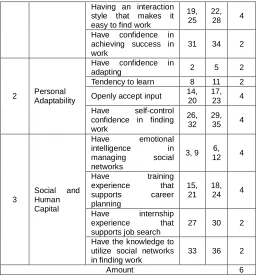
The indicators that reflect each dimension are as follows:
Table 2.
Employability Dimensions and Indicators
No Dimension Indicator item Amo
unt F U
1 Career Identity
Knowing the identity of
the job 1, 7
4, 10 4 Have the hope of a job
3168 Having an interaction
style that makes it easy to find work
19, 25
22, 28 4
Have confidence in achieving success in work
31 34 2
2 Personal Adaptability
Have confidence in
adapting 2 5 2
Tendency to learn 8 11 2
Openly accept input 14, 20
17, 23 4 Have self-control
confidence in finding work
26, 32
29, 35 4
3
Social and Human Capital
Have emotional intelligence in managing social networks
3, 9 12 6, 4
Have training experience that supports career planning
15, 21
18, 24 4
Have internship experience that supports job search
27 30 2
Have the knowledge to utilize social networks in finding work
33 36 2
Amount 6
2.4 Form Validity and Reliability
Testing the validity and reliability of measuring instruments in this study is the outer model test using the SmartPLS 3.2.8 program with reflective constructs. The construct validity test is used to show the quality of the results obtained through the use of measuring instruments that refer to the theory used to define a construct, where the validity test is confirmatory. Construct validity is a construct validity test conducted by looking at the loading factor value> 0.5, the average variance extracted value (AVE)> 0.5, and the discriminant validity seen by comparing the roots of the average variance extracted (AVE) of a construct that must be higher than the correlation between aspect. The next step taken is to test the reliability to show the internal consistency of a measuring instrument by looking at the value of composite reliability and Cronbach's alpha, which according to Cooper, is to be> 0.7 [23].
2.5 Data Analysis
Analysis of the data used in this study uses the SmartPLS 3.2.8 program through the CFA 2nd order. PLS is a variance-based structural equation analysis (SEM) that can simultaneously test measurement models to test the construct validity and reliability [24].
3 RESULT
Based on the results of outer model testing on the scale of employability that has been done using Smart PLS 3.2.8 program, the following results are obtained:
Figure 1. Outer Model Employability Scale
3.1 Convergent Validity
Based on the results of the convergent validity test that has been done, the loading factor value of the variable towards the aspect that meets the requirements> 0.5 is obtained:
Table 3.
Value of loading factor (Variable-aspect) Aspect Value Loading Factor Information
CI 0.893 Valid
PA 0.926 Valid
SHC 0.831 Valid
Based on the results of the convergent validity test on the outer model that has been done, the loading factor value obtained from the aspect to the indicator that meets the requirements> 0.5, which is shown in table 4.
Table 4.
The loading factor value (Aspect-Indicator) Item Value of Loading Factor Information
CA1 0.847 Valid
CA2 0.884 Valid
CA3 0.730 Valid
PA1 0.646 Valid
PA2 0.885 Valid
PA3 0.754 Valid
PA4 0.835 Valid
SHC1 0.596 Valid
SHC2 0.687 Valid
SHC3 0.776 Valid
SHC4 0.793 Valid
Based on the results of the convergent validity test that has been done, the average variance extracted (AVE) value in the employability construct is 0.531, and the AVE value in each aspect can be seen in table 5:
Table 5.
Average variance extracted (AVE) value construct Employability
Aspect AVE Value Information
Career Identity 0.667 Valid
Personal Adaptability 0.617 Valid
Social and Human Capital 0.515 Valid
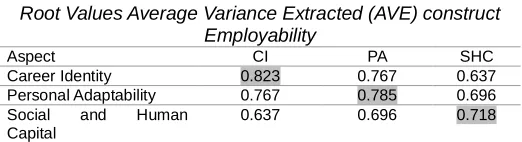
3.2 Discriminant Validity
3169 met. Root Average Variance Extracted (AVE) value of the
employability construct can be seen in table 6.
Table 6.
Root Values Average Variance Extracted (AVE) construct Employability
Aspect CI PA SHC
Career Identity 0.823 0.767 0.637
Personal Adaptability 0.767 0.785 0.696 Social and Human
Capital
0.637 0.696 0.718
3.3. Construction Reliability Test
Based on the results of the reliability test that has been done, the results obtained are the composite reliability and Cronbach's alpha values that meet the requirements> 0.7. Composite reliability and Cronbach's alpha values can be seen in table 7.
Table 7.
Value of Composite Reliability and Cronbach’s Alpha Construct Employability
Variable Composite Reliability
Cronbach’s Alpha
Information
Employability 0.909 0.886 Reliable
The results of construct reliability testing using confirmatory analysis (Confirmatory Factor Analysis Second Order) in table 7 show that constructs or latent variables employability meet unidimensional criteria [25]. This is indicated by the value of composite reliability of 0.909 and Cronbach alpha of 0.886. The validity and reliability test of the construct produces valid and reliable items that can reflect the aspects of employability, namely the items on numbers 3, 8, 11, 12, 13, 14, 21, 22, 23, 24, and 31, while the items things that are not able to reflect employability are items on numbers 1, 2, 4, 5, 6, 7, 9, 10, 15, 16, 17, 18, 19, 20, 25, 26, 27, 28, 29, and 30. Based on the processing and analysis of research data on the dimensions of the variable/construct employability formed using the 2nd Order Confirmatory Factor Analysis, the results show that the model can be accepted because all dimensions can reflect the variables/construct formed.
4 DISCUSSION
Based on the results of the analysis of the construct validity and the reliability of the construct that has been done, it is produced that all aspects and items that make up the employability of students can be declared valid and reliable; thus all aspects and indicators can form and reflect the employability of students. The most dominant aspect that can reflect students' employability is the aspect of personal adaptability with a loading factor of 0.926 which has key indicators such as always being enthusiastic when learning in the classroom, still following practices both at school and outside of school, self-disclosure, and ability to face various situations that occur. Specific behavior that reflects these indicators is feeling excited when following lessons and practices in school and always feels learning is important in supporting in getting a job. This study found that the highest loading factor value (0.926) as a constructor or variable of personal adaptability compared to the other two dimensions, namely the dimensions of career identity with a loading factor value of 0.893; and social and human capital dimensions with a loading factor of 0.831. The lowest aspect that reflects the employability of students in the social and human capital
aspects with a loading factor of 0.831, which has key indicators such as the ability of an individual to see changes that occur as challenges and learning experiences for the individual. The more specific behavior in describing these indicators is the ability to look for relationships related to the desired job. In addition, the findings of this study are in line with the opinion of Clarke [26], who uses three dimensions of employability consisting of human capital, social capital, and individual behavior. While in this study using the same two dimensions, including social and human capital. Other findings regarding the dimensions of employability were stated by Heijde and Heijden [27], stating there were four dimensions of employability, including occupational expertise, anticipation and optimization, personal flexibility, corporate sense, and balance. While in this study using the same dimension, the dimensions of personal flexibility or personal adaptability. In addition, these findings also support the results of empirical studies conducted by Tentama and Abdillah [28] regarding employability that refers to the dimensions of Fugate, Kinicki and Ashforth [3] namely career identity, personal adaptability, and social and human capital. The research proves that employability meets the reliability requirements with Cronbach's alpha of 0.886. Furthermore, research conducted by Tentama and Hardani [29] which refers to the dimensions of the employability of Fugate, Kinicki and Ashforth [3], the results of the study prove that employability meets the Cronbach's alpha reliability requirements of 0.882 while this study has a Cronbach's alpha reliability coefficient of 0.886. The results of this study are expected to provide an overview of the validity and reliability of the employability construct in Sungai Raya Vocational High School 1 student so that it can be used as a reference in further research related to employability.
CONCLUSION
Based on the results of the analysis and discussion that has been done, it can be concluded that: 1) the construct or variable of employability has fulfilled good validity and reliability; and 2) all dimensions or indicator variables can significantly form employability, where indicators or dimensions that have a dominant influence on employability are personal adaptability with a loading factor of 92.6%. Thus, the findings of this study can provide theoretical and practical implications in the development of employability theory.
ACKNOWLEDGMENT
The author would like to thank Ahmad Dahlan University and the Master of the Psychology Program University of Ahmad Dahlan for supporting the implementation of this research.
REFERENCES
[1] Hillage, J. & Pollard, E, ―Employability: Developing a framework for policy analysis,‖ Department for Education and Employment, pp. 1-4, 1998.
[2] Harvey, L, ―Defining and measuring employability. Quality in Higher Education, vol. 7, no. 2, pp. 97-109, 2001. https://doi.org/10.1080/13538320120059990.
[3] Fugate, M. Kinicki, A. J. & Ashforth, B. E, ―Employability: A psycho-social construct, its dimensions, and applications‖, Journal of Vocational Behavior, vol. 65, no. 1, pp. 14–38, 2004. https://doi.org/10.1016/j.jvb.2003.10.005.
3170 what it is not,‖ York: Higher Education Academy, 2004.
[5] Pool, L. D. & Sewell, P, ―The key to employability: Developing a practical model of graduate employability,‖ Education Training, vol. 49, no. 4, pp. 277–289, 2007. https://doi.org/10.1108/00400910710754435.
[6] Berntson, E. & Marklund, S. ―The relationship between percieved employability and subsequent helath‖, Work & Stress, vol. 21, no. 3, pp. 279-292, 2007. https://doi.org/10.1080/02678370701659215.
[7] Depdiknas, ―Republic of Indonesia Law No. 20 of 2003 concerning the national education system [Undang-undang republik indonesia no.20 tahun 2003 tentang sistem pendidikan nasional],‖ Jakarta: Departemen Pendidikan Nasional, 2003.
[8] Gibson, R. L. & Mitchell M. H, ―Introduction to counseling and guidance‖, New York: McMillan Publisher, 2011. [9] Behroozi, M, ―A survey about the function of technical and
vocational education: An empirical study in Bushehr city,‖ Procedia-Social and Behavioral Sciences, vol. 143, pp.
265–269, 2014.
https://doi.org/10.1016/j.sbspro.2014.07.401.
[10] Norman, M. & Hyland, T, ―The role of confidence in lifelong learning,‖ Educational Studies, vol. 29, no. 2/3, pp. 261– 272, 2003. https://doi.org/10.1080/03055690303275. [11] Yorke, M. & Knight, P, ―Evidence-informed pedagogy and
the enhancement of student employability,‖ Teaching in Higher Education, vol. 12, no. 2, pp. 157–170, 2007. https://doi.org/10.1080/13562510701191877.
[12] Benabou, R. & Tirole, J. ―Self-confidence and personal motivation,‖ The Quarterly Journal of Economics, vol. 117,
no. 3, pp. 871–915, 2002.
https://doi.org/10.1162/003355302760193913.
[13] Ronnås, P. & Shamchiyeva, L, ―Employment diagnostic analysis: Maluku, Indonesia. Geneva: International Labour Organization, 2011.
[14] McQuaid, R. W. & Lindsay, C, ―The concept of employability,‖ Urban Studies, vol. 42, no. 2, pp. 197– 219, 2005. https://doi.org/10.1080/0042098042000316100. [15] Hanafi, I, ―Vocational & technical education: Exploring the
successful experiences of Bi-National Institutions in the neighboring country, from concept to implementation [Pendidikan teknik & vokasional: Menggali pengalaman sukses Institusi Bi-National di Negeri Jiran, dari konsep hingga implementasi[,‖ Bandung: Refika Aditama, 2014. [16] Karli, U, ―Adaptation and validation of self-pecieved
employability scale: An analysis of sports departement student and graduates,‖ Academic Journals, vol. 11, no. 8.
pp. 848-859, 2016.
https://doi.org/10.5897/ERR2016.2712.
[17] Rothwell, A. Herbert, I. Rothwell, F, ―Self-Perceived Employability: Construction and Initial Validation of a Scale for University Students,‖ Journal of Vocational Behavior, vol. 73, no. 1, pp. 1-12, 2008. https://doi.org/10.1016/j.jvb.2007.12.001.
[18] Watson, C. & Grant, C. ―Employability: The development and validation of a scale to measure work-related competencies,‖ Assessment and Development Matters, vol. 4, no. 3, pp. 13-16, 2012.
[19] Gee, L. & Steptoe-Warren, G, ―Do psychology students develop the necessary competencies for the graduate labour market? Implications for assessment,‖ Assessment and Development Matters, vol. 3, no. 3, pp. 15–19, 2011. [20] Morley, L, ―Producing new workers: Quality, equality and
employability in higher education,‖ Quality in Higher Education, vol. 7, no. 2, pp. 131-138, 2001. https://doi.org/10.1080/13538320120060024.
[21] De Vos, A. De Haw, S. & Van Der Heijden, ―Competency development and career success: The mediating role of employability,‖ Journal of Vocational Behavior, vol. 79, pp. 438-447, 2011. http://dx.doi.org/10.1016/j.jvb.2011.05.010. [22] Latan, H, ―Structural equation modeling concepts and applications using LISREL 8.80 [Structural equation modeling konsep dan aplikasi menggunakan LISREL 8,80],‖ Bandung: Alfabeta, 2012.
[23] Hinkin, T. R. Tracey, J. B. Enz, C. A. & Tracey, J. B, ―Scale construction: Developing relaible and valid measurement instruments,‖ Journal of Hospitality & Tourism Research, vol. 21, no. 100, pp. 101-120, 1997. https://doi.org/10.1177/109634809702100108.
[24] Jogiyanto, H. M, ―The concept and application of variance-based structural equation modeling in business research [Konsep dan aplikasi structural equation modeling berbasis varian dalam penelitian bisnis],‖ Yogyakarta: UPP STIM YKPN, 2011.
[25] Abdillah, W. & Hartono, J, ―Partial Least Square (PLS): Alternative structural equation modeling (SEM) in business research [Partial Least Square (PLS): Alternatif structural equation modeling (SEM) dalam penelitian bisnis],‖ Yogyakarta: Penerbit Andi, 2015.
[26] Hair, J. F. Black, W. C. Babin, B. J. & Anderson, R. E, ―Multivariate data analysis,‖ Upper Saddle River: Prentice Hall, 2010.
[27] Clarke, M, ―Rethinking graduate employability: the role of capital, individual attributes and context,‖ Studies in Higher Education, pp. 1–15, 2017. https://doi.org/10.1080/03075079.2017.1294152.
[28] Heijde, C. M. & Heijden, B. I. J. M, ―The development and psychometric evaluation of a multi-dimensional measurement instrument of employability and the impact of aging,‖ International Congress Series, vol. 1280, pp. 142-147, 2005. https://doi.org/10.1016/j.ics.2005.02.061. [29] Tentama, F. & Abdillah, M. H, ―Student employability
examined from academic achievement adn self-concept,‖ International Journal of Evaluation and Research in Education, vol. 8, no. 2, pp. 243-248, 2019. https://doi.org/10.11591/ijere.v8i2.18128.
[30] Tentama, F. & Hardani, D. J, ―Self-concept, perception of the learning environment and employability: A study of vocational high school students in Prambanan Yogyakarta, Indonesia,‖ Humanities & Social Sciences Reviews, vol. 7,
no. 1, pp. 433-440, 2019.