Semi-Supervised Named Entity Recognition:
Learning to Recognize 100 Entity Types with Little Supervision
David Nadeau
Thesis submitted to the
Faculty of Graduate and Postdoctoral Studies
in partial fulfillment of the requirements
for the PhD degree in Computer Science
Ottawa-Carleton Institute for Computer Science
School of Information Technology and Engineering
University of Ottawa
Table of contents
List of tables ... iv
List of figures ... v
Abstract ... vi
Acknowledgements ... vii
1 Introduction ... 1
2 Background and Related Work ... 6
2.1 Related Work ... 7
2.2 Applications ... 9
2.3 Observations: 1991 to 2006 ... 10
2.4 Techniques and Algorithms to Resolve the NER Problem ... 14
2.5 Feature Space for NER ... 19
2.6 Evaluation of NER ... 26
2.7 Conclusion ... 30
3 Creating a Baseline Semi-Supervised NER System ... 32
3.1 Generating Gazetteers ... 35
3.2 Resolving Ambiguity ... 42
3.3 Evaluation with the MUC-7 Enamex Corpus ... 45
3.4 Evaluation with Car Brands ... 50
3.5 Supervised versus Unsupervised ... 51
3.6 Conclusion ... 51
4 Noise-Filtering Techniques for Generating NE Lists ... 53
4.1 Generating NE Lists from the Web ... 55
4.2 Lexical Noise Filter ... 58
4.3 Information Redundancy Filter ... 64
4.4 Noise Filter Combination ... 66
4.5 Statistical Semantics Filter ... 68
4.6 Conclusion ... 70
5 Discovering Unambiguous NEs for Disambiguation Rule Generation ... 72
5.2 Massive Generation of NE Lists ... 75
5.3 NE Ambiguity ... 78
5.4 From Unambiguous NE to Disambiguation Rules ... 82
5.5 Experiments on the NER Task ... 85
5.6 Conclusion ... 91
6 Detecting Acronyms for Better Alias Resolution ... 92
6.1 Related Work ... 94
6.2 Supervised Learning Approach ... 99
6.3 Evaluation Corpus ... 103
6.4 Experiment Results ... 104
6.5 Discussion ... 105
6.6 Improving Alias Resolution in NER Systems ... 107
6.7 Conclusion ... 108
7 Discussion and Conclusion ... 110
7.1 Limitations ... 111
7.2 Future Work ... 113
7.3 Long-Term Research Ideas ... 114
Bibliography ... 115
List of tables
Table 1: Word-level features ... 20
Table 2: List look-up features ... 22
Table 3: Features from documents ... 24
Table 4: NER error types ... 27
Table 5: Results of a supervised system for MUC-7 ... 46
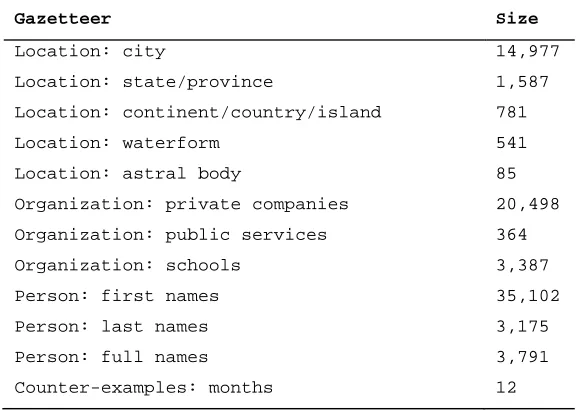
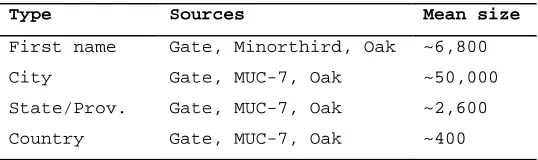
Table 6: Type and size of gazetteers built using Web page wrapper ... 46
Table 7: Supervised list creation vs. unsupervised list creation techniques ... 47
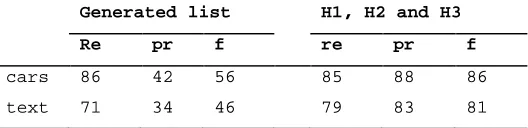
Table 8: Generated list performance on text matching ... 48
Table 9: Performance of heuristics to resolve NE ambiguity ... 48
Table 10: Estimated precision of automatically generated lists ... 49
Table 11: System performance for car brand recognition ... 50
Table 12: NE lexical features ... 59
Table 13: Reference lists for noise filter evaluation ... 63
Table 14: BaLIE performance on MUC-7 corpus with and without noise filtering ... 67
Table 15: BaLIE and Oak lexicon comparison ... 75
Table 16: Additional BaLIE lexicons ... 77
Table 17: Source of ambiguity between entity types ... 79
Table 18: Percentage of entity-entity ambiguity per type ... 81
Table 19: Accuracy of entity-entity classifiers ... 85
Table 20: Three-type BaLIE performance on MUC-7 corpus ... 87
Table 21: 100-type BaLIE performance on MUC-7 corpus with and without rules ... 87
Table 22: BaLIE's performance on the CONLL corpus ... 88
Table 23: System comparison on CONLL corpus ... 89
Table 24: BaLIE's performance on BBN corpus ... 90
Table 25: Summary of constraints on acronyms and definitions ... 97
Table 26: Acronym detection performance reported various teams ... 104
Table 27: Performance of various classifiers on the Medstract corpus... 105
Table 28: Acronym detection on Swedish texts ... 107
List of figures
Figure 1: Overview of the semi-supervised NER system ... 2
Figure 2: Details of the baseline named entity recognition system ... 33
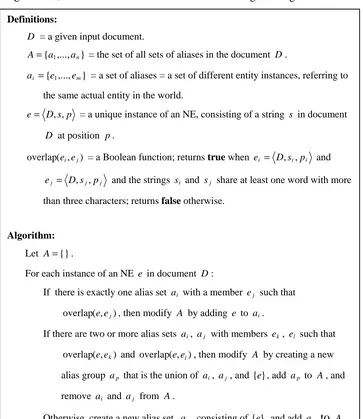
Figure 3: Simple alias resolution algorithm ... 44
Figure 4: Details of noise filtering as a post-process for the Web page wrapper ... 54
Figure 5: Algorithm for one iteration of the NE list generation process ... 56
Figure 6: Comparing lexical filters ... 63
Figure 7: Comparison of lexical filter and information redundancy filter ... 65
Figure 8: Comparison of individual filters and their combination ... 67
Figure 9: Details of training disambiguation rules in a semi-supervised manner ... 73
Figure 10: CONLL corpus metonymic references ... 88
Abstract
Named Entity Recognition (NER) aims to extract and to classify rigid designators in text
such as proper names, biological species, and temporal expressions. There has been growing
interest in this field of research since the early 1990s. In this thesis, we document a trend
moving away from handcrafted rules, and towards machine learning approaches. Still, recent
machine learning approaches have a problem with annotated data availability, which is a
serious shortcoming in building and maintaining large-scale NER systems.
In this thesis, we present an NER system built with very little supervision. Human
supervision is indeed limited to listing a few examples of each named entity (NE) type. First,
we introduce a proof-of-concept semi-supervised system that can recognize four NE types.
Then, we expand its capacities by improving key technologies, and we apply the system to
an entire hierarchy comprised of 100 NE types.
Our work makes the following contributions: the creation of a proof-of-concept
semi-supervised NER system; the demonstration of an innovative noise filtering technique for
generating NE lists; the validation of a strategy for learning disambiguation rules using
automatically identified, unambiguous NEs; and finally, the development of an acronym
detection algorithm, thus solving a rare but very difficult problem in alias resolution.
We believe semi-supervised learning techniques are about to break new ground in the
machine learning community. In this thesis, we show that limited supervision can build
complete NER systems. On standard evaluation corpora, we report performances that
Acknowledgements
Le rêve de bâtir un système autonome est partagé par la plupart des chercheurs du domaine
et s’étend en fait probablement à tous les ingénieurs de systèmes intelligents. Lorsque j’ai
mis au point un premier prototype de système de reconnaissance d’entités nommées, de 2001
à 2003, le problème de la maintenance est rapidement devenu manifeste. En plus, l’effort
d’annotation de documents requis pour étendre le système était tel que le rêve de départ
devenait un impératif. J’avais bien la motivation de créer ce système, mais je n’avais aucune
idée de comment y arriver. C’était la conjoncture idéale pour entreprendre une thèse.
Je tiens à remercier Peter Turney et Stan Matwin qui ont supervisé et contribué à ce travail.
En questionnant et en soupesant chaque idée et chaque phrase, ils m’ont fait comprendre
beaucoup plus que des notions abstraites et des procédures informatiques.
Je tiens aussi à remercier Caroline Barrière, Cyril Goutte et Pierre Isabelle du Groupe de
technologies langagières interactives du Conseil national de recherches Canada pour leur
aide et leur commentaires sur les versions préliminaires de cette thèse.
Merci au Fonds québécois de la recherche sur la nature et les technologies ainsi qu’à
Chapter 1
Introduction
The term “Named Entity” (NE) is in current use in Information Extraction (IE) applications.
It was coined at the sixth Message Understanding Conference (MUC-6) (Grishman &
Sundheim 1996), which influenced IE research in the 1990s. At the time, MUC was focusing
on IE tasks wherein structured information on company and defense-related activities are
extracted from unstructured text, such as newspaper articles. In defining IE tasks, people
noticed that it is essential to recognize information units such as names including person,
organization, and location names, and numeric expressions including time, date, money, and
percentages. Identifying references to these entities in text was acknowledged as one of IE’s
important sub-tasks and was called “Named Entity Recognition (NER).” Before the NER
field was recognized in 1996, significant research was conducted by extracting proper names
from texts. A paper published in 1991 by Lisa F. Rau (1991) is often cited as the root of the
field.
For more than fifteen years, a dynamic research community advanced the fundamental
knowledge and the engineered solutions to create an NER system. In its canonical form, the
input of an NER system is a text and the output is information on boundaries and types of
NEs found in the text. The vast majority of proposed systems fall in two categories: the
handmade rule-based systems; and the supervised learning-based systems. In both
approaches, large collections of documents are analyzed by hand to obtain sufficient
knowledge for designing rules or for feeding machine learning algorithms. Expert linguists
must execute this important amount of work, which in turn limits the building and
maintenance of large-scale NER systems.
This thesis is about the creation of an autonomous NER system. It has the desirable property
of requiring a small amount of work by an expert linguist. It falls in the new category of
semi-supervised and unsupervised systems. Influential work in this category is relatively rare
and recent, and we believe ours to be the first thesis devoted exclusively to the creation of an
This thesis is structured around the construction of an NER system and one of our goals is to
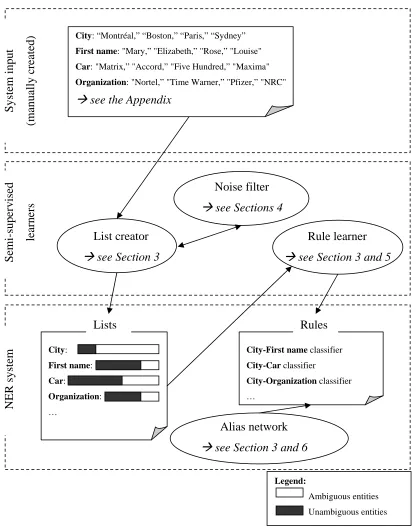
create proof-of-concept software. System architecture is shown in Figure 1 and we’ll refer to
it throughout the thesis.
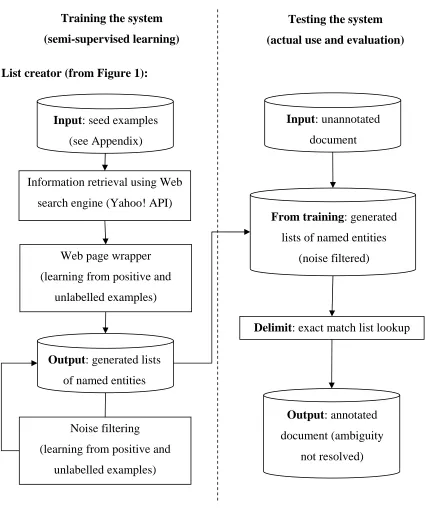
Figure 1: Overview of the semi-supervised NER system
N E R s ys te m List creator
see Section 3
Rule learner
see Section 3 and 5
Noise filter
see Sections 4 City: “Montréal,” “Boston,” “Paris,” “Sydney”
First name: "Mary,” "Elizabeth,” "Rose,” "Louise" Car: "Matrix,” "Accord,” "Five Hundred,” "Maxima" Organization: "Nortel,” "Time Warner,” "Pfizer,” "NRC"
see the Appendix
City: First name: Car:
Organization:
…
City-First name classifier City-Car classifier
City-Organization classifier
…
Lists Rules
Legend:
Ambiguous entities Unambiguous entities Alias network
see Section 3 and 6
Figure 1 has three main parts. The upper part is the system input that consists of a few
examples for 100 entity types, as listed in the Appendix. This input constitutes very little
supervision.
The middle part shows the semi-supervised modules. For instance, the “List Creator” module
is explained in details in section 3.1 and it processes the system input, as illustrated by the
arrow linking upper and middle parts of the Figure 1. The semi-supervised modules require
no other manually created input. They however rely on very large corpora: the Web and a
Terabyte-sized corpus of plain text (not shown in Figure 1).
The bottom part is the NER system, which is the program that can identify named entities in
a given text. The modules of this system follow McDonald (1993) system division: Delimit,
Classify, Record. “Lists” are use to delimit named entities, “Rules” are used to classify
named entities, and an “Alias network” is used to record named entities.
The resulting semi-supervised system is in itself a significant contribution to and advance in
the NER field. In addition, the proposed system implements state-of-the-art techniques from
computational linguistics, semi-supervised machine learning, and statistical semantics. We
claim four specific contributions to these fields:
1. The design of a baseline semi-supervised NER system (called BaLIE1) that performs
at a level comparable to that of a simple supervised learning-based NER system
(Chapter 3). The architecture of this system was published at Canadian AI 2006
(Nadeau et al. 2006).
2. The design of a noise filter for an NE list generation based on computational
linguistic and statistical semantic techniques. The noise filter outperforms previous
art (Chapter 4).
3. The demonstration of a simple strategy based on set intersections that enable the
1
BaLIE is open source software released under GNU GPL: http://balie.sourceforge.net. A Web demo of
identification of unambiguous examples for a given NE type (Chapter 5).
Unambiguous NEs are a requirement for creating semi-supervised disambiguation
rules.
4. An acronym detection algorithm—part of an alias resolution system—that
outperforms previous art (Chapter 6), with experiments published at Canadian AI
2005 (Nadeau & Turney 2005).
These contributions are crucial components of a successful autonomous NER system, and
they are best explained in the context of the whole system. We structured this thesis
accordingly.
In Chapter 2, we introduce background work, related work, and NER applications. We give a
formal definition of the NER task. Problems that are related to and may benefit from NER
are discussed. Applications for both the research and industrial worlds are listed and
presented. We also thoroughly survey fifteen years of research—from 1991 to 2006—in a
systematic review published in a special issue of Linguisticae Investigationes (Nadeau &
Sekine 2007).
In Chapter 3, we present BaLIE (Baseline Information Extraction), a system that learns to
recognize NEs in an autonomous manner. BaLIE solves two limitations of rule-based and
supervised NER systems. First, it requires no human intervention, such as manually labelling
training data or creating gazetteers. Second, the system can handle more than the three
classical named-entity types (person, location, and organization). System performances are
shown to be comparable to that of a simple supervised learning-based system. Some
significant details of the system were published in a regional French-language conference
(Nadeau 2005b), and are translated and reported in this chapter.
Chapters 4, 5 and 6 are the core of this thesis. Here, we present extensions and improvements
to BaLIE. Our contributions come from three hypotheses that were formulated to improve
the baseline system of Chapter 3. First, we hypothesize that lexical features can improve
demonstration of this filter in Chapter 4. Then, we hypothesize that the differences between
multiple NE lists are a set of unambiguous NE examples that are useful in learning
disambiguation rules. We have included experiments that support this hypothesis in Chapter
5. Finally, we hypothesize that in the context of alias resolution, resolving acronyms would
improve the system quality. An acronym detection algorithm is provided in Chapter 6.
Chapter 7 discusses the work that was accomplished in completing this thesis. It sheds light
on the reasons behind BaLIE’s design. More importantly, it discusses the limitations we
faced at all stages of development, and the ideas we will retain in our future work. The
Chapter 2
Background and Related Work
The NER task consists of identifying the occurrences of some predefined phrase types in a
text. Here is an example from Mikheev et al. (1999b), marked up with four entity types:
<Date>, <Person>, <Organization>, and <Location>.
On <Date>Jan 13th</Date>, <Person>John Briggs Jr</Person> contacted
<Organization>Wonderful Stockbrockers Inc</Organization> in <Location>New
York</Location> and instructed them to sell all his shares in
<Organization>Acme</Organization>.
In the expression “Named Entity,” the word “Named” aims to restrict the task to only those
entities for which one or many rigid designators, as defined by Kripke (1982), stands for the
referent. For instance, “the automotive company created by Henry Ford in 1903” is referred
to as “Ford” or “Ford Motor Company.” Rigid designators include proper names as well as
certain natural terms, such as biological species and substances. There is a general agreement
to include temporal expressions and some numerical expressions, such as money and
measures in NEs. While some instances of these types are good examples of rigid
designators (e.g. the year “2001”), there are also many invalid NEs (e.g., I take my vacations
in “June”). In the first example, the year “2001” refers to the 2001st year of the Gregorian
calendar. In the second example, “June” may refer to the month in an undefined year (past
June, next June, June 2020, etc.). It can be argued that the NE definition is loosened in such
cases for practical reasons.
The most common alternative formulation of the NER task is using speech as input (Favre et
al. 2005). The task is considered more difficult since the capitalization of words, and
generally the words themselves, are approximated by Automatic Speech Recognition (ASR)
technologies. The same problem of degraded input arises when it comes from Optical
Character Recognition (OCR) (Maynard et al. 2002). NER can also be done for
information is then available in a structure that may help recognize entity boundaries and/or
entity types. However, textual context may be lost.
2.1 Related Work
In this section, we list some tasks related to NER. These tasks revolve around the notion of
rigid designation, whereby the direct goal is not to recognize the named things from
documents.
Personal name disambiguation (Mann & Yarowski 2003) is the task of identifying the
correct referent of a given designator. In a given context, it may consist of identifying
whether Jim Clark is the race driver, the film editor, or the Netscape founder. Corpus-wide
disambiguation of personal names has applications in document clustering for information
retrieval. In the work of Mann and Yarowski, it is used to create biographical summaries
from corpora. This technology is about to be mainstream, with a new generation of people
search engines, such as Zoominfo.com and Spock.com.
Identification of named entity descriptions (Radev 1998) is the identification of textual
passages that describe a given NE. For instance, Bill Clinton is described as “the President of
the U.S.,” “the democratic presidential candidate” or “an Arkansas native,” depending on the
document. Description identification can be use as a cue in personal name disambiguation
(see related work above). Radev’s intention is to reuse these describers in the context of
natural language generation.
Named entity translation (Fung 1995, Huang 2005) is the task of translating NEs from one
language to another. For instance, the French translation of “National Research Council
Canada” is “Conseil national de recherches Canada.” NE translation is acknowledged as a
major issue in machine translation as it may account for as much as 10% of translation errors
(Vilar et al. 2006).
name. For example, the name “Doctor Paul R. Smith” is composed of a person title, a first
name, a middle name, and a surname. It is presented as a preprocessing step for NER and for
the resolution of co-references to help determine, for instance, that “John F. Kennedy” and
“President Kennedy” are the same person, while “John F. Kennedy” and “Caroline
Kennedy” are two distinct persons.
Entity anaphora resolution (Dimitrov et al. 2002) mainly consists of resolving pronominal
co-reference when the antecedent is an NE. For example, in the sentence “Rabi finished
reading the book and he replaced it in the library,” the pronoun “he” refers to “Rabi.”
Anaphora resolution can be useful in solving the NER problem itself by enabling the use of
extended co-reference networks (see Section 3.2.3). Meanwhile it has many applications of
its own, such as in “question answering” (e.g., answering “Who put the book in the
library?”).
Acronym identification (Nadeau & Turney 2005) is described as the identification of an
acronym’s definition (e.g., “IBM” stands for “International Business Machines”) in a given
document. The problem is related to NER because many organization names are acronyms
(GE, NRC, etc.). Resolving acronyms is useful, again, to build co-reference networks aimed
at solving NER (see Section 6.6). On its own, it can improve the recall of information
retrieval by expanding queries containing an acronym with the corresponding definition.
Record linkage (Cohen & Richman 2001) is the task of matching named entities across
databases. It involves the use of clustering and string matching techniques (Cohen &
Sarawagi 2004) in order to map database entries having slight variations (e.g., Frederick
Mason and F. Mason). It is used in database cleaning and in data mining on multiple
databases.
Case restoration (Agbago et al. 2006) consists of restoring expected word casing in a
sentence. Given a lower case sentence, the goal is to restore the capital letters usually
appearing on the first word of the sentence and on NEs. This task is useful in machine
2.2 Applications
In this section, we list NER applications essentially built on having a textual document that
identifies entities. We label these applications using three classifications: temporal (Temp)
applications locate entities in time to analyze trends or calendar events; information retrieval
(IR) applications are extensions of the search paradigm where the goal is access to relevant
information in large corpora; and very large corpora (VLC) applications are based on
annotating vast amounts of documents to allow information mining or to link information
across documents, but not necessarily to access information.
[Temp] Event detection (e.g., Smith 2002) consists of detecting temporal entities in
conjunction with other entities. For instance, conferences are usually made up of four parts:
one conference name, one location, and two dates (e.g., name: “AAAI,” location: “Boston,”
start date: “July 16th 2006,” end date: “July 20th 2006”).A person’s birth or death is a person
name and date pair (e.g., name: “John Lennon,” date: “December 8th, 1980”). Smith uses
event detection to draw maps where war locations and dates are identified.
[Temp, VLC] Time varying entities analysis (e.g., Swan & Allan 1999) is the analysis of
key entities in a corpus at a given time or over a time period. It extends the event detection
application in a significant manner either by intelligent aggregation or analysis. Swan and
Allan extract events on multiple news, for a given topic, and they generate a story made of
chosen textual passages. For instance, the story may relate that “France elects Jacques Chirac
as president” on May 7th and “Jacques Chirac selects Alain Juppé as premier” on May 17th.
Commercial “trend” or “buzz” analysis, that is, a simple analysis of entity frequencies over
time, has already hit the market2.
[IR] Question answering (e.g., Srihari & Li 1999) often involves NER at the core of the
answering capabilities. A study by Srihari and Li shows that low-level information extraction
like NER is often a necessary component in handling most types of questions. Out of 200
2
questions of TREC-8 competition, 80% asked for an NE as a response (e.g., who [person],
when [time or date], where [location]).
[IR] Semantic information retrieval (e.g., Pasca 2004), unlike question answering, takes
conventional Boolean queries, but returns something more than a list of Web documents.
Pasca cites at least two “semantic” variants: returning a list of elements when the query is an
entity category (e.g., “SAS,” “SPSS,” “Minitab,” “BMDP” and “R” are returned for the
query “statistical packages”); and returning a list of siblings when the query is an entity (e.g.,
returning “Morpheus,” “Grokster” and “Napster” when the query is “Kazaa”).
[IR] Local search (e.g., Wang et al. 2005) is the task of using location information expressed
in a query (e.g., Ottawa restaurants) to return locally relevant results, such as a list of nearby
restaurants. NER on queries, or any short text, is arguably more challenging than on long
documents. Wang et al. proposes NER strategies for query strings. They mention that
accurately and effectively detecting that a location is the true topic of a query has huge
potential impact on increasing search relevance. Major commercial search engines are
already offering local search prototypes.
[VLC] Text/Web mining (e.g., Sánchez & Moreno 2005) is the task of extracting implicit
information from a large repository of documents. The goal is to extract knowledge from the
mass of information that is unavailable in isolated documents. In the work of Sánchez and
Moreno, NEs of the medical domains are extracted from a large corpus to build ontological
knowledge. Those ontologies, in turn, may support collection browsing and classification.
2.3 Observations: 1991 to 2006
Computational research aiming at automatically identifying NEs in texts forms a vast and
heterogeneous pool of strategies, methods, and representations. One of the first research
papers in the field was presented by Lisa F. Rau (1991) at the 7th IEEE Conference on
Artificial Intelligence Applications. Rau’s paper describes a system to “extract and recognize
1995 (we found 8 publications in English), the publication rate remained relatively low. It
accelerated in 1996, with the first major event dedicated to the task: MUC-6 (Grishman &
Sundheim 1996). It has not decreased since, with steady research and numerous scientific
events: HUB-4 (Chinchor et al. 1998); MUC-7 and MET-2 (Chinchor 1999); IREX (Sekine
& Isahara 2000); CONLL (Tjong Kim Sang 2002, Tjong Kim Sang & De Meulder 2003);
ACE (Doddington et al. 2004); and HAREM (Santos et al. 2006). The Language Resources
and Evaluation Conference (LREC)3 has also been staging workshops and main conference
tracks on the topic since 2000.
2.3.1 Language Factor
A good proportion of work in NER research is devoted to the study of English, but a possibly
larger proportion addresses language independence and multilingualism problems. German is
well studied in CONLL-2003 and in earlier works. Similarly, Spanish and Dutch are strongly
represented, and were boosted as the focus of a major conference: CONLL-2002. Japanese
has been studied in the MUC-6 conference, the IREX conference, and other works. Chinese
is studied in abundant literature (e.g., Wang et al. 1992, Chen & Lee 1996, Yu et al. 1998),
and so are French (Petasis et al. 2001, Poibeau 2003), Greek (Boutsis et al. 2000), and Italian
(Black et al. 1998, Cucchiarelli & Velardi 2001). Many other languages received some
attention as well: Basque (Whitelaw & Patrick 2003), Bulgarian (Da Silva et al. 2004),
Catalan (Carreras et al. 2003), Cebuano (May et al. 2003), Danish (Bick 2004), Hindi
(Cucerzan & Yarowsky 1999, May et al. 2003), Korean (Whitelaw & Patrick 2003), Polish
(Piskorski 2004), Romanian (Cucerzan & Yarowsky 1999), Russian (Popov et al. 2004),
Swedish (Kokkinakis 1998), and Turkish (Cucerzan & Yarowsky 1999). Portuguese was
examined (Palmer & Day 1997) and, at the time this survey was written, the HAREM
conference was revisiting that language. Finally, Arabic (Huang 2005) has started to receive
a lot of attention in large-scale projects such as Global Autonomous Language Exploitation
(GALE)4.
3
http://www.lrec-conf.org/
4
2.3.2 Textual Genre or Domain Factor
The impact of textual genre (journalistic, scientific, informal, etc.) and domain (gardening,
sports, business, etc.) has been rather neglected in NER literature. Few studies are
specifically devoted to diverse genres and domains. Maynard et al. (2001) designed a system
for emails, scientific texts, and religious texts. Minkov et al. (2005) created a system
specifically designed for email documents. Perhaps unsurprisingly, these experiments
demonstrated that although any domain can be reasonably supported, porting a system to a
new domain or textual genre remains a major challenge. For instance, Poibeau and Kosseim
(2001) tested some systems on both the MUC-6 collection made up of newswire texts, and
on a proprietary corpus made up of manual phone conversation translations and technical
emails. They report a drop in performance for every system (some 20% to 40% of precision
and recall).
2.3.3 Entity Type Factor
Early work formulates the NER problem as recognizing “proper names” in general (e.g.,
Coates-Stephens 1992, Thielen 1995). Overall, the most studied entity types are three
specializations of “proper names”: names of “persons,” “locations,” and “organizations.”
These types are collectively known as “enamex” since the MUC-6 competition. The
“location” type can, in turn, be divided into multiple subtypes of “fine-grained locations”
(Fleischman 2001, Lee & Geunbae Lee 2005). Similarly, “fine-grained person”
sub-categories, like “politician” and “entertainer,” appear in the work of Fleischman and Hovy
(2002). The “person” type is quite common and used at least once in an original way by
Bodenreider and Zweigenbaum (2000), who combine it with other cues for extracting
medication and disease names (e.g., “Parkinson disease”). In the ACE program, the “facility”
type subsumes entities of the “location” and “organization” types. The “GPE” type is used to
represent a location that has a government, such as a city or a country.
The “miscellaneous” type is used in the CONLL-2002 and 2003 conferences, and includes
with the “product” type (e.g., Bick 2004). The “timex” (another term coined in MUC) “date”
and “time” types, and the “numex” “money” and “percent” types are also quite predominant
in the literature. Since 2003, a community named TIMEX2 (Ferro et al. 2005) has proposed
an elaborated standard for annotating and normalizing temporal expressions. Finally,
marginal types are sometime handled for specific needs: “film” and “scientist” (Etzioni et al.
2005); “email address” and “phone number” (Witten et al. 1999, Maynard et al. 2001);
“research area” and “project name” (Zhu et al. 2005); “book title” (Brin 1998, Witten et al.
1999); “job title” (Cohen & Sarawagi 2004); and “brand” (Bick 2004).
A recent interest in bioinformatics, and the availability of the GENIA corpus (Ohta et al.
2002) led to many studies dedicated to types such as “protein,” “DNA,” “RNA,” “cell line”
and “cell type” (e.g., Shen et al. 2003, Settles 2004), as well as studies exclusively targeted at
“protein” recognition (Tsuruoka & Tsujii 2003). Related works also include “drug”
(Rindfleisch et al. 2000) and “chemical” (Narayanaswamy et al. 2003) names.
Some work does not limit the possible types to extract and is referred to as “open domain”
NER (See Alfonseca & Manandhar 2002, Evans 2003). In this line of work, Sekine and
Nobata (2004) defined a named entity hierarchy, which includes many fine grained
subcategories, such as international organization, river, or airport, and adds a wide range of
categories, such as product, event, substance, animal, religion, or colour. It tries to cover
most frequent name types and rigid designators appearing in a newspaper. The number of
categories is about 200, and they are now defining popular attributes for each category to
make it ontological.
2.3.4 What’s Next?
Recent researches in multimedia indexing, semi-supervised learning, complex linguistic
phenomena, and machine translation suggest some new directions for the field. On one side,
there is a growing interest in multimedia information processing (e.g., video, speech),
particularly extracting NE from it (Basili et al. 2005). Much effort is also invested toward
semi-supervised and unsupervised approaches to NER, motivated by the use of very large
(Nadeau et al. 2006). Complex linguistic phenomena (e.g., metonymy, acronym resolution,
conjunction handling) that are common shortcomings of current systems are under
investigation (e.g., Poibeau 2006). Finally, large-scale projects such as GALE, discussed in
Section 2.3.1, pave the way for integrating NER and machine translation for mutual
improvement, and more generally, multilingual NER (Steinberger and Pouliquen 2007).
2.4 Techniques and Algorithms to Resolve the NER Problem
The ability to recognize previously unknown entities is an essential part of NER systems.
Such ability hinges upon recognition and classification rules triggered by distinctive
modeling features associated with positive and negative examples. While early studies were
mostly based on handcrafted rules, most recent ones use supervised machine learning (SL),
as a way to automatically induce rule-based systems or sequence labelling algorithms,
starting from a collection of training examples. In the research community, this is evidenced
by the fact that five out of eight systems were rule-based in the MUC-7 competition, while
the sixteen systems involved in CONLL-2003 were based on supervised learning techniques.
When training examples are not available, handcrafted rules systems remain the preferred
technique, as shown in Sekine and Nobata (2004), who developed an NER system for 200
entity types.
The idea of supervised learning is to study the features of positive and negative examples of
NE over a large collection of annotated documents and design rules that capture instances of
a given type. Section 2.4.1 explains SL approaches in more detail. The main shortcoming of
SL is the requirement of a large annotated corpus. The unavailability of such resources and
the prohibitive cost of creating them lead to two alternative learning methods:
semi-supervised learning (SSL); and unsemi-supervised learning (UL). These techniques are presented
in Section 2.4.2 and Section 2.4.3, respectively.
2.4.1 Supervised Learning
The current dominant technique for addressing the NER problem is supervised learning. SL
(Sekine 1998), Maximum Entropy Models (ME) (Borthwick 1998), Support Vector
Machines (SVM) (Asahara & Matsumoto 2003), and Conditional Random Fields (CRF)
(McCallum & Li 2003). These are all variants of the SL approach, which typically feature a
system that reads a large annotated corpus, memorizes lists of entities, and creates
disambiguation rules based on discriminative features.
A baseline SL method that is often proposed consists of tagging test corpus words when they
are annotated as entities in the training corpus. The performance of the baseline system
depends on the vocabulary transfer, which is the proportion of words, without repetition,
appearing in both training and testing corpus. Palmer and Day (1997) calculated the
vocabulary transfer on the MUC-6 training data. They report a transfer of 21%, with the
repetition of much as 42% of location names, but only 17% of organizations and 13% of
person names. Vocabulary transfer is a good indicator of the recall (number of entities
identified over the total number of entities) of the baseline system, but it is also a pessimistic
measure since some entities are frequently repeated in documents. Mikheev et al. (1999)
precisely calculated the baseline system recall on the MUC-7 corpus. They report a recall of
76% for locations, 49% for organizations, and 26% for persons, with precision ranging from
70% to 90%. Whitelaw and Patrick (2003) report consistent results on MUC-7 for the
aggregated enamex class. For the three enamex types together, the recognition precision is
76% and the recall is 48%.
2.4.2 Semi-Supervised Learning
The term “semi-supervised” (or “weakly supervised”) is relatively recent. The main
technique for SSL is called “bootstrapping” and involves a small degree of supervision, such
as a set of seeds, for starting the learning process. For example, a system aimed at “disease
names” might ask the user to provide a small number of example names. Then, the system
searches for sentences that contain these names and tries to identify some contextual clues
common to the five examples. Then, the system tries to find other instances of disease names
appearing in similar contexts. The learning process is then reapplied to the newly found
examples, so as to discover new relevant contexts. By repeating this process, a large number
experiments in semi-supervised NER (Nadeau et al. 2006) report performances that rival
baseline supervised approaches. Here are some examples of SSL approaches
Brin (1998) uses lexical features implemented by regular expressions in order to generate
lists of book titles paired with book authors. It starts with seed examples such as {Isaac
Asimov, The Robots of Dawn} and use some fixed lexical control rules such as the
following regular expression, [A-Z][A-Za-z .,&]5,30[A-Za-z.], used to describe a title. The
main idea of his algorithm, however, is that many Web sites comply with a reasonably
standardized format throughout the site. When a given Web site is found to contain seed
examples, new pairs can often be identified using simple constraints, such as the presence of
identical text before, between, or after the elements of an interesting pair. For example, the
passage “The Robots of Dawn, by Isaac Asimov (Paperback)” would allow one to find, on
the same Web site, “The Ants, by Bernard Werber (Paperback).”
Collins and Singer (1999) parse a complete corpus in search of NE pattern candidates. A
pattern is, for example, a proper name (as identified by a part-of-speech tagger) followed by
a noun phrase in apposition (e.g., “Maury Cooper, a vice president at S&P”). Patterns are
kept in pairs {spelling, context} where “spelling” refers to the proper name and “context”
refers to the noun phrase in its context. Starting with an initial seed of spelling rules (e.g.,
rule 1: if the spelling is “New York” then it is a Location; rule 2: if the spelling contains
“Mr.” then it is a Person; rule 3: if the spelling is all capitalized then it is an organization),
the candidates are examined. Candidates that satisfy a “spelling” rule are classified
accordingly, and their “contexts” are accumulated. The most frequent contexts found are
turned into a set of contextual rules. Following the steps above, contextual rules can be used
to find further spelling rules, and so on. Collins and Singer (1999) and Yangarber et al.
(2002) demonstrate the idea that learning several types of NE simultaneously enables finding
negative evidence (one type against all) and reduces over-generation. Cucerzan and
Yarowsky (1999) also use a similar technique and apply it to many languages.
Riloff and Jones (1999) introduce mutual bootstrapping, which consists of growing a set of
Instead of working with predefined NE candidates (found using a fixed syntactic construct),
they start with a handful of seed entity examples of a given type (e.g., Bolivia, Guatemala,
and Honduras are entities of the “country” type) and accumulate all patterns found around
these seeds in a large corpus. Contexts (e.g., offices in X, facilities in X, etc.) are ranked and
used to find new examples. Riloff and Jones note that the performance of that algorithm can
deteriorate rapidly when noise penetrates the entity list or pattern list. While they report
relatively low precision and recall in their experiments, their work proved to be highly
influential.
Cucchiarelli and Velardi (2001) use syntactic relations (e.g., subject-object) to discover more
accurate contextual evidence around the entities. Again, this is a variant of Riloff and Jones
mutual bootstrapping (1999). Interestingly, instead of using human-generated seeds, they
rely on existing NER systems (called “early NE classifier”) for initial NE examples.
Pasca et al. (2006) also use techniques inspired by mutual bootstrapping. However, they
innovate by using Lin’s (1998) distributional similarity to generate synonyms—or, more
generally, words belonging to the same semantic class—allowing pattern generalization. For
instance, in the pattern “X was born in November,” Lin’s synonyms for “November” are
{March, October, April, Mar, Aug., February, Jul, Nov., etc.}, thus allowing the induction of
new patterns such as “X was born in March.” One of Pasca et al.’s contributions is to apply
this technique to very large corpora (100 million Web documents) and demonstrate that
starting from a seed of 10 sample facts (defined as “person” type entities paired with “year”
type entities, standing for the person’s year of birth), it is possible to generate one million
facts with a precision of about 88%.
Unlabelled data selection is a problem Heng and Grishman (2006) address. They
demonstrate that an existing NE classifier can be improved using bootstrapping methods.
The main lesson they report is that relying on large collections of documents is not sufficient
on its own. Selecting documents using information retrieval-like relevance measures, as well
as selecting specific contexts that are rich in proper names and co-references, bring the best
2.4.3 Unsupervised Learning
The typical approach in unsupervised learning is clustering. For example, one can try to
gather NEs from clustered groups based on context similarity. There are also other
unsupervised methods. Basically, the techniques rely on lexical resources (e.g., WordNet),
on lexical patterns, and on statistics computed on a large unannotated corpus. Here are some
examples.
Alfonseca and Manandhar (2002) study the problem of labelling an input word with an
appropriate NE type. NE types are taken from WordNet (e.g., location>country,
animate>person, animate>animal, etc.). The approach is to assign a topic signature to each
WordNet synset by merely listing words that frequently co-occur with it in a large corpus.
Then, given an input word in a given document, the word context (words appearing in a
fixed-size window around the input word) is compared to type signatures and classified
under the most similar one.
In Evans (2003), the method for identification of hyponyms/hypernyms described in the
work of Hearst (1992) is applied to identify potential hypernyms of capitalized word
sequences appearing in a document. For instance, when X is a capitalized sequence, the
query “such as X” is searched on the Web and, in the retrieved documents, the noun that
immediately precedes the query can be chosen as the X hypernym. Similarly, in Cimiano and
Völker (2005), Hearst patterns are used, but this time, the feature consists of counting the
number of occurrences of passages like “city such as,” “organization such as,” etc.
Shinyama and Sekine (2004) observed that NEs often appear in several news articles
synchronously, whereas common nouns do not. They found a strong correlation between
being an NE, and appearing intermittently and simultaneously in multiple news sources. This
technique allows for identifying rare NEs in an unsupervised manner, and it can be useful
when combined with other NER methods.
used as a feature to assess that a named entity can be classified under a given type. PMI-IR,
developed by Turney (2001), measures the dependence between two expressions using Web
queries. A high PMI-IR means that expressions tend to co-occur. Etzioni et al. create features
for each entity candidate (e.g., London) and a large number of automatically generated
discriminator phrases, like “is a city,” “nation of,” etc.
2.5 Feature Space for NER
Features are describers or characteristic attributes of words designed for algorithmic
consumption. An example of a feature is a Boolean variable with the “true” value if a word is
capitalized and “false” if not. Feature vector representation is an abstraction of text where
each word is typically represented by one or many Boolean, numeric, and nominal values.
For example, a hypothetical NER system may represent each word in a text with 3 attributes:
1) a Boolean attribute with the “true” value if the word is capitalized and “false” if not;
2) a numeric attribute corresponding to the length of the word, in characters;
3) a nominal attribute corresponding to the lower case version of the word.
In this scenario, the sentence “The president of Apple eats an apple,” excluding the
punctuation, would be represented by the following feature vectors:
<true, 3, “the”>, <false, 9, “president”>, <false, 2, “of”>, <true, 5, “apple”>, <false, 4, “eats”>, <false, 2, “an”>, <false, 5, “apple”>
Usually, the NER problem is resolved by applying a rule system over the features. For
instance, a system might have two rules, a recognition rule (“capitalized words are entity
candidates”) and a classification rule (“the type of entity candidates of length greater than 3
words is organization”). These rules work well for the exemplar sentence above. However,
real systems tend to be much more complex, and their rules are often created by automatic
learning techniques.
of named entities. We organize them along three different axes: word-level features; list
look-up features; and document and corpus features.
2.5.1 Word-Level Features
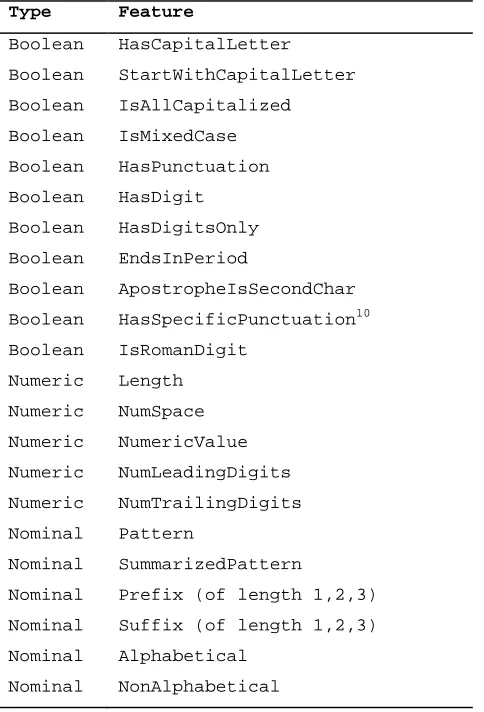
Word-level features are related to the character makeup of words. They specifically describe
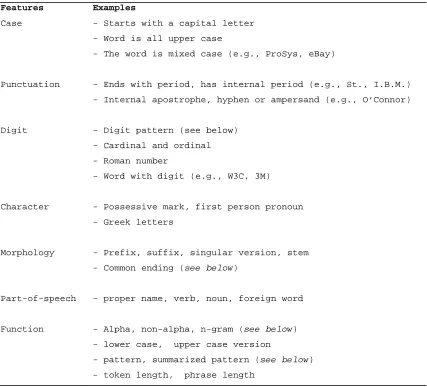
word case, punctuation, numerical value, and special characters. Table 1 lists subcategories
of word-level features.
Table 1: Word-level features
Features Examples Case
Punctuation
Digit
Character
Morphology
Part-of-speech
Function
- Starts with a capital letter - Word is all upper case
- The word is mixed case (e.g., ProSys, eBay)
- Ends with period, has internal period (e.g., St., I.B.M.) - Internal apostrophe, hyphen or ampersand (e.g., O’Connor)
- Digit pattern (see below) - Cardinal and ordinal - Roman number
- Word with digit (e.g., W3C, 3M)
- Possessive mark, first person pronoun - Greek letters
- Prefix, suffix, singular version, stem - Common ending (see below)
- proper name, verb, noun, foreign word
- Alpha, non-alpha, n-gram (see below) - lower case, upper case version
- pattern, summarized pattern (see below) - token length, phrase length
Digit pattern
Digits can express a wide range of useful information such as dates, percentages, intervals,
example, two-digit and four-digit numbers can stand for years (Bikel et al. 1997), and when
followed by an “s,” they can stand for a decade; one and two digits may stand for a day or a
month (Yu et al. 1998).
Common word ending
Morphological features are essentially related to a word’s affixes and roots. For instance, a
system may learn that a human profession often ends in “ist” (e.g., journalist, cyclist) or that
nationality and languages often ends in “ish” and “an” (e.g., Spanish, Danish, Romanian).
Other examples of common word endings are organization names that end in “ex,” “tech,”
and “soft” (Bick 2004).
Functions over words
Features can be extracted by applying functions over words. An example is given by Collins
and Singer (1999), who create a feature by isolating the non-alphabetic characters of a word
(e.g., non-alpha [A.T.&T.] = ..&.). Another example is given by Patrick et al. (2002), who
use character n-grams as features.
Patterns and summarized patterns
Pattern features were introduced by Collins (2002) and then used by others (Cohen &
Sarawagi 2004 and Settles 2004). Their role is to map words onto a small set of patterns over
character types. For instance, a pattern feature might map all upper-case letters to “A,” all
lower-case letters to “a,” all digits to “0,” and all punctuation to “-”:
x = "G.M.": GetPattern(x) = "A-A-"
x = "Machine-223": GetPattern(x) = "Aaaaaaa-000"
The summarized pattern feature is a condensed form of the above, in which consecutive
character types are not repeated in the mapped string. For instance, the preceding examples
become:
x = "G.M.": GetSummarizedPattern(x) = "A-A-"
2.5.2 List Look-Up Features
Lists are the privileged features in NER. The terms “gazetteer,” “lexicon,” and “dictionary”
are often used interchangeably with the term “list.” List inclusion is a way to express the
relation “is a” (e.g., “Paris is a city”). It may appear obvious that if a word (Paris) is an
element of a list of cities, then the probability that this word is a city, in a given text, is high.
However, because of word polysemy, the probability is almost never 1 (e.g., the probability
of “Fast” representing a company is low because “fast” as a common adjective is much more
frequent).
Table 2: List look-up features
Features Examples
General list
List of entities
List of entity cues
- General dictionary (see below) - Stop words (function words)
- Capitalized nouns (e.g., January, Monday) - Common abbreviations
- Organization, government, airline, educational - First name, last name, celebrity
- Astral body, continent, country, state, city
- Typical words in organization (see below) - Person title, name prefix, post-nominal letters - Location typical word, cardinal point
In Table 2, we present three significant list categories used in literature. We could enumerate
many more examples of lists, but we decided to concentrate on those aimed at recognizing
enamex types.
General dictionary
Common nouns listed in a dictionary are useful, for instance, in the disambiguation of
capitalized words in ambiguous positions (e.g., sentence beginning). Mikheev (1999) reports
that in a given corpus, from 2,677 words in ambiguous position, a general dictionary look-up
can identify 1841 common nouns out of 1851 (99.4%), while discarding only 171 NEs out of
Words that are typical of organization names
Many authors propose to recognize organizations by identifying words that are frequently
used in their names. For instance, knowing that “associates” is frequently used in
organization names could lead to the recognition of “Computer Associates” and “BioMedia
Associates” (McDonald 1993, Gaizauskas et al. 1995). The same rule applies to frequent first
words (“American,” “General”) of an organization (Rau 1991). Some authors also exploit the
fact that organizations often include a person’s name (Wolinski et al. 1995, Ravin &
Wacholder 1996), as in “Alfred P. Sloan Foundation.” Similarly, geographic names can be
good indicators of an organization name (Wolinski et al. 1995), as in “France Telecom.”
Organization designators such as “Inc.” and “Corp” (Rau 1991) are also useful features.
On list look-up techniques
Most approaches implicitly require word candidates to match at least one element of a
pre-existing list exactly. However, we may want to allow some flexibility in the match
conditions. The NER field uses at least three alternate look-up strategies.
First, words can be stemmed (stripping off both inflectional and derivational suffixes) or
lemmatized (normalizing for inflections only) before they are matched (Coates-Stephens
1992). For instance, if a list of cue words contains “technology,” the inflected form
“technologies” will be considered as a successful match. For some languages (Jansche 2002),
diacritics can be replaced by their canonical equivalent (e.g., “é” replaced by “e”).
Second, a word candidate can be “fuzzy-matched” against the reference list using some kind
of thresholded edit-distance (Tsuruoka & Tsujii 2003) or Jaro-Winkler (Cohen & Sarawagi
2004). This captures small lexical variations in words that are not necessarily derivative or
inflectional. For instance, “Frederick” could match “Frederik” because the edit-distance
between the two words is very small (suppression of just one character, the “c”).
Jaro-Winkler’s metric was specifically designed to match proper names following the observation
Third, the reference list can be accessed using the Soundex algorithm (Raghavan & Allan
2004), which normalizes word candidates to their respective Soundex codes. This code is a
combination of the first letter of a word plus a three-digit code that represents its phonetic
sound. Hence, similar sounding names like “Lewinskey” (Soundex = l520) and “Lewinsky”
(Soundex = l520) are equivalent with respect to their Soundex code.
2.5.3 Document and Corpus Features
Document features are defined by both document content and structure. Large collections of
documents (corpora) are also excellent sources of features. In this section, we list features
that go beyond the single-word and multi-word expressions, and include meta-information
about documents and corpus statistics.
Table 3: Features from documents
Features Examples
Multiple occurrences
Local syntax
Meta-information
Corpus frequency
- Other entities in the context
- Upper-case and lower-case occurrences (see below) - Anaphora, co-reference (see below)
- Enumeration, apposition
- Position in sentence, in paragraph, and in document
- Uri, email header, XML section, (see below) - Bulleted/numbered lists, tables, figures
- Word and phrase frequency - Co-occurrences
- Multi-word unit permanency (see below)
Multiple occurrences and multiple casing
Thielen (1995), Ravin and Wacholder (1996), and Mikheev (1999) identify words that
appear both in upper-case and lower-case form in a single document. These words are
hypothesized as common nouns that appear both in ambiguous (e.g., sentence beginning) and
Entity co-reference and alias
The task of recognizing the multiple occurrences of a unique entity in a document dates back
to the earliest research in the field (McDonald 1993, Rau 1991). Co-references are the
occurrences of a given word or word sequence referring to a given entity within a document.
Deriving features from co-references is mainly done by exploiting the context of every
occurrence (e.g., Macdonald was the first, Macdonald said, was signed by Macdonald, etc.).
Aliases of an entity are the various ways in which the entity is written in a document. For
instance, we may have the following aliases for a given entity: Sir John A. Macdonald, John
A. Macdonald, John Alexander Macdonald, and Macdonald. Deriving features from aliases
is mainly done by leveraging the union of alias words (Sir, John, A, Alexander, Macdonald).
Finding co-references and aliases in a text can be reduced to the same problem of finding all
occurrences of an entity in a document. This problem is of great complexity. Gaizauskas et
al. (1995) use 31 heuristic rules to match multiple occurrences of company names. For
instance, two multi-word expressions match if one is the initial subsequence of the other. An
even more complex task is recognizing the mention of an entity documents. Li et al. (2004)
propose and compare a supervised and unsupervised model for this task. They propose the
use of word-level features engineered to handle equivalences (e.g., prof. is equivalent to
professor), and relational features to encode the relative order of tokens between two
occurrences.
For complex problems such as metonymy—the use of different words to refer to the same
entity (e.g., “Hexagon” stands for “France”) —word-level features are often insufficient.
Poibeau (2006) demonstrates that in such cases, semantic tagging is a key issue.
Document meta-information
Most meta-information about documents can be used directly: email headers are good
indicators of person names; news often starts with a location name; etc. Some authors make
original use of meta-information. Zhu et al. (2005) uses document URL to bias entity
“project name” if the URL is from a computer science department domain.
Statistics for multi-word units
Da Silva et al. (2004) propose some interesting feature functions for multi-word units that
can be thresholded using corpus statistics. For example, they establish a threshold on the
presence of rare and long lower-case words in entities. Only multi-word units that do not
contain rare lower-case words (rarity calculated as relative frequency in the corpus) of a
relatively long size (meaning size calculated from the corpus) are considered as NE
candidates. They also present a feature called permanency, which consists of calculating the
a word’s frequency (e.g., Life) within a corpus, divided by its frequency in case insensitive
form (e.g., life, Life, LIFE, etc.)
2.6 Evaluation of NER
Thorough evaluation of NER systems is essential to their progress. Many techniques were
proposed to rank systems based on their capacity to annotate a text like an expert linguist. In
the following section, we take a look at three main scoring techniques used for the MUC,
IREX, CONLL, and ACE conferences. First, let’s summarize the task from an evaluation
point of view.
In NER, systems are usually evaluated based on how their output compares with the output
of human linguists. For instance, here’s an annotated text marked up according to MUC
guidelines. Let’s call it the “solution.”
Unlike <ENAMEX TYPE="PERSON">Robert</ENAMEX>, <ENAMEX TYPE="PERSON">John Briggs Jr</ENAMEX> contacted <ENAMEX TYPE="ORGANIZATION">Wonderful
Stockbrockers Inc</ENAMEX> in <ENAMEX TYPE="LOCATION">New York</ENAMEX> and instructed them to sell all his shares in <ENAMEX
TYPE="ORGANIZATION">Acme</ENAMEX>.
<ENAMEX TYPE="LOCATION">Unlike</ENAMEX> Robert, <ENAMEX
TYPE="ORGANIZATION">John Briggs Jr</ENAMEX> contacted Wonderful <ENAMEX TYPE="ORGANIZATION">Stockbrockers</ENAMEX> Inc <TIMEX TYPE="DATE">in New York</TIMEX> and instructed them to sell all his shares in <ENAMEX TYPE="ORGANIZATION">Acme</ENAMEX>.
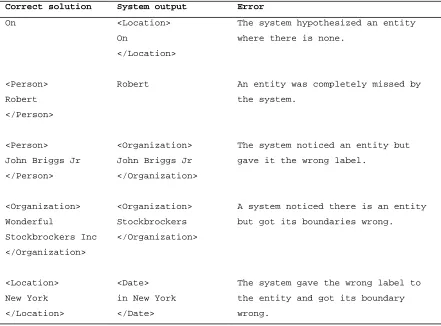
The system produced five different errors5, explained in Table 4. In this example, the system
gives one correct answer: (<Organization> Acme </Organization>). Ultimately, the question
is “What score should we give this system?” In the following sections, we survey how the
question was answered in various evaluation forums.
Table 4: NER error types
Correct solution System output Error
On <Location>
On
</Location>
The system hypothesized an entity where there is none.
<Person> Robert </Person>
Robert An entity was completely missed by
the system.
<Person> John Briggs Jr </Person>
<Organization> John Briggs Jr </Organization>
The system noticed an entity but gave it the wrong label.
<Organization> Wonderful Stockbrockers Inc </Organization> <Organization> Stockbrockers </Organization>
A system noticed there is an entity but got its boundaries wrong.
<Location> New York </Location>
<Date> in New York </Date>
The system gave the wrong label to the entity and got its boundary wrong.
5
Type of errors are from an informal publication
2.6.1 MUC Evaluations
In MUC events (Grishman & Sundheim 1996, Chinchor 1999), a system is scored on two
axes: its ability to find the correct type (TYPE); and its ability to find exact text (TEXT). A
correct TYPE is credited if an entity is assigned the correct type, regardless of boundaries as
long as there is an overlap. A correct TEXT is credited if entity boundaries are correct,
regardless of the type. For both TYPE and TEXT, three measures are kept: the number of
correct answers (COR); the number of actual system guesses (ACT); and the number of
possible entities in the solution (POS).
The final MUC score is the micro-averaged f-measure (MAF), which is the harmonic mean
of precision and recall calculated over all entity slots on both axes. A micro-averaged
measure is performed on all entity types without distinction (errors and successes for all
entity types are summed together). The harmonic mean of two numbers is never higher than
the geometric mean. It also tends toward the lesser number, minimizing the impact of large
outliers and maximizing the impact of small ones. The f-measure therefore tends to favour
balanced systems.
In MUC, precision is calculated as COR/ACT and the recall is COR/POS. For the previous
example, COR = 4 (2 TYPE + 2 TEXT), ACT = 10 (5 TYPE + 5 TEXT), and POS = 10 (5
TYPE + 5 TEXT). The precision is therefore 40%, the recall is 40%, and the MAF is 40%.
This measure has the advantage of taking into account all possible types of errors of Table 4.
It also gives partial credit for errors occurring on only one axis. Since there are two
evaluation axes, each complete success is worth two points. The worst errors cost these same
two points (missing both TYPE and TEXT), while other errors cost only one point.
2.6.2 Exact-Match Evaluations
IREX and CONLL share a simple scoring protocol. We can call it “exact-match evaluation.”
Systems are compared based on the micro-averaged f-measure (MAF), with the precision
percentage of NEs in the solution that are found by the system. An NE is correct only if it is
an exact match with the corresponding entity in the solution.
For the previous example, there are 5 true entities, 5 system guesses, and only one guess that
exactly matches the solution. The precision is therefore 20%, the recall is 20%, and the MAF
is 20%.
For some applications, the constraint of an exact match is unnecessarily stringent. For
instance, in some bioinformatics work, the goal is to determine whether or not a particular
sentence mentions a specific gene and its function. Exact NE boundaries are not required: all
the information needed to determine if the sentence refers to the gene is there (Tzong-Han
Tsai et al. 2006).
2.6.3 ACE Evaluation
ACE has a complex evaluation procedure. It includes mechanisms for dealing with various
evaluation issues (partial match, wrong type, etc.). The ACE task definition is also more
elaborate than previous tasks at the NE “subtypes” and “class” levels, as well as entity
mentions (co-references), and more, but these supplemental elements will be ignored here.
Basically, each entity type has weight parameters and contributes up to a maximum
proportion (MAXVAL) of the final score (e.g., if each person is worth 1 point and each
organization is worth 0.5 point, then it takes two organizations to counterbalance one person
in the final score). According to ACE parameters, some entity types such as “facility” may
account for as little as 0.05 points. In addition, customizable costs (COST) are used for false
alarms, missed entities, and type errors. Partial matches of textual spans are only allowed if
the NE head matches on at least a given proportion of characters. Temporal expressions are
not treated in ACE since they are evaluated by the TIMEX2 community (Ferro et al. 2005).
penalties. In the Table 4 examples, the EDR score is 31.3%. It is computed as follows, using
ACE parameters from 20046. Each of the five entities contributes up to a maximum value to
the final score. Using default ACE parameters, the maximum values (MAXVAL) for person
entities is 61.54% of the final score, the two organizations worth 30.77%, and the location
worth 7.69%. These values sum up to 100%. At the individual type level, one person span
was recognized (John Briggs Jr) but with the wrong type (organization); one person entity
was missed (Robert); the two organization spans (Wonderful Stockbrockers Inc and Acme)
were considered correct, even with the former partial matches; one geopolitical span was
recognized (in New York) but with the wrong type; and there was one false alarm (On).
Globally, the person entities error (function of COST and MAXVAL) accounts for 55.31%
of the final EDR loss (30.77 for the miss and 24.54 for the type error), the false alarm
account for 5.77% of loss, and the location type error accounts for 7.58%. The final EDR of
31.3% is 100% minus these losses.
ACE evaluation may be the most powerful evaluation scheme because of its customizable
error cost and its wide coverage of the problem. However, it is problematic because the final
scores are only comparable within fixed parameters. In addition, complex methods are not
intuitive and make error analysis difficult.
2.7 Conclusion
The NER field has been thriving for more than fifteen years. It aims to extract from text and
to classify rigid designators mentions such as proper names, biological species, and temporal
expressions. In this chapter, we presented related works and applications of NER. We have
also shown the diversity of languages, domains, textual genres, and entity types covered in
the literature. More than twenty languages and a wide range of named entity types are
studied. However, most of the work has concentrated on limited domains and textual genres,
such as news articles and Web pages.
6
We have also provided an overview of the techniques employed to develop NER systems,
documenting the recent trend away from hand-crafted rules towards machine learning
approaches. Handcrafted systems provide good performance at a relatively high system
engineering cost. When supervised learning is used, the availability of a large collection of
annotated data is a prerequisite. Such collections are available from the evaluation forums
but remain rather rare and limited in domain and language coverage. Recent studies in the
field have explored semi-supervised and unsupervised learning techniques that promise fast
deployment for many entity types without the prerequisite of an annotated corpus. We have
listed and categorized the features that are used in recognition and classification algorithms.
The use of an expressive and varied set of features turns out to be just as important as the
choice of machine learning algorithms. Finally we have also provided an overview of the
evaluation methods that are in use in the major forums of the NER research community. We
saw that in a simple example made up of only five NEs, the score of three different
evaluation techniques varies from 20% to 40%.
NER will have a profound impact on our society. Early commercial initiatives are already
modifying the way we use yellow pages by providing local search engines (search your
neighborhood for organizations, product and services, people, etc.). NER systems also enable
monitoring trends in the huge space of textual media produced every day by organizations,
governments, and individuals. It is also at the basis of a major advance in biology and
genetics, allowing researchers to search an abundance of literature for interactions between