KNOWLEDGE-BASED NEURAL NETWORK FOR LINE FLOW
CONTINGENCY SELECTION AND RANKING
Nitin Malik
Dept of Electronics & Instrumentation Engg. Hindustan College of Sc. & Tech.,
Mathura-281122, India [email protected]
L. Srivastava Dept. of Electrical Engg. Madhav Institute of Tech. & Sc.
Gwalior-474005, India [email protected]
Abstract: The Line flow Contingency
Selection and Ranking (CS & R) is
performed to rank the critical
contingencies. An Artificial Neural Network based method for MW security assessment corresponding to line outage events have been reported by various authors in the literature. One way to
provide an understanding of the
behaviour of Neural Networks is to extract rules that can be provided to the user. The domain knowledge (fuzzy rules extracted from Multi-layer Perceptron model trained by Back Propagation algorithm) is integrated with a Neural Network for fast and accurate CS & R in an IEEE 14-bus system, for unknown load patterns and are found to be suitable for on-line applications at
Energy Management Centers. The
system user is provided with the capability to determine the set of conditions under which a line-outage is critical, and if critical, then how severe it is, thereby providing some degree of transparency of the ANN solution.
Keywords: MW security assessment,
Energy Management Centers, Fuzzy
rules, Domain Knowledge, IEEE 14-bus system
I. INTRODUCTION
1.1 General
branches, if such overload results after a forced line outage.
On-line contingency analysis is difficult because of the conflict between the accuracy in solution of PS problem and the speed required to simulate all the contingencies. The simulation of contingency is complex, since it results in change in system configuration. Contingency definition gives the list of contingencies whose probability of occurrence is high. Contingency selection identifies the critical contingencies among them and ranked them in order of their severity. The severity of the contingency is indicated by a scalar Performance Index (PI) which measures system stresses in some manner.
1.2 State-of Art
In reference [2] Pai et. al. described a fast algorithm for on-line load flow and contingency evaluation. This method is based on the elimination of load nodes and the successive approximation technique, and is quite efficient but slow compared with fast-decoupled load flow method. Vankayala and Rao [3] developed a method based on a coupled scheme [Artificial Neural Network (ANN) based contingency screening with Expert System] for PS security enhancement. [4] Presented a fast real power contingency ranking scheme that has been formulated as a pattern recognition problem using a Counter Propagation Network. It also employed feature selection for reducing the dimensionality of the input patterns.
Sobajic and Pao [5] have proposed a rule-based contingency screening for both single- and multiple-line outages. Halphin et al. [6] have proposed a method for evaluating the effectiveness
of various contingency ranking methods in capturing all the active contingencies.
The conventional methods for line-flow Contingency Selection and Ranking (CS & R) are found to be unsuitable for on-line applications. The ANN based methods can learn off-line from training data and is used for on-line classification of new data much faster than it would be possible by solving the model analytically. In this paper, Knowledge-based Neural Network (NN) provides fast and accurate method for on-line MW security assessment corresponding to single-line outage is developed.
II. ANN THEORY
The intelligence of ANN and its capability to solve hard problems emerges from the high degree of connectivity that gives neurons its high computational power through its massive parallel-distributed structure [7]. A connection between a pair of neurons has an associated numerical strength called synaptic weight or adaptive coefficient [8]. The weights of the network are incrementally adjusted so as to improve a predefined performance
measure over time. In order for the net
to learn one need to present a number of examples to the net whose attributes are known or are representatives for the unknown model [9]. The set of given examples is called the training set or training patterns. After the training period, the network should be able to give correct output for any kind of input. This is called testing. If it was not trained for that input, then it should try to give reasonable output depending on how it was trained. This is called
generalization. Every learning algorithm
Hebbian rule for supervised learning and Delta rule for unsupervised learning.
Fig. 1. Artificial Neuron
The net input to the ith neuron is given by NETi = X1W1 + X2 W2 + … Xn Wn
=
∑
i i i
i W X
NET
The output of the ith neuron is given by
)
( i
i F NET
OUT =
< ≥ =
T NET if
T NET if OUT
0 1
The activation function (F) used for Multi Layer Perceptron (MLP) model is sigmoid function, given by
F(x) = 1 (1+ e− x )
Therefore, OUT = 1 (1+ e− NET )
III. METHODOLOGY
3.1 MW Performance Index
The PI corresponding to real power (MW) line flow, used for CS & R is given by
PIMW =
∑
mk=1 OL
wmk
2n
Pmk-Pmkmax BMVA
Pmk Pmk
max
2n (1)
where wmk is a weighted function, and
Base MVA is taken as 100 MVA. The PI is calculated by considering the limit violated (LV) buses only. Assuming wmk=1 results in masking
effect, which is being removed by considering higher exponential power in PI formula i.e. by taking summation only for overloaded (OL)lines. An overload of more than 5% of the rated capacity is used to identify an overloaded line.
3.2 Input Feature Selection <
It would be extremely time consuming to train a NN with all input data as it would increase the dimension of the NN and make its response slow during testing. Therefore we select the optimum number of inputs by eliminating those input features that have no significant effect on its output. Pre-outage real power line-flow (PFL), pre-outage terminal voltages of the contingent line (VT1, VT2), angles at the contingent line (ANG1, ANG2), and total real power demand (TPD) are taken as input features.
3.3 Data Normalisation
Normalising a vector means dividing by a norm of the vector to make the Euclidean length of the vector equal to one. This converts an input factor into a unit vector pointing in the same direction. Normalisation makes all the elements lie between 0 and 1. The data is scaled in the range of 0.1 to 0.9 because value 0 and 1 is difficult to realize by activation function in the NN [10]. 3.4 Large-weight algorithm
The large-weight algorithm [11-13] is used to extract rules from the weight matrix of the output layer of a trained MLP model. For a hidden layer, the main contributory inputs for a hidden neuron are determined by selecting those inputs (aj) whose associated weights are
within some range of the maximum weight for that particular hidden neutron (bk). The fuzzy rule is constructed as
IF(aj)
THEN (bk)
3.5 Solution algorithm
(i) A large number of load patterns are generated at each bus by changing the load randomly at the busses for a wide range of load variation.
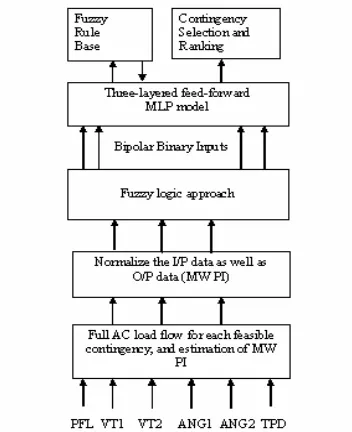
(ii) Full AC load flow is performed for each feasible to an ANN corresponding to single line-outage, and also MW PI using equation (1)
Fig. 2. Block Diagram of NN based Line Flow CS & R
(iii) Exclude the line outage cases having zero values of MW PI, for all load patterns.
(iv) Normalise, for each load pattern, the input data as well as the output data (MW PI) between 0.1 and 0.9 (0.1 for non-critical and 0.9 for most critical case).
(v) The normalised continuous input data are classified into a set as being high, medium, or low.
High, if normalised value of input > 0.62 Medium, 0.62 ≥ normalized value of input > 0.36
Low, if normalised value of input ≤ 0.36 (vi) The linguistic terms high, medium, and low are represented using vectors [-1,-1,1], [-1,1,-1], and [1,-1,-1]
respectively. Using this set, the continuous valued inputs are converted into bipolar binary inputs using fuzzy logic approach [15,16], thereby increasing the input dimension to 18. (vii) With these 18 (3 bipolar inputs corresponding to each input data) inputs, a fully connected three-layered feed-forward MLP model (Rosenblatts, 1957) having 18 input neurons, 9 hidden neurons, and 5 output neurons, with semi-linear sigmoid activation function, is trained by Back Propagation (BP) [iterative, gradient, negative descent search, supervised] algorithm for five-class five-classification task so that line (MW) PI may be ranked in different levels according to their severity (Table 1).
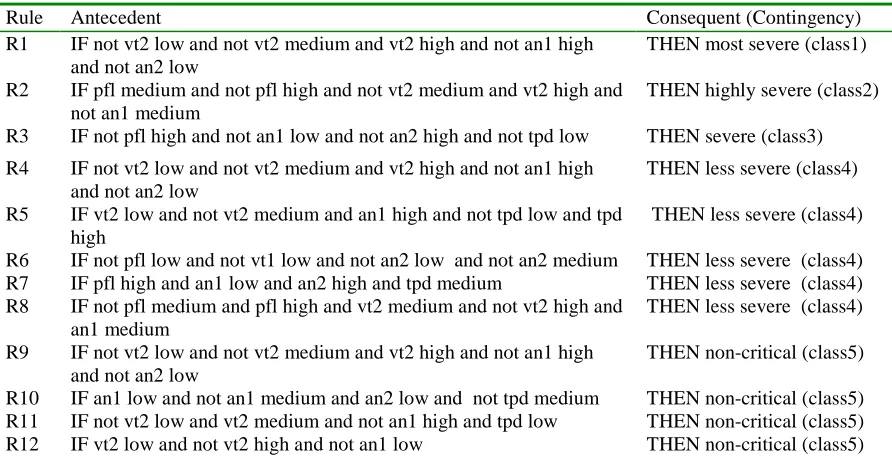
(viii) The rules extracted (Table 2) from a trained MLP model using large-weight algorithm are stored in a fuzzy rule base. (ix) Domain Knowledge (fuzzy rules extracted from MLP model) is integrated with the trained MLP model to select and rank the contingencies accurately and quickly.
IV. RESULTS AND DISCUSSON
Corresponding to five classes of MW PI, five neurons were used in the output layer of the MLP model. The output of the corresponding node was 1 if the PI belongs to that class, otherwise it was 0. If a problem belongs to class V, it means that the corresponding contingency (line outage) is non-critical, but if it belongs to class 1, the corresponding contingency is most severe. The effectiveness of the proposed NN-based method for line flow CS & R has been tested on IEEE 14-bus system, and is found to be superior in terms of accuracy and training time.
converged for 18 cases of single line outage contingencies, out of 20. For two
line outages, load flow solution does not converge. Such line outages are placed at the top of the ranking list with a PI value of 0.9. Hundred load scenarios were generated in the range of 50% to 160% of their base case loading. MW PI was calculated for all the 1800 (100×8) cases.
Several line outages having no line overload (non-critical contingencies) give very small or zero value of MW PI for most of the load scenarios. Such lines were not included in the contingency list. In the system under study, only 8 lines were included in the critical contingency list. Thus total patterns for CS & R are 800 (100×8). For training of MLP model, 720 (90×8) patterns were selected randomly while 91 patterns were conflicting/inconsistent, having different outputs for same input. Of the remaining 151 [720-(478+91)] unique/consistent patterns, only 16 patterns belong to class II. Eighty (16
patterns of each class, 16×5) patterns were used to train a MLP using BP
algorithm. Applying the large weight algorithm, 12 rules were extracted. The trained MLP model was tested with 80 (10×8) patterns. The MLP gave 11 patterns misclassified, producing an accuracy of 86.25%.
Class I (most severe)
II (highly severe)
III (severe)
IV (less severe)
V (non-critical) PI
range 0.9-0.8 0.8-0.6 0.6-0.4 0.4-0.1 0.1
Table 1.Classification of MW Performance Index
V. CONCLUSIONS
Test results of sample system reveal that:
(i) The system user is provided with the set of conditions under which a line-outage is critical or not, and if critical then how severe it is, thereby providing some degree of transparency of the ANN solution.
Rule Antecedent Consequent (Contingency)
R1 IF not vt2 low and not vt2 medium and vt2 high and not an1 high and not an2 low
THEN most severe (class1)
R2 IF pfl medium and not pfl high and not vt2 medium and vt2 high and not an1 medium
THEN highly severe (class2)
R3 IF not pfl high and not an1 low and not an2 high and not tpd low THEN severe (class3)
R4 IF not vt2 low and not vt2 medium and vt2 high and not an1 high and not an2 low
THEN less severe (class4)
R5 IF vt2 low and not vt2 medium and an1 high and not tpd low and tpd high
THEN less severe (class4)
R6 IF not pfl low and not vt1 low and not an2 low and not an2 medium THEN less severe (class4) R7 IF pfl high and an1 low and an2 high and tpd medium THEN less severe (class4) R8 IF not pfl medium and pfl high and vt2 medium and not vt2 high and
an1 medium
THEN less severe (class4)
R9 IF not vt2 low and not vt2 medium and vt2 high and not an1 high and not an2 low
THEN non-critical (class5)
R10 IF an1 low and not an1 medium and an2 low and not tpd medium THEN non-critical (class5) R11 IF not vt2 low and vt2 medium and not an1 high and tpd low THEN non-critical (class5) R12 IF vt2 low and not vt2 high and not an1 low THEN non-critical (class5)
(2) The system user is able to validate the output of the ANN under all possible input conditions, and thus reliability of the ANN solution increases. The developed ANN based method may be suitable for on-line implementation in Energy Management Systems.
VI. FUTURE OUTLOOK Since ANN can be viewed as ‘low level’ data processing tool, hybrid
approaches, such as combination of
ANN with other techniques like Expert Systems, Fuzzy logic, and Genetic algorithm, are promising areas to be investigated.
This paper has only addressed the single line-outage contingency. The work can be extended to consider multiple line-outage contingencies.
VII. REFERENCES
[1] Sandilya, A., Gupta, H.O., Sharma, J.D.,"A method for automatic contingency selection, ranking and line outage simulation", Proceedings, IASTED, Int. Symposium on high technology in the power industry, Scottsdale, Arizona, March 1-4, 1998, pp 88-91
[2] Pai, M A, Aggarwal, R P and Armugam, N, “A fast algorithm for on-line load flow contingency evaluation.”, IFAC Symp. on Computer Applications in large scale power systems, New Delhi (Aug 1979)
[3] V.S.S.Vankayala and N.D.Rao, “Power system security enhancement using a coupled ANN-ES scheme.”, Proc. 4th Expert system applications to power system, Melbourne, 1993. [4] Lo, K. L., Peng, L. J., Macqueen, J.F., Ekwue, A. O. and Cheng, D.T. Y.,”Fast Real Power Contingency Ranking using a Counter Propagation Network" IEEE, 1997, pp. 1259-1264.
[5] Sobjic, D. J. and Pao, Y. H., "An artificial intelligence system for power system contingency screening, " IEEE Trans.Power Syst. Vol PWRS-3 No 2 (1988) pp. 647-65324.
[6] Lauby, M G, Mikolinnas, T A and Reppen, N D, "Contingency selection of branch outages causing voltage problems" IEEE Trans. Power Appar. Syst. Vol. PAS-102 No 12 (1983) 3899-3904
[7] Nitin Malik, “Artificial Neural Networks and their applications.” National Conf. on ‘Unearthing Technological Developments & their Transfer for Serving Masses’, GLA ITM, Mathura, India 17-18 April 2005
[8] L. Srivastava, S. N. Singh and J. Sharma, “ANN applications in power systems: an overview and key issues,” International Conf. on computer applications in electrical engineering, recent advances, pp. 397-403, 8-11 Sept, 1997.
[9] Task force 38-06-06 of study committee 38, “Artificial neural networks for power systems,” Electra No.159, pp. 78-101, April 1995.
[10] V.Brandwaji, B.R.Kumar, A.Bose and S.D.Kuo, “Voltage security indices for contingency screening in dynamic security assessment,.” IEEE Trans. Power Systems, Vol. 12, No 2, August1993
[11] S.B. Tham, “Extracting provably correct rules from artificial neural networks.” Institute for Informatik III, Universitat Bonn, Tech. Rep. IAI-TR pp. 93-95, 1993.
[12] G.Towell and J.W. Shavlik, “Extracting refined rules from knowledge-based neural networks,” Machine learning, vol.13, pp. 71-101, 1993.
[13] Esukimoto and C. Morita, “The discovery of propositions in noisy data,” In Machine Intelligence 13, Oxford, U.K. Oxford Univ. Press. 1994, pp. 143-167
[14] L. Srivastava, S.N. Singh and J.Sharma: “Knowledge-based neural network for voltage contingency selection and ranking.” IEE Proc. Gener. Transm.Distrib., Vol.146, No. 6, November 1999.
[15] Buckley, J.J., Hayashi, Y., and Czogala, E.: “On the equivalence of neural nets and fuzzy expert systems.”, Fuzzy Sets Syst., 1993, 53, pp.129-134