EECDC: An energy Efficient and
Coverage-Aware Distributed Clustering Protocol for
Wireless Sensor Networks
A. Maizate#1, S. Aouad#2
#
RITM-ESTC / CED-ENSEM, University Hassan II, Morocco
Abstract
Despite the developments of a few years wireless sensor networks, several constraints continue to limit their development and degrade the performance of their applications and services. Due to their limited power and signal range, some or all of the sensors may stop functioning, leading to the deterioration of network functionality such as monitoring, detection and data transfer. These networks require robust wireless communication protocols that are energy efficient. Thus, it is a challenge for the self organization protocols to provide network survivability and redundancy features. In this paper, we present a novel clustering algorithm called EECDC (An energy efficient and coverage-aware distributed clustering protocol for wireless sensor networks), which aims to improve the applications performance and the quality of service (QoS) by exploiting geometry techniques. Better coverage, energy efficiency, minimum traffic from nodes to base station, balanced energy consumption are the main features of EECDC to improve life time of WSN. Simulation results confirm that EECDC is effective in prolonging the network lifetime as well as in improving the network coverage.
Keywords — Wireless Sensor Network;
Self-Organization; ClusterHead; Clustering; energyefficiency; network coverage.
I. INTRODUCTION
Rapid growth in the field of Information Technology (IT) and integrated circuits (IC) leads to the development of cheap and compact size sensor nodes. WSN is composed of a set of large number of sensor nodes which are capable of monitoring physical phenomena like temperature, humidity, vibrations, seismic events, and so on [1–3].
Sensor nodes typically use irreplaceable power with the limited capacity, which requires energy efficient self organization protocols need to maximize the network lifetime. Clustering is one of the best techniques to achieve this aim and that was enough studied [4-6].
WSN has limited supply of energy hence an energy conserving self organization protocol is important for these networks. Therefore, energy
consumption and network coverage are important issues to improve the lifetime of the network. With the limited energy and the mobility of the sensors, changes in the physical topology of the network occur frequently, leading in most cases to the appearance of uncovered areas that become isolated from the rest of the network. This explains the need to design new protocols and techniques for self-organization of the network to ensure better coverage, optimum power consumption and avoid service interruption for WSN applications. This is the goal of the work done in this paper through which we propose a new self-organizing protocol to maintain good network coverage and maximize the network lifetime
There is several energy efficient and coverage aware self organization protocols discussed in the literature and this is also the main target of the work presented in this project. Communication energy conservation can be achieved by improving the network coverage and limiting the packet size of the data to be sent and by limiting the number of packets that are routed through the network. The clustering architecture is an efficient architecture for improving the performance of wireless sensor networks.
In a Clustering topology nodes perform different tasks in WSNs and typically are organized into clusters according to specific requirements or metrics. Generally each cluster comprises a leader which called cluster head (CH), aggregates all the data within the cluster and sends the data to BS or to others clusterheads, and other member nodes (MNs) or ordinary nodes (ONs) and the CHs can be organized into further hierarchical levels. In general nodes with higher energy and more neighbors act as CH and perform the task of data processing, data aggregation and information transmission while nodes with low energy act as ordinary nodes and perform the task of information sensing. The typical clustering self organization protocols in WSNs include Low-energy Distributed, energy-efficient, and dual- homed clustering (DED) [7]. Hybrid distributed, Energy-efficient, and Dual homed clustering) algorithm (HDED) [8]. Drifting Towards Corners Algorithm (DTCA) [9]. Extended- multi-layer cluster designing algorithm (E-MCDA) [10].
communication and the network model. In Section 4, we explain the process of the EECDC protocol. In Section 5, we prove the validity and compare the performance of the proposed EECDC with others well-known clustering protocols . Finally, Section 6 concludes this paper and proposes future research directions.
II. RELATEDWORK
In [18], DED (distributed, energy-efficient, and dual- homed clustering) provides robustness for WSNs without relying on the redundancy of dedicated sensors and node density. DED uses the information already gathered during the clustering process to determine backup routes from sources to observers, thus incurring low message overhead. It does not make any assumptions about network dimension, node capacity, or location awareness and terminates in a constant number of iterations. The algorithm is divided into three phases for clarity. Phase I initializes the parameters and variables.
At the start of clustering, the set of neighbours is needed to compute cost and PCH, the
equation for P CH is:
where T is a constant that indicates the upper bound of the duration for which a node can continuously work as a CH. The value of T should be chosen such that the maximum energy of a node in the WSN is not greater than T × Erate. E is the rate at
which energy is expense. The minimum value for Prate
is set to a predetermined threshold Pmin to ensure a
constant time complexity of the algorithm. In Phase II, each node waits for the announcements of Clusterhead candidates that are advertised based on PCH. In Phase
III, the backup is determined locally from the information that a sensor collected at the end of previous phase. The preferable backup of a member node is another Clusterhead within cluster range, if any. Otherwise, the node randomly chooses one of its neighbors whose Clusterhead is different from its own Clusterhead. If no such neighbor is found, the node picks up a neighbour whose Clusterhead is the same as its own Clusterhead, but whose backup destination is not the same as its own Clusterhead.
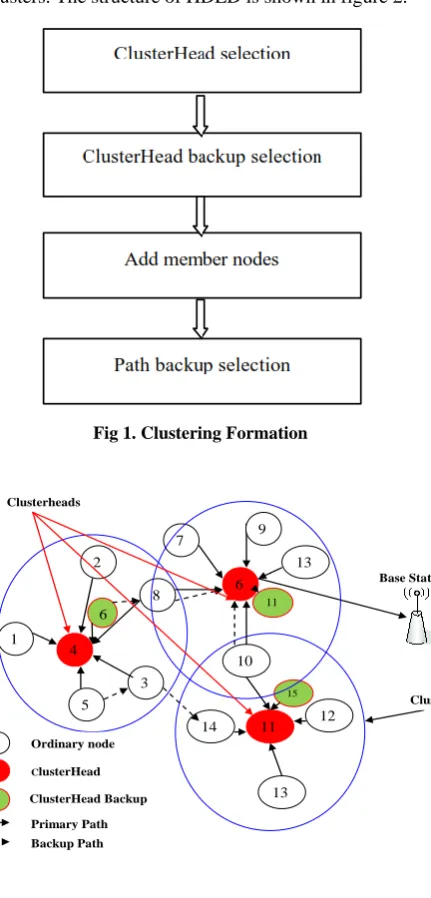
In [8], The self-organized clustering protocol HDED starts by electing nodes critical for the formation of clusters. In addition, the system considers node connectedness, the distance between nodes of the same cluster and remaining energy of cluster head election, and at the same time it sets the cluster head backup for each clusterhead and the path backup for nodes non clusterhead. The HDED algorithm consists of three parts as shown in Figure 1.
To achieve energy efficiency, the criterion in the selection of Clusterhead is the remaining energy, connectless and th distance between nodes in the same cluster. To reduce the load (or overhead) of Clusterhead, the HDED regulates the size of the clusters. The structure of HDED is shown in figure 2.
Fig 1. Clustering Formation
1
2
3 4
5
6 7
8
10
11 12 13
13 14
Base Station
Cluster range
Ordinary node
ClusterHead
Primary Path Backup Path
6
11
1 1
15
ClusterHead Backup
9 Clusterheads
Fig 2 . Cluster Structure with HDED.
South West (SW). It also assumes that the sensors are aware of which partition they belong to in each epoch. Sensors that reach their steady state (residual energy reached a threshold value) start a timer of T epochs to save energy. After elapsing the period T, the sensor opts randomly to migrate to one corner of its partition with different probabilities, and updates its energy.
III.PRELIMINARIES
A. Energy Model for Communication
A light model for radio hardware is used [11]. Two models have been used for energy consumption examination, free space model ef d2 and multipath fading model emd4 . Both models are relying on the distance between the receiver and transmitter.
Equation (2) represents the amount of energy consumed for transmitting l bits of data to d distance. Equation (3) represents the amount of energy consumed for receiving l bits of data which is caused only by circuit loss. Hence, to transmit a k- packet at a distance d, the radio uses up is given as:
Where,
- Free space model’s amplifier energy consumption;
- Multiple attenuation model’s amplifier energy consumption;
- a constant which relies on the application environment.
- ETX: required energy utilization for packet
transmission.
- Eelec: is electronic energy that counts on the
filtering, modulation the digital coding and spreading of the signal.
- ERX: required energy utilization for packet
receiving.
B. Network Model
In this paper, the following assumptions about the network model have been made:
Network is densely populated and the sensor nodes are randomly spread in the environment.
Nodes have been assumed homogeneous
The sensor nodes are mobile and they are deployed randomly in the network
There is only one base station node that could be inside or outside the sensor network.
The sensor nodes are unaware of its location or the position in the network.
The batteries of the sensor nodes are non replaceable and not-rechargeable.
Nodes are able to adjust their sending power according to heir distance to the intended receiver.
All nodes have equal energy and ability.
Location and ID for all nodes is known for base station.
IV. EECDC:ANENERGYEFFICIENTAND
COVERAGE-AWAREDISTRIBUTED
CLUSTERINGPROTOCOLFORWIRELESS
SENSORNETWORKS
The goal of the EECDC algorithm is to extend coverage lifetime of the WSN , for that it can effectively monitor the area continuously and be able to transfer data to the appropriate CHs. The early death of active CH causes loss of total coverage, which is not desirable. In order to overcome this problem, the algorithm deals with the different weight coefficients assigned to the coverage-related ones.
To achieve energy efficiency, the criterion in the selection of Clusterhead is the remaining energy, connectless and the distance between nodes in the same cluster. The cluster formation algorithm used in EECDC algorithm is given as [8].
For the cluster head election, each node (i) calculates its weight based on several parameters. Weight of node is associated with it’s the current remaining energy, the distance between nodes in the same cluster and the number of neighbors (connectedness), number of neighboring node and overlapping degree.
The connectedness can be obtained from broadcasts of neighboring nodes as follows :
2 2
' ( )
(
')
(
')
v v N v
D
x x
y y
(4)D(v)= Dmax/
D
v, (5)Where
D
max is the maximum range of a node.To Compute the current remaining energy, Er, for
every node v, as
E(v)=Er
(v)÷E
max (6)Where Emax is the initial power.
To find the neighbors of each node i (i.e., that are in its transmission range) which defines its degree, dv,
(7)
d(v)=d
v/d
max,w
hered
max is the maximumnumber of neighboring node supported.
The weight of node (i) is defined as follows:
Wv = q1*d(v) + q2* D(v) + q3* E(v)+q4*O(v).
Here, d(v), D(v), E(v), and O(v) terms are defined as the number of neighboring node, distance between sensor nodes, residual energy and overlapping degree respectively. The different weights q1,q2, q3,and q4 used in eq.5 varies between 0 and 1 such that q1+q2+q3+q4=1. The selected weight values are based on optimum value of parameters. In implementation, monitoring area is divided into the grid of equidistant points. It ensures that each sensor covers equidistant points with its sensing range.
V. SIMULATIONANDPERFORMANCE
EVALUATIONS
This section describes the simulation results obtained during the investigation phases of the simulation. We used C/C++ language-based event-driven simulator [12, 13] and the same simulation model as in [11] to implement our improved multihop-HDED protocol. The parameters considered in this simulation are given in Table III.
TABLEIII:PARAMETERSETTINGS
Parameter
Values
E
elec50nJ/bit
E
00.5J
Є
fs10pJ/bit/m2
Є
mp0.0013pJ/bit/m4
In the simulation network, nodes are randomly distributed in some distant geographical location to validate the proposed protocol.
A. Performance Metrics
The following metrics are adopted to access the performance of all clustering protocols involved:
Network lifetime: It defined the periods until a certain number of sensor nodes are all discharged of their energy. The definition of the life span of a sensor network depends on the application where the sensors are deployed.
B. Simulation Results
1) Network Lifetime Comparisons
In figure 3, we change the network distribution by increasing the number of the nodes
from 200 to 1000 with increment in 200. As shown, we can see that the lifetime of network by EECDC protocol is longer than that by the other two protocols. It obtains complete network coverage goal with minimum energy consumption. The main reason is because the algorithm is capable of distributing CHs efficiently to maintain coverage of monitoring field. Later, it the clusters are preserved by the node backup and path backup. As a result, a large amount of energy can be saved which lead to a much longer lifetime.
Fig 3 Network Lifetime
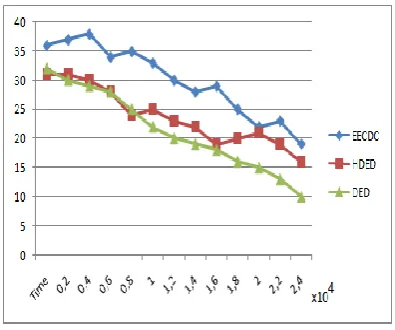
2) Average Number of Clusterheads
The Fig. 4 compares EECDC, HDED and DED in terms of number of CHs with time. The results indicates that EECDC select little more number of CHs. It formulate the optimal way for determining number of CH for different scenario with the objective of guaranteed connectivity and minimizing the total energy spent in the system. Actually, these selected CHs deal with almost same number of active nodes for maintaining full coverage for longer period of time.
Fig 4 Average Number of Clusterheads with time
VI.CONCLUSION
aim of our algorithm is the prolongation of the network lifetime; four parameters were taken into account for the choice of clusterheads: remaining energy, the distance between nodes in the same cluster and the number of neighbors, number of neighboring node and overlapping degree. The simulation results show that our algorithm is more effective in energy and build a stable structure being able to support new sensors and dead sensors without returning to the clusters rebuilding phase.
REFERENCES
[1] Abbasi AA, Younis M. A survey on clustering algorithms for wireless sensor networks. Comput Commun 2007;30:2826–41.
[2] Anastasi G, Conti M, Di Francesco M, Passarella A. Energy conservation in wireless sensor networks: a survey. Ad Hoc Netw 2009;7:537–68.
[3] Akyildiz IF, Su W, Sankarasubramaniam Y, Cayirci E. Wireless sensor networks: a survey. Comput Netw 2002;38:393–422.
[4] Ali, Ahmad, et al. "Enhancement of RWSN Lifetime via
Firework Clustering Algorithm Validated by
ANN." Information 9.3 (2018): 60.
[5] Agrawal, Deepika, and Sudhakar Pandey. "FUCA: Fuzzy based unequal clustering algorithm to prolong the lifetime of wireless sensor networks." International Journal of Communication Systems 31.2 (2018).
[6] Asif, Mohd, and Harjit Singh. "A Review on Design and Analysis of Lifetime Efficient Protocol in Distributed Clustering of WSN." International Journal of Engineering Science 17137 (2018).
[7] Mohammad M. Hasan and Jason P. Jue, “Survivable SelfOrganization for Prolonged Lifetime in Wireless Sensor Networks,” International Journal of Distributed Sensor Networks, Volume 2011, pp. 1-11, 2011.
[8] Maizate, A., El Kamoun, N., A new metric based cluster head selection technique for prolonged lifetime in wireless sensor networks, (2013) International Journal on Communications Antenna and Propagation (IRECAP), 3 (4), pp. 227-236.
[9] Al-Tabbakh, Shahinaz M., and Eman Shaaban. "Energy Aware Autonomous Deployment for Mobile Wireless
Sensor Networks: Cellular Automata
Approach." International Conference on Applied Physics, System Science and Computers. Springer, Cham, 2017. [10] Jabbar, Sohail, et al. "Designing an Energy-Aware
Mechanism for Lifetime Improvement of Wireless Sensor Networks: a Comprehensive Study." Mobile Networks and Applications(2018): 1-14.
[11] Heinzelman W,Chandrakasan A,Balakrishnan H. Energy-efficient Communication Protocol for Wireless Sensor Networks[C]//Proceeding of the Hawaii International Conference System Sciences,Hawaii,January 2000. [12] D. Curren, “A survey of simulation in sensor networks,”