Improved Ant Colony Optimization Algorithm
and Its Application on Path Planning of Mobile
Robot
Juanping ZHAO
Shenyang University of Chemical Technology, Shenyang, China Email: [email protected]
Xiuhui FU
Shenyang University of Chemical Technology, Shenyang, China
Shenyang Institute of Automation Chinese Academy of Sciences, Shenyang, China Email: [email protected]
Abstract—This paper uses the grid method with coding tactic based on effective vertexes of barriers (EVB-CT-GM) as the method of environment modeling and ant colony optimization algorithm with two-way parallel searching strategy (TWPSS-ACOA) is adopted to accelerate searching speed. In view of that the TWPSS-ACOA has the defects of losing some feasible paths and even optimal paths because of its ants meeting judgment strategy (AMJS), so a new AMJS is proposed. Then a new method to rationally distribute initial pheromone is given to accelerate convergence speed of initial stages of ACO algorithm. Later, in order to avoid running into local optima and to speed up optimization process, a new path selecting method and a new global pheromone updating technique are put forward. Finally simulation researches of path planning of mobile robot based on improved TWPSS-ACOA are made under different two-dimension environments and simulation results show the improved algorithm can find safe paths at higher convergence speed even in complex environment.
Index Terms—ant colony optimization, path planning, mobile robot, two-way parallel searching, meeting judgment, initial pheromone distributing, global pheromone updating
I. INTRODUCTION
Nowadays, robotics is an essential part in manufacturing processes automatization. Concerning mobile robots, autonomous navigation entails a great challenge. A mobile robot can be very useful in different situations where humans could be in danger or when they are not able to reach certain targets because of terrain conditions[1]. Then mobile robotics field is an interesting and challenging subject for science and engineering[2]. Hence, robot should have those required characteristics to avoid an obstacle that lies in his path[3], and path planning becomes an important task in mobile robotics to enable
the robot navigation system to identify a safe path (without colliding with obstacles) to goal[4].
Many scholars make lots of researches on path planning and put forward some methods, such as artificial potential field approach[5,6], the free space method[7,8], neural networks[9,10], genetic algorithm[11,12], simulated annealing algorithm[13,14],fuzzy Logic [15,16]and so on, but generally, these methods were shown to lack of computational complexity, local minimum, adaption and non-robust behavior[17].
The ant colony optimization (ACO) algorithm is a meta-heuristic approach inspired by the behavior of the biological ants in real world and proposed by Dorigo M.. The algorithm is a kind of random optimization approach and has the many advantages, such as good robustness, distributed computing, easy combined with other methods[18]. It is also one of the most successful examples of swarm intelligent systems and has been applied to solve many different types of problems[19], such as quadratic assignment problem[20,21] , job shop scheduling problem[22-24], vehicle routing problem[25-27], network routing selecting problem[28,29] and robot path planning problem[30,31], and so on.
This work presents a new proposal to solve the problem of path planning for mobile robots; it is based on TWPSS-ACOA to find the best route according to certain cost function. There are two core steps about path planning methods: environment modeling and planning algorithm. So we firstly build the environment model of robot by EVB-CT--GM[32], since this method was certified to be an effective method to overcome environment traps problem, and then TWPSS-ACOA proposed in [33] is used to adequately develop mutual cooperation ability between ants. But in view of that the TWPSS-ACOA has the defects of losing some feasible paths and even optimal paths, a new ants meeting judgment method that can judge if ants meet according to the kind of pheromones is proposed. And then a new method, which rationally distributes initial pheromone of ants, is given to speed up the convergence velocity of initial stages of ACO algorithm, since equivalent
Manuscript received October 14, 2011.
distributing of initial pheromone in ant colony optimization algorithm results in longer searching time. Further, a new path selecting method and a new global pheromone updating technique are introduced to avoid running into local optima. Simulation results under two-dimension environment indicate that improved algorithm can plan a safe and optimal path quickly.
The rest of the paper is organized as follows. In the next section, we introduce the problem of environment problem. Section III is devoted to the algorithm improvements and the program flow chart of improved algorithm is given in Section IV. Simulation is shown in Section V. Conclusions are addressed in Section IV.
II.ENVIRONMENT MODELING
The Grid method proposed by W. E. Howden in 1968 is the most widely-used and well-developed environment modeling algorithm. It is brief and effective, has better adaptability to barriers, can readily store and calculate for computer and is applied to many mature algorithms and techniques successfully. So the work space of mobile robots is still divided by grid method in this paper. Although using conventional grid method to establish environment model of robot workspace can avoid complex calculation when barriers boundaries are disposed, it is also easy to run into environment traps. Therefore EVB-CT-GM[32] is used to avoid environment traps problem in this paper. The detailed process is as follows.
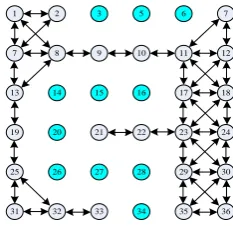
Firstly, appropriate distension treatment is made for barriers according to volume radius of practical robot in order to ensure the security of robot movement until physical robot can be regarded as a particle at last, as Fig.1 shown, and then the robot workspace is divided by grids method. Next, grids are identified by serial numbers as shown in Fig.2 and Fig.3. So the serial number is used as a parameter of coding of robot path planning to shorten the length of coding.
Finally, effective vertexes of barriers are constructed. They should satisfy two conditions: (1) The crossover point between barriers grids are not on the edge of environment map since robots don’t pass through them. (2) There is only one barrier grid in four grids centered on a barrier vertex.
So there are thirty-one effective vertexes in Fig.4 that can be used to code path and practical coordinate of every vertex can be handily fixed according to grids coordinate. Robot path planning based on it can avoid difficulties due to coordinate transformation and is more suitable for computer realization, so the generality of algorithm is enhanced.
Now, the path planning is the problem to find a sequence of free grid nodes from the start position to the target position in grids environment shown as Fig.4.
III. ALGORITHM IMPROVEMENTS
A. Rational Distributing of Initial Pheromone
Since the differences of the initial pheromones between paths are not clear, ants walk to each feasible direction nearly in the same probability when original ant colony is created. In the other words, it takes long time until the pheromone superiority of better paths is obvious, so it is need long time to search initial feasible solutions for ACO algorithm and most of the time is used to construct solutions. So it seriously affects the quality of ACO algorithm searching for the best solutions.
In order to accelerate convergence speed of initial stages of ACO algorithm, heuristic information is augmented to distribute initial pheromones reasonably. Namely, initial pheromone is distributed according to local information of relative length of path of current city, and chaos information is added to tiny adjust to avoid running into local optima.
1 2 8
15 1
66 68 86 88
+ + +
+ + +
+ + + + ++
+ +
+ + + + + + + + + +
+ +
+ +
+ + +
A
B
C
D
E F
7 6 5 3 4 0
2 3 4 5 6 7 8 9
9
Figure 4. Sketch map of ants meeting identification
1 2 3 5 6 7
7 8 9 10 11 12
13 14 15 16 17 18
19 20 21 22 23 24
25
31 26
32 27
33 28
34 29
35 30
36
Figure 3. Figure structure of the grid environment
1 2 3 4 5 6
7 8 9 10 11
22 21 19
18 17 16 15 14 13
12
35 36
34 33 32 31
25 26 27 28 29 30
24 23 20
Figure 2. Coding of grids
2r
r
former boundary of barrier
distension boundary of barrier physical robot
robot particle
Now, the expression of pheromone distributing is
min min
0 0
( )
2
i j
ij
ij
d d
t q
d
(1)
Where, dimin is the city distance nearest to city i ,
min
j
d is the city distance nearest to city j, dijdenotes the distance from cityito city j,
0 is a pheromone constant.[0,1]
q shows the intensity of chaos and denotes the chaos.
Appling typical Logistic obtains[34]
( 1) ( ) (1 ( ))
( ) [0,1], [3.56, 4]
t t t
t
(2)
B. Two-way Parallel Searching Tactic
In conventional ACO algorithm, a new path
new
L creates when an ant reaches a goal from a start point, so the efficiency and convergence speed of ACO algorithm are relatively slow since it doesn’t make good use of interoperability between ants. TWPSS-ACOA is designed in [33] to increase the efficiency of ACO algorithm and bring interoperability between ants into full play. In other words, whole ants are divided into the same two groups, and ants simultaneously search feasible paths respectively from two different directions. A feasible path is produced if an ant walks from a start point to a end point by itself or two ants from different directions meet during searching process.
The searching strategy not only improves constructed efficiency of initial feasible solutions, but also keeps searching diversity, so the searching strategy is used in this paper.
C. New Meeting Judgment Strategy between Ants
Two ants from different directions can meet during TWPSS process, ants separately carry their searching information, and a new feasible path can be obtained by linking the paths meeting ants walked. Then how to determine whether ants encounter becomes a focal problem.
In most literatures ants are to be affirmed encountering by the distance between two grids on which two ants are at the moment. Namely, antski, kj
i j
k k
flag flag are on gridsgiandgj at the same time tduring executing process of algorithm, if d g g
i, j
2 and there is logical connecting line between the two grids, then antski,j
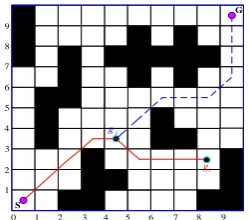
k will be called encountering. But this judgment method is easy to lose some feasible paths, as in Fig.5. It even loses optimal path and makes algorithm can’t find global optima.
In Fig.5 gi is the location of ant kicoming from the start point and gjis the position of ant kjcoming from end point at moment t during executing process of ACO
algorithm. The red real line is the path ant ki has passed by and the blue dotted line is the path ant kjwent through. From Fig.5 it follows that ants ki and kj both passed through node gj , but at same moment t the distance between them d g g( i, j) 2. According to the former AMJS, the two ants will be regarded as no-encountering, so there is not feasible path between them. Factually, there is a feasible path between them as shown in Fig.5. We are now confident that the AMJS of [33] loses some feasible paths, reduces optimization range artificially and even makes algorithm can’t find global optima, so an effective AMJS is needed.
For convenience, some definitions are given firstly, as follows.
Definition I: Let 0(i j,)(0)be the pheromone released by ants coming from the start point and 1( )i j, (0) the pheromone released by ants coming from the end point.
Definition II: if a grid both has the pheromone ,
0i j(0)
( ) and the pheromone 1( )i j, (0) at same moment during algorithm executing process, then there are at least two ants passing by the grid. So the ants are known as meeting.
A new path is obtained by connecting the records in taboo tables of the two meeting ants during algorithm executing process.
The path ants met can be described as follows:
( _ ) ( _ )
i j
new k k
P P ant tabu P ant tabu (3)
Where,Pnew is a new path obtained by meeting, and
( _ )
i
k
P ant tabu and ( _ )
j
k
P ant tabu are the paths individually obtained from taboo tables of ants kiand kj when ants kiand kj met.
For example, grid forty-five has both the pheromone ,
0i j(0)
( ) and the pheromone1( )i j, (0) in Fig.5, and then the ants kiand kj can be said meeting. The grids the two ants passed by are found, and the records of _
i
k ant tabu is {Start, 12, 23, 33, 44, 45, 35, 26, 17}, the records of
_ j
k
ant tabu is {Goal, 90, 80, 70, 59, 58, 57, 46, 45}. The new path is obtained, {Start, 12, 23, 33, 44, 45, 46, 57, 58, 59, 70, 80, 90, Goal}, by connecting ant tabu_ k1 and
2
_ k
ant tabu . S
j
g
i g
1 2 7 8
15
66 68
86 88
5 6 9
3 4 0
1 2 3 4 5 6 7 8
D. New Path Selecting Strategy
The transference probability only depends on the historical information ij and the current informationij in conventional ACO algorithm, so the transference probability lacks the leading of the future information and it makes algorithm easily running into local optima[17]. Therefore a new path selecting strategy is proposed in this paper.
Definition III: activity degree of cityj: denotes the branching extent of city connection established by ant colony in city j during an iteration, described by
j
liveness .
_ j
j
node branch liveness
n
(4)
Where, node branch_ j is the branching number of cityj.
Then the expression of transference probability with activity degree of city is
_[ ( )] [ ( )] [ ( )] [ ( )]
_
0
i k
j ij ij
s is is
s ant window k
i ij
k
liveness t t
liveness t t
p t
j ant window
otherwise
(5)
Where,
is a pheromone heuristic factor, which reflects the function of the accumulated pheromone on ants’ movement, and is a desired heuristic divisor, shows the important degree of heuristic information on the path selecting of ants. ij
t is the information quantity on the path
i j, at moment t , ij( )t is a heuristic function which denotes the expected degree for ant moving from city ito city j, and which is usually equal to the inverse of the distant from city ito cityjfor ACO algorithm, namely:1 ( ) ij
ij
t d
. (6)
Where, dijis the distant between two neighbor cities i
andj. So the less dijis, the bigger ij( )t is and the larger ( )
k ij p t is.
As shown, heuristic information ijand ijis used as future information to guide probability updating and city activity degree is added in transference probability formula. Form the definition of city activity degree, it is shown that the less city branches are, the lower city activity degree is, but the more city branches are, the higher city activity degree is. Namely, if choosing a city with low city activity, candidate cities are fewer and the diversity of ant colony reduces, so cities with higher city activity degree must be selected to prevent getting into local optima. On the other hand, the invalid paths are
reduced since the paths with lower city activity degree aren’t selected when paths are selected according to city activity degree, so it decreases the computation by ant meeting judgment and quickens the speed of ACO algorithm.
E. New Method for Global Pheromone Updating
All ants update their pheromones after ant colony completed an iteration in conventional ACO algorithm. But it doesn’t adequately reveal guidance function of optimal solutions; at the same time the information of bad solutions also disturbs colony iteration of next generation. But if only optimal ants update their pheromones, there are also some problems. More specifically, if only global optimal ants update their pheromones, then the convergence speed is quicker at initial phase of ACO algorithm, but the possibility of running into local optima will increase. On the contrary, if current optimal ants are updated, the diversity of ACO algorithm appeared well maintained, but the convergence speed isn't perfect. So this paper applies itself to find preferable updating strategy and replace former two kinds of updating strategies in order to improve performance of algorithm.
Colony iteration is divided into two stages: the stage that ACO algorithm does not reach stagnancy and stagnation phase. In the first stage, the updating probability of global optimal ants should be great, whereas the updating probability of current optimal ants should be increase step by step in order to insure the diversity of ACO algorithm when it enters stagnancy stage. This is a kind of alternant tactic of probability type and two different updating strategies both are work at every stage.
Let alternation probability be:
0 0
0
min( plateau,1
plateau
now plateau
plateau Plateau N
q q
N
q Plateau N
q Plateau N
)
(7)
Where, qnow is the probability that current optimal ants update their pheromones and q0[0,1] is a constant.
Plateaudenotes the accumulation of generations after appearing successive stagnation, Nplateaushows the start time when the successive stagnation arises. This expression means that current optimal ants update their pheromones with fixed probability q0before stagnation stage but the updating probabilities of current optimal ants increase step by step after achieving stagnation stage in order to obtain better diversity of ACO algorithm.
Current optimal ants are confirmed as formula (8) shown.
Now
best now
best G
best now
Ant q q
Ant
Ant q q
. (8)
Now best
Ant denotes current optimal ants and G best
Ant shows global optimal ants.
Lastly, the pheromones of selected ants are updated, as shown follows.
The expression of pheromone iteration is
ij(t 1)
1
ij( )t ijbest. (9) The incremental formula is( , )
0
best best
best ij
Q
tour i j tour L
otherwise
. (10)
WhereQis the pheromone intensity, Lbestis the overall length of the path thatAntbest, the currently used ant, takes across in this circulation.
IV. THE FLOWCHART OF IMPROVED ALGORITHM
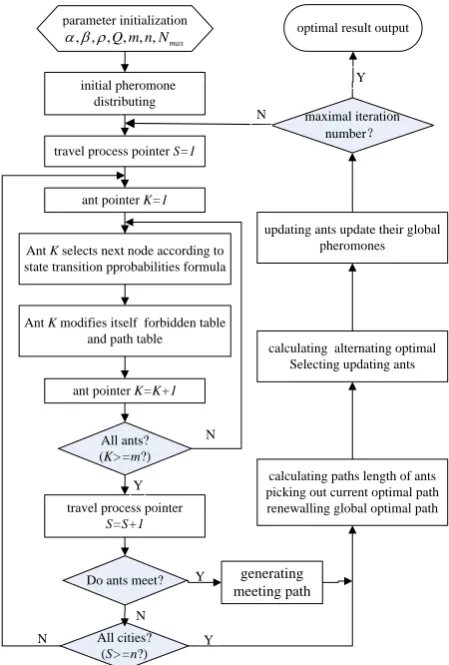
The flowchart of improved TWPSACO algorithm is shown as Fig.6.
IV. SIMULATION RESEARCHES
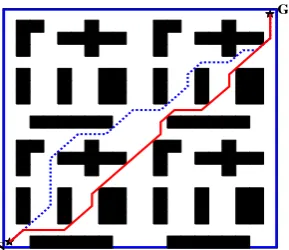
Simulation researches are made in two-dimension environment. Because ant-cycle model is used in this paper, basic parameters are set as follows: 1, 5 ,
1 0.5
,
2 0.5 referring to the conclusions obtained by DUAN Hai-bin in[35]. Other parameters are taken as1 2 30
m m ,Nmax 100, Q12, Q21, Q30.5,
0.05
, the starting point is
0.5, 0.5
, and the finishing point is
29.5, 29.5
. Simulation results are shown as follows.original improved
0 5 10 15 20 25 30 35 40 45 50 10
11 12 13 14 15 16 17 18 19 20
iteration times
e
v
a
lua
te
d
va
lu
e
o
f
o
pt
ima
l p
a
th
(b). Convergence curve of optimal path based on EVB-CT-GM
Figure 8. Convergence curves of optimal path in map 1
parameter initialization
, , , , , ,Q m n Nmax
travel process pointer S=1
ant pointer K=1
Ant K selects next node according to state transition pprobabilities formula
ant pointer K=K+1
All ants? (K>=m?)
Ant K modifies itself forbidden table and path table
travel process pointer
S=S+1
Do ants meet? Y
N
N Y
calculating paths length of ants picking out current optimal path renewalling global optimal path calculating alternating optimal
Selecting updating ants initial pheromone
distributing
updating ants update their global pheromones maximal iteration
number?
Y N
optimal result output
All cities? (S>=n?)
generating meeting path
Y N
Figure 6. Flowchart of improved algorithm.
S
G
(b). Path planning figure based on EVB-CT-GM.
Figure 7. Path planning figures in map 1
S
G
(a). Path planning figure based on common grids method.
original improved
0 5 10 15 20 25 30 35 40 45 50
10 11 12 13 14 15 16 17 18 19 20
iteration times
e
v
a
lu
a
te
d
v
a
lu
e
o
f o
p
ti
m
a
l
p
a
th
S
G
(b). Path planning figure based on EVB-CT-GM.
Figure 11. Path planning figures in map 3
S
G
(a). Path planning figure based on common grids method.
original improved
0 5 10 15 20 25 30 35 40 45 50 10
20 30 40 50 60 70
iteration times
e
v
a
lu
a
te
d
va
lu
e
of
o
p
ti
ma
l
pa
th
(a). Convergence curve of optimal path based on common grids method.
S
G
(a). Path planning figure based on common grids method.
S
G
(b). Path planning figure based on EVB-CT-GM.
Figure 9. Path planning figures in map 2
original improved
0 5 10 15 20 25 30 35 40 45 50 10
20 30 40 50 60 70
iteration times
e
v
a
lu
a
te
d
v
a
lu
e
o
f o
p
ti
m
a
l
p
a
th
(b). Convergence curve of optimal path based on EVB-CT-GM.
Figure 10. Convergence curves of optimal path in map 2
original improved
0 5 10 15 20 25 30 35 40 45 50 iteration times
30 40 50 60 70 90 100
e
v
a
lu
a
te
d
v
a
lu
e
o
f o
p
ti
m
a
l
p
a
th
80
(a). Convergence curve of optimal path based on common grids method.
original improved
0 5 10 15 20 25 30 35 40 45 50 iteration times
30 40 50 60 70 90 100
e
v
a
lu
a
te
d
va
lu
e
of
o
p
ti
ma
l
pa
th
80
(b). Convergence curve of optimal path based on EVB-CT-GM.
Simulation results show that the improved algorithm can find paths at higher convergence speed. In other words, global optimizing ability and search speed of improved algorithm are both enhanced obviously.
IV. CONCLUSIONS
ACO Algorithm is a colonial intelligence-optimized algorithm which is successfully applied to many problems, and applying it to path planning of mobile robot reflects the autonomy and intelligent of path planning of mobile robot. Primary TWPSS-ACOA is improved to overcome its defects and then the improved algorithm is used to path planning of mobile robot in this paper. Simulation results indicate that improved method has stronger robustness, better efficiency, and the optimal path can be obtained safely and rapidly even in complex environment.
ACKNOWLEDGMENT
The authors would like to thank the anonymous referees for their constructive and useful comments during the development stage of this paper. This work was supported by Chinese National Natural Science Foundation(60334010).
REFERENCES
[1] M.A. Porta Garcia, Oscar Montiel, Oscar Castillo, “Path
planning for autonomous mobile robot navigation with ant colony optimization and fuzzy cost function evaluation,”
Applied Soft Computing, vol. 9, pp. 1102–1110, Sep. 2009.
[2] J.M. Holland, Designign, Autonomous Mobile Robots:
Inside the Mind of an Intelligent Machine. United States: Newnes, 2004.
[3] Dhananjay Bodhale, Nitin Afzulpurkar, Nguyen Truong
Thanh, “Path Planning for a Mobile Robot in a Dynamic
Environment,” in Proc. of the 2008 IEEE Int. Conf. on
Robotics and Biomimetics, Thailand: Bangkok, 2008, pp. 2015-2120.
[4] Nohaidda Binti Sariff, Norlida Buniyamin, “Comparative
Study of Genetic Algorithm and Ant Colony Optimization
Algorithm Performances for Robot Path Planning in
Global Static Environments of Different Complexities,” in
IEEE Int. Symposium on Computational Intelligence in Robotics and Automation, South Korea: Daejeon, 2009, pp. 15-18.
[5] Khatib. “Real-time obstacle for manipulators and mobile
robot”, The International Journal of Robotic Research,
vol.1, pp. 90-98, 1986.
[6] Zhang Handong, Zheng Rui, Cen Yuwan. “Present Situation and Future Development of Mobile Robot Path Planning Technology”, Vol. 17, pp. 439-443, Feb. 2005.
[7] Meijuan Gao, Jingwen Tian, “Mobile Robot Global Path
Planning Based on Improved Augment Ant Colony
algorithm,” in Second Int. Conf. on Genetic and
Evolutionary Computing, USA: Piscataway, pp. 2008, 273-276.
[8] Joon-Woo Lee, Jeong-Jung Kim, “Improved Ant Colony
Optimization Algorithm by path crossover for optimal path
planning,” 2009 IEEE Int. Symposium on Industrial
Electronics, Korea : Seoul , 2009, pp. 1996-2000.
[9] Mustafa Doraid M., Tahboub K.K., “Mobile robot
trajectory planning using neural networks,” Int. J. of
Robotics and Automation, vol.18, pp.55-62, Feb. 2003.
[10]Hong Qu, Simon X. Yang, Allan R. Willms, Zhang Yi,
“Real-Time Robot Path Planning Based on a Modified
Pulse-Coupled Neural Network Model,” IEEE Trans. on
Neural Networks, vol.20, pp. 1724 – 1739, Nov. 2009.
[11]M. Gemeinder, M. Gerke, “GA-based path planning for
mobile robot systems employing an active search
algorithm,” Applied Soft Computing, vol.8, pp.149–158,
Mar. 2003.
[12]T. W. Manikas, K. Ashenayi, R. L. Wainwright, “Genetic
algorithms for autonomous robot navigation,” IEEE
Instrumentation & Measurement Magazine, vol.10, pp. 26-31, Jun. 2007.
[13]Vougioukas S., Ippolito M., Cugini U., “Path planning
based on accelerated simulated annealing,” in Proc. of the
1996 Research Workshop on ERNET - European Robotics Network, Singapore: World Scientific,1996, pp.259-268, 300.
[14]Lifeng Liu, Shuqing Zhang, “Three-dimensional flight path
planning by artificial immune algorithm,” in Sixth Int. Conf. on Natural Computation, Shandong: Yantai, 2010, pp.2876-2880.
[15]Lee Tsong-Li, Wu Chia-Ju, “Fuzzy motion planning of
mobile robots in unknown environments,” J. of Intelligent
TABLE I.
STATISTICS RESULTS OF THE ALGORITHMS IN THE MAP 1,2 AND 3 environment
map performance index
Based on common grids method Based on EVB-CS-GM
former algorithm improved algorithm former algorithm improved algorithm
Map 1
optimal path length 17.0711 15.0711 15.2532 14.6836
path inflexion number 7 7 6 3
running time 0.43214 0.42365 0.36378 0.30276
iteration times 17 15 17 14
optimal evaluating value 14.0498 12.6498 12.4772 11.1785
Map 2
optimal path length 30.9706 29.7990 30.0820 29.4931
path inflexion number 13 11 8 8
running time 0.8063 0.7625 0.75337 0.69763
iteration times 22 20 20 16
optimal evaluating value 25.5794 24.1593 23.4574 23.0452
Map 3
optimal path length 47.4558 45.1127 45.8610 44.6985
path inflexion number 19 17 12 12
running time 1.6656 1.5906 1.5806 1.5294
iteration times 43 39 40 33
and Robotic Systems: Theory and Applications, vol. 37, pp. 177-191, Feb. 2003.
[16]Gianluca Antonelli, Stefano Chiaverini, Giuseppe Fusco,
“A fuzzy-logic-based approach for mobile robot path
tracking,” IEEE Trans. on Fuzzy Systems, vol.15, pp.
211-221, Feb. 2007.
[17]I. A. Taharwa, A. Sheta and M. A. Weshah, “A mobile
robot path planning using genetic algorithm in static environment,” J. of Computer Science, vol.4, pp. 341-344, April 2008.
[18]Yuwan Cen, Choingzhi Song, Nenggang Xie, Lu Wang,
“Path Planning Method for Mobile Robot Based on Ant
Colony Optimization algorithm,” in 2008, pp. 298-301.
[19]Michael Brand, Michael Masuda, Nicole Wehner,
Xiao-Hua Yu, “Ant Colony Optimization Algorithm for Robot
Path Planning,” in Int. Conf. On Computer Design And
Appliations, pp. 436-440, 2010.
[20]V.Maniezzo, A.Colorni, M.Dorigo, “The Ant System
Applied to the Quadratic Assignment Problem,” Technical
Report IRIDIA, Bruxelles: Belgium, 1994, pp. 94-28.
[21]L.M.Gambardella, é.D.Taillard, M.Dorigo, “Ant colonies
for the QAP,” J. of the Operational Research Society, vol.
50, pp. 167-176, April 1999.
[22]A.Colorni, M.Dorigo, V.Maniezzo, M.Trubian, “Ant
system for job-shop scheduling,” Belgian J. of Operations
Research, Statistics and Computer Science, vol. 34, pp. 39-53, Feb. 1994.
[23]Xiao-lan Zhou, Jun ZHANG, Wei-neng Chang, “Research
on Job-Shop Scheduling Problem Based on Genetic Ant
Colony Algorithms,” in 2007 IEEE Congress on
Evolutionary Computation, USA: Piscataway, 2007,
1963-1969.
[24]Surekha P., P.RA.Mohanaraajan, S.Sumathi, “Ant colony
optimization for solving combinatorial fuzzy Job Shop
Scheduling Problems,” in Proc. of the Int. Conf. on
Communication and Computational Intelligence 2010, Erode: Kongu Engineering College, 2010, pp. 295-300.
[25]B.Bullnheimer, R.F.Hartl, C.Strauss, Applying the Ant
System to the vehicle routing problem. Dordrecht, Kluwer
Academic Publishers, 1999, pp. 285–296.
[26]LIU Zhishuo, SHEN Jinsheng, CHAI Yueting, “Vehicle
algorithm routing problem based on an adaptive ant colony
algorithm,” Control and Decision, vol. 20, pp. 562-566,
May 2005. (in Chinese)
[27]Guenther Fuellerer, Karl F. Doerner, Richard F.Hartl,
Manuel Iori, “Ant colony optimization for the
two-dimensional loading vehicle routing problem,” Computers
& OperationsResearch, vol. 36, pp. 655-673, Oct. 2009.
[28]Di Caro G., Dorigo M., “AntNet Distributed Stigmergetic
Control for Communications Networks,” J. of Artificial
Intelligence Research, vol. 9, pp. 317-365, 1998.
[29]SUN Yan, MA Huadong, LIU Liang, “An Ant-Colony
Optimization Based Service Aware Routing Algorithm for
Multimedia Sensor Networks,” Chinese J. of Electronics,
vol. 35, pp. 705-711, April 2007. (in Chinese)
[30]YUE Fu-zhan, CUI P ing -yuan, CUI Hu-tao, “Planetary
Rover Path-planning Based on Ant Colony Optimization
Algorithm,” Control and Decision, vol. 21, pp.
1437-1440, Dec. 2006. (in Chinese)
[31]TAN Guan-Zheng, HE Huan, SLOMAN Aaron, “Ant
Colony System Algorithm for Real-Time Globally Optimal
Path Planning of Mobile Robots,” ACTA AUTOMATICA
SINICA, vol. 33, pp. 279-285, Mar. 2007.
[32]Zhang Handong, Dong Baohua, Cen Yuwan, Zheng Rui,
“Application of path encoding novel mechanism based on
grids in path planning for mobile robot,” J. Huazhong Univ.
of Sci. & Tech. (Nature Science Edition), Vol.35, pp.50-53, Jan., 2007.
[33]ZHU Qingbao, ZHANG Yulan, “An ant colony algorithm
based on grid method for robot path planning,” ROBOT,
vol. 27, pp. 132-136, March 2005. (in Chinese)
[34]Ma Zhanshan, Krings, Axel W., “Is Chaos theory relevant
to reliability and survivability,” in Aerospace conference
2009, Vol. 3. USA. : IEEE Computer Society, 2009,
pp.1-10.
[35]DUAN Hai-bin, Theory and Application of Ant Colony
Algorithm. Beijing: Science Press, 2005.
Juanping A. ZHAO received the M.Sc. degree in control theory and application from Shenyang University of Chemical Technology, Shenyang, China, in 1996. Currently, she’s working towards her PhD in Northeast University, and is a lecturer in Shenyang University of Chemical Technology.
She has interest on the following topics: path planning of mobile robot, ant colony optimization (ACO) algorithm, intelligent control methods and their applications.
Xiuhui B. FU received the B.S. degree in automation and the M.Sc. degree in control theory and application from
Yanshan University, Qinhuangdao,
China, in 1986 and 1989, respectively. And then he received the Ph.D. degree from Shenyang Institute of Automation
Chinese Academy of Sciences,
Shenyang, China.
From Mar. 1989 to Jun. 1990, he was an engineer of electric control equipment plant of Jinzhou. In 1990 he joined Liaoning University of Technology, where he was an associate professor from 1990 to 1996. In May 1996, he has been with the faculty of Zhongxing Telecom Ltd.. In 2001, he was a Visiting Researcher of Nagoya university of Japan. Since July 2010, he joined Shenyang University of Chemical Technology, where he was an professor.