ISSN (e): 2250-3021, ISSN (p): 2278-8719
Vol. 08, Issue 7 (July. 2018), ||V (I) || PP 81-85
Identification and Risks Control Accidents the Implementation of
Construction High Rise Buildings
Intan Febriana Nur Hamida
1, Arief Rachmansyah
2, Yatnanta Padma Devia
21(M. Eng. Student, Department of Civil Engineering, Brawijaya University, Indonesia) 2
(M. Eng. Lecturer, Department of Civil Engineering, Brawijaya University, Indonesia) Corresponding Author: Intan Febriana Nur Hamida
Abstract:
The construction industry has unique properties and has different characteristics on each project. These properties and characteristics that make the construction insudtry become one of the industries that have a high level of accident risk. Based on data reports International Labor Organization (ILO) every day there are about 6,000 fatal workplace accidents in the world, so they need for identification and risk prevention. Prevention use to minimize the risk of accidents that can occur. Classification of risks that can be done based on the type of work. Data collection was done by distributing questionnaires through google form on 10 projects at PT.X. The collected data is used as primary data in this research. Based on the result of the test, 14 indicators of occupational accidents risk are found in medium level, while 47 other indicators are in low level. Risk control is performed with engineer risk control, administrative risk control, and risk control in self-protection equipment (PPE). Risk control is an effort to minimize the risk of occupational accidents, so as to reduce the level of accidents that can occur during project implementation.Keywords:
Construction industry, risk management, risk control--- Date of Submission: 22-06-2018 Date of acceptance: 07-07-2018 --- ---
I.
INTRODUCTION
The construction industry is one industry that has a relatively high level of accident risk. The construction industry is unique in nature and has different types for each project including its implementation methods, project character, materials used to different application techniques for the construction industry to have a relatively high level of occupational accident risk [7].As an illustration, the data of accident rate from PT. Jamsostek Year 2011 in Indonesia recorded 96,314 cases of work accidents, where there are 2,144 people died, 42 people with total disability. Based on data reports International Labor Organization (ILO) every day there are about 6,000 fatal workplace accidents in the world. In Indonesia accidents is experienced by 30% from every 100.000 workers [6]. Stakeholder project is an asset that must be protected in order to work properly and productively until the project is completed without any accidents. Labor needs protected from accidents and health in assurance [5]. Accident risk control is necessary to minimize the risk of accidents.
II.
MATERIAL AND METHODS
A. Risk Management
Occupational Accidents
Occupational accidents are accident related with work , that accidents occur due to work or during work, including accidents occurring on the way from home to work or vice versa [4]. From the statement there are two problems that occur that the accident is a direct result of the work, or accidents that occur while the work is being done
Accident Classification
Occupational accidents in general can be classified which include [2]: a. Classification of occupational accidents by accident type
1. Falling
2. Crushed falling objects
3. Pounded or exposed to objects unless objects fall 4. Squashed by objects
5. Movement beyond ability 6. Effect of extreme temperatures 7. Affected by electric current
International organization of Scientific
Research
82 | P a g e
b. Classification of occupational accidents by work environment1. Accidents that occur outside the building 2. Accidents in the building
3. Underground crash
A factor that poses threat to worker’s safety and healty, it has been proposed, among other very dangerous, dangerous and impractical [1].
Risk Identify
The major dimensions are the factors that exist to a level of detail and then determine the specification (potential) and its causes, through surveying and searching programs on existing issues [5]. Based on the results of research that has been done, the identification is grouped based on the causes and results of his work [3].
Risk Measurement
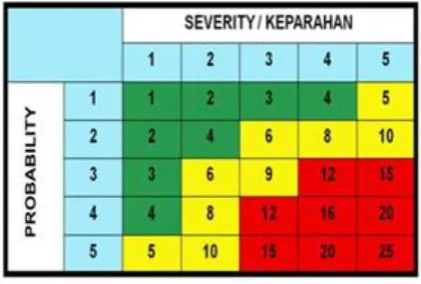
Measurement of risk assessment is to determine the level of risk based on the result of hazard identification that has been done [5]. A risk assessment can be made of a risk assessment matrix to be classified on each identified risk.
Figure no 1: OHS risk assessment matrix Information:
1-4 : Low risk (L) 5-10 : Medium risk (M) 12-25 : High Risk (H)
Risk Control
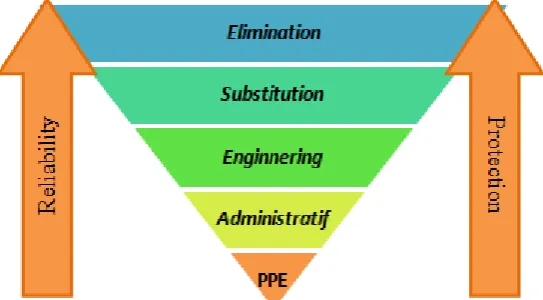
Risk assessment activities, the hierarchy of risk control is one of the things that must be considered. The selection of a risk hierarchy can determine the effectiveness and efficiency, so that risks can be minimized and can be a controlled in project implementation. Risk control plays a role in tackling and reducing the occurrence of risk from the lowest level to the highest level [6].
Hierarchy of risk control that is [4]:
a. Elimination
The top hierarchy is eliminating a dangerous material / stage, during design, the goal is to eliminate the possibility of human error in running a system due to a lack of design.
b. Substitution
This control method aims to subtitute materials, processes, operations or equipment from harmful to less harmful. With this control lowers the danger and minimal risk through system design or redesign.
c. Enginnering Control
This control is done formally to separate hazards with workers and to prevent humans. Teaching is done in a machine unit or equipment system.
d. Administratif Control
e. Personal Protective Equipment (PPE)
The selection and use of personal protective equipment is a matter of concern in hazard control. PPE serves to reduce the risk of hazard impact. PPE including, helmet, earplug / earmuff, gloves, mask, apron, eye protection, safety harnees, safety shoes, and face protection.
Figure no 2: The Hierarchy of Risk Control
B. Research Methods
Primary data collection through spreading questionnaire to 85 respondents at PT.X in Indonesia. Respondents in the research are Project Manager (PM), Site Manager (SM), estimator, supervisor, Quality Surveyor (QS), Quality Control (QC), and HSE division (HSE). Data analysis is done by assessing risk by means of risk assessment matrix. Then proceed with risk control in accordance with risk type and risk control hierarchy
III.
RESULT
3.1. Risk AnalysisRisk analysis is done by identifying risks based on their work on project activities. The research conducted there are 60 risk indicators based on the work done. The number of risk indicators for each job will be presented in Table 1.
Table No 1: The number of risks at each job
No. Type of work Number of
indicators
1 Saving logistics 8
2 Excavation work 7
3 foundation 5
4 Structural work 10
5 Mechanical Electrical Work 8
6 Roof Work 9
7 Architectural Work 10
8 Operational tools 5
60
3.2. Risk Assessment
In accordance with the results of risk identification, then risk assessment is based on the chance of a risk occurring and the impact caused by an accident. Risk assessment is based on the risk assessment matrix in accordance with Figure 1. The results of the risk assessment can be seen in table 2.
Table No 2: Risk Assessment Results
Level / risk rating Quantity
Low Risk 47
Medium Risk 14
International organization of Scientific
Research
84 | P a g e
In accordance with table 2, then the risk assessment at a Medium level will be described in table 3.Table No 3: Medium risk assessment
No. Item Risk
Assessment Opportunity Impact
1 Tool tripped 2 3 Medium
2 Stumble Material 2 3 Medium
3 Exposed to spark during welding 3 3 Medium
4 Hands / feet punctured iron
protruding 2 3
Medium
5 Hit by sparks during welding 2 3 Medium
6 Wounded by a saw when cutting a
pipe 2 4
Medium
7 Hands / feet are pinched during
electrical panel installation 2 3
Medium
8 Workers fall from a height 2 4 Medium
9 Scaffolding falls and affects
workers 2 4
Medium
10 Falling material from altitude and
overwriting workers 2 3
Medium
11
Respiratory disturbance due to exposed dust roof coverings and ceiling
2 3
Medium
12 Hearing loss when installing doors
or windows 2 3
Medium
13 Hearing loss during ceramic
cutting 2 3
Medium
14 Hands or feet injured by exposure
to the appliance 2 3
Medium
1.3.Risk Control
Risk control will be conducted accordance to risk control hazard in figure 2. In accordance with table 2 level of risk with a medium level can be minimized by controlling the engineer, administration, and use of PPE. Such control described such as:
a. Control of the engineer
Engineer control is controlled by managing the source of danger, where the source of danger is kept to a safe extent. In this study control include by:
Transferring dangerous materials and tools
To minimize the risk of tripping material or tools, it can be prevented by moving materials and tools to places where no workers trespassing
Tidy up and clean the location
After work in the project side, clean up the location from materials and tools that may harm other workers required.
b. Administrative control
Administrative control with administration in minimizing the source of risk, in this case control include by: Provision of signs
In areas where the dangerous work and iron bulge exist, it can minimize the risk of work-related iron accidents.
In locations that workers working on the ground, so workers will be cautious as they cross the site. Periodic maintenance of the device
The tools used during project execution should be carried out periodically, so there is no risk of equipment damage during implementation.
Counseling in the use of tools according to SOP
Counseling is so important that workers understand how the tool works and understand how to use it safely. Conducting safety induction, as well as safety talk before doing the job
International organization of Scientific
Research
85 | P a g e
Conducting partrol safetyIt is important to improve supervision and order of workers in the use of PPE when doing field work. Conduct OSH training for workers and parties involved in the project
c. Use of PPE
The use of PPE is the latest way to minimize the risks that can occur during construction projects. Controls with PPE may include:
Use of PPE in accordance with the work being done.
Workers performing welding work are required to wear face shields, so sparks do not affect the face. Workers working at altitudes are required to use safety belts, that is minimizing the risk of falling from a
height.
Workers who are doing ceramic cutting are required to use erarplug to prevent hearing loss while cutting. The use of masks in work can also reduce the risk of respiratory illness for workers who performing
painting, cleaning and other work.
Workers are always required to wear safety shoes, so they can protect themselves and minimize the risk of tripping, and stabbed when they are at the project site.
Workers are required to use helmets while at the project site.
Helmets can protect the head from falling objects, knock on runs, and etc.
Workers are required to use a working vest, because when the construction project location is turn dark, the workers will aware with other workers at the location and they be more careful.
The full use of PPE.
IV.
CONCLUSION
In accordance with the results of research that has been done then from 60 indicators there are 13 indicators included in the assessment of Medium risk. The risk assessment is done by means of risk assessment matrix. To mitigate risks risk control can be exercised based on the hierarchy of risk control, in which case the risks are controlled by means of complete engineer control, administration and use of PPE.
REFERENCES
[1]. Hola,B., Nowobilski,T., Szer,I., Szer,J. Identification of Factor Affecting The Accident Rate in the Construction industry. Procedia Engineering. 2017: 35-42.
[2]. International Labor Office. Guidelines on Occupational Safety and Health Management Systems (ILO-OSH). 2001
[3]. Palloan, D. Analisis Risiko Kecelakaan Kejra Pada Proyek Konstruksi Gedung Bertingkat Pada Proyek Konstruksi Gedung Bertingkat di Kota Makassar (Studi Kaus: Vida View Apartemen). 2016.
[4]. Rawis,T.D., Tjakra,J., Arsjad,T.Tj. Perencanaan Biaya Keselamatan dan Kesehatan Kerja (K3) Pada Proyek Konstruksi bangunan (Studi Kasus: Sekolah ST. Ursula Kota Moba Gu). Jurnal Sipil Statik. 2016;4(4):241-252.
[5]. Sucita, I.K., Broto, A.B. Identifikasi dan Penanganan Risiko K3 Pada Proyek Konstruksi Gedung (Studi Kasus Proyek Gedung Centro City Recidences). Poli Teknologi. 2011;10(1):83-92.
[6]. Nadhila,A.N., Wisnumurti, Devia,Y.P. Analisa Manajemen Risiko Keselamatan dan Kesehatan Kerja (K3) Pada Pembangunan Gedung Fakultas Pertanian Universitas Brawijaya.Jurnal Mahasiswa Teknik Sipil. 2018;1(1):128-133.
[7]. Yoon,S.J., Lin,H.K., Chen,G., Yi,S., Choi,J., Rui,Z. Effect of Occupational Health and Safety Management System on Work-Related Accident Rate and Differences of Occupational Health and Safety Management System Awareness Between Managers In South Korea’s Construction Industry.Safety and Health Work. 2013;4:201-209.