Investigation into Interoperability in Cloud Computing:
An Architectural Model
Susan Sutherland
*, Girija Chetty
University of Canberra, PO Box 148 Jamison Centre ACT 2614 Australia.
Manuscript submitted February, 2015; accepted May 31, 2015. doi: 10.17706/jcp.11.2.159-168
Abstract: This paper presents an architectural model that enables the convergence of the interoperability of Enterprise Architecture (EA), Service Oriented Architecture (SOA) and Cloud Services. As per the reviewed literature by the authors, there is a lack of research in this space of cloud computing. Hence the authors' research developed an innovative solution to provide a ‘plug and play’ architectural model to seamlessly connect the enterprise systems to cloud within the governance standards of enterprise architecture. The rest of the paper discusses the identified research problem and articulates the developed model while validating the model with a few use cases, and concluding that the research community could further validate the model with their respective application use cases.
Key words: Interoperability, cloud computing, service oriented architecture, enterprise architecture, architectural model.
1.
Introduction
This paper presents an innovative model for a problem identified earlier by Sutherland [1] that there is a gap in academic literature on the convergence of Cloud Services, Service Oriented Architecture (SOA) and Enterprise Architecture (EA). This research highlighted key emerging themes in the researched literature on the interoperability cloud computing. Such themes included market oriented architecture, interoperability and disruptive technology and identified the above gap while highlighting the significance of managing risks, return on investments and Service level agreements to transition to the cloud paradigm.
The need for standard based interoperability protocols for the convergence between EA and SOA is a requirement that has been also confirmed by scholarly research by Tang, Dong and Zhao [2]. Though there is an existence of convergence of interoperability in practice between cloud computing and SOA as researched from the published scholarly material by Wei and Blake, there is no such convergence of interoperability among EA, SOA and cloud services [3]. Several research works, including the seminal work by Raj and Periasamy identified the need to set up standard based interoperability protocols between and among the EA, SOA and the Cloud [4]. The underlying theme for this convergence to occur is to use interoperability standards and protocols as per the suggested model. Further work by Sutherland suggest that, interoperability focuses on the setting up of an agreed framework/technology that enables easy migration of integration of applications and data from between different cloud systems/vendors and also facilitates for secure data exchange and integration between and among platforms within an enterprise [5].
and who are also in the strategic management positions to either influence their respective Information Communications and Technology (ICT) strategies and/or have the decision making powers to deploy cloud computing. This survey provided an overview of the significance of interoperability in the process of migrating to cloud services along with the preferred services that the enterprises needed to migrate and their preferred vendors. The results confirmed that the enterprises will need to evaluate the cloud computing services on offer against their respective requirements to ensure all enterprise architectural aspects such as interoperability, data migration and security are addressed during evaluation. This survey also confirmed that interoperability is perceived as an issue when migrating to cloud computing as most enterprises prefer not to be challenged by vendor locking issues.
2.
Problem Discussed
The cloud APIs between vendors are not standardised as yet. While the Cloud Computing Interoperability Forum (CCIF) is working towards developing standards, the vendors are not stopping deployment. The issue of interoperability has become a significant factor in migrating to cloud services. Each Cloud provider has its own set of APIs to connect enterprises to cloud. Individual cloud vendor APIs have evolved over time with the respective vendor legacies and they are inherent in the vendor solutions of cloud services. Hence the significance of this research is that it identifies the current industry standards and services that will allow seamless interoperability between and among EA, SOA and Cloud Services
Lack of standard based APIs and protocols for interoperability between cloud vendors has a great impact on the enterprises where an enterprise has chosen a number of cloud suppliers to deploy its various cloud deployments. For example, an enterprise may deploy Google docs for its collaboration services including emails and another, such as MS Azure (http://www.microsoft.com/azure/servicebus.mspx), for its applications. As there is lack of standard based interoperability between and among cloud vendors, a given enterprise is unable to provide an integrated service to its downstream customers. It is the APIs and protocols that drive standard based interoperability between applications systems and cloud via enabling technologies such as SOA. While most of the researched literature [7] suggests the need for secure APIs and protocols for interoperability between the cloud vendors and the enterprise applications, the issue of interconnectivity is also a primary concern for the downstream customers of such enterprises. Hence the author’s research in progress has a focus on the secure interoperability of the convergence of cloud computing, enabling technology such as SOA, and enterprise applications.
Seminal work by Loutas, Kamateri, and Bossi [8] discusses the different security management standards such as Information Technology Information Library (ITIL) and International Standards Organisation (ISO). There are two other key works in progress on APIs and interoperability are DMTF’s Open Cloud Standards Incubator (OCSI) focus on building interoperability standards between different cloud vendor offerings, and the open cloud computing interface working group (OCCI-WG) develops practical specifications related to IaaS.
There are a number of areas that secure interoperability is of interest to vendors, customers, researchers, and the standards bodies. Some of these areas include secure interoperability between different cloud vendors such as between Microsoft Azure and Google Docs, secure based interoperability within a given cloud services, and secure interoperability between enterprise applications and cloud services.
However, this researched architectural model concentrates on the interoperability between enterprise applications to cloud and the interoperability of the convergence of EA, enterprise applications and the cloud services.
2.1.
Cloud Computing Reference Architecture Models
architectural framework, vendors differ in their architectural models/framework Examples of the different models and architecture include DMTF Cloud Service Reference Architecture, IBM Cloud Computing Reference Architecture, NIST Cloud Computing Reference Architecture, Cloud Security Alliance, CISCO Cloud Reference Alliance, and IEFT Cloud Reference Framework.
For the purpose of this research paper, NIST Cloud Computing Architecture framework as illustrated below will be used as a referenced point [9]:
Fig. 1. Source: NIST cloud computing/architecture.
The value in using reference architecture is that it provides a consistency in such aspects in terminology, deliverable and governance across an enterprise. This also enables sensible reuse of capabilities. Based on this reference, this research has developed a base architectural model for the convergence of EA, SOA and Cloud Services.
2.2.
Architectural Problem Being Addressed
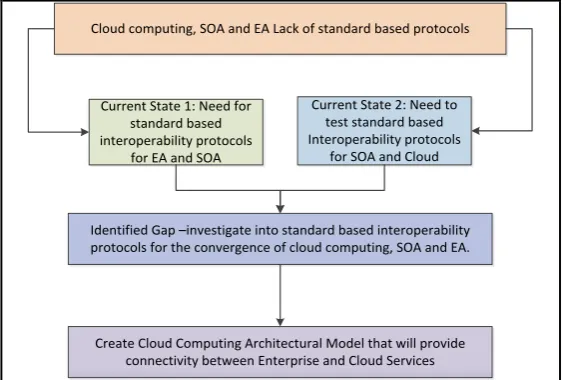
The Fig. 2 identifies gaps in the convergence of EA, SOA and Cloud Services illustrates the problems being addressed, namely, interoperability of EA and SOA; and secondly the integrated interoperability of EA, SOA and Cloud Services.
Cloud computing, SOA and EA Lack of standard based protocols
Current State 1: Need for standard based interoperability protocols
for EA and SOA
Current State 2: Need to test standard based Interoperability protocols
for SOA and Cloud
Identified Gap –investigate into standard based interoperability protocols for the convergence of cloud computing, SOA and EA.
Create Cloud Computing Architectural Model that will provide connectivity between Enterprise and Cloud Services
Fig. 2. Identified gaps in the convergence of EA, SOA and cloud.
3.
The Interoperability of Convergence Architectural Model/S:
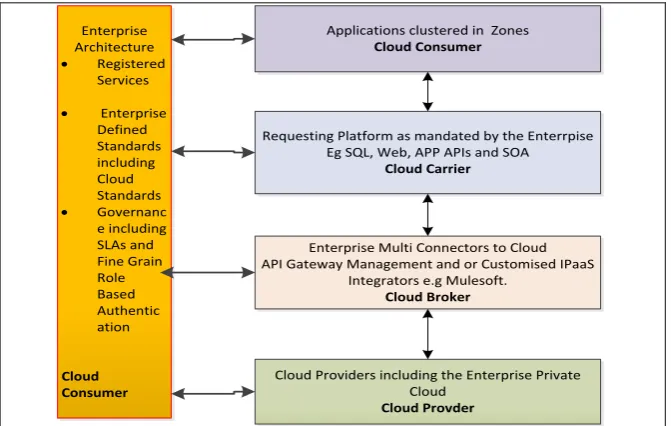
as illustrated in the figure below (Fig. 3) provide a plug and play model such that enterprises could use multiple vendors to deliver them with multiple cloud services at the same time ensuring to have a return on investment of the existing enterprise standards. Furthermore, this model will form a strong alignment with enterprise architecture and its framework.
Applications clustered in Zones Cloud Consumer Enterprise
Architecture · Registered
Services · Enterprise
Defined Standards including Cloud Standards · Governanc
e including SLAs and Fine Grain Role Based Authentic ation
Cloud Consumer
Requesting Platform as mandated by the Enterrpise Eg SQL, Web, APP APIs and SOA
Cloud Carrier
Enterprise Multi Connectors to Cloud API Gateway Management and or Customised IPaaS
Integrators e.g Mulesoft. Cloud Broker
Cloud Providers including the Enterprise Private Cloud
Cloud Provder
Fig. 3. Architectural model to allow multi connectors and multi-vendor.
3.1.
Components of the Architecture Model
This model utilises one vertical layer, namely EA which includes Registered Services and Standards Definitions and four horizontal layers namely, Application Zones, Requesting Platform e.g. SQL, SOA APIs and web services; and Cloud Providers.
3.1.1.
Enterprise architecture and services register
In this model, the Enterprise architecture supports the registration services which are basically an identified list of services that the enterprise uses to support it operations for the delivery of cloud services. These services need to be also registered with the cloud vendors as unless they are included in the Service Level Agreements with the Vendors and or unless they are also registered in the Enterprise Register of Services, services could not be released by a Cloud Vendor. Further conditions apply as where a service is required and is not in the SLA, it needs to be included in the SLA before it is released to the user; and where a service is not in the Register of Services and not in the SLA, it will need to be created and registered by the Enterprise Architect and then forwarded to the contracts department to register the services in the enterprise registry service and within the SLAs with the respective vendors.
3.1.2.
Enterprise architecture and enterprise defined standards including clouds
standards and enterprise defined services
The purpose of this component is to ensure that all standards defined by the EA are to be the standards used in the deployment of Cloud Services within the Enterprise irrespective of the vendors. This will ensure that the vendor standards are not imposing on the Enterprise architecture. The enterprise stipulates the standards that both the enterprise and cloud vendors use for delivery of cloud services within a given enterprise.
services which is linked with the service level agreement (SLA) for the agreed services with the vendor. A dynamic updates needs to occur between the enterprise and vendor services whenever the SLA gets updated with a new service
3.2.
Applications Zones
Enterprises that use self-managed Internet Gateway Services to manage the network traffic throughput also use the classifications for zoning applications that use same standards and protocols such as Web Applications, SQL Applications and SOA applications. A similar zoning is proposed for this research architecture model. This will provide a platform that will allow requests from a zone to go through the API Gateway Management Service or IPaas Integrator or the hub that utilises both the integrated services of API Gateway and IPaas.
3.3.
Requesting Platforms
The Requesting Platforms are based on Standards such as SQL, SOA and WEB. This research study focuses on the use of SOA as a component for the convergence of EA, SOA and Cloud Computing. SOA is an architecture that allows for the structuring of an application that goes through identification of a number of functional units which can be reused many times for the delivery of an application service. Web Services provide developers methods of integrating. With the emergence of cloud computing, researchers are finding a place for SOA in the transition of existing applications to cloud services. This no doubt will be leveraged by the protocols that emerged as part of the web 2.0 technologies, especially those that had been based on SOAP (simple object access protocol). SOAP is an XML (Extensible Mark-up Language) based on open source message transport protocol). SOA is also a business-driven IT architectural approach that supports integrating a business as linked, repeatable tasks or services.
The key technical concepts of SOA are services, interoperability, and loose coupling.
The services are built on the specific procedures, policies, and framework. The services are based on protocols and can be discovered and published and are independent of platform in a non-coupling manner. Blatzan, Lynch, & Blakely [10] summarise the protocols that are commonly used in a SOA environment which include universal Description, Discovery, and Integration, UDDI, the Web Services Description Language,
WSDL, SOAP is the Service Oriented Architecture Protocol, the Lightweight Directory Access Protocol or
LDAP , and extract, transform, and load, ETL.
In using SOA, the Enterprise Architecture also stipulates the governance component of the SLA including the fine grain authorisation – that is - a user upon authentication is automatically granted access to the services and the level of services. Variation of the access and access levels need to be authorised by the Chief Architect.
3.4.
Cloud Multi Connectors
In this research architectural model, in order for the convergence of the three to occur, the SOA needs to be the focal point of connection to the vendor cloud. SOA is a method of design, deployment, and the management of both applications and the software on the infrastructure where all software is organized into business services that are accessible and executable and where service interfaces are based on public standards for
interoperability (Blake & Wei [3]).
cloud have matured and there are two clear winners in terms of connecting to cloud. The two models being:
· A model using API Management Gateway;
· A model using IPaaS Integrator such as Mule soft or Informatics.
The authors further propose an integrated model of the above two where some of the applications could use both of these models while others only one.
3.5.
API Gateway Management
To achieve Cloud computing interoperability, the use of standardised API is of high importance. API management software can be built in-house or purchased as a service through a third-party provider like Mashery Inc., Apigee Corp. or C.A.’s Layers. API management software tools automate and control connections between an API and the applications that use it; ensure consistency between multiple API implementations; monitor traffic from individual applications; and protect the API security procedures and policies.
More specifically, the functionality can be leveraged from an API Management Gateway to convert enterprise application services into developer friendly Restful APIs. Application services associated with common SOA style generally employ SOAP protocol whereas Web devises rely on REST. The most effective API Management Gateway solutions will include functionality for presenting enterprises as Restful. This entails using SAO to convert protocols such as SOAP to Restful APIs. This is another significance of using of SOA.
Cloud APIs present a range of new and unique security challenges that go beyond what enterprises have been used to dealing when using Web technologies. However, traditional online security solutions do not cover all the potential threats created by cloud API publishing. As such, specific API protocols need to be implemented and supported by an API Gateway as per the requirements of the enterprise and hence the need for the researched architecture model to include the architectural layer of requesting platforms which includes the APIs to be used by an enterprise.
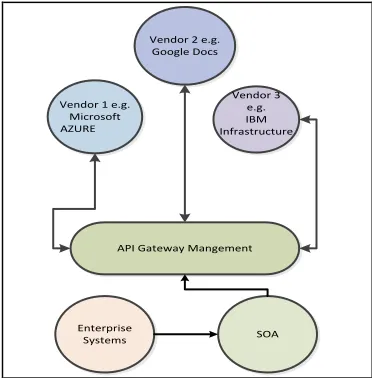
An API Management Gateway illustration below as in Fig. 4 is how this research envisages enterprises will connect to cloud:
Enterprise Systems
Vendor 3 e.g. IBM Infrastructure
API Gateway Mangement Vendor 2 e.g.
Google Docs
Vendor 1 e.g. Microsoft AZURE
SOA
Fig. 4. Logical view of API management gateway architecture.
3.6.
Model with Customised IPaaS Integrator Software
between a variety of connectivity protocols and data/message delivery, data/message mapping and transformation, data quality, routing, and adaptors for cloud based and on premises applications, data sources and technology,
Some industry literature suggests that the ebus architecture is the preferred method of connecting enterprise systems to cloud when using IPaaS integrators. However, there is no scholarly work that supports this. While IPaas integrators will provide seamless connection to multiple cloud vendors, it does lack the independence the enterprises could have if they created their individual gateway though there is the argument that the implementation of an IPaas integrator can be customised to maintain the enterprise standards and protocols. Hence the research model proposes mandatory use of requesting platform standards as stipulated by the Enterprise architecture; and the use of the customised IPaas integrator software such as Mule soft. Fig. 5 below illustrates a logical view of the use of IPaas integrator.
SOA Vendor 3 e.g. IBM Infrastructure
IPaaS Integrator Vendor 2 e.g.
Google Docs
Vendor 1 e.g. Microsoft AZURE
Enterprise Systems
Fig. 5. Logical view of IPaaS integrator architecture.
SOA Vendor 3
e.g. IBM Infrastructur
e
API Gateway
Vendor 2 e.g. Google Docs Vendor 1 e.g.
Microsoft AZURE
Enterprise Systems
IPaaS Integrator
Enterprise Hub
Fig. 6. An Enhanced Integrated Architectural Model of API Gateway and an IPaaS Integrator.
3.7.
An Enhanced Integrated Model Where the API Management Gateway and an IPaas
Model Based on Products such as Mules Soft
For this model to work, the zoning of applications is important as each zone can be allocated as to path it will follow, namely whether to go via the API Gateway and or via the IPaaS Integrator software. Hence the significance of the enterprise hub is to allow the applications to be directed to either the API Gateway or the IPaaS integrator while still maintaining the control on the requesting platform of standards to be used by the vendor. Figure 6 illustrates the logical view of this part of the model.
4.
Validation by Use Case
This research validates a number of use cases against the developed architectural model. A set of Cloud Computing Use Cases at www.cloudsusecases.org has been put out by the Cloud computing Use Case Discussion Group. Three of the key use cases stated this discussion group are:
· End user to cloud,
· Enterprise to cloud to end user,
· Enterprise to cloud to enterprise.
listed use cases against the developed model:
· End user to the cloud e.g. accessing email;
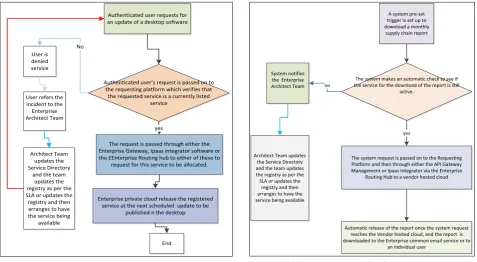
· Enterprise to Cloud to End user e.g. publishing updates on the user desktops; and
· Enterprise to Cloud to Enterprise e.g. Down loading a report from a Supply Chain System.
4.1.
Validation of the Use Case: Accessing Email
The use logs in to access
User is authenticated
Use request for email service is directed to Email
Zone
The request then passes through Requesting Platform
Tier
It then passes through the Broker
Tier User is granted
access to Email
Through to API Gateway to the Enterprise Cloud which is hosted by
the Enterprise.
Is authentication successful
yes
User seeks registration to
access email
No
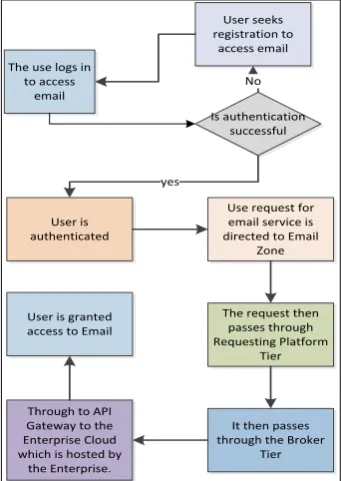
Fig. 7(a). End user to the cloud e.g. accessing email.
The diagram (Fig. 7(a)) illustrates how an end user is able to access an email from cloud, using the model
Requirements for this use case
The authentication service must be registered as a service being delivered by the enterprise private cloud. The user must be registered to have access to the email service.
All architecture components must be working such as the email zone, the requesting platform and the broker tier to enable the successful transmission of the request and the response.
4.2.
End-User to Cloud to End User e.g. Publishing Updates on the User Desktops
The Fig. 7(b) illustrates how an end user is able to access an email from cloud, using the model
Requirements for this use case
The user must be registered to request for this service.
The service must be registered in the Service Registry and in the SLA.
All architecture components must be working such as the email zone, the requesting platform and the broker tier to enable the successful transmission of the request and the response.
4.3.
Enterprise to Cloud to Enterprise e.g. Downloading a Supply Chain Report: A
Pre-set Service
The diagram (Fig. 7(c)) illustrates how an end user is able to download a supply chain report – a present service
Requirements for this use case
The service must be registered in the Service Registry and in the SLA.
All architecture components must be working such as the email zone, the requesting platform and the broker tier to enable the successful transmission of the request and the response.
Authenticated user requests for an update of a desktop software
Enterprise private cloud release the registered service at the next scheduled update to be
published n the desktop The request is passed through either the Enterprise Gateway, Ipaas integrator software or the EEnterprise Routing hub to either of these to
request for this service to be allocated.
End
Authenticated user’s request is passed on to
the requesting platform which verifies that the requested service is a currently listed
service User is
denied service
User refers the incident to the Enterprise Architect Team
Architect Team updates the Service Directory
and the team updates the registry as per the SLA or updates the registry and then arranges to have the service being
available No
yes
Fig. 7(b). Enterprise to cloud to end user e.g. publishing updates on the user desktops.
The system request is passed on to the Requesting Platform and then through either the API Gateway Management or Ipaas Integrator via the Enterprise
Routing Hub to a vendor hosted cloud A system pre-set trigger is set up to download a monthly
supply chain report
Automatic release of the report once the system request reaches the Vendor hosted cloud, and the report is downloaded to the Enterprise common email service or to
an individual user The system makes an automatic check to see if the service for the download of the report is still
active. System notifies
the Enterprise Architect Team
Architect Team updates the Service Directory and the team updates the registry as per the SLA or updates the
registry and then arranges to have the service being available
yes no
Fig. 7(c). Enterprise to cloud to enterprise e.g. downloading a supply chain report: A pre-set service.
5.
Conclusions: Summary of the Model Based Architectural Model for the Enterprise
Connection to Cloud Services
Current industry solutions via an API Management Gateway and or via the use of IPass Integrators do not provide a solution for the interoperability within an enterprise.
Hence the gap identified earlier that there is no proven academic literature to resolve the lack of seamless interoperability of cloud has been resolved. In revisiting the stated problem, this model validates the interoperation between EA and SOA to connect to cloud either via API Gateway, IPaas Integrator; or both API and IPaas Integrator . As such, this proposed researched model puts forth an architectural model that allows for the validation of the convergence of the three domains, namely EA, SOA and the Cloud Services. Hence, the research architectural model caters and supports the interoperation between EA and SAO; SOA and Cloud computing and the convergence of the above three.
Until further testing is carried out via use cases, it will be difficult to establish the cost of the provision of these services via this model. Thus this researched architectural model also provides an opportunity to the research community to validate their respective applications use cases and provide comments and feedback to the authors.
References
[1] Sutherland, S. (2013). Convergence of interoperability of cloud computing, service oriented architecture and enterprise architecture. International Journal of E-Entrepreneurship and Innovation, 4(1), 43-51 [2] Tang, L., Dong, J., Zhao, Y., & Zhang, L. J. (2010, July). Enterprise cloud service architecture. Proceedings
of 2010 IEEE 3rd International Conference on Cloud Computing (pp. 27-34).
opportunities. IEEE Internet Computing, 14(6), 72-75.
[4] Raj, P., & Periasamy, M. (2011). The convergence of enterprise architecture (EA) and cloud computing.
Cloud Computing for Enterprise Architectures, 61-87. Springer London.
[5] Sutherland, S. (2014). Secure APIs and protocols to connect enterprise applications to cloud services.
Proceedings of Informing Science & IT Education Conference (pp. 323-336).
[6] Sutherland, S., & Chetty, G. (2014). Migration to cloud computing: a sample survey based on a research in progress on the investigation of standard based interoperability protocols for the convergence of cloud computing, service oriented architecture and enterprise architecture. Int. J. Inf. Process. Manag, 5(1), 50-61.
[7] Lewis, G. A. (2013, January). Role of standards in cloud-computing interoperability. Proceedings of 2013
46th Hawaii International Conference on System Sciences (pp. 1652-1661).
[8] Loutas, N., Kamateri, E., & Bossi, F. (2011) Cloud computing interoperability: The state of play. Proceedings of Third IEEE International Conference on Cloud Computing Technology and Science.
[9] The NIST definition of cloud computing (draft). NIST special publication 800: 145.
[10]Blatzan, P., Lynch, K., & Blakely, P. (2010). Business Driven Information Systems. McGraw Hill Australia Pty Ltd.
Susan Sutherland has post graduate qualifications in IS., business administration and education. She has worked in large and complex enterprises both public and private. Her experience includes operational and at strategic levels and has worked on the mainframe, midrange and desktop applications systems; and infrastructure and networks. Her infrastructure and network experience includes implementations of X.500, X400 and X435 standards. She has also consulted in migrating applications to Web 2.0. She was part of a team that implemented an internet security gateway service for a large government department. She had pioneered the deployment of the internet in the Australian government. She is interested in the deployment of bleeding edge technologies and their migration and integration into mainstream computing. Hence her motivation to undertake this research study in cloud computing interoperability is a natural progression of her previous work.
Girija Chetty has bachelor and master degrees in electrical engineering and computer science from India, and PhD in information sciences and engineering, from University of Canberra Australia.
She has more than 25 years of experience in Industry, Research and Teaching from Universities and Research and Development Organizations from India and Australia, and has held several leadership positions including head of Software Engineering and Computer Science, and course director for Master of Computing (Mainframe) Course. Currently, she is an associate professor, and the head of the Multimodal Systems and Information Fusion Group in University of Canberra, Australia, and leads a research group with several PhD students, Post Docs, research assistants and regular international and national visiting researchers.