A Wavelet Neural Networks License Recognition
Algorithm and Its Application
Pan Yonghui
Department of Computer Science, Jiangyin Polytechnic College, Wuxi, China, 214405 Jiangsu Engineering R&D Center for Information Fusion Software, Jiangsu Jiangyin, China, 214405
Email: [email protected]
Fan Rui
Department of Computer Science, Jiangyin Polytechnic College, Wuxi, China, 214405 Email: [email protected]
Abstract— Using wavelet transform to handle auto-mobile image with complex background for license localization, then preprocess license characters on vehicle licenses, and extracting the textural features of license characters in wavelet space, this paper proposed a novel algorithm for vehicle license localization and character recognition which is based on adaptive wavelet neural networks. Firstly, it uses the wavelet transform to preprocess color vehicle image into index image which undergoes wavelet transform to obtain wavelet feature coefficients. Secondly, license position could be located through morphological operation. Thirdly, it extracts the features of localized license characters in wavelet space which is presented to the wavelet neural network as inputs. At last, an adaptive wavelet neural network based on wavelet transform is constructed to recognize license characters. Experimental results demonstrate that the proposed approach could efficiently be used as a vehicle license characters recognition system with high convergence, which is robust for size, license-color and background complexity.
Index Terms—license localization, character recognition, wavelet transform, feature extraction, wavelet neural network
I. INTRODUCTION
Since vehicle images are usually photographed in complex background influenced by various illuminations, it’s rather difficult to detect license plate and recognize characters therein. Therefore, it’s becoming a key issue as to how to accurately locate vehicle license region and recognize license characters. With the anticipation to resolve the above-mentioned problem, people have conducted various researches and proposed numerous license localization and character recognition algorithms,
most of which are based on the different features of the vehicle license.
Among these algorithms, the relatively matured are listed as follows: structural pattern recognition uses the rich structural information of characters to extract textural feature as recognition norm [1-3]. Statistical pattern recognition extracts a group of statistical features of the license characters, then classifies it by decision functions according to some rules [4-5]. Combination-based algorithms generally integrate advantages of both statistical and structural recognition algorithms, and enable themselves to process various and even more complicated patterns [6-7]. Artificial neural network is an adaptive non-linear dynamic system by stimulating the structure of human brain cells, which is composed of tremendous inner-connected neural. It achieves classification and recognition for data by adjusting connected-weights between nets [8-10]. Fuzzy neural network, as an integration of fuzzy systems and neural networks, is rapidly being developed to handle with fuzzy information [11-12].
Although current vehicle license localization and character recognition algorithms have been exploited in practical appliances, the recognition accuracy is still not high enough for real time supervising vehicle. In this paper, a novel algorithm of license localization based on wavelet transform and character recognition based on adaptive wavelet neural network is proposed, which can greatly improve the accuracy of license localization and character recognition.
The principle of license localization can be stated as follows: first to transform the color vehicle image into index image which then undergoes wavelet transform. So we can further analyze the wavelet coefficients of LH sub-band. Secondly, wavelet coefficients can be classified into two groups through dynamic threshold, which was obtained through the mean, energy and entropy of the coefficients of LH sub-band. By applying morphological operations, these two clusters form two areas: license candidates and non-license candidates. At last, the detected license candidates undergo the empirical
Supported by the Opening Project of Jiangsu Engineering R&D Center for Information Fusion Software (No.SR-2011-03), sponsored by Qing Lan Project of Jiangsu Province.
rules to identify license areas and project profile to refine their location.
And the procedure of license character recognition is: firstly a binary process is applied to the extracted license gray image, whose result will then be transformed into the corresponding index image. And the index image will also undergo a wavelet transform to obtain high frequency sub-bands (LH, HL, HH). Secondly, features of the wavelet coefficients such as the mean, energy, entropy can be worked out, and a dynamic threshold will be obtained through these features. The big wavelet coefficients will be reserved through the threshold. Then wavelet coefficients of each sub-bands will be projected horizontally and vertically to extract a group of statistical features of license character. At last, with the obtained character feature vector, the wavelet neural network will recognize it correctly.
The paper is organized as follows. Section II presents the individual steps of our approach for license localization. Section III presents the procedure for license characters recognition. Section IV discusses the experiment results. In the final section, the conclusions are given.
II. LICENSE LOCALIZATION
In this section, the processing steps of license localization are presented. Our aim is to build an automatic license detection system which is capable of handling automobile image with complex background, little slope, arbitrary size and color. From Fig. 1 we can see that the proposed approach is mainly performed by four steps: wavelet transform, texture feature extraction, license candidates detection, license localization, which will be described in detail as follows.
Input Color Image
Index Image
HL LH HH
Feature
Extraction Classification Wavelet
Transform
Background License Candidates License Block
Identification License Location
Figure 1. Flow chart of license localization
A. Wavelet Transform of the Image
Vehicle license plate (VLP) in china is mainly composed of about 50 Chinese characters, 26 English capitalization characters and 10 Arabian figures, and the font of the VLP is stable. A VLP consists of about 7 characters and forms a rectangle which ratio of width and height is 4:1. Text is mainly made up of the strokes in horizontal, vertical, up-right, up-left direction. It has weak and irregular texture property, and can be done as a special texture. Texts in the same VLP often have the same color, and contrast clearly with the background which also has the same color. There are “blue background white character”, “yellow background black character”, “black background white character” and “white background black character”, and so forth. So the edge information of the VLP is abundant. These texture properties and color features are combined to locate VLP
in vehicle images. Firstly, we convert the color vehicle image into indexed image. Then on the indexed image a wavelet transform is applied to capture coefficients of respective sub-bands.
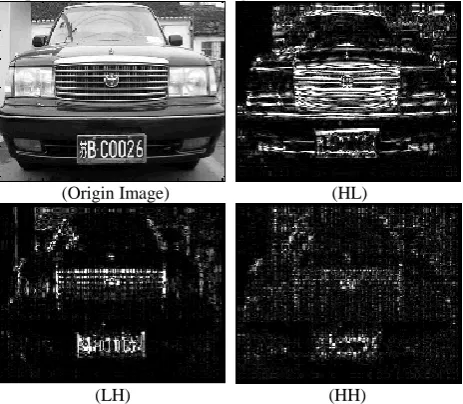
The main characteristic of wavelet transformation is to decompose a signal into sub-bands at various scales and frequencies, which is useful to detect edges with different orientations. In the 2-D case, when the wavelet transform is performed by a low filter and a high filter, four sub-bands are obtained after filtering: LL (low frequency), LH (vertical high frequency), HL (horizontal high frequency) and HH (high frequency). In the three high-frequency sub-bands (HL, LH, HH), edges in horizontal, vertical and diagonal directions were detected [13]. Since license area is commonly characterized by high contrast edges, high valued coefficients can be found in the high-frequency sub-bands. From Fig. 2 we can see it.
(Origin Image) (HL)
(LH) (HH)
Figure 2. Wavelet coefficients of vehicle image
B. License Feature Extraction
As we know, the shape of license is a horizontal rectangle. There are about 7 characters and 20-25 pieces of high contrast, dense edge information in a license area. From Fig. 3 we can see it. So high valued coefficients can be found in the vertical high frequency sub-bands (LH) and the coefficients form a dense block.
Figure 3. Edge information of license
wi h
j
j
i
I
h
w
f
1 1
1
1
,
. (1)
wi h
j
j
i
I
h
w
f
1 1 2
2
1
,
. (2)
i
j
I
i
j
I
f
j i
,
log
,
,
3
. (3)
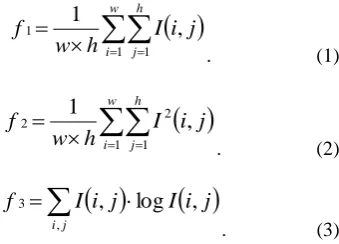
Where, I is the license, w is the width of the image, h is the height, and (i, j) is the pixel position in the image. The dynamic threshold is computed using (4).
m m m
a
f
K
. (4)Where Km is the threshold in various situations, am is the respective coefficient of Km, and fm is the statistical features of (1), (2), (3), and, m=1,2,3,4. To accelerate the computation speed, the statistical feature of mean and energy is chosen to capture the dynamic threshold. From Fig. 4 we can see the filtered wavelet coefficients (LH, HH).
(LH) (HH)
Figure 4. Wavelet coefficients after filtered
C. License Candidates Detection
When we detect the license in the image, it could be assumed that the vehicle image is composed of two clusters: license area and background. Seen from Fig. 4, high valued coefficients can be found in the vertical high frequency sub-bands (LH) and the coefficients form a dense block. Firstly, a binary process is applied to the remained coefficients of LH sub-band. Then two morphological operations “dilation” and “open” are applied to the transformed image (LH sub-band). The result can be seen from Fig. 5 (a). Finally, a sliding window of size k×l pixels is moved over the transformed image to discard small isolated objects as background and reserve the corresponding license candidates [15-17]. The results of the license candidates were shown after morphological operation in Fig. 5 (b).
D. License localization
License localization is mainly performed by three steps based on some empirical knowledge:
Step 1, the algorithm of region growing is used to compute the ratio of width, height and areas of all license candidates. If the ratio or areas is too big or small, we think the candidate is background and discard it.
(a) LH on dilate and fill operation (b) LH on open operation
Figure 5. Wavelet coefficients after morphological operation
Step 2, according to the stable property of the couples of license characters and background, such as “blue background white character”, “yellow background black character”, “black background white character” and “white background black character”, we apply C-means algorithm to cluster the pixels of all license candidates based on color-couple [18-19], and compute the pixel number of every cluster.
Step 3, almost all of the position of the license in a vehicle image is lower than half of the image height. We can compute the height of the license candidate from itself to the bottom of the vehicle image to locate the license.
If any of the above steps locates the license, then license detection task has been accomplished.
The rules are noted as follows:
--- the ratio of width and height of license candidates (t): t1< t < t2
--- the areas of license candidates (s): s1 < s < s2 --- the pixel number of clusters based on color couple (c): c > c1
--- the height of license candidates in vehicle image (h): h < h1
Here, t1, t2, s1, s2, c1, h1 is respective threshold for the above rules. According to experiments, they are appropriate as noted in Table I.
TABLE I. PARAMETERS OF EMPIRICAL RULES
t1 t2 s1 s2 c1 h1
2 5 1000 8000 s/2 H/2
In Table I, H is the height of vehicle image.
If the license candidate does not satisfy the rules, it is considered to be a non-license area. On the contrary, the candidate is license if it satisfies the rules. Finally, the license undergoes a project profile analysis to refine the license location.
III. LICENSE CHARACTER RECOGNITION
wavelet neural network training, which will be described in detail in Fig. 6.
Transform Wavelet License
Index Image
HL LH HH
Feature Extraction
Wavelet Neural Network License
Character Recognition License
String
Figure 6. Flow chart of license character recognition
A. License Character Feature Extraction
As we know, the shape of license is a horizontal rectangle. There are about 7 characters and each is made up of the strokes in horizontal, vertical, up-right, up-left directions. So, a wavelet transform is applied to the extracted license index image to capture coefficients of respective sub-bands. Then high valued coefficients of the character edge can be found in the high-frequency sub-bands [20]. We can see it from Fig. 7.
(Origin Image) (HL)
(LH) (HH)
Figure 7. Wavelet coefficients of vehicle license image
We also can filter the low valued coefficients through a dynamic threshold to retain the higher valued coefficients which can best represent the feature of license characters edge. Here, we also employ the statistical features in mean, energy and entropy on the transformed vehicle license image to capture the dynamic threshold [21-22]. Equation (4) is used to compute the dynamic threshold. From Fig. 8 we can see the filtered and binary wavelet coefficients (HL, LH, HH) of character image “5”.
(Origin) (HL) (LH) (HH)
Figure 8. Wavelet coefficients after filter of character image “5”
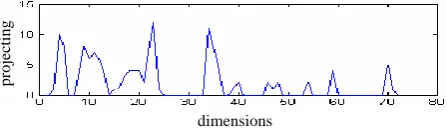
By vertically projecting high-frequency HL, horizontally projecting LH, both vertically and horizontally projecting HH, the statistical features of the character “5” can be captured. Here, we assume the size of the character is 21 ×15, therefore, each character forms a 72 dimensions feature vector. From Fig. 9, we can see it.
dimensions
p
ro
je
ct
in
g
Figure 9. Projecting statistical features of binary wavelet coefficients of character “5”
B. Designed wavelet neural network
Adaptive wavelet neural network is a neural network model based on the theory of wavelet transforms and neural networks. It uses linear base to replace non-linear activation function in general neural networks, and integrates the merits of wavelet transforms and neural networks.
In this paper, an adaptive wavelet neural network is proposed to recognize the license characters. We can see it in Fig. 10. It looks for a group of proper wavelet bases in the wavelet feature space, and adjusts wavelet parameters adaptively to minimize the value function through network learning [23].
.
.
.
.
.
.
.
.
.
1
j
1
y
i
y
1
x
k
x
2
x
morlet
sigmoid
layer
input hiddenlayer outputlayer
Figure 10. Adaptive wavelet neural network model
Equation (5) is applied in the designed wavelet neural network to recognize vehicle license characters.
)]
(
)
(
[
)
(
1 1
j j m
k k J
j i i
a
b
k
t
x
t
y
. (5)
Where, xk(t) is k input variables, yi(i=1,2,…,n) is i'th output, j is the node number of the hidden layer. Weight function, from the k'th node of input layer to the j'th node of hidden layer, is the wavelet function ψ((k-bj)/aj). Here, wij is the connection weights from the j'th node of hidden layer to the i'th node of output layer, σ is Sigmoid function. wij, aj and bj are training parameters of wavelet neural network [24-25]. Since vehicle license is mainly composed of about 50 Chinese characters, 26 English characters and 10 Arabian figures, the node number of output layer must be more than 8. Considering the training speed and feature vector dimension of single license character, the numbers of neural nets in input layer, hidden layer and output layer are respectively k, j and i. Each number is shown in Table II.
TABLE II. NEURAL NUMBER IN WAVELET NEURAL NETWORK
input layer(k) hidden layer(j) output layer(i)
72 10 10
C. Wavelet neural network training
that the total number of input samples is p0, thus the energy function is (6).
0 1 1 2)
(
)
(
2
1
p p n i p i pi
t
y
t
g
E
. (6)
Suppose n0 is number of iterations, in order to accelerate the convergence speed and avoid the training vibration, a momentum constant α is introduced. Therefore, the update equation about weights can be (7), (8), (9). ) ( ) ( ) 1 ( 0 1 0 0 1 n a E n a n
a j
j
. (7)
) ( ) ( ) 1 ( 0 1 0 0
1 b n
b E n
b n
b j j
. (8)
)
(
)
(
)
1
(
0 0w
n
0w
E
n
w
n
w
ij ij ijij
. (9)
Where, η is the predefined step length. It becomes the general gradient algorithm when α equals zero. Thus, we have the training algorithm of parameters wij, aj and bj as follows:
Algorithm: Wavelet Neural Network Training
Input: weights set
w
kji for each layer, input sample setX, target sample set G
Output: weight w'kji for each layer
begin
foreach wkji, aj, bj do wkji, aj, bj random(0,1) end
foreach xk∈X, gi∈G do xk, gi normalize end
while E>expected threshold do foreach layer do
layer-output=compute(node,X, wkji, aj, bj) end
0 1 1 2)
(
)
(
2
1
p p n i p i pi
t
y
t
g
E
forlayer input hidden do
Δwkji, Δaj, Δbj =grad(morlet,E) wkji, aj, bj = wkji, aj, bj +Δwkji, Δaj, Δbj end
forlayer hidden output do
Δwkji=grad(sigmoid,E) wkji = wkji +Δwkji end
end end
IV. EXPERIMENTAL STUDIES
A. Vehicle license localization
In order to evaluate the proposed license localization algorithm, a dataset of 200 vehicle images was obtained in various backgrounds. We preprocess all the images into nearly 200000 pixels (500×400) depending on the original image size to save computation costs. A bior3.7 wavelet was applied to transform the vehicle image. From Table III, we can see the value scope of threshold coefficients am in (4). Parameters k=60 and l=20 are introduced to scan the image, since the size of license candidate is more than that of the rectangle of 60×20.
TABLE III. SCOPE OF THRESHOLD COEFFICIENTS
1
a
a
2a
35-10 1.5-3 10-18
After processed by step 1 of license localization, the accuracy of license localization is very high. And the accuracy is nearly 100% with processing of step 2 & 3. The accuracy of once localization is 96%. Further more, a color segmentation based on color feature of license is proposed. It made the accuracy of license localization amount to 99.6%. In this paper, the once accuracy of the license localization approach based on wavelet transform is nearly 98%. The further accuracy of license localization is amount to nearly 100%.
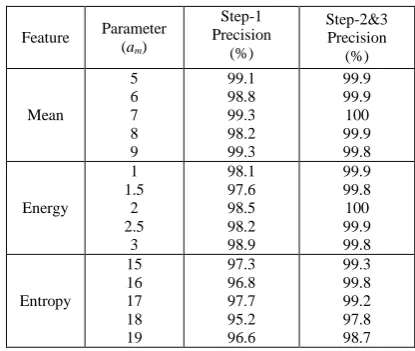
The experimental results tested by the feature of mean, energy and entropy can be seen in Table IV. It demonstrates, on license localization, the accuracy and robust of our algorithm is far better than that of any other algorithm.
TABLE IV. DETECTION RESULTS BY DIFFERENT FEATURE IN VARIOUS THRESHOLD COEFFICIENTS
Feature Parameter (am)
Step-1 Precision (%) Step-2&3 Precision (%) Mean 5 6 7 8 9 99.1 98.8 99.3 98.2 99.3 99.9 99.9 100 99.9 99.8 Energy 1 1.5 2 2.5 3 98.1 97.6 98.5 98.2 98.9 99.9 99.8 100 99.9 99.8 Entropy 15 16 17 18 19 97.3 96.8 97.7 95.2 96.6 99.3 99.8 99.2 97.8 98.7
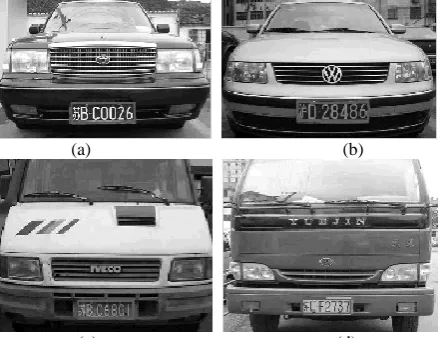
character” license of white car with background of building site, and the size of license is 149×35. Fig. 11 (c) shows a “blue background white character” license of white bus with background of parking center, and the size of license is 94×25. Fig. 11 (d) shows a “yellow background black character” license of truck with background of road, and the size of license is 105×26. The experimental results demonstrate the proposed approach is robust for the different color, size, illumination and background of vehicle license.
(a) (b)
(c) (d)
Figure 11. Experimental results of license localization
B. License character recognition
A dataset of 50 vehicle license plates was used to evaluate the proposed license character recognition algorithm described above. To save the computation costs, we preprocess all the license character images into the size 21×15. Depending on the original image size, using a proper wavelet to extract character feature is helpful for license character recognition, therefore, a bior wavelet from 1.1 to 3.7 was applied to transform all the license characters. Then the corresponding feature vector is extracted through the mean of wavelet coefficients. Assuming that the threshold coefficient am is 2, the feature vector of license “苏BC0026” in wavelet space under bior 1.1 and bior 2.8 are listed in Table V.
TABLE V. CHARACTER FEATURES OF “苏BC0026”
Wavelet Char Km Wavelet Feature(Hex)
bior 1.1
苏 6.42
0 7 9 3 5 6 0 0 3 3 6 9 4 9 5 9 A2 8 4 2 6 6 1 3 1 0 8 7 6 C 7 A3 4 0 1 2 3 2 6 1 11 1 4 1 8 7 4 7 8 1 0 2 0 3 8 6 5 5 4 B 2 7 3 3 6 1 3 0 0
B 7.36
0 1 0 3 6 1 3 8 8 5 A6 4 2 C 1 1 1 2 3 1 0 0 5 1 0 9 D 1 5 3 5 3 7 4 0 1 0 0 1 0 4 2 6 4 2 7 0 0 4 2 4 2 5 0 6 6 4 0 8 4 6 0 C 5 2 0 3 2 6 0 0
C 6.17
1 0 4 0 1 0 2 0 0 0 1 5 9 0 1 4 0 0 1 0 0 0 0 4 2 2 D0 0 1 0 3 2 0 0 0 0 6 7 1 1 1 0 0 1 0 3 1 1 0 0 0 0 1 0 8 0 0 1 0 0 2 0 1 0 1 0 8 0 1 1 0
0 6.72
1 1 6 4 7 1 5 4 1 0 0 2 3 0 5 1 2 2 6 3 1 0 3 1 1 7 5 7 6 4 5 1 0 1 1 0 4 0 1 7 3 7 0 1 1 0 0 2 0 1 0 5 0 1 0 5 A0 1 3 1 2 5 0 0 0 0 5 1 1 3 1
0 4.65
0 8 8 5 3 0 0 0 0 0 0 0 0 1 0 0 5 7 7 1 0 0 2 3 2 3 1 1 1 3 3 9 7 1 A0 1 1 5 3 8 1 0 0 0 4 1 0 0 0 0 1 0 0 5 1 0 1 0 1 1 A1 1 0 0 7 2 1 1 0 0
2 4.18
06 D0CC00 58476311153843B8 5 3 1 1 0 0 1 0 4 4 7 3 0 1 0 0 5 1 0 0 8 2 1 0 0 0 0 0 1 3 1 1 1 0 0 8 7 1 1 0 1 0 3 1 0 0 1 3
6 5.72
0 C 8 4 9 0 1 0 3 7 9 6 5 8 1 1 4 7 6 9 7 5 9 7 8 8 6 0 0 0 0 1 8 6 8 F 0 1 0 0 2 1 0 0 1 0 1 0 1 1 0 0 2 1 4 D3 1 1 1 4 5 9 6 0 0 1 1 2 1 0 1
bior 2.8
苏 5.21
0 D 8 4 4 3 0 1 3 1 4 8 4 6 9 7 9 3 2 3 1 1 3 1 1 0 0 2 3 6 3 8 D0 3 1 0 1 0 0 4 0 6 0 1 5 3 1 4 0 1 7 3 0 0 0 2 3 0 1 9 6 4 8 5 3 2 5 9 0 2 1
B 4.19
0 2 8 1 0 1 0 3 3 4 5 C 2 3 5 3 1 0 1 1 1 2 4 0 4 1 3 4 5 3 2 9 3 2 1 0 2 0 0 0 0 7 3 1 A0 7 1 0 3 2 5 1 0 1 1 3 8 7 6 0 1 1 1 5 3 1 8 3 2 1 0
C 3.84
0 1 6 2 0 0 3 0 5 0 5 C 8 3 3 0 2 0 1 0 1 0 1 1 0 1 8 1 1 1 2 0 1 0 21 0 1 3 9 A1 1 C 1 1 5 1 0 1 0 1 0 0 1 1 2 3 1 0 1 C 2 1 0 4 2 0 1 2 1 0
0 6.72
1 0 8 3 5 9 2 1 0 1 0 0 0 6 3 2 4 7 3 1 1 0 1 1 0 8 5 8 6 3 4 0 2 4 1 0 1 0 A7 3 1 0 1 1 6 1 0 0 2 1 0 0 0 0 1 3 2 1 0 0 1 0 2 9 0 1 C 1 8 1 0
0 4.93
0 4 3 I5 0 1 1 0 0 1 0 0 2 1 0 4 8 0 1 1 0 2 0 12 4200 C961 AD1 010 5210 3001 0 0 0 2 1 0 1 6 2 1 0 1 0 9 8 1 6 3 1 0 4 0 1 0
2 3.65
1 8 4 9 8 0 0 2 1 9 5 4 C 3 0 0 1 2 7 4 5 2 4 1 0 0 0 1 0 0 1 1 6 2 2 D2 8 3 4 2 0 3 0 3 1 0 1 1 2 0 1 1 4 5 0 1 0 0 0 2 8 3 A0 0 1 0 0 1 1 0
6 3.11
0 2 9 8 1 0 0 1 0 8 3 1 3 0 0 2 0 3 0 1 1 7 B 8 3 5 1 0 1 0 1 0 0 3 8 C 2 1 0 3 1 3 0 0 0 1 0 1 2 0 0 0 1 3 0 1 9 2 2 0 1 0 3 3 2 B 0 1 0 1 0 0
In the same way, the feature vector of license “苏 BHC055” in wavelet space under bior 1.1 and bior 2.8 are listed in Table VI.
TABLE VI. CHARACTER FEATURES OF “苏BHC055”
Wavelet Char Km Wavelet Feature(Hex)
bior 1.1
苏 9.10
0 6 1 3 0 0 5 0 1 3 0 6 1 5 2 0 3 1 5 2 0 0 0 0 4 A9 4 6 0 3 C 4 1 0 0 0 2 0 0 0 0 40 1 1 0 4 0 5 2 0 2 0 3 1 0 0 0 0 3 4 4 1 2 0 3 4 3 1 0 0
B 5.18
0 7 0 2 0 0 0 2 6 2 0 2 1 1 0 0 0 5 0 5 0 0 0 5 0 E 1 1 0 0 4 7 0 3 6 0 0 0 0 2 0 0 0 2 4 2 0 2 1 1 0 0 0 5 0 2 0 0 0 4 0 2 1 1 0 0 4 2 0 3 4 0
H 6.09
0 2 2 0 0 0 0 0 0 0 0 2 0 0 0 0 0 0 0 1 0 0 0 F F 2 1 0 0 0 0 0 1 1 0 0 0 2 2 0 0 0 0 0 0 0 0 2 0 0 0 0 0 0 0 1 0 0 0 0 2 2 1 0 0 0 0 0 1 1 0 0
C 3.85
0 2 3 4 0 0 2 0 0 0 0 0 0 0 0 2 0 2 2 1 6 0 E 2 0 0 0 0 0 0 0 0 0 0 5 3 0 0 0 0 0 0 2 0 0 0 0 0 0 0 0 0 0 0 1 0 0 0 0 1 0 0 0 0 0 0 0 0 0 0 1 1
0 5.32
0 3 3 6 0 1 0 0 0 0 0 0 0 0 0 0 0 4 0 4 0 0 C 0 0 2 1 1 1 0 0 C 3 1 5 0 0 1 1 4 0 1 0 0 0 0 0 0 0 0 0 0 0 1 0 2 0 0 0 0 0 2 1 1 1 0 0 0 2 1 2 0
5 3.78
0 0 2 C 0 0 0 0 4 6 0 6 0 0 0 1 0 5 0 2 2 0 B 7 0 0 0 0 0 0 0 0 0 0 6 6 0 0 2 3 0 0 0 0 0 3 0 3 0 0 0 0 0 3 0 0 0 0 4 5 0 0 0 0 0 0 0 0 0 0 4 1
5 4.83
0 2 4 A0 0 0 0 5 6 0 0 0 0 0 4 0 3 3 2 7 0 0 4 0 6 3 0 0 0 4 5 5 0 5 A0 1 3 3 0 0 0 0 4 3 0 0 0 0 0 2 0 3 2 2 1 0 0 2 0 4 3 0 0 0 2 3 3 0 5 2
bior 2.8
苏 5.30
06 A1 A5621575 573 A22671576 9 6 C 1 0 1 A9 9 2 4 0 0 0 2 0 5 0 10 5 1 0 0 1 5 1 9 0 1 3 4 0 5 2 5 4 4 1 0 4 0 5 2 1 3 2 0
B 5.04
0 8 8 8 5 0 0 5 8 6 7 2 2 1 0 1 5 5 4 8 0 0 F7 2 1 C 2 1 0 6 9 8 4 D0 0 1 1 4 4 0 01 5 2 1 1 3 1 0 2 1 2 1 4 0 0 0 3 1 1 1 2 1 0 5 4 4 3 9 0
H 6.11
0 1 2 0 0 0 0 0 0 7 1 6 6 0 0 0 0 0 0 6 0 0 0 F 1 F0 0 0 0 0 FE 3 F0 0 3 3 0 0 0 0 0 0 3 0 0 0 0 0 0 0 0 0 4 0 0 0 1 2 4 0 0 0 1 1 0 1 2 1 0
C 4.22
0 5 9 4 9 1 4 4 0 0 0 0 0 0 0 6 2 6 5 3 8 0 D4 4 F3 0 0 2 2 9 6 3 7 4 0 1 6 3 4 0 2 2 0 0 0 0 0 0 0 4 1 2 3 4 2 0 0 3 4 7 1 0 0 2 1 3 2 3 5 3
0 5.14
0 4 6 5 9 0 0 0 0 0 0 0 0 0 0 0 3 5 7 9 0 0 D3 2 E11133 DD1E0014 371100000 0 0 0 0 1 3 2 3 0 0 2 4 3 1 2 0 0 4 2 1 1 1 5 0
5 4.14
0BA1B00454676203595840A5 2 8 4 0 0 0 5 8 7 4 8 6 0 0 1 1 3 0 0 0 3 3 2 3 0 1 0 1 1 5 4 4 1 0 0 6 2 6 0 1 0 0 5 4 2 2 3 2
5 4.32
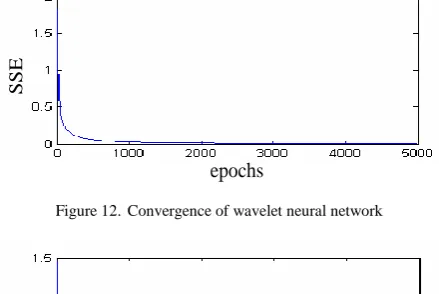
After extraction of license character features, the feature vector is used to train the designed wavelet neural network. The adaptive wavelet neural network proposed in this paper is a single-layer network with wavelet functions as the activation functions. It’s weights and hidden layer bias is also respectively replaced by the scale and frequency parameters of morlet wavelet function. That is to say, the activation function is wavelet function base. And a connection is constructed between wavelet transform and neural network through affine transform. Assume that the momentum constant α is 0.5 and the iteration number of network training is 5000, after initialing network weights of w, a and b, Fig. 12 demonstrates the convergence of the designed wavelet neural network. Fig. 13 demonstrates the convergence of the general BP network for the same input/output samples. It is obvious that the convergence of wavelet network is faster than general BP network's.
epochs
S
S
E
Figure 12. Convergence of wavelet neural network
epochs
S
S
E
Figure 13. Convergence of general BP neural network
By numerous experiments, comparison of convergence on average between wavelet network and general BP network is presented in Table VII.
TABLE VII. CONVERGENCE COMPARISON OF GENERAL BP
NETWORK AND WAVELET NETWORK
Epochs SSE of BP Network SSE of Wavelet Network
5000 3.675 0.689
10000 1.979 0.427
15000 1.357 0.342
20000 1.073 0.303
25000 0.923 0.276
30000 0.836 0.237
35000 0.804 0.218
We used 50 vehicle licenses as experiment data, 40 vehicle licenses as training samples and 10 vehicle licenses as the test samples. We find out the proposed algorithm can recognize the training license characters by 100% and also can predict non-training license characters accurately with the percentage of 98.7%.
V. CONCLUSIONS
In this paper, a novel algorithm based on adaptive wavelet neural network is presented for license character recognition. The detailed working process is expressed as follows: first to transform the color vehicle image into index image, then the index image will undergo wavelet transform to obtain high frequency sub-bands (LH, HL, HH). Secondly, features of the wavelet coefficients such as the mean, energy, entropy can be worked out, and a dynamic threshold will be obtained through these features. Thirdly, license candidates and non-license candidates were obtained by applying morphological operations. Fourthly, the extracted index license image will also undergo a wavelet transform to obtain high frequency sub-bands. And the bigger wavelet coefficients will be reserved through the threshold and undergo normalize process. Fifthly, the useful wavelet coefficients of each sub-bands will be projected horizontally and vertically to extract a group of statistical feature of license character. At last, with the input of character feature vector, the wavelet neural network will recognize it correctly. The experimental results with various kinds of the vehicle images demonstrate that the proposed method is effective to recognize license character automatically in a vehicle image. It is robust for license size, license color, background complexity and various illuminations.
The algorithm is executed at a computer of P4-2G, 1G taking nearly 0.6 seconds. So it needs to improve the calculation speed. To test the effectiveness of the approach proposed in this paper, we apply license localization algorithm in the moving vehicle images to locate the license, and also apply character recognition algorithm in generally printed character recognition. The experimental results are satisfactory. It is found that the proposed algorithm also meets difficulties in few vehicle images with strong variational illumination, badly distortion and some character images with strong complicated color and weak edge information. In addition, the linear combination and non-linear combination of mean, energy and entropy can be used to capture the threshold, which will optimize the algorithm and improve the accuracy of license localization and character recognition. For these shortcomings, these problems need to be tackled in future researches.
REFERENCES
[1] J. L. Liu, J. T. Song, L. Y. Ding, H. Q. Ma and P. H. Li, “Vehicle license plate recognition system with high performance,” Acta Automatica Sinica, vol. 29, pp. 457-465, 2003.
alignment,” Systems and Computers in Japan, vol. 38, pp. 49-61, 2007.
[3] M. Cinsdikici, A. Ugur and T. Tunali, “Automatic number plate information extraction and recognition for intelligent transportation system,” The Imaging Science Journal, vol. 55, pp. 102-113, 2007.
[4] K. Deb, S. J. Kang and K. H. Jo, “Statistical characteristics in HIS color model and position histogram based vehicle license plate detection,” Intel Serv Robotics, vol. 2, pp. 173-186, 2009.
[5] Z. X. Chen, C. Y. Liu, F. L. Chang and G. Y. Wang, “Automatic license-plate location and recognition based on feature salience,” IEEE Transactions on Vehicular Technology, vol. 58, pp. 3781-3785, September 2009. [6] Y. P. Huang, C. H. Chen, Y. T. Chang, and F. E. Sandnes,
“An intelligent strategy for checking the annual inspection status of motorcycles based on license plate recognition,” Expert Systems with Applications, vol. 36, pp. 9260-9267, 2009.
[7] T. Jain, S.N. Singh and S.C. Srivastava, “Recognition of vehicle license plates from a video sequence,” IAENG International Journal of Computer Science, vol. 36, pp. 26-33, 2009.
[8] J. B. Jiao, Q. X. Ye and Q. M. Huang, “A configurable method for multi-style license plate recognition,” Pattern Recognition, vol. 42, pp. 358-369, 2009.
[9] S. M. Youssef and S. B. AbdelRahman, “A smart access control using an efficient license plate location and recognition approach,” Expert Systems with Applications, vol. 34, pp. 256-265, 2008.
[10]T. D. Chen, “License-plate recognition using DWT and neural network,” International Journal of Wavelets, Multiresolution and Information Processing, vol. 4, pp. 601-615, 2006.
[11]C. N. E. Anagnostopoulos, I. E. Anagnostopoulos, V. Loumos and E. Kayafas, “A license plate-recognition algorithm for intelligent transportation system applications,” IEEE Transactions on Intelligent Transportation Systems, vol. 7, pp. 377-392, 2006. [12]S. L. Chang, L. S. Chen, Y. C. Chung and S. W. Chen,
“Automatic license plate recognition,” IEEE Transactions on Intelligent Transportation Systems, vol. 5, pp. 42-54, 2004.
[13]W. Huang, L. Xiaobo and X. J. Ling, “Wavelet packet: based feature extraction and recognition of license plate characters,” Chinese science bulletin, vol. 50, pp. 97-100, 2005.
[14]D. J. Kang, “Dynamic programming-based method for extraction of license plate numbers of speeding vehicles on the highway,” International Journal of Automotive Technology, vol. 10, 2004, pp. 205-210, 2009.
[15]J. M. Guo and Y. F. Liu, “License plate localization and character segmentation with feedback self-learning and hybrid binarization techniques,” IEEE Transactions on Vehicular Technology, vol. 57, pp. 1417-1424, 2008. [16]W. J. Jia, H. F. Zhang and X. J. He, “Region-based license
plate detection,” Journal of Network and Computer Applications, vol. 30, pp. 1324-1333, 2007.
[17]J. J. Liaw, L. H. Chang and L. H. Fang, “A simple car license plate detection method in the real time video
system,” WSEAS Transactions on Information Science and Applications, vol. 4, pp. 1169-1174, 2007.
[18]V. Abolghasemi and A. Ahmadyfard, “An edge-based color-aided method for license plate detection,” Image and Vision Computing, vol. 27, pp. 999-1006, 2009.
[19]K. Deb and K. H. Jo, “A vehicle license plate detection method for intelligent transportation system applications,” Cybernetics and Systems, vol. 40, pp. 689-705, 2009. [20]N. Kharma, R. Ward, “A novel invariant mapping applied
to hand-written Arabic character recognition,” Pattern Recognition, vol. 34, pp. 2155-2120, 2001.
[21]A. H. Hassin, T. Xianglong, L. Jiafeng, “Printed Arabic Character Recognition Using HMM,” Journal of Computer Science & Technology, vol. 19, pp. 538-543, 2004. [22]A. M. Sarhan, “A Comparison of Vector Quantization and
Artificial Neural Networks Techniques in Typed Arabic Character Recognition,” International Journal of Applied Engineering Research, vol. 4, pp. 805-817, 2009.
[23]T. Jain, S. N. Singh, S. C. Srivastava, “Adaptive Wavelet Neural Network-based Fast Dynamic Available Transfer Capability Determination,” IET generation, transmission & distribution, vol. 4, pp. 519-529, 2010.
[24]S. Yilmaz, “Fuzzy Wavelet Neural Network Models for Prediction and Identification of Dynamical Systems,” IEEE Transactions on Neural Networks, vol. 21, pp. 1599-1609, October 2010.
[25]A. Banakar, M. F. Azeem, “Artificial Wavelet Neural Network and Its Application in Neuro-Fuzzy Models,” Applied Soft Computing, vol. 8, pp. 1463-1485, 2008.
Pan Yonghui was born in Jiangyin, Jiangsu Province, China, on August 24, 1972. He received the B.S. degree of physics education and the M.S. degree of physics electronics from Nanjing Normal University, Nanjing, China, in 1996 and 1999 respectively, and the Ph.D. degree of information technology from School of Information Technology, Southern Yangtze University, Wuxi, China, in 2008.
He is currently working as a teacher of Jiangyin Polytechnic College, Jiangyin, China. Since 2010 he has been working as the Dean of Jiangsu Engineering R&D Center for Information Fusion Software. His research interests include image processing, intelligence computation and fuzzy system.
Fan Rui was born in Wurumuqi, Xinjiang Province, China, on August 4, 1972. She received the B.S. degree of computer technology & application from Tianjin Institute of Textile Science and Technology, Tianjin, China, in 1995, and the M.S. degree of computer application technology from School of Computer Science & Technology, Soochow University, Suzhou, China, in 2008.