INTERNATIONAL REVIEW OF HUMANITIES AND SCIENTIFIC RESEARCH By International Scientific Indexing
ISSN (Online) : 2519-5336 www.irhsr.org
IMPACT OF SCHOOL-BASED FEEDING PROGRAM ON THE PHYSICAL
GROWTH, ACADEMIC PERFORMANCE, AND SOCIAL DEVELOPMENT OF
STUDENTS IN HOLY SPIRIT ELEMENTARY SCHOOL, QUEZON CITY
Dr. Gregorio A. Reyes
Asst. Prof. Ma. Lolita V. Abecia Polytechnic University Of The Philippines, [email protected]
---ABSTRACT
Introduction
Research has shown that nutrition is important for cognitive and brain development; therefore, making
healthy food choices becomes vital to a student’s academic performance. Adverse effects of
malnutrition on the cognitive functioning of children are well documented around the world, in particular, the negative effect of under nutrition (Averett and Stifel, 2007; Alaimo et al., 2001; Kaestner and Grossman, 2009 and Taras, 2005). In-school meals provide an important nutritional intervention during an often overlooked critical growth period. By providing food at school during the school day, they have two advantages. First, well-timed school meals alleviate short term hunger, possibly
improving students’ ability to concentrate and learn. Second, they provide an incentive for school
attendance directly to the child (Caldes and Ahmed 2004). Therefore, the impact of in-school meals on learning appears to operate boththrough improvements in school attendance and through better learningefficiency while in school. Thus, well-run programs that provide reasonably nutritious meals should have positive impacts on school participation, learning, and child dietary intake. However, the size of these effects depends on various programmatic and contextual factors. In some cases, they may be small or even null.
To determine the impact of the in-school feeding programs, researchers hope to measure the difference in the outcomes that can be attributed to the presence of the program, or the causal impact. This measurement requires comparing outcomes for beneficiaries of a program to the counterfactual—what those outcomes would have been had these beneficiaries not participated in the program. All evaluation strategies are designed to find a method for constructing a proxy for these counterfactual outcomes from information on non-beneficiaries. Most empirical findings suggest that school feeding programs have a positive impact on learning achievement, as measured by increases in test scores and on dropout rates.
According to the 2007 Food and Agriculture Organization’s (FAO) estimate, 923 million people in the world were chronically hungry, which was an increase of about 75 million people from the 2003-05 estimates (FAO 2008).Many of these are children, and a vast majority of them are in developing countries. These numbers suggest that the Millennium Development Goals related to hunger and malnutrition may not be met by 2015. The persistence of hunger, malnutrition, and micronutrient deficiencies can have long lasting effects on the health status and productivity of people and their nations. Early malnutrition can adversely affect physical, mental, and social aspects of child health, which in turn leads to underweight, stunted growth, lowered immunity, and mortality. Research has shown that the physical effects of malnutrition as measured by indicators such as body mass index
(BMI) have a significant impact on an individual’s productivity.
The Department of Education (DepEd) recognizes the importance of good nutrition for the improvement of academic performance of learners. It is considered to be sound investment in education as it is associated with increased enrolment, improved attendance, better performance, decreased repetition and decreased dropout. Hence, DepEd proposed in the 2014 Budget a School-Based Feeding Program (SBFP) that will cater to a targeted 562,262 severely wasted (SW) school children in Kinder to Grade 6 nationwide. The proposal was approved but the budget was lodged with the Department of Social Welfare and Development (DSWD) as President Benigno Aquino Directed the DSWD to implement a national feeding program that will cover the daycare center pupils and the school children.
2 2 2 2
2
INTERNATIONAL REVIEW OF HUMANITIES AND SCIENTIFIC RESEARCH By International Scientific Indexing
ISSN (Online) : 2519-5336 www.irhsr.org
Study Context
Nutritional and health status are powerful influences on a child’s learning and on how well a child
performs in school. Children who lack certain nutrients in their diet (particularly iron and iodine), or who suffer from protein-energy malnutrition, hunger, parasitic infections or other diseases, do not have the same potential for learning as healthy and well-nourished children. Weak health and poor nutrition among school-age children diminish their cognitive development either through physiological changes or by reducing their ability to participate in learning experiences - or both.
Poor nutrition and health among school children contributes to the inefficiency of the educational system. Children with diminished cognitive abilities and sensory impairments naturally perform less well and are more likely to repeat grades and to drop out of school than children who are not impaired; they also enrol in school at a later age, if at all, and finish fewer years of schooling. The irregular school attendance of malnourished and unhealthy children is one of the key factors in poor performance. Even temporary hunger, common in children
Who are not fed before going to school, can have an adverse effect on learning. Children who are hungry have more difficulty concentrating and performing complex tasks, even if otherwise well nourished. Research and program experience shows that improving nutrition and health can lead to better performance, fewer repeated grades and reduced drop out.
According to Del Rosso (1999), the following are the ways on how school feeding programs can improve educational quality and efficiency: alleviate short-term hunger in malnourished or otherwise well-nourished schoolchildren. This helps to increase the attention and concentration of students producing gains in cognitive function and learning. Then, motivate parents to enrol their children in school and have them attend regularly. When programs effectively reduce absenteeism and increase the duration of schooling, educational outcomes (performance, dropout, and repetition) improve. Next, address specific micronutrient deficiencies in school-age children. Most important of these are iodine and iron, which directly affect cognition. Meeting the iron and iodine needs of school-age children can translate into better school performance. Lastly, increase community involvement in schools, particularly where programs depend on the community to prepare and serve meals to children. Schools with their communities behind them are more effective than schools with less community involvement.
The Philippines has a Medium Term Philippine Food and Nutrition Plan (MTPFNP). This has also been referred to as the Philippine Plan of Action for Nutrition (PPAN), which serves as the country’s
blueprint for nutrition improvement. The current PPAN covers the period 1999-2004. The PPAN is an integral component of the Medium Term Development Plan for the Philippines. The NNC is the main policy-making body for nutrition and is responsible for formulating the MTPFNP/PPAN. A distinct feature of the PPAN is the systematic collaboration of national government agencies, local government units, NGOs and the business sector. The PPAN uses existing organizational structures at the national and sub national levels for the implementation, monitoring, and evaluation of nutrition interventions.
the coordination of planning, funds release, implementation, monitoring and evaluation of nutrition programs. Technical assistance is provided to the NNC Governing Board by the Technical Committee, which also facilitates interagency communication and coordination. The NNC Technical Committee is composed of representatives from government departments and agencies, the academe (University of the Philippines at Los Baños), and NGOs. The NNC also has a Council Secretariat that advises the Governing Board on matters related to food and nutrition policies, programs, and projects, as well as providing technical, financial, and logistical support to local governments and agencies for the development and implementation of nutrition programs and projects. At the local level, local nutrition committees, chaired by local chief executives, serve as the planning and coordinating body at the local level. A designated Nutrition Action Officer assists the local chief executives on matters and activities related to nutrition and food. At the barangay level are the frontline community-based or volunteer workers who provide basic nutrition-related services that include growth monitoring and promotion, promotion of home and community food production, and the conduct of nutrition education activities, among others (NNC, 1995).
Objectives
This study aim to determine the Impact of the School-Based Feeding Program on the Physical, Mental, and Social Development of the students at Holy Spirit Elementary School, Quezon City. Specifically, this study sought to answer the following questions:
1. How do the respondents assess the Development of their children in terms of the following:
1.1 Physical; 1.2 Mental; 1.3 Social?
2. Is there any significant difference in the physical aspects, academic performances, and behavioral status of the students according to the assessment of the respondents when they are grouped according to age, gender, and occupation?
Hypothesis of the Study
There is no significant difference in the physical aspects, academic performances, and behavioral status of the students according to the assessment of the respondents when they are grouped according to age, gender, and occupation.
Theoretical Framework
The potential impact goal of targeting children through feeding program is to increase their educational achievement so as to improve their potential future productivity. However, improvement in educational achievement due to serving food in SBFPs is thought to occur through three pathways. First, SBFP help students to improve their physical condition by means of involving them in the said educational program. This leads to the alleviation of short term hunger which improves children’s cognitive
INTERNATIONAL REVIEW OF HUMANITIES AND SCIENTIFIC RESEARCH By International Scientific Indexing
ISSN (Online) : 2519-5336 www.irhsr.org
Improved in Students School Performance
- Increases the number of school enrolment and attendance
- Lessen the number of student’s drop-out
- Help students to become more engaged in class
Improved in Social Development
- Helps children to become more approachable and sociable
- Reducing the stress on students
Improved in Physical Development
- Increase students Body Mass Index (BMI)
- Lessen the number of students who get sick
improving the student’s performance inside the class which makes them more active and cooperative
during class discussion. The third path is improving the student’s mental and social attributes which
helps children to become more sociable and friendly among others.
Relationship between SBFP and potential outcomes and impacts on school children.
Source: Adapted from Grantham-McGregor et al. (1998) and Jacoby et al. (1998).
Conceptual Framework
This study conceptualizes the impact of School Based Feeding Program to the Physical, Mental, and Social Development of Elementary Children.
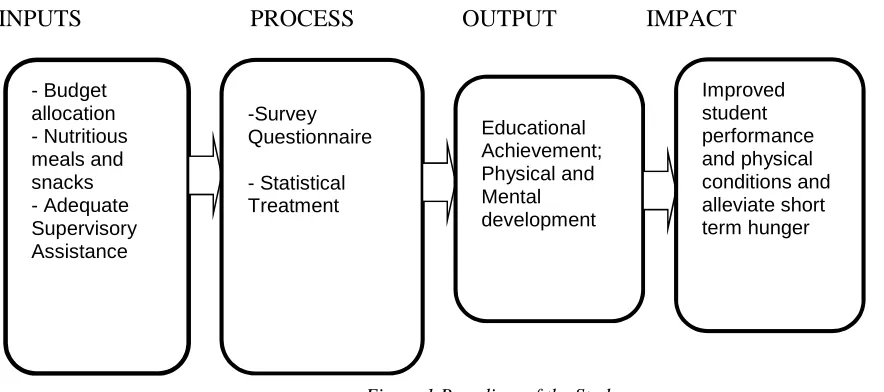
INPUTS PROCESS OUTPUT IMPACT
Figure 1 Paradigm of the Study
The Researchers used the IPOI method to show the flow of process that was used in gathering data. As shown in the input, the variables were derived from theoretical framework in this study, it consists of Budget allocation, Nutritious meals and snacks and Adequate Supervisory Assistance.
SCHOOL- BASED FEEDING PROGRAM
Achievement in
The next process contained the survey-questionnaire (Researcher made questionnaire) as a research instrument in gathering data, and also statistical treatment which was given by Statistician to calculate the result from the data gathered.
After gathering and calculating the data, the researchers’ expected a result onEducational Achievement; Physical and Mental development as the outcome of the study.
Lastly, the impact showed an improved student performance and physical conditions and alleviate short term hunger.
Methodology
The Descriptive-Survey method of research was used in this study. According to Estolas and Boquiren, the descriptive research is a study that can obtain facts about existing conditions or detach significant relationship between current phenomena. It describes and interprets prevailing condition or relationship that exists or do not exists, practices that prevail or do not, beliefs or points of view or attitude that are held, processes that are going on or otherwise, effects that are being felt, or trends that are developing. Dr. Y.P. Aggarwal (2008) defined descriptive-survey research as: “a type of
research method that is concerned not only with the characteristics of individual but with the characteristics of the whole sample thereof. It provides information useful to the solutions of local issues (problems). Survey may be qualitative or quantitative in verbal or mathematical form of expression; such studies are factual and hence supply practical information.
Data Generation
INTERNATIONAL REVIEW OF HUMANITIES AND SCIENTIFIC RESEARCH By International Scientific Indexing
ISSN (Online) : 2519-5336 www.irhsr.org
Results and Discussion 1. Profile of the Respondents
Table 1
Frequency and Percentage Distribution of the Respondents According to Age, Sex, and Occupation
Table 1 shows that: ages 19 years old and below had 0.7% with 1 response; 32 respondents’
ages 20-27 years having 21.30%; The most number of respondents ages 28-35 years old with 31.30%;
36 respondents’ ages 36-43 years old having 24%; 22respondents’ ages 44-51 years gaining 14.70%; 9
respondents’ ages 52-59 years old having 6%; 2 respondents’ ages 60-67 years with 1.3% ; 1 respondent age 76-83 years old obtaining 0.7%.
The frequency and percentage distribution according to sex, shows that there are greater number of female than male respondents. There were 110 female respondents with 73.3% and 40 male respondents with 26.7% of the total population.
Table 2
Frequency Distribution of the Respondents According to Occupation as to employment title
EMPLOYED f
Government Employee 4
Chef 3
Hair dresser 1
Nanny 2
Janitor 1
Janitress 1
Call Center Agent 1
Teacher 19
Driver 5
Assistant cook 1
Clerk 1
Merchandiser 1
Accounting clerk 1
Cashier 1
Liaison officer 1
Housekeeper 1
Employee 6
Catering crew 1
Admin staff 1
Sales lady 1
Age (f) (%) Sex (f) (%) Occupation (f) (%)
19
below 1 .7 Female 110 73.3 Employed 61 40.7
20-27 32 21.3 Male 40 26.7 Self-Employed 18 12.0
28-35 47 31.3 Unemployed 71 47.3
36-43 36 24.0 44-51 22 14.7
52-59 9 6.0
60-67 2 1.3
76-83 1 .7
Installer 1
Pharmacist 1
Street sweeper 1
Staff 1
Manager 1
Security guard 2
Concrete pump operator 1
TOTAL 61
SELF-EMPLOYED f
Business woman 1
Vendor 9
Self-employed 1
Swimming coach 1
Avon sales leader 1
Launderer 1
Carpenter 1
Plumber 1
TOTAL 18
UNEMPLOYED f
Housewife 33
NONE 38
TOTAL 71
TOTAL 150
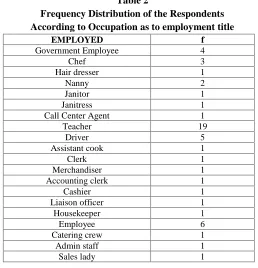
Table 2 shows that there are 61 employed (Government Employee, Chef, Hair dresser, Nanny, Janitor, Janitress, Call center agent, Teacher, Driver, Assistant cook, Clerk, Merchandiser, Accounting clerk, Cashier, Liaison officer, Housekeeper, Employee, Catering crew, Admin staff, Sales lady, Installer, Pharmacist, Street sweeper, Staff, Manager, Security guard, Concrete pump operator) that covers 40.7%, 19 self-employed(Business woman, Vendor, Self-employed, Swimming coach, Avon sales leader, Launderer, Carpenter, Plumber) that covers 12.0% and 71 unemployed(Housewife, NONE) that covers 47.3%of all the 150 respondents. Therefore, most of the respondents are either employed or unemployed.
2. The assessment of the respondents on the benefits of Children in the School Based Feeding Program according to Physical Development, Academic Performance, and Social Development
Table 3
Frequency and Percentage Distribution of the Respondents According to Physical Development
Table 3 reveals the benefits on physical development of the children under the School-Based Feeding Program at Holy Spirit Elementary School. The first statement got 4.44 weighted mean interpreted as agree pertains to the SBFP helps children to gain weight. The second statement got a weighted mean of 4.33 interpreted agree that SBFP improves the Body Mass Index (BMI) of the children. The third statement got 3.99 weighted mean interpreted as agree that SBFP prevents children
Physical Development (f) (%)
School-based feeding program helps children gain weight. 4.44 Agree SBFP improves the Body Mass Index (BMI) of the children. 4.33 Agree
SBFP prevents children from being sick. 3.99 Agree
SBFP reduces malnutrition. 4.19 Agree
SBFP alleviate short term hunger. 4.27 Agree
INTERNATIONAL REVIEW OF HUMANITIES AND SCIENTIFIC RESEARCH By International Scientific Indexing
ISSN (Online) : 2519-5336 www.irhsr.org
from being sick. The fourth statement got a weighted mean of 4.19 interpreted as agree that SBFP reduces malnutrition. And the last statement got 4.27 weighted mean interpreted as agree that SBFP alleviate short term hunger. The weighted mean of 4.25 interpreted as agree that SBFP helps on
children’s physical development according to the assessment of the respondents.
Table 4
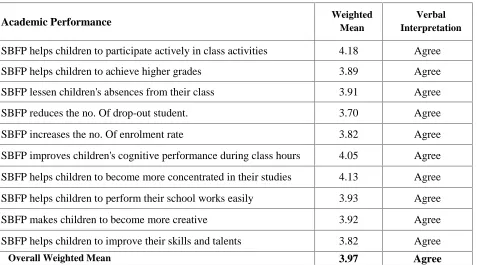
Frequency and Percentage Distribution of the Respondents According to Academic Performance
Table 4 showed the benefits on academic performance of the children under the School-Based Feeding Program at Holy Spirit Elementary School. SBFP helps children to participate actively in class activities got a weighted mean of 4.18 and interpreted agree. SBFP helps children to achieve higher grades obtained 3.89 weighted mean with a verbal interpretation agree. SBFP lessen children's absences from their class earned a weighted mean of 3.91 interpreted as agree. SBFP reduces the no. of drop-out student got 3.70 weighted mean and interpreted as agree. SBFP increases the no. of enrolment rate had a weighted mean of 3.82 interpreted as agree. SBFP improves children's cognitive performance during class hours gained a 4.05 weighted mean interpreted as agree. SBFP helps children to become more concentrated in their studies got a weighted mean of 4.13 interpreted as agree. SBFP helps children to perform their school works easily obtained a 3.93 weighted mean and interpreted as agree. SBFP makes children to become more creative got a weighted mean of 3.92 interpreted as agree. SBFP helps children to improve their skills and talents got 3.82 weighted mean interpreted as agree. The Academic performance was agreeable to the respondents having an overall weighted mean of 3.97.
The result concur with the study of Del Rosso (1999), the following are the ways on how school feeding programs can improve educational quality and efficiency: alleviate short-term hunger in malnourished or otherwise well-nourished schoolchildren. This helps to increase the attention and
Academic Performance Weighted
Mean
Verbal Interpretation
SBFP helps children to participate actively in class activities 4.18 Agree
SBFP helps children to achieve higher grades 3.89 Agree
SBFP lessen children's absences from their class 3.91 Agree
SBFP reduces the no. Of drop-out student. 3.70 Agree
SBFP increases the no. Of enrolment rate 3.82 Agree
SBFP improves children's cognitive performance during class hours 4.05 Agree
SBFP helps children to become more concentrated in their studies 4.13 Agree
SBFP helps children to perform their school works easily 3.93 Agree
SBFP makes children to become more creative 3.92 Agree
SBFP helps children to improve their skills and talents 3.82 Agree
concentration of students producing gains in cognitive function and learning. Then, motivate parents to enroll their children in school and have them attend regularly.
Table 5
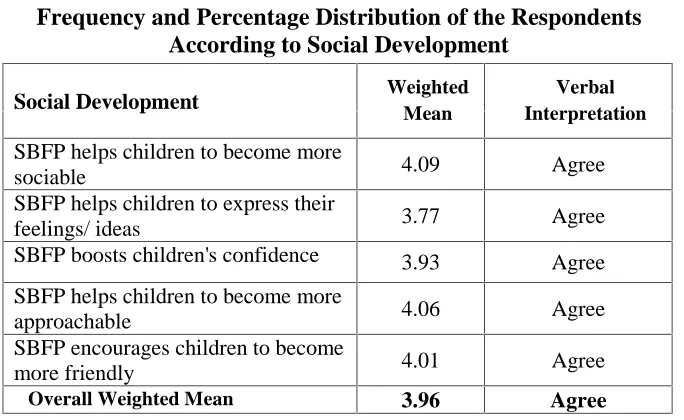
Frequency and Percentage Distribution of the Respondents According to Social Development
Table 5 reveals the benefits on social development of the children under the School-Based Feeding Program at Holy Spirit Elementary School. The entire statement got a verbal interpretation of agree with a respective mean: SBFP helps children to become more sociable (weighted mean=4.09). SBFP helps children to express their feelings/ ideas (weighted mean=3.77). SBFP boosts children's confidence (weighted mean=3.93). SBFP helps children to become more approachable (weighted mean=4.06). SBFP encourages children to become more friendly (weighted mean=4.01). The respondents gave a verbal interpretation of agree to Social Development with an overall weighted mean of 3.97.
Table 6
Comparison of the Respondents Assessment when they are grouped according to Gender
Benefits of SBFP in terms of:
Gender t-value
P-value Decision Remarks
Physical Development
Male
.357 .722 Retain Ho Not
Significant Female
Academic Performance
Male
1.362 .175 Retain Ho Not
Significant Female
Social Development
Male
1.675 .096 Retain Ho Not
Significant Female
Table 6 shows that there is no significant difference on the assessment of the respondents on statements under physical development, academic performance and social development of the children under the School-Based Feeding Program at Holy Spirit Elementary School when they are grouped according to gender. With the result hypothesis had to be retained.
Social Development Weighted Mean
Verbal Interpretation
SBFP helps children to become more
sociable 4.09 Agree
SBFP helps children to express their
feelings/ ideas 3.77 Agree
SBFP boosts children's confidence 3.93 Agree
SBFP helps children to become more
approachable 4.06 Agree
SBFP encourages children to become
more friendly 4.01 Agree
INTERNATIONAL REVIEW OF HUMANITIES AND SCIENTIFIC RESEARCH By International Scientific Indexing
ISSN (Online) : 2519-5336 www.irhsr.org
Table 7
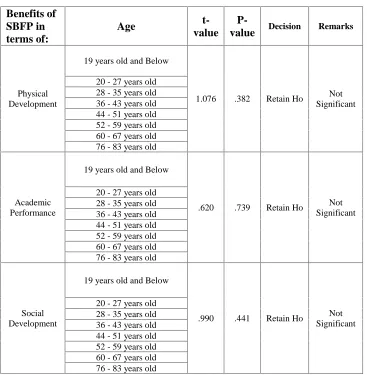
Comparison of the Respondents Assessment when they are grouped according to Age
Benefits of SBFP in terms of:
Age
t-value
P-value Decision Remarks
Physical Development
19 years old and Below
1.076 .382 Retain Ho Not Significant 20 - 27 years old
28 - 35 years old 36 - 43 years old 44 - 51 years old 52 - 59 years old 60 - 67 years old 76 - 83 years old
Academic Performance
19 years old and Below
.620 .739 Retain Ho Not Significant 20 - 27 years old
28 - 35 years old 36 - 43 years old 44 - 51 years old 52 - 59 years old 60 - 67 years old 76 - 83 years old
Social Development
19 years old and Below
.990 .441 Retain Ho Not Significant 20 - 27 years old
28 - 35 years old 36 - 43 years old 44 - 51 years old 52 - 59 years old 60 - 67 years old 76 - 83 years old
Table 8
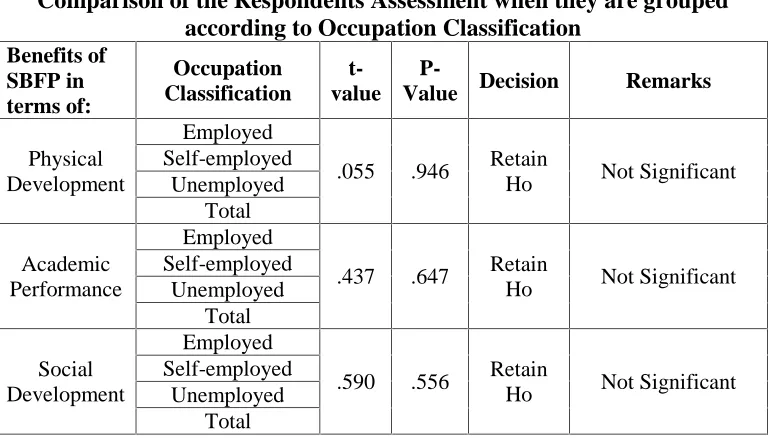
Comparison of the Respondents Assessment when they are grouped according to Occupation Classification
Benefits of SBFP in terms of:
Occupation Classification
t-value
P-Value Decision Remarks
Physical Development
Employed
.055 .946 Retain
Ho Not Significant Self-employed
Unemployed Total
Academic Performance
Employed
.437 .647 Retain
Ho Not Significant Self-employed
Unemployed Total
Social Development
Employed
.590 .556 Retain
Ho Not Significant Self-employed
Unemployed Total
Table 8 shows that there is no significant difference on the assessment of the respondents on statements under physical development, academic performance and social development of the children under the School-Based Feeding Program of Marcelo Del Pilar Elementary School when they are grouped according to their occupation classification. With the result hypothesis had to be accepted.
Summary of Findings
1. In terms of benefits under the School-Based Feeding Program at Holy Spirit Elementary School in all 3 aspects obtained the following weighted mean respectively: Physical Development (weighted mean =4.25); Academic Performance (weighted mean = 3.97); Social Development (weighted mean = 3.96) The whole respondents are agreeable as to the benefits their children are receiving from the said program with an overall weighted mean of 4.06.
2. There is no significant difference on the perception of the respondents on the benefits under the School-Based Feeding Program at Holy Spirit Elementary School whey they are grouped according to age, sex and occupation.
Conclusions
1. Since that all the benefits under the School-Based Feeding Program at Holy Spirit Elementary School in all 3 aspects and obtained a verbal interpretation of agree by all respondents. It is therefore concluded that the SBFP have a good impact on the beneficiaries.
INTERNATIONAL REVIEW OF HUMANITIES AND SCIENTIFIC RESEARCH By International Scientific Indexing
ISSN (Online) : 2519-5336 www.irhsr.org
Recommendations
Based on the conclusions, the researchers recommend the following:
1. Continuous implementation of the SBFP should be done by the government in order to address the constant improvement of the beneficiaries in terms of Physical Growth, Academic Performance, and Social Development. Also, the researchers recommend that this should be implemented specially in remote area in the provinces.
2. Since that there is co-equal result of the respondents assessment whey they are grouped according to age, sex, and occupation reflecting that they are very much satisfied with the result of the program. It is recommendable to make the parent greater number involvement in the program to ease the implementation.
References
Garcia, A. M. ET AL., (2007) Research for All Discipline: Developing the Research Design.
Lawson, T.M., (2012) Impact of School Feeding Programs on Educational, Nutritional and Agricultural Development Goals: A Systematic Review of Literature.
Del Rosso, J.M., (1999). School Feeding Programs: Improving effectiveness and
increasing the benefit to education. A Guide for Program Manager: The Partnership for Child Development Retrieved from
http://sitesources.worldbank.org/NUTRITION/Resources/Tool10-FullReport.pdf.
Department of Education. DepEd Orders. Retrieved last October 7, 2015 from
http//www.deped.gov.ph/prders?search_api_views_fulltext=&f0]=field_classification%3A164.
DepEd Order No. 37, s. 2014. Implementation of the Department of Education
and Department of Social Welfare and Development funded School-based Feeding Program for School Year 2014-2015
DepEd Teacher’s Blog.Guidelines on the Implementation of School Feeding Programs. Retrieved last October 7, 2015 from
http//depedteacher.blogspot.com/2013/12/guidelines-on-implementation-of-school.html.
Adelman, S.W., Giligan, D.O., & Lehrer, K. (2008). How effective are food for
education programs?. Washington, DC: International Food Policy Research Institiute (IFPRI). Retrieved fromwww.ifpri.org/publication/how-effective-are-food-programs-0
Pollitt, E., Gersovitz, M., &Gargiulo,M. (1978). Educational Benefits of the United
States School Feeding Program: A Critical Review of the Literature. Retrieved from http://aphapublications.org/doi/pdf/10.2105/AJPH.68.5.477
Rodriguez, F. (2014). School Feeding Programs for Filipino Kids. Retrieved
fromhttp://www.rappler.com/move-ph/issues/hunger/49213-school-feeding -programs-filipino-kid
Umali, T. (2014).Business Mirror. DepEd’s School Based Feeding Program.