ISSN: 2393-8366
588
Secure Onion Protocol Implementation for
Reliable Routing in Wireless Sensor Networks
Mighty Ecclisha M1, Jisha Liju Daniel2, S. Brindha3 1
Research Scholar, St.Peter’s University, Chennai. [email protected]
2
Asst.Prof. & Dept. of Computer Science & Applications, St.Peter’s University, Chennai 3
Asst.Prof. & Dept. of Computer Science & Applications, St.Peter’s University, Chennai
Abstract-- In this paper, we propose secure onion protocol implementation for reliable routing in
wireless sensor networks. Deploy onion protocol is implemented using AES algorithm and with
corresponding primary key of all the hops. Every node while registering, server will provided with Id, primary key, secondary key and decryption key. Source will find out the optimum path and it will collect primary key of all intermediate node. Data’s first encrypted using AES algorithm and then with corresponding primary key of all the hops. This wholesome is transmitted to first hop, where initial decryption is achieved using decryption key of that node. Then collecting its id and secondary key which is transmitted to both source and destination node. Same way all the id’s and secondary key are collected and concatenated, so as to verify both source and destination. TPA implementation is also achieved for successful validation of concatenated keys their by reward is provided to the intermediate hops.
Keywords: AES, TPA, Onion Protocol
I. INTRODUCTION
Mobile Adhoc Network (MANET) is using a temporary network communication they do not have any central administration and existing infrastructure. So nodes in wireless network dynamically form their own network. Wireless network nodes use some default routing protocols to identify the sender and receiver for every message and network security is a major issue. Over some years, more number of networks has been proposed with onion routing technique and some networks have been implemented. Onion routing, is a technique where message are covered in multiple encryption layers, forming an encryption like onion. In this scheme delivering message to destination by a no of intermediate onion nodes or routers, each intermediate router and node is responsible to decrypt one layer, and forward the packet or message to next router or node. In onion routing scheme they randomly select a path over the onion routers network and form a circuit. After formed the circuit, each nodes in the circuit shares symmetric to user, that key will be used to encrypt future onion layers. In this proposed system we present onion routing protocol and Advanced Encryption technique. In that First network is constructed with n no of nodes. After that nodes in the network can request data packet to other nodes. We can simulate nodes in the networks are moving because of the nodes mobility property. All nodes are maintained to forward data packet to other nodes. In this proposed scheme, discovering the shortest path is first process, and sends the packets to other node. When nodes come for registering into to the network, they get id and other information.
ISSN: 2393-8366
589
In this multi hop route forwarding is used to identify shortest path detection and Advanced Encryption Standard algorithm is used to achieve encryption process. Data is encrypted using Advanced Encryption Standard (AES) technique with primary key of all intermediate nodes. The wholesome is forwarded to first node, where the first decryption will be done by that node decryption key.In this proposed system, source node transmits the encrypted data packet to intermediate node depending on the selected route. Then intermediate nodes decrypt and transmit packet to destination node. Finally destination nodes get data securely by its last decryption process. Using this system we achieve the data forwarding securely and shortest way. This system mainly overcomes the problems of Existing Electronic Suspense Tracking and Routing (ESTAR) system, which ensure route stability, malicious, selfish attacks, and node failure. This proposed system use new protocol with encryption for packet delivery speed and most secure data forwarding.
II. MATERIAL AND METHODS
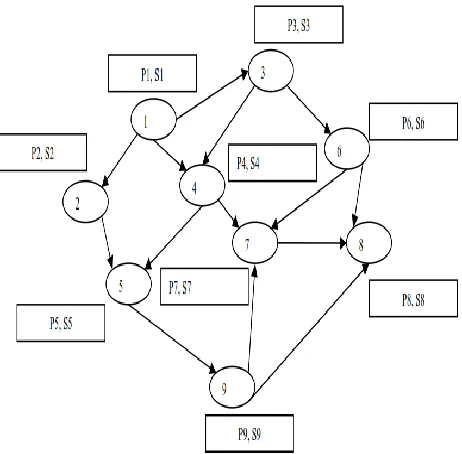
This paper proposes onion routing protocol with Advanced Encryption Standard and multi hop route forward algorithm. By implementing onion protocol every node while registering, server will be provided with Id, primary key, secondary key and decryption key. This system provides a very securable and fast reliable packet delivery. Source will find out the optimum path and it will collect primary key of all intermediate node. First we need to construct the network with n number of nodes. After that nodes can forward data from one to other node in that network. Nodes in the network are moving, because it’s having the mobility property.
Fig 1. Network construction
ISSN: 2393-8366
590
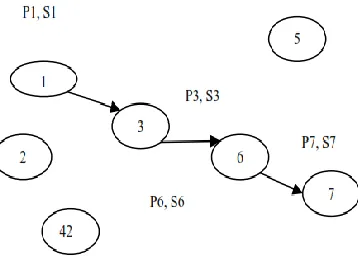
is an important concern while forwarding the packet. By using multi hop route forwarding algorithm to discover the shortest path from source to destination. After finding routes between source and destination, Source sends packet to destination. This protocol is used to provide security on data by some layer of encryption, and it overcomes the packet delay latency. Normally nodes in the multi-hop wireless networks would like to communicate with other nodes in networks; so it can transmit the packet by the help of other nodes in the network. This type of multi hop packet transmission is able to extend the network coverage area by spectral efficiency of area and limited power this multi hop networks can be used in rural and developing areas at low cost in is more readily available. When consider the multi hop wireless civilian networks, nodes in network contains the long connection with network.
Fig 2. Shortest Route Discoveries from Source to Destination
ISSN: 2393-8366
591
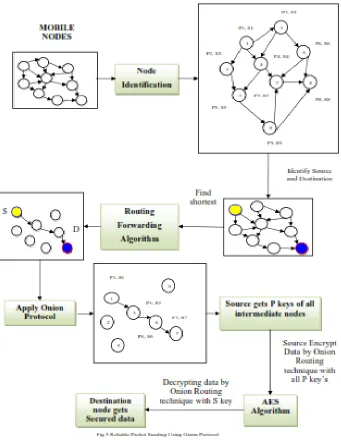
Fig 3.Reliable packet sending using onion protocol
ISSN: 2393-8366
592
After route selection, source encrypts the data based on AES encryption and it collects the selected neighbor nodes public key from routing table. Although source conducts the encryption process based on selected route public keys using AASR protocol based on onion routing. In packet forwarding, source node forwards the encrypted packet to neighbor node based on selected route. Neighbor node gives it own private key for one part of decryption process. After that it will send to next neighbor node. Similarly each neighbor nodes in selected route decrypts the packet based on its private key using AASR protocol. Sometime attacker node also receives the packets. In that time, it gives its private key but packet is not decrypted. So it didn’t analyzes how many number of encryptions placed on. Thus we improve the data security. In decryption process, neighbor node decrypts the packet and finally sends to destination node. Then the destination node decrypts the packet with its private key and AES decryption key. Finally destination node views the original data. Since the paths capacity will vary dynamically, so that the paths will be changed dynamically as per data transfer along the network. So it increases the packet delivery ratio and decreases the average end-to-end delay. In TPA verification and payment process, after data transmission each intermediate node in selected path sends its id and secondary key to trusted party auditor. Destination node also sends the id and secondary keys of selected nodes to TPA after data retrieval from source node. Then TPA audits the both id and secondary keys are match or not based on ESTAR protocol. If match means TPA rewards to that trusted node. Suppose it mismatch it easily identify the attacker node.
A. RESULTS
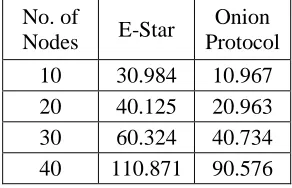
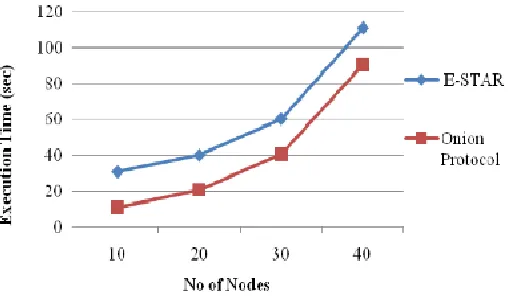
This paper proposes Advanced Encryption Standard with onion protocol to overcome the issues of Electronic Suspense Tracking and Routing (E-STAR) protocol, and we use multi hop route forward algorithm to select the shortest path from source to destination. The First process of this paper is constructing the network with n number of nodes. Network construction with n number of nodes. Constructing the network is used to relay the data packet from one node to other node in the network. The process of nodes getting its node id, primary and secondary key. These two key are used to perform the encryption and decryption operation on data packet. In the proposed system multi hop route forwarding algorithm is used to find the shortest path from source to destination. Finding the route is important to forward the packet from one node to another. In existing system Electronic Suspense Tracking and Routing (E-STAR) protocol is used to transmit the packet with secure and reliable way. It used the reward and the below table shows the node execution time from source node to destination node. When compared to existing system our proposed system minimize time for nodes to reach the destination. This system also support, if number of nodes increases in intermediate path in network, it will reach the destination more quickly than existing system.
No. of
Nodes E-Star
Onion Protocol 10 30.984 10.967 20 40.125 20.963 30 60.324 40.734 40 110.871 90.576
ISSN: 2393-8366
593
Fig 4. Packet reaching time from source to destination
The advantages of proposed system are less waiting time, reliable, high data transmission rate, more effective and highly secure.
III DISCUSSION
ISSN: 2393-8366
594
Example of some reasons includes node failure, low resources, and selfish attacks. To overcome these issues we use onion routing protocol with Advanced Encryption Standard and multi hop routing algorithm. This proposed system provides reliable and secure packet forwarding mechanism. TPA implementation is also achieved for successful validation of concatenated keys their by reward is provided to the intermediate hops.
IV CONCLUSION
In existing system E-STAR that uses payment/trust systems with trust-based and energy-aware routing protocol for stable routes. E-STAR stimulates the nodes not only to relay others’ packets but also to maintain the route stability. It also punishes the nodes that report incorrect energy capability by decreasing their chance to be selected by the routing protocol. In proposed system we use onion routing protocol for secure and reliable packet transmission. Onion protocol provides the layer of encryption and decryption process to secure the packet while transmitting to destination node and this system uses the multi hop route forwarding algorithm to find the shortest path from source to destination. Onion protocol with Advanced Encryption Standard algorithm is a two key encryption process. In this source the encrypted data with primary keys and each neighbor node is responsible for decrypting the packet with its secondary key, so any neighbor node in the selected route cannot access the data while transmitting the packet to other neighbor node. When compared to the existing system our proposed system provides more security on data and minimizes the overhead of network. In future enhancement, to ensure Data security and privacy data is spitted into multiple blocks encrypted and stored in multiple images to ensure security.
REFERENCES
[1]Ismail, D, Jaafar, M, (2007), “Mobile ad hoc network overview”, Applied Electromagnetics, Asia-Pacific Conference, IEEE , Page 1 - 8 DOI 10.1109/APACE.2007.4603864
[2]Volker Fusenig, Dagmara Spiewak; Engel, T. (2007), “Acimn protocol: A protocol for Anonymous Communication In Multi hop wireless Networks” Wireless Telecommunications Symposium, Pomona, CA, IEEE , DOI: 10.1109/WTS.2007.4563320.
[3]G. Shen, J. Liu, D. Wang, J. Wang, and S. Jin, (2009), “Multi-Hop Relay for Next-Generation Wireless Access Networks,” Bell Labs Technical Journal, vol. 13, no. 4, pp. 175-193.
[4]Ritu Aggarwal, (2013) “Security on Dynamic Source Routing Protocol Using Onion Routing Encryption”, International Journal of Engineering and Advanced Technology, ISSN: 2249 – 8958, Volume-2, Issue-6
[5]G. Indirania and K. Selvakumara, (2014), “A Swarm-Based Efficient Distributed Intrusion Detection System for Mobile Ad Hoc Networks (MANET),” Int’l J. Parallel, Emergent and Distributed Systems, vol. 29, pp. 90-103.
[6]H. Li and M. Singhal, (2007), “Trust Management in Distributed Systems,” Computer, vol. 40, no. 2, pp. 45-53.
[7]C. Chou, D. Wei, C. Kuo, and K. Naik, (2007), “An Efficient Anonymous Communication Protocol for Peer-to-Peer Applications over Mobile Ad-Hoc Networks,” IEEE Journal on Selected Areas in Communications, VOL. 25, NO 1.
ISSN: 2393-8366
595
[9]Wireless Networks” Wireless Telecommunications Symposium, Pomona, CA, IEEE , DOI: 10.1109/WTS.2007.4563320.
[10]Vasantha, V., Manimegalai, D., (2007), “Mitigating Routing Misbehaviors Using Subjective Trust Model in Mobile Ad Hoc Networks” Conference on Computational Intelligence and Multimedia Applications International Conference IEEE (Volume:4 ) Pp.417 - 422
[11]K. Liu, J. Deng, and K. Balakrishnan, “An Acknowledgement- Based Approach for the Detection of Routing Misbehavior in MANETs,” IEEE Trans. Mobile Computing, vol. 6, no. 5, pp. 536-550, May 2007.
[12]S. Zhong, J. Chen, and R. Yang, “Sprite: A Simple, Cheat-Proof, Credit Based System for Mobile Ad-Hoc Networks,” Proc. IEEE INFOCOM ’03, vol. 3, pp. 1987-1997, Mar./Apr. 2003. [13]S. Marti, T. Giuli, K. Lai, and M. Baker, “Mitigating Routing Misbehavior in Mobile Ad Hoc Networks,” Proc. ACM MobiCom’00, pp. 255-265, Aug. 2000.