353
Detection Of Pharming Attack On Websites Using
Svm Classifier
Saloni Manhas, Swapnesh Taterh, Dilbag Singh
Abstract: Attackers are constantly trying to con users and organizations to cause financial damage, loss of sensitive information, and ruin their reputation. Pharming attacks are becoming a headache for website users due to its severe consequences. This attack is achieved by stealing user’s credentials and redirect them to malicious websites by using DNS based techniques. Therefore, to give additional safety Transport Layer Security/Secure Sockets Layer (TLS/SSL) was introduced. It operates by authorizing the actual web server for you to the customer, vice a new versa in so doing each party confirming the actual reliability by using digital certificates. However, SSL is still vulnerable to pharming attacks. Results show that the proposed technique provides 97% accuracy along with high performance in F-measure, sensitivity and specificity which is commendable and proves that SVM is an adequate machine learning method to successfully carry out detection of pharming attack.
Index Terms: Phishing, Support Vector Machine (SVM), Secure Socket Layer (SSL) attacks, Malicious websites, Pharming, Machine learning, Network attacks.
—————————— ——————————
1.
INTRODUCTION
It is quite evident that all of the advances seen in the information technology realm helped both the good guys and the bad. Subsequently, we have seen a steep increase in the amount of malware and website exploits seen throughout websites[1]. Therefore, in past years one need to be an efficient programmer, social engineer and service administrator to misuse any website. But, today due to scientific advancement, a person only needs basics of programming to compromise hundreds of websites. Transport layer security or its predecessor Secure Socket Layer is an encryption method developed to offer secure transactions and data transfer over the internet. SSL permits users to authenticate the identity of servers by validating their X.509 digital certificates and discard connections if the server’s certificate is not published by a trusted certificate authority [1]. Netscape communications launched SSL layer for security sensitive communication in 1994. The Internet Engineering Task force embraced it in 1999 as a standard called Transport Layer Security to safeguard HTTP layer [2]. Various flaws have been come into limelight during recent years, such as Apple’s "goto fail" bug and other cryptography related shortcomings as demonstrated by Poodlebleed vulnerability. Thus SSL is not unblemished [3].Pharming attack is one of the notorious networking attacks present on secure socket layer protected websites. It is operated by performing domain spoofing. Unlike phishing it will not lure you with the help of social engineering to redirect user into malicious websites. Rather, pharmers work sheepishly by changing your local DNS server to redirect you to malevolent websites [4]. Pharming came into existence in 2005, when there was an attack by some tempered DNS servers which redirected many (.com) sites to malicious pages [5]. With the help of
DNS cache poisoning, pharming attack is executed and leaves user facing dire consequences like password hijacking, stolen credentials etc. It is often said that HTTP should not be used to pass sensitive information. SSH (secure shell) or HTTPS should be preferred. But as it is said, nothing is 100% secure. Pharming exploits DNS cache poisoning and deceives CA into supplying fake certificates for domains the mugger does not really own [6]. Proposed method includes detection of malicious websites affected by pharming attacks. Process includes URL based feature selection method to segregate normal websites and malicious websites. Raw data was labelled and put to use in Support Vector Machine. Classifier was trained and tested to identify malevolent websites affected by pharming. The rest of paper is summarized as: Pharming attack is discussed in Section 2. Related review and motivation behind the proposed work is discussed in Section 3. The proposed technique is discussed in Section 4. The performance analysis of the proposed technique is demonstrated in Section 5. Finally, concluding remarks are discussed in Section 6.
2.
PHARMING ATTACK
The term ―Pharming‖ is derived from words farming and phishing. Pharming is basically a tricking practice in which malevolent code is installed on victims’ computer or server to redirect the user to fake websites without their consent. It is also known as ―phishing without wooing‖ [7]. A description of causes of this attack is as follows [8].
2.1. Client Side
2.1.1. Local host file attack- All Operating systems preserves a host file containing URL, IP mappings etc. of previously completed task. Mugger manipulates user’s file to redirect traffic to his chosen IP address.
2.1.2. Home Router Attack- Intruder can hijack router of target to manipulate DNS queries. Thus he can divert target’s traffic to fake websites.
2.1.3. Rouge DHCP- Invader installs counterfeit DHCP(Dynamic Host Configuration Protocol) server secretly in user’s network. User is provided IP from fake IP pool. Thus, DNS requests are directed to counterfeit DNS server.
2.1.4. Browser Proxy Configuration Attack- Intruder overrides target’s browser proxy conformation possibilities
_______________________
Saloni Manhas is currently pursuing PhD degree in software engineering in Amity University,Jaipur, India,
E-mail: [email protected]
Swapnesh Taterh is currently working as Associate Professor in AIIT department, Amity University Jaipur, India.
E-mail:[email protected].
using DNS poisoning methods. It again redirects victim to proxy server which is managed by intruder.
2.2.Server side
2.3. 2.2.1. Transparent Proxies- Proxy server exists between a user and internet. To increase browsing speed transparent proxies are used. It diverts prey’s traffic to intruder’s server.
2.4. 2.2.2. Cache poisoning- Mugger takes benefit of DNS server cached vulnerabilities to put fraud resolution entries. By exploiting this intruder manipulates resolution entries for any selected website.
2.5. 2.2.3. Alike Domain Names- Pharmer registers various domain names similar to victim’s domain and makes victim believe that domain name is accurate.
3.
RELATED WORK
In order to mitigate pharming attack, Target Identification algorithm was used along with third party DNS lookup method. To know the legitimacy of webpage, R. Gowtham, A. V. Vidyapeetham, and I. Krishnamurthi used IP address comparison barring usage of domain names. For example considering substitutes of www.gmail.com as mail.google.com, thus domain comparison causes false positives [9]. S. Gastellier-prevost et al proposed client-side framework to authenticate website. It consists of checking IP address and webpage content analysis, using data provided by different DNS servers. Approach is integrated within web browser of user so that notification arises in case of any doubtful website [10]. Y. Li, S. Chu, and R. Xiao have proposed hybrid detection model to detect pharming attack on the basis of IP address and website content. IP address filtration through different DNS servers is conducted. SVM classifier optimized by PSO for website classification algorithm [11] . A methodology based on dual step scrutiny and collaboration of numerous DNS servers is proposed by S. Gastellier-prevost, and M. Lauren at the client side for mitigating DNS exploitations. They explained that IP address check is a vital pointer of to check the legitimacy of a visited website [12]. B. Arya has presented (CSAP) Client-Side Anti Pharming methodology to avert pharming attacks at client side. Multiple DNS servers were used to check the validity of DNS response given by local DNS server. If IPs are different from the original IPs then it is concluded that pharming is detected [8]. K. Gajera has used ANN (Artificial Neural Networks) for pharming detection. Features were selected on the basis of URL parameters and fed into neural networks for training. To identify between legitimate and malicious website. For identification of malicious websites, IP addresses were queried to local and global DNS, if they both return same result then it is safe otherwise pharming attack was presented [4]. I. S. Alfayoumi has presented a client side approach for detecting pharming attacks on the basis of Authorized DNS server IP address matching approach [7]. IPs are selected from local and legitimate servers then in the next step their IP addresses are checked. If IP address is matched then it is forwarded as a trustworthy website else information gathered from ZONE file is checked and if mismatches then it is said that Pharming has occurred. User behavior mining is a method implemented by C. Tiwary and S. Rathod to detect suspicious activities. System captures image of the user and matches the image
during registration process, After login, system will monitor user activities like editing, moving copying, deleting files and then it will check log file that if user has given permission of read only or read and write also. conditions don’t match then system will click screenshot and send it to the original user’s mail id. In this way user will be notified of the intrusion activity [13]. Therefore, it has been found that the development of an efficient machine learning technique for web site attacks is still a challenging issue. It has also been found that one may enhance the existing machine learning techniques either by using ensemble or by using hyper-parameter tuning techniques [14]. The existing machine learning techniques require certain initial parameters which are generally taken on the hit and trail basis [15].The decision tree based machine learning model suffers from the over-fitting issue [16]. Therefore, random forest has been used to overcome this issue. However, random forest unable to overcome the parameter tuning issue and provide poor results whenever the input feature values are very close to each other [17]. This is the main motivation behind the proposed work to introduce SVM to overcome overfitting issues.
4.
PROPOSED METHODOLOGY
To identify malicious websites over SSL/TLS layer protected websites we have used SVM classifier along with unique set of features. Users often think that a secure lock in front of their URL can protect them from possible attacks but it is no more the case now. As attackers have gone one step ahead to find out the vulnerabilities and exploit them. Pharming attack is discovered in various SSL protected websites also.
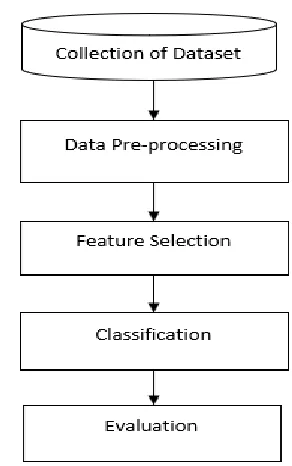
4.1. Process Flow
Fig 1. Flow of the steps followed in proposed work
355 Selection of appropriate dataset is a prime task because
the whole performance of the whole model is dependent on the precision of dataset. Data is needed to be accurate in order to get reliable results. Raw data need to be properly filtered for the unbiased results. To get a real time traffic of websites tend to expensive task. There are some authenticated sources on web which provides reliable datasets. The datasets were collected from Phishtank.com and Alexa list of safe websites.
4.1.2. Data Pre-processing
Generally non-numeric features are omitted from dataset as they do not really play an important part in detecting any malicious activity. Dataset should be addressed thoroughly to check whether there are no duplicate records, half mentioned queries, unrelated information etc. We usually eliminate non-numeric and irrelevant symbols to improve the accuracy of model. Raw data should be refined carefully as it the soul of functioning of the whole process. We refined our dataset by keeping above mentioned points into consideration.
4.1.2. Feature Selection
We have selected important features for the determination of safe and phished websites. Also keeping in point pharming attack, we have selected basic features related to this attack from websites containing TLS/SSL protocol. Some features were added by studying research articles based on intrusion detection.
1. Fake SSL/TLS protocol- Pharmers generally use fraudulent HTTPs protocol to phish users. One should check expiry date of certificates, issuing authority whether it is coming from reliable source or not. For example- Verisign, GoDaddy etc.
2. Unusual redirects- If website is taking more than usual time to redirect or taking three or four times to redirect you to the desired website then it can be the case of phishing.
3. IP Address- Usage of IP address in the URL itself is a questionable thing. Muggers use IP addresses of non-working websites. Websites starting with IP addresses are not trustworthy.
4. Suspicious URL- If URL of the website is not matching with records in WHOIS database, then website is considered unsafe.
5. Pop-up Window- If you are directed to any website where a pop-up window emerges and ask you to write credentials then also it is suspicious website.
6. SSL having @ symbol- Genuine SSL doesn’t contain @ symbol in its domain name
7. Website domain containing hash symbol- Websites having SSL security mechanism doesn’t contain # symbol in its domain name.
8. Certificate Validity- The certificates used by websites should be valid and not expired.
Fig 2. Red arrow symbol pointing certificate invalid error message.
9. DNS record- If records of DNS are not available then it is fishy in nature.
10.Unusual Domain Name- If the website that you are redirected to has unusual domain name. For example, Amaz0n.com in place of Amazon.com then it is also case of pharming.
4.1.3. Classification
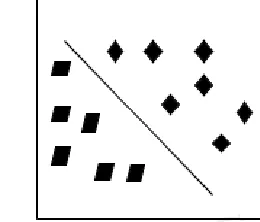
Support Vector Machine based classification is used for the detection of malicious websites. It was proposed by Cortes and Vapnik in 1995. It is a machine learning classification method which generates a hyper- plane splitting two objects. A best hyper-plane is based on how optimally it is dividing two objects along with large separation distance between two objects.
Fig 3. Hyper-plane separating two classes
In order to obtain an optimal hyper-plane, the width (w) of the margin needs to be maximized, as described in following figure.
Various kernels functions (for e.g. linear, polynomial, sigmoid, radial basis etc.) are used to maximize the boundary between two hyper-planes.
1. Sigmoid Kernel function- K(x,y)=tanh( xTy+c)
2. Gaussian radial basis function- k(x,y)=exp( ‖ ‖ )
3. Polynomial kernel- ( ) ( )
4. Linear kernel- k(x,x’) = xTx’
In our work, we have used linear kernel as it is less prone to overfitting and also it is relatively faster than other non-linear kernel functions. Suppose you want to clearly divide two classes then linear kernel gives great results.
The separating function of SVM is defined by following equation 1:
wx+b=0 (1) In standard SVM, w is known as weight vector and value of x and y comes from training set X={x1,x2,x3,….,xn} and set Y={y1,y2,y3,….,yn}. b is known as bias of optimal hyper-plane. Separating margin contains boundary function which is explained by formula 2:
wx+b= 1
wx+b= -1 (2) Formula can be further moderated to let samples in dataset complete the following requirements:
wxi +b≥+1, where yi=+1. (3)
wxi+b≤-1, where y1=-1. (4) Linear separation problem is defined as:
yi(wxi+b)≥1 (5) The problem of non-separation is defined as:
‖ ‖ ∑ (6) Where C is denoted as regularization parameter.
5.
PERFORMANCE EVALUATION
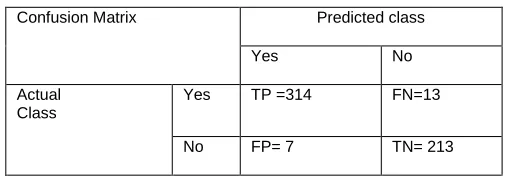
To evaluate the performance of proposed methodology confusion matrix was used. It is a table which provides the performance of classifier on the basis of some parameters on test data containing 747 URLs. It is also known as ―Error Matrix‖. It shows how your classification model gets confused while making predictions. To begin with confusion matrix, one has to follow steps given below:
1. A validation or test dataset with expected outcome results.
2. Predict each row in the test dataset.
3. The expected predictions and expected outcomes give us the number of accurate predictions for each class and the number of inaccurate predictions for each class, ordered by the class that was predicted.
4. The values are organized in matrix containing Predicted class and Actual class, allocated to following terms:
True Positive (TP), False Negative (FN) False Positive (FN), True Negative (TN)
The following confusion matrix derived by model shows values of both predicted and actual class.
TABLE 1. CONFUSION MATRIX
Confusion Matrix Predicted class
Yes No
Actual Class
Yes TP =314 FN=13
No FP= 7 TN= 213
Following are some parameters on which we have evaluated the performance:
1. Accuracy- It is calculated as number of correct predictions divided by total number of datasets.
Accuracy= = 0.9732
2. Sensitivity- It is calculated by dividing number of correct positives with number of true positives.
Sensitivity= = 0.9685
3. Precision- It is calculated by dividing number of correct positive predictions with total number of positive predictions.
Precision= = 0.9778
4. Specificity- It is calculated by dividing number of correct negative predictions with total number of negatives.
Specificity= = 0.9685
Thus, from the above mentioned results, we can say that the performance given by classifier is quite efficient and reliable and it is able to detect a number of pharming attacks.
6.
CONCLUSION
Pharming attacks are continuously at rise. There is a dire need of protecting organizations and institutions from this attack. Users are needed to be more alert in order to avert these kinds of attacks. With the help of research, we were able to define a classifier which was able to predict the malicious websites up to great extent. The implementation was setup in MATLAB along with its different modules and libraries for feature selection. Further this work can be extended by going into depth of parameters of pharming attacks by finding more suitable features based on URL and website behavior. Researchers can also work on setting up an alarm plug-in on google chrome bar, which will alert users on occurring of the attack.
REFERENCES
357 Protocol.‖
[3] J. Sigholm, ―Papering Over the Cracks : The Effects of Introducing Best Practices on the Web Security Ecosystem,‖ 2016 Int. Conf. Inf. Netw., pp. 1–6, 2016.
[4] K. Gajera, ―A Novel Approach to Detect Phishing Attack Using Artificial Neural Networks Combined with Pharming Detection,‖ 2019 3rd Int. Conf. Electron. Commun. Aerosp. Technol., pp. 196–200, 2019.
[5] I. T. Program, ―Detection Model for Pharming Attack Based on IP-Address Check and Website Predictability Prepared by,‖ 2013.
[6] ―German researchers find a way to circumvent Domain Validation.‖ [Online]. Available:
https://www.thesslstore.com/blog/german-researchers-circumvent-domain-validation/. [Accessed: 03-Oct-2019].
[7] I. S. Alfayoumi, ―Client – Side Pharming Attacks Detection using Authoritative Domain Name Servers,‖ vol. 113, no. 10, pp. 26–31, 2015.
[8] B. Arya, ―A Client-Side Anti-Pharming ( CSAP ) Approach,‖ 2016.
[9] R. Gowtham, A. V. Vidyapeetham, and I. Krishnamurthi, ―An efficacious method for detecting phishing webpage through Target Domain Identification,‖ no. June 2018, 2014.
[10] S. Gastellier-prevost et al., ―A dual approach to detect pharming attacks at the To cite this version : A dual approach to detect pharming attacks at the client-side,‖ 2016.
[11] Y. Li, S. Chu, and R. Xiao, ―Optik A pharming attack hybrid detection model based on IP addresses and web content,‖ Opt. - Int. J. Light Electron Opt., vol. 126, no. 2, pp. 234–239, 2015.
[12] S. Gastellier-prevost, and M. Lauren, ―Defeating pharming attacks at the client-side To cite this version : HAL Id : hal-01303641 Defeating pharming attacks at the client-side,‖ 2016.
[13] C. Tiwary and S. Rathod, ―Privacy Protection System for Secure Authentication and Internal Intrusion Detection System,‖ vol. 4, no. cPGCON, pp. 8074–8077, 2017.
[14] H. S. Pannu, D. Singh, and A. K. Malhi, ―Multi-objective particle swarm optimization-based adaptive neuro-fuzzy inference system for benzene monitoring,‖ Neural Computing and Applications, Springer London, pp. 1–11, 31-Aug-2017.
[15] H. S. Pannu, D. Singh, and A. K. Malhi, ―Improved Particle Swarm Optimization Based Adaptive Neuro-Fuzzy Inference System for Benzene Detection,‖ Clean - Soil, Air, Water, vol. 46, no. 5, May 2018. [16] M. Kaur, H. K. Gianey, D. Singh, and M. Sabharwal,
―Multi-objective differential evolution based random forest for e-health applications,‖ Mod. Phys. Lett. B, vol. 33, no. 5, Feb. 2019.
[17] B. Kumar, O. P. Vyas, and R. Vyas, ―A comprehensive review on the variants of support vector machines,‖ Mod. Phys. Lett. B, vol. 33, no. 25, p. 1950303, Sep. 2019.