ATTACHMENT, REFLECTIVE-SELF FUNCTIONING,
AND INTERPERSONAL DIFFICULTIES IN ADOLESCENT IN-PATIENTS
PAUL WALLIS
This thesis is submitted in part fulfillment of the
Doctorate in Clinical Psychology
ProQuest Number: 10017799
All rights reserved
INFORMATION TO ALL USERS
The quality of this reproduction is dependent upon the quality of the copy submitted.
In the unlikely event that the author did not send a complete manuscript and there are missing pages, these will be noted. Also, if material had to be removed,
a note will indicate the deletion.
uest.
ProQuest 10017799
Published by ProQuest LLC(2016). Copyright of the Dissertation is held by the Author.
All rights reserved.
This work is protected against unauthorized copying under Title 17, United States Code. Microform Edition © ProQuest LLC.
ProQuest LLC
789 East Eisenhower Parkway P.O. Box 1346
TABLE OF CONTENTS
Acknowledgments... 1
Abstract... 2
Introduction... 4
Overview
Adolescence and Psychopathology Attachment Theory
The Strange Situation
Metacognitive Knowledge and Internal Working Models The Adult Attachment Interview (AAI)
Reflective Self-Functioning Research with the AAI
Interpersonal Theory and Attachment The Present Study
Hypotheses
Method... 39
Participants Procedures Measures
Ethical Considerations
Results... 48
Overview
Adolescent Attachment Patterns Attachment Insecurity
Attachment and Resolution of Loss, Abuse and Trauma Attachment and Diagnosis
Attachment and Reflective Self-Functioning Self-report Measures
Attachment and Self-report Symptomatology Attachment and Interpersonal Problems Qualitative Data
Discussion... 71
Overview Main findings
Limitations of the Present Study Directions for Future Research Clinical Implications
ACKNOWLEDGEMENTS
I would like to thank both Howard Steele and Bruce Irvine, who have acted as my supervisors on this research project. To Howard Steele in particular, I offer my thanks for diligently rating my research interviews. Thankyou to the clinicians and staff at the various sites visited in the completion of this research, in particular Brendan McGuinness, Rosalind Brent, Dr.Kevin Healy, and Tanya Sichel. Further thanks should be given to my friends and colleagues on the course for offering support and advice, in particular Emma Silver, whose contribution to the research was invaluable. Special thanks also to Jude.
A BSTRA CT
INTRODUCTION
Adolescence and Psychopathology
The past twenty to thirty years have seen a dramatic increase in interest in the developmental phase of adolescence. This period can be defined in a variety of ways : chronological age might define adolescents as those in their teenage years; the physical changes that are an inevitable consequence of puberty may define the beginning of this life-stage; and changes in schooling, family relationships, or social position may help to define the nature of adolescence (Coleman, 1990). Although traditional notions that disturbance in adolescence is a natural phenomenon incumbent on these changes may not be entirely accurate, a variety of large scale studies have highlighted increasing levels of psychopathology in this age group e.g. Rutter, Tizard, Yule, Graham, & Whitmore (1976) and the Health Advisory Service (1995). These studies suggest that factors other than developmental changes may be influential in the emergence of psychological disturbance in adolescence. Enrico Jones (1996) recently highlighted the way in which Attachment Theory has sparked tremendous interest for clinical psychologists and those interested in the origins of psychopathology in adolescents. Attachment theory, through the development of the Adult Attachment Interview may help provide a formal quantitative means for examining the importance of early childhood experiences in shaping the development of personality, and in turn the aetiology of psychopathological disturbance in adolescence. The present research intends to further extend the literature on the importance of attachment processes on the development of psychopathology, specifically in adolescence, an existing literature which is still in it’s infancy.
adolescent’s emerging sexual drives force him or her to seek appropriate love objects' outside of the family, and as such demands are made for the adolescent to sever ties with the family. He wrote that such a process inevitably leads to heightened anxiety, and thus proposed that the adolescent develops a set of defences to cope with the anxieties created by this transition, many of which are seen as maladaptive. Bios (1967) viewed the process of adolescence as analogous to the concept of separation- individuation proposed by Mahler (1968, 1983), to describe the transition made by the growing infant from seeing oneself as merged with ones mother to being seeing her as a separate entity. Bios conceived of adolescence as being a second separation- individuation stage whereby the increase in a variety of impulses, particularly sexual, shown by the young person, threatens the parent-child relationship, thus requiring the separation process. Interestingly both of these perspectives inherently suggest it is the changes incumbent on moving away, physically and emotionally, from one’s caregiver that give rise to the challenge of adolescence.
However, the psychodynamic model has been criticised on a number of levels, as only focusing on individual maturation, but perhaps more importantly in it’s suggestion the adolescence is generically a period during which psychological disturbance or anxiety is conceived of as the norm. Such a generalised account of adolescence is not reflected by increased morbidity rates during this period. Indeed epidemiological research has suggested that approximately 20% of adolescents will present with diagnosable problems during this period (Graham, 1979). Lewisohn, Hops, Roberts, & Seeley (1993) in a recent survey of a sample of 1,710 high school students in the USA examined numbers reaching DSM-II-R criteria for affective and other disorders. This study demonstrated that of the adolescents sampled 9.6% met the criteria for a current disorder, with more than 33% having experienced a disorder over their lifetimes.
(1997) has described adolescence a period of ‘disconnection’s’, a transitional stage where the individual finds themselves disconnected from the security of childhood, but not yet connected to the maturity of adulthood. Though some adolescents may respond to this uncertainty with difficulty, manifesting itself in disorder, for the large majority, Wilson suggests that this period represents a challenge, an opportunity to grow and develop in a whole range of arenas, including physically, socially, and psychologically.
In 1993 the National Institute of Mental Health identified a number of critical knowledge gaps in relation to adolescent psychopathology. These included research on adolescent depression, conduct disorder, and anxiety disorders. It is interesting that comparatively little work on adolescent psychopathology has been carried out, relative to that with children and adults. Ebata, Peterson & Conger (1990) have suggested a number of reasons for this : as suggested above traditional psychodynamic perspectives on adolescence have lead many to view difficulties during this period as a natural concomitant of the life stage; there is also a common myth that exists that when psychological problems do occur in adolescence, it is merely as a consequence of the stage and thus, as they move into adulthood adolescents will ‘grow out o f these problems; in relation to definition, workers have been reluctant to view adolescence as a discrete life-stage, but rather either as an extension of childhood, or the beginning of adulthood. In addition within the study of adolescent psychopathology a number of problems exist in relation to diagnosis and classification. If adolescence is viewed as a period of developmental change, a transition during which fundamental structures of personality are formed (Erikson, 1968) it may be difficult, and indeed premature to attempt to classify adolescent problems, when such factors as stability of personality are in question. Cantwell (1996) has also highlighted a variety of methodological and epistemological issues relating to classification of adolescent psychopathology. These include : whether disorders should be seen as dimensional rather than categorical, thus allowing for changes in personality structure; whether classifications of disorders can be seen as both quantitatively or qualitatively different from normal; whether the classification categories presented in the DSM-IV and ICD-10 systems can be seen as discrete entities; how these classification systems accommodate the often observed difficulty of co-morbidity in adolescence.
sex differences, in particular that females are significantly more likely to present with anxiety, unipolar depression, eating disorders, and adjustment disorders, while males display significantly higher rates of conduct disorders (Lewisohn et al, 1993). As suggested both above and in Lewisohn et al’s study, considerable overlapping of symptoms, and often multiple diagnoses are seen in adolescence, approximately 10% of the study sample experiencing concurrent disorders.
Attachment Theory
O f particular interest to both researchers and professionals working with troubled adolescents has been the application of Attachment Theory to understanding the origins of psychopathology. Attachment Theory adopts a developmental pathways approach to addressing psychopathology, suggesting that development is influenced particularly by the early environment in which it takes place, emphasising the importance of the transactional nature of relationships in the development of later psychopathology. Overton and Horowitz (1991) have pointed out how attachment theory views pathological development as an adaptive deviation from normal development.
predict that just as security of attachment may aid successful transition through adolescence, so difficulties in the attachment relationship with ones caregivers, may interfere with successful separation-individuation and result in psychopathology.
Attachment Theory was developed by John Bowlby. Bowlby was a psychoanalyst in the years leading up to the Second World W ar and became increasingly interested through work at the Tavistock’s Child Guidance Clinic in the notion of 'transgenerational transmission of neurosis', whereby unresolved difficulties of parents may be passed on and perpetuate problems in their children. In his early work Bowlby was beginning to put forward the notion that environmental factors have a profound influence on development, his WHO commissioned work ‘Maternal Care and Mental Health’, providing evidence of the link between maternal deprivation and it's physical, social and psychological implications. Bringing together his own work with juvenile delinquents and studies of children brought up in institutional care, Bowlby was keen to empiricise his thinking, but also to demonstrate that the experience of maternal deprivation per se does not lead to psychological difficulties, but rather it is the way in which the infant experiences and gives meaning to a lack of care which may lead to later difficulty.
it's mother as internal objects, thus forming the basis of thinking. The child is not simply linked to it’s mother as a vehicle to reduce physiological discomfort, but loss of mother may also be seen as a psychological threat.
Bowlby departed from these ideas by suggesting that the infant-mother relationship does not have to be conceived of as a vehicle for physical demands, but may be seen as a psychological bond in its own right, a 'primary motivational system'. Attachment thus is a term which applies to an experiential and theoretical concept (Holmes, 1993), the former pertaining to the infant or the adult's the experience of feeling safe and secure, the latter suggesting that one may hypothesise about the nature of an attachment relationship and the motivation of an individuals behaviour. For example 'to feel attached is to feel safe and secure'. Insecure attachment suggests that the individual has a mixture of feelings towards his/her attachment figure, of intense love and dependency, vigilance, and fear of rejection. One can hypothesise that individuals who are insecurely attached may experience their insecurity as arousing ambivalent feelings of excessive need to be close to ones attachment figure, with the concomitant desire to punish that figure at the slightest sign that they may be abandoned.
In addition to the term 'attachment', the theory also proposes the notion of 'attachment behaviour', that which results in a person 'attaining or retaining proximity to some other differentiated and preferred individual' (Holmes, 1993). Attachment behaviour is triggered by separation or the threat of separation from an attachment figure, and is assuaged when reunion is attained whether by physical, visual or emotional proximity.
pattern shown by an individual. This notion of internal representations, or what Bowlby (1973) termed 'internal working models' will be discussed in detail below.
Weiss (1982) has further used three important characteristics to define the attachment relationships, which are equally applicable throughout the life-span, as for the developing infant. Attachment is firstly defined by the individuals tendency to seek the proximity of certain preferred individuals, usually for the infant this is the mother. However, it is important to note that attachment as a developmental acquisition takes place within the context of a two-person relationship (although there is a recognised hierarchy of possible attachment figures). Thus although the primary caregiver is usually thought of as the mother in attachment relationships, there is no reason why this primary figure should not be father, if the conditions exist.
The second important feature of attachment is what is known as 'the secure base effect'. This describes the capacity of the attachment relationship to provide the individual with a secure base, as a mainspring to exploration and curiosity. Thus for the infant, the attachment figure represents a 'base' to which it can return if danger is apparent. When danger passes, the presence of the attachment figure means that the infant can continue to explore, play, and relax, but only if he/she knows that the attachment figure will remain available if danger occurs again. If no secure base exists the individual does not have the safety in knowing that he/she can be supported and protected in dangerous situations, and thus he/she may resort to defensive gestures in order to defend against the pain of separation anxiety. Thus individuals without a secure base may be observed to inhibit their anger, inhibit their sexuality, or over- sexualise their relationship with the care-giver in an attempt to manipulate the caregiver, and maintain an approximation of a secure base.
development of a number of measures of attachment, in particular Ainsworths Strange Situation.
The Strange Situation
The development of the Strange Situation (Ainsworth, Blehar, Waters, & Wall, 1978) has been a fundamental tool in the furthering of Attachment theory. Although Anna Freud had noted as early as 1944, that variations in infant responses to separation and reunion with their mother may impact on the 'inner' relationship between mother and child, such processes were not available for systematic study until the development of the Strange Situation. Thus it has been central in defining the differential quality of attachment in infants, and has sparked work attempting to further assess attachment processes throughout the life-span. The basic arrangement of the Strange Situation involves a twenty-minute session involving the mother and the one-year-old-child, the aim of which is to observe individual patterns in coping with the stress of separation. Initially mother and child are shown into a playroom with an experimenter, after which the mother is asked to leave the room for three minutes, thus leaving the child with the experimenter. Following her return the pattern of the re-union between mother and child is observed. The experimenter and mother then leave the room together for a further three minutes, leaving the child on its own. Following this separation, mother and child are then re-united once more. Four patterns of response by the child have been identified :
• Secure Attachment ( ‘B ’) As the name suggests this pattern of behaviour represents what happens in the context of the ‘ideal’ attachment relationship. Thus the child is most often distressed by mothers departure, but on re-union greets mother, is accepting of mothers comfort, and is able to return to play happily. • Insecure-Avoidant (‘A ’) This pattern of response is characterised by a relative lack
• Insecure-Ambivalent ( ‘C ’) In contrast to category ‘A ’, these children manifest the insecurity of their attachment, by responding in a highly distressed state to mothers departure, and showing difficulty in being easily comforted on mothers return. As such they may seek contact with mother, but often resist by kicking, turning away etc. The response continues to oscillate between anger and clinging to mother. Further play following re-union is inhibited.
• Insecure-Disorganised (‘D ’) This recently identified group is characterised by responses which appear confused and diverse, such as ‘freezing’ or stereotyped movements, on re-union with mother.
Ainsworth’s original study provided data on the distribution of attachment patterns in a sample if middle-class American subjects. 66% of that sample were judged to be ‘B ’ (secure), 20% as ‘A ’ (avoidant), and 12% as ‘C ’ (ambivalent). Since this original study the Strange Situation has been widely adopted as a research tool, with high levels of reliability and validity found across studies. Cross-cultural studies have also demonstrated its robustness as a tool, supporting the notion that attachment is a universal developmental process. It is particularly interesting that where differences occur in the distribution of response patterns in the Strange Situation, these are more likely in comparisons of different levels of psychological disturbance than as an artefact of cultural difference.
Thus the Strange Situation raises a host of other related questions, regarding the meaning of the different response patterns, the stability of these patterns over time, how they might predict disturbed behaviour later in life, how these patterns of attachment may be consequent on mothers own experience of being parented. These are but a few questions that further research has attempted to address.
continue to be available. As such the child develops an 'internal working model' of attachment relationships which allows for relative freedom of attention for exploration, and the development of a coherent integration of information about the attachment figure.
The parents of children classified as insecure are often observed to be unresponsive, interfering, rejecting and insensitive to their child’s behaviour and needs. As mentioned above such insensitivity may lead the child to develop what Main (1990) has called ‘conditional’ or ‘secondary attachment strategies’ which mean that the child remains in close proximity to it’s care-giver. Thus children whose caregivers are consistently rejecting or unavailable show a marked lack of attaichment behaviours such that they appear to have little need for the attachment figure, although they show anger and anxiety when faced with rejection. Parents who present as inconsistently available, elicit in their children a response characterised by an attempt to maximise attachment behaviour, presumably as the child fears the caregivers potential inaccessibility.
Internal Working Models and Metacognitive Knowledge
developmental psychopathology, how might this lead to difficulties throughout childhood and later in life?
Mary Main, one of the originators of the Adult Attachment Interview (discussed below), was one of the first workers to suggest that the quality of ones attachment relationship may have a profound effect on the development o f central thought processes which guide relationships in later life. Her 1991 essay on metacognitive knowledge has been extremely influential in guiding development in thinking about how attachment may play such an important role in child development.
Bowlby (1973) used the term 'internal working model' to describe the 'individuals internal representation of the world, his/her attachment figures, him/herself, and the relations among them'. It is seen as central to the attachment system, a model that can be implemented in situations where action is necessary, which contains references to direct experience regarding ones attachment figure, and ideas of the self derived from these experiences. Thus it is seen as a model of how we may see ourselves in relation to others. With respect to the notion of 'action' it is necessary in order that individuals may plan and represent action to have a model of the world (Craik, 1943; Dennett, 1978; Johnson-Laird, 1983), thus avoiding the need in new situations, for individuals to continually rethink their relationship with the world. These models may in part be accessible to conscious manipulation, and in part unconscious processes.
the critical period of formation of attachment related thinking, the insecurity of the attachment relationship may lead people to develop 'multiple models' o f experience. This notion of 'multiple models' was not seen as descriptive of the multiplicity, complexity and hierarchical nature of those mental models which constitute normal mental life (Johnson-Laird, 1983), but rather a specific notion related to attachment experiences. In particular that insecurely attached individuals may be representing one aspect of reality in implicitly multiple and contradictory ways. Main gives a clear example of how this may manifest itself for the child displaying multiple models of an experience for which there should only be one model, in the conflicting propositions : T believe that mother is unfailingly loving and has always acted in my best interests/I believe that mother is ridiculing and rejecting and does not consider my interests’. These contradictory propositions are of the type displayed in individuals classified as insecurely attached
children are able to anticipate the behavioural reaction of their care-giver, through anticipation of the likely effects of their actions on the mental states of others.
Extended to attachment theory, the process of attachment becomes more than just the establishment of a secure base, from which the infant can then further explore it’s environment, and becomes the basis by which the infant begins to develop an understanding of it’s own mental state in relation to others, thus allowing for movement beyond the immediate reality of the world to the level of representation of thought. As Main (1973) has pointed out ‘the child who does not have to monitor the physical and psychological accessibility of primary attachment figures may indeed have a greater attentional (or working memory) capacity than other children'.
The implications of these ideas have been studied extensively in children, employing some of the techniques derived from the more general investigation of the development of a theory of mind' (Baron-Cohen, 1992). At a very early age infants who are judged at 12 months to be securely attached to mother are observed 9 months later to be engaged in more extensive exploratory play than their insecure counterparts, in particular showing increased levels of concentration and undistractability (Main, 1973, 1981). In the same set of 21-month old toddlers studied above. Main found that self-directed speech was more common in those infants classified as secure, indicating a developing tendency to think about ones actions on a more than concrete level. Kaplan (1987) extended the work with 6-year old children who had been classified in the Strange Situation. When presented with a picture of child-parent separations and asked what the child would feel and do about the separation, those children judged as securely attached offered constructive solutions to the child’s situation, acknowledging spontaneously that they may feel more than one thing at the same time, and in some cases offering clear representations of thinking.
research employed a projective assessment of attachment quality, the Separation Anxiety Test (SAT) which was adapted by Klagsbrun and Bowlby (1976). The children were then asked to complete a theory of mind test, known as a belief-desire reasoning task (Harris, Johnson, Hutton, Andrews & Cooke, 1989). In their sample of 77 children a significant correlation was shown between attachment security and heightened ability on a theory of mind task.
Main and colleagues have recently extended the study of internal models during childhood, interviewing 10-11 year-olds with a short autobiographical interview, rating these on their coherence, with specific reference to evidence of metacognitive speech. Of the sample, those Judged as securely attached showed the most coherence in their speech, with those judged as insecure showing more difficulty accessing spontaneous memories. With respect to metacognitive monitoring, secure 10-11 year-olds showed more evidence of reflectiveness in their speech than that of their insecure counterparts. There has been no work as yet examining the differential nature of metacognitive processes as related to attachment status in an adolescent population.
The Adult Attachment Interview (AAI)
structured interview which aims to 'surprise the unconscious', by asking questions about a range of attachment related topics i.e. separation, rejection, and loss, and enquiring as to specific memories that may support a persons story. However, analysis of the AAI does not involve careful consideration of apparent life histories provided in the interview, but rather detailed inspection of the narrative presented, with particular reference to the coherence and collaboration on the part of the interviewee. Such discourse analysis uses as a referent four conversational maxims (Grice, 1975, 1989), which are required for a narrative to be considered as coherent and collaborative :
• Quality - “be truthful and have evidence for what you say” • Quantity - “be succinct and yet complete”
• Relation - “be relevant to the topic as presented” • M anner - “be clear and orderly”
Thus analysis of interviews is considered in terms adherence to or violation of these maxims across a number of scoring systems e.g. violation may be judged when interviewees present vague discourse, insist that they lack memories about attachment related events, or fail to support or actively contradict descriptions given, when invited to do so by the interviewer. More detail regarding the specific coding of the AAI is given in the Methods section. The full list of questions is given in Appendix I.
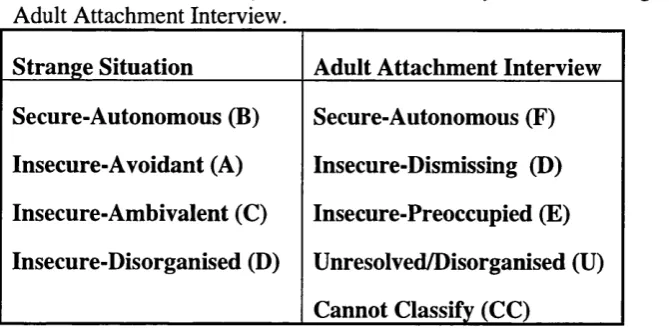
Table 1. Classification systems for attachment style for the Strange Situation and the Adult Attachment Interview.
Strange Situation
Adult Attachment Interview
Secure-Autonomous (B)
Insecure-Avoidant (A)
Insecure-Ambivalent (C)
Insecure-Disorganised (D)
Secure-Autonomous (F)
Insecure-Dismissing (D)
Insecure-Preoccupied (E)
Unresolved/Disorganised (U)
Cannot Classify (CC)
Secure-Autonomous (F) classifications are assigned to AA I’s where the speaker, in presenting and evaluating life history, whether favourable or unfavourable, is internally consistent, providing clear, relevant and succinct responses. This classification is assigned to the majority of interviews conducted with a low-risk non- clinical population.
As with the Strange Situation two insecure classifications are distinguished with respect to AAI discourse : Insecure-Dismissing (D) and Insecure-Preoccupied (E). The D classification is assigned when there is clear violation of Grice’s maxim of quality. For example the speaker may use positive terms to describe parents such as “excellent mother, very normal relationship”, which are later either unsupported or actively contradicted i.e. “I didn’t tell her I broke my arm; she would have been really angry”. In addition such interviews often violate the maxim of quality with speakers insisting that they lack memories. This interview classification links to the Insecure- Avoidant category of the Strange Situation.
of quantity by speaking far beyond the natural conversational turn. Fonagy, Leigh, Steele, Steele, Kennedy, Mattoon, Target & Gerber (1996) have identified a rare subgroup of E classifications where interviewees appear to be fearfully preoccupied by experiences of trauma. This sub-category is associated with the subjects presenting with Borderline Personality Disorder. The Insecure-Preoccupied category is linked to the insecure-ambivalent classification for the Strange Situation.
The additional classification of Unresolved-Disorganised (U) has recently been introduced to describe those interviews where the speaker displays lapses of reasoning or discourse when discussing potentially traumatic events. For example the interviewee may talk about someone important having died on a number of different occasions, or abruptly shift to talking in eulogistic terms. Interviews with clinically distressed subjects tend to show a greater number of these types of lapses. The U category is linked to the disorganised classification in the Strange Situation.
Hesse (1996) has recently written about those interviews which show no well- defined discourse strategy, with interviewees alternating between apparently incompatible dismissing and preoccupied states of mind. These interviews are assigned a rating of Cannot-Classify (CC), and are found in higher numbers in psychiatric samples and individuals who are either abusive, or have experienced abuse.
Reflective Self-Functioning
awareness of others’ mental states in emotional reactions of guilt and shame (Emde, 1990), the emergence of empathy (Zahn-Waxier, Cole, & Barrett, 1991), and the emergence of pretence in social interaction and play (Dunn and Brown, 1991; Fonagy and Fonagy, 1992). The scale as applied to the AAI is based on the hypothesis proposed above that environmental factors, particularly in relation to ones attachment experiences, will lead to differences in individuals capacity for mentalisation. Thus raters using the scale should be able to assess the extent to which the interviewee is able engage in a variety of speech indicating Reflective Self-Functioning (RSF).
A number of key elements are highlighted as particularly important in this respect : 1. Special mention of mental states by the interviewee - i.e. representing the self or other as thinking and feeling, making explicit statements as to the source of interpersonal knowledge, or anticipation of the reaction of another taking into account the other's perception of their own mental state.
2. Sensitivity to the characteristics of mental states - i.e. recognising the fallible nature of knowledge, explicit recognition of the limitations of wishes thoughts and desires with respect to the real world, or acknowledgement that the mental world is uncertain but has a causative effect on events.
3. Sensitivity to the complexity and diversity of mental states - i.e. reference to the possibility of diverse perspectives and points of view of the same event, recognition that causality in the social world may be complex, and not necessarily analogous to the world of physical causality, or recognition that social roles interact and the same person may hold differing, even contradictory attitudes in different relationships or contexts.
5. Appreciation of possibility of change in mental states, with implications for corresponding changes in behaviour - i.e. recognition that change is possible between the ideas of childhood and those of adulthood, or recognition of the possibility that attitudes may change in the future.
As noted above the Reflective-Self Functioning scale provides a means by which the internal mentalising processes of adults may be accessed. Fonagy, Steele, Steele, Leigh, Kennedy, M attoon, & Target (1996) have provided a cogent argument of how attachment may influence the development of mentalisation which is increasingly influencing the way in which researchers conceptualise the difficulties encountered by individuals presenting with various psychopathological disturbance. In essence this model proposes that, as suggested above, the mother-infant relationship provides the earliest environment for the development of thinking, particularly in the development of mentalising. In secure attachment relationships they suggest that the caregiver not only responds in behavioural terms in a way that provides the infant with an internal model that the caregiver too has an internal model of the infant, but is able to convey that they have an internal model of the infant as a thinking entity, with the capacity for mentalisation. Object-relations theory suggests that the child internalises a model of a containing caregiver, in order to develop in it's thinking. Fonagy et al (1996) extend this notion of internalisation, suggesting that it is not simply that the child internalises a model of the caregiver as containing, but rather internalises a model of the themselves as a thinking entity within the containing caregiver. Thus the child does not simply internalise the notion of the caregiver as capable of mentalising, and thus able to contain the child’s distress, but rather perceives and further internalises a model of the caregivers stance with regard the child’s own mentalising capacity.
child as an individual capable of mentalising. As mentioned above, if the child within the attachment relationship experiences itself in the other as non-mentalising, it may develop concrete forms of thinking based on physical reality. Those attachment relationships which are characterised by abuse, hostility or emotional emptiness in particular, may lead the child to deliberately turn away from the process of mentalising, as the consideration of the caregivers hostile, dangerous or indifferent thoughts may be overwhelming. The implications of this hypothesis as it may relate to specific psychopathological disorders is discussed below, but as Fonagy et al (1997) have argued, there may be a particular reason for considering adolescence as a developmental phase during which mentalising is especially crucial to the development of psychopathology. The notion that adolescence is a particular phase of identity formation (Erikson, 1963, 1968;) and particularly that of the ego development (Loevinger, 1976, 1979), is central to many theories of this life-stage. If adolescence is a period during which identity formation is precarious, or in the process of developing, those individuals who have been unable to acquire mentalising capacity through their attachment experiences, may encounter difficulties in self awareness. In successfully negotiating the transition from the family environment to that of social responsibility, self awareness may be seen as essential. Fonagy et al suggest that lack of self awareness, as influenced by deficits in mentalising capacity, may serve to reduce the individuals sense of responsibility for their actions, and in part influence the development of externalising psychopathology such as conduct disorders or violence. Thus mentalising capacity may seen to be intimately linked to the increased incidence of criminal behaviour and delinquency during adolescence.
Research With the AAI
on the AAI. With infants classified as insecure-avoidant, mothers tended to be rated as Dismissing-detached (D) on the AAI, while insecure-ambivalent infants, had mothers who tended to rate as Preoccupied-entangled (E) parents. These findings have been replicated on a number of occasions, by Ainsworth herself, and Grossman and Grossman (1991). Of even more interest is the finding of Fonagy et al (1991), who demonstrated a 75% concordance between pregnant mothers ratings on the AAI and their child’s subsequent classification in the Strange Situation at one year. Thus 80% of secure mothers had securely attached infants, while 73% of insecurely rated mothers, had infants classified as insecure. The implications of this study indicate perhaps more clearly than before the traditional notion that early childhood experience has a profound effect on determining ones future attachment. This impressive demonstration of transgenerational transmission of attachment quality has paved the way for further research into the role of fathers with respect to development of attachment, and extensive longitudinal work examining the robustness of these initial findings using the AAI.
In it’s proposed capacity to access an individuals current ‘state of mind with respect to attachment’, researchers have also been interested in the AAI as a tool for collecting normative data from various adult populations regarding distribution of attachment patterns. Recently van Ijzendoom and Bakermans-Kranenburg (1996) carried out a meta-analysis of 33 studies, on more than 2,000 AAI’s, collected from non-clinical fathers, mothers, adolescents, samples from different cultures, and clinical samples. In many studies numbers have been relatively low but patterns have emerged suggesting a consistent pattern of attachment distribution within non-clinical samples. Thus 58-62% of mothers and fathers are classified as Secure-Autonomous (F), 22-24% as Dismissing (D), and 16-18% as Preoccupied (E).
AAI to study 42 clients identified as having serious psychopathological disorders that significantly interfered with social functioning. 12 subjects in the sample met DSM-II- R criteria for schizophrenia, 25 for manic-depression, 3 for major depression, and 2 for atypical psychosis. This early study primarily looked at two dimension of attachment Security vs. Insecurity, and whether this attachment was Dismissing (D) or Preoccupied (E). The sample was split into a primarily thought disordered group, and a primarily affective disordered group. The study demonstrated that those in the affective disordered group were more securely attached as measured by the AAI, but that there was no distinction between groups as to whether insecure attachment was Dismissing or Preoccupied in quality.
In a further study Dozier, Stevenson, Lee & Velligan (1991) examined the relationship between attachment style as assessed using the AAI in a sample of 40 adults with serious psychopathological disorders, and familial over-involvement or Expressed Emotion. A clear link was demonstrated between insecure attachment styles and familial over-involvement, further suggesting the strength of parental and familial relationships in determining the development of psychopathology.
may predict outcome at follow-up. The results of the study provide some of the most recent evidence that the way in which adults represent their early attachment relationships, links closely to the development of psychopathological disturbance. In particular that representations of insecure attachment patterns are significantly more apparent in a psychiatric sample as compared to ‘normal’ controls. In the study only 18 of the sample of 82 were rated as Secure-Autonomous on the AAI, as compared to 53 in the non-clinical sample of 85.
With respect to examining how attachment classification relates to BPD, the study demonstrated that on the Reflective Self-functioning scale, as applied to the AAI, those subjects meeting criteria for Axis II Borderline Personality Disorder, displayed a significantly lower capacity to reflect on either their mental states or those of others. This appeared to be particularly the case when these subjects reported having experienced physical or sexual abuse. Thus it seems that the experience of trauma associated with abuse may impact on a persons ability to reflect on mental states.
accessible to psychotherapy, than those Insecure-Preoccupied individuals, who already have a set of firmly held perceptions about past events.
Studies of Adolescents Using the AAI
The Adult Attachment Interview was initially designed as a means by which the internal representations of adults with respect to their past attachment could be accessed. However, soon after it’s development, Kobak and Sceery (1988) applied the AAI with a non-clinical sample of adolescents. Their study of 53 older adolescent college students, provided normative data on the distribution of attachment in late adolescence, illustrating that 28 of the total sample were classified as Secure- Autonomous (F), 17 as Insecure-Dismissing (D), and 8 as Insecure-Preoccupied (E). Larger sample studies have replicated these general findings (Hesse, van Ijzendoom, & Main, 1993; Sagi, van Ijzendoom, Scharf, Koren-Krie, Joels & Mayseless, 1994), demonstrating that approximately half those adolescents in a non-clinical sample show Secure-Autonomous pattems of attachment on the AAI. For the other half it would appear that approximately two-thirds display Insecure-dismissing attachment styles, while the remaining third are classified as Insecure-Preoccupied.
From studies of non-clinical samples, research has moved, as with AAI studies in adults, to examining adolescent clinical populations. There has been consistent evidence from a variety of sources that attachment insecurity may link to increased levels of psychopathology in adolescence. Armsden and Greenberg (1987) and Armsden et al (1990) for example have shown that insecurely attached adolescents are more likely to engage in problem-drinking, while Kwakman, Zuiker, Schippers, & deWuffel (1988) and Hughes, Francis, & Power (1989) have shown a link between insecurity of attachment and substance misuse. Cole and Kobak (1996) have also demonstrated the link between depression and Insecure-Preoccupied attachment, and eating disorders and Insecure-Dismissing attachment in young adults.
suicidal behaviour and attachment. There has long been a proposed link between the influence of family background and the aetiology of adolescent suicidal behaviour (Adam, 1990; Spirito, Brown, Overholser, & Fritz, 1989). Adam (1994) has presented a developmental model of suicidal behaviour based on attachment theory. This suggests that current suicidal behaviour is an :
‘extreme attachment behaviour occurring in response to current attachment threat, signalling distress and expressing anger toward an unresponsive or unavailable attachment figure ’
It is hypothesised that one may be able to determine the probability of engagement in suicidal behaviour, by analysing the discourse patterns of the AAI. Adam et al (1996) suggest that adolescents presenting with suicidal behaviour may represent the most insecure with respect to attachment, with high sensitivity to loss, disappointment and rejection. In particular they hypothesise that such adolescents may display a higher propensity to be classified as Unresolved-disorganised (U). As described above this classification applies to people who appear unable to maintain coherence when discussing traumatic experiences such as loss or abuse. They show lapses in their continuity of thought, express illogical or unusual beliefs, and show evidence of extreme behaviour at times of trauma
The study recruited 69 adolescent presenting with histories of suicidal behaviour and severe suicidal ideation, and 64 adolescents to a comparison group, who had never experienced suicidal behaviour or ideation. All subjects were interviewed with the AAI, with particular interest being focused on questions relating to trauma and resolution of loss. The hypotheses of the study were that adolescents in the case sample i.e. presenting with suicidal behaviour would be more likely to show responses that were unresolved-disorganised with respect to attachment-related trauma, and be classified overall as insecurely attached, as compared to those in the clinical comparison group.
insecure-preoccupied. 41% of males in the case sample and 30% of females in the case group showed this pattern. In the comparison group, males tended to be classified as dismissing with no associated unresolved-disorganisation (45%), while females tended towards autonomous patterns with no associated unresolved-disorganisation (27%). In total participants classified as Unresolved-disorganised dominated the case group, 64% as opposed to 34% in the comparison group.
In this study both groups had a similar prevalence in terms of history of exposure to attachment related trauma, yet the AAI appears able to distinguish those with a history of suicidal behaviour within a clinical sample. The finding that suicidal adolescents present as more Unresolved-disorganised with respect to those traumatic experiences, links to the suggestion by Main (1991), and Fonagy et al (1991) that there are profound implications for the development of thinking, in particular metacognition, as a result of disturbances in early attachment relationships. The ability to reach some kind of resolution with respect to early attachment related trauma and organise this in a coherent way distinguishes those who do not engage in suicidal behaviour from those who have high levels of suicidal ideation. There is an interesting similarity between the incoherence of discourse in the study sample, and the lack of reflective-self functioning or ability to mentalise displayed by those with BPD (Fonagy et al, 1996).
• That differing pattems of insecure attachment as measured by the AAI should relate to specific forms psychopathology. In particular it was hypothesised that those disorders defined as 'externalising' such as conduct disorders are closely associated with an Insecure-Dismissing attachment style, and that those labelled as primarily 'internalising' or affective disorders will co-occur with an Insecure- Preoccupied attachment style.
• Similarly to the Fonagy study, above, there was also an interest in looking at how personality disorders may be seen as representing a particular case with respect to attachment. Rosenstein and Horowitz in particular hypothesised that those personality disorders where effectively repressive defences are apparent should relate closely to Dismissing attachment style, and those characterised by affective lability should co-occur with Preoccupied attachment.
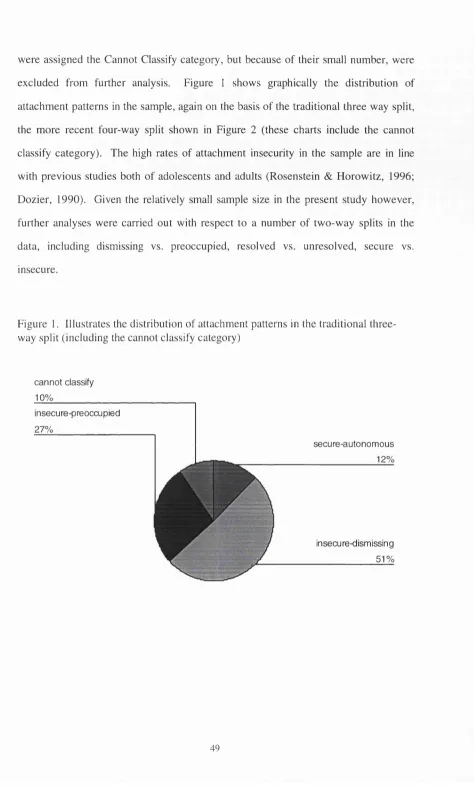
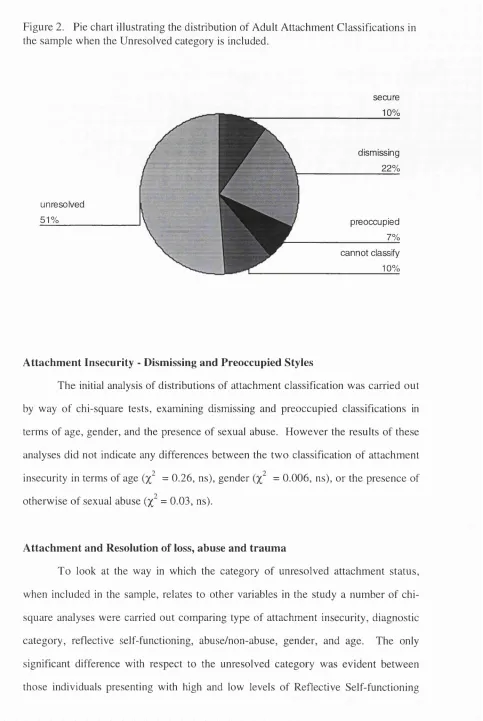
The overall results of the study show a distribution of classifications on the AAI, clearly distinct from that found by Kobak and Sceery (1988) in their non-clinical sample. Two analyses were carried out, the first including the three traditional categories on the AAI i.e. Autonomous (F), Preoccupied (E), and Dismissing (D), the second including the recently included Unresolved (U) category. In the first analysis 3% of the sample were classed as Secure-Autonomous, 47% were Insecure- dismissing, and 50% were Insecure-Preoccupied. When the Unresolved category was included 2% were classed as autonomous, 38% as dismissing, 42% as preoccupied, and 18% as unresolved. These high levels of insecure attachment are consistent with distributions found in adults populations (Dozier, 1990).
Insecure-Preoccupied. The sample also included subjects who presented with co-morbidity, thus either both affective, conduct or substance misuse disorders, in varying combinations. The study found that those adolescents presenting with concurrent conduct and affective disorders were more likely to be classified as Dismissing in their attachment style, as were those presenting with all three disorders.
Interesting gender differences were also observed in the study with respect to distribution of attachment styles. Thus from the male sample there was a strong tendency towards dismissing attachment style, (66%) as opposed to preoccupied (34%). In the female sample 68% showed a preoccupied attachment style as opposed to 25% showing a dismissing classification.
The study also employed Millon Clinical Multiaxial Inventory as a measure of personality characteristics of the sample. Interesting associations were found with respect to attachment classification and particular personality traits. Thus those classified as dismissive differed significantly from the preoccupied group, showing higher levels of antisocial, narcissistic and paranoid personality characteristics as measured by the MCMI. Those classified as Insecure-preoccupied on the other hand, showed high levels of avoidance, anxiety and dysthymia on the MCMI.
Attachment and Interpersonal Difficulties
As highlighted by the above study, and in line with Jones (1996) suggestion, an important area of future attachment research would be to examine the relationship between that AAI and other clinically relevant measures of interpersonal behaviour, role expectations and repetitive emotional structures. Attachment theory is primarily about relationships, and interpersonal communication, therefore it would seem reasonable to further examine of the validity of the AAI, by examining how classification relates to a measure of interpersonal difficulties. In particular the recent work of Fonagy et al (1996, 1997) suggests that examination of the interpersonal consequences of deficits in individual capacities for reflective self functioning, as measured by the AAI, would be extremely important in further exploring the link between mentalising and psychopathology.
The notion that people will continue to act in ways, sometimes maladaptive, in an attempt to maintain a psychological tie with an earlier attachment figure forms the basis of Interpersonal Theory (Sullivan, 1953; Leary, 1957). Thus an individual will continue to enact interpersonal styles that are similar in some representational or actual way to that of their earliest attachment relationship. Although this may often be painful in itself and cause difficulties in current relationships, it is hypothesised that these patterns of interpersonal relating serve to reduce the anxiety produced by relating in a different manner and thus protect the self-image. A current account of interpersonal theory suggests a number basic postulates :
That every interpersonal behaviour can be described along two axes
-• A dimension of affiliation of nurturance that ranges from hostile behaviour to friendly behaviour
• A dimension of power, control, and dominance ranging from submissive behaviour to dominating behaviour
action from another person. These often occur in complementary forms, such that each person assumes ways of behaving that fall at opposing ends of the axes i.e. one person is dominant in an interaction, whilst the other is submissive. It is proposed that conflict in relationships occur when two people interacting attempt to behave in the same way e.g. both dominating.
Difficulties with interpersonal relationships are among the most commonly problems reported in clinical settings, and therefore Horowitz and Rosenberg (1988) developed the Inventory of Interpersonal Problems as an instrument to measure such problems. Much of the research using this instrument has so far focused on validation studies. However, Horowitz and Rosenberg (1993) themselves produced an important piece of work examining the link between interpersonal problems, attachment styles, and outcome in brief dynamic psychotherapy. This work bridged the gap in the research literature between the long hypothesised link between attachment relationships and the later development of interpersonal difficulties. Horowitz and Rosenberg hypothesised that an individual's interpersonal style is intimately linked to his/her interpersonal learning history, and in part this must include that person's attachment history. Thus for example, people whose earliest social experience with their caregiver was disappointing, or insecure, may develop a distrust of other people, avoid intimate contact, or dogmatically retain control in relationships. A different set of experiences in ones early attachment relationship, such that the caregiver serves to underscore ones incompetence and dependence on others, may lead one to become submissive within adult interpersonal relationships.
participants hypothesised attachment style. In contrast to the development of the AAI described above, Bartholomew (1990) and Bartholomew and Horowitz (1991) have devised an alternative way of classifying individuals’ attachment style. The notion that the child internalises his/her experiences into a working model of attachment is still adopted, but also conceptualised in terms of the interpersonal problems with which they are associated. Four categories, three very similar to those proposed by the AAI, are generated :
• Secure - where the individual is judged to be comfortable with intimacy and autonomy
• Preoccupied - where the individual is preoccupied with relationships • Dismissing - where the individual is dismissing of intimacy, and is thus counter-dependent
• Fearful - where the individual fears intimacy, and is thus socially avoidant
It is interesting that in this study, Horowitz and Rosenberg adopt a very similar method for assessing attachment style, as in AAI research. Thus they use a semi-structured interview asking questions about the importance of close relationships, their experiences with loneliness and shyness, their trust of others, their impressions of other people evaluations of themselves, and their hopes for change in their social lives. These interviews are tape-recorded and then assigned to of the above classifications by a team of three raters. Of the sample in the study, 47% were judged as secure, 18% as dismissing, 14% as preoccupied, and 21% as fearful.
preoccupied group showed elevated levels of over-expressiveness, dominance and autocratic interpersonal styles. Finally, the fearful group reported interpersonal problems relating to submissiveness, introversion, and social inhibition.
Fonagy et al (1996, 1997) suggest a strong link not simply between an individuals attachment history and later interpersonal functioning, but how this may manifest itself as a consequence of the development of mentalising capacity. Thus the differences in interpersonal difficulties observed between those individuals rated as Dismissing and Preoccupied with respect to attachment, may reflect more their respective capacities for mentalising. It may be hypothesised that those individuals presenting as Dismissing, with associated interpersonal difficulties of coldness and introversion, may have a lower capacity for reflecting on the mental states of others, thus through their deficit in understanding the others perspective, tend to alienate people in interpersonal situations. By contrast individuals presenting as Preoccupied in their attachment style may show higher capacities for mentalisation, but through constant engagement, rumination, or preoccupation with the thoughts of other people, behave in ways which mediate anticipated threat, and thus show interpersonal styles of submissiveness or over-dependency.
THE PRESENT STUDY
From the current state of research it would seem that there is a need to further develop our understanding of adolescent psychopathology, with respect to attachment theory. The existing studies of adolescence employing the Adult Attachment interview have examined the link between adolescent representations of attachment experiences and the development of specific forms of psychopathology. However, aside from the Fonagy et al (1996) study, which focused on adult pathology, no study as yet has examined the relationship between adolescent psychopathology and the capacity to use reflective-self functioning. Thus the present study aims to bridge the gap between work with younger children examining links between attachment security and capacity for mentalising (Main, 1973, 1981; Kaplan, 1987; Fonagy et al, 1997), and the recent Fonagy et al study. With particular reference to the process of mentalising, Fonagy et al (1997) have highlighted a particularly interesting area of research which the present study aims to address, i.e. the link between decreased reflective self-functioning as measured by the AAI, and the presentation of externalising or conduct disorders in adolescents.
HYPOTHESES OF THE STUDY
The current study aims to address a number of hypotheses, and extend the existing literature with respect to attachment processes in adolescence.
• To replicate the distribution of AAI classifications demonstrated by Rosenstein and Horowitz (1996), particularly with respect to presenting psychopathology. Thus the current study hypothesises that for adolescents requiring inpatient treatment, those presenting with Internalising type disorders will be more likely to be classified as Insecure-Preoccupied with respect to attachment, while those with Externalising Disorders, will be more likely to be classified on the Adult Attachment Interview as Insecure-Dismissive
• That specific classifications on the AAI will be associated with differing capacities for reflective self-functioning. Thus those classified as securely attached will show a higher capacity for RSF then those rated as insecurely attached, and that in particular those classified as Unresolved with respect to trauma or loss will display the most difficulty with mentalising.
• That there will be specific associations between adolescent psychopathology and difficulties with the capacity for reflective self-functioning. Thus in line with the Fonagy et al (1997) work, those adolescents presenting with conduct or externalising disorder will be more likely to present with difficulties in mentalising capacity.
• To examine how attachment style may relate to self-report symptomatology and interpersonal problems, and further to explore whether, specific interpersonal difficulties may relate to problems with RSF.
METHOD
Participants
41 adolescents, aged between 13 and 20 participated in the study. All participants were either resident on, or had been resident and were now attending as day-patient, an in-patient treatment unit. The sample included participants with a wide range of reasons for admission, the majority presenting with emotional and behavioural disturbance. The range of psychiatric diagnoses within the sample are outlined below. Those people presenting as either actively psychotic or with significant developmental delay were not included in the study.
Clinical professionals at each site were reluctant to assign diagnoses to any of the participants, (this issue will be discussed in more detail later). Thus classification of psychiatric diagnosis was established through careful examination of subjects medical notes, in conjunction with the Diagnostic and Statistical Manual of Mental Disorders 4th Edition, American Psychiatric Association (1994). For the purposes of the present study diagnoses were then initially classified into three types : Affective Disorders, Conduct Disorders, and Substance Misuse Disorders. This follows the system adopted by the Royal College of Psychiatry for classifying adolescent psychiatric problems (Scarth, 1993). However, when co-morbidity was accounted for numbers in respective groups (excepting Affective Disorders) were too small for further analysis. Thus diagnosis was further categorised by assigning each participant to either an Externalising disorders group (Conduct disorders. Substance Abuse), or Externalising Disorders Group (Affective disorders). For those participants presenting with co-morbidity, the primary presenting difficulty was taken into account in assignment to diagnostic group. This yielded two groups.
The average age of the sample was 16, with ages ranging from 13 to 20. 29 females and 12 males were recruited to the study, based on availability of participants at each sample site. Although not formally assessed, examination of participant medical and historical notes indicated that the sample reflected backgrounds of all social/occupational classes I-V. Formal assessment of intelligence was not carried out, but again further examination of participant notes, showed an even distribution in terms of educational achievement.
Design and Procedure
sought from their parent or guardian. Copies of these consent forms are shown in Appendix (III). Once the appropriate consent had been received participants were seen for approximately one and 1/2 hours, to carry out the interview and pscyhometric measures.
Measures
The Adult Attachment Interview - AA7 (George, Kaplan & Main, 1985). As described above the AAI is a semi-structured interview, the aim of which is to access an individuals current representation of their childhood experiences with respect to attachment. A variety of attachment related topics are covered in the interview including the general quality of the early child-caregiver relationship, experiences of early illness, separation, rejection, loss, and maltreatment. For each topic area the interviewer probes the interviewee for specific memories in support of general statements made, in addition to a number of further standard probe questions. Interviews last approximately 30-75 minutes each, being audiotaped and then transcribed, before rating.
Coding system fo r the AAI. The interviews in the current study were assessed by an experienced rater (Howard Steele), who was trained in conducting the coding by M.Main and E.Hesse in 1987, and again in 1994. This rater has extensive experience of both using and rating the AAI. The rater was unfamiliar with the sample having no knowledge or access to demographic information.
Probable Experience
State of Mind
• Loving parents Idealisation of parents
• Rejecting parents Derogation of parents
Neglecting parents Involving anger with parents
• Role reversal with parents Quality of recall
• Pressure to achieve Coherence of narrative
Overprotection Passivity of thought
Fear of loss of child Reflective self
With reference to the above categories the interview is assigned an overall rating of the interviewees state of mind with respect to attachment experiences. Theses categories are outlined above. The three main categories can be classified into subtypes of F, Ds, and E interviews. Fonagy et al (1996) give the example of subtypes o f Preoccupied (E) interviews : E l is assigned when interviews given the overall rating of E indicate a passive stance in relation to an ill-defined experience of childhood; E2 classifies an interview characterised by high levels of current anger concerning past experiences; E3 classifies interviews characterised by fearful preoccupation with previous traumatic events.
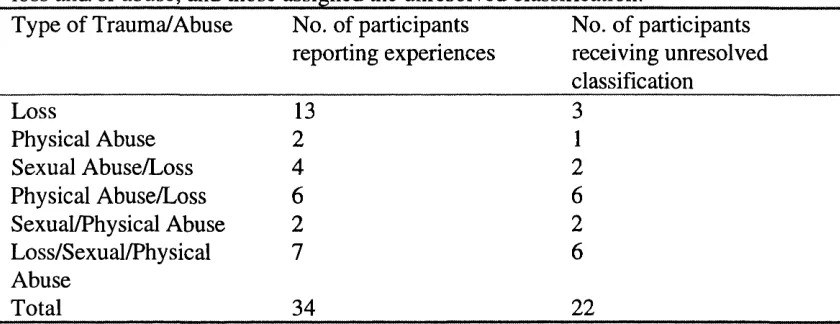
Unresolved category would be high. The assignment of the unresolved category depends on consideration of particular passages in the AAI which ask about experiences of loss and/or abuse. If the respondent replies that he/she has experienced loss or trauma the rater assigns a score on a nine-point scale regarding the degree to which the respondent appears to have resolved this experience. Scores of five or below are reflective of resolution. Scores above five indicate that the individual is currently unresolved with respect to that experience. Respondents can obtain ratings of lack of resolution for loss, sexual abuse, and/or physical abuse. The following are guidelines suggested by Main (1994) for the scoring of lack of resolution of trauma. (Although obviously pertaining to a different set of experiences passages pertaining to loss are rated in a similar fashion). They indicate which areas of discourse qualify for ratings of resolution and give indications of how to score lack of resolution of trauma.
Trauma is indicated by any of the following :
• Participants remembers being badly hit, enough to be frightened of the physical situation at the time, even if now he/she doesn’t regard it as necessarily being abuse.
• Any striking of the child which leaves marks.
• Parent goes into rages directed at the child, gets out the belt etc. and these are frightening.
• Subject was locked into closets, punished in bizarre ways.
• Parent threatens to harm or kill participant, and it is clear that this is not joking, simple exasperation, etc.
The following are discourse patterns which indicate lack of resolution :