S.SARAVANAN
Professor, Department of EEE,
B.V. Raju Institute of Technology, Narsapur, Telangana, India [email protected]
S.AMOSEDINAKARAN
Assistant Professor, Department of EEE,
Gojan School of Business and Technology, Redhills, Chennai Tamil Nadu, India [email protected]
K.KARUNANITHI
Professor, EEE Department, Siddharth College of Engineering and Technology, Puttur, Andhra Pradesh, India [email protected]
Abstract : The main objective of the present study is to apply the meta-heuristic techniques such as Genetic Algorithm (GA) and Differential evolution (DE) to estimate the electricity consumption (EC) of domestic sector (DS) in India. Population, per capita GDP and Electricity production were selected as independent variables. The models are developed in exponential form is proposed to forecast the DS-EC of India. Results of the comparison showed that the performance values of the DE method are better than the performance values of the GA. According to obtained results, Mean Absolute Percentage Error (MAPE) of the DE model provides better-fit solutions. DS-EC of India is forecasted up to the year 2025. According to the DE model, India’s DS-EC will increase to a value of 440931.68 Giga Watt hour (GWh).
Keywords: Differential Evolution, Genetic Algorithm, Domestic sector, Electricity consumption, Electricity production.
1. INTRODUCTION
Electricity is one of the most significant components in energy sources. It has substantial increase in consumption mainly due to the growing population, increasing living standards and industrialization process [1]. During the earlier period, electricity was generally used for lighting but in the latter part with the installation of new appliances such as television, washing machine, cooker, kettle, refrigerators the consumption for using electricity becomes high. In India, EC has been growing in parallel with the urbanization and industrialization level and economic development of the countries. DS-EC estimates have been used by a number of researchers and policy decision makers to investigate the demand behavior and to understand other issues such as forecasting, demand side management and policy analysis [2].
Figure 1 India’s electricity consumption between the years 1975 and 2010
The DS-EC and its determinants are of crucial importance for the contemplation of energy policy of an economy. The idea is that the supply of electricity requires the operation of electricity-generating plants which are costly to construct and also take considerable time (approximately 4 to 10 years) to have them operational [4]. The DS-EC varies significantly between regions and countries. These variations are due to differences in economic factors such as real electricity prices, efficiency improvements as well as structural and behavioral factors such as socio demographic factors, climatic condition and living standards. The aim of this study is to provide an accurate and a realistic estimation model for DS-EC using population, per capita GDP and electricity production. Over the last decades there has been a growing interest in algorithms inspired from the observation of natural phenomenon. It has been shown by many researches that these algorithms are good replacement as tools to solve complex computational problems. Recently genetic algorithm (GA) is adopted by researchers around the world to estimate the EC. Differential evolution algorithms (DEs), as powerful and broadly applicable to a wide range of optimization problem and stochastic search techniques, are the widely known types of evolution computation methods nowadays. DE has been successfully applied to wide range of problems such as optimization problems in power system planning, optimal power flow and economic dispatch.
2. LITERATURE SURVEY
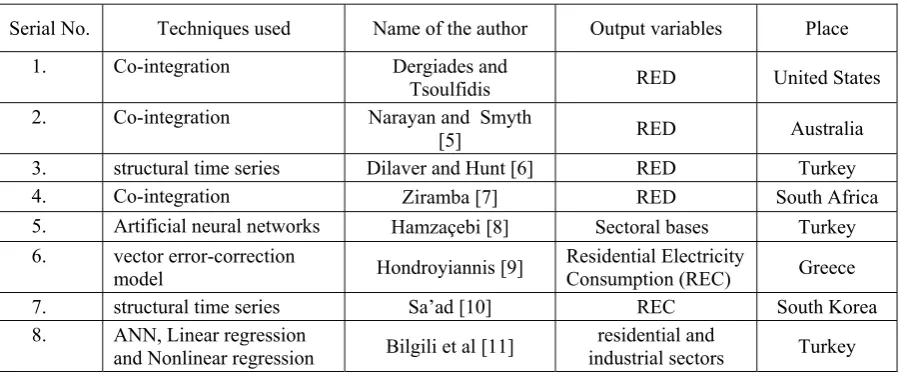
Energy studies have received a great deal of attention during the last two decades. Thus, there is an extensive literature in which electricity demand functions have been estimated or forecasted by using several econometric and statistical methods such as univariate and multivariate technique [1]. There are several empirical studies that have examined the determinants of residential demand for electricity in a number of countries [4-13]. Empirical studies of the residential electricity demand have received considerable attention in both developed and developing countries. Different approaches have been used to analyze the determinants of residential demand for electricity in the literature. Some methods frequently used as a forecasting tool are summarized in Table 1.
Table 1 Literature survey for forecasting Residential electricity demand (RED) and techniques used
Serial No. Techniques used Name of the author Output variables Place
1. Co-integration Dergiades and
Tsoulfidis RED United States
2. Co-integration Narayan and Smyth
[5] RED Australia
3. structural time series Dilaver and Hunt [6] RED Turkey
4. Co-integration Ziramba [7] RED South Africa
5. Artificial neural networks Hamzaçebi [8] Sectoral bases Turkey 6. vector error-correction
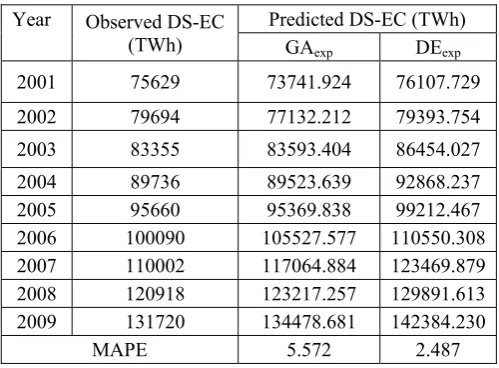
for the test data between the years 2001 to 2009. In the last step, this algorithm selects the preferred method based on minimum MAPE.
4. ESTIMATION OF INDIA’S DS-EC
In this study, the estimation of Residential sector EC based on economic indicators was modeled by using various evolutionary techniques such as GA and DE. Exponential forms of these techniques can be expressed as (1),
The nonlinear, exponential form of the model is
GAexp= w1 + w2 X1w3 +w4 X2w5 + w6 X3w7 (1) where,
X1 is the Population. X2 is the per capita GDP. X3 is the Electricity production.
w1,w2,w3,….,wn are the weighting parameters.
The fitness function (i.e. MAPE) takes the following form (2):
where, Eobs and Eest are the observed and estimated electricity consumption and n is the number of observation.
4.1 Application of the models:
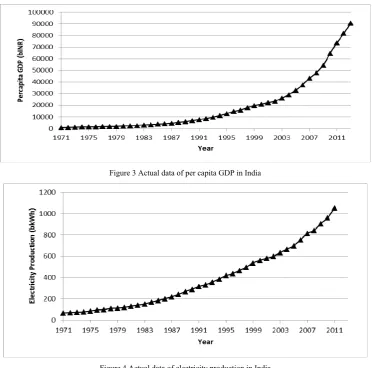
The data related to the design parameters of India’s Population, per capita GDP and Electricity production are obtained from the World Bank data [16] values are shown in figures 2 to 4.
Figure 3 Actual data of per capita GDP in India
Figure 4 Actual data of electricity production in India The DS-EC of the GA and DE model are performed with following parameters:
Table 2 GA and DE parameters
Parameters GA and DE
Population size (NP) 90
Generation (Gmax) 300
Number of weighting variable (w) 7
Crossover constant (CR) 0.3
Scaling mutation factor (F) 0.92
The application of the GA model results in the following estimated optimum (or) near optimum weighting variables (i.e. minimum MAPE).
GAexp= 9.8045-0.1760 X1-16.6373 +10.3812 X2-17.0283 +8.6608 X31.4272 MAPE = 5.572
The application of the DE model results in the following estimated optimum (or) near optimum weighting variables (i.e. minimum MAPE).
DEexp= -96.7200+0.1790 X12.4490 -5.0000 X20.6860 +5.0000 X31.4820 MAPE = 2.487
2007 110002 117064.884 123469.879 2008 120918 123217.257 129891.613 2009 131720 134478.681 142384.230
MAPE 5.572 2.487
The performance of the GA and DE for the testing period was given in Table 3. From the results in Table 3, the actual value of DS-EC in the year 2004 was 89736 GWh and in the year 2006 was 100090 GWh. The EC predicted using GA was 89523.639 GWh (year 2004), and 117064.884 GWh (year 2006). The DS-EC predicted using DE was 92868.237 GWh (year 2004), and 110550 GWh (year 2006). The results for the remaining years were also presented in Table 3. The lowest MAPE (2.487) was in the exponential form of DE model when compared with the exponential form of the GA model.
5. FUTURE ESTIMATION
The future estimation of EC-DS for the year (2017 to 2025) using GA and DE model was made. To forecast the EC-DS, input variables (population, per capita GDP and electricity production) should be analyzed and their trends for the future need are to be predicted. The forecasted results of input variables based on historical data are given in Table 3 [15]. Population is given in Millions, Per capita GDP in Million Indian Rupees (MINR) and Electricity Production in Tera Watt hour (TWh).
Table 3 Predicted input variables [15]
Year Population (Millions) Per capita GDP (MINR) Electricity Production (TWh)
2017 1342.290 650790.391 1413.561326
2018 1359.113 683509.243 1483.875721
2019 1375.935 716361.066 1554.741822
2020 1392.758 749309.372 1626.041669
2021 1409.581 782326.252 1697.677433
2022 1426.403 815385.477 1769.530726
2023 1443.226 848471.102 1841.526076
2024 1460.048 881573.425 1913.615533
2025 1476.871 914686.459 1985.768223
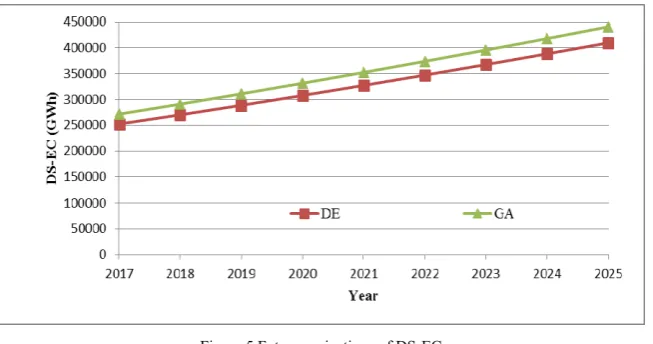
Figure 5 Future projections of DS-EC
Figure 5, shows the estimated DS-EC value for GA and DE of India. The predicted DS-EC calculated using the application GA is 327264.62 GWh and DE is 352548.93 GWh.
6. CONCLUSION
Electricity is vitally important for modern economies. It enables consumers to use appliances such as computers, medical devices, telecommunication appliances and transport vehicles; all of which increase the quality of life. Most of these appliances are arguably now indispensable in consumers’ daily lives and they are powered by electricity. Given its importance, the focus of this paper is to identify, quantify and understand the main drivers of India’s DS-EC. Thus, it is important to examine the main determinants of DS-EC since the analysis of the electricity demand conveys useful information for India. The results of the presented study are helpful to give a new direction to the energy planning studies by policy designers, manufacturer of power system components and independent power producers among others. In 2025, the DS-EC of India may reach between 409943GWh and 440931 GWh by using GA and DE model. Thus, the selected DE model of the DS-EC may be used for policy simulations and forecasting purposes.
REFERENCE
[1] Arisoy, I.; Ozturk, I. (2014): Estimating industrial and residential electricity demand in Turkey: A time varying parameter approach. Energy, 66, pp. 959-964.
[2] Halicioglu, F. (2007): Residential electricity demand dynamics in Turkey. Energy Economics, 29(2), pp. 199-210. [3] Electricity consumption [on line] http://goo.gl/468Aj
[4] Dergiades, T.; Tsoulfidis, L. (2008): Estimating residential demand for electricity in the United States, 1965–2006. Energy Economics, 30(5), pp. 2722-2730.
[5] Narayan, P. K.; Smyth, R. (2005): The residential demand for electricity in Australia: an application of the bounds testing approach to co-integration. Energy policy, 33(4), pp. 467-474.
[6] Dilaver, Z.; Hunt, L. C. (2011): Modeling and forecasting Turkish residential electricity demand. Energy Policy, 39(6), pp. 3117-3127. [7] Ziramba, E. (2008): The demand for residential electricity in South Africa. Energy Policy, 36(9), pp. 3460-3466.
[8] Hamzaçebi, C. (2007): Forecasting of Turkey's net electricity energy consumption on sectoral bases. Energy Policy, 35(3), pp. 2009-2016.
[9] Hondroyiannis, G. (2004): Estimating residential demand for electricity in Greece. Energy Economics, 26(3), pp. 319-334. [10] Sa’ad, S. (2009): Electricity demand for South Korean residential sector. Energy Policy, 37(12), 5469-5474.
[11] Bilgili, M.; Sahin, B.; Yasar, A.; Simsek, E. (2012): Electric energy demands of Turkey in residential and industrial sectors. Renewable and Sustainable Energy Reviews, 16(1), pp. 404-414.
[12] Athukorala, P. P. A.; Wilson, C. (2010): Estimating short and long-term residential demand for electricity: New evidence from Sri Lanka. Energy Economics, 32, pp. S34-S40.
[13] Amjadi, M. H.; Nezamabadi-Pour, H.; Farsangi, M. M. (2010): Estimation of electricity demand of Iran using two heuristic algorithms. Energy Conversion and Management, 51(3), pp. 493-497.
[14] Jobert, T.; Karanfil, F. (2007): Sectoral energy consumption by source and economic growth in Turkey. Energy Policy, 35(11), pp. 5447-5456.
[15] Saravanan, S.; Kannan. S.; Thangaraj, C. (2014): Electric energy consumption of domestic sector in INDIA”, REVISTA TECNICA DE LA FACULTAD DE INGENIERIA UNIVERSIDAD DEL ZULIA (Technical Journal of the Faculty of Engineering, TJFE)¸ 37(4), pp. 41-50.