• No results found

2018 BLAST LAB PPT.pdf

N/A
N/A
Protected

Academic year: 2020

Share "2018 BLAST LAB PPT.pdf"

Copied!
29
0
0

Loading.... (view fulltext now)

Full text

(1)

Comparing DNA Sequences to

Understand Evolutionary

Relationships with BLAST

(2)

Lab Investigation 3: BLAST Pre-Lab

Essential Question:

(3)

Lab Investigation 3: BLAST Pre-Lab

Learning Objectives: You will be able to

-•

create cladograms that depict evolutionary

relationships

analyze biological data with a sophisticated

bioinformatics online tool

use cladograms and bioinformatics tools to

ask other questions of your own and to test

your ability to apply concepts you know

(4)

Lab Investigation 3: Pre-Lab

Background Information:

Read pages S41 to S44.

Answer the following on your pre-lab handout.

1. Explain why being able to identify the location and

sequence of genes is important.

2. Why is bioinformatics considered a powerful tool?

Provide 2 pieces of evidence to support your claim.

3. What is a cladogram? How are cladograms used?

4. Draw a cladogram that depicts the evolutionary

(5)

Lab Investigation 3: Pre-Lab

5. Use data in

Table 1

to construct a cladogram of the major

plant groups. (page S43)

6. Look at

Table 2

.

Percentage Similarity Between the GAPDH

Gene and Protein in Humans and Other Species

on page S44

that compares the % similarity between the GAPDH gene and

protein in humans with the other species in the table.

a. Why is the percentage similarity in the gene always lower than

the percentage similarity in the protein for each of the

species? (Hint: Think about how a gene is expressed to

produce a functional gene product, in this case a protein.)

(6)
(7)

Comparing DNA Sequences to

Understand Evolutionary

Relationships with BLAST

(8)

Lab Investigation 3: BLAST Lab

Procedure –

Read the paragraphs at the

bottom of page S44.

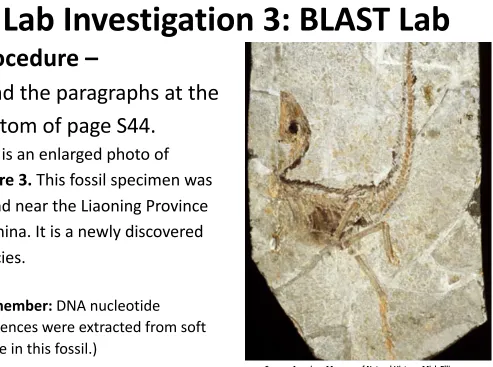
This is an enlarged photo of

Figure 3.

This fossil specimen was

found near the Liaoning Province

in China. It is a newly discovered

species.

(

Remember:

DNA nucleotide

sequences were extracted from soft

tissue in this fossil.)

(9)

Lab Investigation 3: BLAST Lab

Procedure

It’s uncommon for any soft tissue to survive

fossilization, but DNA nucleotides were extracted

from small amounts of soft tissue in this fossil.

Scientists used that information to sequence

several genes.

(10)

Lab Investigation 3: BLAST Lab

STEP 1:

Using Figure 4. Fossil Cladogram, form an initial

hypothesis as to where you think the fossil specimen

should be placed on the cladogram based on the

morphology (form and structure of an organism) you

made earlier.

Write your hypothesis to the right of the cladogram.

Remember to draw where you think the fossil

(11)

Lab Investigation 3: BLAST Lab

STEP 2:

Highlight and copy one of the 4

genes* on the handout provided.

STEP 3:

Upload one of the gene sequences into

BLAST by going to the BLAST homepage.

https://blast.ncbi.nlm.nih.gov/Blast.cgi

(12)

Home page for

BLAST

at NCBI

(13)
(14)
(15)

Uploading a Gene Sequence

(16)

Uploading a Gene Sequence

*

Be sure to add a job title so you know which gene nucleotide sequence you

uploaded.

Here’s the nucleotide

sequence.

(17)

Click on BLAST

(18)

Results

(19)

Results

(20)

Results

Click on a particular species to find out more specific information, including the

classification scheme (scientific name), the protein that the sequence codes for, and

the sequence of bases that appear to align with your gene of interest.

(21)

Results

(22)

Make a Distance Tree of Results

(23)

The Cladogram

(24)

The Legend

You will be provided

with a legend with that

includes a “Label Color

Map” and a “BLAST

names color map” so

that you can better

understand the

cladogram your search

produced.

(25)

Modifying the View

Change the Max Seq

Difference from

Change the Max Seq Difference

from 0.75 to 0.15 to see a close-up

of the tree. Your gene is

(26)

What’s next?

You will

Repeat this process for 2 other genes of interest.

Analyze your results.

Decide whether or not the data from the BLAST

search supports your hypothesis about the

placement of the fossil species on the cladogram.

(27)

Design and Conduct Investigation

You will

Find and BLAST your own genes of interest.

Use example procedure provided.

(28)
(29)

FOR TEACHERS:

You can use other resources like those

found at the

ENSI

,

UCMP

, and

BioInteractive

sites before or after doing

Figure

Figure 3. This fossil specimen was

References

Related documents

Primary: To test the effect of a face-to-face structured patient-specific smoking cessation program delivered by trained ambulatory pharmacists on smoking cessation rates in

This study investigates the influence of the skip fire cycle method for applied CDA to small displacement engine on specific fuel consumption and exhaust emissions

The ring leader of the 7/7 bombers, Mohammed Siddique Khan, was a part-time youth worker within one of Hamara’s projects, and may well have developed the plot with two other local

The most common instance of muscle entrapment occurs when the inferior rectus muscle becomes entrapped in a trapdoor fracture of the orbital floor (Figure 8) (Helveston,

Our contribution can be summarized as follows: (1) We propose a general formal PoR model with public verifiability for cloud data storage, in which block- less verification is

Entity Entity’s Tax ID (decedent’s Social Security Number is not valid**) IMPORTANT: INHERITANCE ELECTION (Page 2) - If you are requesting the beneficiary proceeds

A variation of phase shifting interferometry has been developed using a combination of a swept wavelength laser light source coupled with Fourier analysis of the returned

For example, if the students have selected one of the “F” or “C” terms but have provided for a payment mechanism in which the buyer does not pay until after the goods have been