S Y S T E M A T I C R E V I E W
Open Access
Community involvement in design,
implementation and evaluation of nutrition
interventions to reduce chronic diseases in
indigenous populations in the U.S.: a
systematic review
Jinan Banna
1*and Andrea Bersamin
2Abstract
Background:
Indigenous peoples of the United States disproportionately experience chronic diseases associated
with poor nutrition, including obesity and diabetes. While chronic disease related health disparities among
Indigenous people are well documented, it is unknown whether interventions adequately address these health
disparities. In addition, it is unknown whether and to what extent interventions are culturally adapted or tailored to
the unique culture, worldview and nutrition environments of Indigenous people. The aim of this review was to
identify and characterize nutrition interventions conducted with Indigenous populations in the US, and to
determine whether and to what degree communities are involved in intervention design, implementation and
evaluation.
Methods:
Peer-reviewed articles were identified using MEDLINE. Articles included were published in English in a
refereed journal between 2000 and 2015, reported on a diet-related intervention in Indigenous populations in the
US, and reported outcome data. Data extracted were program objectives and activities, target population,
geographic region, formative research to inform design and evaluation, partnership, capacity building, involvement
of the local food system, and outcomes. Narrative synthesis of intervention characteristics and the degree and type
of community involvement was performed.
Results:
Of 1060 records identified, 49 studies were included. Overall, interventions were successful in producing
changes in knowledge, behavior or health (79%). Interventions mostly targeted adults in the Western region and
used a pre-test, post-test design. Involvement of communities in intervention design, implementation, and
evaluation varied from not at all to involvement at all stages. Of programs reporting significant changes in
outcomes, more than half used at least three strategies to engage communities. However, formative research to
inform the evaluation was not performed to a great degree, and fewer than half of the programs identified
described involvement of the local food system.
Conclusions:
The extent of use of strategies to promote community engagement in programs reporting significant
outcomes is notable. In planning interventions in Indigenous groups, researchers should consider ways to involve
the community in intervention design, execution and evaluation. There is a particular need for studies focused on
Indigenous youth in diverse regions of the US to further address diet-related chronic conditions.
* Correspondence:
1
Department of Human Nutrition, Food and Animal Sciences at the
University of Hawai
’
i at M
ā
noa, Honolulu, USA
Full list of author information is available at the end of the article
© The Author(s). 2018Open AccessThis article is distributed under the terms of the Creative Commons Attribution 4.0 International License (http://creativecommons.org/licenses/by/4.0/), which permits unrestricted use, distribution, and reproduction in any medium, provided you give appropriate credit to the original author(s) and the source, provide a link to the Creative Commons license, and indicate if changes were made. The Creative Commons Public Domain Dedication waiver
Background
Indigenous peoples of the United States
disproportion-ately experience chronic diseases associated with poor
nutrition, including obesity and diabetes. American
Indian and Alaska Native (AIAN) preschool children have
the highest prevalence of obesity compared to other
racial/ ethnic groups (37.0% among AIAN compared to
17.4% among non-Hispanic whites) [
1
]. Disparities persist
into adulthood, and recent reports indicate that the
preva-lence of obesity among AIAN adults is approximately 80%
higher than among non-Hispanic whites and Asians [
2
].
Furthermore, although the prevalence of obesity appears
to have leveled off in other ethnic and racial groups, the
prevalence continues to rise among AIAN people [
3
,
4
].
Consistent with obesity rate, the prevalence of diabetes
is considerably higher in AIAN (17.9%) than in
non-Hispanic whites (7.9%) [
5
].
While chronic disease related health disparities among
AIAN people are well documented, it is unknown
whether interventions adequately address these health
disparities. In addition, it is unknown whether and to
what extent interventions are culturally adapted or
tailored to the unique culture, worldview and nutrition
environments of AIAN people. Genuine and equitable
partnerships between researchers and AIAN
communi-ties are critical to ensuring that interventions are
rele-vant. Community based participatory research (CBPR) is
considered best practice for conducting research with
AIAN communities [
6
,
7
]. Using a CBPR approach that
draws on the traditional knowledge of communities can
engender strength-based interventions that reinforce
cultural continuity and have broad positive impacts. For
example, programs seeking to strengthen the traditional
food system have the potential to address high
preva-lence of chronic disease in addition to promoting food
sovereignty. These traditional practices also provide a
foundation for cultural identity, a basis for social support
networks, and assist Indigenous Peoples in gaining
greater autonomy [
8
].
While involvement of the community at every step of
the process in intervention planning and implementation
in Indigenous groups has been widely noted to be
important in promoting adequate dietary intake, not all
programs have involved engagement with community
members. Examining and characterizing interventions
that have involved community engagement to various
degrees may prove useful for researchers and educators
planning to implement programs in Indigenous
commu-nities. The primary objectives of this systematic review
were to: 1) Identify and characterize nutrition
interven-tions conducted with Indigenous populainterven-tions in the
United States; and 2) To determine whether and to what
degree communities are involved in the design,
imple-mentation, and evaluation of the intervention.
Methods
Peer-reviewed journal articles were identified using the
online database MEDLINE.
Study inclusion and exclusion criteria
To be included in the review, research articles had to 1)
be published in a refereed journal between 2000 and
2015; 2) report on a diet-related program or intervention
conducted in an Indigenous population in the United
States; 3) report outcome data. Studies that were
reported in a language other than English, reported on
process data only, and review papers were not included.
Search strategy
The following two overarching concepts were identified
to guide selection of search terms and phrases based on
the review objectives: Indigenous populations and
chronic disease prevention/health promotion. For the
first key concept, related terms and phrases identified
were:
‘
Hawaii/ethnology
,
’ ‘
Native Hawaiian
,
’ ‘
Indians,
North American
,
’ ‘
American Indian
,
’ ‘
Native American
,
’
‘
Native Alaskan
,
’ ‘
Oceanic Ancestry Group/ethnology
.
’
For the second key concept, search terms and phrases were
as follows:
‘
diabetes mellitus/education
,
’ ‘
diabetes mellitus/
prevention and control
,
’ ‘
chronic disease/prevention and
control
,
’ ‘
nutritional sciences/education
,
’ ‘
obesity/prevention
and control
,
’ ‘
health promotion
,
’ ‘
overweight/prevention and
control
,
’ ‘
cardiovascular diseases/prevention and control
,
’
‘
wellness
,
’
and
‘
intervention
.
’
Boolean operators such as
AND and OR were used to link search terms.
Using the search terms, one researcher (JB) identified
abstracts for review. Referencing the inclusion criteria,
the same researcher examined the abstracts and
ex-cluded studies not meeting the requirements for
inclu-sion. The same procedure was followed with the full
papers identified using the abstracts remaining. Finally,
for all full papers included, a search was conducted for
other papers reporting on the same study by searching
for the title of the intervention and examining the
refer-ences in each paper. This search was conducted to
address the fact that many papers reporting outcomes
do not report on the steps involving community
engage-ment. While one goal of the review was to characterize
interventions and thus gauge the effectiveness of
pro-grams through outcomes reported, it was also imperative
to capture community involvement through examination
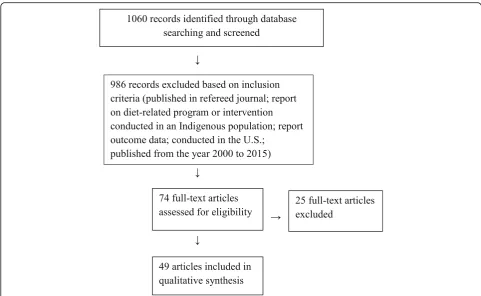
of all papers related to each study. Figure
1
illustrates
the search strategy used for this review.
Data extraction
of full studies identified and completed the abstraction
table. Data entered in the abstraction table included the
following: study objectives, target population/inclusion
criteria, study design, study setting (city, state), study
duration, sample size, response rate, intervention (focus
and main activities of the program), outcome variables,
measures utilized, involvement of the community in the
design, implementation, and evaluation of the
interven-tion (formative research to inform design and evaluainterven-tion,
partnership, community capacity building, involvement
of local food system), treatment length/follow up, drop
out, results, main implications, and limitations.
Data synthesis
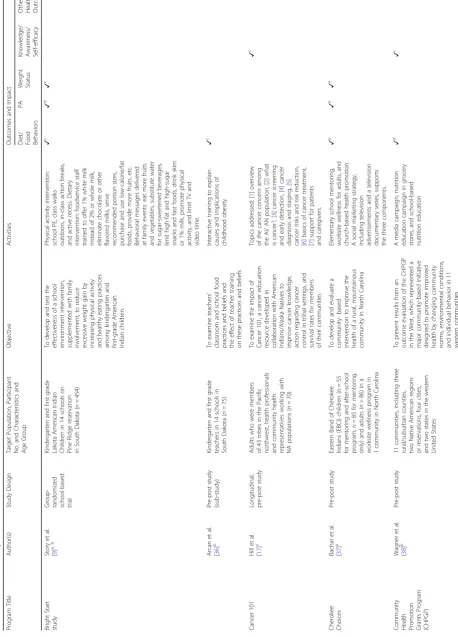
Table
1
contains a list and description of the 49 studies
identified in the literature search. Within these 49
studies, there were 39 distinct programs, given that the
outcomes of some programs were described in multiple
publications.
Quality appraisal of studies
Study quality was assessed using the Effective Public
Health Policy Project (EPHPP) Quality Assessment Tool.
The EPHPP Quality Assessment Tool provides criteria
to evaluate studies on the basis of selection bias, study
design, confounders, blinding, data collection methods,
withdraws and dropouts, intervention integrity, and
analysis. Each criterion is scored numerically according
to the guidelines as strong (score = 1), moderate (score
= 2), or weak (score = 3). Subsequently, the entire article
is rated as strong (no weak ratings), moderate (one weak
rating), or weak (two or more weak ratings).
Results
Program objectives
Program objectives varied. Four focused on reducing
BMI, one focused on increasing physical activity, five
focused on improving diet or food behaviors, six focused
on improving knowledge/awareness and/or self-efficacy,
five focused on improving other health outcomes (e.g.,
Hgb A1c, blood pressure, cholesterol), and 18 studies
had multiple objectives.
Program activities
All programs had a nutrition education component.
Seven also focused on changes to the physical
environ-ment (Table
1
). For example, an obesity prevention trial
in American Indian children incorporated changes to
foods served in the school setting to reduce calories [
9
].
In another study in Native American high school youth,
an existing room in the high school was remodeled into
a fitness center [
10
]. Twenty-nine programs included a
Table
1
List
and
description
of
the
49
studies
identified
in
the
literature
search
Program Tit le Author(s) Stud y Design Target Population, Participant No. and Characteristics and Age Group Object ive Ac tivities Ou tcomes and Impact D iet/ Food Beh aviors PA Weight Status Kn owledge/ Awar eness/ Self-eff icacyOther Health Outcome
Bright Start study Story et al. [ 9 ] a, b Group- randomiz ed school-based trial Kindergarten and first grade Lakota American India n Children in 14 schools on Pine Ridge reservation in South Dako ta ( n = 454) To develop and test the effectiven ess of a school envi ronment intervention, supplemen ted with family invo lvement, to reduce exc essive weight gain by increasin g physic al activity and healthy eating prac tices among kindergarten and first-grade American India n children . Phys ical activity interve ntion: school PE, class walks outdo ors, in-class action breaks, and active recess. Dietary interv ention: foodservice staff train ed to offer 1% white milk inste ad of 2% or whole milk, elimina te choco late or other fla vored milks, serve recommen ded po rtion sizes, purch ase and use low-ca lorie/fat foods, provide more fruits, etc. Beh avioral me ssages delivered at family events: eat more fruits and vegetables, subst itute water for sugar-sweetened be verages, limit high-fat and high-sugar sna cks and fast foods, drink skim or 1% milk, promot e ph ysical act ivity, and limit TV and video time. ✓ c ✓ d ✓ c Arcan et al. [ 36 ] b Pre-post study (sub-st udy) Kindergarten and first grade teachers in 14 schools in South Dako ta ( n = 75) To examine teachers ’ class room and school food prac tices and beliefs and the effect of teac her trainin g on these practices and be liefs Intera ctive training to explain caus es and impl ications of ch ildhood obesity ✓ c Cancer 101 Hill et al. [ 17 ] a Lon gitudinal, pre-p ost study Adults who were members of 43 tribes in the Pacific northwe st, health profes sionals and community heal th represent atives working with NA popula tions ( n = 70) To examine the impact of Cancer 101, a cancer education reso urce develo ped in collabo ration with American India ns/Alaska Natives to improve cancer knowledg e, acti on regarding cancer contr ol in tribal settings, and survival rates for members of their co mmunities Topics addressed: [ 1 ] overview of the cancer concern among the AI/ AN population, [ 2 ] what is cancer?, [ 3 ] cancer screening and early detectio n, [ 4 ] cancer diagn osis and staging, [ 5 ] cancer risks and risk reduction, [ 6 ] basics of cancer treatment, [ 7 ] support for patients and caregivers. ✓ c Cherokee Choices Bachar et al. [ 37 ] a Pre-post study Eastern Band of Cherokee Indians (EBCI ) childre n (n = 55 for mentoring and after-school program; n = 85 for mentoring only) and adults ( n = 86) in a worksite well ness progr am in 1 community in North Carolina To develop and evaluate a commu nity-based interv ention to improve the heal th of a rural, mountaino us commu nity in North Carol ina Elemen tary school me ntoring, works ite wellness for adults, and ch urch-based health promot ion. A socia l market ing strategy , includin g televisio n adver tisements and a television do cumentary series, supports the three compone nts. ✓ e ✓ e ✓ e
Community Health Promotion Grants
Table
1
List
and
description
of
the
49
studies
identified
in
the
literature
search
(Continued)
Program Tit le Author(s) Stud y Design Target Population, Participant No. and Characteristics and Age Group Object ive Ac tivities Ou tcomes and Impact D iet/ Food Beh aviors PA Weight Status Kn owledge/ Awar eness/ Self-eff icacyOther Health Outcome
Community Health Worker intervention Beckham et al. [ 39 ] a Pre-post study Native Hawaiian and Samoans on Oahu, 18 ye ars of age or older, diagnosis of type 2 diabetes and HbA1c readings over 10.0%; n = 116: n =8 0 CHW intervention, n =3 6 N o CHW intervention To examine the effectivenes s of CHWs on diabet es management among a po pulation with primari ly Nativ e Hawaiian and Sam oan ethnic minority participant s with HbA1c greater than 10%. CH Ws co nducted diabet es self-m anagement education for participant s. Participants were given voluntar y access to the Traditional Hawaiian Healing Center . ✓ c
Diabetes Prevention Program
(DPP) Mayer-Davis et al. [ 40 ] RCT Diverse adults age > 25 years, BMI > 24 kg/m2 (> 22 kg/m2 for Asian Americans), at high risk for diabetes (specifically, impaired glucose toleran ce plus a fasting plasma glucose of 5.3 – 6.9 mmol/l [or ≤ 6.9 mmol/l for American Indians]). recruited from 27 clinical centers throughou t the US ( n = 2934) To describe usu al dietary intake assessmen t at base line and 1-year post-randomization in the ethnically diverse DPP cohort. Train ing in diet, exercise and be havior modification skills, frequ ent contac t with the interv entionist, and delivery of the intervention in a cultu rally sensitive manner. ✓ c Wing et al. [ 41 ] RCT (seconda ry analysi s) Participa nts assigned to the intensive lifestyle interve ntion who were at least 25 years, BMI of 24 kg/m2 or greater (22 kg/m2 or higher in Asians), a fas ting plasma glucose of 95 to 125 mg/dL (125 mg/dL in Native Americans) and a plasma glucose value of 140 to 199 mg/dL 2 h after a 75-g glucose load from 27 clinical centers througho ut the US ( n = 1079). To examine demographic, psy chosocial, and behaviora l fact ors related to achieving weigh t loss and physical acti vity go als in the DPP lifest yle participant s. Par ticipants were assigned an indiv idual case manager . Core curricul um introduced basic skills relate d to nutrit ion, exerci se, and behavior change . ✓ e
Family Education Diabetes
Table
1
List
and
description
of
the
49
studies
identified
in
the
literature
search
(Continued)
Program Tit le Author(s) Stud y Design Target Population, Participant No. and Characteristics and Age Group Object ive Ac tivities Ou tcomes and Impact D iet/ Food Beh aviors PA Weight Status Kn owledge/ Awar eness/ Self-eff icacyOther Health Outcome
Table
1
List
and
description
of
the
49
studies
identified
in
the
literature
search
(Continued)
Program Tit le Author(s) Stud y Design Target Population, Participant No. and Characteristics and Age Group Object ive Ac tivities Ou tcomes and Impact D iet/ Food Beh aviors PA Weight Status Kn owledge/ Awar eness/ Self-eff icacyOther Health Outcome
Life in BALANCE pilot study Benyshek et al. [ 49 ] Pre-post study Urban American Indian /Alaskan Native (AI/ANs) residents in Las Vegas, Nev ada. 21 ye ars of age or older , AI/AN self-identi fication, BMI ≥ 25 kg/m2, HbA1c level between 5. 4 and 6.4% ( n = 22) To describe the translational type 2 diabet es prevention program spec ifically modified for an urban AI/A N po pulation and utilize the results of the pilot project to infor m larger future type 2 diabet es prevention progr ams target ing urban AI/AN po pulations through diet mo dification and increased ph ysical activity . Type 2 diabet es prevention co re curriculum and regular follow up. Curriculum included: weigh t-loss curriculum, meal plan ning, fat gram and calorie co unting, po rtion size, and food content education. ✓ c ✓ c
Medicine Wheel Nutrition Intervention Kattelmann et al. [ 50 ] a RCT Northern Plains Indian s from Cheyenne River Sioux Tribe in South Dako ta aged 18 to 65 years, with type 2 diabet es ( n = 114). To determine if Northern Plains India ns with type 2 diabetes mellitu s who are randomiz ed to receive culturally adapted educational lessons based on the Medicin e Wh eel Model for Nutrit ion in addition to their usual dietary education will have better contr ol of their type 2 diabetes than a noninterventi on, usual care grou p who received usual dietary education from personal provider s. The education group received nutrit ion lessons based on the Medi cine Wheel Nutrition Model to encourage consumption of a diet patterned after the tradit ional consumption of macr onutrients for Northern Plains India ns; protein (25% of ener gy), mode rate in carb ohydrate (45 to 50% of ener gy), low in fat (25 to 30% of ener gy). A registere d dietitian and tribal member, trained in the curriculum, led the classes. ✓ d ✓ d ✓ c
Native American Cardiovascular Risk
Reduction Program Burden et al. [ 51 ] Retro spective study Native Americans/ All patients enrolled in the cardiovascular risk reduction program from March 1997 – Octo ber 1999. Populations of 11 Rio Grande pueblos and numero us Native Americans living in urban areas in New Mexico ; n = 74 (36 men, 38 women) To report lipid management outcome s assoc iated with a card iovascular risk reduction progr am for Native Americans Eac h pat ient enrolled in the progr am were managed by a ph armacist clinician (PhC)-regis tered dietitian team. The primar y nutritio n interv ention strategy utilized the American Heart Associat ion diet in co njunction with increases in dietar y fiber and physic al act ivity. ✓ c
Native Hawaiian Diabetes Intervention Program
Table
1
List
and
description
of
the
49
studies
identified
in
the
literature
search
(Continued)
Program Tit le Author(s) Stud y Design Target Population, Participant No. and Characteristics and Age Group Object ive Ac tivities Ou tcomes and Impact D iet/ Food Beh aviors PA Weight Status Kn owledge/ Awar eness/ Self-eff icacyOther Health Outcome
Table
1
List
and
description
of
the
49
studies
identified
in
the
literature
search
(Continued)
Program Tit le Author(s) Stud y Design Target Population, Participant No. and Characteristics and Age Group Object ive Ac tivities Ou tcomes and Impact D iet/ Food Beh aviors PA Weight Status Kn owledge/ Awar eness/ Self-eff icacyOther Health Outcome
Table
1
List
and
description
of
the
49
studies
identified
in
the
literature
search
(Continued)
Program Tit le Author(s) Stud y Design Target Population, Participant No. and Characteristics and Age Group Object ive Ac tivities Ou tcomes and Impact D iet/ Food Beh aviors PA Weight Status Kn owledge/ Awar eness/ Self-eff icacyOther Health Outcome
im plemented a toll-free phone service for patients and staff to call for information and suppor t. Regularly schedule d breast feeding education classes for women and their families and for health care professional staff were initiated. PILI ‘ Ohana Pilot Project Mau et al. [ 14 ] a Pre-post study NH, Filipin o or OPI overweight/ obese adu lts ≥ 18 years or older in Hawai ’ i( n = 239) To implement and examine the effectiven ess of the culturally-adapted Diabetes Prev ention Progr am Lifestyle Intervention (DPP-LI) to promote weight loss in 5 NHOPI commun ities. Commu nity peer ed ucators de livered lessons on lifest yle ch ange, being active, healthy eating, managing stress, and co mmunicating with heal th profe ssionals. ✓ c Kaholokula et al. [ 64 , 65 ] a Pre-post study Native Hawaiian, Filipi no or other Pacific Islander ances try (i.e., Chuukese, Samoan) , 18 years of age, ove rweight/obese in Hawaii ( n = 239). To elucidate the sociodemogr aphic, be havioral, and biological factors associated with early weight-loss effor ts among four ethnically and organiza tionally diverse groups with me mbers at high risk for diabetes. The POP translated the Diabetes Prev ention Program Lifestyle Interv ention (DPP-LI) to initiate weigh t-loss efforts as part of a larger commu nity-based lifestyle interv ention. The interven tion focuse d on eviden ce-based be havioral weight loss strategies for healthy eating, physical act ivity and stress/negative em otions management utilizing indiv idual action planning. ✓ c ✓ c ✓ c ✓ c Sacred Beginnings Richards et al. [ 66 ] a Pre-post study em bedded in RCT AI girls aged 11 – 14 years old in the Norther n Plains region ( n = 77) To examine the influence of a CBPR preconcepti on health interv ention amon g AI adole scent females The educational intervention co nsisted of 15 preconception hea lth education sessions and was piloted duri ng a summer high school residen tial academ ic program. Topics included nutritio n; fitnes s and exerci se; diabe tes; prescription me dication abuse; Lakota cultu ral perspectives on womanho od, pregnancy, and parenting. ✓ c
Special Diabetes Program
for
Indians Diabetes Prevention (SDPI-DP)
Table
1
List
and
description
of
the
49
studies
identified
in
the
literature
search
(Continued)
Program Tit le Author(s) Stud y Design Target Population, Participant No. and Characteristics and Age Group Object ive Ac tivities Ou tcomes and Impact D iet/ Food Beh aviors PA Weight Status Kn owledge/ Awar eness/ Self-eff icacyOther Health Outcome
Special Diabetes Program
for Indians Healthy Heart Demonstra tion Project Moore et al. [ 68 ] Pre-post study AI/AN 18 years or older with diabetes ( n = 3373) To evaluated the effect on multipl e CVD disea se risk factors among AI/ANs with diabe tes who participated in a large-sc ale, multidi sciplinary, intens ive case management interv ention. Mu ltidisciplinary teams im plemented an intensive case managemen t intervention. The case manager develope d an indiv idualized care plan for CVD risk redu ction for each participant and periodically upda ted it in response to participant progr ess. ✓ c
Stanford Chronic Disease
Self-Manageme nt Program (CDSMP) Jernigan et al. [ 69 ] a Pos t-test Native American adults, aged 18 years and older, with Type 2 diabetes in the Santa Clara Valley ( n = 12) To demonstrate how the CBP R process facili tates the successful trans lation of the Stanfo rd progr am and how CBPR is used within this commu nity to build commu nity capaci ty. The Stanford CDS MP is a pe er-led program that integra tes self-efficacy theory through guided mastery exp eriences, acquisition of skills and enhanceme nt of self-co nfidence through peer mo deling, reinterpretati on of ph ysiological symptoms, and socia l pe rsuasion. ✓ e
Stop Atherosclerosis in
Native Diabetics Stud y (SANDS) Howard et al. [ 70 , 71 ] Pre-post study AI men and wome n ( n = 548) with type 2 diabetes, aged 40 years or older in Oklahoma, Arizona, and South Dako ta To compare progression of subclini cal atheroscl erosis in adul ts with type 2 diabetes tre ated to reach aggressive target s of low-density lipoprotein cholest erol (LDL-C) of 70 mg/dL or lower and systolic blood press ure (SBP ) of 115 mmHg or lowe r vs standa rd targets of LDL-C of 100 mg/dL or lower and SBP of 130 mmHg or lower. Stud y perso nnel performed BP and lipid management . Par ticipants receive nutrition co unseling and physic al activity recommen dations consist ent with Indian Health Service (IHS) guidelin es for peop le with diabet es, hypertension, and dys lipidemia, and were referr ed to IHS provider for diabetes managemen t. ✓ c Strong in Body and Spirit Gilliland et al. [ 11 ] a Nonr andomized co mmunity-base d interv ention Native Americans ≥ 18 years with type 2 diabetes in New Mexico ( n = 159) To determine the effects of a cultu rally appropriate diabetes lifest yle interv ention for Nativ e Am ericans with risk factors or compl ications of diabet es. The interven tion was de signed to improve participants ’ overa ll risk fact or profile s and focused on maki ng heal thy changes (e.g. eating less sugar and fat, more exerci se) and was not a weigh t -los s program. ✓ c
Toddler overweight and
toot
h
decay prevention study
Table
1
List
and
description
of
the
49
studies
identified
in
the
literature
search
(Continued)
Program Tit le Author(s) Stud y Design Target Population, Participant No. and Characteristics and Age Group Object ive Ac tivities Ou tcomes and Impact D iet/ Food Beh aviors PA Weight Status Kn owledge/ Awar eness/ Self-eff icacyOther Health Outcome
Table
1
List
and
description
of
the
49
studies
identified
in
the
literature
search
(Continued)
Program
Tit
le
Author(s)
Stud
y
Design
Target
Population,
Participant
No.
and
Characteristics
and
Age
Group
Object
ive
Ac
tivities
Ou
tcomes
and
Impact
D
iet/
Food Beh
aviors
PA
Weight Status
Kn
owledge/
Awar
eness/
Self-eff
icacy
Other Health Outcome
N/A
Rinderknech
t
et
al.
[
16
]
a
Single
-group
pret
est,
posttest
104
urban
Native
American
youth
(65
children
and
39
adolescents)
attending
an
after
-school
program
in
Minneapoli
s.
To
improve
dietary
self-efficacy
through
a
7-month
nutrition
interv
ention
for
Native
American
children
(5
to
10
years)
and
adole
scents
(1
l
to
18
years).
Les
sons
focused
on
improving
self-effi
cacy
by
exposing
the
yo
uth
to
mo
re
healthful
foods,
providing
opportunit
ies
for
the
yo
uth
to
success
fully
choose
the
more
heal
thful
alternatives
(taste
-testing),
discussing
ways
to
achieve
balance
through
hea
lthful
eating
and
ph
ysical
act
ivity,
and
conducting
the
participat
ive
learning
activities
with
peer
groups
,
allowing
mo
deling
opportuniti
es.
✓
c
N/A
Smith
et
al.
[
77
]
Pre-post
study
WIC
clients
from
the
Aleut
ian
Islands
(51%
Alaskan
Aleut
,
27%
white
Non-Hispanic,
15%
Asian,
and
6%
Hispanic)
(
n
=
400).
Other
ethnic
groups
represented
were
Filipino
,
Eskimo
,
and
Native
American.
Educational
back-ground
varied
from
high
school
or
less
to
graduate
degrees;
English
was
a
second
language
for
most.
To
get
a
better
understanding
of
how
television
can
serve
a
Nativ
e
po
pulation
to
enhance
nutrition
education.
Fifteen
30-min
programs
were
produ
ced
featuring
a
central
nutrit
ion
theme
consist
ent
with
WI
C
project
objectives
and
were
broadcasted
throughou
t
the
summer
through
state-suppor
ted
Alaska
Rural
Commu
nication
Systems
.
✓
c
N/A
Thompson et
al.
[
78
]
Pre-post
study
em
bedded
in
RCT
Young
urban
American
Indian
women
aged
18
–
40
years
in
New
Mexico
(
n
=
200)
To
describe
the
effects
of
a
cultu
rally
influenced
intervention
on
behaviora
l
risk
fact
ors
for
type
2
diabet
es
among
asympt
omatic
AI
women
recruite
d
from
the
general
urban
co
mmunity.
Five
discussion
group
sessions
were
held
focusing
on
healthful
eating,
physical
activity,
go
al-sett
ing,
and
social
suppor
t.
✓
c
AI
American
Indian,
AN
Alaska
Natives
,
RCT
randomized
controlled
trial,
CHW
com
munity
health
worker,
CBPR
com
munity-ba
sed
partic
ipatory
research,
NA
Native
American
,
NH
Native
Hawaiian,
NHOPI
Native
Hawaiia
n
and
Other
Pacific
Islander,
BMI
body
mass
index
aUsed
at
least
three
out
of
the
five
strateg
ies
to
engage
communities
bInterve
ntion
included
chang
es
to
the
physical
environme
nt
cStatistically
significant
results
reported
dResul
ts
not
statistically
significant
eNo
statis
tical
test
physical activity component in addition to the dietary
component.
Target populations
Sixteen programs focused on groups suffering from a
chronic condition, such as overweight/obesity or
dia-betes. Twenty-four programs focused exclusively on
adults, seven programs focused exclusively on children,
and seven programs included a wide age range. Nineteen
studies focused exclusively on American Indian
popula-tions. Seven studies included AI and/or AN in addition
to one or more ethnic groups. None focused on Alaska
Native populations exclusively. Information on the target
population is reported in Table
1
.
Geographic region
With regards to geographic region, two programs were
conducted in the Northeast, six in the Midwest, three in
the South, 22 in the Western region, and six in more
than one region of the US.
Formative research to inform design
Twenty-five programs reported conducting formative
re-search to inform the design of the intervention, although
the nature and duration of the formative research varied.
While in some cases investigators relied on literature
re-view or rere-view of existing data to inform design, in most
cases, the community was directly involved in this step.
Formative activities included interviewing or conducting
focus groups with members of the target population for
guidance regarding the content, format, and method of
delivery of the intervention, pilot testing of the
interven-tion in the community, and review of the curriculum by
the community. For example, the
Strong in Body and
Spirit
program in Native Americans involved focus
group sessions in the community that allowed members
to express their desire for inclusion of traditional foods
and values [
11
]. The types of formative research used to
inform design of the intervention in each study are
displayed in Table
2
.
Formative research to inform evaluation
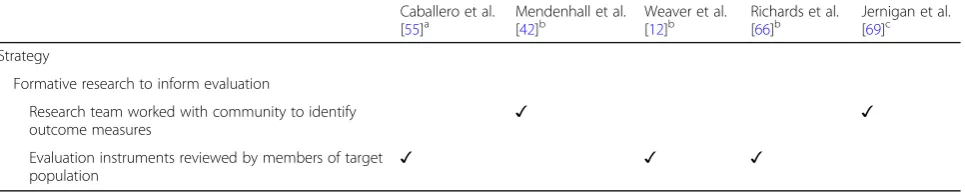
Five programs identified included formative research to
inform evaluation of the intervention. These activities
included collaborative work of the research team with
the community to identify outcome measures, as well as
examination of evaluation instruments by members of
the target population to ensure relevance. For example,
for the
Healthy Living in Two Worlds
project conducted
in urban Native youth, a draft of the instrument to be
used to assess knowledge, attitudes and behaviors related
to tobacco use, dietary practices and physical activities
was evaluated by several Haudenosaunee youth to insure
that the questions were clear and meaningful to this
particular population [
12
]. The types of formative research
used to inform evaluation of the intervention in each
study are displayed in Table
3
.
Partnership
Twenty-eight programs involved a partnership between
researchers and the community. Such partnerships
involved collaboration with the target population on data
collection, collaboration with local organizations or
es-tablishments, development of a community action plan
with the target population, delivery of the intervention
by members of the target population, holding regular
meetings with the target population, and collaboration
with the tribal review board or ethics committee. For
example, in a type 2 diabetes prevention intervention in
Native American communities, program staff networked
with local agencies to share information and resources
to inform the intervention [
13
]. The types of
partner-ships formed in each study are displayed in Table
4
.
Capacity building
Twenty-one programs included some aspect of capacity
building among project staff and community members in
their programs. Examples of capacity building included
training community members to perform health-promoting
practices, use of
“
train the trainer
”
sessions, joint
develop-ment of a community action plan, formation of local
work-ing groups, and promotion of career development of
project staff. For example, several studies used community
peer educators to deliver lessons that formed part of the
intervention [
14
,
15
]. The types of capacity building that
were part of each study are displayed in Table
5
.
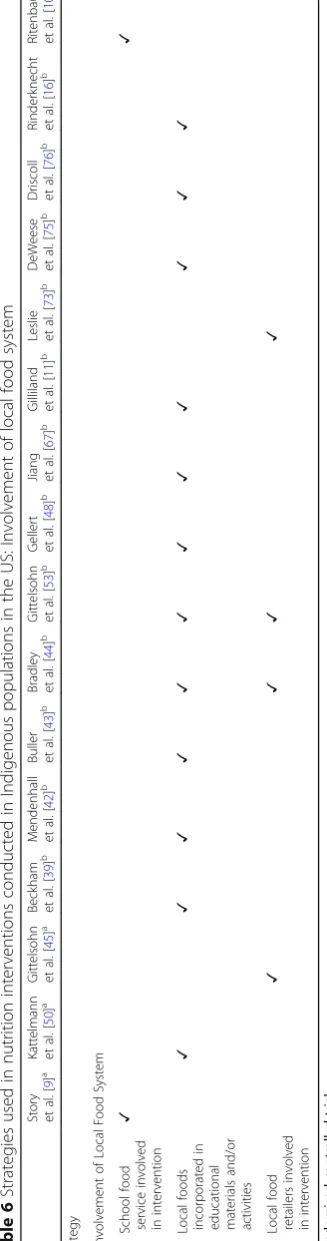
Involvement of local food system
Sixteen programs incorporated some aspect of the local
food system into the intervention. This included
involv-ing local food service or local food retailers in the
intervention, as well as incorporating local foods into
the educational materials and/or activities programs.
For example, in an after-school intervention of urban
Native American youth, discussion of the importance
and roles of traditional foods of the group under study
formed part of lessons provided [
16
]. The types of
involvement of the local food system in each study are
displayed in Table
6
.
Outcomes
Thirty
–
one programs of the 39 programs (79%)
identi-fied reported significant changes in knowledge, behavior
or health (Table
1
). In terms of the degree of community
Table
2
Strategies
used
in
nutrition
interventions
conducted
in
Indigenous
populations
in
the
US:
Fo
rmative
research
to
inform
design
Story
et
al.
[
9
]
a
Brown
et
al.
[
47
]
a
Gittelsoh
n
et
al.
[
45
]
a
Caballero
et
al.
[
55
]
a
H
ill
et
al.
[
17
]
b
Bac
har
et
al.
[
37
]
b
Menden
hall
et
al.
[
42
]
b
Bu
ller
et
al.
[
43
]
b
Gittel
sohn
et
al.
[
53
]
b
We
aver
et
al.
[
12
]
b
Gell
ert
et
al.
[
48
]
b
Sinclair
et
al.
[
54
]
b
Strateg
y
Form
ative
research
to
inform
design
Focus
groups/
interview
s
with
comm
unity
me
mbers
✓✓
✓
✓
✓
✓
✓
✓
✓
✓
Pilot
testing
of
interve
ntion
in
comm
unity
✓
Review
of
curriculum
by
comm
unity
✓
aRandomized
controlled
trial
bPre-post
study
cPost
Table
2
Strategies
used
in
nutrition
interventions
conducted
in
Indigenous
populations
in
the
US:
Fo
rmative
research
to
inform
design
(Continued)
Murphy
et
al.
[
13
]
b
Mau
et
al.
[
14
]
b
Richards
et
al.
[
66
]
b
Jiang
et
al.
[
67
]
b
Karanja
et
al.
[
72
]
b
Witmer
et
al.
[
74
]
b
DeW
eese
et
al.
[
75
]
b
Dris
coll
et
al.
[
76
]
b
Rind
erkne
cht
et
al.
[
16
]
b
Thom
pson
et
al.
[
78
]
b
Gi
lliland
et
al.
[
11
]
b
Jernigan
et
al.
[
69
]
c
Riten
baugh
et
al.
[
10
]
Strateg
y
Form
ative
research
to
inform
design
Focus
groups/
interview
s
with
comm
unity
me
mbers
✓✓
✓
✓
✓
✓
✓
✓
✓
✓
✓
Pilot
testing
of
interve
ntion
in
comm
unity
✓✓
✓
Review
of
curriculum
by
comm
out of the five strategies (Table
1
). For example, the
Cancer 101 program employed formative research to
inform the design of the program in working with tribal
health directors to review the curriculum, demonstrated
partnership with organizations that had established
rela-tionships with tribal communities and involved capacity
building in the form of train the trainer sessions [
17
]. In
further examining the studies reporting significant
results, five were RCTs, 24 were pre-post studies, one
had a multiple cross-sectional design, and one was a
retrospective study.
Study quality
Twelve studies were rated as strong, 13 studies were
rated as moderate, and 14 studies were rated as weak
according to the EPHPP Quality Assessment Tool.
Discussion
Results of the current literature review yielded research
studies conducted with a variety of objectives in diverse
Indigenous groups throughout the US. Overall,
interven-tions were successful in producing changes in knowledge,
behavior or health. The degree to which communities
were involved in the design, implementation, and
evalu-ation of the intervention varied from not at all to
involve-ment at all stages. Of the programs reporting significant
changes in outcome measures, more than half used at
least three strategies to engage communities. The extent
of use of strategies to promote community engagement in
programs reporting significant outcomes is notable.
While formative research to inform the design of the
interventions was performed in most studies, formative
research to inform the evaluation was not performed to
a great degree, with only six programs identified
includ-ing this step. In some of these cases, researchers worked
with the community to determine what outcomes should
be measured, a process that enhances the program
’
s
align-ment with traditional values. In particular, following an
in-digenous evaluation framework, as described by LeFrance
and colleagues, ensures that programs pay sufficient
atten-tion to the cultural context in which behaviors arise,
thereby increasing the potential success of interventions
[
18
]. In other cases, members of the target population
provided input on the content of evaluation tools and
par-ticipated in pilot testing. Previous research has revealed
the importance of this step and has outlined procedures
that may be used to determine face validity of instruments
[
19
], as well as other procedures that should be conducted
to evaluate the psychometric properties of evaluation tools
[
20
]. It is essential that evaluation tools are designed in
collaboration with the target audience to ensure relevance
[
20
]. Given that very few studies identified in this review
involved formative research to inform evaluation, it is
possible that not all relevant outcomes were reported.
While results were often presented in terms of changes in
weight and diet, there may be other outcomes such as
cultural connectedness that may be important for the
communities in question but were not measured.
Fewer than half of the programs identified described
involvement of the local food system. In further seeking
to promote health in Indigenous communities,
incorpor-ation of local foods is an important considerincorpor-ation.
Working in concert with local food retailers or other
establishments may allow for the inclusion of traditional
foods in the intervention. In communities in which
people identify themselves with their culture and natural
environment, use of traditional food systems to improve
health builds community support and engagement for
holistic health and well-being [
21
]. Factors contributing
to obesity and diabetes in Indigenous people are
com-plex, and are rooted in dietary Westernization that leads
to significant changes in food sources and nutrient
intake [
22
]. In Indigenous communities, participating in
the traditional food system is linked to higher diet
quality, lower levels of chronic disease risk factors, lower
levels of stress and overall well-being. The traditional
diet of Yup
’
ik People in Southwestern Alaska, for
example, is rich in vitamin D, vitamin A, vitamin E, iron,
and n-3 fatty acids through inclusion of foods such as
fatty fish, fish roe, seal oil and wild game [
22
]. Similarly,
the traditional diet of Native Hawaiians has been found
to be high in fiber, polyunsaturated fatty acids, and low
Table 3
Strategies used in nutrition interventions conducted in Indigenous populations in the US: Formative research to inform
evaluation
Caballero et al.
[
55
]
aMendenhall et al.
[
42
]
bWeaver et al.
[
12
]
bRichards et al.
[
66
]
bJernigan et al.
[
69
]
cStrategy
Formative research to inform evaluation
Research team worked with community to identify
outcome measures
✓
✓
Evaluation instruments reviewed by members of target
population
✓
✓
✓
a
Randomized controlled trial b
Pre-post study c
Table
4
Strategies
used
in
nutrition
interventions
conducted
in
Indigenous
populations
in
the
US:
Partnership
Sto
ry
et
al.
[
9
]
a
Brown
et
al.
[
47
]
a
Katte
lmann
et
al.
[
50
]
a
Gi
ttelsohn
et
al.
[
45
]
a
Cab
allero
et
al.
[
55
]
a
Hill
et
al.
[
17
]
b
Bachar
et
al.
[
37
]
b
Beckham
et
al.
[
39
]
b
Me
ndenha
ll
et
al.
[
42
]
b
Bradle
y
et
al.
[
44
]
b
Gittelsoh
n
et
al.
[
53
]
b
Carrel
et
al.
[
46
]
b
Be
nyshek
et
al.
[
49
]
b
Burde
n
et
al.
[
51
]
Strateg
y
Partn
ership
Collaboration
with
target
popu
lation
on
data
colle
ction
✓
Collaboration
with
local
organizations
or
estab
lishments
✓✓
✓
✓
✓
✓
✓
Develop
ment
of
comm
unity
action
plan
with
targ
et
popu
lation
✓
Delivery
of
interven
tion
by
memb
ers
of
target
popu
lation
✓✓
✓
Regular
meeting
s
with
targ
et
popu
lation
✓
✓
Collaboration
with
tribal
review
board
/ethni
cs
comm
ittee
aRandomized
controlled
trial
bPre-post
study
cPost
Table
4
Strategies
used
in
nutrition
interventions
conducted
in
Indigenous
populations
in
the
US:
Partnership
(Continued)
Mau
et
al.
[
14
]
Sin
clair
et
al.
[
54
]
b
Murphy
et
al.
[
13
]
b
Mau
et
al.
[
14
]
b
Richards
et
al.
[
66
]
b
Jian
g
et
al.
[
67
]
b
Moo
re
et
al.
[
68
]
b
Ho
ward
et
al.
[
70
]
b
Gilli
land
et
al.
[
11
]
b
Ritenbau
gh
et
al.
[
10
]
DeWe
ese
et
al.
[
75
]
b
Rind
erkne
cht
et
al.
[
16
]
b
Smith
et
al.
[
77
]
b
Jern
igan
et
al.
[
69
Strateg
y
Partn
ership
Collaboration
with
target
popu
lation
on
data
colle
ction
Collaboration
with
local
organizations
or
estab
lishments
✓✓
✓
✓
✓
✓
✓
✓
✓
Develop
ment
of
comm
unity
action
plan
with
targ
et
popu
lation
Delivery
of
interven
tion
by
memb
ers
of
target
popu
lation
✓✓
Regular
meeting
s
with
targ
et
popu
lation
✓
Collaboration
with
tribal
review
board
/ethni
cs
comm
ittee
Table
5
Strategies
used
in
nutrition
interventions
conducted
in
Indigenous
populations
in
the
US:
Capacity
building
Story
et
al.
[
9
]
a
Brow
n
et
al.
[
47
]
a
Katte
lmann
et
al.
[
50
]
a
Gittel
sohn
et
al.
[
53
]
a
Cab
allero
et
al.
[
55
]
a
Hill
et
al.
[
17
]
b
Bachar
et
al.
[
37
]
b
Be
ckham
et
al.
[
39
]
b
Mende
nhall
et
al.
[
42
]
b
Bu
ller
et
al.
[
43
]
b
Weave
r
et
al.
[
12
]
b
Strateg
y
Cap
acity
building
Commu
nity
me
mbers
train
ed
to
pe
rform
health-p
romot
ing
pract
ices
✓✓
✓
✓
✓
✓
✓
✓
✓
Train-t
he-trainer
sessio
ns
inc
orporat
ed
✓
Joint
develo
pment
of
com
mun
ity
action
plan
✓
Local
working
group
forme
d
Promoti
on
of
car
eer
de
velopm
ent
of
projec
t
staff
✓
aRandomized
controlled
trial
bPre-post
study
cPost
Table
5
Strategies
used
in
nutrition
interventions
conducted
in
Indigenous
populations
in
the
US:
Capacity
building
(Co
ntinued)
Be
nyshek
et
al.
[
49
]
b
Sin
clair
et
al.
[
54
]
b
Mu
rphy
et
al.
[
13
]
b
Mau
et
al.
[
14
]
b
Richards
et
al.
[
66
]
b
Karanja
et
al.
b
Harve
y-Be
rino
et
al.
[
15
]
b
Smith
et
al.
[
77
]
b
Thom
pson
et
al.
[
78
]
b
Jernigan
et
al.
[
69
]
c
Strateg
y
Cap
acity
building
Commu
nity
me
mbers
train
ed
to
pe
rform
health-p
romot
ing
pract
ices
✓✓
✓
✓
✓
✓
✓
✓
Train-t
he-trainer
sessio
ns
inc
orporat
ed
Joint
develo
pment
of
com
mun
ity
action
plan
Local
working
group
forme
d
✓✓
Promoti
on
of
car
eer
de
velopm
ent
of
proje
ct
Table
6
Strategies
used
in
nutrition
interventions
conducted
in
Indigenous
populations
in
the
US:
Involvement
of
local
foo
d
system
Story et
al.
[
9
]
a
Kattelmann et
al.
[
50
]
a
Gittelsohn et
al.
[
45
]
a
Beckham et
al.
[
39
]
b
Mendenhall et
al.
[
42
]
b
Buller et
al.
[
43
]
b
Bradley et
al.
[
44
]
b
Gittelsohn et
al.
[
53
]
b
Gellert et
al.
[
48
]
b
Jiang et
al.
[
67
]
b
Gilliland et
al.
[
11
]
b
Leslie et
al.
[
73
]
b
DeWeese et
al.
[
75
]
b
Driscoll et
al.
[
76
]
b
Rinderknecht et
al.
[
16
]
b
Ritenbaugh et
al.
[
10
]
b
Strategy
Involvement
of
Local
Food
System
School
food
service
involved
in
intervention
✓
✓
Local
foods
incorporated
in
educational materials
and/or
activities
✓
✓✓
✓
✓✓
✓✓
✓
✓✓
✓
Local
food
retailers
involved
in
intervention
✓✓
✓
✓
aRandomized
controlled
trial
bPre-post
in fat and cholesterol [
23
]. Over the past century,
Indi-genous food systems have been compromised as a result
of social, economic, political and environmental
pres-sures [
24
]. The consequences of the transition away
from nutrient-rich traditional food in Indigenous
com-munities include shifts in nutrients intake, obesity and
associated diet-related chronic conditions [
25
–
27
]. In a
study of Pima Indians in Arizona, for example, intake of
complex carbohydrate, dietary fiber, insoluble fiber,
vege-table proteins and the proportion of total calories from
complex carbohydrate and vegetable proteins were
sig-nificantly higher in the Indian than in the Anglo diet
[
28
]. Intervention activities must work in concert with
the local cultural and social settings, local personnel and
local sources of food [
21
].
The majority of programs were carried out in the
Western region. Of note, of the studies conducted in this
region, relatively few were focused on populations in
Alaska and Hawai
’
i. As Indigenous groups in these states
face health disparities, future studies may further focus on
these geographic areas. Among Native Hawaiians, for
ex-ample, the prevalence of chronic diseases constituting the
leading causes of death in the U.S.
—
heart disease, cancer,
and diabetes
—
is notably high [
29
]. Rates of diet-related
chronic conditions such as cardiovascular disease are also
high in Alaska Natives [
30
]. Other researchers have pointed
to the need for individual-level interventions for behaviors
related to obesity in groups such as Native Hawaiians [
29
].
Also of note, most programs focused exclusively on
adults. As particular nutrition-related burdens fall on
youth, children continue to be an important target group
in further addressing issues related to diet in Indigenous
groups. According to data from the National Health and
Nutrition Examination Survey (NHANES), 17% of
children and adolescents in the U.S. were obese in
2011
–
2014 [
31
]. Previous studies indicate that the diet
quality of children and adolescents in the U.S. falls short
of the recommendations, and that diet quality may be
improved by increased intake of foods such as
vegeta-bles, whole grains and seafood [
32
]. Good nutrition is
essential for child growth and development, as well as
for maintenance of a healthy weight [
33
].
Ten of the interventions identified were randomized
controlled trials, and half of these reported significant
results. Most studies used a pre-test, post-test design.
Without a control group, such studies do not provide
the same level of evidence as the RCT and do not allow
conclusions of the same caliber to be drawn [
34
].
How-ever, given that research in Indigenous populations may
be performed in small, geographically dispersed samples,
it may not always be feasible to conduct a RCT. Studies
with a pre-test, post-test design may provide evidence to
inform additional studies in the population of interest.
Of note, there were a number of studies rate as
“
weak
”
with regards to study quality. These ratings reflected
is-sues such as failure to report withdrawals and drop-outs,
as well as lack of assessment of validity and reliability of
data collection tools. Failure to report withdrawals and
dropouts leads to difficulty in determining the degree to
which participants engaged in the intervention and the
effects of the program, as evaluation of all participants
enrolled in the program may not have been possible. In
other cases, it was not possible to ascertain whether the
outcome assessors were aware of the intervention or
ex-posure status of participants or if the study participants
were aware of the research question. These issues may
have compromised study results to varying degrees. If,
for example, outcome assessors were aware of the
inter-vention or exposure status of participants, this may have
led them to alter their behavior toward participants or
perform measurements differently in the two groups. In
cases in which less than 100% of participants received
the allocated intervention, it is possible that there may
have been systematic differences between those who
completed the intervention and those who did not,
compromising the results of the study.
With regards to program activities, relatively few
pro-grams involved changes to the physical environment.
However, of those that did, all found significant results,
and five out of the seven studies also involved used of at
least three strategies to engage communities. Other
researchers have noted the need to design interventions
at multiple levels, including individual, social
environ-mental, physical environenviron-mental, and macrosystem [
35
].
While all of the programs identified in this review had a
nutrition education component, a change in health
out-comes may not result without concomitant
environmen-tal changes. In planning future interventions, this is an
important consideration.
Limitations
While not all studies made use of the strategies
identi-fied in this review to engage communities, it should be
noted that not all studies focused exclusively on
Indigen-ous populations. In some cases, the target population
was comprised of both Indigenous people and members
of other groups. In these instances, it may not have been
possible or reasonable to use some of the st