A Review On Numerical Error Correction Using
Various Techniques
Iqra Ahmed, Fatima Ejaz, Safa Abdul Karim, Sehrish Khan, Meemona Khanam
Abstract: From decades, the work of symbolic computations cannot be ignored in real time calculations. During the discussion of various automated machines, for estimated calculations we came to know where there are inputs and the corresponding outputs the term error is obvious. But the error can be minimized by using different suitable algorithms. This study focusses on techniques used for error correction in numeric and symbolic computations. After reviewing on different techniques discussed before we generate analysis by taking some of the parameters. The Experimental results shows that these algorithm has better performance in terms of accuracy, performance, cost, validity, safety, security, reliability and power consumption.
Index Terms: Postal Numeric Encoding Techniques, Majority Logic Detector/Decoder, Reed Muller, Pulse Amplitude Modulation
————————————————————
1.
INTRODUCTION
Error is the difference between the estimated result and the approximated result that is obtained after applying some mathematical operations or algorithms. These errors prevent the good performance of systems in real time automated machines. Hard we try to make our automated machines perfect, there is always degradation or error chance. So, once the error has been detected, the error is to be corrected by applying some techniques that will be helpful for systems. All the techniques that are implemented has different methodologies used that deals with error correction in various applications of numeric computations. The errors need to be removed by taking effective steps for the improvement of machines. Therefore, different algorithms has been implemented to attain accurate and error free results in future. In this paper different techniques are presented for the error correction in different automated systems that are POSTNET that are used for missing bars correction for postal bar decoder, coloring directionality graph for M-ary asymmetric symbol error correcting codes, Polynomial Approximation for Recognition and classification of Numerical labels ,T-algebra for Automatic Assessment of Step-by-Step Solutions, ASICs for safety computations of Integrated circuits, Cryptography Hash Functions for unidirectional errors, RM (Reed Muller) code for high data rate Aerospace Applications, MLDD technique for memory applications, RS code for PAM-4 in data centered applications and Reed Solomon coding for ADSL.
By applying different error recovery techniques, the effective results are obtained in terms of accuracy, performance, validity, reliability, cost, safety, security and power consumption that are discussed later.
2. NUMERICAL ERROR CORRECTION USING
VARIOUS TECHNIQUES
2.1 An Image-Based Postal Barcode Decoder with Missing Bar Correction [1]
The paper has suggested the algorithm for the postal barcode decoder that implies the detection and correction of missing bars in symbols. The missing bars in symbols generates errors that are detected and corrected by method proposed in this paper. To validate this method POSTNET (Postal Numeric Encoding Techniques) is applied. POSTNET can encode only numeric digits that are of 5, 6 and 9 digits, its encoding is based on height of the bars each digit represents the five bars in which two are of long length and three are of short length, it uses check digit to ensure accuracy. Results shows that this algorithm can correct one missing bar in a digit and at most ten bars in POSTNET symbol.
2.2 A class Of M-ary Asymmetric Symbol Error Correcting Codes Constructed By Graph Coloring [2]
The crux of this paper is error correction in data entry devices of m-Ary symbols. While entering data there will be chance of error occurrence by the usage of alphanumeric symbols, m-Ary symbols processed by these devices may sometimes cause mistake due to some error such as mistyping using keyboard and misreading in character recognition systems that have high error probability. These are asymmetric errors. M-Ary asymmetric symbol error control code can be used to resolve these type of errors. The codes are constructed using coloring directionality graph that expresses the asymmetric symbols. Now it became beneficial for the m-Ary data that is used in bank accounts, postal codes, identification numbers etc.
2.3 Forward Error Correction For Asymmetric Digital Subscriber Lines (ADSL) [3]
Transmission of correct data recovery over the noisy channel is crucial task, for controlling data forward error correction technique is applied, it is a method of error control in data in this transmission the source send the ______________________
Iqra Ahmed is currently pursuing Bachelor’s degree program in computer sciences from Fatima Jinnah women university, Pakistan,. E-mail: [email protected]
Fatima Ejaz is currently pursuing Bachelor’s degree program in computer sciences from Fatima Jinnah women university, Pakistan, E-mail: [email protected]
Safa Abdul Karim is currently pursuing Bachelor’s degree program in computer sciences from Fatima Jinnah women university, Pakistan,. E-mail: [email protected]
Sehrish Khan is currently pursuing Bachelor’s degree program in computer sciences fromFatima Jinnah women university, Pakistan, E-mail: [email protected]
Memmona Khanam is Assistant Professor, Fatima
Jinnah women university, Pakistan,
redundant data so, that the receiver can only recognize the data the is apparently error free because it is one way communication receiver cannot request for the negative acknowledgment. The paper explain the two types of FEC, the Reed Solomon coding and optional interleaving, Model is presented to correct burst error that are caused by impulse noise with ADSL during the transmission of data. The performance of codes in presence of noise is analyzed by this model. The bit error rate with the crosstalk is also determined. The performance shows that the interleaved Reed Solomon coding has effective results for ADSL.
2.4 Recognition and Classification of Numerical Labels Using Digital Image Processing Techniques [4]
The work of classifying the products before their final packing is a lot more of work in companies. There are errors in manually classifying the packages and risk of inappropriate results. To deal with this there is an automatic classification procedure which reads the numeric codes which are printed on packages in the form of bar codes. This technique removes the errors by using the polynomial approximation method in which a rectangle that frames the numerical code is detected and then the correction algorithm is applied on that region, after it optical character recognition is applied which determines the values of the characters encoded. With the help of this automation, errors, time and cost can be removed.
2.5 Prospects of Automatic Assessment of Step-by-Step Solutions in Algebra [5]
For a very long time, there was an absence of satisfactory solution of assessment step by step and it was difficult to analyze a student‟s progress. For grading the answer, the program checks whether the response matches with the answer with the help of built in computer algebra system. Many changes have been made in existing programs of grading. One of the notable solutions to this problem is use of T-algebra. The students solve the task step by step and T-algebra checks the solution. First step for calculating the results is the „Positive component‟ in which students are mostly compel to correct their mistakes before moving to next operation of the task. Second step is „Negative component‟ in which the results which have errors are placed in a table with rows having errors and columns having the tasks. While evaluating the score, penalties and hints scores are subtracted from the score obtained in the previous stage. Third step is „Economy component‟ in which students are allowed to perform shorter or longer steps without losing the importance of the algorithm. Hence step by step evaluation by T-algebra proposed a much better solution.
2.6 Safety Computations In Integrated Circuit [6]
For so long, safety of railway control system was based on software techniques including arithmetic codes. „Coded processor‟ used was a better approach but cost was too much high. To reach the goal of unique and centralized wayside system, a new generation of ASICs has been designed which are more adapted to the safety constraints than software computations. The software computations on the check fields induce an important loss of performance. In ASICs a coprocessor has been designed to work in parallel
with the CPU: the CPU works on the functional fields and the coprocessor works on the coded fields. From the safety point of view, the coprocessor works internally on undated data, this possibility was very restricted in the software Implementation. The new Vital Controller used in ASICs is able to tolerate errors from time to time. The technique used in processing is called "destructive generation". Safety is guaranteed by the destructive generation of the date‟s increment: once it has been generated, it is safely destroyed and can no more be produced for a safely determined period of time. Hence, ASICs represent a better safety control of code computations.
2.7 Unidirectional Error Correction by Crypto Functions [7]
In computer memories unidirectional errors are the common errors. When data is stored in bytes per chip, to prevent this data from the byte error byte error correcting codes are required. To attain the security and reliability, Non-volatile memory are used so that data may not be lost in the power off situations. Such system exhibits the unidirectional error. To avoid these unidirectional errors, ECC technologies are supposed to be implement but due to high cost and the complexity of the existing system increased are ignored. Instead of this “Cryptography Hash Functions “technique is used that involves in correcting a class of byte oriented unidirectional codes in the existing hash bits. It is used as a mean of efficient unidirectional error correcting within the existing units. Results shows that the simple hash functions such as SHAI and MD5 gives better output for error correction. By the use of “crypto hash functions” unidirectional error correction improves the high speed, security and reliability in data transformation.
2.8 Multiple Bit Error Correction for High Data Rate Aerospace Applications [8]
On chip memories are dedicated to multi bit soft errors due to environmental changes such as cosmic rays, alpha particles and the neutrons. These multi bit soft error can lead to disasters and data loss in case of on board aerospace applications. Earlier methods used for this are the detecting and correcting codes as “Hamming codes with SEC-DEC” capability but it is not proved as helpful. So, there required a prevention from these type of errors and the code used is the” RM (Reed Muller) code”. It is used to address multi bit error correcting codes for high reliability and high data rate in aerospace applications. These results are obtained by implemented (2,5) decoder in Actel Proasic3 FPGA using the MLD technique. By the comparison of MR code with traditionally used coding, improved speed power performance are obtained.
2.9 A novel fault detection and correction technique for memory applications [9]
consumption and no error free code words therefore, a new technique named, Majority Logic Detector/Decoder (MLDD) is proposed. MLDD has less delay of 12.578 and completes the process of error detection in just three cycle. It is notices that the power consume by this technique is 4% less than the MLD. As the error free code word for larger number of code word size so, it speed up the situation to 1100 ns. By the use of this technique great time saving is obtained, when memory read access does not make errors, the performance is increased. For the error detection and correction, MLDD is considered as efficient design.
2.10 A Study of Error Correction Codes for PAM Signals in Data Center Applications [10]
With the increasing use of data centered applications, there is a need of larger bandwidth transmission medium as the usage of online document sharing, broadband access networks and the social media is increased. This will help to upgrade their systems for efficient data communication for network service provider. It is considered as the PAM-2 signaling is better from the power consumption point of view but their bandwidth is limited to 40 Gb/s therefore, for the less power consumption and more data transmission, for PAM-4 (Pulse Amplitude Modulation) system RS code is presented for error correction. PAM-4 signal is formed by combining two PAM-2 signals with different amplitude. As it is of higher amplitude so the existence of forward error correction (FEC) is necessary. It is noticed that PAM-4 doubles the transmission capacity but the power consumption rate is increased. System complexity reduces
and also the cost comparable with the QAM (Quadrature Amplitude Modification) and the PM (polarization Multiplexing). For the lower latencies RS codes is considered better approach for PAM-4 signaling.
3.
ANALYSIS
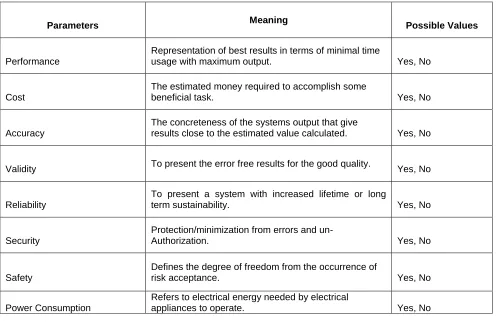
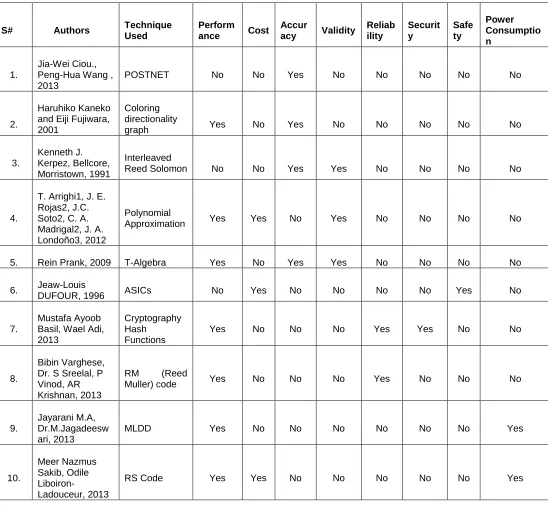
Error correction is the most critical aspect for the automated machines to run efficiently for various applications where numerical computations are involved. If the errors are not recover than this leads to poor performance of the systems. So, the error corrections is required to gain the use of existing systems in different applications. In Jia-Wei Ciou et al [1], Haruhiko Kaneko et al [2], Kenneth J. Kerpez et al [3], T. Arrighi1 et al [4], Rein Prank et al [5] and Bibin Varghese et al [8], error correction in different applications are discussed by applying various algorithm or techniques. This helps the machines to achieve the task of error free results. With the less error chance the systems non -functional requirements are obtained. In Jeaw-Louis DUFOUR et al [6], Mustafa Ayoob Basil et al [7], Jayarani M.A et al [9] and Meer Nazmus Sakib et al [10], error correction is dealing in case of computer‟s memory related applications and for data centered applications. More the technology enhanced is, more will be the need of efficient and accurate systems that requires the systems to be fully checked in terms of validity by keeping measures in error correction. Table I and II discusses the evaluation of parameters taken for the numerical error correction using various techniques.
Table 1.Evaluation Parameters of Numerical Error Correction
Parameters Meaning Possible Values
Performance
Representation of best results in terms of minimal time
usage with maximum output. Yes, No
Cost
The estimated money required to accomplish some
beneficial task. Yes, No
Accuracy
The concreteness of the systems output that give
results close to the estimated value calculated. Yes, No
Validity To present the error free results for the good quality. Yes, No
Reliability
To present a system with increased lifetime or long
term sustainability. Yes, No
Security
Protection/minimization from errors and un-
Authorization. Yes, No
Safety
Defines the degree of freedom from the occurrence of
risk acceptance. Yes, No
Power Consumption
Refers to electrical energy needed by electrical
Table 2.Analysis OF Parameters for ‘NUMERICAL ERROR CORRECTION USING VARIOUS TECHNIQUES
S# Authors Technique Used
Perform
ance Cost
Accur
acy Validity
Reliab ility
Securit y
Safe ty
Power Consumptio n
1.
Jia-Wei Ciou., Peng-Hua Wang , 2013
POSTNET No No Yes No No No No No
2.
Haruhiko Kaneko and Eiji Fujiwara, 2001
Coloring directionality
graph Yes No Yes No No No No No
3.
Kenneth J. Kerpez, Bellcore, Morristown, 1991
Interleaved
Reed Solomon No No Yes Yes No No No No
4.
T. Arrighi1, J. E. Rojas2, J.C. Soto2, C. A. Madrigal2, J. A. Londoño3, 2012
Polynomial
Approximation Yes Yes No Yes No No No No
5. Rein Prank, 2009 T-Algebra Yes No Yes Yes No No No No
6. Jeaw-Louis
DUFOUR, 1996 ASICs No Yes No No No No Yes No
7.
Mustafa Ayoob Basil, Wael Adi, 2013
Cryptography Hash
Functions
Yes No No No Yes Yes No No
8.
Bibin Varghese, Dr. S Sreelal, P Vinod, AR Krishnan, 2013
RM (Reed
Muller) code Yes No No No Yes No No No
9.
Jayarani M.A, Dr.M.Jagadeesw ari, 2013
MLDD Yes No No No No No No Yes
10.
Meer Nazmus Sakib, Odile
Liboiron-Ladouceur, 2013
RS Code Yes Yes No No No No No Yes
4.
CONCLUSION
Numerical computations requires error correction for the correct running of automated machines. Without applying different techniques or algorithm complete running of a system cannot be attained as the error is the obvious term in these cases. More the check performance parameters involved for a system more will be the chance of error. To recover all these errors, there is a need of different techniques that helps the machines to achieve maximum output with less error occurrence. When error correction algorithm are implemented on the existing systems performance of the systems can be obtained in different applications by achieving the lesser costs, minimal power consumptions and increasing the validity, security, safety
and reliability for machines. Thus the usability of that system vanished until an error technique is not applied on it.
REFERENCES
[1] Jia-Wei Ciou., Peng-Hua Wang, “An Image-Based Postal Barcode Decoder with Missing Bar Correction”, IEEE , 2012.
[3] Kenneth J. Kerpez, Bellcore, Morristown, “Forward Error Correction For Asymmetric Digital Subscriber Lines (ADSL)”, IEEE, 1991.
[4] T. Arrighi1, J. E. Rojas2, J.C. Soto2, C. A. Madrigal2, J. A. Londoño3, “Recognition and
[5] Classification of Numerical Labels Using Digital Image Processing Techniques”, IEEE, 2012.
[6] Rein Prank, “Prospects of Automatic Assessment of Step-by-Step Solutions in Algebra”, IEEE , 2009
[7] Jeaw-Louis DUFOUR, “Safety Computations In Integrated Circuit”, IEEE, 1996.
[8] Mustafa Ayoob Basil, Wael Adi, ”Unidirectional Error Correction by Crypto Functions”, IEEE, 2013.
[9] Bibin Varghese, Dr. S Sreelal, P Vinod, AR Krishnan, “Multiple Bit Error Correction for High Data Rate Aerospace Applications”, IEEE, 2013.
[10] Jayarani M.A, Dr.M.Jagadeeswari , “A novel fault detection and correction technique for memory applications”, IEEE, 2013.