PATTERNS OF ATTACHMENT ON THE DEVELOPMENT OF
CHILDREN’S UNDERSTANDING OF MINDS
Juliet Elizabeth Holder
Thesis presented to the Faculty of Science
of the University of London
for the degree of Ph.D.
All rights reserved
INFORMATION TO ALL USERS
The quality of this reproduction is dependent upon the quality of the copy submitted. In the unlikely event that the author did not send a complete manuscript and there are missing pages, these will be noted. Also, if material had to be removed,
a note will indicate the deletion.
uest.
ProQuest 10042965
Published by ProQuest LLC(2016). Copyright of the Dissertation is held by the Author.
All rights reserved.
This work is protected against unauthorized copying under Title 17, United States Code. Microform Edition © ProQuest LLC.
ProQuest LLC
789 East Eisenhower Parkway P.O. Box 1346
Recently, there have been suggestions in the theory o f mind hterature that there are
individual differences in children’s understanding o f mental states which can be attributed to
influences within the social world o f the family, such as the sibling relationship, and
parent-chfld discourse. Following recent developments in attachment theory, this thesis examines
the possibility that it is the quahty o f the attachment relationships within the family which are
influencing individual differences in children’s understanding o f minds. The thesis draws on
data collected in the context o f a longitudinal study o f attachment patterns among 90 first
born children, spanning a period o f six years.
Children’s understanding o f mental states were assessed at five years o f age using
three theory o f mind paradigms: (1) a standard false-behef paradigm; (2) a cognitive- emotion
paradigm; and (3) a higher-order paradigm These three paradigms require increasing levels
o f representational skills in order to pass them Additionally, paradigms (1) and (3) assess
children’s understanding o f the links between beliefe, thoughts and actions, whereas paradigm
(2) assesses children’s understanding o f the links between behefs, thoughts and emotions.
Attachment relationsbÿs with both mother and father were assessed m infancy by the
Strange Situation, and at five years by a modified Strange Situation procedure. The parents’
attachments were assessed before the birth o f the child by the Adult Attachment Interview.
Multivariate analyses examined the role o f the attachment constructs in the
development o f children’s understanding o f the links between behefs, thoughts and actions,
analyses controlled for the influence o f other family relationships (sibling and marital),
personality and temperamental factors, educational and demographic factors, and children’s
mental development and expressive language skills.
The analyses revealed that attachment quality (both parent and parent-infant) is
predictive o f children’s understanding o f the links between beliefs, thoughts and emotions but
not o f their understanding o f the links between beliefs, thoughts and actions. An
‘affect-mirroring interactions’ hypothesis is advanced as the mechanism o f influence, a hypothesis
ACKNOWLEDGMENTS
Many people have helped me, both directly and indirectly, in the work presented in
this thesis. I would like to thank Professor Peter Fonagy for his continuing enthusiasm and
support for this thesis, his invaluable guidance and his inspirational ideas and continuous
refinements o f those ideas, ideas which are central to this work and without which would have
made for a greatly in^overished thesis.
This thesis would not have been possible without the work Drs. Miriam and Howard
Steele, who began the London Parent-Child Project in collaboration with Peter Fonagy, a
project upon whose data this thesis is based and a project which inspired me to direct my
interests into the writing o f this thesis.
hi the recent phase o f data collection for this project, I was fortunate to be part o f a
great research team, including Matt Woolgar, Jo Alves, Susan Yabsley, Carla Crofl; and
Jacques China. The mothers, fethers and children involved in the research project have been
incredibly loyal and gave generously o f their time.
Both my mother, Elizabeth, and my father, Alex, call for special mention for their
unfailing support. I am also indebted to my mother for ofl;en clari^ông my thoughts and
smoothing out the rough edges o f sections o f this thesis, using her exquisite giJft for writing.
I also thank Maria Berger for her detailed interest in this thesis and her insightful questioning.
And I thank both Zigmunt Berger and Wally for not only their support, but also their
humourous tolerance o f lengthy family conversations about this work.
For three years o f financial support, I am indebted to the Economic and Social
Research Council.
I thank all my firiends for their support and interest.
TABLE OF CONTENTS
Chapter One - Theory o f mind and attachment: theoretical and empirical review s... 1
Part One: Theory o f Mind ...1
Part Two: A ttachm ent... 38
Part Three: The present investigation... 65
Chapter Two - Assessing the child’s theory o f m in d ...78
Introduction... 78
Method ... 87
R esults... 97
D iscu ssio n ...110
Chapter Three - The role o f demography, intellect and linguistic a b d ity ...116
Introduction... 116
Method ... 120
R esults...125
D iscu ssio n ...136
Chapter Four - The role o f the family: personahties, affects and relationships...146
Introduction... 146
Method ... 160
R esults...167
D iscu ssio n ...188
Chapter Five - The role o f quahty o f attachment to mother and father in the sixth year 221 Introduction... 221
Method ...225
R esults... 230
D iscu ssio n ... 244
Chapter Six - The role o f quahty o f attachment to mother and father in in fa n c y 252 Introduction... 252
Method ...259
R esults... 262
Introduction... 305
Method ...312
R esu lts... 316
D iscu ssio n ... 334
Chapter Eight - Predicting children’s understanding o f minds: a path analytic approach ...347
Chapter Nine - Final d iscu ssion ...390
Sum m ary...390
Theoretical model ...393
Alternative accounts... 406
LIST OF APPENDICES
Appendix 2.1a
Transcripts o f children’s responses to the cognitive-emotion task justification questions (and how they were co d ed )...451
Appendix 2. lb
Transcripts o f children’s responses to the higher-order justification question (and how they were c o d e d )...456
Appendix 2.2
Associations between theory o f mind performance and gender - observed (and expected) frequencies... 460
Appendix 3.1
A short vocabulary scale ... 461
Appendix 3.2
Bayley (Mental Development Index) Scoring Sheet ...463
Appendix 3.3
The Bus S t o r y ... 465
Appendix 3.4
Means and standard deviations for the continuous variables presented in Chapter T h ree... 467
Appendix 3.5
Associations between children’s performance on the cognitive-emotion task and their mother’s social class - observed (and expected) frequencies
Associations between children’s performance on the cognitive-emotion task and their father’s social class - observed (and expected) frequencies
Associations between children’s performance on the higher-order task and their mother’s social class - observed (and expected) frequencies
Appendix 3.6
Correlations between children’s performance on the theory o f mind tasks and the Bus Story - girls
Correlations between children’s performance on the theory o f mind tasks and the Bus S t o r y - b o y s ...471
Appendix 3.7
Correlations between children’s performance on the theory o f mind tasks and their parents’ vocabulary skills - girls
Correlations between children’s performance on the theory o f mind tasks and their parents’ vocabulary skills - b o y s ...473
Appendix 4.1
Marital relationship questioimaire... 475
Appendix 4.2
Family questioimaire ... 477
Appendix 4.3 a
Antenatal questioimaire ... 478
Appendix 4.3b
Father’s antenatal questionnaire...481
Appendix 4.4
Schaefer-Manheimer Postnatal Research Inventory ...483
Appendix 4.5a
Mothers’ postnatal questionnaire... 487
Appendix 4.5b
Fathers’ postnatal questionnaire...489
Appendix 4.6
Autonomy and Relatedness Inventory ... 491
Appendix 4.7
E .P .Q ... 492
Appendix 4.8
Appendix 4.9
Infant questionnaire... 497a
Appendix 4.10
Child Behaviour Checklist ... 498
Appendix 4.11
Dyadic Adjustment S c a le ... 500a
Appendix 4.12
Means and standard deviations for the continuous variables presented in Chapter Four ...501
Appendix 4.13
Correlation matrix o f parental perceptions o f infant temperament at three months and at 12 months (n=100 couples) ... 512
Appendix 4 .14a
Correlations between parents’ ratings on the Child Behaviour C heckhst 513
Appendix 4 .14b
Correlations between parents’ ratings on the Child Behaviour Checklist - for boys Correlations between parents’ ratings on the Child Behaviour Checklist- for girls
...514
Appendix 4.15a
Correlations between ratings (by mother) on the Child Behaviour Checkhst and children’s performance on the two theory o f mind t a s k s ... 515
Appendix 4.15b
Correlations between ratings (by father) on the Child Behaviour Checkhst and children’s performance on the two theory o f mind t a s k s ... 516
Appendix 5.1
Observed (and expected) frequencies o f children’s performance on the cognitive-emotion task according to the three traditional attachment groups (as assessed at five years with mother) - with the disorganized group fo rced )...517
Appendix 5.2
Appendix 5.3
Observed (and expected) frequencies o f children’s performance on the higher-order task according to the three traditional attachment groups (as assessed at five years with mother) - with the disorganized group fo r c e d ... 519
Appendix 5.4
Observed (and expected) frequencies o f children’s performance on the higher-order task according to their overall child-mother attachment security... 520
Appendix 5.5
Observed (and expected) frequencies o f children’s performance on the cognitive-emotion task according to their overall child-father attachment secu rity 521
Appendix 5.6
Observed (and expected) frequencies o f children’s performance on the higher-order task according to their overall child-father attachment security...522
Appendix 6.1
Means and standard deviations for the attachment behaviour scales ... 523
Appendix 6.2
Stability and change in attachment patterns from infancy to the sixth year . . . . 525
Appendix 6.3
Observed (and expected) frequencies o f children’s performance on the cognitive-emotion task according to their overall infant-mother attachment security . . . 526
Appendix 6.4
Observed (and expected) frequencies o f children’s performance on the cognitive-emotion task according to their minor attachment classification (as assessed at 12 months with mother) - with Ds forced
Observed (and expected) frequencies o f children’s performance on the cognitive-emotion task according to their minor attachment classification (as assessed at 12 months with mother) - with Ds excluded ... 527
Appendix 6.5
Observed (and expected) frequencies o f children’s performance on the higher-order task according to the different attachment (as assessed at 12 months with mother) Observed (and expected) frequencies o f children’s performance on the higher-order task according to the three traditional attachment groups (as assessed at 12 months with mother) - with the disorganized group forced)
Observed (and expected) frequencies o f the pass and fail responses to the cognitive-emotion task according to the three traditional attachment classification groups (as assessed at 18 months with father) - with the disorganized group forced 530
Appendix 6.7
Observed (and expected) frequencies o f children’s performance on the cognitive-emotion task according to their minor attachment classification (as assessed at 12 months with father) - with Ds excluded ...531
Appendix 6.8
Observed (and expected) frequencies o f the pass and fail responses on the higher-order task according to the overall infant-father attachment security
Observed (and expected) frequencies o f the pass and fail responses on the higher-order task according to the traditional attachment classification groups (as assessed at 18 months with father) - with the disorganized group forced ... 532
Appendix 7.1
The reflective-self fimction scale ...533
Appendix 7.2
Means and standard deviations for the Global State o f Mind sca les...541
Appendix 7.3
Correlation matrix o f the Global State o f Mind scales for the mothers’ AAI . . 543
Appendix 7.4
Observed (and expected) frequencies o f children’s performance on the cognitive-emotion task according to their mother’s ratings on the four component “mentalizing” sc a le s...544
Appendix 7.5
Observed (and expected) frequencies o f children’s performance on the higher-order task according to their mother’s attachment (according to the traditional three categories, with the Unresolved group force classified)
Observed (and e?q)ected) frequencies o f the pass and fail responses to the higher-order task according to their mother’s overall attachment classification... 545
Appendix 7.6
Appendix 7.7
Observed (and expected) frequencies o f children’s performance on the cognitive-emotion task according to their father’s attachment classification (according to the traditional three groups, with the Unresolved group force classified)
Observed (and expected) frequencies o f children’s performance on the cognitive-emotion task according to their father’s overall attachment secu rity ... 547
Appendix 7.8
Observed (and expected) frequencies o f children’s performance on the higher-order task according to their father’s AAI scale ra tin g s... 548
Appendix 7.9
Observed (and expected) frequencies o f the pass and fail responses on the higher-order task according to their father’s overall attachment classification ...549
Appendix 7.10
LIST OF FIGURES
Figure 1.1
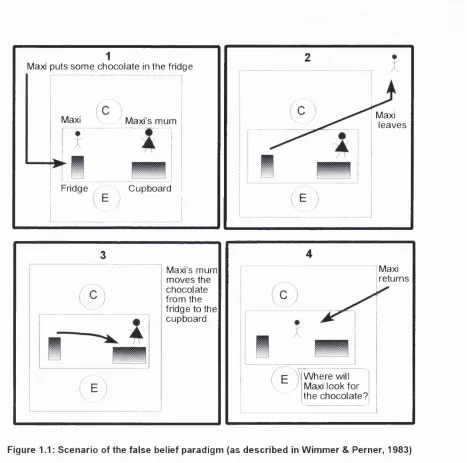
Scenario o f the false-belief paradigm (as described in Wimmer & Pemer, 1983) 17
Figure 2.1
Scenario o f the higher-order t a s k ...92
Figure 2.2
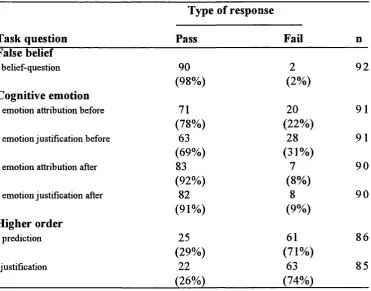
Percentages o f children passing the four questions o f the cognitive-emotion task ...99
Figure 2.3
Proportion o f children’s responses faUing in the six justification categories o f the higher-order t a s k ... 103
Figure 2.4
Pie chart showing the association between children who passed the higher-order task and their performance on the cognitive-emotion t a s k ... 107
Figure 4.1
Children’s performance on the higher-order task according to the number o f siblings in tbeir fam ily... 185
Figure 5.1
Frequency distribution o f children’s attachment classifications with their mothers at five years (n=86) ... 230
Figure 5.2
Frequency distribution o f children’s attachment classifications with their fathers at SVi
years (n = 6 8 )... 231
Figure 5.3
Children’s performance on the cognitive-emotion task according to their concurrent attachment classification with their mother (A, B, C, or D ) ... 232
Figure 5.4
Figure 6.1
Frequency distribution o f infant-motber attachment classifications at 12 months ( n = 8 8 ) ... 262
Figure 6.2
Frequency distribution o f infant-father attachment classification at 18 months (n=83) ... 263
Figure 6.3
Children’s performance on the cognitive-emotion task according to their attachment classification with mother in infancy (A, B, C or D) (n=88) ... 265
Figure 6.4
Children’s performance on the cognitive-emotion task according to their overall security o f attachment with mother in infancy... 267
Figure 6.5
Children’s performance on the cognitive-emotion task according to stability and change in the overall quahty o f their attachment relationship with their mother (secure vs. insecure) from infancy to five years (n = 8 5 ) ... 270
Figure 6.6 Children’s responses to the higher-order task according to their attachment status with mother in infancy (A, B, C, or D ) ...271
Figure 6.7
Children’s responses to the cognitive-emotion task according to their attachment status with father in infancy (A, B, C or D) ... 273
Figure 6.8
Children’s performance on the cognitive-emotion task according to stabihty/change in their security o f attachment with father from infancy to 5 V2 years (n=65) . . 277
Figure 6.9
Proportion o f children classified as A, B, C or D in infancy with their father according to whether they passed or failed the higher-order task ... 278
Figure 6.10
Children’s performance on the co gnitive- emotion task according to their combined infant attachment classification with both p a ren ts... 281
Figure 7.1
Frequency distribution o f mothers’ prenatal attachment classifications (n=89) . 316
Figure 7.2
Figure 7.3
Children’s performance on the cognitive-emotion task according to their mother’s attachment classification (D, E, F, or U ) ... 319
Figure 7.4a
Proportion o f children passing or failing the cognitive-emotion task according to wðer their mother scored above or below the median on the Reflective-self scale ... 325
Figure 7.4b
Proportion o f children passing or failing the cognitive-emotion task according to Wiether their mother scored above or below the median on the Passivity o f Thought sca le...325
Figure 7.4c
Proportion o f children passing or failiag the co gnitive- emotion task according to whether their mother scored above or below the median on the Coherence o f Transcript s c a l e ... 325
Figure 7.4d
Proportion o f children passing or failing the cognitive-emotion task according to whether their mother scored above or below the median on the Coherence o f Mind scale...325
Figure 8.1
Building a causal model - the cognitive-emotion t a s k ...352
Figure 8.2
Intercorrelations for the correlates o f children’s performance on the cognitive-emotion task (n=83) ... 355
Figure 8.3
Path analysis o f the predictors o f children’s performance on the cognitive-emotion task (n=83) ... 357
Figure 8.4
Path analysis o f the predictors o f children’s performance on the cognitive-emotion task - the expressive language model (n=83) ... 359
Figure 8.5
Figure 8.6
Path analysis o f the predictors o f girls’ performance on the cognitive-emotion task ( n = 3 8 ) ... 363
Figure 8.7
Building a causal model - the higher-order task ...368
Figure 8.8
Intercorrelations for the correlates o f children’s performance on the higher-order task ( n = 8 5 ) ... 369
Figure 8.9
Path analysis o f the predictors o f children’s performance on the higher-order task ( n = 8 5 ) ... 370
Figure 8.10
Path analysis o f the predictors o f boys’ performance on the higher-order task (n=44) ... 372
Figure 9.1
LIST OF TABLES
Table 1.1
Outline o f the basic representational changes underlying the development o f a theory o f mind (after Pemer, 1 9 9 1 )... 26
Table 1.2
Project design ...77
Table 2.1
Summary o f the levels o f sophistication required to pass each o f the three theory o f mind paradigm s...85
Table 2.2
The Maxi-chocolate story for the false-behef ta s k ...89
Table 2.3
The Elbe and the coke can story for the co gnitive- emotion t a s k ... 90
Table 2.4
The ice-cream story for the higher-order t a s k ... 91
Table 2.5
Frequencies (and percentages) o f subjects’ responses to the three theory o f mind tasks ...97
Table 2.6
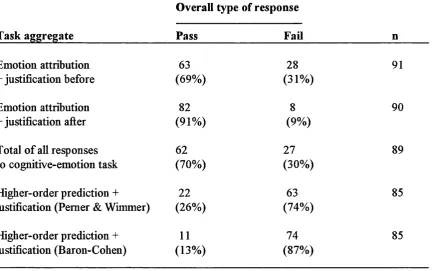
Frequencies (and percentages) o f subjects’ aggregated responses for both the cognitive-emotion and the higher-order ta s k s ... 98
Table 2.7
Cognitive-emotion task: Frequencies (and percentages) o f subjects’ responses to the justification questions according to the Harris et al. (1989) coding scheme . . . 100
Table 2.8
Higher-order task: Frequencies (and percentages) o f justification in the Pemer & Wimmer (1985) coding scheme categories... 101
Table 2.9
Table 2.10
Point-biserial correlations for the theory o f mind t a s k s ...107
Table 2.11
Means (standard deviations) and tests o f significance o f children’s chronological age for the pass and fail categories o f response on the theory o f mind questions . . 108
Table 3.1
Correlations between mental development quotient (ass assessed by the Bayley scales at 12 months), expressive language (as assessed at 60 months by the Bus Story) and theory o f m in d ...126
Table 3.2
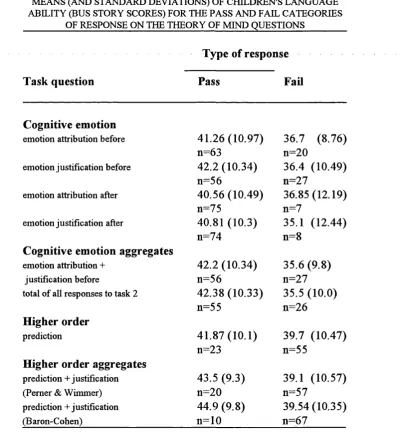
Means (and standard deviations) o f children’s language abihty (Bus Story scores) for the pass and fad categories o f response on the theory o f nund questions 127
Table 3.3
Correlations between the children’s expressive language and their parents’ verbal skills and education ...129
Table 3.4
Correlations between parents’ education level, parents’ verbal skills, and chddren’s theory o f m in d ...130
Table 3.5
Partial correlations between parents’ verbal skills and the child’s theory o f mind, controlling for gender... 131
Table 3.6a
Correlations amongst the variables in the cognitive-emotion regression model 132
Table 3.6b
Regression equation examining the prediction o f chddren’s performance on the cognitive-emotion task fi*om the variables in Chapter T h r e e ... 133
Table 3.6c
Summary table for the multiple regression analysis on the cognitive-emotion task ...133
Table 3.7a
Table 3.7b
Regression equation examining the prediction o f children’s performance on the higher-task from the variables in Chapter T h r e e ... 134
Table 3.7c
Summary table for the multiple regression analysis on the higher-order task . . 135
Table 4.1
Correlations between the mothers’ prenatal assessments and children’s performance on the two theory o f mind t a s k s ... 168
Table 4.2
Correlations between the frthers’ prenatal assessments and children’s performance on the two theory o f mind tasks ...169
Table 4.3
Correlations between the mothers’ responses to the Schaefer-Manheimer Postnatal Research Inventory (as assessed at three months) and children’s performance on the two theory o f mind tasks ... 171
Table 4.4
Correlations between the mothers’ responses to the Adaptation to maternal role questionnaire (as assessed at three months) and children’s performance on the two theory o f mind ta sk s... 173
Table 4.5
Correlations between the fathers’ responses to the Adaptation to the paternal role questionnaire (as assessed at three months) and children’s performance on the two theory o f mind ta sk s...175
Table 4.6
Correlations between ratings o f infant temperament (by both mother and father at three months) and children’s performance on the two theory o f mind tasks . . . 177
Table 4.7
Correlations between the mothers’ 12 month assessments and children’s performance on the two theory o f mind t a s k s ... 178
Table 4.8 Correlations between the frthers’ 12 month assessments and children’s performance on the two theory o f mind t a s k s ... 179
Table 4.9
Table 4.10
Correlations between ratings on the Child Behaviour Checkhst (average o f ratings by mother and father) and children’s performance on the two theory o f mind tasks
... 183
Table 4.11
Correlations between the number o f siblings in the family and children’s performance on the two theory o f mind ta s k s ...184
Table 4.12
Correlations between mothers’ ratings on the Dyadic Adjustment Scale and children’s performance on the two theory o f mind ta s k s ...186
Table 4.13
Correlations between fathers’ ratings on the Dyadic Adjustment Scale and children’s performance on the two theory o f mind tasks ... 187
Table 5.1
Summary o f episodes o f the modified strange situation for preschool children 226
Table 5.2
Observed (and expected) fi*equencies o f children’s performance on the cognitive-emotion task according to the different attachment groups (as assessed at five years) ...233
Table 5.3
Security and avoidance ratings for children’s attachment with their mother at five years grouped by their performance on the cognitive-emotion t a s k ...234
Table 5.4
Observed (and expected) fi*equencies o f children’s performance on the higher-order task according to the different attachment groups (as assessed a five years with mother) ... 235
Table 5.5
Security and avoidance ratings for children’s attachment with their mother at five years grouped by their performance on the higher-order t a s k ...236
Table 5.6
Table 5.7
Security and avoidance ratings for children’s attachment with their father at 5!4 years grouped by their performance on the cognitive-emotion task ...238
Table 5.8
Observed (and expected) frequencies o f children’s performance on the higher-order task according to the different attachment groups (as assessed at 5Va years with father) ... 238
Table 5.9
Security and avoidance ratings for children’s attachment with their father at 5 Va years grouped by their performance on the higher-order ta s k ... 240
Table 5.10
Observed (and expected) frequencies for children’s performance on the cognitive-emotion task according to a cross-tabulation o f their attachment classification (secure versus insecure) with both parents in the sbcth year [based on the logUnear model]
... 240
Table 5.11
Observed (and expected) frequencies for children’s performance on the cognitive-emotion task according to a cross-tabulation o f their attachment classification (secure versus insecure) with both parents in the sixth year [based on the additive model]
... 241
Table 5.12
Observed (and expected) frequencies o f children’s performance on the higher-order task according to a cross-tabulation o f their attachment classification (secure versus insecure) with both parents in the sixth year [based on the loglinear model] . . 242
Table 5.13
Observed (and expected) frequencies o f children’s performance on the higher-order task according to a cross-tabulation o f their attachment classification (secure versus insecure) with both parents in the sixth year [based on the additive model] . . . 243
Table 6.1
Observed (and expected) frequencies o f children’s performance on the cognitive-emotion task according to the different attachment groups (as assessed at 12 months with mother) ...264
Table 6.2
Table 6.3
Correlations o f the mother-infent attachment dimensions with the child’s performance on the cognitive-emotion task ... 269
Table 6.4
Observed (and expected) frequencies for children’s performance on the cognitive-emotion task according to a cross-tabulation o f stability and change in their attachment classification (secure versus insecure) with mother from infancy to five years ...270
Table 6.5
Observed (and expected) frequencies o f children’s performance on the cognitive-emotion task for the different attachment groups (as assessed at 18 months with father) ... 273
Table 6.6
Observed (and expected) frequencies o f children’s performance on the cognitive-emotion task according to their overall infant-father attachment security . . . . 274
Table 6.7
Correlations o f the frther-infant attachment dimensions with the child’s responses to the cognitive-emotion t a s k ... 276
Table 6.8
Observed (and expected) frequencies for children’s performance on the cognitive-emotion task according to a cross-tabulation o f stability and change in their attachment classification (secure versus insecure) with frther from infancy to 5^2 years [based on the additive m od el]...277
Table 6.9
Observed (and expected) frequencies o f children’s performance on the higher-order task according to the different attachment groups (as assessed at 18 months with father) ... 278
Table 6.10
Observed (and expected) frequencies for children’s performance on the cognitive-emotion task according to a cross-tabulation o f their attachment classification (secure versus insecure) with each parent in infancy [based on the loglinear model] . . 280
Table 6.11
Table 6.12
Observed (and expected) frequencies for children’s performance on the cognitive-emotion task according to a cross-tabulation o f their attachment classification (disorganized versus not-disorganized) with each parent in infancy...282
Table 6.13
Observed (and expected) frequencies o f children’s performance on the higher-order task according to a cross-tabulation o f their attachment classification (secure versus insecure) with both parents in infancy [based on the loglinear m o d e l]... 283
Table 6.14
Observed (and expected) frequencies o f children’s performance on the higher-order task according to a cross-tabulation o f their attachment classification (secure versus msecure) with both parents m infancy [based on the additive m od el]... 284
Table 7.1
Observed (and expected) frequencies o f children’s performance on the cognitive-emotion task according to their mother’s prenatal attachment classification . . 3 1 8
Table 7.2
Observed (and expected) frequencies o f children’s performance on the cognitive-emotion task according to their mother’s attachment classification (according to the traditional three groups, with the Unresolved group force classified) ... 320
Table 7.3
Observed (and expected) frequencies o f children’s performance on the cognitive-emotion task according to their mother’s overall attachment secu rity ... 321
Table 7.4
Observed (and expected) frequencies o f children’s performance on the cognitive-emotion task according to their mother’s AAI scale ratings ... 323
Table 7.5
Correlations between mother’s scores on the four component ‘mentalizing’ scales and children’s performance on the co gnitive- emotion task ... 324
Table 7.6
Observed (and expected) frequencies o f children’s performance on the higher-order task according to their mother’s prenatal attachment classification...326
Table 7.7
Table 7.8
Observed (and expected) frequencies o f children’s performance on the higher-order task according to their father’s prenatal attachment classification... 328
Table 7.9
Observed (and expected) frequencies o f children’s performance on the higher-order task according to their father’s prenatal attachment classification (as classified in the traditional three categories, with the Unresolved group force classified ) 329
Table 7.10
Observed (and e?q)ected) frequencies o f children’s performance on the cognitive-emotion task according to a cross-tabulation o f their parents’ attachment classification (secure versus insecure) [based on the loglinear model] ... 331
Table 7.11
Observed (and expected) frequencies o f children’s performance on the cognitive-emotion task according to a cross-tabulation o f their parents’ prenatal attachment classification (secure versus insecure) [based on the additive m od el]... 332
Table 7.12
Observed (and expected) frequencies o f children’s performance on the higher-order task according to a cross-tabulation o f their parents’ prenatal attachment classifications (secure versus insecure) [based on the loglinear model] ...332
Table 7.13
Observed (and expected) frequencies o f children’s performance on the higher-order task according to a cross-tabulation o f their parents’ prenatal attachment classifications (secure versus insecure) [based on the additive m o d e l]... 333
Table 8.1
The correlates o f children’s performance on the cognitive-emotion t a s k 348
Table 8.2
Aggregates created for the cognitive-emotion path analysis ... 349
Table 8.3
The correlates o f children’s performance on the higher-order task ...365
Table 8.4
CANDIDATE’S INDEPENDENT CONTRIBUTION
TO THE LONGITUDINAL PROJECT
Phase III pilot study
# Organisation, including recruiting 40 families, selecting and devising assessment tools
# Data collection, including interviewing the children
# Data coding, including developing adult narrative coding schemes
Phase III of the longitudinal project
# Organisation, including selecting and devising assessment tools
# Data collection, including interviewing the children at the 5 year follow-up, and
interviewing the mothers at the 5Va year follow-up
# Data coding, including classifying the Cassidy & Marvin separation-reunion
procedures, the LEDS transcripts, the child assessment measures, and developing
THEORY OF MIND AND ATTACHMENT:
This chapter is presented in three parts. Part one introduces the theory of mind
literature: it defines a theory of mind and its functional significance, describes the
methodologies developed to assess it, highlights the developmental origins of a theory
of mind, establishes the importance of interpersonal experiences in relation to
individual differences in the development of a theory of mind and reveals a
corresponding gap in related empirical work. Part two introduces the attachment
literature in three sections: attachment theory itself, the methodologies developed to
assess attachment security, and the attachment research, highlighting the predictive capacity of attachment security with regards various aspects of preschoolers’
competence Part three introduces the present investigation, presents a theoretical link
between the theory of mind and attachment literatures and identifies a corresponding
empirical gap - the raison d’etre of the present investigation.
PART ONE
THEORY OF MIND
Jane wants grandma to carry her, but grandma is resisting, saying that sh e ’s too
“Jane says “OK”. And then she puts her arms around grandma, and grandma
thinks she’s having a cuddle, but she hops into grandma’s arms!” ^_____________
Jane (the younger sister) falls over and hurts her knee. Later, they [Susan (the older sister) and Jane] are...
“doing a walking race to see who can walk the fastest, and Jane won, because
Susan let her win because she fell over”.^
1.1. Defining a theory of mind
The children narrating the stories above can be credited with a "theory o f mind", a
phrase coined by Premack & W oodruff (1978). Why? Because they are demonstrating that
they have the skills and conceptual knowledge necessary to become able to infer unobservable
mental states in oneself and in others, and to use such knowledge to explain and predict
behaviour in the social world. Through the acquisition o f a theory o f mind, children come to
understand that the overt actions o f self and others are the products o f internal mental states
such as behefs and desires. They thus come to distinguish between accidental and intended
behaviour, between wishes and reahty, between plans and outcomes, between truth and
deception. For exarqple, in the stories above, the first child is demonstrating her
understanding that Jane’s intentional action to deceive her grandma will lead to her grandma
having the false behef that Jane is putting her arms around her for a cuddle and not to be
carried. The second child is demonstrating her understanding that the outcome o f a race can
be determined by intentional acts, in this case, an intentional act by one character based on
that characters erqpathic understanding o f vshat will make another character, who is unhappy,
happy.
By using the phrase theory o f mind, it is to indicate that the child’s understanding o f
minds is mentahstic and coherent - that is, it concerns a system o f inferences that is not
directly observable, and the system can be used to make predictions. There is also a case for
arguing that children are theorists in much o f their knowledge acquisition (Carey, 1985; Keil,
1989; Karmiloff-Smith, 1988) and in the acquisition o f their theory o f mind in particular
(Pemer, 1991; Wellman, 1990; Gopnik & Wellman, 1992). However, perhaps the alternative
terminology, “naïve psychology” or “folk psychology” may be a better term, since it reminds
us that it is sinq)ly our everyday, lay understanding o f people as psychological beings.
1.2. The roots of the theory of mind research explosion
and in the philosophy o f mind and language (see Pemer & Wilde-Astington, 1991).
Children’s understanding o f the mind was one o f the first topics tackled by Piaget (1929), and
he was also the first to tackle the topic. Piaget (1976) described intellectual development as
the movement toward greater flexibihty and increased intentionahty o f thought. He detailed
the child’s transition fi"om reflex behaviour to the development o f formal operations in which
the child has such control over his^ own mental processes that he has httle need to deal with
the concrete world at all, but instead, can use mental representations o f reahty and possibihty.
In Piaget’s theory, a core notion was that o f early childhood egocentrism, m which the child
operates without an understanding o f the ways in which others’ views and thoughts may be
Ç i-C
different to his own (Piaget & Inhelder, 1966/1969).
In the 1970's, a barrage o f experiments challenged and amended the view that young
children are reahsts and egocentric (Flavell, Botkin, Fry & Jarvis., 1968; FlaveU, 1978;
Donaldson, 1978), and the 1980's have seen the mushrooming o f several relatively
autonomous programmes o f work examining the young child’s psychological understanding
in more detaü. Work has ranged over children’s developing abihty to compute other’s
perceptions, distinguish appearance and pretence fi*om reahty, take account o f others’ behefs,
emotions and intentions, and acquire the language with which to talk about such things.
In the past eight years or so, these research groups have discovered that they share
interests aptly captured under the umbreha term ‘theory o f mind’. Thus, research on
children’s theory o f mind returns to the classic developmental topic o f how and when children
come to adopt common-sense mentahsm.
It is likely that children’s theory o f mind understanding has captured the centre stage
of developmental psychology precisely because o f its inq)ortance in human development. It
is an inq)ortant change in the way the child thinks about the world. Acquiring such a theory
o f mind involves the simultaneous recognition that there is a single reahty, but that different
people, or the same people at different times, may have different representations o f that
reahty, i.e. the child develops a distinction between subjective and objective.
As a theory, it is particularly important for children’s development as social beings,
since social interaction is thought, to a large degree, to be based on an interaction o f minds.
Thus, the assumption is that a theory o f mind understanding guides ah social action and
interaction. The philosopher Dennett (1978b) was perhaps one o f the first to put forward the
case for the necessary role o f a theory o f mind to understanding the social world. His thesis,
entitled the Intentional Stance theory, claimed that attributing mental states to a complex
system (such as a human) was by far the easiest way o f understanding it. By understanding,
he meant coming up with explanations o f its behaviour, and predicting what it would do next.
Thus, according to Dennett (ibid.), the Intentional Stance, or what has become better known
as a theory o f mind, is evolution’s solution to enable us to understand and predict our own
and other people’s behaviour. As Baron-Cohen (1994) has concluded, “it is a simple-to-use
and powerful theory, which is exactly what we need when we are in the thick o f a social
situation”.
A theory o f mind is crucial not only to making sense o f social behaviour, but also to
making sense o f social communication, as philosophers o f language clearly articulated. For
example, Grice (1967/ 1975) has argued that aside fi*om decoding the referent o f each word
for meaning in wiiat someone has said is to imagine what their communicative intention might
be. This latter process obviously involves going beyond the perceptual input to hypothesize
about the speaker’s mental state. The need for such a process becomes even clearer in the
case o f decoding figurative speech, such as irony, sarcasm, metaphor, or humour, where the
speaker does not intend their utterance to be taken hterally (Baron-Cohen, 1988).
Arguably, the most ûnpoitant fimctions o f a theory o f mind are to understanding social
behaviour and communication. This can be seen most poignantly in observations o f autistic
children. One o f the defining features o f these children is their profound impairment m social
and communicative development (Kanner, 1943; Rutter, 1983; Parks, 1983) - they display a
lack o f reciprocity in social contact, inappropriate gaze behaviour, and a paucity o f joint play
and communicative skills (Volkmar, 1987). Recently a sizeable body o f work has also
documented deficits in these children’s understanding o f mental states (Baron-Cohen, Leshe
& Frith, 1985, 1986; Baron-Cohen, 1989c, 1989d; Leshe & Frith, 1988; Pemer, Frith, Leshe
&Leekham, 1989; Reed & Peterson, 1990; Baron-Cohen, Tager-Flusberg & Cohen, 1993).
Thus, from these findings, it has been suggested that the difficulties autistic children have in
understanding mental states appear to relate to the symptoms these children show in social
and communicative development (Baron-Cohen, 1988).
There are several other fimctions o f this cmcial abihty which also stand out. The use
o f deception is an obvious one. Deception is o f course ah about making someone believe
something is tme when it is actuaUy false, as the child in the first o f the narrative examples at
the beginning o f this chapter clearly demonstrated. Indeed, it has been postulated, in the
Machiavelhan Intelhgence hypothesis, that the benefits o f being able to deceive might have
been an important evolutionary pressure in the development o f a theory o f mind (Byrne &
Another exaraple is teaching or attempting to change a person’s mind. The
reahsation that other people’s thoughts and behefs are shaped by the information to which
they are exposed to allows for the possibihty o f informing others in order to change what they
know. Thus, there are anecdotal accounts o f four year olds teaching their younger siblings in
dififerent ways, and o f older children simplifying the information in recognition o f the limited
knowledge o f the younger child (Dunn, 1988).
A final examg)le is that o f self-consciousness or self-reflection. As soon as children
can attribute mental states to themselves, they can begin to reflect on their own minds.
Clearly, this transforms their thoughts fi*om a focus on the here and now to a focus on their
own subjectivity.
Obviously there are many other spin-ofifs once the child has a theory o f mind, but the
above serves to highhght why the acquisition o f a theory o f mind is such a milestone in
children’s development and in their understandmg o f the world.
1.4. The precursors to a theory of mind
Given the centrahty o f a theory o f mind to children’s social understanding, attempts
to trace the development o f a theory o f mind have searched the documentation o f infant’s
social understandmg, and appear to have assumed that a theory o f mind develops m stages,
perhaps as a legacy o f the previously dominant Piagetian approach to cognitive development
(Gopnik & Wellman 1992; Pemer, 1991; Sullivan & Winner, 1991; Wimmer & Hartl, 1991).
Although the theory o f mind milestone transforms children’s social understanding, clearly
in&nts also have some understanding o f the social world. In fact they have even been credited
with an “imphcit theory o f mind” (Bretherton, McNew & Beeghly-Smith, 1981). The next
1.4.1 Up to nine months
Research in early infancy shows that infants are predisposed to social interaction
(Trevarthen, 1979; Stem, 1977); they imitate some human actions (MeltzofiF & Moore, 1993),
they preferentially attend to faces (Sherrod 1981,), and are able to discriminate facial
expressions o f emotion at an early age (Nelson, 1987). For these first few months o f their life,
infants are intensely interested in people, spending much time in dyadic social interaction. The
attachment hterature, and research on parent-infant interaction (e.g. Stem, 1985) provide rich
accounts o f the proclivities that help the infant pick out, attend to, and represent people as
special, significant, and information-laden entities.
However, although these infents are complex social creatures, it is fair to say that their
social interactions are not yet governed by some mental process that corresponds to, or
imphcitly represents, others' mental states. Importantly, they are only able to interact in
fece-to-face situations which do not mvolve external referents (such as peek-a-boo). This is
something which characterizes the next period o f development - around nine to twelve
months.
1.4.2. The period around nine to twelve months
Researchers have described a general transition in infant social cognition which occurs
around nine to twelve months, characterised by the development o f communicative actions
or gestures to regulate interactions with others (usually adults) in relation to external objects
(Schaffer, 1984). The development of'prelinguistic intentional communication' has variously
intersubjectivity (Trevarthen & Hubley, 1979), intentional communication (Bates et al.,
1979b), a theory ofinterfacible minds (Bretherton et al., 1981), triadic awareness (Adamson
& Bakeman, 1985), and the relatedness triangle (Hobson, 1990, 1994). The evidence for this
abounds with many well-documented social abihties such as social referencing (Campos &
Sternberg, 1981) and early protolinguistic communications such as joint-attention behaviours
(or protodeclaratives) (Murphy 1978; Bates, Benigni, Bretherton, Camaioni & Volterra,
1979b; Baron-Cohen, 1989c, 1991, 1993; Gomez, Sarria & Tamaiit, 1993; Mundy, Sigman
& Kasaii, 1993). However, the interpretations o f the advent o f these new abihties in infants
fall into a dichotomy; those authors who are led to attribute an imphcit theory o f mind to
infants (for exanq)le, Bretherton et al, 1981), and those who take a more parsimonious stance
(for exan^le, Pemer, 1991).
It might be usefiil to consider the evidence in more detail. What can be inferred from
the in&nfs abihty to consult their mother’s free for 'advice', as seen in the "visual cliff' studies
(Walk & Gibson, 1961; Sorce, Emde, Canpos & Klinnert, 1985)? It could be argued that the
infant is demonstrating an understanding o f his mother as intentional in the mdimentary
sense o f having certain experiences about or o f external objects. On the other hand, one could
argue that infrnts can react appropriately to their mothers' fearful face without understanding
the deeper mental reason vAiy she shows a fearful face; ah they need to do is understand that
she is overtly displaying a fearful expression toward a certain object.
hi terms o f the relation between early protolinguistic communication and a theory o f
mind, there is an important distinction between protoimperatwes (requesting gestures) and
protodeclaratrves (joint-attention behaviours). The former are characterised by the use o f
eye-contact and gestures for an instmmental or imperative purpose, such as to gain another
gestures and eye-contact to share an awareness or experience o f an object or event. Both o f
these involve vAiat have been referred to as triadic exchanges, since they demand that the child
and a second person share or coordinate attention vis-à-vis some third object or event
(Bakeman & Adamson, 1984).
Research with autistics has demonstrated more robust deficits on measures o f
protodeclaratives than measures o f protoinq)eratives or other types o f non-verbal
social-communication skills Wien conq)ared to developmentally matched controls with mental
retardation, language delays, or normal development (Baron-Cohen, 1989c; Mundy et al.,
1990; Sigman et al., 1986).
The inferences drawn from early protolinguistic communication are spht m a similar
way to inferences from social referencing which were described above. Hobson (1990) has
argued that infrnts' protodeclarative pointing indicates their goal o f sharing experiences rather
than just o f influencing behaviour. Indeed, the argument for the intentional nature o f infants'
communications would appear to be strengthened by demonstrations that infants also check
the gaze o f the adult whose attention they are seeking in between referencing the goal-object
itself, and modify their gestures until their goal has been achieved (Franco & Butterworth,
1989). On the other hand, it can also be argued, as Pemer (1991) and Gopnik, Slaughter &
May (1994) do, that in the case o f proto declarative gestures, it remains unclear whether the
infant is really aiming at manipulating attention so as to produce a shared experience.
Furthermore, it could be that infants are not making a distinction between merely seeing and
actually attending, and thus, that when they engage in protodeclarative behaviours they are
simply attributing vision to the other person, and therefore are not demonstrating an
understanding o f propositional attitudes, as Baron-Cohen & Cross (1992) propose.
communication and intentional conceptions. However, the suggestion that these early
communicative behaviours could be precursors to a theory o f mind is also supported by
evidence from the data on autistic children, which, as mentioned earlier, has revealed they
evidence deficits on measures o f protodeclaratives as well as a theory o f mind (Baron-Cohen,
1989c; Mundy et al., 1990; Sigman et al., 1986). And, as Dennett and others (for example,
Dennett 1978) have suggested, there must be some level o f intersubjectivity for there to be
understanding between the child and her principal caregiver(s) before the emergence o f
linguistic skills in the child.
1.4.3. The second year o f life - the advent o f language
In the months after their first birthday, children begin to be able to communicate
verbally, and their early language reveals at least a rudimentary understanding o f a number o f
intentional-eigeriential states. The clearest evidence that such young children have a theory
o f mind comes from their emergent language - in particular, from their appropriate
spontaneous references to single inner state words in their everyday conversation (Bretherton
et al., 1981; Bretherton & Beeghly, 1982; Dunn, Bretherton & Munn, 1987; Ridgeway,
Waters & Kuczaj, 1985), such as 'want', 'happy', 'see', - which concerns itself with subjective
experiences about real objects or situations. The fact that the targets o f these inner states are
'real' in the sense o f potentially available, as opposed to imaginary, counterfactual, or false,
is inq)oitant. Being able to maintain inner states in relation to the latter presents considerably
greater difiBculties to the growing child. However, by 18-24 months, children are able to
understand people as having inner experiences o f certain types (notably desiring, perceiving
and simple emotional states) about external objects, situations and actions.
manÿulate symbols, and to represent a conceptual system. The idea that learning a language
makes it possible for the child to form rules and to think abstractly is well-estabhshed in Soviet
psychology (for example, Luria, Vygotsky). More recently, Donaldson (1978, 1984) on the
premise that language is the principal symbohc system to which the preschool child has access,
has proposed that the child must learn to turn language and thought in upon himseH^ and
thereby expand his conceptual system in the direction o f increasing ability to represent itself.
However, reflective awareness o f language invokes a notion o f control, which in turn can be
related to the child's more general self-awareness - "control o f a fimction is the counterpart
o f one's consciousness o f it" (Vygotsky). Piaget expressed similar sentiments by postulating
that the child can heighten his awareness o f what is actual by considering what is possible.
It is evident that the advent o f language is o f paramount importance for the
development o f the child's theory o f mind^, and has important theoretical and empirical
imphcations. Considerable attention will be devoted to these at a later stage (see Chapter
Three). For now, suffice it to say that children develop a host o f exciting new abihties soon
after they become language-using creatures.
1.4.4. By two years o f age
In the few months preceding or succeeding the child's second birthday, a whole set o f
qualitatively new behavioural achievements emerge more or less in synchrony. In relation to
the development o f a theory o f mind, several authors have hypothesized that these changes
correspond to a qualitative maturational change in the representational system that allows the
infant to break away fi"om the single, primary model o f reahty that was being built on the basis
o f direct perceptual experience (for exanq)le, Leslie, 1987; Pemer, 1991; Meltzofi^ 1990).
These authors all suggest that, due to the change in the representational system, the toddler
becomes able to constmct multiple representations that can model hypothetical as well as real
situations. Their evidence is drawn from the following developmental achievements which
emerge between 18 months and two years o f age.
1.4.1.1. Mirror self-recognition
Sometime between 18 months and their second birthday, children become able to pass
the mirror self-recognition (MSR) test (the 'red dot test' - Mussen, 1984); in other words,
children are able to understand that the mark they perceive on the mirror image o f their
nonvisible body parts (forehead, ear) is, in fact, on the corresponding part o f their body
sur&ce. Gergely (1994) has provided a lucid account o f the relationship and developmental
sequence o f steps between the cognitive prerequisites for MSR and those for a theory o f mind.
He postulates that in order to pass the MSR facial mark test, the child must be able to
appreciate the duahty between the projection o f objects in the mirror and their relative
position in the environment, i.e. represent reahty in multiple models, such as reahty as
reflected in the mirror versus reahty as perceived in the world; and the child must also be able
to update their primary model o f reahty through conceptual inference as weh as through direct
perception.
Gergely (1994) notes importantly that in order to pass the MSR test, the child does
not need to be able to represent hypothetical situations. This, in fact, is the next stage along
1.4.4.2. Pretend play
The emergence o f the capacity for the two-year-old to engage in pretend play has been
heralded by Alan Leshe (1987) as a great turning point for the toddler's developing theory o f
mind. In his account, he illustrates that being able to pretend, and, more importantly,
understanding themselves and others as pretending, requires mastery o f exactly the same
cognitive structures as understanding mental states. In other words, pretending is the
characterisation o f an attitude toward intentions o f mind, and engages the child in the
generation and manipulation o f mental models or representations. Thus, pretend play is
assumed to index the development o f skills that are either indicative o f the emergence o f the
theory o f mind module (ToMM - Leshe, 1987, 1988), or indicative o f the acquisition o f
cognitive skills that may be necessary but not sufficient for the emergence o f a theory o f
mind.
Pretence, conceived o f as a nascent theory o f mind skill, becomes all the more
poignant if one departs from previous accounts o f early pretence. These emanated from
camps concerned with the autonomous growth o f the individual (such as Piaget), and
consequently only considered solitary pretend play. In contrast, Leshe has made an inq)ortant
advance by referring to shared pretence, which is imbued with the notion o f dyadic
development. Only in shared pretence is the general nature o f pretence cognition revealed,
since it necessitates both pretending and two-way intentional communication. Engaging in
shared pretence is a notable advance over simple intentional understanding because the child
exhibits an abihty to reason about people's pretend attitudes toward pretend objects, all the
while keeping track o f the pretence and the reahty. In negotiating this sort o f pretence, the
child must construe people as seeing, reaching for, manipulating, liking or not liking,
pretence obviates the need for the child to infer the pretend context, since he can singly
stipulate this himself
1.4.4.3. Empathy
The emergence o f enq)athic behaviour provides strong evidence that toddlers can
understand emotions as internal states. This is in^)Hcit in Pemer's (1991) phenomenological
definition o f empathy - "the experience o f participating in or sharing another person’s
emotional state and thereby understanding what that state is" [p. 132, ibid.]. There is an
abundance o f evidence o f empathie responses in toddlers from Judy Dunn's detailed
observations o f preschoolers (for example, 1988). She has reported two-year-olds showing
distress in response to parental disputes, and even trying to intervene (such as trying to
comfort the parent wfro is emotionally hurt, or kicking the one who is perceived as the guilty
party). The fret that these children not only particÿate in the emotional distress, but also take
appropriate comforting action toward the distressed person suggests that they do understand
the other person's emotional state by analogy to their own experience. Following the premise
that these children's enq)athic reactions are based on an understanding o f their own inner
experience o f distress, then they must be imputing a state o f distress to the other person.
Since this state is not directly observable in the other, Pemer (1991) postulates that it is
'hypothetically constmcted' as analogous to the child's own 'inner experience' o f sadness, and
that it is this constmct that creates the necessary connection between the distressfiil event,
outer signs o f distress, and the child's own inner experience.
1.4.5. The third year o f life
resulting in the three-year-old being able to talk sensibly about contentful mental states via
words such as "think', "know", and 'remember' (for example, Shatz, Wellman & Silber, 1983).
They also develop the abihty to incorporate mental states into a causal framework,
most commonly led by the mental state o f desire, which enables them to recognise that
individuals will react differently to a situation depending on the desires or preferences that
those individuals bring to the situation (Wellman & Woolley, 1990; YuiU, 1984). This
powerful residual tendency to comprehend the relationship between people's internal states
and external situations or emotional reactions largely in terms o f people's desires alone,
ignoring behefs, governs the preschooler's understanding until about their fourth birthday.
1.4.6. By three or four vears o f age
Any time around this age, the famous cognitive watershed occurs, which
revolutionises preschoolers' existing grasp o f mental states as theoretical constructs in a theory
o f behaviour, and has led them to be attributed with a theory o f mind.
Soon after reaching this milestone, the child develops an understanding o f the
representational underpinnings o f emotions as mental states. Children start to acknowledge
that emotional reactions depend on behefs as weh as desires (Wellman & Baneijee, 1991);
in particular, they begin to grasp that emotional reactions are contingent not on what actuaUy
happens, but on what people expect to happen, even when those expectations are incorrect
(Harris, Johnson, Hutton, Andrew & Cooke, 1989; Baron-Cohen, 1989). However, it is only
by five or six years that children's understanding o f the 'aboutness' that emotion inherits from
behef develops in import and consistency (Hadwin & Pemer, 1991).
Also around this later age, children's theory o f mind develops in sophistication.