4978
Design Of Social Arithmetic Students Worksheets
With Rme Approaches To Improve Critical
Thinking Ability
Hanendasari Kusumaningrum, Suparman
Abstract : Critical thinking is one of the skills students must have in the 4.0 and 21st-century industrial revolutions. Students who have low critical thinking skills will have difficulty in solving the PISA model HOTS type of UN questions. This study aims to analyze the need for teaching materials that are by following the Realistic Mathematics Education (RME) approach that can improve students' critical thinking skills. Research conducted is development. The research subjects were grade VII students of SMPN 1 Banguntapan Bantul. The object of research is critical thinking, learning approaches, and teaching materials. Data collection instruments in the form of observation guidelines, test questions, questionnaires, and interview guidelines. While model research this is the fourth-D. The critical thinking skills of students are still low. The learning approach that can be applied to improve critical thinking skills in students is RME. Social arithmetic is one of the materials that are difficult for students. The characteristics of students have not been integrated into the teaching materials used. Teachers need worksheets that are by following RME approach that can improve critical thinking skills on a particular material. This research can be developed in the development of worksheets with RME approach to improving critical thinking skills.
Index Terms: Critical Thinking, Worksheets, RME.
————————————————————
1 INTRODUCTION
Critical thinking is a process and strategy that is reflective, systematic, constituent, in making decisions [1]. Besides, critical thinking an open mind without wavering, thinking that analytical, judge without a vote, as well as strong without [2]. One of the concepts related to CL and TR is critical thinking [3]. Critical Thinking has five indicators, including clarification of basic (elementary clarification), give reasons for a decision (the basis for the decision), concluded (inference), further clarification (advanced clarification), as well as alleged and integration (supposition and integration) [4]. Critical thinking is a skill that must be owned by students at 4.0 and the industrial revolution of the 21st-century skills of critical thinking is very important because it can deal with the social, scientific, and functional [5]. Critical thinking skills are one of the priorities for educational purposes [6]. In preparing the 21st-century generation, insights into critical thinking show a significant contribution [7]. Students are trained to think Krit is going to have a positive attitude. So that, can study problems systematically, organized, and can make accurate decisions in solving problems [8]. Mathematics is one of the subjects that must be achieved by student, where the learning goal is to train the ability to think logically, analyze, systematically, critically, innovatively, creatively, and can work together [9]. Mathematics is also a basic asset in solving problems in everyday life. Therefore, mathematics must be taught at all levels [10]. Mathematics and critical thinking skills are two inseparable things because mathematical material is understood through critical thinking [11].In the context of mathematics, critical thinking encourages teachers and students to learn more about the emerging definition of mathematical concepts [12]. The critical thinking skills include: (1) problem analysis, criticizing the argument, and verification; (2) conclusions obtained using inductive or deductive reasoning; (3) assess and evaluate; and (4) making decisions or solving problems [13]. One cause of low levels of critical thinking is the implementation of teacher-centered teaching, where students as recipients of passive [14]. Science education not only makes students knowledgeably fixed, but has a scientific attitude that is critical, logical, inventive and innovative, and consistent. However, based on the results of TIMSS, Indonesia gained ranked 3 from behind. This is very unfortunate. Students who have low critical thinking skills will have trouble. One of them in the resolution about the UN-type models HOTS TIMSS or PISA. Learning tools that do not have critical thinking skills will have an impact on the effectiveness of achieving competency standards. This also happened at SMPN 1 Banguntapan. Based on observations that have been made, obtained the following results. First, students' critical thinking skills are low, this can be seen in solving the problem. Students have not met the indicators of critical thinking skills. The characteristics of students have not been integrated into the teaching materials used. Not no teaching materials by following the model of learning, which can enhance the critical thinking skills of
students.Realistic Mathematics Education (RME) based
learning is one alternative to effective learning, where mathematical concepts can be conveyed well [15]. The characteristics of this RME lead to progressive mathematical processes, which allow students to connect problems with context, identify relevant mathematical concepts, solve problems, and interpret solutions based on their context [16]. In RME, students are expected to work actively and build their knowledge [17]. At RME, students use literacy skills to formulate real problems into mathematical problems, then solve and interpret them in real contexts [18]. Students are expected to know how to work in groups, be active,
be creative in rediscovering a concept and
developing a model to solve contextual problems [19]. "Real" ____________________________________
• Hanendasari Kusumaningrum is currently pursuing master’s degree program in mathematics education at Ahmad Dahlan University,
Indonesia, PH-+628989074536. E-mail:
• Suparman is an associate professor in mathematics at Ahmad
Dahlan University, Indonesia, PH-+6281328201198. E-mail:
4979 in this case is anything that is real or concrete and can be
observed or understood through imagination [20]. In the real world context, RME is used as a starting point for students in creative thinking [21]. Realistic learning is not only related to the real-world context but also related to the
emphasis of imagination, so the problems given in
learning can be imagined by students [22]. Therefore, RME
approach is learning that was born with the main principles to achieve meaningful and enjoyable learning goals [23]. In the classroom, RME approach starts with contextual problems and
gives students the freedom to describe, interpret and
solve contextual problems in their way, and according to their initial knowledge [254]. RME learning provides closeness between the experience of students with the material being
taught, so it is easier to understand mathematics and
more meaningful [25]. It is expected that with the use of RME approach, learning with or without teachers, students will be able to use these contextual problems as sources of mathematical concepts or definitions that increase in the
abstract [26]. Of course, an increase in conceptual
understanding is in line with an increase in students' learning
achievement [27]. The steps of Realistic Mathematics
Education (RME) include understanding contextual problems, solving contextual problems, comparing and discussing
answers, and concluding [28]. In Realistic Mathematics
Education (RME) based learning, student worksheets are needed. Based on teacher interviews, student worksheets are not by following the learning model used. On the other hand, researchers conducted an assessment of learning resources in the form of worksheets used by schools. Based on the results of the material expert validation, several results were obtained. The standard deviation of the content eligibility aspect is 1.25; linguistic aspects of 1; feasibility aspects of presentation 1; aspects of RME syntax conformity of 0; and the suitability aspect of the critical thinking indicator by 0. The highest percentage was 87% in the linguistic aspect. As for some deficiencies were identified: (1) The example given is not much, (2) Presentation materials less attractive, so it does not give an incentive to the students, (3) Do not include learning model, (4) Do not include the ability to improve. Based on the results of the media expert validation, several results were obtained. The standard deviation of the content eligibility aspect is 0.57; presentation eligibility 1.52; graph eligibility 1.59. The highest percentage is 90% in the aspect of content eligibility. As for some of the deficiencies found, namely (1) There is no illustrated image, (2) Worksheets is less attractive, (3) There are no instructions for using worksheets.Based on the explanation above, this study aims to determine the characteristics of students, determine the level of critical thinking of students, know the learning model that can improve students' critical thinking skills, analyze the curriculum, analyze the material, and analyze the needs of worksheets by following RME approach that can improve students' critical thinking skills.
2
RESEARCH
METHOD
The research used by researchers is development. The subjects in this study were all grade VII students of SMPN 1 Banguntapan Bantul, who were randomly selected from eight classes. The object of research is critical thinking, learning
approaches, and teaching materials. Data collection
techniques in this study include observation, test questions, questionnaires, and interviews. Data collection instruments in
the form of observation guidelines, test questions,
questionnaires, and interview guidelines. At the observation stage, the researcher analyzes the curriculum, analyzes the subject values of the UN results in mathematics, and analyzes the learning model that can improve students' critical thinking through literature studies. The provision of test questions is
used to measure the level of critical thinking in
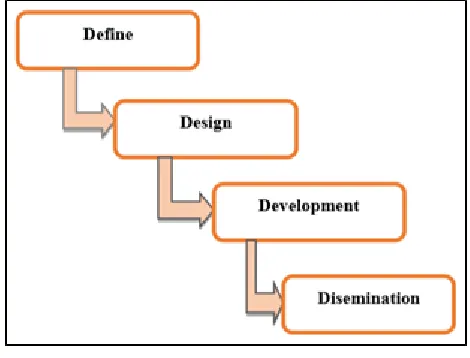
students. Questionnaires are used to analyze material that is difficult for students and analyze teaching materials that make it easier for students in learning mathematics. While at the interview stage, the researcher asked several questions about students' critical thinking skills in grade VII mathematics teachers, about learning models, as well as learning resources that can enhance critical thinking. The research model is 4 D. Stages of the 4D model, among others, the stage of definition, design phase and the development phase of the dissemination phase [29]. The 4D stages can be seen in Figure 1.
Figure 1. 4D Stage
3
RESULTS
AND
DISCUSSION
1 Analysis
4980 The scope of mathematics material at junior high school level
includes rational numbers, algebra, geometry, statistics and opportunities, and sets. Based on the results of a questionnaire about the order of material that has been given to 26 students, it is known that one of the materials that are considered difficult for students is social arithmetic. As many as 38,5% of students had difficulty in social arithmetic material; 23,1% of students had difficulty in algebraic material; 23,1% had difficulty in lines and angles; 15,4% lines and angles in equations and linear inequalities one variable, and the rest in the other material. In the results of a questionnaire about teaching materials, it is known that 84,6% of students choose worksheets as teaching material that makes it easy for students in learning mathematics.Test questions are given to students to determine the ability of critical thinking levels. Based on the results of the analysis of the test questions, it is known that the level of critical thinking in students is still relatively low. This is evident in the answers of students, where most of them have not met the indicators of critical thinking. The wrong results of students' work can be seen in Figure 2.
Figure 2. Examples of Student Answers
Example answers from one of the students in Figure 2 above show that critical thinking skills in students are still low. Students have not been able to find the right strategy in solving these problems. Students have not been able to identify problems in the problem.Interviews were given to mathematics teachers in grade VII to find out the extent of students' thinking skills. Based on the results of the interview, the following information is obtained: 1) The ability of students to ask and answer questions is still low. 2) Students think of the answers first before expressing them to the teacher, if the answers are felt to be incorrect then it will be discussed together. 3) Some students have not been able to observe or analyze examples of problem-solving correctly. 4) Not all students can solve the questions correctly after observing the examples of the questions given. 5) Some students have not been able to solve problems coherently, because it depends on the abilities possessed by each student. 6) Not all students can evaluate their work. 7) Not all students can explain the steps in solving problems. 8) Not all students can use other alternatives in solving problems, because it depends on the abilities possessed by each student. 9) There are still students who quickly give up if they have difficulty in working on the problems.
2 Design
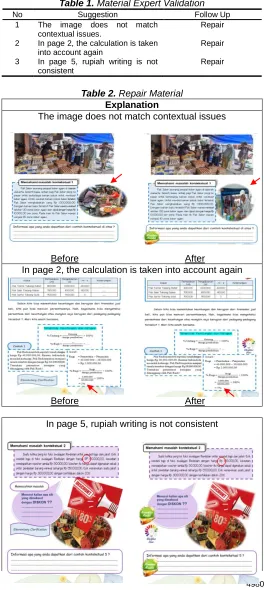
Based on the results of the analysis of the needs of worksheets, the researchers created worksheets design with RME approach that could improve students' critical thinking skills. The worksheet’s design that was created was validated by two validators. Media expert validator and material expert. The comments/suggestions and improvements by the material expert validator can be seen in Table 1 and Table 2.
Table 1. Material Expert Validation
No Suggestion Follow Up
1 The image does not match contextual issues.
Repair
2 In page 2, the calculation is taken into account again
Repair
3 In page 5, rupiah writing is not consistent
Repair
Table 2. Repair Material
Explanation
The image does not match contextual issues
Before After
In page 2, the calculation is taken into account again
Before After
4981
Before After
Based on the results of the material expert validation, several results were obtained. The standard deviation obtained in the aspect of content eligibility is 0,64; linguistic aspects of 1; aspects of the feasibility of serving 0,55; aspects of RME syntax suitability of 0.89; and the suitability aspect of the critical thinking indicator of 0,5. The highest percentage is 92% in the feasibility aspect of the presentation. As for comments/suggestions and improvements by the media, the expert validator can be seen in Table 3 and Table 4.
Table 3. Media Expert Validation
No Suggestion Follow Up
1 Table of contents adjusted to the
contents page. Repair
2 It does not include indicator information from critical thinking and RME learning models.
Repair.
3 The cover needs to be added curriculum information, book name, book level.
Repair.
Table 4. Improvement of Media
Explanation
Table of contents adjusted to the contents page
Before After
It does not include indicator information from critical thinking and RME learning models
Before After
The cover needs to be added curriculum information, book name, book level
Before After
Based on the results of the media expert validation, several results were obtained. The standard deviation obtained in the aspect of content eligibility is 0,5; aspects of presentation eligibility of 0,45; and the feasibility aspect of the graph of 0,45. The highest percentage is 85% in the aspect of content eligibility and graphic suitability.
4
CONCLUSION
Based on the results of the study of the needs of the worksheets near RME, it can be concluded that. One of the characteristics of students is the ability to think critically. The ability to think critically in students is classified as low. One learning approach that can be applied to improve critical thinking skills in students is RME. The curriculum in the school is by following the Ministry of Education and Culture. Arithmetic material is one material that is considered difficult by students. Worksheets teaching materials make it easier for students to understand mathematics learning. However, it is unfortunate that the available worksheets have not been able to integrate the characteristics of students, one of which is the ability to think critically. Teachers need worksheets that are by following RME approach that can improve critical thinking skills on a particular material.Worksheets which are used as teaching material in RME learning approach needs to be
designed and developed. Designing and developing
emphasizes the fulfillment of the needs of students, the applicable curriculum, and the cultivation of 21st-century skills.
6
REFERENCES
[1] S.M. Palmer, ―Critical Thinking Dispositions of Part-Time
Faculty Members Teaching at The College Level Pro Quest‖, 2017.
[2] Ismail et all, ―Critical Thinking Skills Of Junior High School Female Students With High Mathematical Skills In Solving Contextual And Formal Mathematical Problems‖, J. Phys: Conf. Ser. 953 012205, 2018.
[3] F. Erdogan, ―Effect of Cooperative Learning Supported
by Reflective Thinking Activities on Students Critical Thinking Skills‖, Eurasian Journal of Educational Research. Vol. 80, pp. 89 – 112, 2019.
[4] Ennis, R.H. ―A Logical Basic for Measuring Critical
Thinking Skill‖, Education Leadership, Vol. 43, No. 2, pp. 44 – 48, I985.
[5] A. Abbasia and S. Izadpanah, ―The Relationship
4982 Thinking‖, ACJES, pp. 91 – 10, 2018.
[6] S. Solihati and Suparman, ―Design Of Mathematics
Module Development Based on PMRI to Improve Critical Thinking Ability Students Of Class VII Junior
High School In Indonesia‖, International Journal Of
Scientific & Technology Research, Vol. 8, Issue 10, pp. 3673 – 3679, 2019.
[7] B.P. Syafina and Suparman, ―Designing Student
Worksheets to Improve Critical Thinking Ability Based On Problem Based Learning‖, International Journal Of Scientific & Technology Research, Vol. 8, Issue 10, pp. 1194 – 1199, 2019.
[8] U. Aripin, W. Setiawan, H. Hendriana, ―Critical Thinking
Profile of Mathematics in Integral Materials‖, Journal of Educational Experts, Vol. 2, No. 2, pp. 97 – 106, 2019.
[9] A. Triyono and Suparman, ―Inquiry-Based Worksheet
Design to Improve Critical Thinking of Students in Indonesia‖, International Journal Of Scientific &
Technology Research, Vol. 8, Issue 10, pp. 1183 –
119987, 2019.
[10] I. Andriani and Suparman, ―Design Of Module to
Increasing Critical Thinking Ability for Seventh Grade Students‖, International Journal Of Scientific & Technology Research, Vol. 8, Issue 10, pp. 853 – 856, 2019.
[11] D.D. Wijayanti and Suparman, ―Design of Realistic
Mathematics-Based Student Worksheets to Improve Students' Critical Thinking Ability‖, Asian Journal of Assessment in Teaching and Learning, Vol 9, Issue 1, pp. 28 – 36, 2019.
[12] C. Chikiwaand and M. Schäfer, ―Promoting Critical
Thinking in Multilingual Mathematics Classes through Questioning‖, EURASIA Journal of Mathematics, Science and Technology Education, Vol. 14, Issue 8, pp. 1 – 15, 2018.
[13] I.W. Widana et. all, ―Higher Order Thinking Skills
Assessment towards Critical Thinking on Mathematics Lesson‖, International Journal of Social Sciences and Humanities, Vol. 2, No. 1, pp. 24 - 32, 2018.
[14] T. Badengo and Suparman, ―Design Module of Learning
With RME Approach To Improve Creative Thinking Ability‖, International Journal Of Scientific & Technology Research, Vol 8, Issue 10, pp. 1178 – 1182, 2019.
[15] Irwanto, E. Rohaeti, and A.K. Prodjosantoso, ―A Survey
Analysis Of Pre-Service Chemistry Teachers' Critical Thinking Skills‖, MIER Journal of Educational Studies, Trends & Practices, Vol. 8, No. 1 pp. 57 – 73, 2018.
[16] T. Laurens et. all, ―How Does Realistic Mathematics
Education (RME) Improve Students’ Mathematics Cognitive Achievement ?‖, EURASIA Journal of Mathematics, Science and Technology Education, Vol. 14, No. 2, pp. 569 – 578, 2018.
[17] Ruswanto, Dwijanto, and Widowati, ―Realistic
Mathematics Education Model Includes Characteristic to Improve the Skill of Communication Mathematic‖, Unnes Journal of Mathematics Education Research, Vol. 7, No. 1, pp. 94 – 101, 2018.
[18] Rusdi et. all, ―Based on Realistic Mathematics
Education and Literacy in Junior High School‖, Advances in Social Science, Education and Humanities Research, Vol. 178, pp. 120 – 125, 2018.
[19] D. Herawaty, ―The Improvement of the Understanding of
Mathematical Concepts through the Implementation of
Realistic Mathematics Learning and Ethnomathem‖, 2018.
[20] P. Angraini and Suparman, ―Students Worksheet Design
on Geometry for Seventh Grade Students With RME Approach‖, International Journal Of Scientific & Technology Research, Vol. 8, Issue 10, pp. 1155 – 1158, 2019.
[21] A.L. Palinussa, J. Molle, and M. Gazpers, ―Differences
of Student Learning Outcomes with Realistic
Mathematics Education Model in Rural Context and Conventional Education Model of Flat Materials In 8th Class of Amahai Christian Middle School‖, 2018.
[22] W.A. Basuki and A. Wijaya, ―Students worksheet based
on realistic mathematics education: How the effect toward reasoning ability ?‖, J. Phys.: Conf. Ser. 1157 022130, 2019.
[23] A. Rosita, Wardono, and Kartono, ―Discovery Learning -
PMRI in Improving Mathematics Literacy of Junior High School Students‖, UJMER, Vol. 7, pp. 35 – 39, 2018.
[24] Y. Septriyana, A. Fauzan, and R. Ahmad, ―The Influence
of Realistic Mathematics Education (RME) Approach on Students’ Mathematical Problem Solving Ability‖, Advances in Social Science, Education and Humanities Research, Vol. 178, pp. 165 – 169, 2018.
[25] D. Dhayanti, R. Johar, and C.M. Zubainur, ―Improving
Students’ Critical and Creative Thinking through Realistic Mathematics Education using Geometer’s Sketchpad‖, Journal of Research and Advances in
Mathematics Education, Vol. 3, No. 1, pp. 25 – 35,
2018.
[26] A.L. Azmi, ―Mathematics Literacy On Creative Problem
Solving With Realistic Mathematics Education Approach Assisted By Elearning Schoology‖, 2018.
[27] A. Inharjanto and Lisnani, ―Implementing Realistic
Mathematics Education for Elementary Schools in Indonesia‖, Advances in Social Science, Education and Humanities Research, Vol. 295, pp. 188 – 191, 2018.
[28] H. Afthihah, Mardiyana, and I. Pramudya, ―Think Pair
Share Using Realistic Mathematics Education Approach in Geometry Learning‖, IOP Cof. Series: Journal of Physics : Conf. Series 895, 2017.
[29] C. Houghton, K. Murphy, D. Shaw, and D. Casey,