Abstract—Along with the resource in resource-constrained project scheduling problem being extended to flexible resource with capability difference, a mix-integer programming model is established for project scheduling problem constrained by flexible resource with capability difference (PSPFRCD). Formulated model is a practical extension of traditional resource-constrained project scheduling problem (RCPSP). To solve the model, it presented particle swarm optimization algorithms based on activity list. In decoding process of particle swarm optimization (PSO), a Dispatching rule based Flexible Resource Assignment Algorithm (DFRAA) is presented, and it discusses Modified Serial Schedule Generation Scheme (MSSGS) and Modified Parallel Schedule Generation Scheme (MPSGS), algorithm framework and selective particle update methods in detail. Comprehensive computational experiments were performed on adapted standard project sets in PSPLIB. Experimental results verify feasibility and effectiveness of algorithm, results also show that PSO algorithm which uses MSSGS and most suitable dispatching rule has high solution quality.
Index Terms—Flexible resource, capability difference, resource-constrained, project scheduling problem, particle swarm optimization.
I. INTRODUCTION
21 century is a new economy era of globalization, information network, knowledge capitalization, flat organization and flexible management. In this era, more and more enterprises adopt project management mode, and good project management capability can increase competition capability. Project scheduling is critical to project management, well-know project scheduling tools includes Critical Path Method, Program Evaluation and Review Technique and Resource-Constrained Project Scheduling Problem. Nevertheless, in real world, resource constraining project management has flexibility, such that programmer masters Delphi and .Net, cutting machine has various cutting capability. Moreover, capability of flexible resource is definitely different, how to assign resource in project management considering flexible resource with capability difference is worthwhile in both theory and practice.
Currently, some researchers begin to study the flexible-resource-constrained project scheduling problem. Vairaktarakis developed model of resource-constrained job
Manuscript received May 9, 2014; revised August 15, 2014.
Xinhui Zhao is now with Nanjing Artillery Acedemy, Nanjing, Jiangsu, 211100, China (e-mail: enihc@ tom.com).
Xuezhi. Lü, Qiyi Mei, and Weidong Feng are with the Artillery Training Base of General Staff, Xuanhua, Hebei, 075100, China (e-mail: [email protected], [email protected], [email protected]).
assignment problem (RCJAP), proposed heuristics algorithm to get lower bound of problem and analyzed value of flexible resource [1]. French scholar Bellenguez addressed multi-skill project scheduling problem (MSPSP), in his model skill level are classified, for example, software development maybe includes junior, intermediate and senior programmer, personnel have some unavailable time, which is to say personnel cannot be assigned to job when they are on vacation [2], [3]. French scholar Kadrou and Najid researched on multi-skilled labor multi-mode resource constrained project scheduling problem (MSL-MRCPSP), the model developed not only considered multi-mode, but also considered constraint of activity center [4]. Wu researched on flexible resource constrained multi-mode project scheduling problem [5]. Yu proposed flexible resource constrained resource leveling project scheduling problem and developed mathematical model, presented a Path Relinking (PR) algorithm which was based on an Adaptive Serial Schedule Generation Scheme (ASSGS) and Maximum network flow based Flexible Resource Assignment Model (MFRAM) [6]. Huang proposed a modified genetic algorithm to deal with flexible resource constrained product development project scheduling problem. The algorithm was constructed on the basis of standard genetic algorithm and maximal flow theory with respect to precedence, skills and flexible resource constrained [7].
From review above, it is obvious that researchers have not considered capability difference. As for some capability, resource was assumed either absolutely be with, or absolutely be without. Moreover, it was assumed that resource assignment does not affect activity duration. However, in reality, more capable resource will shorten duration, while less capable resource will lengthen duration. So, first objective of this paper is extend capability level form set of {0,1} to range of [0,1] and formulate relationship between capability and activity duration, making developed model more practical. Second objective is to present a solving algorithm based on particle swarm optimization. To deal with shortcoming of existing flexible resource assignment model based on maximal flow theory, a flexible resource assignment algorithm based on dispatching rule is presented. The new method not only decrease complexity of programming adopted flexible resource assignment model based on maximal flow theory significantly, but also make resource assignment more reasonably.
The remainder of this paper is organized as follows. In Section II, flexible resource with capability difference is introduced. Section III, model of project scheduling problem constrained by flexible resource with capability difference is formulated. Section IV, a model solving algorithm based on
Project Scheduling Problem Constrained by Flexible
Resource with Capability Difference
PSO is described. Section IV, Comprehensive computational experiments are performed on adapted standard project sets in PSPLIB.
II. FLEXIBLE RESOURCE WITH CAPABILITY DIFFERENCE
Flexible resources are resources that can take multiple tasks and be assigned to multiple positions and possess multiple skills. It’s essential character is multiple capabilities. Capability is skill or function that is needed to take a task, for human resource it means skill, for machine it means function. For example, personnel possess welding skill and painting skill; machine has function of bending and cutting. Resource flexibility refers to property of having multiple capabilities, can be represented by resource capability matrix (RCM). Let
R represent resource set, |R| represents quantity of resource. Let C represent capability set, |C| represents quantity of resource capability. Let RCM=[rcrc]|R|×|C|, where rcrc
represents level of resource r possesses capability c, rcrc∈
[0,1], r∈R, c∈C. If rcrc=l, resource r possesses capability c
completely. If rcrc=0, resource r doesn’tpossesses capability
c completely between 0 and 1. If rcrcis between 0 and 1, it
means capability c of resource r is not perfect. For example, level of capability c of resource 1 is 1, level of capability c of resource 2 is 0.8, for same task, resource 1 need 1 hour, and then resource 2 has to spend 1.25 hours on it. Capability level influences project quantity and schedule, for this paper it is assumed that it only affect duration of activity. The relation of capability level and duration can be described by
ceil(
)
c j c j
j j jrc rc jrc r R c C r c
d
d
X
rc X
j J
∈ ∈
′ =
∑ ∑
∑ ∑
∀ ∈
,where, d′j is actual duration of activity j; dj is standard
duration of activity j, namely it is activity duration when capability level of all resource is 1; if Xjrc is 1, it means
resource r undertakes activity j with capability c, or else resource r doesn't undertake activity j with capability c. ceil is a function that round toward positive infinity, for example, ceil(2.2)=3. Certainly, you can use other equation to describe relation of duration, capability of flexible resource and resource assignment.
III. MODEL FORMULATION
Project Scheduling Problem Constrained by Flexible Resource with Capability Difference (PSPCFRCD) can be formulated as following:
1) Structure of whole project can be represented by Activity On Node (AON) G=(J, Q), where J denotes set of activity, Q denotes relation between activities. |J|
represents number of activities in activity set. There may be temporal relation between activities, Pj
represents predecessor activities set of activity j; activity 1 is only earliest starting activity, activity |J| is only latest finishing activity, and they are dummy activity that need no resource and no time, and they can be called source and sink respectively. Number of non-dummy activity is |J|-2. Duration of activity j is dj.
2) C denotes capability set related with project undertaking,
|C| represents number of capability in C. As for every activity in project, their requirement to capability are different, namely, activity j need a set of capability Cj,
Cj∈C. Relation between activity and capability can be
represented by Job Capability Matrix (JCM), JCM=[jcjc]|J|×|C|, where jcjc represents requirement of
activity j to capability c.
3) Let R denote resource set, |R| represents number of resources in resource set. So, RCM=[rcrc]|R|×|C|, where
rcrc denotes level of capability c of resource r. If rcrc=l,
it means resource r possesses capability c completely. If
rcrc=0, it means resource r possesses no capability c. if
rcrcis between 0 and 1, it means resource r possesses
certain level of capability c, but there is gap to totally possession.
4) We further make the following assumptions: A1) No preemption is allowed, i.e., an activity cannot be interrupted once it starts; A2) the set of capability Cj
have to be present simultaneously for activity j to progress; A3) A resource can perform at most one capability at any time point, i.e., each resource is treated as a unary resource.
5) The solution of PSPCFRCD includes starting time and finishing time of every activity, as well as resource-capability assignment concept.
6) Decision variables are following: 1) Xjrc: if Xjrc is 1, it
means resource r undertakes activity j with capability c, or else resource r doesn't undertake activity j with capability c. 2) Yjj′: if activity j finishes before activity j'
start, then Yjj′=1, or else Yjj′=0; 3) Tj: starting time of
activity j. In above variables, r∈R, j,j'∈J, c∈C. When RCM, G, JCM, dj are given, PSPCFRCD can be
formulated as hybrid integer programming as following:
| |
min
T
J(1) s.t. , ; jc j R r jc
jrc j J c C
X
c = ∀ ∈ ∈
∑
∈ (2) , , , , ;1 j J c c C c c r R
X
X j
c jr
jrc+ ′≤ ∀ ∈ ′∈ ≠ ′ ∈ (3)
, , ) , ( 1 j j
j j j J j P
Y ′= ∀ ′ ∈ ∈ ′ (4) , ) rc (
ceil X X j J
d d
c j
c j r R cC rc jrc
R r cC jrc j
j = ⋅ ∑ ∑ ∑ ∑ ⋅ ∀ ∈
′
∈ ∈
∈ ∈ (5)
, , ) , ( ) 1
( Y j j J J j j
d T
Tj′≥ j+ ′j−Ω⋅ − jj′ ∀ ′ ∈ × ≠ ′ (6)
, ; , ; , ) , ( 1 R r C c C c j j J J j j X X Y Y j j c r j jrc j j j j ∈ ∈ ′ ∈ ′ > × ∈ ′ ∀ − + ≥ + ′ ′ ′ ′
′ (7)
} 1 , 0 { } 1 , 0 { ,
0 ∈ ∈
≥ jrc jj′
j X Y
T , (8)
Objective (1) is to minimize span of project. Constraint set (2) assigns exactly resource quantity to each capability required by an activity. Constraint set (3) prevents a resource from being assigned to capability required by the same activity due to assumption A2) and A3). Constraint set (4) imposes relation between value of decision variable Yjj′ and
between value of decision variable Yjj′ and starting time of
activity j and j′. Constraint set (7) imposes sequence of two activities. Constraint set (8) is (0, 1) integrality constraints.
IV. MODEL SOLVING ALGORITHM BASED ON PSO
A. Algorithm Framework
Algorithm framework is following:
1) Generate initial particle swarm, and assess initial particle swarm to get fitness value of each particle xi,
personal best pi of individual and global best pg of all;
2) Iteration number plus 1 and update particles according to update equation;
3) Reassess particle swarm to get fitness value of each particle xi, personal best pi of individual and global best
pg of all;
4) Determine whether algorithm meet the terminating requirement, if it is true, then turn to step (5), else turn to step (2);
5) Transform global best particle pg into task assignment
concept.
B. Particle Presentation and Initialization
Several types of solution representation for the resource constrained project scheduling problem (RCPSP) have been proposed in the literature and reviewed in the paper of Kolisch [8]. In this paper, we represent a particle with a precedence feasible activity list (An activity list is precedence feasible if any predecessor of an activity appears before this activity in the list.), such that xi=(xi,1, …xi,j, …, xi,|J|)
(i=1,…,N, N denotes size of particle swarm); position of activity in activity list represents its priority order, i.e. priority order of activity xi,j is j; and fitness value of particle is
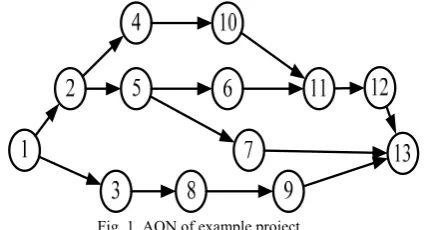
span of project, i.e., f(xi)=T|J|. x1 represents an example of a feasible activity list for a project with 13 activities, x1=(1, 2, 3, 4, 10, 8, 5, 6, 11, 7, 9, 12, 13), AON of example project can be seen from Fig. 1.
Fig. 1. AON of example project.
C. Dispatching rule Based Flexible Resource Assignment Algorithm
The key point of flexible resource assignment lies in how to determine resource and capability assignment. Dispatching rule based flexible resource assignment problem can be formulated as follows: when JCMj (capability requirement
vector of activity j, JCMj=[jcj1,...,jcj|C|]), dj (standard activity
duration), A (A is status vector of resources, that
A=[A1,…,Ar,…A|R|], Ar∈{0,1}; Ar=1 iff r∈RA, here RA
denotes available resource set), RCM (Resource Capability Matrix) are given, Xj (resource assignment Matrix
Xj=[Xjrc]|R|×|C|, Xjrc∈{0,1}, r∈R, c∈C), d'j (real duration)
and Zj (required resource vector Zj=[Zjr]1×|R|, Zjr∈{0,1};
Zjr=∑c∈C Xjrc) of activity j are got.
Pseudo code of flexible resource assignment algorithm is following:
If
∑
∈Cj c
jc
jc
>∑
∈R r r
A
Xjrc=0(r∈R, c∈C); Zjr=0 (r∈R);
For c∈Cj
For r∈R
If Ar=0|| Zjr=1|| r
∉
RcPRIr=inf
Continue End if
According to (9) or (10) or (11), caculating PR Ir
End for
[PR I′1,…,PR I′r′,…,PR I′|R|]=sort([PR I1,…,PR
Ir,…,PR I|R|])
If PR I′|jcjc|≠inf
Xjrc=1, Zjr=1, r∈{r|PR Ir=PR I′r′, r′∈{1,…|jcjc|}}
Else
NoSolution=1; Break;
End if End for Else
NoSolution=1; End if
If NoSolution=1
Xjrc=inf (r∈R, c∈C); Zjr=inf(r∈R); d'j=inf
Else
) rc (
ceil ∑ ∑ ∑ ∑ ⋅
⋅ = ′
∈ ∈
∈Rc ∈ j r RccCj rc jrc r cC jrc
j
j d X X
d
End if
Three dispatching rule is following: 1) Most suitable dispatching rule:
PR r rc sign( rc)
c C
I ω rc rc
∈
= − ⋅ +
∑
(9)2) Least suitable dispatching rule:
PR r rc sign( rc)
c C
I ω rc rc
∈
= ⋅ −
∑
(10)3) Randomly selection dispatching rule:
PRIr =rand() (11)
function, if x> 0, then y=1; if x<0, then y=-1; if x=0, then Y=0.
D. Particle Decoding Method
A potential solution to the FRCPSP should be transformed to a schedule, so that the status of each particle during the search process can be evaluated in terms of the project duration corresponding to generated schedule. Here, we adopt a modified serial schedule generation scheme (MSSGS) and a modified parallel schedule generation scheme (MPSGS).
Like the serial generation scheme for the RCPSP [9], modified serial schedule generation scheme for the PSPCFRCD also consists of |J| stages. There are two activity sets, scheduled set PSi (i=1,2,…, |J|) and decision set Dn
(i=1,2,…, |J|) associated with each stage. The scheduled set
PSn includes the activities which are already scheduled, and
the decision set D n contains the unscheduled activity whose
predecessors are already in the scheduled set. B(t) denotes processing activity at time of t; U(t) is set of remained flexible resource at time of t; [Xj, Zj, d'j]=F(JCMj, A, RCM, dj)
is function to get resource assignment based on dispatching rule. The procedure is following:
Input: particle xi, JCM and RCM.
Output: starting time Tj, finishing time T'j and resource
assignment Xjof activity j, j∈J.
Initialization: PS1={1}, D1=Φ, n=2, Tj=0,T'j=0.
While n≤|J| do
Update Dn, Dn= {j| j
∉
PSn, PjPSn, j∈J};Let nth activity in activity list of particle be activity j: j=xi,n;
Get earliest feasible starting time of activity j:
ESj=max{T'j'|j′∈Pj};
Get starting time of activity j: Tj=min{t |t≥ESj,
Zjr≤Ar(r∈R),[Xj, Zj, d'j]=F(JCMj, A, RCM, dj), Ar=1
iff r∈U(τ), τ=[t, t+d'j) };
Get finishing time of activity j: T'j=Tj+d'j;
Get resource assignment and real duration of activity j: [Xj, Zj, d'j]=F(JCMj, A, RCM, dj) (Ar=1 iff
r∈U(τ), τ=[Tj, T'j]);
Update PSn: PSn=PSn∪{j};
n=n+1; End
Modified parallel schedule generation scheme for the PSPCFRCD consists of |J| stages at most. Every stage corresponds to a scheduling time tn. There are three activity
sets, finished activity set En (n=1,2,…, |J|), active activity set
Bn and decision set Dn (n=1,2,…, |J|) associated with each
stage. The finished activity set En includes the activities
which are already finished at tn, i.e., En={j| T'j≤tn}. The active
activity set Bn contains the processing activity at tn, i.e., Bn=
{j| Tj≤tn<T'j }. Decision set Dn contains the unscheduled
activity whose precedence is feasible at tn, i.e.,
Dn={j|j
∉
En∪Bn, Pj⊂
En}. [Xj, Zj, d'j]=F(JCMj, A, RCM, dj)is function to get resource assignment based on dispatching rule. The procedure is following:
Input: particle xi, JCM and RCM.
Output: starting time Tj, finishing time T'j and resource
assignment Xjof activity j, j∈J.
Initialization: n=1, k=2, t1=0, E1=B1={1}, Dn=Φ, A=R,
Tj=0, T'j=0.
While | En∪Bn |≤ |J| do
n=n+1;
tn=min{T'j|j∈Bn-1}; j={j|T'j=tn}; En=En∪{j};
Bn=Bn\{j}; Dn={j| j
∉
En, Pj∈En, j∈J }; A=A+Zj ;While Dn≠Φdo
Let kth activity in activity list be activity j:
j=xi,k ;
[Xj, Zj, d'j]=F(JCMj, A, RCM, dj) ;
If Zjr≤Ar (r∈R)
Tj=tn ;T'j=tn+d′j ;
k=k+1;
Bn←Bn∪{j}, Dn=Dn\{j}, A=A-Zj;
Else Break; End End End
E. Particle Update Methods
The particle update equation is following as:
) ), ), ( ( ( 1
2 i i g
i c Gc G w H x p p
x = ⊗ ⊗ ⊗ (12)
where, H(xi) denotes particle xi reflecting on current status,
G(xi, pi) and G(xi, pg) denotes particle xi inheriting
information from other particle . Equation (22) consists of 3 parts:
1) Particle's reflection on current status, namely
)) ) ( ) ( 1 exp( , 1 min( ) , , , ( m M x f x f m x x
O i i
i i ⋅ − − ′ − = ′ κ κ ⎩ ⎨
⎧ ′ ′ < = ⊗ = = ′ . , (); ) , , , ( , ) ( ) ( otherwise x rand w m x x O x x H w x x H x i i i i i i i i
where, x'i represents operated particle; f(xi) is fitness value of
particle xi; m is iteration number; M is iteration limit of PSO;
κis coefficient, it may be w, c1, c2; Q(xi, x'i, m, κ) is function
to control particle update probability according to particle fitness value of new particle and original particle, iteration number, algorithm control parameter. Purpose of this function is that accept inferior particle at prophase of algorithm to increase diversity, while only accept superior particle at anaphase of algorithm to strength constringency.
2) Particle inheriting information from personal best particle pi
⎩ ⎨
⎧ ′ ′ < = ⊗ = = ′ . , (); ) , , , ( , ) , ( ) , ( 1 1 otherwise x rand c m x x O x p x G c x p x G x i i i i i i i i i i
3) Particle inheriting information from global best particles pg
⎩ ⎨
⎧ ′ ′ < = ⊗ = = ′ . , (); ) , , , ( , ) , ( ) , ( 2 2 otherwise x rand c m x x O x p x G c x p x G x i i i i g i i g i i
The reflection and information inheriting of particle xi are
following.
4) Particle's reflection by itself
methods are following. Let one random integer r1 generate in range of [2, |J|-1], suppose last position of predecessors of activity zir1 in particle is r2, and first position of successors of activity zir1 in particle is r3. Next select a position between r2 and r1, or between r1 and r3 randomly, insert to that position.
5) Particle's information inheriting
Let x1, x2 denote inheriting particle and inherited particle respectively, the methods is following. A random integer r is generated in range of [1, |J|]. Particle x1 keeps before r (includes rth position), and inherits x
2, and keep the activity order in x2, that is x1, i=x2, d, k=min{k| x2
∉
{ x1, 1, x1, 2,…, x1,i-1}, k=1,2,…, |J|}, n=r+1,…, |J|。
V. COMPREHENSIVE COMPUTATIONAL EXPERIMENTS
Experimental Design. Experimental project problem is adapted project scheduling problem J30, J60, J90, J120 from PSPLIB [10]. Adaptation includes 2 steps. 1) It is assumed that project has 4 kinds of capability. Let resource requirement of original problem to be capability requirement of new problem, i.e., if c=k, jcjc=αjk, where αjk represents
demand of activity j for resource of type of k in original problem. 2) Generate RCM (Resource Capability Matrix) randomly, selects number from {0, 0.6, 0.7, 0.8, 0.9, 1} randomly and assign it to rcrc in RCM in turn. Moreover, if
c=k then rcrc=1, assuring adapted project problem includes
original problem.
For PSPCFRCD is unique, so there is no existing algorithm, say nothing of standard optimum solution to compare algorithms. So, we use an existing algorithm (PEPSO) to get the lower bound of experimental problem as basis to assess performance of three kind of PSO [11]. How to get lower bound of experimental problem? We know that adapted project problem is partial flexible resource constrained project problem, and its solution is not less than solution of completely flexible resource constrained project problem. Therefore, it is feasible to solve completely flexible resource constrained project problem with PEPSO to get lower bound of experimental problem.
Transform J30, J60, J90, J120 of PSPLIB into completely flexible resource constrained project problem includes 2 steps. 1) it is assumed that project need only one kind of resource. as for every activity in project problem, let resource requirement of activity of new problem be sum of resource requirement of original problem. 2) Let available resources of new problem be sum of all kind of resources of original problem.
Comparison of algorithms. In experiments, size of particle swarm is 10, iteration limit is 40, w=0.75, c1=0.75,
c2=0.75, ω=8. Here we consider three dispatching rules, modified serial schedule generation scheme (MSSGS) and modified parallel schedule generation scheme (MPSGS), so there six algorithms. We named them as SMPSO, SLPSO, SRPSO SMPSO, SLPSO and SRPSO respectively (Obviously, S denotes modified serial schedule generation scheme, P denotes modified parallel schedule generation scheme, M denotes most suitable dispatching rule, L denotes least suitable dispatching rule, R denotes randomly selection dispatching rule).
First, get solution of completely flexible resource constrained project scheduling problem with PEPSO as lower bound of experimental problem. Next, solve four problem sets with 6 kinds of PSO. At last, according to different problem sets and algorithms, get average deviation and average computing time corresponding to problem sets and algorithms, we can see results form table I.
From table I, we can find that algorithm adopting Modified Serial Schedule Generation Scheme (MSSGS) are better than algorithm adopting Modified Parallel Schedule Generation Scheme (MPSGS) on average. As for the three dispatching rule, most suitable dispatching rule is best, while least suitable dispatching rule is worst. Therefore, the SMPSO is best in six algorithms. The algorithm deviation not only includes performance difference of algorithm, but also contains difference of solution of two kind of problem set. Since most of resource capability level is less than one, so the optimum solution may be considerably bigger than lower bound, which is the reason why there are considerable average deviation.
TABLEI:PERFORMANCE OF THREE ALGORITHMS performence Problem
set
SMPSO SLPSO SRPSO PMPSO PLPSO PRPSO
Average Deviation to
lower bound
J30′ 4.39 42.11 28.95 15.79 77.19 74.56 J60′ 5.81 34.20 19.05 26.84 72.73 41.99 J90′ 16.42 53.23 43.78 80.10 136.82 120.40 J120′ 11.22 41.03 36.54 67.63 124.36 98.72 Average
Computing time
/s
J30′ 20.95 21.68 20.24 18.59 18.91 17.15 J60′ 65.72 69.63 71.44 59.02 59.31 58.10 J90′ 141.60 163.12 162.04 125.68 129.08 123.90 J120′ 263.04 298.92 322.99 249.16 241.72 313.24
VI. SUMMARY
REFERENCES
[1] G. L. Valraktarakis, “The value of resource flexibility in the resource-constrained job assignment problem,” Management Science, vol. 49, pp. 718-732, Jun. 2003.
[2] O. Bellenguez, “Methods to solve multi-skill project scheduling problem,” A Quarterly Journal of Operation Research, vol. 6, pp. 85-88, Jan. 2008
[3] O. Bellenguez and E. Ne′ron, “Lower bounds for the multi-skill project scheduling problem with hierarchical levels of skills,” Lecture Notes in Computer Science, vol. 3616, pp. 229-243, Jan. 2005.
[4] Y. Kardrou and N. M. Najid, “A new heuristic to solve RCPSP with multiple execution modes and multi-skilled labor,” Computational Engineering in Systems Applications, Beijing, 2006, pp. 8-16. [5] B. Wu, “Research on the flexible resource-constrained multi-mode
project scheduling problem,” Ph.D. dissertation, Wuhan Technology University, Wuhan, Hubei, Apr. 2008. (in Chinese)
[6] X. G. Yu , D. C. Zhan, L. S. Nie et al., “Flexible resource-constrained resource leveling project scheduling problem,” Computer Integrated Manufacturing Systems, vol. 16, pp. 1967-1976, Sep. 2010.
[7] M. M. Huang and R. G. Luo, “Study on Flexible-Resource-Constrained Product Development Project Scheduling,” Journal of Industrial Engineering/Engineering Management, vol. 24, pp. 143-148, Apr. 2010.
[8] R. Kolisch, “ Serial and parallel resource-contrained project scheduling methods revisited: theory and computation,” European Journal of Operational Research, vol. 90, pp. 320-333, Jan. 1996
[9] A. Sprecher, R. Kolisch, and A. Drexl, “Semi-acitive, active, and non-delay schedules for the resource-constrained project scheduling problem,” European Journal of Operational Research, vol. 80, pp. 94-102, Jan. 1995.
[10] R. Kolisch and A. Sprecher. PSPLIB-A Project Scheduling Problem Library. [Online]. Available: http://www. 129.187.106.231/psplib/indes.html.
[11] L. Y. Deng and Y. Lin, “Particle swarm optimization for resource-constrained project scheduling problems with activity splitting,” Control and Decision, vol. 19, pp. 681-684, Jun. 2008.
Xinhui Zhao was born in Qingyuan, Liaoning China, in 1968. He received his B.E. in Daling University of Technology in 1992, and he received his M.E. degrees in Artillery Command Academy of China, in 2002, and he got Ph.D. degree in Hefei Artillery Academy of China. His research interests include reliability analysis, maintenance decisions, and operation research.
Xuezhi Lü was born in Zhangjiakou, Hebei China, in 1979. He received his B.E. and M.E. degrees in artillery command academy of China. He is currently working towards a Ph.D. degree in the ordnance engineering College of China.
Qiyi Mei was born in Hubei, China, in 1981. He received his B.E. from National University of Defense Technology, and M.E. from Peking University. His research interests include communication Engineering, control theory and control engineering.