E-ISSN: 2278-7461, P-ISSN: 2319-6491
Volume 5, Issue 1 [Oct. 2015] PP: 61-68
Reducing the Fiber Non-Linearities by Mitigating the PAPR in
Optical OFDM Systems
I.
1T
maheshwar
,
2Ch reddiah,
3S srikanth
1,2,3Department of Electronics and Communication Engineering.SREEDATTHA INSTITUTE OF
ENGINEERING & SCIENCE
Abstract: Orthogonal Frequency Division Multiplexing (OFDM) plays a vital role in many wireless network
applications. However, it has a huge drawback called as higher peak to average power ratio (PAPR), which in results increases the complexity of digital to analog converters (DAC) and analog to digital converters (ADC) and also degrades the efficiency of high power amplifiers (HPA). Here, we have implementednon-linearities reduction in optical- OFDM (O-OFDM) system by mitigating the PAPR. Simulation results have shown that the proposed algorithm has performed superior results over the conventional algorithms and original OFDM system.
Keywords:OFDM, PAPR, Non-Linear Companding, Smoothing Function and Optical- OFDM (O-OFDM).
I.
INTRODUCTION
Due to the multipath fading effect and receiver many-sided quality of wireless channels, the conventional modulation techniques which depend on single carrier can accomplish restricted data rates. High data-rate is attractive in numerous late wireless multimedia applications [1]. Be that as it may, as the data-rate in correspondence framework expands, the symbol duration gets lessened. In this manner, the correspondence frameworks utilizing single carrier modulation experience the ill effects of serious inter symbol interference (ISI) created by dispersive channel drive reaction, in this way requiring a mind boggling balance component. Orthogonal Frequency Division Multiplexing (OFDM) is an exceptional type of multicarrier modulation strategy, in which the total Frequency specific fading channel will be separated into numerous orthogonal slender band level fading sub channels. In OFDM framework high-piece rate data stream is transmitted in parallel over various lower data rate subcarriers and don't experience ISI because of the long symbol duration [2]. Significant favourable circumstances of OFDM frameworks are
High ghastly effectiveness.
Simple computerized acknowledgment by utilizing the FFT operation.
Due to the ISI evasion, the many-sided quality in the receiver will be decreased.
Various modulation plans will be utilized to accomplish the best execution of the framework.
Because of the previously mentioned favorable circumstances, OFDM has been utilized as a part of numerous wireless applications, for example, Wireless Personal Area Network (WPAN), Wireless Local Area Network (WLAN) [4], Wireless Metropolitan Area Network (WMAN), Digital Audio Broadcasting (DAB) [3] and Digital Video Broadcasting (DVB) [5]. It is likewise being considered for IEEE 802.20, 802.16 [6], [7] and 3GPP-LTE. With the utilization of cyclic prefix for killing the effect of ISI, there is a requirement for a basic one tap equalizer at the OFDM receiver. OFDM gets unparalleled transmission capacity funds, which prompts to high otherworldly proficiency. Regardless of the across the board acknowledgment of OFDM, it has its downsides:
OFDM signals with high peak-to-average power ratio (PAPR) prompts to the corruption in framework execution, which in results the improved out-of-band power.
OFDM frameworks are touchier to Doppler spread when contrasted with single carrier modulation plans. The framework execution will be corrupted by the stage clamor, which is brought about by the blemishes of
the transmitter and receiver.
As recorded above, huge envelope vacillation in OFDM flag is one of the real disadvantages of OFDM. Such vacillations make challenges on the grounds that useful correspondence frameworks are peak power restricted. Hence, envelope peaks require a framework to suit a momentary flag power that is bigger than the flag average power, requiring either low working power efficiencies or power amplifier (PA) saturation. Keeping in mind the end goal to increase the OFDM motion with huge envelope changes, PAs with substantial direct range are required, which makes it extremely costly. In the event that PA has restricted straight range then its operation in non-direct mode presents out of band radiation and in band distortion. It is additionally important to have D/An and A/D converters with huge element range to change over discrete time OFDM flag to simple flag and the other way around.
II.
RELATED WORK
A. PAPR in OFDM Systems:
Input data sequence to be transmitted with 𝑁 subcarriers in an OFDM symbol is (0),(1), ···,𝑋(𝑁 -1). The baseband representation of the OFDM symbol is given by:
(1)
is OFDM symbol duration. When N value will be increased then both the real and imaginary parts of would become Gaussian distributed and each with zero mean with a variance of , and the OFDM symbol amplitude follows a Rayleigh distribution. Therefore, it is possible that the OFDM symbol amplitude will be exceeds than the maximum amplitude. Practical hardware such as A/D and D/A converters, high power amplifiers (HPA) has finite dynamic range; therefore the maximum amplitude of OFDM signal should be limited. PAPR of an OFDM signal has been defined as:
(2)
In dB value the PAPR can be written as . It is easy to see from (2) that reduction of PAPR can be achieved by reducing the numerator and increasing the denominator, or both. Complementary cumulative distributed function (CCDF) will be used as a measurement of PAPR effectiveness, which is the probability that PAPR exceeds some threshold, i.e.,
(3) where is the threshold.
B. New Companding Algorithm:
Let a non-linear companding function is and be the compander input, then the companded signal can be written as:
(4)
The companding algorithm uses a smooth function named as airy function to reduce the peak value. The companding function is as follows:
(5)
Where is the airy function, is the adjusting factor for the average output power of the compander to the same level of input power.
(6)
Here E [.] denotes the expectation.
III.
PROPOSED ALGORITHM
Generally, the SCP is an invertible function H: Rn->Rn (where R denotes the set of real numbers) and it is a linear function. The N real numbers x0, ...., xN-1 are transformed into the N real numbers H0, ..., HN-1.
The Pre-coding matrix P can be written as
Where P is a Pre-coding Matrix of size N×N is shown in above equation. The complex baseband OFDM signal with N sub carriers can be written as
,
Figure1 O-OFDM system with pre-coding matrix
Figure2 QAM System
We can express modulated O-OFDM vector signal with N subcarriers as follows: (8)
The SCP is a linear transform and N-point SCP can be defined as:
(9) Where
(10)
P is pre-coding matrix of size N×N. and both (m, n) are integers from range 0 to N-1. The SCP is also invertible transform which allows us to recover the from and inverse can be obtained by simply multiplying SCP of by 1/N. In this, we analyzed the performance of SC Pre-coding matrix for the reduction of fiber non-linearities in high speed O-OFDM systems using M-QAM constellation modulation scheme (where M=16, 32, 64, 128 and so on). Additionally, it does not require any power increment, complex optimization and side information to be sent for the receiver.
IV.
SIMULATION RESULTS
V.
(a)
(b)
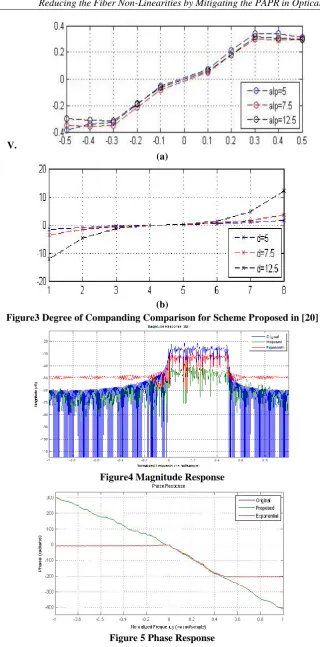
Figure3 Degree of Companding Comparison for Scheme Proposed in [20]
Figure4 Magnitude Response
Figure6 Estimation of Magnitude Response
Figure7 Round-off Noise Power Spectrum
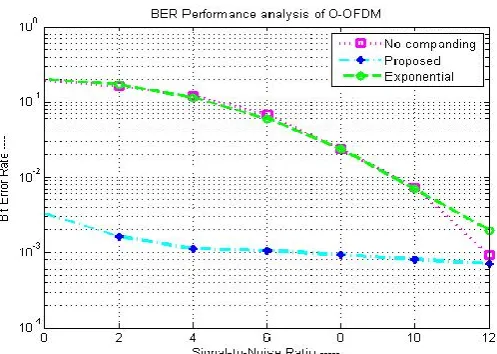
PAPR reduction of proposed SCP algorithm has been shown in figure 9. We have reduced it to 0.69 dB which is very lesser value over the all conventional reduction schemes proposed in the literature. Therefore, our proposed algorithm has reduced the non-linearities of fiber in optical OFDM systems to maximum extend. Finally, we have compared the bit error rate performance of proposed and conventional schemes to achieve higher speed data rates for O-OFDM.
Figure10 Comparison of BER Performance for O-OFDM
Table I Simulation Parameters
Parameters Specifications
FFT&IFFT Size 256
No.ofSubcarriers 512
Alpha 30 dB
Channel model AWGN
Modulationscheme QAM
Constellationpoints 4, 8, 16, and so on
VI.
CONCLUSION:
In this letter, we analyzed the performance of fiber non-linearities reduction schemes in O-OFDM system using M-QAM constellation modulation (where M=16, 32, 64, 128 and so on). The simulation results, which have been implemented in MATLAB shows that the proposed SCP algorithm has got the better performance than the conventional schemes. Thus, it is concluded that proposed system shows maximum reduction of fiber non-linearities than conventional reduction techniques. Additionally, it does not require any power increment, complex optimization and side information to be sent for the receiver.
REFERENCES:
[1] Wu Y., W. Y. Zou, “Orthogonal frequency division multiplexing: A multi-carrier modulation scheme,” IEEE Transactions on Consumer Electronics, vol. 41, no. 3, pp.392–399, Aug. 1995.
[2] Van Nee R., Prasad R., OFDM for wireless Multimedia Communications, Artech House, 2003.
[3] ETSI, “Radio broadcasting systems; Digital Audio Broadcasting (DAB) to mobile, portable and fixed receivers”, European Telecommunication Standard, Standard EN-300401, May 1997.
[4] Hiperlan2, “Broadband Radio Access Networks (BRAN), HIPERLAN Type 2; Physical (PHY) layer”, ETSI, Tech. Rep., 1999.
[5] ETSI, “Digital Video Broadcasting (DVB); Framing structure, channel coding and modulation for digital terrestrial television”, European Telecommunication Standard, Standard EN-300-744, 2004-2006. [6] Part 16: Air Interface for Fixed Broadband Wireless Access Systems Amendment 2: “Medium Access
Control Modifications and Additional Physical Layer Specifications for 2-11 GHz”, IEEE, Standard IEEE Std. 802.16a-2003, 2003.
[8] A. E. Jones and T. A. Wilkinson "Block coding scheme for reduction of peak to mean envelope power ratio of multicarrier transmission schemes", IEE Elect. Lett, vol. 30, pp.2098 -2099, march 1994 [9] X. Li and L. J. Cimini, "Effect of clipping and filtering on the performance of OFDM," Proc. IEEE VTC
'97, pp. 1634-1638, 1997.
[10] T. Wattanasuwakull, W. Benjapolakul, “PAPR Reduction for OFDM Transmission by using a method of Tone Reservation and Tone Injection” Fifth International Conference on Information, Communications and Signal Processing, ISBN: 0-7803-9283-3, pp. 273-277, 2005.