EFFICIENCY ANALYSIS IN RAPIER LOOM.
1
A. N. M. Masudur Rahman & 2Md. Ruhul Amin Department of Textile Technology. Ahsanullah University of Science and Technology 141-142, Love Road, Tejgaon I/A, Dhaka-1208, Bangladesh.
ABSTRACT
The study was carried out to find out the effects of various parameters on efficiency in rapier looms. To do so, the efficiency is analyzed by various parameters such as weaver’s skillness, loom speed, weave structure, pick density and R.H%, loom allocation per weaver, size take up %, tension on warp etc. The main objective of this study is to increase the efficiency and through that increase the productivity and profitability. Unlike in winding, warping and sizing where the emphasis is on the quality of preparation, in the loom shed, control of fabric quality as well as of productivity assumes significant importance. The weaving operation contributes by far the largest proportion to the cost of conversion of yarn into fabric. Surveys shown that the cost of actual weaving operation in mills with modern preparatory machines and automatic looms about 60%- 65% of the total cost for conversion of yarn into fabric. This means that a small increase in loom shed efficiency via productivity will result in considerable reduction of manufacturing cost. More importantly an increase in efficiency will bring in additional realization on the extra fabric available. For a medium size average mill, an increase of 2% in loom shed productivity can increase the annual cash flow by about Tk. Ten lakhs. Consequently, in evolving a satisfactory process control programmed for the loom shed, considerable weight age should be given to efficiency.
Key words: Rapier loom, Weaving, productivity, fabric construction, weave type and efficiency losses.
1. INTRODUCTION
Generally, loom shed efficiency is calculated for each shift on the basis of production. In loom shed, the production is measured in terms of either pieces booked, meters woven or picks inserted. This method of calculation only gives an idea of the efficiency achieved. It does not indicate the performance index of a mill in relation to an expected optimum. In order to know exactly what a mill can achieve, it is necessary to have standards for efficiency losses due to various causes and a method of estimating the expected efficiency under a given set of circumstances.
The causes for efficiency losses in looms can be divided into two broad categories as frequency dependent and miscellaneous. Warp and weft breaks, beam gaiting belongs to first category, where as healds broken, doffing, loom repairs, weave away, etc. are termed as miscellaneous causes. Interference is, yet another cause of stoppage.
Its extent depends upon the number of looms assigned to a weaver and frequency of warp and weft breaks. Miscellaneous causes are those occurring at random. Further, such causes cannot be ascribed any definite frequency. Whenever an operator is in charge of more than one machine, there is loss due to interference. On looms, this loss is observed to be essentially a function of such stoppages as warp breaks, weft breaks and hence for all practical purposes, it may be expressed as a percentage of the total loss on account of these causes.
116203-8383 IJBAS-IJENS © June 2011 IJENS
beam change varies according to its frequency, while other losses depend upon the organizational setup, frequency of breakdowns, types of looms, sorts woven and level of maintenance. [1][2].
As stated earlier, efficiency losses due to warp and weft breaks and beam gaiting of frequency dependent and hence they vary from mill to mill and also sort to sort within the same mill. On the other hand, efficiency losses, ascribable to loom repairs, cleaning and oiling, doffing and other stoppages are observed to be of more or less the same order between mills. For all practical purposes, it would be quite in order to provide an overall allowance for the losses arising from these causes.
2. MATERIALS AND METHOD
2.1 Loom specifications
No. of looms used: 20 Weft insertion type: Rapier Loom type: Flexible rapier.
Loom maker: PROMATECH S.P.A, ITALY. Loom model: THEMA SUPER EXCEL. Loom speed: 450-575 r.p.m
Reed width: 66"-67" Reed space: 64"-65"
Weft Selection 8 colors pick with programmable microprocessor. Shed Formation Electronic dobby (STAUBLI).
Weft Stop Motion Electronic 8 hole weft slide sensor. Warp Detection Electric dropper pin type with 6 rows.
Let-Off Electronic let-off system ensuring uniform warp beam tension. Take Up system Electronically controlled.
Weave type: Plain, Twill, and Satin.
Count of yarn: 16 Ne, 20 Ne, 40Ne and 50 Ne combed yarn.
2.2 Method
Loom efficiency can be measured by the following formulae:
Loom Efficiency (%) = Actual Production x 100 Calculated Production
The efficiency can be calculated quickly and expeditiously from computers. The use of computers enables the parameters to be continuously assessed so that better accuracy can be obtained. [2]
After calibration of the computer software along with the parameters efficiency was taken after one shift production.
3. DATA ANALYSIS
3.1 Analysis of Efficiency by Speed
Table:-1 Table:-2
Construction: 40x40/110x74 Construction: 40x40/120x80
Weave type: Plain Weave type: Plain
Table:-3 Table:-4
Construction: 40x40/130x90 Construction: 50x50/144x76 Weave type: Plain Weave type: Plain
Table:-5
Construction: 40x40/130x90 Weave type: Twill (2/2)
From the above table it is found whenever there is higher loom speed it leads to higher end breakages. This will reduce the efficiency. But when we run a loom at lower speed then the productivity decreases. Higher production also plays an important role in the industries improvement. So it is recommended to run the looms at optimum speed.
3.2 Warp tension Vs Efficiency
Table: 6 Table: 7
Construction: 40x40/110x74 Construction: 40x40/130x90
Weave type: Plain Weave type: Twill (2/2)
Speed (R.P.M)
Efficiency (%)
422 91.2
432 90.5
442 88.7
450 85
475 80.1
Speed (R.P.M)
Efficiency (%)
400 95
415 97.8
420 98.9
440 88.7
450 80.4
Speed (R.P.M)
Efficiency (%)
408 81
425 90.8
430 93.2
440 87.5
444 84.2
Speed (R.P.M)
Efficiency (%)
408 88.4
417 90.1
432 93.5
440 88.7
Speed (R.P.M)
Efficiency (%)
420 86.5
430 83
440 78.5
465 73.2
Speed (R.P.M) Warp tension(Kg) Efficiency (%)
423 140 78.5
423 150 80.5
423 160 82
423 180 84.8
423 185 85
423 190 82.3
423 210 79.5
Speed (R.P.M) Warp tension(Kg) Efficiency (%)
420 120 86.5
420 130 88.6
420 145 93
420 152 98.9
420 160 90.5
420 170 86
420 185 84.5
116203-8383 IJBAS-IJENS © June 2011 IJENS
More tension on warp yarn causes more breakage, but low tension makes the yarn entangled with each other. So, appropriate tension should be applied to get better quality fabric and optimum efficiency.
3.3 Weave type Vs Efficiency
Table: 8 Table: 9
Construction: 40x40/110x74 Construction: 40x40/120x80
Table: 10
Construction: 40x40/130x90
Since a fabric with high number of interlacing in the design or a high end density (epi) and pick density (ppi) tends to have a large number of breaks. Plain weave gives the highest efficiency than other weaves for a particular condition. For complex design warp breaks more because of uneven tension on warp yarn. The more critical design the weaver takes more time for repair the warp breaks because of different sort of drawing. So, for complex design efficiency becomes low.
3.4 Analysis of Efficiency by Weavers
Here the efficiency of different weavers was analyzed. By analyzing the inefficient weavers as well as the idle weavers can be identified. It will help to take corrective measures on the inefficient and the guilty.
Table:-11 Table:-12
Many reasons contribute to the lower weaver’s efficiency. If one of the allocated loom stops and at the same time another allocated loom also stops then the weaver cannot able to attend both. This will Weave
type
Speed (R.P.M)
Efficiency (%)
Plain 420 98.9
Twill(2/2) 420 86.5
Plain+Twill(2/2) 420 82.1 Plain+Satin(4E) 420 78.9
Weave Type
Speed (R.P.M)
Efficiency (%)
Plain 430 91.2
Twill(2/2) 430 83
Plain+Twill(2/2) 430 79.3 Plain+Satin(4E) 430 77.2
Weave type
Speed (R.P.M)
Efficiency (%)
Plain 440 88.7
Twill(2/2) 440 78.4
Plain+Twill(2/2) 440 73.5 Plain+Satin(4E) 440 70.7
Weaver Efficiency (%)
1 96.1
2 93.2
3 90.2
4 89.5
5 85
Weaver
Efficiency (%)
1 92.3
2 88.5
3 84.4
4 83.6
decrease the loom efficiency, to reduce this, labour cooperation is needed. That is the weaver who is idle can attend the other loom.
Other causes are, if a multiple breakage occurs and at the same time another allocated loom stops, then the weaver should first attend the loom which can be restarted first. By doing this the idle time of one of the loom is reduced and efficiency is increased. The other causes following the inefficient weavers and talking with neighbors.
3.5 Analysis of Efficiency by Loom Allocation
To decide ‘How many looms per weaver’ one has to take into account several aspects. These aspects relate to the production efficiency, labors workload and productivity, and finally cost and profitability. As these factors have mutual effects on each other while deciding the allocation, the management must decide about the objectives to be pursued. The optimum loom allocation may be the allocation which gives maximum profits, or it may be that one which will give maximum productivity or one which will give minimum cost of production. For instance, maximum machine efficiency may be obtained when less number of looms are assigned to a weaver, whereas the loom efficiency may be lost by increasing number of looms per weaver. In the first case the worker is considerably underutilized while in the later case the labour utilization is more. In both the cases, either operator has to wait for the machine or the machine has to wait for the operator. The loss in machine efficiency due to more loom assignment results in lower production and lower revenue and vice versa. However cost varies at different loom assignments and the total profits also vary depending upon cost and the production at respective assignments. Thus, when an allotment of machines is thought of, a proper balance of these factors is very essential. [1]
Here loom allocation of the weavers was analyzed. Loom allocation plays an important role in the loom efficiency. Care should be taken here because; when more looms are allocated then there will be a problem of efficiency. When less looms are allocated then there will be a problem of wages.
Table:-13 Table:-14
Weave type: Plain Weave type: Plain
Table:-15 and Table:-16
Weave type: - Miscellaneous ( Plain,Twill,Plain+twill,Plain+satin)
This above chart shows that when lower looms are allocated the efficiency drops and when more looms are allocated the efficiency increases. While analyzing the reason this is because of the labours mischievous behaviors. When there are more labours in a place it will lead them to be more talkative and thus not attending the looms properly. To recover from this type of lower efficiency it is better recommended to keep a supervisor.
No. of looms/weaver
Efficiency (%) Avg.
5 82.3
4 89.6
3 80.2
No. of looms/weaver
Efficiency (%) Avg.
5 80.7
4 91.1
3 86.4
No. of looms/weaver
Efficiency (%) Avg.
5 75.3
4 80.4
3 78.6
No. of looms/weaver
Efficiency (%) Avg
5 72.8
4 82.5
116203-8383 IJBAS-IJENS © June 2011 IJENS 3.6 Analysis of Efficiency by Relative Humidity
Here the temp. and relative humidity in the industry was measured and analyzed how they affect the efficiency.
Table 17
The above chart shows the relation between Temp., R.H and Efficiency, and the international standards also say that for cotton weaving the efficiency is higher at (65±5) % relative humidity and temperature of (26-27)◦C. So this should be controlled for better performance.
3.7 Size take- up% Vs Efficiency
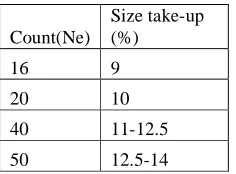
For better performance following size take up % should be maintained.
Table 18
Count(Ne)
Size take-up (%)
16 9
20 10
40 11-12.5
50 12.5-14
For a particular count, if size take-up % is more than required amount, than yarn becomes sticky and friction occurs more between yarn to yarn and yarn to reed. Problem also arises when knot passes into the reed. Again if size take up % is less than required amount than yarn becomes weak, can’t tolerate much stretch during weaving, hairiness causes entangled with each other. So, it is recommended for better performance of weaving appropriate size take up should be maintained strictly.
4. DISCUSSION
Various stops should be controlled and the stoppage rate should be low.
The various stops can be classified as
1. Stops due to warp breaks and warp faults. 2. Stops due to weft breaks.
3. Stops due to mechanical failures. 4. Miscelleneous stops.
Machine maintenance also plays an important role in the efficiency of the machine. Proper lubrication and cleaning should be done frequently. The preventive maintenance is advised for better performance of the loom.
Temp.(°C) R.H (%)
Efficiency (%)
30.6 59.4 89.6
31.4 54.6 85.4
27 65.8 96.1
28.5 63.5 94.4
A supervisor should be present for all eight hours of the shift. It will considerably increase the efficiency. It is also very useful if rotating cameras are fixed all around the loom shed so that the efficiency will increase.
It is proven that in mills where there is a consistently low warp breakage rate, the yarn CSP is higher and also the number of thin places is less than the certain minimum level. A weak, fuzzy yarn will break very often whereas a strong smooth uniform yarn will withstand the weaving conditions better. When there is poor raw material, then the efficiency of the loom as well as the quality of the fabric decreases.
Sizing plays a vital role on efficiency. So appropriate size take up should be maintained strictly.
Skilled weavers can repair broken yarns very quickly compared to unskilled weavers. Also the work load of the weaver has a very important effect on the weaving efficiency, since it affects the time a loom is stopped awaiting attendance. The weaver should be trained so that he takes the minimum possible time for clearing a stop. Loom allocation should be optimum.
The weaver’s room atmosphere plays an important role in loom efficiency. The relative humidity and the temperature should be maintained properly and constantly to get a maximum efficiency. Whenever there is a change in these two parameters then there will be a chance for drop in the efficiency
Motivation is another major thing to be considered. If a weaver is able to produce higher efficiency he should be encouraged by higher percentage of wages or in some other way. At the same time if a weaver produces lower efficiency he should be punished by reducing the percentage of wage or by some other way. [4]
5. CONCLUSION
The efficiency is analyzed by various parameters. This gives a detailed idea of how the efficiency is dropped. While taking corrective action from the results analyzed, we can get a higher efficiency. A small increase in efficiency will give higher productivity and profitability and that has been obtained. From the results the various factors affecting the efficiency is found and by concentrating in those areas the efficiency of the loom shed is increased.
6. REFERENCES
[1]. Talukdar, M.K, Sriramulu, P.K and Ajgaonkar, D.B (1998) Weaving Machines, Mechanism, Management, Mahajan publishers Ltd. , ISBN 81-85401-16-0, Ahmedabad, India.
[2]. Lord, P.R and Mohamed, M.H (1982) Weaving: Conversion of Yarn to Fabric, Merrow Publishing Ltd.,ISBN 0 904095 38 X, Durham, England.
[3]. Sen Gupta, R., (1971) Weaving Calculations, D.B.Taraporevala Sons & Co. Ltd.,Bombay,India.