ANALYZING THE HISTORY TEACHING PERCEPTION OF SECONDARY EDUCATION STUDENTS
Mehmet Bakanlar1, Yunus Emre Göktepe1, Onur Köksal2 1
Seydisehir Vocational High Shool, Necmettin Erbakan University, Konya, Turkey 2Yabancı Diller Yüksekokulu, Selcuk University, Konya, Turkey
Abstract
History teaching that exists in every phases of Turkish education system aims creating the history knowledge and conscious for students. Every education strategy in that process needs to be student centered together with teaching. Determinig the perceptions of students towards history teaching has great importance to define the education strategies. The aim in that study is to define the perspectives of secondary education students towards history and history teaching and express the relation between the demographical characteristics and their perceptions towards history teaching of students. After a wide literature research about that aim, surveys were prepared and they were applied to 670 secondary education students in Seydiseehir district of Konya by using face to face conversation method in April and May 2013. The datas taken from the surveys were analyzed with SPSS 21.0 statistics programme. The study is thought to be useful because of defining the perspectives of secondary education students towards history and history teaching and shaping the strategies which run that process rationally.
Key words: secondary education, student, perception of history teaching
1. INTRODUCTION
History is a dissatisfoctory branch of knowledge with its many characteristics: it is untrustworthy, contradictionary. It is in the form of unit, always defiant and it has liabilities. But it is also valuable because of these facts. It reflects the human image in a right way. Beause of that, it is a useful element not only for understanding the past but also the events taking place today and finding the answer of the question what will happen in the future for our education and perceiving ourselves. The intention of people towards percetion, acceptance and manipulation of history perception usually chances. Every generation tries to revise the past in accordance with their own interest and anxiety as far as he can. (Özbaran, 2005). So what is history?
History is a long conflict to understand people’s environment and affect it by using their mind. (Carr, 1996). According to Toynbee, history is the examination of cultural differances of living societies by comparing them. (Özbaran,2005). According to İbn-i Haldun history is the examination of people’s social life and understanding the social life in the border of time and place..(Şıvgın, 2009). History is the science of change. While it examines the similarities and differances between the events from past to present, it chooses as a theme the relation between people and events, the responses of people for the events and the changes seen in these responses, individual, social and cultural changes, stability in the changes, the relation of reason and result in the changes (Dilek, 2007).
When the literature research about history teaching is examined, it is seen that branch teaching is loaded a lot of meanging. The agreed aims are seen in different ranges from transferring the knowledge to teaching the scientific thinking ability. If we gather these aims together in the sub-catagory, we can order as in the below: (Demircioğlu, 2011).
1- History teaching for historical knowledge, social values, and culture transferation,
2- History teaching for understanding past and today,
3- History teaching for adopting the available ideological structure and identitiy development,
4-History teaching for bringing the experience and scientific thinking for students,
5- History teaching for the teaching of basic concepts about history,
6- History teaching for developing language skills and spending free time
According to John Dewey the purpose of history teaching is to cause the child to sense the value of social life, keep to forces making people come together and show the role of individuals in that general activity (Köstüklü, 2006).
The general aims of history subjects explained in the Modern History Teching Programmes shows there is a continuity in the approaches existing as per date in the history teaching in Turkey and there is no radical change in the purposes. According to new programmes, the aims of history teachings are (Aktekin ve diğerleri, 2009).
1. By getting the students comprehend the position of Ataturk’s principles and revolutions and Turkish Republic for the political, social, cultural and economical growth, ensure the students to be enthusiastic about perpetuating secular, democratic and modern values.
2. Bringing the historical awareness in the perception of past, present and future.
3.By making the students grasp the process and basic elements making out Turkish Culture and Turkish history, provide the students to take responsibility of protecting and improving the cultural heritage.
4. To make the students grasp the necessity of making the national identity out and the protection of that identity.
5. By relating past and present, make the students grasp the importance of national association and unity,
6. provide them knowledge about the civilizations and nations founded along the hiistory,
7. To get them grasp the position of Turkish culture in the growth of worldwide culture and civilization and their offerings to humanity,
8. Overcome their curiosity about the culture world surrounding them,
9. By making them aware that history covers not only political areas but also economical, social and cultural areas, providing them with the conscious that people from the life are the subject of history.
10. Providing them with usage of methods and techniques of History science, concepts belonging to history science and skills of historians in a right way ,
11. By making the students analyze poiticial, cultural and economical interation inter-communities beloning to differant ages, places, people, and encourage them to make inference about the reflections of that interaction to today,
12. By getting them comprehend the importance of basic values like peace, tolerance, mutual understanding, democracy and human rights, assure them to protect and improve these values,
13. Giving them opportunity to interact with different cultures by sticking to their own values,
14. Making them have the value of diligence, love of art, scientistic by making historical research on concrete or intangible heritage,
15. Getting the students the skill of true and effective Turkish language usage when they express historical narratives as written or oral.
Classifications having the similar qualities take place in literature widely. (Aslan,2006), (Aslan, 2004) we see there is no radical change in the contents of History lesson programmes which do not make any radical change also in the targets.
History teaching has a role of causing the world nations come together, intensfying the international studies, bringing up the generations who are ready to integrate with peaceful, humanist, tolerant world above all other subjects.(Yetkin,1995).
Tunçay also gives the qualities being in the history teaching as: ‘Making the people understand the common values of humanity, helping the student to understand past and present, awakening the feeling of emphaty towards all the activities of humanity, widening their perspective, making him see himself in a continuous flow, in the time dimension, making him gain the experience of free and critical thinking, trying to explain the events by seeing their reasons and results (Tunçay,2012). But history teaching which is far from free and critical thinking, as in the expression of Zafer Toprak, brings the problems of history understanding which defends the stable structure of society not towards the growth of it.” (Özbaran:1995).
The concept of consciousness is used for expressing the individual’s perceptions, emotions, thinkings about the events taking place his around in a definite time. The concept of History consciousness formed by the combination of these two words is evaluated in its broadest sense as understanding the present and forming the expectations about future by associationg today and past. (Dinç, 2011). If we evaluate the situation from the perspective of students who will shape our future, historical consciousness and perspective provided by historical knowledge gained in the right way embodies different acquisitions as for the perspective of being the individuals of society. It provides the individuals to take part in the society as having modern outlook, developed pularist and empatic skills, facing the differances with tolerance, and peaciful individulas.(Akçalı, 2007)
The aim of that study; history has a special place in social sciences. It takes part in every steps of education from primary school to university (Aslan,2006).
The manner of a student towards that subject will effect both the success that he will show in that subject and also the power and direction of manner about that subject (Safran,2006). There is need for that study because there is not enough study about analyzing the manners towards history lesson in our region.
In the research extend, it is tried to identify the manners of secondary education students towards history teaching. The research will light the way for the students who are educated in our region, teachers and academics to the recent studies seen in history and occuring policies.
The research is tought to be useful because it will define the perspectives of secondary education students about history and history teaching and direct methods and strategies for operating the process rationally.
2. METHOD
That research is a study as scanning method. That model is a research approach that describes and depicts a situation taking place in present or past as it happens. The survey form is taken from Safran (2011) History Teaching Articles and Notification.
2.1 The region and Sampling
The region of study is made up by the students who are educating in the level of high school and taking the history subject in the district of Seydisehir in Konya. The sampling of stduy is made up by 670 students who are educating in high schools (8 pieces) (Mahmut Esat Anatolian High School, Seydişehir Anatolian High School, Enis Şanlıoğlu High School, Vocational Religious High School, Trade Vocational High School, Anatolian Teacher Training High School, Health Vocational High School and Industry Vocational High School) in the district of Syedisehir. The research is done in 2012-2013 Educational Year.
2.2 Data Collection Tool and the Analysis of Datas
As data collection tool, a survey is used to measure the general students’manner towards Atatürk Principles and Reforms subject and define the general circumstances. The survey form is taken from the study called Safran (2000) History Teaching Articles and Notifications (7-17).
During the development of that survey, different kind of questions are made out for the purpose of defining the manners and sensibilities of students in different schools towards history lesson. In the fisrt part of the survey, there are nine demographic questions, and in the second part there are 20 questions to define the manners of students towards history teaching.
The results taken from the survey are analyzed according to SPSS Statistics 21 programme. To analyse the datas, values such as percent frequency, crossing analyze, arithmetic avarage, standart deviation on the datas including the students manner towards history lesson.
3. FINDINGS AND COMMENTS
Table 1. The gender of individuals taking part in the research
The sapmle Group of research is made up by 358 females withle %57,8 and 283 males with e %42,2 af research.
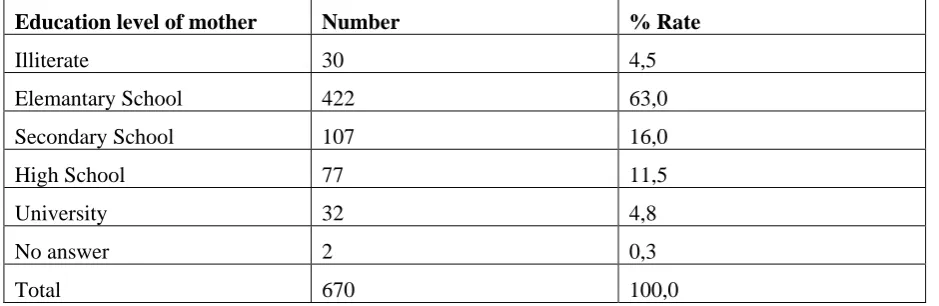
Table 2. The education level of Individuals’mothers taking part in the research
Education level of mother Number % Rate
Illiterate 30 4,5
Elemantary School 422 63,0
Secondary School 107 16,0
High School 77 11,5
University 32 4,8
No answer 2 0,3
Total 670 100,0
422 (%63,0) mothers of individuals who are taking part in the research are elemantary school graduated, 107 (%16) of them secondary school graduated, 77 (%11,5) of them are high school graduated. 32 (%4,8) of them are university graduated. Two individuals do not answer the question. The number of illiterates are 30.
Gender Number % Rate
Female 387 57,8
Male 283 42,2
Total 670 100,0
Table 3. The education level of fathers who are taking part in the research
The education level of mothersi Number %rate
İlliterate 9 1,3
Elemantary School 240 35,8
Secondary School 141 21,0
High school 166 24,8
University 114 17,0
Total 670 100,0
The 240 (%35,8) of mothers who are taking part in the research are elemantary school graduated, 141 (%21,0) of them are secondary school graduated, 166 (%24,8) of them are high school graduated, 114 (%17,0) of them are university graduated. The number of illiterates are nine.
Table 4. The family income level of individuals taking part in the research
Income level Number %Rate
750 TL and below 133 19,9
751-1000 TL 255 38,1
1001-1500 TL 137 20,4
1501-2500 TL 90 13,4
2501-5000 TL 39 5,8
5001 TL and over 16 2,4
Total 670 100,0
The number of individuals having 750 Tl income and below is 133 (%19,9), the number of them having 751-1000 TL income are 255 (%38,1), the number of individuals having 1001-1500 TL income is 137 (%20,4), the number of individuals having 1501-2500 TL income is 90 (%13,4), the number of individuals having 2501-5000 TL income is 39 (%5,8) and the number of individuals having 5001 TL income is 16 (% 2,4).
Table 5. The opinions of participants about the history having an important place in modern cultures or not
The history has an important place in modern cultures
Number % Rate
I do no agree definitely 96 14,3
I do not agree 71 10,6
Iamuncertain 84 12,5
I do not agree 185 27,6
I definitely agree 234 34,9
Total 670 100,0
The answers of individuals who are taking part in the research about “The history has an important place in modern societies” are evaluated (1-I do not definitely agree, 2-I do not agree, 3-I am not sure, 4-I agree and 5-I definitely agree). The rate of people who are confirming that idea (I agree and I definitely agree) is %62,5.
HYPOTHESIS1: The frequency of following the publication of seccondary school students differs according to gender.
Table 6. The following rate of publication of individuals according to gender
Gender The frequency of publication folllwing of students Total Never Seldom Sometimes Often Always
Male 15,5% 26,5% 39,9% 11,7% 6,4% 100,0%
Female 24,8% 37,7% 28,7% 4,7% 4,1% 100,0%
Total 20,9% 33,0% 33,4% 7,6% 5,1% 100,0%
The lower frequency following rate of males who are taking part to the research (never and seldom) is %42,0 but that rate in females is %62,5. On the other hand the higher frequency following rate of males(often and always) is %18,1 but that rate in females is %8,8.
To define the continuity of following rate of history publication differs according to gender or not, IndependentSamples t-Test is used. According to taken results, the average of continutiy of following rate of males is 2,67, but the rate of females is 2,26. So hypothesis l is accepted.
HYPOTESIS2: The contunity rate of following a publication of secondary education students suitable for their level differs according to gender.
Table 7. The research about the frequency of following a publication (magazine, newspaper etc.) for the gender
Gender I always follow ahistory publication(magazines, newspapers, etc)
Total
1 2 3 4 5
Male 13,4% 20,8% 30,4% 21,9% 13,4% 100,0%
Female 17,6% 32,3% 20,4% 20,2% 9,6% 100,0%
Total 15,8% 27,5% 24,6% 20,9% 11,2% 100,0%
The frequency of following a history publication of males taking part in the research (1-I do not definitely agree, 2-I do not agree, 3-I am not sure, 4-I agree and 5-I definitely agree)the rate of lower ones (I do not definitely agree and I do not agree) is %34,2 but that rate in females is %49,9.
To define whether the continuity of following a history publication of secondary education students changes according to gender or not, IndependentSamples t-Test is used. According to taken results, the avarega rate of continuity of following publication of males is 3,01, but it is 2,71 for females. So hypothesis 2 is accepted.
Table 8. The comments about the answer given for the question “History is not useful because it usually deals with past
Gender History is not useful because it usually deals with past Total
1 2 3 4 5
Male 29,3% 25,1% 19,1% 12,0% 14,5% 100,0%
Female 35,1% 31,5% 12,9% 11,6% 8,8% 100,0%
Total 32,7% 28,8% 15,5% 11,8% 11,2% 100,0%
The answers given for the question “History is not useful because it usually deals with past (1-I do not definetly agree 2-I do not agree, 3-I am sure, 4-I agree and 5-I definetly agree) the rate of negative ones (I do not definitely agree and I do not agree) is %54,5 but that rate in females is %66,6.
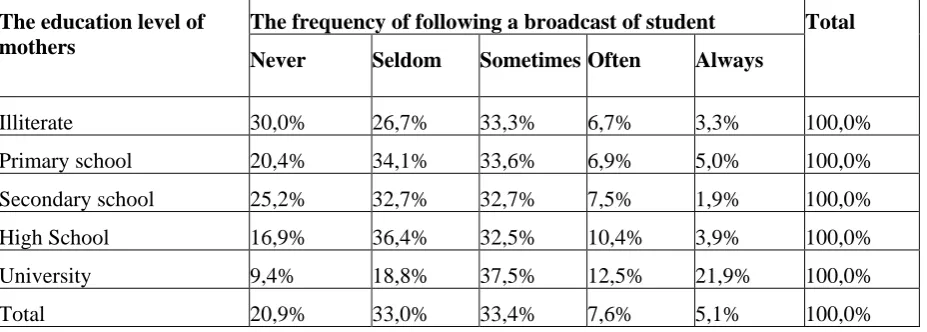
HYPTHESIS3: The frequency of following a history broadcast of secondary students changes according to education level of mothers.
Table 9. The change of the frequency of following a history broadcast of individuals taking part in the research according to education level of mothers
The education level of mothers
The frequency of following a broadcast of student Total Never Seldom Sometimes Often Always
Illiterate 30,0% 26,7% 33,3% 6,7% 3,3% 100,0%
Primary school 20,4% 34,1% 33,6% 6,9% 5,0% 100,0%
Secondary school 25,2% 32,7% 32,7% 7,5% 1,9% 100,0%
High School 16,9% 36,4% 32,5% 10,4% 3,9% 100,0%
University 9,4% 18,8% 37,5% 12,5% 21,9% 100,0%
Total 20,9% 33,0% 33,4% 7,6% 5,1% 100,0%
The frequency of following a broadcast of individuals taking part in the research differs according to the education level of mother. It is seen that the %30 of subjects whose mothers are illiterate do notfollow any broadcast. Whereas, that rate, following a broadcast of individuals whose mothers are university graduated, falls %9,4. Similarly the %3,3 of subjects whose mother are illiterate express that they always follow a broadcast, the %6,7 of subjects whose mothers are university graduated Express they often follow a broadcast, the %21,9 of subjects whose mothers’education level is university state that they always follow a broadcast, and %12,5 of them often follow a broadcast. It is stated that the more the level of mothers’education level increase, the more the probability of following a broadcast increases.
To test whether the continuity of secondary students following a broadcast changes according to the level of mother education level or not, IndependentSamples t-Test is usedr. According to taken results , the average of following a broadcast is at the rate of 2,56 in the individuals whose mothers’ education level is sencodary education or under the secondary education, and for the highschool and higher level that rate is 2,44. So the hyphothesis 3 is accepted.
Table 10. The evaluation of individuals about the importance of history education for their daily life based on their schools in which they are educated
The schools that the education is given
History does not have an importance in daily life Total
1 2 3 4 5
Mahmut Esat Anatolian High School
21,6% 18,9% 16,2% 18,9% 24,3% 100,0%
Seydişehir Anatolian High School
27,1% 23,4% 13,1% 24,3% 12,1% 100,0%
Enis Şanlıoğlu High School 29,1% 37,3% 14,5% 10,0% 9,1% 100,0% Anatolian Religious High
School
44,4% 24,4% 17,8% 7,8% 5,6% 100,0%
Vocational High School 15,3% 26,4% 13,9% 25,0% 19,4% 100,0%
Anatolian Teacher Training High School
45,7% 42,9% 2,9% 0,0% 8,6% 100,0%
Health Vocational High School 37,5% 43,8% 12,5% 0,0% 6,3% 100,0%
Industry Vocational High School
24,1% 35,5% 17,5% 15,1% 7,8% 100,0%
Total 28,4% 30,1% 14,9% 15,1% 11,5% 100,0%
The opinions of individuals who are taking part in the survey about the history education are evaluated. (1-I do not definitely agree, 2-I do not agree, 3-I am not sure, 4-I agree and 5-I definitely agree). According to survey’s results, %43,2 of students from Mahmut Esat Anatolian High School, %44,,4 of students from Vocational High School emphasized that the history has no importance in daily life. %44,4 of students from Anatolian Religious High School and %45,7 of students from Anatolian Teacher Training School think that history is so important for daily life.
Table 11. The evaluation of individuals’ opininons about using the history for solving the daily life problems based to their school
The school in which education is given
One of the benefits of history is to use it for solving the daily life problems
Total
1 2 3 4 5
Mahmut Esat Anatolian High School
6,8% 25,7% 24,3% 29,7% 13,5% 100,0%
Seydişehir Anatolian High School
14,0% 23,4% 22,4% 27,1% 13,1% 100,0%
Enis Şanlıoğlu High School 16,4% 21,8% 25,5% 20,9% 15,5% 100,0%
Anatolian Religious High School
16,7% 14,4% 26,7% 26,7% 15,6% 100,0%
Vocational High School 9,7% 22,2% 30,6% 23,6% 13,9% 100,0%
Anatolian Teacher Training High School
5,7% 17,1% 25,7% 28,6% 22,9% 100,0%
Health Vocational High School 6,3% 12,5% 18,8% 31,3% 31,3% 100,0%
Industry Vocational High School
7,8% 18,1% 32,5% 30,7% 10,8% 100,0%
Total 11,3% 20,1% 27,2% 27,0% 14,3% 100,0%
The opinions of students about the importance of history in daliy life are evaluated. (1-I do not definitely agree, 2-I do not agree, 3-I am not sure, 4-I agree ve 5-I definitely agree). According to survey results, %43,2 of students from Mahmut Esat Anatolian High School, %44,4 of students from Vocational High School think that history has no importance for solving the problems about daily life. (the answers I do not agree and I do not definitely agree). %44,4 of students from Anatolian High School and %44,4 of students from Anatolian Teacher Training High School think that history has a little contiribution for solving the daily life problems.
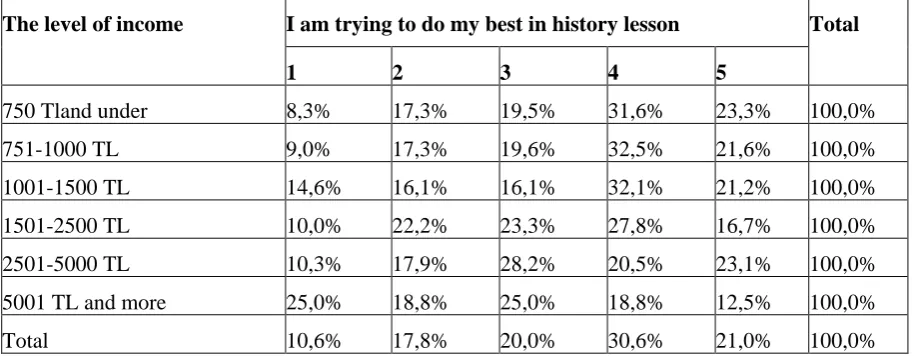
HYPOTHESIS4: The manners of seconday education students towards doing their best in the history lesson differ according to the income of family.
Table 12. The evaluation of individuals’anwers taking part in the survey for the question of “I am trying to do my best in the history lesson” according to the income of family
The level of income I am trying to do my best in history lesson Total
1 2 3 4 5
750 Tland under 8,3% 17,3% 19,5% 31,6% 23,3% 100,0%
751-1000 TL 9,0% 17,3% 19,6% 32,5% 21,6% 100,0%
1001-1500 TL 14,6% 16,1% 16,1% 32,1% 21,2% 100,0%
1501-2500 TL 10,0% 22,2% 23,3% 27,8% 16,7% 100,0%
2501-5000 TL 10,3% 17,9% 28,2% 20,5% 23,1% 100,0%
5001 TL and more 25,0% 18,8% 25,0% 18,8% 12,5% 100,0%
Total 10,6% 17,8% 20,0% 30,6% 21,0% 100,0%
The answers of individuals taking part in the survey for the question “I am doing my best in the history lesson” are evaluated (1-I do not definitely agree, 2-I do not agree, 3-I am not sure, 4-I agree and 5-I definitely agree). According to survey results %8,3 of students whose family income is i 750 TL and under do not agree with this idea whereas that rate climbed to %25 level when the income level rises. In the same way, the rate of doing their best in history lesson (I agree and I do not agree) it is %54,9 for the individuals whose income level is 750 TL and under, that rate decreases with the fall of income level and that rate is %31,3 for the people whose income is 5001 TL and more.
To test whether the manners of secondary school students for doing their best in the history lesson change according to the family income level or not, IndependentSamples t-Test is used. According to the taken results, the average rate of doing their best in the history lesson for the individuals whose family income is 1001TL and under is 2,51 and that rate is 2,77 for the family having higher income. So the hypothesis 4 is accepted.
4. DISCUSSION AND RESULT
In the result of study, it is seen that the education level of mothers is much more important than the education of fathers for the interest and success in the history lesson. As in the same way the education level of families has an important role for the frequency of following a broadcast.
The study done for the purpose of defining the viewpoints of students towards history lesson and explaining some relations between the perception of students towards history education and their some demographic is based on analyzing the datas of 670 students educated in Seydişehir, Konya by the survey method. In the scope of research, the manners of students towards history teaching is tried to evaluated. According to that, the frequency of following a broadcast of males is higher than females and, the higher the level of mother s’education is become, the more the rate of following a broadcast increase. Also %70 and mare of students from Anatolian Religious High School, Religious High School, Anatolian Teacher Training High School, Enis Şanlıoğlu High School and Health Vocational High School think that history is important in daily life. That rate is in the lowest in Mahmut Esat Anatolian High School with tre rate of %40. By making inference from the datas of research, the rate of individuals thinking that history has no imporatnce in solving the everyday’s problem in about all the school is %40. According to another finding, it is stated that the more the income level increase, the more effort for doing their best increase.
Also 4 hpothesis are tested in the research. In first hypothesis made up in the scope of research, the frequecy of following a broadcast changes according to the gender is tested. According to taken results the continuty rate of following a broadcast of males is 2,67 whereas that rate is 2,26 in females. So the hypothesis 1 is accepted. In hypothesis 2, the rate of following a broadcast changes according to gender is tested. According to taken results, the rate of following a broadcast of males is 3,01 and that rate is 2,71 in females. So the hpothesis 2 is accepted. In the hpothesis 3, the frequency of following a broadcast changes according to the level of mother’s education level is tested. According to the result, the rate of following a broadcast of individuals whose mothers are seconday school graduated is 2,56, tahat rate is 2,44 for the high school and above. So the hypothesis 3 is accepted. As for the fourth, the rate of doing their best in the history lesson changes according to the level of family income is tested. According to the result, the rate of efforts of doing their best in the history lesson is 2,51 for the individual whose family income is 1001 TL and under whereas it is 2,77 for the individuals having higher family income. So the hpothesis 4 is accepted.
Including the samples, and not incluiding all the students in the district (they are selected randomly from the students of schools existing in the distric) make up the restriction. But these restrictions are not resolved because of time and cost reasons. Also the number of students, school, district event the city can be increased to see the general manner of secondary school students. Also if the findings are applied in different education groups ( for example in universities), there will be a change of comparing.
5. REFERENCES
Aktekin, S.,Harnett, P., Öztürk, M. and Smart D., (2009). Çok Kültürlü Avrupa İçin Tarih ve Sosyal Bilgiler Eğitimi, Harf Eğitim Yayıncılığı, 27-44,Ankara, Turkey.
Akçalı, A, A, Aslan, E,(2007),Yerel Tarih ve Tarih Öğretimindeki Rolü,Dokuz Eylül Üniversitesi Buca Eğitim Fakultesi Dergisi:21 80-88,İzmir,Turkey.
Aslan, B, (2004), Türkiye’de Milli Tarih Anlayışı Bağlamında Dünden Bugüne İnkılap Tarihi Dersleri, Kazım Karabekir Eğitim Fakültesi Dergisi sayı:9,81-109,Erzurum, Turkey.
Aslan, E,(2006),Neden Tarih Öğretiyoruz? Dokuz Eylül Üniversitesi, Buca Eğitim Fakültesi Dergisi: 20,162-173, İzmir, Turkey.
Carr, E. H., (1996), Tarih Nedir? Birikim Yayınları,157-183, İstanbul, Turkey.
Demircioğlu, İ. H., (2011), Tarih Öğretiminin Amaçları, Tarih Nasıl Öğretilir? Tarih Öğretmenleri İçin Özel Öğretim Yöntemleri, Yeni İnsan Yayınevi, 65-69, İstanbul, Turkey.
Dinç, E., (2011), Tarih Öğretiminin Amaçları, Tarih Nasıl Öğretilir? Tarih Öğretmenleri İçin Özel Öğretim Yöntemleri, Yeni İnsan Yayınevi, 70-76, İstanbul, Turkey.
Dursun, D., (2007), Tarih Derslerinde Öğrenme ve DüşünceGelişimi,NobelYayın, 5-22, Ankara, Turkey.
Köstüklü, N., (2006), Sosyal Bilimler ve Tarih Öğretimi, Sebat Ofset Matbaacılık, 9-20, Konya,Turkey.
Özbaran, S.,(2005),Tarih Tarihçi ve Toplum,Tarih Vakfı Yurt Yayınları,63-97 İstanbul,Turkey. Tunçay, Mete., Eleştirel Tarih Yazıları, Liberte Yayınları,274-287, Ankara, Turkey.
Safran, M., (2006), Tarih Eğitimi Makale ve Bildiriler, Baran Ofset, 7-17, Ankara,Turkey.
Safran,M., (2011), Tarih Nasıl Öğretilir? Tarih Öğretmenleri İçin Özel Öğretim Yöntemleri, Yeni İnsan Yayınları.
Şıvgın, H,(2009),Ulusal Tarih Eğitiminin Kimlik Gelişimindeki Önemi, Gazi Üniversitesi, Akademik Bakış: Cilt 2 S.4,35-52, Ankara-Turkey.
Yetkin, S., Lise Tarih kitaplarında İslam,Tarih Öğretimi ve Ders Kitapları,Buca Sempozyumu (Editör:Salih Özbaran), Tarih Vakfı Yurt Yayınları,167-195, İstanbul, Turkey.