THE COMPETENCY-BASED APPROACH IN THE TRAINING OF THE HEALTHCARE MANAGERS
Polina A. Balkanska
Faculty of Public Health, Medical University - Sofia, Bulgaria
Abstract
During the past decade, there has been a growing interest in competency-based performance systems for enhancing both individual and organizational performance in health professions. The applied aspects of management profiles created many opportunities for systematic and focused design of activities to develop leaders. It is reasonable to expect differences in requirements for the training needs of managers from different levels of management - strategic, operational and team. This study attempted to identify what the respondents consider as the most important skills for a manager of their position within their organization and draw up guidelines for basic modeling of key management skills necessary to optimize the training of health managers. The study was carried out among 220 health managers, 730 health professionals from hospitals. Clearly are identified three basic skills needed for managers of low and medium level: teamwork, discipline, planning and organizing. Based on the evaluations and specific requirements and development needs of managers modular training programs for development may be designed and academic bachelor and master programs in healthcare management rethought.
Key words: healthcare management, competency, training, development
1. Introduction
Human resources crisis in health care is widely recognized. Currently, most functions in human resources remain fragmented and often are a responsibility of clinicians who manage health facilities and who have little or no training for human resources management. The progress in achieving the objectives of the strategy for development of the human potential depends not only on increasing resources, but also the competence of managers that run teams at all levels of the health system. Managers need training and preparation to deal with these challenges (Cook, J., Hepworth, S., Wall, T. & Warr, P. 2004; Adair, J., 2005; Dimitrov, P., 2007).
In accordance with the Lisabon Strategy and Bologna Process the competency-based approach founded on so-called defined management responsibilities may be relative to processes and activities enhance skills of health managers. This is a continuous process driven by the people’s internal motive to cope better in the area in which operate. And the experience and knowledge should not build up as an end in itself. They must corespond with the professional goals that person sets himself, and to support the achievement of concrete results reaching the goal. If for managers at a lower level is important to integrate the practical action orientation with specific attention to the experience and skills with people, for those of higher level now is necessary development of skills with information, analysis, reflection understanding and experience relating to solve strategic issues(Management Standards Centre National Occupational Standards for Management and Leadership,2008; Balkanska, P., 2009).
2. Results of own research 2.1. The aim of the study
The aim of this study is to examine the views of current health managers when building a competency profile of the effective manager and leader in healthcare.(Balkanska, P., 2010: 109).
2.2. Materials and methods
The study was carried out among 220 executives on team and operational level, 730 health professionals from hospitals in the cities - Teteven Region, Gabrovo, Lovech, Blagoevgrad, Kyustendil and Sofia. The sample was randomly selected.
Following methods of research were used while achieving the goals: critical analysis and synthesis of scientific literature on the research problem; documentary method - national and European documents were examined, inquiry method - direct inquiry.
2.3. Results and discussion
For the purposes of modeling the key skills that are needed for best performance of the activities of managers and team operational level, were used with some modifications, empirically groups drawn by R. Boyatsis skills and a team of Hay Group (Boyatzis, R., Cowen, S. & Kolb, D., 1998). They are formulated on basis of the main functions in work as 1) diagnosis of situations and needs, 2) design and planning of interventions, 3) implementation of interventions, 4) establishing and maintaining relationships, 4) appropriate I-image, in addition to the necessary special skills ensure smooth execution of work.
Within the framework of the questionnaire, the following question were drawn up and posed to the respondents - managers: "In your opinion, what skills does a person need in your position in order to cope in the best possible way as manager?
To maximize the objectivity of the results, these manager’s skills are classified in three different ways: 1) according to how many times the relevant skill was ranked at first place by all interviewed managers, 2) according to how many times it was generally referred as a relevant skill, no matter at which place from 1 to 4 it was ranked, and 3) according to the points collected by each skill. Points are calculated as follows: skill classification I gives 4 points, II gives 3, III gives 2 and IV gives.
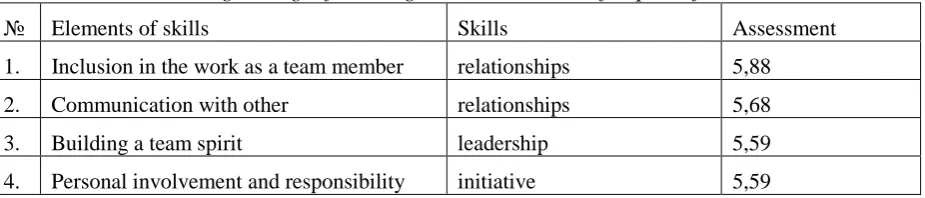
Three basic skills that managers of low and medium level need are clearly identified: teamwork, discipline, planning and organizing. They are significantly more often classified than all other skills. The top rated managerial competencies are in relationships, leadership and initiative (Table № 1).
Table 1. Average ratings of the 4 highest rated elements of required for work skills
№ Elements of skills Skills Assessment
1. Inclusion in the work as a team member relationships 5,88
2. Communication with other relationships 5,68
3. Building a team spirit leadership 5,59
4. Personal involvement and responsibility initiative 5,59
motivation skills, conflict resolution and team cohesion, communication skills, persuasion and influencing / leadership skills.
The problems of leadership in the various organizations is one of the eternally topical, simply because no matter how familiar it sounds, the human factor remains crucial, and especially in situations of reform, crisis and introducing new technologies. But in our conditions we accumulate such moments, which further requires us to offer and implement approaches for improving the leadership cadres.
Implementation of development programs in border consolidation of competence in health care is something that the health reform can not be implemented successfully without, no matter how good our doctors professionals are in their narrow specialties. Hence the problem - expertise in health management becomes a strategic task for managing resources, not just for their redistribution (Balkanska P., 2010: 221; Borisov, V., 2006).
Critically important for the health manager is to combine guidance with leadership. Such skills are achieved primarily by education and learning through experience. Because leadership, according to the thesis of John Adear / which I maintain also /, is both a quality and the role that can be absorbed (Adair,J., 2005). Modeling the main aspects of the managerial competence in health management creates opportunities for systematic and focused design activities for the development of managers at different levels in the health system (Avolio, B., 2004).
Based on certain defined competency manager’s profile on team and on operational level, it is appropriate to conduct a training program for development.
In their design as key areas occur topics and issues that are orientated to develop the identified by the participants as important key competencies to develop of management expertise in healthcare management (Balkanska, P., 2010; 228). Table № 2 shows the structure of such a program.
Table 2. Modules on thematic areas
№ Skills modules areas Skills which focuses to form a
module
1. The competent manager –terms of references, self-knowledge and self-government
Self-discipline, confidence, Reflexivity. Steps towards a mentality of a winner.
2. Planning, communication and control Planning and organizing,
relationships, communication, setting targets.
3. Skills for engaging and managing people Leadership and relationships, persuasion and influence, objectivity and impartiality, expressions of concern for people, partnership, development of others.
4. Change management Initiative, flexibility, persuasion, motivational communication
5. Team Management Team building and improving the
operation of the team. Teamwork, team leadership, mentoring.
6. Effective use of resources and quality management Planning and organizing, analyzing data, setting targets, assessing motivation, communication.
The program is built towards the cycle of learning through experience and includes activities based on background and specific experience, reflection, connection with the theory and the possibility of experimentation in practice. It is directed both to the formation of appropriate attitudes and development skills. First, using a wide range of methods training sessions are designed forming elements studied skills such as self-assessment and determination of strengths and weaknesses, setting priorities, delegation, planning techniques and communication, setting goals, giving and receiving feedback, negotiating etc.
On the other hand, the program envisages a number of training sessions orientated to understand the new roles of managers, creating a culture of quality and continuous improvement and to developing skills for developing others, change management etc. An important element in it are the practical assignments in which from the participants is required to implement lessons learned through the lens of specific examples of their managerial work. In such way the program relies on clear benchmarks for the manager’s skills based on an assessment through models of good practice and also on needs of the organization in terms of its development.
Guidelines for improving communication practices can be used with success in the field of healthcare management in order to improve internal communication context and implementation of quality health care activities.
It is obviously that the program will require from the students to acquire new learning skills that enable them to undertake development in their own hands and direct it in a direction corresponding to both their personal interests and objectives of the organization. For this purpose the trainee will have to know himself well, and requirments for his competency.
The first module of the program for managers development self awareness expects a new approach to learning, skills and attitude to learning in the context of an integrated learning process. This module is focused on developing skills of reflection on own experience and experiences and their application to form a proper attitude of mind (perspective, thinking systems and processes) for the next phases of the learning process, ie formation of the manager as' thinking practitioner.
The following modules seek to further develop these skills through assignments that encourage reflection on personal experience and acquired experiences, as well as that of colleagues.
The next interdisciplinary, problem-oriented modules, seeks a broad discussion of the raised problems.
Also the ability to select suitable for teaching and the key issues for the organization and projects will be essential. Here the decisive factor will be the coordination between teachers, organization and trainee manager.
The implementation process is associated with a suitable environment and infrastructure based on: • standards of competence;
• methodology for assessment of competence in performance of work; • tools and methods for developing skills for effective learning;
• synchronously active facilitators supporting the development process; • environment that encourages the development process.
The implementation of the proposed vision is associated with significant resources and readiness to change and the three stakeholders.
3. Conclusion
Based on the made evaluations and on specific requirements and needs for development of managers from prominent organizations, modular training program development can be designed and give new meaning to academic bachelor and master programs in healthcare management. In their design as key areas it is appropriate to commit topics and issues aimed to develop core competencies identified as important.the by participants It is reasonable to expect differences in requirements for the training needs of managers from different levels of management - strategic, operational and team. Supervisors usually grow and develop within the organization. Therefore, their development requires special attention.
Effective management of modern hospitals is associated with the establishment of an orderly and efficient system of powers in connection with use of competency concept in practice. Administering and maintaining such a system, however, is intertwined in many cases reaching competence in conflict with other activities in the management of hospitals. Requirements for health managers are directly related to the ongoing health care reform and the need to adopt a new type of organizational culture, a new management style, skills and attitudes to work. Tends to be a glaring need for health managers to be prepared for new roles in developing leaders and agents of change.
References
Adair, J., 2005. How to Grow Leaders: The Seven Key Principles of Effective Leadership Development, Kogan Page.
A v o l i o, B. 2004. Examining the Ful Range of Leadership: Looking back to transform forward. In: D. Day, St. Zaccaro & S. Halpin. Leader development for Transforming Organizations Lawrence Erlbaum Associates Inc. , p.71 - 98.
Balkanska P. 2009. Psychological approaches to health management, Bulvest 2000, Sofia.
Balkanska, P. 2010. Model for development of leadership competence in the field of Health / habilitats.work, Sofia.
Borisov, V. 2006. Strategic Management, Firmest, Sofia.
Boyatzis, R., Cowen, S. & Kolb, D. 1998. Innovation in Professional Education, McBer &Company.
Cook, J., Hepworth, S., Wall, T. & Warr, P. 2004. The Experience of Work: A Compendium and review of 249 Measures and their Use. Academic Press Inc., London.
Dimitrov, P. 2007. Catalogue of competences, Psihoblog, Sofia.
Management Standards Centre National Occupational Standards for Management and Leadership. London. 2004-2008. www.management-standards.org.