A REVIEW OF SEGMENTATION TECHNIQUES
USED IN IMAGE PROCESSING
Nini
1, Sonika Jindal
21,2
Computer Science, SBSCET (India)
ABSTRACT
Image segmentation can be defined as the process of partitioning a digital image into multiple segments. It is
the first step in analysis of an image. Image segmentation finds uses in several image processing techniques
such as image compression and object recognition. Several methods for image segmentation have been
developed over last five decades. Broadly these can be categorized into edge-based, region-based,
threshold-based and cluster-threshold-based segmentation. The techniques used in either of these methods are not efficient enough
to give good results individually. Therefore, a combination of two or more techniques from each method is used
for achieving good segmentation results. In this paper, such methods of image segmentation have been
reviewed.
Keywords: Canny, K-means, Threshold, Segmentation, Region
I. INTRODUCTION
Image segmentation is an important part of image processing. It is a technique that subdivides an image into its
constituent elements so that it becomes more understandable. The level to which the image is divided depends
on the problem being solved [1]. In case of image compression, we want to segment the image only to reduce its
size while in case of satellite imagery same segmentation may be done to enhance the features of image for its
proper study. A good segmentation algorithm is that which stops after achieving accurate results and does not
lead to over segmentation. The first techniques for image segmentation were developed in 1960s at Bell Labs.
Today it has become a vast area for research and development of digital image processing. Image segmentation
finds applications in many fields - medical field, locate tumor, recognize infected cells [7], remote sensing, to
identify regions of interest and objects in the scene which is beneficial to subsequent image analysis and
annotation [14], image enhancement, satellite imagery (locate road, forests and cities in satellite images) and
many others.
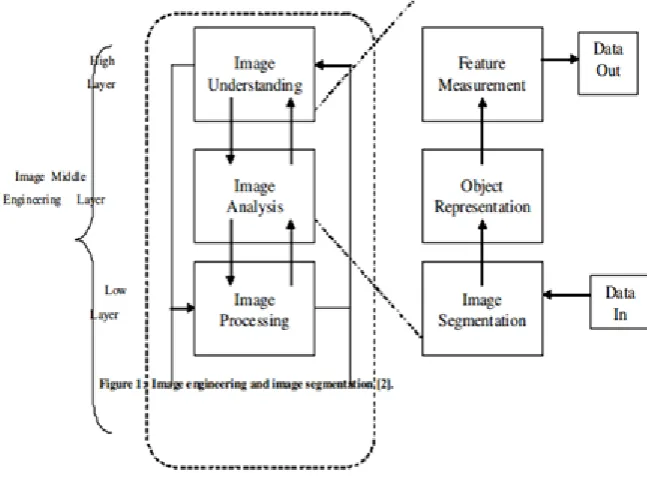
Image segmentation is a part of the bigger process of image engineering [2], as shown in Fig:1 which consists of
mainly three stages:
a. Image understanding
b. Image analysis
Fig 1: Image Engineering
II. IMAGE SEGMENTATION TECHNIQUES:
Many different methods of image segmentation have been developed since 1960. Broadly these methods can be
classified into following types:
1. Edge based
2. Region based
3. Threshold based
4. Clustering based
1.
Edge based:
An edge is defined as the boundary between two regions. It is here that the neighboring pixels of the region
become dissimilar. In edge based image segmentation each object is surrounded by a closed border [3]. The
edges divide the image into various objects that it is composed of.
Edge based segmentation can be done in two ways:
a. Gradient based: It works according to the spatial gradient, which is the first derivative of an image. It is
given by
It detects the edges by looking for the maximum and minimum in the first derivative of the image [15]. The
magnitude of gradient tells about the strength of the edge while the change in intensity tells about the direction
of the edge.
b. Gaussian based: It works by finding zero crossings in the second derivative of image. The zero crossing is
useful for locating the centers of thick connected edges [16]. The second derivative of image is given by:
Gradient based:
(i) Robert edge detection: It was the first edge detection method introduced by Lawrence Roberts in 1963.
The operator consists of a pair of 2×2 convolution kernels as shown in the figure. Kernels respond to
maximize edge running at 45° to each pixel grid.
(ii) Sobel edge detection: The Sobel operator is based on convolving the image with a small valued filter in
horizontal and vertical direction. It is a computationally inexpensive method. For high frequency
variations in the image it produces crude gradient approximation.
(iii) Prewitt edge detection: The Prewitt filter is very similar to Sobel filter. The 3x3 total convolution
masking is used to detect gradient in the X, Y directions as shown in Figure. It is a fast method for edge
detection. It is only suitable for well-contrasted noiseless images.
Advantages: These techniques are simple and easy to implement
Disadvantages: These are sensitive to noise present in the image, hence are less efficient. Edges detected could
be inaccurate and less reliable [17].
Gaussian based:
(i) Canny Edge detection: Canny edge detector is a commonly used image processing tool. It is a robust
algorithm and is adaptable to various environments. It is faster than Roberts method.[4]
Steps in canny edge detection:
(b) Finding Gradient: Sobel operator is used to perform 2-D gradient in both horizontal and vertical directions.
It detects edge strength and edge direction.
(c) Non-maximal Suppression: Only pixels with local maxima are marked as edges, while the rest are
suppressed to minimize false edges.
(d) Continuation in edges: broken and weak edges are removed using double threshold. Two threshold values,
th, high threshold value and tl, low threshold value are calculated according to local content of the image.
Pixel value, p, is marked as edge if it is greater than th i.e. p(x,y) > th. If it lies between th and tl ,i.e.
tl<p(x,y)<th. then it is kept only if it is connected to continuous edge. Pixel valueless than tl i.e. p(x,y)< tl
are rejected straight away.
Thus, proper connected edges are formed.
Fig 2: Steps in Canny Edge Detection
Advantages: It works better on noisy images than gradient based filters.
Limitation: It is a complex and time consuming process.
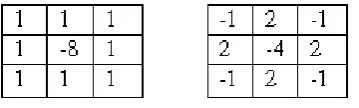
(ii) Laplacian: It is seldom used directly, as being a second order derivative it is very sensitive to noise. Its
magnitude produces double edges and it is unable to detect direction of the edge. But this property can be
used for edge detection by looking for zero crossings between the positive and negative value of double
edges [16].
It is thus used in combination with Gaussian, which removes noise, as Laplacian of Gaussian (LoG) filter. LoG
is very effective in detection of thick edges. It takes a gray scale image and input and gives another gray level
image as output. The association of Gaussian with Laplacian can be done as a preprocessing step. It has two
major advantages. Since both the Gaussian and the Laplacian kernels are usually much smaller than the image,
this method usually requires far fewer arithmetic operations. The LoG kernel can be pre-calculated in advance
so only one convolution needs to be performed at run-time on the image [18].
Fig: Commonly used approximations of Laplacian Filter
2. Region based: This method segments the image on the basis of low-level features of the image – color,
texture and intensity. Unlike the edge-detection method which works for only gray scale images, it can
work for colored images as well. It assumes that the pixels in a region are similar to each other while pixels
of different regions are not [9]. The similarity criterion of pixels can be one or more of the three features.
I/P (noisy image)
Smoothening (Noise Reduction)
Edge Detection and Direction)
Non-maximal Suppression
Continuous Edge Detection
Results heavily depend on what criterion has been chosen. The commonly used techniques in this method
are JSEG segmentation, seed-growing and region split-and-merge.
(i) JSEG-segmentation: JSEG (Joint Systems Engineering Group) [12] is a novel approach for an automatic
approach to colored image segmentation. It is a useful method for segmentation of natural scenes as those
are rich in color and texture pattern [14]. It works on the following assumptions of the image [13]: The image contains regions with uniformly distributed color texture pattern.
The color information of a region can be represented by a few quantized values of colors. Color difference among different regions is quite noticeable.
JSEG works in two stages: color quantization and spatial segmentation. In color quantization, the colors of the
image are reduced to a less number of classes, up to 24, without degrading the quality of color information of
the image. The quantized colors are assigned labels. Each label is associated with a class. The original color
pixels of the image are replaced by these labels resulting in class-maps. The reduction in number of colors
reduces the complexity of the algorithm. Spatial distribution of colors in the image is not taken into
consideration while performing color quantization.
In spatial segmentation, j image is formed. A j-image is a gray-scale image whose pixel values are the J- values
calculated over local windows centered on these pixels [11]. J values are related with the sizes of the windows.
These values are calculated from a window placed on the quantized image, where the J-value belongs and the
size of the window can be varied [13]. Then homogeneity and uniformity of regions is calculated. Homogeneous
regions are merged together for proper results.
Figure: Steps in JSEG image segmentation
Advantages: It is a robust method and has good computational capability. It works well on natural scenes
which are composed of complex objects and texture.
Disadvantage: It could lead to over segmentation when intensity change in the image is taken into
(ii) Region-growing: It is a very popular and simple method of region based segmentation. The widely used
procedure is set a similarity criterion for comparison of pixels. Then we take one pixel and compare it with
its neighbors. If a similarity principle is satisfied, the pixel is set to belong to the cluster as one or more of
its neighbors otherwise it is kept aside until another pixel which fulfils the criteria is found [10]. The
selection of the similarity criterion is important. There are two types in region growing, Seeded and
Unseeded. In seeded region growing (SRG), a set of seeds is selected initially and the region is grown
around it by adding piels one by one to the region. In unseeded region growing, no initial selection of seed
points is necessary. The seed points are generated automatically [9]. This is not a very popular method.
Advantages: The regions can be formed based on more than one criterion at the same time.
Disadvantage: It can lead to over segmentation, which is undesirable for proper segmentation.
(iii)Region-split and merge: In this the whole image is taken as single region initially and then split into
smaller regions based on the difference in pixel properties. The process is repeated until no more splits are
possible [2]. Then the regions are merged based on the similarity of their pixels. Usually it starts with
smaller regions being merged to create a bigger one. The regions are merged only if they have some
similarity between them [1]. It is based on the concept of quad trees, each node represents the subdivision
of a node into four descendent nodes and root represents the entire image [9].
Advantages: It guarantees connected regions.
(iv)Clustering K means: This is the basic algorithm for creating clusters. It splits the image into k clusters each with a centroid. Distance between centroid and pixels of a cluster is measured till it becomes as small as possible. In the process the centroids are changed repeatedly, till no more change in centroids is possible [3].
The algorithm for K-means is as follows:
Step1: Randomly choose k number of centroids in the image.
Step 2: Form a cluster around each centroid based on the distance of surrounding pixels from it. This distance is the Euclidean distance between the centroid and the pixel.
Step 3: Repeat Step 2 till the centroids become fixed for a given cluster.
Applications: Advanced versions of K-means are used medical imagery for clustering of cell tissues as
described in [6], [7].
Limitations: The algorithm is sensitive to initial selection of centroids.
3. Threshold based method: It is a simple but effective technique for image segmentation. It basically
separates the objects of image from the background. It converts a multilevel image into a binary image i.e.,
it choose a proper threshold T, to divide image pixels into several regions. If it is an image of a light object
on dark background then a pixel p(x,y) is considered a part of the object if its value is less than the
threshold i.e p(x,y) < T, else it is considered to be a part of the background[8]. In this way by comparing the
pixel values to a set threshold value the whole image can be segmented. Thresholding can be divided into
two methods: global threshold and local threshold.
(i) Global threshold: It works when the intensity of pixels is even i.e the background and objects can be easily
classified based on a constant threshold value.
g(x,y) = 1 if f(x,y)>T
where g(x,y) id the global threshold and f(x,y) is the pixel value [2]
(ii) Local threshold: it is used when the intensity distribution of pixels is uneven. There are multiple threshold
values.
Applications: It is used to differentiate foreground from back ground.
Limitations: It cannot be applied to noisy or multichannel images as it generates only two classes of images.
III. CONCLUSION
In this paper I have discussed different image segmentation techniques. As these techniques individually have
some limitation, these are used in a combination for better results. The clustering algorithm K-means is usually
applied in its advanced form as moving K-means or Fuzzy K-means to improve the accuracy of the results. Also
clustering algorithms and region based algorithms are sometimes combined. The future scope of these
techniques is to reduce time and improve the accuracy of results.
REFERENCES
[1] Nida M. Zaitoun, Musbah J.Aqel “Survey on Image Segmentation Techniques” Procedia Computer
Science 65(2015) 797-806
[2] Amanpreet Kaur “A Review Paper on Image Segmentation and its various Techniques in Image
Processing” International Journal of Science and Research (2012)
[3] R.Yogamangalam#1, B.Karthikeyan, “ Segmentation Techniques Comparison in Image Processing”,
International Journal of Engineering and Technology Vol 05 Issue 1(2013)
[4] Poonam Dhankhar, Neha Sahu, “ A Review an Research of Edge Detection Techniques for Image
Segmentation” IJCSMC, Vol.2, Issue 7, July (013), pg 86-92.
[5] Kewal Krishan and Sukhjit Singh “Color Image Segmenatation Using Improved Region Growing and
K- means Method” IOSR Journal of Engineering Vol. 0 Issue 05
[6] Farah H.A. Jabar, Waidah Ismail, Rosaline A. Salam, Roseline Hassan “Image Segmentation Using a
Hybrid Clustering Technique and Mean Shift for Auomated Detection of Acute Lukemia blood Cell Images” JATIT, Vol 6 No.1 June 2015
[7] A.S.Abdul Nasir, M.Y.Mashor, Z.Mohamed “Segmentation Based Approach for Detection of Malaria
Parasites Using Moving K-means Clustering” IEEE EMBS Intenational Conference on Biomedical
Engineering and Sciences (2012)
[8] Rajeshwar Dass, Priyanka and Swapna Devi “Image Segmentation Techniques” IJCET vol03 Issue 01.
(2012)
[9] Mehdi Hosseinzadeh, Parisa Khoshvaght “A Comparative Study of Image Segmentation Algorithms”
International Journal of Computer, Electrical, Automation, Control and Information Engineering Vol:9,
No:8, (2015)
[10] Tejaswini C, Mamatha Y N “Region Based Satellite Image Segmentation Using JSEG Algorithm”
[11] Akshay P. Vartak, Dr. Vijay Mankar “Colour Image Segmentation - A Survey” International Journal of
Emerging Technology and Advanced Engineering Volume 3, Issue 2, February 2013
[12] Shruti Pardhi, Mrs. K. H. Wanjale “Survey on Techniques Involved in Image Segmentation”
International Journal of Computer Science Trends and Technology (I JCS T) – Volume 4 Issue 3, May -
Jun 2016
[13] Amritpal Kaura, Dr.Yogeshwar Randhawab “Image Segmentation Using Modified K- Means Algorithm and JSEG Method” International Journal Of Engineering And Computer Science ISSN:2319-7242
Volume 3 Issue 6 June, 2014 Page No. 6760-6766
[14] Khamael Abbas, Mustafa Rydh “Satellite Image Classification and Segmentation by Using JSEG
Segmentation Algorithm” I.J. Image, Graphics and Signal Processing, 2012, 10, 48-53
[15] Mamta Juneja , Parvinder Singh Sandhu “Performance Evaluation of Edge Detection Techniques for
Images in Spatial Domain” International Journal of Computer Theory and Engineering, Vol. 1, No. 5,
December, 2009
[16] Rafael C.Gonzalez, Richard E.Woods “Digital Image Procesisng”
[17] Er. Komal Sharma, Er. Navneet Kaur “Comparative Analysis of Various Edge Detection Techniques”
International Journal of Advanced Research in Computer Science and Software Engineering Volume 3,
Issue 12, December 2013
[18] Raman Maini & Dr. Himanshu Aggarwal, “Study and Comparison of Various Image Edge Detection