
FORMULATION AND EVALUATION OF SOLID DISPERSION OF LOPINAVIR BY USING DIFFERENT TECHNIQUES
7
0
0
Full text
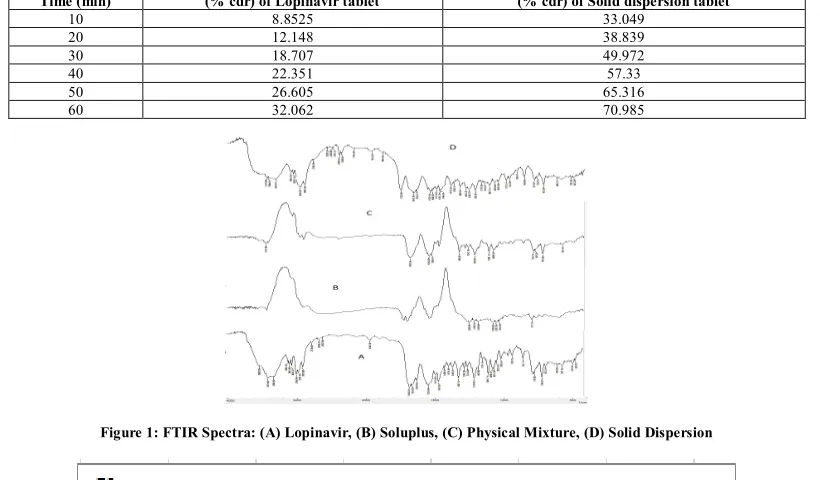
(2) Pekamwar S. S et al. Int. Res. J. Pharm. 2015, 6 (9) Evaluation of solid dispersion. scanning electron microscope was operated at an acceleration voltage of 20 kV.. FTIR Study Drug-excipients compatibility study was done to study the interaction between drug and polymers used in the preparation of solid dispersion. FTIR spectra of pure drug Lopinavir, Polymer Soluplus, physical mixture of drug and polymer and Solid dispersion of optimised batch of selected method were recorded by using a Spectrophotometer (Shimadzu, IRaffinity-1, kyoto, Japan). The samples were dispersed in dry potassium bromide (KBr). FTIR spectra were run between 500 cm-1 to 4000 cm-1. Saturation Solubility Study for Lopinavir and Solid Dispersion For solubility determination, excess amount of Lopinavir and Solid Dispersion was added in vials containing distilled water. The vials were subjected to shaking for 24 hrs. on a magnetic stirrer. The resultant suspension was then filtered through Whatmann filter paper No.1 and suitably diluted with distilled water. Finally, the samples were analysed by UV-Spectrophotometer (Shimadzu, 1800, kyto, Japan) at 257nm. 8,9 Estimation of drug content Solid Dispersion equivalent to 400 mg of Lopinavir were weighed accurately, dissolved in the 50 ml of water and sonicated for 20 minutes. The solution was filtered, diluted suitably. Drug content was analyzed at 257 nm by UV spectrophotometer. The Drug Content was determined using the following equation:6,9,10 Drug Content =. Abosrbance of Std. (Cstd. ) × 100 Absorbance of Tset (Ctest). Dissolution Study Dissolution rate of Lopinavir and Solid dispersion prepared by different methods were studied by using USP type II (paddle type) dissolution test apparatus (Electrolab, TDT – 08L) in 900 ml of 0.1N HCl with 50 rpm. The temperature was maintained at 37oC throughout the study. Drug and solid dispersion equivalent to 400 mg of Lopinavir was used in each test. Aliquots of 5 ml were withdrawn through a Syringe at different time of intervals. The aliquots were assayed by UV spectrophotometer at 257 nm.9-12 X Ray Diffraction Pattern Powered XRD were traced employing X ray diffractometer (Bruker D8) for the samples of Lopinavir and solid dispersion of batch CK2, using K-beta filtered K α radiation of wavelength 1.54Ao. A voltage of 30kV, a current of 15 mA and receiving slit of a 0.1mm. The samples were analysed over 2θ scanning range of 20-80o with a time of 2o/minute. Differential Scanning Calorimetry (DSC) Thermal characteristics of the Lopinavir, Soluplus and Solid dispersion of batch CK2 were determined by a scanning electron calorimeter (Diamond DSC perkin Elmer). The rate of scanning was 10oC/minute and the scanning temperature range was kept between 0-300oC. Scanning Electron Microscope (SEM) The SEM analysis was carried out using a scanning electron microscope (JEOL Model JSM-6390LV). Prior to examination, samples were mounted on an aluminum stub using a double-sided adhesive tape and then making it electrically conductive by coating with a thin layer of gold (approximately 20 nm) in vacuum. The. Preparation and evaluation of Lopinavir immediate release Tablet and solid dispersion immediate release tablet Formulation was prepared by using superdisintegrant and other excipients. Immediate release tablets of Pure Lopinavir and optimized batch of selected method of solid dispersion of Lopinavir were formulated by direct compression method by using Karnavati Tablet compression machine. Accurately weighed quantity of Lopinavir and solid dispersion and other excipients were blended together then pass all the materials through 60-mesh screen and compressed into tablets (Table 2 and 3). Prepared tablets were evaluated for Hardness (Monsanto hardness tester), Friability Roche friabilator, Weight variation and dissolution study (Electrolab, TDT – 08L). (Parameters are kept same as per dissolution of solid dispersion). 13-20 RESULTS FTIR Study The FT-IR spectra of Lopinavir showed characteristic peaks at 1662.64 cm-1 (C=O stretching aliphatic aldihydic group), 3061.03cm1 (OH stretch hydrogen bonded acidic group), 3396.64 cm-1 (NH stretching Amidic group). The spectrum of polymer Soluplus and physical mixture was shown in Figure 1. The spectrum of solid dispersion, which was prepared by kneading method (CK2 batch), was shown the peak at 3396 cm-1 due to the intermolecular hydrogen bonding. A number of indistinguishable peaks was shown in the region of 3026–3450 cm-1 in the solid dispersion which was also present in the crystalline drug spectra which indicate that the no interaction occurred in between Lopinavir and Soluplus. The results revealed no considerable changes in the IR peaks of Lopinavir, when mixed with Soluplus. These observations indicated the compatibility of Soluplus with Lopinavir. Solubility study Table 4 represents the saturation solubility of the pure drug and the solid dispersion of all batches, which was prepared by three different methods by taking various ratios of drug and polymer. Based on solubility studies solvent kneading method and batch CK 2 was selected for formulation of immediate release tablet because they showed highest increase in the solubility of drug in aqueous solution as compare to pure drug and all other batches. The Solvent Kneading method, CK 2 batch (Lopinavir: Soluplus is 1:1) was shown 2.173 folds increase in the solubility. Drug content The Drug content profile from the solid dispersion prepared by Physical mixture, Solvent evaporation and Kneading method was mentioned in the Table 5. All the values obtained were expressed in percentage. From the three methods, Solid dispersion prepared by kneading method in 1:1 ratio shown 75.88 percentage drug content Dissolution Study Dissolution profiles of the Lopinavir and solid dispersions prepared by Physical mixture, Solvent evaporation and Solvent kneading method was represented in Table 6. It proves that the solid dispersion technique has improved the dissolution rate of all batches as compare to pure Lopinavir to great extent. In addition, Figure 2 represents the dissolution profiles were plotted as the percentage of dissolution from the pure drug and solid dispersions of optimized three batches (AP2, BS2 and CK2). All values expressed in percentage cumulative drug release.. 664.
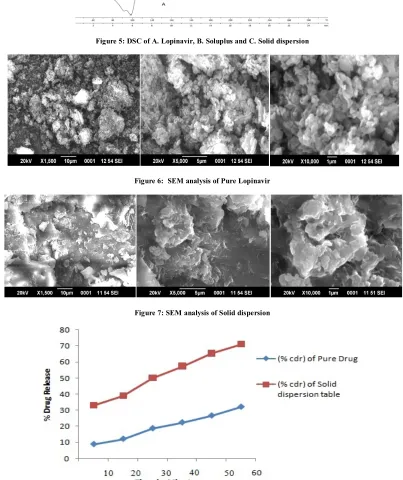
(3) Pekamwar S. S et al. Int. Res. J. Pharm. 2015, 6 (9) From the dissolution study, it is clearly observed that the dissolution rate of Lopinavir is low because of only 28.5% of drug dissolved in 60 minutes and all solid dispersions batches shows significantly enhanced dissolution rate of 36-64% in 60 minutes. Highest improvement in a dissolution rate was observed in solid dispersion batch CK2 that is prepared by solvent kneading method (1:1 ratio) with corresponding to 60 minutes. X-Ray Diffraction (XRD) Studies The XRD pattern of pure drug Lopinavir shown several diffraction peaks at 2θ= 21.58, 22.73, 26.34, 28.13, 29.77, 31.14 and 34.44 deg. indicating the crystalline nature of the drug. The XRD of solid dispersion of Lopinavir - Soluplus doest shown any diffraction Peaks. It corresponds to the amorphous nature of solid dispersion. (Figure 3 and 4) Differential Scanning Calorimetry (DSC) studies In DSC, samples were heated at a constant heating rate at 10oC and the amount of energy required is detected. Pure Lopinavir thermogram showed an endothermic peak at 98.480C. These indicate that, crystallinity nature of Lopinavir. Soluplus thermogram showed endothermic peak at 76.870C. (Figure 5) Solid dispersion thermogram showed endothermic peak at 74.850C. (Figure 5) In solid dispersion thermogram there was no endothermic peak at 98.48oC, it seems to be polymer get melt and drug particles dissolved in the Soluplus. Crystallinity reduction occurs after the reduction in thermal temperature and melting point. When crystallinity decreases, crystalline nature converted to amorphous which results solubility enhancement. [03] SEM Analysis Study (Scanning Electron Microscope) In order to determine the crystal shape and crystal size of solid dispersion, SEM analysis of the samples were performed. SEM photomicrographs obtained for Lopinavir and Solid dispersion was shown in Figure 6 and 7. From the photomicrogram of the pure Lopinavir it was found that the nature of pure Lopinavir was irregular crystalline. From the photomicrogram of Solid dispersion was shown dispersion was uniform and drug particles are entrapped within the carrier. It was also confirming by the XRD and DSC analysis. Tablet preparation and evaluation To formulate Tablet of Solid dispersion CK2 batch of Solvent Kneading Method was selected on the basis of its Solubility and Superdisintegrants accelerate dissolution performance. disintegration of tablets by virtue of their ability to absorb a large amount of water when exposed to an aqueous condition. The absorption of water results in breaking of tablets and therefore faster disintegration takes place. All the tablets were prepared under similar conditions. Weight variation test of both batches tablet met the requirement for weight variation test according to USP 32 (more than 2 tablets exceeded the official limit of 5% for the ± percent difference from the mean). The disintegration time for the tablets correlated well with their hardness (the greater the hardness of the tablet the longer was the time needed to achieve disintegration.) Disintegration time of prepared immediate release tablets was in the range of 33 to 42 seconds Hardness of tablets prepared by direct compression was 3.8±0.022 to 4.2±0.042 kg/cm2.The friability of all Formulations was found to be. less than 1.0 % and hence the tablets with lower friability may not break during handling on machines. Dissolution profile of Lopinavir tablet and solid dispersion tablet was represented in Table 7. It is evident that the solid dispersion tablet has improved the dissolution rate as compare to Lopinavir tablet to great extent. In addition, Figure 8 represents the dissolution rate profiles were plotted as the percentage of dissolution rate from Lopinavir tablet and solid dispersion tablet. All the values obtained were expressed in percentage cumulative drug release. From the dissolution study, it was clearly observed that, the dissolution rate of Lopinavir tablet was low because of only 32.062% of drug dissolved in 60 minutes and solid dispersion tablet was shown enhanced dissolution rate of 70.985% in 60 minutes. DISCUSSION Solubility data demonstrated that, solubility of Lopinavir increases with Soluplus which acts as solubility enhancer polymer. Solubility of solid dispersion was higher in solvent evaporation method as compared to other two methods i.e. Physical method and Solvent kneading method. The dissolution curves of all batches and pure Lopinavir were presented in figure 2. The release rate profiles were plotted as percentage release of Lopinavir from Solid dispersion from Pure Lopinavir, Physical mixture, Solvent Evaporation and Solvent Kneading method batches verses Time (60 minutes). It was evident that the rate of dissolution of pure Lopinavir was slow with respective time 60 minutes, while dissolution rate of Physical mixture batch was appeared faster than pure Lopinavir. However it was much lower than of the release of drug from Solvent Kneading method. XRD of Lopinavir Shows Characteristics Peaks at different angles and indicates that the Lopinavir present in a crystalline form. Results of XRD of Solid dispersion indicate that conversion of Lopinavir Crystalline to amorphous form. XRD data revealed that the typical pure drug show diffraction peaks due to its Crystalline nature and solid dispersion does not show any type of diffraction peaks due to its amorphous nature. This finding again confirming from the DSC thermogram, it shows an endothermic peak of Lopinavir at 98.480C. These indicate that, crystallinity nature of Lopinavir and which require the more thermal energy to break the crystal and shows peak at higher temperature. Whereas Solid Dispersion thermogram showed an endothermic peak at 74.850C which indicate that the amorphous nature of Dispersion which require thermal energy is less than Crystal form so shows peak at lower temperature. Decrease in the crystallinity of the drug and polymer contribute to enhancement of dissolution of the drug. CONCLUSION From the above study, it is summarized and concluded that the SD was prepared successfully by using three methods (physical, solvent evaporation and solvent kneading method). From these, solvent kneading method is more suitable and shows highest results for saturation solubility, drug content, and dissolution rate as compared to Physical method and Solvent evaporation method. Results indicated that used preparation method was promising approach for the solubility, dissolution rate enhancement of Lopinavir and can be formulated as a tablet solid dosage form development for oral use in order to commercialize.. 665.
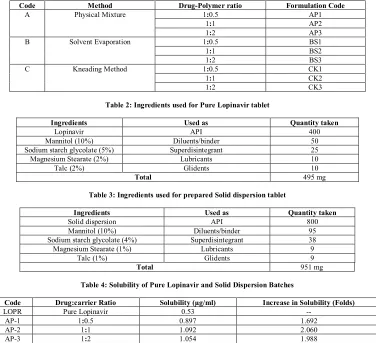
(4) Pekamwar S. S et al. Int. Res. J. Pharm. 2015, 6 (9) Table 1: Drug-Carrier Formulation in various ratios Code A. Method Physical Mixture. B. Solvent Evaporation. C. Kneading Method. Drug-Polymer ratio 1:0.5 1:1 1:2 1:0.5 1:1 1:2 1:0.5 1:1 1:2. Formulation Code AP1 AP2 AP3 BS1 BS2 BS3 CK1 CK2 CK3. Table 2: Ingredients used for Pure Lopinavir tablet Used as API Diluents/binder Superdisintegrant Lubricants Glidents. Ingredients Lopinavir Mannitol (10%) Sodium starch glycolate (5%) Magnesium Stearate (2%) Talc (2%). Quantity taken 400 50 25 10 10 495 mg. Total Table 3: Ingredients used for prepared Solid dispersion tablet Ingredients Solid dispersion Mannitol (10%) Sodium starch glycolate (4%) Magnesium Stearate (1%) Talc (1%) Total. Used as API Diluents/binder Superdisintegrant Lubricants Glidents. Quantity taken 800 95 38 9 9 951 mg. Table 4: Solubility of Pure Lopinavir and Solid Dispersion Batches Code LOPR AP-1 AP-2 AP-3 BS-1 BS-2 BS-3 CK-1 CK-2 CK-3. Drug:carrier Ratio Pure Lopinavir 1:0.5 1:1 1:2 1:0.5 1:1 1:2 1:0.5 1:1 1:2. Solubility (µg/ml) 0.53 0.897 1.092 1.054 0.794 1.015 0.954 0.614 1.152 1.120. Increase in Solubility (Folds) -1.692 2.060 1.988 1.498 1.915 1.800 1.158 2.173 2.113. Table 5: Drug content of solid dispersion Formulation code AP-1 AP-2 AP-3 BS-1 BS-2 BS-3 CK-1 CK-2 CK-3. Drug:carrier ratio 1:0.5 1:1 1:2 1:0.5 1:1 1:2 1:0.5 1:1 1:2. Percentage Drug content 47.56 52.46 48.92 59.63 55.01 63.48 59.69 75.88 69.25. Table 6: Dissolution study of Pure Lopinavir and Solid Dispersion Time (min) 10 20 30 40 50 60. Pure Drug 9.6 14.4 17.7 20.4 22.8 28.5. Percentage cumulative Drug release (% cdr) Physical Mixture Solvent Evaporation Solvent Kneading 12.3 15.3 29.4 20.7 21.9 41.1 25.5 29.4 45.9 29.4 33.6 56.1 34.5 36.9 60.3 36.3 40.8 64.5. 666.
(5) Pekamwar S. S et al. Int. Res. J. Pharm. 2015, 6 (9) Table 7: Dissolution study of Pure Lopinavir and of Solid dispersion tablet Time (min) 10 20 30 40 50 60. (% cdr) of Lopinavir tablet 8.8525 12.148 18.707 22.351 26.605 32.062. (% cdr) of Solid dispersion tablet 33.049 38.839 49.972 57.33 65.316 70.985. Figure 1: FTIR Spectra: (A) Lopinavir, (B) Soluplus, (C) Physical Mixture, (D) Solid Dispersion. Figure 2: Drug Release rate for Pure Lopinavir and solid dispersions. Figure 3: XRD image of pure Lopinavir. Figure 4: XRD image of Solid dispersion. 667.
(6) Pekamwar S. S et al. Int. Res. J. Pharm. 2015, 6 (9). Figure 5: DSC of A. Lopinavir, B. Soluplus and C. Solid dispersion. Figure 6: SEM analysis of Pure Lopinavir. Figure 7: SEM analysis of Solid dispersion. Figure 8: Dissolution study of Lopinavir and solid dispersion tablet. 668.
(7) Pekamwar S. S et al. Int. Res. J. Pharm. 2015, 6 (9) ACKNOWLEDGMENT The authors are thankful to Microlabs Ltd. Bangalore and Eumedia Pharma Pvt. Ltd. Mumbai for providing the gift sample of API and Soluplus respectively. The authors are also thankful to School of Pharmacy S.R.T.M University, Nanded (MH), India. For giving valuable guidance and platform to do work. REFERENCES 1. Pandya P, Gattani S, Jain P, Khirwal L, Surana S. Co-solvent Evaporation Method for Enhancement of Solubility and Dissolution Rate of Poorly Aqueous Soluble Drug Simvastatin: In vitro–In vivo Evaluation. AAPS PharmSci Tech 2008; 9:12471252. http://dx.doi.org/10.1208/s12249-008-9176-z 2. Jun HP, Hoo KC. Enhancement of solubility and dissolution of Cilostazol by solid dispersion technique. Archives of Pharmacal Research 2015; 38:1336–1344. http://dx.doi.org/10.1007 /s12272-014-0547-6 3. Negi JS, Chattopadhyay P, Sharma AK, Veerma R. Development of solid lipid nanoparticles of Lopinavir using hot self nanoemulsification (SNE) technique. European Journal of Pharmaceutical Sciences 2013; 48: 231–239. http://dx.doi.org /10.1016/j.ejps.2012.10.022 4. Aji Alex MR, Chacko AJ, Jose S, Souto EB. Lopinavir loaded solid lipid nanoparticles (SLN) for intestinal lymphatic targeting. European Journal of Pharmaceutical Sciences 2011; 42:11–18. http://dx.doi.org/10.1016/j.ejps.2010.10.002 5. Sinha S, Ali M, Baboota S, Ahuja A, Kumar A, Ali J. Solid Dispersion as an Approach for Bioavailability Enhancement of Poorly Water-Soluble Drug Ritonavir. AAPS PharmSciTech 2010; 11suppl 2: 518-528. http://dx.doi.org/10.1208/s12249-0109404-1 6. Kulkarni PK, Dixit M, Selvam P, Jain J. Preparation and Evaluation of Naproxen by solid dispersion technique. Int Res J Pharm 2012; 3(9):174-177. 7. Debnath S, Gampa VK, Satyanarayana SV. Preparation and Evaluation of Solid Dispersion of Terbinafine Hydrochloride. Asian J Pharm. Tech. 2013; 3(1): 09-15. 8. Prasad AK, Narayanan N, Rajalakshmi G. Preparation and Evaluation of Solid Dispersion of Terbinafine Hydrochloride. International Journal of Pharmaceutical Sciences Review and Research 2010; 3(1):130-134. 9. Enose AA, Dasan PK, Sivaramakrishnan H, Shah SM. Formulation and Characterization of Solid Dispersion Prepared by Hot Melt Mixing: A Fast Screening Approach for Polymer Selection. Journal of Pharmaceutics 2014; 1-7. 10. Sharma A, Jain CP. Preparation and characterization of solid dispersions of carvedilol with PVP K30. Research in pharmaceutical Sciences 2010; 5(1): 49–56.. 11. Homayouni A, Sadeghi F, Varshosaz J, Garekani HA, Ali N. Promising dissolution enhancement effect of Soluplus on crystallized celecoxib obtained through antisolvent precipitation and high pressure homogenization techniques. Article in Press, Colloids and Surfaces B: Biointerfaces 2014; 1-10. 12. Chaulang G, Patil K, Ghodke D, Khan S, Yeole P. Preparation and Characterization of Solid Dispersion Tablet of Furosemide with Crospovidone. Research J. Pharm. and Tech. 2008; 1(4):386 - 389. 13. Patel HP, Karwa P, Bukka R, Patel NJ. Formulation and Evaluation of Immediate Release Tablets of Zolpidem Tartrate by Direct Compression. International Journal of Pharmaceutical Sciences Review and Research 2011; 7(2): 80-85. 14. Hadel Abo EA, Development and Evaluation of Fast Disintegrating Extended Release Tablets Containing Antihypertensive Drug. International Journal of Pharmacy and Pharmaceutical Sciences 2014; 6(6): 165-174. 15. Jadhav SB, Mali AD, Rajeghadage SH, Bathe RS. Formulation and evaluation of immediate release tablets of Imipramine hydrochloride. International Journal of Biomedical and Advance Research 2014; 5(11): 559-565. http://dx.doi.org/10.7439 /ijbar.v5i11.980 16. Antoine AA, Patel B. Formulation and optimization of potassium iodide tablets. Saudi Pharmaceutical Journal 2015; 23:95–101. http://dx.doi.org/10.1016/j.jsps.2014.06.001 17. Patel H, Shah V, Upadhyay U. New pharmaceutical excipients in solid dosage forms – A review. International Journal of Pharmacy & Life Sciences 2011; 2(8): 1006-1019. 18. Jivraj M, Luigi GM, Carol MT. An overview of the different excipients useful for the direct compression of tablets. Pharmaceutical science & technology today 2000; 2(8): 68-63. http://dx.doi.org/10.1016/s1461-5347(99)00237-0 19. Mohanachandran PS, Sindhumol PG, Kiran TS. Superdisintegrants: An Overview. International Journal of Pharmaceutical Sciences Review and Research 2011; 6(1):105109. 20. Shah TJ, Amin AF, Parikh JR, Parikh RH. Process Optimization and Characterization of Poloxamer Solid Dispersions of a Poorly Water-soluble Drug. APS Pharm Sci Tech 2007; 8(2):1-7. http://dx.doi.org/10.1208/pt0802029 21. Sharma Dinesh Kumar, Gupta Vipin Bihari, Purohit Suresh. Solubility improvement using solid dispersion; strategy, mechanism and characterization: Responsiveness and prospect way outs. Int Res J Pharm 2011;2(1):55-60 Cite this article as: Pekamwar S. S., Kankudate A.D., Kale G.K. Formulation and evaluation of solid dispersion of Lopinavir by using different techniques. Int. Res. J. Pharm. 2015; 6(9):663-669 http://dx.doi.org/ 10.7897/2230-8407.069130. Source of support: Nil, Conflict of interest: None Declared Disclaimer: IRJP is solely owned by Moksha Publishing House - A non-profit publishing house, dedicated to publish quality research, while every effort has been taken to verify the accuracy of the content published in our Journal. IRJP cannot accept any responsibility or liability for the site content and articles published. The views expressed in articles by our contributing authors are not necessarily those of IRJP editor or editorial board members.. 669.
(8)
Figure
Related documents
A history of hypertension, low platelet count, and Stanford type A aortic dissection on admission could be risk factors for AKI after initial aortic dissection, and the
Stephen Balsky at the above address. A case of a 74-year-old woman complaining of pain, loss of strength and diminished range of motion in her left wrist is presented. These
When these nations were divided into three groups, the median (range) HIV prevalence estimates remained constant at 0.7% (0.05 – 33.7%) and 0.75% (0.05% – 33.4%) for the lower
The use of acetamino- phen for pain control has been shown to significantly reduce agitation among nursing home residents with moderate to severe dementia [13], but evidence
Patienten mit Beschwerden, die man wahrscheinlich zum Teil auch als Laie mit dem Rauchen assoziieren würde, wie beispielsweise die Durchblutung der Beine oder des
It is of course to be expected that Rome and Italy of the empire continue to use the two forms so well established by the end of the Republic; the interesting thing is
Over all analyses expressed that independent variable Number of branches and control variable firm size has the significant impact on the one of the independent variable Earning
The peels of all varieties were found rich in phenolic and flavonoid contents, reducing power of antioxidants and DPPH scavenging activity than pulp.. Among four apple
