48 |
P a g e
DESIGN AND DEVELOPMENT OF BOTTOM POURING
CRUCIBLE FOR THE PRODUCTION OF AL6063 SIC
REINFORCED METAL MATRIX COMPOSITES
Sarbjit Singh
PEC University of Technology, Chandigarh
ABSTRACT
The MMCs will possess the desirable attributes of metal and ceramics if they are designed and developed correctly.
The high strength, ductility and high temperature resistance are some of the major attributes of metals and on the
other hand the ceramic reinforcements have high stiffness and hardness with highly brittle behavior. The properties
of the ceramic reinforcement combined with the ductile metal matrix, produce a material which has mechanical
properties in-between the metallic matrix and the ceramic reinforcement.The present study includes the development
and fabrication of a stir casting set-up using melt-stir-squeeze-bottom pouring route to yield near net shape of metal
matrix composites.
Keywords: Metal Matrix Composites, Bottom Pouring, Wettability
I INTRODUCTION
The main design consideration for the development of stir casting set-up is to obtain the objectives as follows [1]:
Stirring mechanism design with variable speed
Type of stirrer, blade angles and position of blade in the melt
Temperature measurement and control
Squeezing unit design and placement for bottom pouring
Design of crucible for bottom pouring
Inert mixing atmosphere to prevent oxidation of the melt
Particle addition arrangement in the melt
Pretreatment of reinforcement to enhance wettability
Use of allowing elements to enhance wettability
Self-alignment of all mating parts for better control on the process
Design of mold for near net manufacturing
Selection of material for stirrer, stirrer blade, crucible and squeezer
49 |
P a g e
The valuation of the developed setup for the production of MMC was judged by the characteristics of the product(MMC) produced. Trials and errors led to the overall development in the design and manufacturing of various
components in the setup which enhanced the performance of the setup. The porosity and wettability [2-3] are the
most challenging issues faced by the research fraternity. The optimal control of the process parameters and
conditions such as, operating temperature, stirring speed, stirrer blade angles, pre-treatment of SiC particles, addition
of alloying elements, reduction of time gap between phases of stirring and squeezing led to the successful stir
casting procedure [4-5].
II DESIGN AND DEVELOPMENT OF BOTTOM POURING CRUCIBLE
A bottom pouring crucible was designed and developed for near-net-shape manufacturing of metal matrix
composites. Numbers of brain storming sessions were organized with fellow researchers and supervisors to finalize
the design of bottom pouring crucible. Numbers of experimental trials were performed for successful/unsuccessful
manufacturing of MMCs by bottom pouring arrangement but they led to several manufacturing or material
problems. The three partially/fully successful attempts have been discussed in the subsequent sections for the
successful casting of Al-6063-SiC metal matrix composites using bottom pouring route.
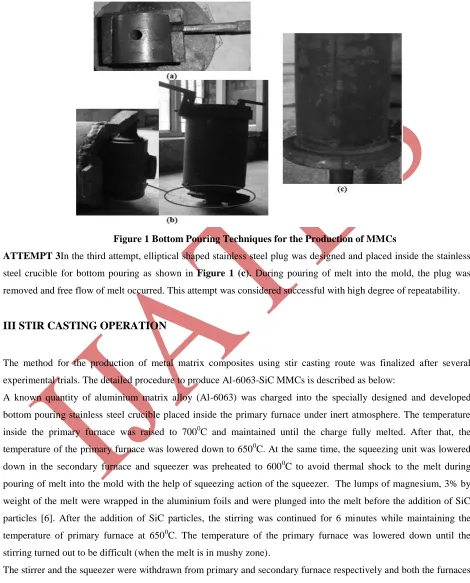
ATTEMPT 1: A cylindrical valve of stainless steel as shown in Figure 1 (a) was designed and developed. The
valve consist of cylindrical rod of diameter 70 mm, with a circular hole of 12 mm at the center of the surface of rod
perpendicular to the central axis of rod. The cylindrical rod was placed on the sleeve and the sleeve was cut into two
parts in proportion of 1/3. The smaller cut part of the sleeve was connected to the bottom (base) of the crucible and
the larger part along with cylindrical rod was connected to the mold. The whole assembly was placed inside the
furnace and the mold was placed below the furnace. The valve has only two positions (on and off) and is controlled
with the help of a stainless steel lever as shown in Figure 1(a). The complete assembly, including valve assembly,
and crucible were placed on the closed metallic mold of mild steel. When the valve was in off position, the upper
portion of the sleeve makes contact with the solid surface of the cylindrical rod and a self-sealing is maintained due
to gravity action provided the mating surfaces which are very smooth. When the valve is in on position, a passage of
12 mm was available for free flow of melt in the mold. A successful Al-6063 alloy casting was made with this
attempt. But when the SiC reinforcement was added to the melt, chocking of the opening takes places because of
semi-solid state of the melt.
ATTEMPT 2: The drawbacks of attempt 1 were improved in attempt 2, and a butterfly type valve of stainless steel
was made and placed at the bottom of the crucible as shown in Figure 1 (b). Similar to the previous attempt, the
valve consists of two positions and is controlled by a stainless steel lever as shown in Figure 1(b) inset. The valve
has an elliptical hole of major and minor diameter of 30 and 15 mm, respectively for free flows of melt when the
valve is in on position. This attempt yielded successful MMC casting. But after only three castings, the surface of
50 |
P a g e
the valve into the furnace as well as in the mold. This attempt was considered as successful but with a limitedrepeatability.
Figure 1 Bottom Pouring Techniques for the Production of MMCs
ATTEMPT 3In the third attempt, elliptical shaped stainless steel plug was designed and placed inside the stainless
steel crucible for bottom pouring as shown in Figure 1 (c). During pouring of melt into the mold, the plug was
removed and free flow of melt occurred. This attempt was considered successful with high degree of repeatability.
III STIR CASTING OPERATION
The method for the production of metal matrix composites using stir casting route was finalized after several
experimental trials. The detailed procedure to produce Al-6063-SiC MMCs is described as below:
A known quantity of aluminium matrix alloy (Al-6063) was charged into the specially designed and developed
bottom pouring stainless steel crucible placed inside the primary furnace under inert atmosphere. The temperature
inside the primary furnace was raised to 7000C and maintained until the charge fully melted. After that, the
temperature of the primary furnace was lowered down to 6500C. At the same time, the squeezing unit was lowered
down in the secondary furnace and squeezer was preheated to 6000C to avoid thermal shock to the melt during
pouring of melt into the mold with the help of squeezing action of the squeezer. The lumps of magnesium, 3% by
weight of the melt were wrapped in the aluminium foils and were plunged into the melt before the addition of SiC
particles [6]. After the addition of SiC particles, the stirring was continued for 6 minutes while maintaining the
temperature of primary furnace at 6500C. The temperature of the primary furnace was lowered down until the
stirring turned out to be difficult (when the melt is in mushy zone).
The stirrer and the squeezer were withdrawn from primary and secondary furnace respectively and both the furnaces
51 |
P a g e
squeezing unit. At this movement, the valve of bottom pouring crucible was opened and the semisolid (mushy zone)melt was mechanically squeezed into the mold placed below the furnace using reciprocating action of the squeezer.
After pouring action, both furnaces slide on the rails to come back to their previous positions. The mold with melt is
immediately taken and water quenched. The quenching ensures better uniformity in the distribution of reinforcement
particles throughout the casting. The MMC billet was removed from the mold by unscrewing its side plates.
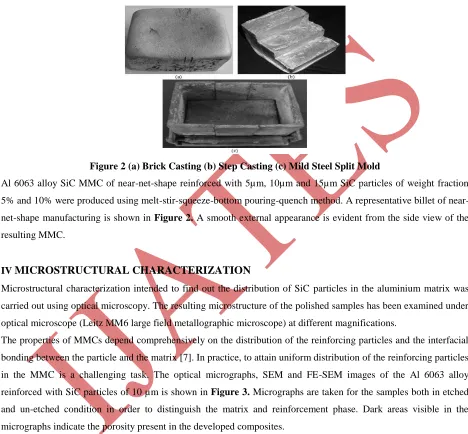
Figure 2 (a) Brick Casting (b) Step Casting (c) Mild Steel Split Mold
Al 6063 alloy SiC MMC of near-net-shape reinforced with 5µm, 10µm and 15µm SiC particles of weight fraction
5% and 10% were produced using melt-stir-squeeze-bottom pouring-quench method. A representative billet of
near-net-shape manufacturing is shown in Figure 2. A smooth external appearance is evident from the side view of the
resulting MMC.
IV
MICROSTRUCTURAL CHARACTERIZATION
Microstructural characterization intended to find out the distribution of SiC particles in the aluminium matrix was
carried out using optical microscopy. The resulting microstructure of the polished samples has been examined under
optical microscope (Leitz MM6 large field metallographic microscope) at different magnifications.
The properties of MMCs depend comprehensively on the distribution of the reinforcing particles and the interfacial
bonding between the particle and the matrix [7]. In practice, to attain uniform distribution of the reinforcing particles
in the MMC is a challenging task. The optical micrographs, SEM and FE-SEM images of the Al 6063 alloy
reinforced with SiC particles of 10 µm is shown in Figure 3. Micrographs are taken for the samples both in etched
and un-etched condition in order to distinguish the matrix and reinforcement phase. Dark areas visible in the
micrographs indicate the porosity present in the developed composites.
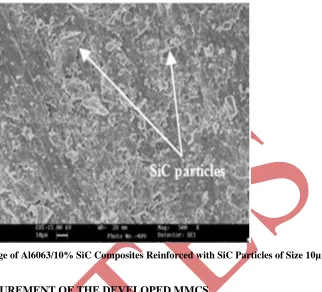
Figure 3shows the SEM image of Al6063/10%-SiC reinforced composites with SiC particles of size 10 μm.
Reasonably uniform distribution is identified from the SEM image. Good interfacial bonding between the SiC
52 |
P a g e
Figure 3 SEM Image of Al6063/10% SiC Composites Reinforced with SiC Particles of Size 10µmIV HARDNESS MEASUREMENT OF THE DEVELOPED MMCS
Hardness is a material property and it is a defined as resistance offered by the material for indentation or permanent
deformation. The hardness of the developed MMCs was measured with Brinell hardness tester (Make: Democratic
Republic, Germany). The Brinell hardness testing is based upon a simple indentation test performed on polished
specimen to find their hardness and it is extensively used for MMCs. It provides better average hardness value over
a large area, which contains both matrix and reinforcing phase. In order to eliminate the agglomeration effect, the
mean of four tests was taken for each specimen.
Figure 4 Variation of Hardness with the Variation in Reinforcement size
Figure 4 presents the variation of hardness for Al6063/10%SiC for 5µm, 10µm and 15 µm reinforcement sizes.
53 |
P a g e
compared to 5 µm size reinforced MMC. The percentage increase in hardness of 10 µm and 15 µm size reinforcedMMC with respect to 5 µm reinforced MMC is 40% and 33% respectively. The increase in hardness with increase in
reinforcement size indicates the better interfacial bonding with the matrix and reinforcement. However, a slight
decrease in hardness for 15 µm reinforce MMCs is attributed to larger metal reinforcement interface area and
increased gravitational effect on the SiC particles because of density difference. Porosity present in the developed
MMCs also affects the hardness, because increase in hardness is attributed by less amount of porosity present in the
composites [8].
V CONCLUSIONS
The following conclusions can be drawn for design and development of bottom pouring crucible for the production
of metal matrix composites:-
1. The metal matrix composites were successfully developed using stir-squeeze-bottom pouring casting route.
2. A uniform distribution of SiC particles is evident from the SEM images
3. Wettability of the SiC particles with the aluminium matrix is a critical issue for proper interfacial bounding
and it can be improved with the addition of magnesium particles during the stirring action.
4. The SiC particulate size has significant effect on hardness of the developed composites.
REFERENCES
1. Ahmad S.N., Hashim J. and Ghazali M.I., 2005, “The effects of porosity on mechanical properties of cast
discontinuous reinforced metal-matrix composite”, Journal of Composite Materials, Vol. 39 (5), pp.451-466.
2. Badini C., VecchiaM.La and Cobell P., 2000, “Gravity casting processing of brake disc: use of partially
recycled (Al-Si-Mg)/SiCp composited”, Materials Science and Technology, Vol. 16, pp.681-686.
3. Chawla N., Chawla K.K., 2006, “ Metal matrix composites” Springer publication, USA
4. Hashim J., Looney L., Hashmi M. S. J., 1999, “Metal matrix composites: production by the stir casting
method,” Journal of Materials Processing Technology, Vol. 92-93, pp.1-7.
5. Hashim J., Looney L., Hashmi M. S. J., 2001, “The enhancement of wettability of SiC particles in cast
aluminium matrix composites”, Journal of Materials Processing Technology, Vol. 119, Issues 1-3, pp.329-335.
6. Hashim J., Looney L., Hashmi M. S. J., 2001, “The wettability of SiC particles by molten aluminium alloy”,
Journal of Materials Processing Technology, Vol.119, Issues 1-3, pp.324-328.
7. Hashim J., Looney L., Hashmi M. S. J., 2002, “Particle distribution in cast metal matrix composites-Part I”,
Journal of Materials Processing Technology, Vol. 123, Issue 2, pp.251-257.
8. Sahin Y., and Acilar M., 2003, “Production and properties of SiC reinforced aluminium alloy composites”,