Outcomes of elderly advanced soft tissue sarcoma patients treated with
first-line chemotherapy: a pooled analysis of twelve EORTC Soft Tissue
and Bone Sarcoma Group trials.
Running Title: Elderly outcomes in EORTC-STBSG chemotherapy trials.
Younger E1, Litière S2, Le Cesne A3, Mir O3, Gelderblom H4, Italiano A5, Marreaud S2, Jones RL1, Gronchi A6, van der Graaf WT1,7,8
Affiliations :
1. The Royal Marsden NHS Foundation Trust, London, U.K. 2. EORTC Headquarters, Brussels, Belgium
3. Gustave Roussy Institute, Villejuif, France.
4. Leiden University Medial Center, The Netherlands. 5. Institut Bergonié, 33076 Bordeaux, France.
6. Fondazione IRCCS Istituto Nazionale dei Tumori, Milano, Italy. 7. The Institute of Cancer Research, London, U.K.
8. Radboud University Medical Center Nijmegen, The Netherlands
Corresponding Author
Professor Winette van der Graaf MD PhD The Institute of Cancer Research
15 Cotswold Road Sutton, Surrey United Kingdom Tel: 0208-722-4448 Fax: 0207-349-0701
Email: [email protected]
Abstract
Background
Almost half of patients diagnosed with soft tissue sarcoma (STS) are older than 65 years, however the outcomes of elderly patients with metastatic disease are not well-described.
Patients and Methods
An elderly cohort of patients aged ≥65 years was extracted from the EORTC-STBSG database of patients treated with first-line chemotherapy for advanced STS within twelve EORTC clinical trials. End points were overall survival (OS), progression free survival (PFS) and response rate (RR).
Results
Of 2810 participants in EORTC trials, there were 348 elderly patients (12.4%, median 68 years; IQR 67-70; max.84 years) and 2462 patients aged <65 years (median 49 years; IQR 39-57). Most elderly patients had performance status of 0 (n=134; 39%) or 1 (n=177; 51%). Leiomyosarcoma (n=130; 37%) was the most common histological subtype. Lung metastases were present in 181 patients (52%) and liver metastases in 63 patients (18%). Overall, 126 patients (36%) received Doxorubicin, 114 patients (33%) Doxorubicin-Ifosfamide, 43 patients (12%) Epirubicin, 39 patients (11%) Trabectedin and 26 patients (7%) Ifosfamide. Overall RR was 14.9% (n=52), median PFS 3.5 months (95% CI 2.7-4.3) and median OS 10.8 months (95%CI 9.43-11.83). In patients <65 years overall RR was 20.3% (n=501), median OS 12.3 months (95%CI 11.9-12.9) and median PFS 4.3 months (95%CI 3.9-4.6).
Conclusion
Introduction
Global life expectancy is increasing annually. In 2015, the World Health Organisation (WHO) estimated that this figure reached 71.4 years, exceeding 82 years in twelve countries.(1) Cancer is predominantly a disease of the elderly due to the cumulative acquisition of genetic abnormalities and lifetime exposure to carcinogens.(2) Currently more than 60% of all cancer diagnoses and 70% of cancer-related deaths occur in patients aged >65 years.(3)In view of the ageing population, it is widely acknowledged that the incidence of cancer will continue to rise significantly in the years to come.(3) The challenges of treating elderly cancer patients are multifactorial. Physiological changes associated with ageing, comorbid medical conditions, psychosocial factors, functional and nutritional status and polypharmacy are several key issues which require careful consideration in elderly cancer patients.(4) The interaction of these factors is complex, and their influence on cancer biology, treatment tolerance, compliance, efficacy and outcomes remains uncertain.(3)Currently a
multidisciplinary approach is recommended, however it is undeniable that new guidelines specifically for elderly cancer patients are urgently needed.(2)
Despite the large number of elderly patients with cancer, they are often disproportionally
underrepresented in clinical research trials.(5) Strict exclusion criteria, attrition (mortality, relocation), patient heterogeneity, costs and longer recruitment processes contribute to this finding.(6)Data from studies in younger patients are often extrapolated in order to aid clinical decision-making in elderly patients. Outcomes for elderly patients in clinical trials are not routinely distinguished from all data, thus limiting evidence-based decision-making in clinical practice. Furthermore, dose reductions are frequently implemented in elderly ‘frail’ patients, without clear evidence of treatment efficacy at lower dose levels.(3)
anthracycline-based regimen, has been the mainstay of treatment since the 1970s.(9)Median overall survival for patients with advanced soft tissue sarcoma is around 12-19 months.(10-13)STS are common in elderly patients aged ≥65+ years, with an age-adjusted incidence of 11.3 cases per 100,000 population compared with 2.3 cases per 100,000 in those aged <65 years (SEER database).(14) Although approximately 40-50% of all patients diagnosed with STS are aged >65 years, the median age of patients in prospective first-line chemotherapy trials for advanced STS ranges from 48-60 years.(14-17) The objective of this study is to examine outcomes of elderly patients treated with first-line chemotherapy within EORTC-STBSG clinical trials.
Patients and Methods
Patient sample
The EORTC-STBSG database comprises 3711 patients treated with first-line chemotherapy in 15 EORTC advanced soft tissue sarcomas trials. In this analysis, patients with GIST, those who had received prior (adjuvant or palliative) chemotherapy and patients for whom age or time to treatment failure (discontinuation of treatment for any reason, including disease progression, toxicity or death) was missing are excluded. Furthermore, we wished to focus on outcomes with currently used chemotherapy schedules and consequently patients treated with CYVADIC, Ifosfamide 12mg/m2, or Brostallicin were not included in this analysis. Therefore, 2810 patients from 13 trials were used for the descriptive part of this report. Elderly patients were defined as those aged 65 years or greater. The randomised trial of doxorubicin versus doxorubicin plus ifosfamide (EORTC 62012) had an upper age range of 60 years (oldest patient 63 years), and therefore patients in this trial did not contribute to the elderly subgroup. From the remaining twelve studies 348 elderly patients were identified
End points
End points for this analysis were overall survival, progression free survival and response to chemotherapy. Progression free survival (PFS) was defined as the time interval between the date of randomisation, or the date of prospective registration in the nonrandomised trials, and the date of first report of progression or death whichever came first. Patients who were alive and without progressive disease at the last follow up date were censored. Overall survival (OS) was computed from the date of randomisation (in randomised trials) or the date of prospective registration (in nonrandomised trials) to the date of death. Patients who were alive at the last follow up date were censored. Response to chemotherapy was evaluated in all trials using WHO response criteria or RECIST; complete reponse, partial reseponse, stable disease or progressive disease.
Covariates
The variables included in the study were demographic data, histological subytpe of sarcoma and the extent of the disease at the time of inclusion in the trials and the assigned treatment. The demographic variables include age and performance status before the start of chemotherapy. Performance status (PS) was measured on the WHO scale (except for two trials in which it was retrospectively converted from Karnosky scale to the WHO scale). As few patients had PS 3, PS 2 and 3 were combined in the same category named “PS 2+”. Variables related to the history of sarcoma were prior radiotherapy, and prior surgery which had three categories i.e. no surgery, partial surgery (includes palliative surgery and other) and total surgery. Note that for the study 62012, data about primary surgery was not collected, therefore the variable was missing for all the patients of that trial. Histopathological grade estimated by a panel of reference pathologists was preferred over the use of local diagnosis to ensure the consistency and homogeneity of the database. Similarly the reviewed histopathological cell type was preferred over the local diagnosis.
150mg/m2), ifosfamide alone (ifosfamide 5 mg/m2, ifosfamide 3mg/ m2 [days 1-3], ifosfamide 9 mg/m2 [continuous infusion over 72 hours]), the combination of doxorubicin and ifosfamide (doxorubicin 50mg/m2 - ifosfamide 5 mg/m2, doxorubicin 75 mg/m2 - ifosfamide 5 mg/m2, doxorubicin 75 mg/m2 - ifosfamide 10 mg/m2) and trabectedin (1.3 mg/m², 3 hrs infusion or 1.5 mg/m², 24 hrs infusion).
Statistical methodology
All baseline variables are described. The categorical data are summarized by frequencies and percentages, and the continuous covariates are summarized by median, interquartile range and the overall range. The overall and progression free survival were estimated by the Kaplan–Meier method. Medians are provided with corresponding 95% Confidence Intervals (CI). Response to chemotherapy is summarized as a percentage with corresponding 95% CI.
Results
A total of 348 elderly patients with advanced soft tissue sarcoma who entered in EORTC first-line chemotherapy clinical trials between 1980 and 2012 were identified for this analysis.
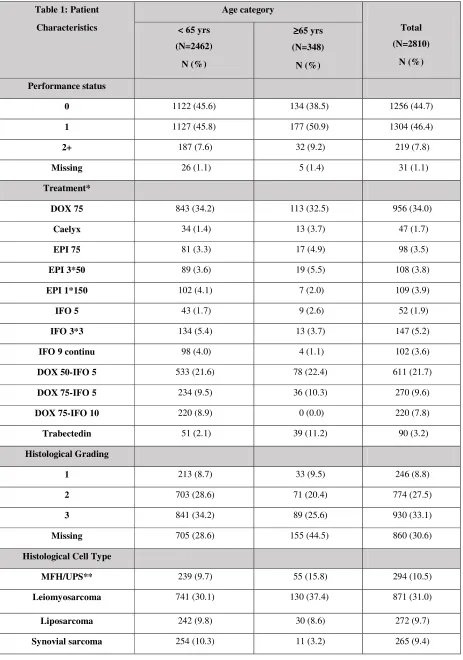
Patient Characteristics (Table 1)
primary site of disease, more than half of patients had pulmonary metastases (n=181, 52.0%), 63 patients (18.1%) had liver metastases, 24 patients (6.9%) bone metastases and 139 patients (39.9%) with metastases at ‘other’ sites.
Prior surgical details were missing for more than half of patients (n=194, 55.7%), however, of the remaining 154 patients with available data, 65 patients had received previous partial surgery, and 69 patients previous total surgery. Prior radiotherapy details were missing for 76 patients (21.8%), however, out of the remaining 272 patients, 71 patients (26%) had received prior radiotherapy. Overall, 126 (36%) patients were treated with first-line single-agent doxorubicin, 114 pts (33%) with combination doxorubicin and ifosfamide, 43 pts (12%) with epirubicin, 39 pts (11%) with trabectedin and 26 (7%) with single-agent ifosfamide.
Outcomes
The median follow-up time for elderly patients who were still alive at the time of their analyses was 9.5 months (IQR 6-25). Of note, the median follow-up time for patients treated with trabectedin who were still alive at the time of the clinical cut-off date was considerably shorter than for the other treatment groups (trabectedin 6.7 months (IQR 5.8-9.2) vs doxorubicin+ifosfamide 24 months (IQR 7-38), doxorubicin alone 14 months (IQR 5.5-29), epirubicin 24 months (IQR 8-43) and ifosfamide alone 4 months (IQR 3.5-16)). At the time of their respective analyses, 84 patients (24.1%) were alive and 264 patients (75.9%) were deceased.
Response Rates (Table 2)
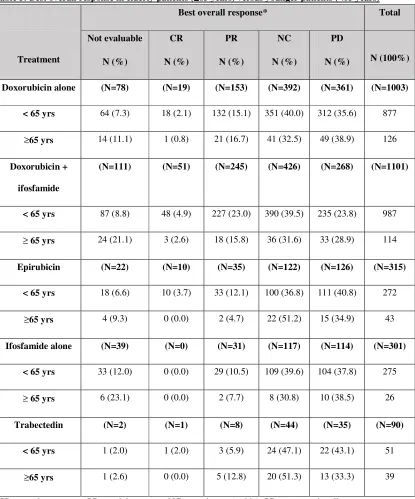
In total, 48 patients (13.8%) had a partial response and 4 patients (1.1%) had complete response. There were 127 patients (36.5%) with stable disease and 115 patients (33.0%) with progressive disease as best response. Response was not evaluable for 49 patients (14.1%). Radiological responses were primarily seen in patients treated with single-agent doxorubicin (n=22) or combination
Overall Survival (OS) (Table 3)
Median OS was 10.8 months (95% CI 9.4-11.8); for single agent doxorubicin 9.8 months (95% CI 7.4-11.5), and doxorubicin plus ifosfamide 12.1 months (95% CI 9.6-14.9), epirubicin 9.9 months (95% CI 5.9-11.8), single-agent ifosfamide 9.7 months (95% CI 2.9-14.4), trabectedin 17.3 months (95% CI 9.4-17.3). Due to the shorter follow-up in the trabectedin group there is some overestimation of overall survival in this group as compared to the other treatment groups. Median OS across
treatment groups at 3, 6 and 12 months respectively were 82.6%, 69.2% and 44.0%. Kaplan-Meier OS curves for all patients and according to treatment received are available as supplementary material.
Progression Free Survival (PFS) (Table 4)
Median PFS was 3.48 months (95% CI 2.76-4.27); doxorubicin 3.1 months (95% CI 2.1-4.1), doxorubicin plus ifosfamide 5.2 months (95% CI 3.1-6.4), epirubicin 3.8 months (95% CI 1.4-6.2), ifosfamide alone 2.2 months (95% CI 1.4-3.8), trabectedin 2.8 months (95% CI 1.6 – 5.8).
Older, elderly patients (aged ≥75 years)
There were 31 patients aged ≥75 years. Their median survival was 10.1 months (95% CI 4.8-13.0) and median PFS was 3.4 months (95% CI 1.4 – 5.5).
Comparison of elderly (≥65 years)) versus younger patients (<65 years) (Tables 5,6,7))
There were 2462 patients aged <65 years, who were treated in thirteen EORTC-STBSG trials of the same chemotherapy regimens described above. The median age of these patients was 49 years (IQR 39-57). Median follow-up was 46 months (IQR 29-72).
were most commonly histopathological grade 3 (34.2%) or grade 2 (28.6%), however tumour grading was missing for 705 patients (28.6%). As observed in elderly patients, the most common histological cell type in patients aged <65 years was leiomyosarcoma (n=741, 30.1%). The second most frequent histological subtype in younger patients was synovial sarcoma (n=254, 10.3%); only reported in 11 elderly patients (3.2%). MFH (UPS) was proportionally less common in patients aged <65 years compared with the elderly patient group (9.7% vs 15.8%). The frequency of liposarcoma was similar in both age groups (9.8% vs 8.5%).
The lung was the most common site of metastases in patients aged <65 years (57.6%). Liver
metastases were present with similar frequency in younger and elderly patients (17.1% vs 18.1%). A slightly higher proportion of younger patients had bone metastases compared with elderly patients (10.2% vs 6.9%). Rates of prior partial surgery (19.3%) and total surgery (19.6%) in younger patients were almost identical to elderly patients. As seen in the elderly patient group, very few patients had received prior radiotherapy; 20.4% younger vs 26.5% elderly patients.
Treatments received by patients aged <65 years (younger) are compared with treatments received by elderly patients; doxorubicin (36% younger vs 36% elderly), doxorubicin plus ifosfamide (40% younger vs 33% elderly), epirubicin (11% younger vs 12% elderly), ifosfamide alone (11% younger vs 7% elderly), trabectedin (2% younger vs 11% elderly).
those treated with combination doxorubicin plus ifosfamide (n=227, 23.0%). Table 5 summarises radiological responses in younger versus older patients according to treatment received.
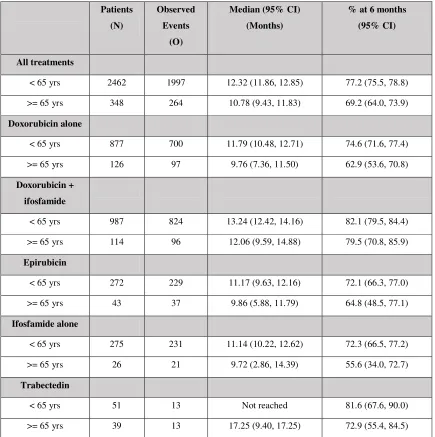
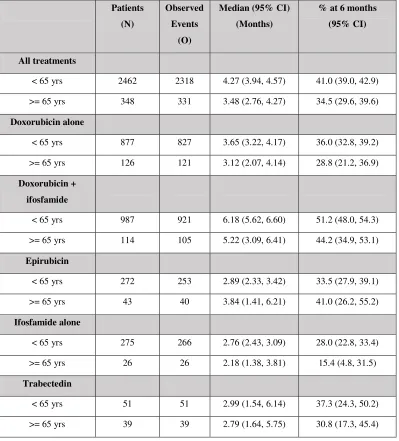
Median overall survival (OS) was better in younger patients (<65 years) compared with elderly patients (>65 years); median OS 12.3 months (95% CI 11.9 – 12.9) vs median OS of 10.8 months (95% CI 9.4-11.8) in elderly patients (Table 6). Younger patients had a slightly better median progression free survival compared with elderly patients: median PFS 4.3 months (95% CI 3.9-4.3) compared to 3.5 months (95% CI 2.8 – 4.3) for elderly patients (Table 7).
Discussion
Although almost half of patients diagnosed with STS are aged >65 years, elderly patients only represented 12% of participants in EORTC clinical trials of first-line chemotherapy for advanced STS.(15) Furthermore, the median age of elderly in these studies was 68 years, which is relatively low. This is concordant with previous studies which have shown that elderly cancer patients account for less than one quarter of all participants in clinical trials.(18)
As expected, most elderly patients had a performance status of 0 or 1 due to strict eligibility criteria required for clinical trials. Good performance status (0 or 1) is an independent predictive factor for overall survival.(19) Lung and liver metastases were present with similar frequency in elderly and younger patients. Liver metastases are associated with poor response rates and worse overall survival in advanced STS treated with anthracyclines. (19)
that low histological grade is associated with lower response rates in advanced STS patients treated with anthracycline chemotherapy and improved overall survival(19, 20) Histological subtypes differed according to age group; synovial sarcomas were more common in young patients and MFH (UPS) was more frequent among elderly patients. Synovial sarcoma is associated with improved survival in advanced STS patients treated with anthracyclines, and longer PFS in those treated with ifosfamide-containing regimens. (19, 20) Conversely, MFH (UPS) is associated with reduced overall survival in patients treated with anthracyclines. (19)
A minority of patients in this analysis had received prior radiotherapy. This is unexpected given that pre-or post-operative radiotherapy is now recommended for the majority of patients with intermediate or high-grade tumours.(21) These results may reflect inaccurate data recording, lack of adherence with guidelines and changes in practice over the last few decades.(22)
Overall, elderly patients had shorter overall survival than younger patients. There was also a trend towards shorter progression free survival and lower response rates. Despite favourable baseline characteristics, these results demonstrate that older age (>65 years) is an adverse prognostic factor for patients with advanced STS treated with first-line chemotherapy. In reality, the heterogeneity of an unselected elderly STS population encountered in clinical practice is not directly comparable with these patients. A previous single-institution, retrospective review of 120 elderly advanced STS (excluding GIST) patients treated with first-line chemotherapy, most commonly single-agent
care.(25) In this study, age ≥80 years, PS≥2 and number of metastatic sites were independent prognostic variables for OS.(25) The majority of patients received an anthracycline-based regime (63%) and patients were usually treated with single-agent chemotherapy (83%).(25)
Doxorubicin has been standard first-line chemotherapy for advanced STS since the 1970s, however, side-effects include myelosuppression, mucositis and cardiotoxicity. Empirical dose reductions are often used in patients who are ‘frail’ or have pre-existing comorbidities such as renal dysfunction, due to the risk of severe toxicity and hospitalisation. Previous studies have demonstrated a dose-response relationship with optimal anti-tumour activity at doses of ≥60mg/m2 (administered every three weeks) and reduced efficacy at lower levels.(26, 27) Older patients may therefore be disadvantaged due to suboptimal treatment.
The combination of doxorubicin and ifosfamide has been shown to provide higher response rates, however no improvement in overall survival and at the cost of increased toxicity.(21) In EORTC STBSG clinical trials (62842, 62851, 62883, 62903 trials) 114 elderly patients were treated with combination therapy (Dox+Ifo). These patients had a median OS of 12 months (95% CI 9.59-14.88) and PFS 5 months (95% CI 3.09-6.41). There is often a misconception that elderly patients do not tolerate chemotherapy, however these results demonstrate that even doublet chemotherapy can be used effectively in carefully selected patients
who received combination ifosfamide plus doxorubicin, which has a significantly higher response rate compared to single agent doxorubicin (16).
Determining which patients will tolerate chemotherapy is challenging. The ability of physicians to predict chemotherapy induced toxicity has been evaluated in lung cancer patients.(28) This group found that severe toxicity and successful completion of treatment were equally likely in patients who were deemed eligible for treatment.(28) They suggested that more detailed geriatric assessments are needed in order to predict those patients who are at risk of toxicity.(28) The effectiveness of such tools have been tested in other tumour groups. Mini-mental state examination (MMSE) and instrumental activities of daily living (IADL) were predictive of toxicity in elderly, metastatic colorectal cancer patients.(29) Comprehensive geriatric assessment (CGA) has been used in
metastatic breast cancer patients (aged ≥65 years) to predict grade 3-4 toxicity.(30) The International Society of Geriatric Oncology (SIOG) consensus has determined the ‘G8’ assessment as the most ‘robust, predictive/prognostic’ tool for outcome measures in elderly patients.(31) The EORTC-STBSG are now routinely incorporating the G8 assessment tool in their clinical trials.
Participants in research studies must be representative the population of interest.(5) With an ageing population, there is increasing need for clinical trials which are designed to assess the optimal pharmacotherapeutic strategies for elderly patients. The feasibility of metronomic oral
The challenge is to design trials which are not only for ‘elite’ older patients but consider the
heterogeneity of older patients. Although the median overall survival was inferior for elderly patients, response rates were similar, suggesting that elderly patients can derive benefit from standard
chemotherapy regimens which are routinely prescribed for younger patients. Although the patients described in this report were of good performance status, our data can provide a benchmark for designing future trials. Study designs should also consider tools which can accurately assess potential toxicity of treatments and enable stratification of patients. These trials should be done within a multidisciplinary team, including geriatricians and trained nursing staff to provide adequate support for patients. Given the marginal survival benefit of chemotherapy in advanced STS, clinical trials should also incorporate health-related quality of life (HRQoL) assessments as study endpoints. This data will enhance clinical decision making and enable clinicians to provide a holistic, evidence-based approach to the care of elderly patients.
Although there were few patients in these EORTC-STBSG clinical trials aged ≥75 years, their outcomes were similar to those aged ≥65 years. It is probable that these patients were highly selected ‘older-elderly’ individuals in order to meet eligibility criteria for these clinical trials. In a ‘real-life’ setting the METASARC observational study (n=2,165) reported that patients aged ≥75 years (n=279) were significantly less likely to receive any systemic treatment for metastatic disease and more likely to be offered best supportive care than those aged <75 years.(35) This French group attributed this finding to the general ‘reluctance’ of oncologists to prescribe anthracyclines to elderly patients in view of potential haematological and cardio-toxic effects these drugs in older patients with functional decline or co-morbid medical conditions.(35) The complex association of cellular senescence, ageing and cancer is outwith the scope of this paper.
Limitations
patients means that these results may not reflect outcomes in clinical practice. No details were available on treatments received on progression of disease. However, due to the limited availability of effective 2nd/3rd line treatment options, it is likely that all patients will have received similar
treatments. In addition, this database contains historical data from patients recruited in clinical trials from the 1980s and therefore results may be influenced by differences in concomitant standards of care.
Conclusion
Elderly patients with advanced STS have slightly worse outcomes than younger patients when treated with first line chemotherapy within clinical trials. In light of the ageing population, there is increasing need to design studies which specifically evaluate treatments in elderly patients, not only those with favourable characteristics. The results of this analysis can help in the design of future trials,
incorporating geriatric tools to stratify patients and assess risk, and including health-related quality of life as endpoints.
Conflicts of Interest
The authors declare that there are no conflicts of interest regarding the publication of this paper.
Acknowledgements
This research was supported by the EORTC Cancer Research Fund and the Biomedical Research
References
1. World Health Organisation. World Health Statistics 2016: Monitoring Health for Sustainable Health Goals. http://www.who.int/gho/publications/world_health_statistics/2016/en/ (accessed 1/3/17)
2. Terret C, Zulian GB, Naiem A et al. Multidisciplinary approach to the geriatric oncology patient. J Clin Oncol. 2007;25(14):1876-81.
3. Berger NA, Savvides P, Koroukian SM et al. Cancer in the elderly. Trans Am Clin Climatol Assoc. 2006;117:147-55; discussion 55-6.
4. Balducci L. Studying cancer treatment in the elderly patient population. Cancer Control. 2014;21(3):215-20.
5. Townsley CA, Selby R, Siu LL. Systematic review of barriers to the recruitment of older patients with cancer onto clinical trials. J Clin Oncol. 2005;23(13):3112-24.
6. Knechel NA. The challenges of enrolling older adults into intervention studies. Yale J Biol Med. 2013;86(1):41-7.
7. Burningham Z, Hashibe M, Spector L et al. The epidemiology of sarcoma. Clin Sarcoma Res. 2012;2(1):14.
8. Coindre JM, Terrier P, Guillou L et al. Predictive value of grade for metastasis development in the main histologic types of adult soft tissue sarcomas: a study of 1240 patients from the French
Federation of Cancer Centers Sarcoma Group. Cancer. 2001;91(10):1914-26.
9. Benjamin RS, Wiernik PH, Bachur NR. Adriamycin: a new effective agent in the therapy of disseminated sarcomas. Med Pediatr Oncol. 1975;1(1):63-76.
10. Blay JY, van Glabbeke M, Verweij J et al. Advanced soft-tissue sarcoma: a disease that is potentially curable for a subset of patients treated with chemotherapy. Eur J Cancer. 2003;39(1):64-9. 11. Schroyen S, Adam S, Jerusalem G et al. Ageism and its clinical impact in oncogeriatry: state of knowledge and therapeutic leads. Clin Interv Aging. 2015;10:117-25.
13. Tap WD, Jones RL, Van Tine BA et al. Olaratumab and doxorubicin versus doxorubicin alone for treatment of soft-tissue sarcoma: an open-label phase 1b and randomised phase 2 trial. Lancet. 2016;388(10043):488-97.
14. Howlader N, Krapcho M, Miller D et al. SEER Cancer Statistics Review 1975-2014. National Cancer Institute, Bethesda. Availale from:
https://seer.cancer.gov/faststats/selections.php?run=runit&output=2&data=1&statistic=1&ca ncer=51&year=201703&race=1&sex=1&series=age&age=6;157 (accessed 1.3.18)
15. Nijhuis PH, Schaapveld M, Otter R et al. Epidemiological aspects of soft tissue sarcomas (STS)--consequences for the design of clinical STS trials. Eur J Cancer. 1999;35(12):1705-10.
16. Judson I, Verweij J, Gelderblom H et al. Doxorubicin alone versus intensified doxorubicin plus ifosfamide for first-line treatment of advanced or metastatic soft-tissue sarcoma: a randomised controlled phase 3 trial. Lancet Oncol. 2014;15(4):415-23.
17. Tap WD, Papai Z, Van Tine BA et al. Doxorubicin plus evofosfamide versus doxorubicin alone in locally advanced, unresectable or metastatic soft-tissue sarcoma (TH CR-406/SARC021): an
international, multicentre, open-label, randomised phase 3 trial. Lancet Oncol. 2017;18(8):1089-103. 18. Aapro MS, Kohne CH, Cohen HJ et al. Never too old? Age should not be a barrier to enrollment in cancer clinical trials. Oncologist. 2005;10(3):198-204.
19. Van Glabbeke M, van Oosterom AT, Oosterhuis JW et al. Prognostic factors for the outcome of chemotherapy in advanced soft tissue sarcoma: an analysis of 2,185 patients treated with
anthracycline-containing first-line regimens--a European Organization for Research and Treatment of Cancer Soft Tissue and Bone Sarcoma Group Study. J Clin Oncol. 1999;17(1):150-7.
21. Dangoor A, Seddon B, Gerrand C et al. UK guidelines for the management of soft tissue sarcomas. Clin Sarcoma Res. 2016;6:20.
22. Bagaria SP, Ashman JB, Daugherty LC et al. Compliance with National Comprehensive Cancer Network guidelines in the use of radiation therapy for extremity and superficial trunk soft tissue sarcoma in the United States. J Surg Oncol. 2014;109(7):633-8.
23. Yousaf N, Harris S, Martin-Liberal J et al. First line palliative chemotherapy in elderly patients with advanced soft tissue sarcoma. Clin Sarcoma Res. 2015;5:10.
24. Comandone A, Boglione A, Guibellino E et al. Metastatic Soft Tissue Sarcomas in Elderly Patients: 18 Years of Monoinstitutional Experience. Clin Oncol. 2017;2:1231.
25. Garbay D, Maki RG, Blay JY et al. Advanced soft-tissue sarcoma in elderly patients: patterns of care and survival. Ann Oncol. 2013;24(7):1924-30.
26. O'Bryan RM, Baker LH, Gottlieb JE et al. Dose response evaluation of adriamycin in human neoplasia. Cancer. 1977;39(5):1940-8.
27. Toma S, Palumbo R, Sogno G et al. Doxorubicin (or epidoxorubicin) combined with ifosfamide in the treatment of adult advanced soft tissue sarcomas. Ann Oncol. 1992;3 Suppl 2:S119-23.
28. Zauderer MG, Sima CS, Korc-Grodzicki B et al. Toxicity of initial chemotherapy in older patients with lung cancers. J Geriatr Oncol. 2013;4(1):64-70.
29. Aparicio T, Jouve JL, Teillet L et al. Geriatric factors predict chemotherapy feasibility: ancillary results of FFCD 2001-02 phase III study in first-line chemotherapy for metastatic colorectal cancer in elderly patients. J Clin Oncol. 2013;31(11):1464-70.
30. Hamaker ME, Seynaeve C, Wymenga AN et al. Baseline comprehensive geriatric assessment is associated with toxicity and survival in elderly metastatic breast cancer patients receiving single-agent chemotherapy: results from the OMEGA study of the Dutch breast cancer trialists' group. Breast. 2014;23(1):81-7.
32. Mir O, Domont J, Cioffi A et al. Feasibility of metronomic oral cyclophosphamide plus prednisolone in elderly patients with inoperable or metastatic soft tissue sarcoma. Eur J Cancer. 2011;47(4):515-9.
33. Karch A, Koch A, Grunwald V. A phase II trial comparing pazopanib with doxorubicin as first-line treatment in elderly patients with metastatic or advanced soft tissue sarcoma (EPAZ): study protocol for a randomized controlled trial. Trials. 2016;17(1):312.
34. Kasper B, Reichardt P, Schuler M et al. Geriatric assessment of elderly chemotherapy-naive patients treated with trabectedin for advanced soft tissue sarcomas (STS): The E-TRAB study of the German Interdisciplinary Sarcoma Group (GISG-13). Annals of Oncology. 2017;28.
Table 1: Patient Characteristics Age category Total (N=2810) N (%) < 65 yrs
(N=2462) N (%) ≥ ≥ ≥ ≥65 yrs (N=348) N (%) Performance status
0 1122 (45.6) 134 (38.5) 1256 (44.7)
1 1127 (45.8) 177 (50.9) 1304 (46.4)
2+ 187 (7.6) 32 (9.2) 219 (7.8)
Missing 26 (1.1) 5 (1.4) 31 (1.1)
Treatment*
DOX 75 843 (34.2) 113 (32.5) 956 (34.0)
Caelyx 34 (1.4) 13 (3.7) 47 (1.7)
EPI 75 81 (3.3) 17 (4.9) 98 (3.5)
EPI 3*50 89 (3.6) 19 (5.5) 108 (3.8)
EPI 1*150 102 (4.1) 7 (2.0) 109 (3.9)
IFO 5 43 (1.7) 9 (2.6) 52 (1.9)
IFO 3*3 134 (5.4) 13 (3.7) 147 (5.2)
IFO 9 continu 98 (4.0) 4 (1.1) 102 (3.6)
DOX 50-IFO 5 533 (21.6) 78 (22.4) 611 (21.7)
DOX 75-IFO 5 234 (9.5) 36 (10.3) 270 (9.6)
DOX 75-IFO 10 220 (8.9) 0 (0.0) 220 (7.8)
Trabectedin 51 (2.1) 39 (11.2) 90 (3.2)
Histological Grading
1 213 (8.7) 33 (9.5) 246 (8.8)
2 703 (28.6) 71 (20.4) 774 (27.5)
3 841 (34.2) 89 (25.6) 930 (33.1)
Missing 705 (28.6) 155 (44.5) 860 (30.6)
Histological Cell Type
MFH/UPS** 239 (9.7) 55 (15.8) 294 (10.5)
Leiomyosarcoma 741 (30.1) 130 (37.4) 871 (31.0)
Liposarcoma 242 (9.8) 30 (8.6) 272 (9.7)
* DOX 75 (doxorubicin 75mg/m2), Caelyx (caelyx 35mg/m2), EPI 75 (epirubicin 75mg/m2) EPI 3*50
(epirubicin 50mg/m2 [days 1-3]), EPI 1*150 (epirubicin 150mg/m2), IFO 5 (ifosfamide 5 mg/m2), IFO 3*3
(ifosfamide 3mg/ m2 [days 1-3]) IFO 9 continu (ifosfamide 9 mg/m2 [continuous infusion over 72 hours]))
DOX 50-IFO 5 (doxorubicin 50mg/m2 - ifosfamide 5 mg/m2), DOX 75-IFO 5 (doxorubicin 75 mg/m2 - ifosfamide 5 mg/m2) DOX 75 – IFO 10 (doxorubicin 75 mg/m2 - ifosfamide 10 mg/m2), TRAB (1.3 mg/m², 3 hrs infusion or 1.5 mg/m², 24 hrs infusion).
**MFH/UPS –Malignant fibrous histiocytoma (now reclassified as undifferentiated pleomorphic sarcoma)
*** MPNST – Malignant peripheral nerve sheath tumour
Fibrosarcoma 74 (3.0) 12 (3.4) 86 (3.1)
Rhabdomyosarcoma 56 (2.3) 3 (0.9) 59 (2.1)
Angiosarcoma 78 (3.2) 12 (3.4) 90 (3.2)
MPNST*** 127 (5.2) 7 (2.0) 134 (4.8)
Miscellaneous 398 (16.2) 45 (12.9) 443 (15.8)
Unclassified 160 (6.5) 21 (6.0) 181 (6.4)
Missing 93 (3.8) 22 (6.3) 115 (4.1)
Prior Surgery
No 213 (8.7) 20 (5.7) 233 (8.3)
Partial 474 (19.3) 65 (18.7) 539 (19.2)
Total 482 (19.6) 69 (19.8) 551 (19.6)
Missing 1293 (52.5) 194 (55.7) 1487 (52.9)
Prior radiotherapy
No 1677 (68.1) 201 (57.8) 1878 (66.8)
Yes 675 (27.4) 71 (20.4) 746 (26.5)
Missing 110 (4.5) 76 (21.8) 186 (6.6)
Site (s) of Disease involvement
Primary site involved 1076 (43.7) 167 (48.0) 1243 (44.2)
Bone metastases 252 (10.2) 24 (6.9) 276 (9.8)
Liver metastases 420 (17.1) 63 (18.1) 483 (17.2)
Lung metastases 1417 (57.6) 181 (52.0) 1598 (56.9)
Table 2: Best overall response elderly patients (all treatments)
Best Overall
Response
Treatment Received
Total
(N=348)
N (%) Doxorubicin
alone
(N=126)
N (%)
Doxorubicin+
ifosfamide
(N=114)
N (%)
Epirubicin
(N=43)
N (%)
Ifosfamide
alone
(N=26)
N (%)
Trabectedin
(N=39)
N (%)
Complete Response 1 (0.8) 3 (2.6) 0 (0.0) 0 (0.0) 0 (0.0) 4 (1.1)
Partial Response 21 (16.7) 18 (15.8) 2 (4.7) 2 (7.7) 5 (12.8) 48 (13.8)
Stable Disease 41 (32.5) 36 (31.6) 22 (51.2) 8 (30.8) 20 (51.3) 127 (36.5)
Progressive Disease 49 38.9) 33 (28.9) 15 (34.9) 10 (38.5) 13 (33.3) 115 (33.0)
Not evaluable 14 (11.1) 24 (21.1) 4 (9.3) 6 (23.1) 1 (2.6) 49 (14.1)
Survival status
Alive 29 (23.0) 18 (15.8) 6 (14.0) 5 (19.2) 26 (66.7) 84 (24.1)
Dead 97 (77.0) 96 (84.2) 37 (86.0) 21 (80.8) 13 (33.3) 264 (75.9)
PFS status*
Censored 5 (4.0) 9 (7.9) 3 (7.0) 0 (0.0) 0 (0.0) 17 (4.9)
Event 121 (96.0) 105 (92.1) 40 (93.0) 26 (100.0) 39 (100.0) 331 (95.1)
Table 3: Overall survival elderly patients (all treatments)
Treatment
Patients
(N)
Observ.
Events*
(O)
Median OS
(95% CI)
(Months)
% alive at 3
months
(95% CI)
% alive at 6
months
(95% CI)
% alive
at 1 Year
(95% CI)
Doxorubicin
alone
126 97 9.76 (7.36,11.50) 83.1 (75.3,88.6) 62.9 (53.6,70.8) 40.1 (31.1, 49.0)
Doxorubicin
+ ifosfamide
114 96 12.06 (9.59,14.88) 87.6 (80.0,92.5) 79.5 (70.8,85.9) 51.8 (42.0, 60.7)
Epirubicin 43 37 9.86 (5.88,11.79) 74.4 (58.5,84.9) 64.8 (48.5,77.1) 35.3 (21.2, 49.7)
Ifosfamide
alone
26 21 9.72 (2.86,14.39) 69.2 (47.8,83.3) 55.6 (34.0,72.7) 32.5 (14.8, 51.6)
Trabectedin 39 13 17.25 (9.40,17.25) 84.5 (68.6,92.7) 72.9 (55.4,84.5) 60.6 (37.0, 77.7)
All 348 264 10.78 (9.43,11.83) 82.6 (78.2,86.2) 69.2 (64.0,73.9) 44.0 (38.3, 49.5)
Table 4: Progression free survival elderly patients (all treatments)
Treatment Patients
(N) Observ. Events* (O) Median PFS (95% CI) (Months)
% at 3 months
(95% CI)
% at 6 months
(95% CI)
% at 1 Year
(95% CI)
Doxorubicin
alone
126 121 3.12
(2.07,4.14) 50.4 (41.4,58.8) 28.8 (21.2,36.9) 12.0 (7.1,18.4) Doxorubicin + ifosfamide
114 105 5.22
(3.09,6.41) 61.3 (51.7,69.6) 44.2 (34.9,53.1) 21.8 (14.6,30.0)
Epirubicin 43 40 3.84
(1.41,6.21) 50.7 (34.9,64.5) 41.0 (26.2,55.2) 8.4 (2.3,19.8) Ifosfamide alone
26 26 2.18
(1.38,3.81) 38.5 (20.4,56.3) 15.4 (4.8,31.5) 3.9 (0.3,16.4)
Trabectedin 39 39 2.79
(1.64,5.75) 48.7 (32.5,63.2) 30.8 (17.3,45.4) 5.1 (0.9,15.2)
All 348 331 3.48
(2.76,4.27) 52.9 (47.5,58.0) 34.5 (29.6,39.6) 13.4 (10.0,17.2)
Table 5: Best overall response in elderly patients (≥≥≥≥65 years) versus younger patients (<65 years)
Treatment
Best overall response* Total
Not evaluable
N (%)
CR
N (%)
PR
N (%)
NC
N (%)
PD
N (%) N (100%)
Doxorubicin alone (N=78) (N=19) (N=153) (N=392) (N=361) (N=1003)
< 65 yrs 64 (7.3) 18 (2.1) 132 (15.1) 351 (40.0) 312 (35.6) 877
≥65 yrs 14 (11.1) 1 (0.8) 21 (16.7) 41 (32.5) 49 (38.9) 126
Doxorubicin +
ifosfamide
(N=111) (N=51) (N=245) (N=426) (N=268) (N=1101)
< 65 yrs 87 (8.8) 48 (4.9) 227 (23.0) 390 (39.5) 235 (23.8) 987
≥ 65 yrs 24 (21.1) 3 (2.6) 18 (15.8) 36 (31.6) 33 (28.9) 114
Epirubicin (N=22) (N=10) (N=35) (N=122) (N=126) (N=315)
< 65 yrs 18 (6.6) 10 (3.7) 33 (12.1) 100 (36.8) 111 (40.8) 272
≥65 yrs 4 (9.3) 0 (0.0) 2 (4.7) 22 (51.2) 15 (34.9) 43
Ifosfamide alone (N=39) (N=0) (N=31) (N=117) (N=114) (N=301)
< 65 yrs 33 (12.0) 0 (0.0) 29 (10.5) 109 (39.6) 104 (37.8) 275
≥ 65 yrs 6 (23.1) 0 (0.0) 2 (7.7) 8 (30.8) 10 (38.5) 26
Trabectedin (N=2) (N=1) (N=8) (N=44) (N=35) (N=90)
< 65 yrs 1 (2.0) 1 (2.0) 3 (5.9) 24 (47.1) 22 (43.1) 51
≥65 yrs 1 (2.6) 0 (0.0) 5 (12.8) 20 (51.3) 13 (33.3) 39
Table 6. Overall survival: Comparison elderly (≥≥≥65 years) versus younger (<65) patients ≥
Patients
(N)
Observed
Events
(O)
Median (95% CI)
(Months)
% at 6 months
(95% CI)
All treatments
< 65 yrs 2462 1997 12.32 (11.86, 12.85) 77.2 (75.5, 78.8)
>= 65 yrs 348 264 10.78 (9.43, 11.83) 69.2 (64.0, 73.9)
Doxorubicin alone
< 65 yrs 877 700 11.79 (10.48, 12.71) 74.6 (71.6, 77.4)
>= 65 yrs 126 97 9.76 (7.36, 11.50) 62.9 (53.6, 70.8)
Doxorubicin +
ifosfamide
< 65 yrs 987 824 13.24 (12.42, 14.16) 82.1 (79.5, 84.4)
>= 65 yrs 114 96 12.06 (9.59, 14.88) 79.5 (70.8, 85.9)
Epirubicin
< 65 yrs 272 229 11.17 (9.63, 12.16) 72.1 (66.3, 77.0)
>= 65 yrs 43 37 9.86 (5.88, 11.79) 64.8 (48.5, 77.1)
Ifosfamide alone
< 65 yrs 275 231 11.14 (10.22, 12.62) 72.3 (66.5, 77.2)
>= 65 yrs 26 21 9.72 (2.86, 14.39) 55.6 (34.0, 72.7)
Trabectedin
< 65 yrs 51 13 Not reached 81.6 (67.6, 90.0)
Table 7. Progression free survival: Comparison elderly (≥≥≥≥65 years) versus younger (<65) patients
Patients
(N)
Observed
Events
(O)
Median (95% CI)
(Months)
% at 6 months
(95% CI)
All treatments
< 65 yrs 2462 2318 4.27 (3.94, 4.57) 41.0 (39.0, 42.9)
>= 65 yrs 348 331 3.48 (2.76, 4.27) 34.5 (29.6, 39.6)
Doxorubicin alone
< 65 yrs 877 827 3.65 (3.22, 4.17) 36.0 (32.8, 39.2)
>= 65 yrs 126 121 3.12 (2.07, 4.14) 28.8 (21.2, 36.9)
Doxorubicin +
ifosfamide
< 65 yrs 987 921 6.18 (5.62, 6.60) 51.2 (48.0, 54.3)
>= 65 yrs 114 105 5.22 (3.09, 6.41) 44.2 (34.9, 53.1)
Epirubicin
< 65 yrs 272 253 2.89 (2.33, 3.42) 33.5 (27.9, 39.1)
>= 65 yrs 43 40 3.84 (1.41, 6.21) 41.0 (26.2, 55.2)
Ifosfamide alone
< 65 yrs 275 266 2.76 (2.43, 3.09) 28.0 (22.8, 33.4)
>= 65 yrs 26 26 2.18 (1.38, 3.81) 15.4 (4.8, 31.5)
Trabectedin
< 65 yrs 51 51 2.99 (1.54, 6.14) 37.3 (24.3, 50.2)
Summary of EORTC-STBSG Clinical Trials: Elderly Patients per Protocol (Appendix) EORTC Study Elderly patients(n) References
62801 41 Mouridsen HT, Bastholt L, Somers Rt et al. Adriamycin versus epirubicin in advanced soft tissue sarcomas. A randomized phase II/phase III study of the EORTC Soft Tissue and Bone Sarcoma Group. Eur J Cancer Clin Oncol. 1987
Oct;23(10):1477-83
62842 16 Schütte J, Mouridsen HT, Stewart W et al. Ifosfamide plus doxorubicin in previously untreated patients with advanced soft tissue sarcoma. The EORTC Soft Tissue and Bone Sarcoma Group. Eur J Cancer. 1990;26(5):558-61.
62851 66 Santoro A, Tursz T, Mouridsen H et al. Doxorubicin versus CYVADIC versus doxorubicin plus ifosfamide in first-line treatment of advanced soft tissue sarcomas: a randomized study of the European Organization for Research and Treatment of Cancer Soft Tissue and Bone Sarcoma Group. J Clin Oncol. 1995 Jul;13(7):1537-45.
62883 14 Steward WP, Verweij J, Somers R et al. Doxorubicin plus ifosfamide with rhGM-CSF in the treatment of advanced adult soft-tissue sarcomas: preliminary results of a phase II study from the EORTC Soft-Tissue and Bone Sarcoma Group. J Cancer Res Clin Oncol. 1991;117 Suppl 4:S193-7.
62901 40 Nielsen OS, Dombernowsky P, Mouridsen H et al. High-dose epirubicin is not an alternative to standard-dose doxorubicin in the treatment of advanced soft tissue sarcomas. A study of the EORTC soft tissue and bone sarcoma group. Br J Cancer. 1998 Dec;78(12):1634-9.
62903 45 Le Cesne A, Judson I, Crowther D et al. Randomized phase III study comparing conventional-dose doxorubicin plus ifosfamide versus high-dose doxorubicin plus ifosfamide plus recombinant human granulocyte-macrophage colony-stimulating factor in advanced soft tissue sarcomas: A trial of the European Organization for Research and Treatment of Cancer/Soft Tissue and Bone Sarcoma Group. J Clin Oncol. 2000 Jul;18(14):2676-84.
62912 19 van Oosterom AT, Mouridsen HT, Nielsen OS et al. Results of randomised studies of the EORTC Soft Tissue and Bone Sarcoma Group (STBSG) with two different ifosfamide regimens in first- and second-line chemotherapy in advanced soft tissue sarcoma patients. Eur J Cancer. 2002 Dec;38(18):2397-406
62941 4 Verweij J, Lee SM, Ruka W et al. Randomized phase II study of docetaxel versus doxorubicin in first- and second-line chemotherapy for locally advanced or metastatic soft tissue sarcomas in adults: a study of the european organization for research and treatment of cancer soft tissue and bone sarcoma group. J Clin Oncol. 2000 May;18(10):2081-6.
62962 22 Judson I, Radford JA, Harris M et al. Randomised phase II trial of pegylated liposomal doxorubicin (DOXIL/CAELYX) versus doxorubicin in the treatment of advanced or metastatic soft tissue sarcoma: a study by the EORTC Soft Tissue and Bone Sarcoma Group. Eur J Cancer. 2001 May;37(7):870-7.
62971 7 Lorigan P, Verweij J, Papai Z, et al. Phase III trial of two investigational schedules of ifosfamide compared with standard-dose doxorubicin in advanced or metastatic soft tissue sarcoma: a European Organisation for Research and Treatment of Cancer Soft Tissue and Bone Sarcoma Group Study. J Clin Oncol. 2007 Jul 20;25(21):3144-50
62061 20 Gelderblom H, Blay JY, Seddon BM et al. Brostallicin versus doxorubicin as first-line chemotherapy in patients with advanced or metastatic soft tissue sarcoma: an European Organisation for Research and Treatment of Cancer Soft Tissue and Bone Sarcoma Group randomised phase II and pharmacogenetic study. Eur J Cancer. 2014 Jan;50(2):388-96.
62091 54 Bui-Nguyen B, Butrynski JE, Penel N et al. A phase IIb multicentre study comparing the efficacy of trabectedin to doxorubicin in patients with advanced or metastatic untreated soft tissue sarcoma: the TRUSTS trial. Eur J Cancer. 2015
Jul;51(10):1312-20.