DOI: 10.30954/2249-6637.02.2019.2 ©2019 IJSS. All rights reserved
Assessment of Efficacies of Different Skill Development
Training Methods Organized by Rathindra KVK,
Visva-Bharati
Prabuddha Ray
1* and Subrata Mandal
21Subject Matter Specialist (Agricultural Extension), Rathindra Krishi Vigyan Kendra, Palli Siksha Bhavana (Institute of Agriculture), Visva-Bharati, Sriniketan, Sriniketan, West Bengal, India
2Programme Coordinator (Officiating) and Subject Matter Specialist (Agronomy), Rathindra Krishi Vigyan Kendra, Palli Siksha Bhavana (Institute of Agriculture), Visva-Bharati, Sriniketan, West Bengal, India
*Corresponding author: [email protected]
ABSTRACT
Training is one of the basic intellectual investment needed for Human Resource Development and as well as empowerment of a targeted clientele. Training as a systemic knowledge and skill enhancement and rejuvenation technique has been widely accepted by the Development Support Workers all over the world from very ancient times. However, the efficacy of any Training Programme depends on a multiple of factors both intrinsic and extrinsic in nature. The Training Methods refer to a combination of various instructional media used for conducting the Training to achieve the learning objective efficiently and effectively. The selection of suitable Training Methods is largely influenced by the Training Objectives, Subject Matter handled, participants’ nature, resources availability such as Time, Location and Budget, Organizational considerations and Trainers’ capability. The choice of the Training Method will also depend upon whether the Training is intended to develop a general or specific level of knowledge and skill. The participants’ learning style, their experience and size of the group are also some of the factors that are to be kept in mind while deciding upon the Training Methods. Keeping this background in mind, the present author and Scientist of the Rathindra Krishi Vigyan Kendra has decided to evaluate the efficacy of different Training Methods for Skill Development Trainings organized by the Kendra in two consecutive years i.e. 2016-17 and 2017-18. Here, this will be relevant to mention that the Rathindra KVK itself utilizes various Training Methodologies in its skill development training programmes. So, evaluating the efficacy of various Training Methods is in dire need. This becomes more of importance as the selection of appropriate Training Methods is important for an effective learning of the targeted Trainees. The selected trainees are from the same Category i.e. Scheduled Tribe (ST) and marginal farmers. Six Groups of the selected Trainees, each of 10 (Ten) farmers in numbers have undergone the six different types of Training Methodology viz. (i) Lecture Method; (ii) Group Discussion Method; (iii) Case Study Method; (iv) Field Visits Method; (v) Demonstration Method and (vi) Experiential Learning Method on the same Skill Development Training Topic and Training programme i.e. High Value Winter Vegetable Cultivation in the Financial Years of 2016-17 and 2017-18. The Trainee farmers ranked the Training Methods according to their own perception on various aspects of performance indicators of different training methods. In both the above mentioned Years, the Experiential Learning Training Method holds the First Rank in all the Performance Indicator Parameters as well as in the overall performance for assessing the efficacy of the different Training methods distantly followed by Demonstration Method and Field Visit Method in the second and third places respectively. The Experiential training Method may be the most appropriate Training Method for Skill Development Training because it provides a kind of experience which may easily lead participant trainees from the point of participation to reflection, draw conclusion and identify application points through hands-on approach.
Training is one of the basic intellectual investment needed for Human Resource Development and as well as empowerment of a targeted clientele. Training as a systemic knowledge and skill enhancement and rejuvenation technique has been widely accepted by the Development Support Workers all over the world from very ancient times. However, the efficacy of any Training Programme depends on a multiple of factors both intrinsic and extrinsic in nature.
One of the critical issues related to the success of any Training Programme is the very choice of a particular Training Method for a specific group of trainees. This is of more relevance in case of skill development training programmes where the main objective is to impart a specific or a set of skills into the trainees’ cognitive domain. However, the challenge before any skill development programme to be successful is to orient the cognitive processes of the trainees’ into an
action-oriented paradigm in which there will perfect or near perfect cognitive synergy between the view of the mind and the practice.
Though the emphasis of the majority of the skill development training programmes is on “action”, however the skill development training paradigm is well-suited to address real-world problems while advancing fundamental understanding. As Skill Trainings have the real-world impacts which entails social risk; therefore, to be ethical, Training Programmes in action-oriented cognition should be performed openly and in dialogue with the wider public, especially with the clientele, in this case trainees.
The action-oriented paradigm in Training Methodologies is emerging alongside a broader movement towards a more contextualized, pragmatic, and socially distributive programme. The synergy between the view of the mind as practice and the practice of the science of mind are to be complimented in the development of a new, robust, and socially useful understanding of the Skill Development Training Programme through which scientific insights can connect with broader intellectual traditions and refocus on societal and economic impact.
The Training Methods refer to a combination of various instructional media used for conducting the Training to
achieve the learning objective efficiently and effectively. The selection of suitable Training Methods is largely influenced by the Training Objectives, Subject Matter handled, participants’ nature, resources availability such as Time, Location and Budget, Organizational considerations and Trainers’ capability. The choice of the Training Method will also depend upon whether the Training is intended to develop a general or specific level of knowledge and skill. The participants learning style, their experience and size of the group are also some of the factors that are to be kept in mind while deciding upon the Training Methods.
Keeping this background in mind, the present author and Scientist of the Rathindra Krishi Vigyan Kendra has decided to evaluate the efficacy of different Training Methods for Skill Development Trainings organized by the Kendra in two consecutive years i.e. 2016-17 and 2017-18. Here, this will be relevant to mention that the Rathindra KVK itself utilizes various Training Methodologies in its skill development training programmes. So, evaluating the efficacy of various Training Methods is in dire need. This becomes more of importance as the selection of appropriate Training Methods is important for an effective learning of the targeted Trainees.
Objective of the Study
1. Evaluation of the efficacies of the Training Methods viz. (i) Lecture Method; (ii) Group Discussion Method; (iii) Case Study Method; (iv) Field Visits Method; (v) Demonstration Method and (vi) Experiential Learning Methodwith respect to selected performance indicators viz. (a) level of participation, (b) level of understanding, (c) level of knowledge gain, (d) degree of decision making skill, (e) degree of application skill, (f) degree of problem solving skill and (g) degree of proper concluding skill acquired by the participating trainees attending specific trainings under the Study.
Methodology
different type of Training Methodology on the same Skill Development Training Topic and Training programme i.e. High Value Winter Vegetable Cultivation. The Trainee farmers ranked the Training Methods according to their own perception on various aspects of performance indicators viz. (a) level of participation, (b) level of understanding, (c) level of knowledge gain, (d) degree of decision making skill, (e) degree of application skill, (f) degree of problem solving skill and (g) degree of proper concluding skill acquired by the participating trainees in the Financial Years of 2016-17 and 2017-18.
The indicators of efficacies of the Skill Development Training Programme were measured through the following process
(a) Level of extension participation was measured through Extension Participation Index according to the Trainees’ Perception.
Extension participation refers to the extent of involvement by the farmers in different extension activities conducted by the different extension agencies. The extension participation was measured with the help of scale developed by Siddarmaiah and Jalihal (1983), also used by Singh (2015). Extension participation index was calculated by using the following formula:
Extension participation index =
Actual total score values 100 Possible total scale values×
(b) Level of understanding was measured through the Understanding Index according to the Trainees’ Perception.
In the present study, understanding refers to the “degree of easiness in utilizing the knowledge possessed by the selected trainee farmers participated in the Skill Development Training Topic and Training programme regarding High Value Winter Vegetable Cultivation. All the important operations for a vegetable crop cultivation including the additional aspect were selected based on the judgment of specialists. The responses were collected in three continuum scales i.e. “totally”, “partially” and “not at all”. The weightages given to these were ‘2’, ‘1’
and ‘0’, respectively. Total understanding index of each respondent was obtained by adding the respective scores for each item. A understanding index was worked out to assess the level of understanding of each respondent about High Value Winter Vegetable Cultivation activities with the help of following equation:
Understanding index = Total score obtained 100 Maximum possible score×
(c) Level of knowledge gain was measured using the Knowledge Index according to the Trainees’ Perception. In the present study, knowledge refers to the “knowledge possessed by the selected trainee farmers participated in the Skill Development Training Topic and Training programme regarding High Value Winter Vegetable Cultivation. All the important operations for a vegetable crop cultivation including the additional aspect were selected based on the judgment of specialists. The responses were collected in three continuum scales i.e. “correct”, “partially correct” and “incorrect”. The weightages given to these were ‘2’, ‘1’ and ‘0’, respectively. Total knowledge of each respondent was obtained by adding the respective scores for each item. A knowledge index was worked out to assess the level of knowledge of each respondent about High Value Winter Vegetable Cultivation activities with the help of following equation as used by Singh (2015):
Knowledge index = Maximum possible scoreTotal score obtained ×100
(d) Degree of decision making skill acquired by the Trainees was tested through Viva-Voce Examination of the Trainees and expressed in Percentage of Marks. The Viva-Voce Examination was conducted at the end of the aforesaid Skill Development Training Programme with the help of a standard set of questions set in consultation with the experts and applied uniformly over the sixty numbers of the participants.
Skill Development Training Programme with the help of a standard set of questions set in consultation with the experts and applied uniformly over the sixty numbers of the participants.
(f) Degree of problem solving skill acquired by the Trainees was tested through Practical Examination (100 Marks) + Theoretical Examination (100 Marks) of the Trainees and expressed as the Percentage of Marks. Both the Practical and Theoretical Examinations were conducted at the end of the aforesaid Skill Development Training Programme with the help of standard sets of question s set in consultation with the experts and applied uniformly over the sixty numbers of the participants.
(g) Degree of proper concluding skill of the trainees was tested through Theoretical Examination of 100 Marks and it was also expressed as Percentage of Marks. The Theoretical Examination was conducted at the end of the aforesaid Skill Development Training Programme with the help of a standard set of question set in consultation
with the experts and applied uniformly over the sixty numbers of the participants.
Then Average of the Summative Total Score of each separate Indicator for the selected 60 numbers of the trainees on 100 Point Scale was calculated and Rank ordered.
RESULTS AND DISCUSSION
Generally the Lecture Method for Skill Development Training is being employed by the Scientists of the Rathindra Krishi Vigyan Kendra where a “Lecture” consisting of oral presentation of the subject matter along with the help of visual as well audio-visual aids such as black board, Over-head Projector, slides, charts etc., so as to help the Trainees understand the concept, principle and method being presented.
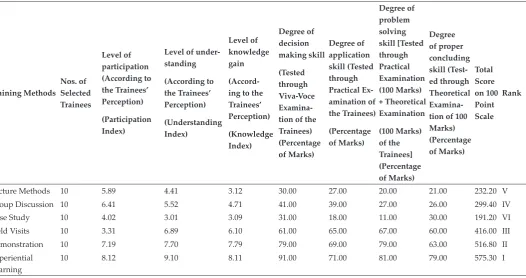
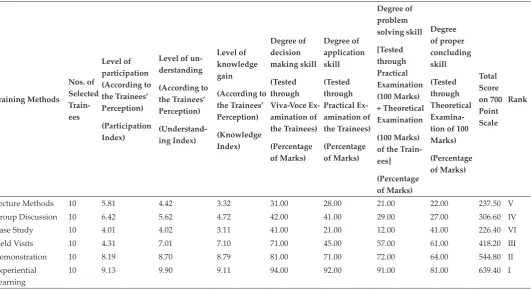
However, in the case of the present study, the following results were observed as presented in the Table 1 and 2 for the Years 2016-17 and 2017-18.
Table 1: Evaluation of efficacy of different Training Methods for the Selected Skill Development Trainings Programmes organized by the Rathindra Krishi Vigyan Kendra in 2016 – 17
Training Methods Nos. of Selected Trainees Level of participation (According to the Trainees’ Perception) (Participation Index)
Level of under-standing (According to the Trainees’ Perception) (Understanding Index) Level of knowledge gain (Accord-ing to the Trainees’ Perception) (Knowledge Index) Degree of decision making skill (Tested through Viva-Voce Examina-tion of the Trainees) (Percentage of Marks) Degree of application skill (Tested through Practical Ex-amination of the Trainees) (Percentage of Marks) Degree of problem solving skill [Tested through Practical Examination (100 Marks) + Theoretical Examination (100 Marks) of the Trainees] (Percentage of Marks) Degree of proper concluding skill (Test-ed through Theoretical Examina-tion of 100 Marks) (Percentage of Marks) Total Score on 100 Point Scale Rank
Lecture Methods 10 5.89 4.41 3.12 30.00 27.00 20.00 21.00 232.20 V
Group Discussion 10 6.41 5.52 4.71 41.00 39.00 27.00 26.00 299.40 IV
Case Study 10 4.02 3.01 3.09 31.00 18.00 11.00 30.00 191.20 VI
Field Visits 10 3.31 6.89 6.10 61.00 65.00 67.00 60.00 416.00 III
Demonstration 10 7.19 7.70 7.79 79.00 69.00 79.00 63.00 516.80 II
Experiential Learning
In both the above mentioned Years, the Experiential Learning Training Method holds the First Rank in all the Performance Indicator Parameters as well as in the overall performance for assessing the efficacy of the different Training methods distantly followed by Demonstration Method and Field Visit Method.
CONCLUSION
The selected farmers are from the same Category i.e. Scheduled Tribe (ST) and marginal farmers. Six Groups of the selected Farmers, each of 10 (Ten) farmers in numbers have undergone the six different type of Training Methodology on the same Skill Development Training Topic and Training programme i.e. High Value Winter Vegetable Cultivation in the Financial Years of 2016-17 and 2017-18. The Trainee farmers ranked the Training Methods according to their own perception on various aspects of performance indicators of different training methods.
In both the above mentioned Years, the Experiential Learning Training Method holds the First Rank in all the Performance Indicator Parameters as well as in the overall performance for assessing the efficacy of the different Training methods distantly followed by Demonstration Method and Field Visit Method in the second and third places respectively.
The Experiential training Method may be the most appropriate Training Method for Skill Development Training because it provides a kind of experience which may easily lead participant trainees from the point of participation to reflection, draw conclusion and identify application points through hands-on approach.
Experiential Learning should be used as Training Method for Skill Development trainings as far as possible. However, it needs more time for proper planning, implementation and collection of feed back in Experiential Learning Methodology and also it is more costly as time consumption is more.
Table 2: Evaluation of efficacy of different Training Methods for the Selected Skill Development Trainings Programmes organized by the Rathindra Krishi Vigyan Kendra in 2017 – 18
Training Methods Nos. of Selected Train-ees Level of participation (According to the Trainees’ Perception) (Participation Index)
Level of un-derstanding (According to the Trainees’ Perception) (Understand-ing Index) Level of knowledge gain (According to the Trainees’ Perception) (Knowledge Index) Degree of decision making skill (Tested through Viva-Voce Ex-amination of the Trainees) (Percentage of Marks) Degree of application skill (Tested through Practical Ex-amination of the Trainees) (Percentage of Marks) Degree of problem solving skill [Tested through Practical Examination (100 Marks) + Theoretical Examination (100 Marks) of the Train-ees] (Percentage of Marks) Degree of proper concluding skill (Tested through Theoretical Examina-tion of 100 Marks) (Percentage of Marks) Total Score on 700 Point Scale Rank
Lecture Methods 10 5.81 4.42 3.32 31.00 28.00 21.00 22.00 237.50 V
Group Discussion 10 6.42 5.62 4.72 42.00 41.00 29.00 27.00 306.60 IV
Case Study 10 4.01 4.02 3.11 41.00 21.00 12.00 41.00 226.40 VI
Field Visits 10 4.31 7.01 7.10 71.00 45.00 57.00 61.00 418.20 III
Demonstration 10 8.19 8.70 8.79 81.00 71.00 72.00 64.00 544.80 II
Experiential Learning
Future thrust for research in this aspect should be more on designing the Training Methods which would incorporate the fundamentals of Experiential Learning, simplicity of Lecture Method and “Seeing is believing” Principle of Demonstration Method.
REFERENCES
Siddarmaiah, B.S. and Jalihal, K.A. 1983. A scale to measure extension participation of farmers, Indian Journal of Extension Education,19(3 – 4): 74 – 76.