University of New Hampshire Scholars' Repository
University of New Hampshire Scholars' Repository
UNH Personality Lab Research Institutes, Centers and Programs
1-31-2019
(2019) Technical Supplement for the article "Advances in
(2019) Technical Supplement for the article "Advances in
Measuring Personal Intelligence"
Measuring Personal Intelligence"
John D. Mayer
University of New Hampshire, Durham, [email protected] David R. Caruso
Yale University Abigail T. Panter
University of North Carolina, Chapel Hill
Follow this and additional works at: https://scholars.unh.edu/personality_lab
Part of the Personality and Social Contexts Commons, and the Social Psychology Commons
Recommended Citation Recommended Citation
Mayer, John D.; Caruso, David R.; and Panter, Abigail T., "(2019) Technical Supplement for the article "Advances in Measuring Personal Intelligence"" (2019). UNH Personality Lab. 31.
https://scholars.unh.edu/personality_lab/31
Technical Supplement
for the article
“Advances in Measuring Personal
Intelligence”
8 March 2019
John D. Mayer
University of New Hampshire
David R. Caruso
Yale University
Abigail T. Panter
University of North Carolina
Please note: This technical supplement was developed alongside the article it cross-references. The supplement is provided as a more extensive resource for those interested in the details of the project carried out and reported by the authors. The article covers the key points; the technical supplement covers the key points and includes tables and figures from the article, as well as additional tables and figures, further analyses, and other extra detail.
The article to which this supplement refers is published in the Journal of Intelligence as:
Mayer, J.D., Caruso, D.R., & Panter, A.T. (2019). Advancing the measurement of personal intelligence with the Test of Personal Intelligence, Version 5 (TOPI 5), Journal of Intelligence, 7(1), 1-17, doi:
Table of Contents
Chapter 1. Key Elements of the Research Program Through December 2017 ... 5
Overview of the Test of Personal Intelligence (TOPI) and its Item Clusters ... 5
Description of the TOPI ... 5
Breadth in Measurement ... 5
Breadth of Personal Intelligence in Terms of Problem-Solving Areas ... 5
Breadth in Terms of Human Mental Abilities ... 5
Version Numbers of the TOPI and TOPI Factor Models ... 11
Renaming the TOPI Versions 1.0 to 1.4 to the TOPI Versions 1 through 4R ... 11
Versions of Two-Factor Models of the TOPI ... 11
Overview of the Test Versions with Clusters and their Reliabilities ... 12
Chapter 2. Development and Construction of the TOPI 5 ... 14
First Step: Modifications of the TOPI 4 ... 14
Second Step: Composition of New Tasks and Their Study in Two Pilot Studies ... 14
Overview of the Pilot Studies ... 14
TOPI Item Research 2013 (Pilot Study 1) ... 14
Participants ... 14
TOPI Item Research 2014 (Pilot Study 2) ... 15
Participants. ... 15
Third Step: Addition of New Tasks ... 15
Chapter 3: The TOPI 5 in Study 1 ... 16
Sample ... 16
Initial logins to the study. ... 16
Screening in greater detail. ... 16
Procedure ... 16
Additional Details Regarding Selected Factor Analyses and Results ... 16
Item retention in the factor model process ... 16
Exploratory Factor Analysis ... 17
A Further Evaluation of the Models in Terms of Item-Indicators ... 17
Expanded Version of Exploratory Factor Analysis Table in the article ... 17
Further Exploring the 2 Factors of the TOPI 5 ... 18
Do the Factors Yield Reliable Scales? ... 18
Correlation between the 2 Factors of the TOPI 4 and TOPI 5 ... 18
Testing the model on the present data ... 19
A fly in the ointment ... 19
Issues of Factor Interpretability ... 20
Post-Hoc Search for Artifactual Causes due to Test Form Qualities in (Slightly) Greater Detail. .... 20
Item Difficulty ... 20
Readability ... 21
Item Position ... 21
Chapter 4. The TOPI 5R in Study 2 ... 22
Participants and Screening ... 22
Measures ... 22
Developing the TOPI 5R from the TOPI 5 ... 22
The Test of Personal Intelligence 5R (a.k.a., TOPI 1.7 or 7) ... 22
Removing Tasks When Abridging the TOPI 5 to the TOPI 5R (a.k.a. TOPI 7) ... 22
Additional Measurement Scales ... 23
Self-Estimated Personal Intelligence—16-items (SEPI-16). ... 23
Item-Level Exploratory Factor Analysis ... 23
Item-Level Confirmatory Factor Analysis... 24
Chapter 5: Study 1 and 2 Analyses of the TOPI 5 and 5R at the Task Level ... 25
Exploratory Factor Analyses of the Tasks Paralleled Those of the Items ... 25
TOPI 5 Analyses at the Task Level ... 25
Dimensionality of the Individual Tasks of the TOPI 5 ... 25
Exploratory Factor Analyses at the Individual Task Level ... 25
Test of a One-Factor Model at the Level of the 13 Tasks ... 26
Confirmatory Factor Analysis at the Task Level ... 27
TOPI 5R Analyses at the Task-Level ... 27
Results from the task-level analyses ... 28
Exceptions to the rules ... 28
Comparative Fit Levels for TOPI 5 and 5R Analyses ... 28
(Non-) Interpretation of the Meaning of the Two Factors at the Task Level ... 29
A Partial Working Through of a “Most Distinct Tasks” Approach to the 2-Factor Solution ... 32
The Most Distinct Tasks Approach ... 32
Stable Indicator Tasks Identified ... 34
Possible Interpretation of the “Most Distinct Tasks” ... 34
First Test of the “Most Distinct Tasks” Model ... 36
Chapter 6. Study 3 “Analyses of Clarification” and the Application of Models 4 and 5 Across the Six
Data Sets ... 37
Hypotheses ... 37
Research Approach ... 37
Method of Analyses ... 37
Test Archives ... 37
Analyses of Clarification: Results ... 39
Did college-aged military and civilian test-takers exhibit different structures of mental ability? (Hypothesis a) ... 39
Was the model fit dependent upon whether the 58 identical items were embedded in the TOPI 4 or 5 test versions? (Hypothesis b) ... 39
Post-Hoc Search for Artifactual Causes due to Test Form Qualities ... 40
Analyses of Clarification: Discussion ... 40
Invariance Tests of the Six Data Sets ... 42
Selected Examples of Invariance Tests for the Two- and One-Factor Models 4 and 5 ... 42
Metric Invariance of the One-Factor Model(s) ... 43
Chapter 7. Study 3 Development of the TOPI 5—General Version (TOPI 5G, a.k.a. TOPI-RG47)... 44
Notes on the TOPI 5G (a.k.a., TOPI 1.4-RG47) ... 44
The Removal Process for Problematic Pair Items ... 44
Why Did Problematic Pairs Arise? ... 47
Examining the TOPI 5G Through the Lens of Item Analysis ... 48
Chapter 8. Study 3 Development of the TOPI 5—Extended Version (TOPI 5E) ... 50
Difficulty Level and Reduced Skew of the TOPI 5 ... 50
Comparison of the TOPI 4R as a Whole to the 58 Common Items ... 50
Comparison of the TOPI 5 With the 58 Items ... 50
Notes on the TOPI 5E in (Slightly) Greater Detail (a.k.a., TOPI 15-G66) ... 51
Corrections for Attenuation due to Unreliability ... 54
Data for the Test Characteristic Curves for the TOPI 5G and 5E for the TOPI 5 Sample N = 961 (Figure) ... 55
Data for the TOPI 5E and 5G for the Test Information Curves and Standard Errors ... 59
Interpreting (and Checking) the Test Information Curve and Conditional Standard Errors ... 61
Chapter 9. Reanalysis of the TOPI-at-Work Data Using the TOPI 5G (Table) ... 64
Chapter 10. Further Thoughts on Two Factors versus One ... 65
Does Personal Intelligence Consist of Two Mental Abilities or One? Revised Thoughts ... 65
References ... 67
Chapter 1. Key Elements of the Research Program Through December
2017
Overview of the Test of Personal Intelligence (TOPI) and its Item Clusters
Description of the TOPI
The Test of Personal Intelligence (TOPI) is an ability-based measure of personal intelligence consisting of a number of multiple choice items. Scoring of correct answers is based on research on personality. We’ve developed several versions of the TOPI and this Technical Supplement is intended to accompany the article “Advances in Measurement with the Test of Personal Intelligence, Version 5 (TOPI 5). That said, it contains information relevant to the TOPI versions 2 through 5.
All versions of the Test of Personal Intelligence share several characteristics in common. First, all versions are divided into the four areas of problem solving that the original theory of personal intelligence delineates to define and demarcate the intelligence. The areas are: (a) the identification of personality-relevant information, (b) forming models of personality, (c) using personality-relevant information to guide choices, and (d) systematizing plans and goals. Second, each problem-solving area is further divided into subsets of items. Those items are divided into item clusters in the early forms of the test, and more explicitly into subtests beginning with the TOPI 4.
Breadth in Measurement
The present article poses the question of whether the TOPI 5 is broader in its measurement than the TOPI 4. That raises the question of “How broad is personal intelligence?”. This question can be approached in two ways. The first approach asks, “How many different content areas of reasoning about personality might personal intelligence encompass?” The second approach inquires “How many distinct human mental abilities does a person draw on to answer questions about personality?” This is answered with factor analysis and related mathematical models.
Breadth of Personal Intelligence in Terms of Problem-Solving Areas
The theory of personal intelligence specifies four areas in which people must problem-solve about personality:
(a) to recognize personally relevant information from introspection and from observing oneself and others, (b) to form that information into accurate models of personality, (c) to guide one's choices by using personality information where relevant, and (d) to systematize one's goals, plans, and life stories for good outcomes.
In past versions of the Test of Personal Intelligence such as the TOPI 1.4, about 9 to 11 item clusters/tasks were examined. In two exploratory studies, we examine the feasibility of adding five more areas that could also be keyed to the research area in personal intelligence. These “new areas of breadth” will be described shortly.
Breadth in Terms of Human Mental Abilities
of test design and that, in fact, a single unitary factor may provide a better representation (see TOPI 5 article).
[Text continues after table(s)].
buffer text contiguous with table Table 1.1
Overview and Reference Guide to TOPI Clusters by Area in the Test of Personal Intelligence versions 2 through 5
Abbreviated Task Name (with code)
Brief Task Description
Given: Solve for:
Identifying Personality-Relevant Information (RVx Tasks) Identifying Motives (RVA) ●several behaviors and/or pursuits ●the common motive among them Inner States (RVF/RVB) ●a situation, activity, or role in which a
person is engaged.
● infer a person’s inner state from information
Evidence about the Self (RVC) ●a need for information about oneself ● ways to receive accurate feedback. Inner Experience-to-Behavior
(RVD)
●a person is carrying out a common activity
● identify an inner experience that likely accompanies that activity. Forming Models of Personality (FMx Tasks)
Trait Knowledge (FMA/FMB) ● that a person possesses two traits, ● the person’s third likely trait. Integrating Information (FMD) ● several personality-relevant pieces of
information
● a characteristic of the person’s knowledge, intellect, or beliefs Discrepancies-Defense (FME) ● a discrepancy between a person’s words
and behavior.
● infer something about a person’s defense and coping
Act Frequencies (FMF) ● a person’s trait. ● behaviors associated with it
Guiding Choices Using Personality-Relevant Information (GCx Tasks)
Trait Inferences (GCA) ● someone’s trait(s) ● the person’s likely reaction in a
situation Observers’ Trait Ascriptions
(GCB)
● an observer’s plans or behaviors around a target individual
● identify the trait that an observer ascribes to the target person Motivating Memories (GCC) ● a person’s motivational need, identify. ● the personal memory that will
enhance the individual’s motivation Systematizing Plans and Goals (SGx Tasks)
Goal-Related Subsidiary Actions (SGA)
● a longer-term goal ● an intermediate or subsidiary goal,
attitude or behavior that could satisfy it Goal Evaluation (SGB/SGC) ● a person’s objective (e.g., to make
friends),
● a goal that likely will create conflicts for the person because it is unrealistic, hard to fulfil, or contradicts the aim. Personality Change (SGE/SGF) ● a person’s intentions and behaviors ● how ready they are to change
Discontinued Tasks
Room with a Cue (RVE) ● a person’s physical surrounding ● infer some relevant traits
Trait Judgeability (FMG) ● several traits ● which are most visible/judgeable.
Misc. Hard TOPI Questionse
aThe exploratory loadings are for the complete task; bthe TOPI final are for the tasks after they were screened such that only
“functional” items remained, i.e., > .35 loadings on their chief factor; < .25 on any secondary. cA version of the of the FME task
that included several borderline items was re-introduced to augment the task’s reliability. dThe SGE items are indicated in brackets
because they were not counted as items in the TOPI 5-ABR proper but instead included as an experimental task-in-development.
eNot including the augmented 5 from FME. E. From Forms 1.0 and 1.1 (MSC) buffer text contiguous with table
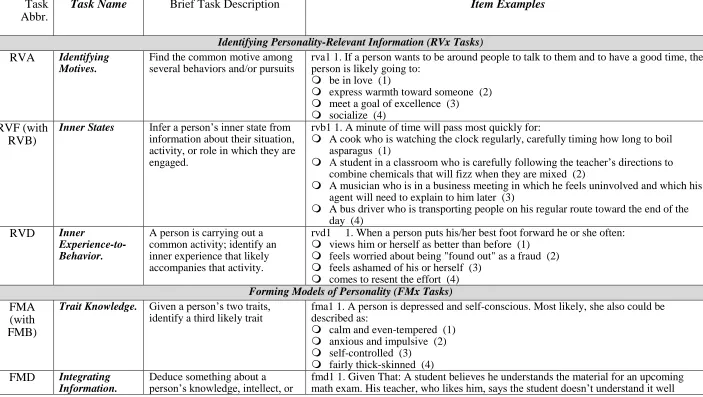
Table 1.2 contains much the same information as in Table 1.1, but also includes examples of items within each item cluster.
buffer text contiguous with table Table 1.2
Overview and Reference Guide to TOPI Tasks by Area in the TOPI 4 through the TOPI 5R, including 2013-2014 Item Research Trials, with Sample Items
Task Abbr.
Task Name Brief Task Description Item Examples
Identifying Personality-Relevant Information (RVx Tasks)
RVA Identifying
Motives.
Find the common motive among several behaviors and/or pursuits
rva1 1. If a person wants to be around people to talk to them and to have a good time, the person is likely going to:
be in love (1)
express warmth toward someone (2) meet a goal of excellence (3) socialize (4)
RVF (with RVB)
Inner States Infer a person’s inner state from
information about their situation, activity, or role in which they are engaged.
rvb1 1. A minute of time will pass most quickly for:
A cook who is watching the clock regularly, carefully timing how long to boil asparagus (1)
A student in a classroom who is carefully following the teacher’s directions to combine chemicals that will fizz when they are mixed (2)
A musician who is in a business meeting in which he feels uninvolved and which his agent will need to explain to him later (3)
A bus driver who is transporting people on his regular route toward the end of the day (4)
RVD Inner
Experience-to-Behavior.
A person is carrying out a common activity; identify an inner experience that likely accompanies that activity.
rvd1 1. When a person puts his/her best foot forward he or she often: views him or herself as better than before (1)
feels worried about being "found out" as a fraud (2) feels ashamed of his or herself (3)
comes to resent the effort (4) Forming Models of Personality (FMx Tasks) FMA
(with FMB)
Trait Knowledge. Given a person’s two traits,
identify a third likely trait
fma1 1. A person is depressed and self-conscious. Most likely, she also could be described as:
calm and even-tempered (1) anxious and impulsive (2) self-controlled (3)
fairly thick-skinned (4)
FMD Integrating
Information.
Deduce something about a
beliefs from several personality-relevant pieces of information about the individual.
enough to do well.The student’s friend doesn’t know whether the student understands the material or not.
The student should conclude:
He is unlikable given that is friend is so unhelpful. (1)
His teacher might be right and he doesn’t know as much as he thought he did. (2) He knows the material – he knows himself best (3)
His friend’s uncertainty means no one can know until he takes the exam. (4)
FME
Discrepancies-Defense
Infer something about a person’s defense and coping from a discrepancy between their words and behavior.
fme1 1. A teacher’s performance in class has declined recently. She has also been having a stressful time at home and, recently, her husband asked for a trial separation, but she does not spend much time thinking about this issue. She is critical of her school, her principal and many of her fellow teachers. She is:
taking her hard feelings out on her co-workers (1) behaving impulsively and recklessly (2)
ignoring her true feelings about the other teachers – she is jealous of their skill (3) denying her real problems which plainly are at home (4)
FMF Trait-Behavior
Associations
Identify what behaviors are associated with a given trait.
fmf1 1. A person who is aloof would most clearly exhibit that quality by:
responding to a question or other conversational comment with a monosyllabic response (1)
saving money for the future (2)
interrupting others during a conversation (3)
drawing in her chair at a meeting closer than the others (4) Guiding Choices Using Personality-Relevant Information (GCx Tasks)
GCA Trait Inferences. Given someone’s traits, predict
how they are likely to react or behave
gca1 1. Ned's boss, Alan, is highly conscientious and orderly. When Alan finds out Ned was late for work, Alan likely:
won't care (1)
will - at minimum - make a note of it, and may be disturbed by it (2) greet Ned enthusiastically (3)
feel distressed and anxious (4)
GCB Observers’ Trait
Ascriptions
Identify the trait that an observer ascribes to another person, given the observer’s plans or behaviors around the person.
gcb1 1. A college student returned to his room and noticed a scratch on his desk he never had seen before. He immediately suspected his roommate. The student's reaction makes sense if his roommate is...
rigid (1) careless (2) deceitful (3) studious (4) GCC Motivating
Memories
Given a person’s motivational need, identify the personal memory that will enhance the individual’s motivation.
gcc1 1. When younger, Sam remembered being cut from his baseball team and the humiliation he felt, and how he wondered if he had practiced enough. Sam used this memory to help himself:
recall that self-doubt just isn't helpful (2) perform well in a job interview (3)
cope with the challenges of shopping for sports equipment (4) Systematizing Plans and Goals (SGx Tasks)
SGA Goal-Related
Actions
. Identify the intermediate or subsidiary goal, attitude or behavior that could satisfy a longer-term goal.
sga1 1. A person wants “to perform at work with excellence”. What goal might most promote this?
to take a training course to learn to do the job better (1) to be a good leader to others (2)
to use forceful, strong actions so as to become a good leader (3) to try to be a good friend (4)
SGB (with SGC)
Goal Evaluation. Given a person’s objective (e.g.,
to make friends), identify a goal around that objective that likely will create conflicts for a person because it is unrealistic, hard to fulfil, or contradicts the objective.
sgb1 1. A person wants to make friends. Which goal might cause him problems when he pursues new friendships?
be a good friend to his friends (1) to be all things to all people (2) to be myself (3)
to spend time meeting new people (4) SGE/SGF Personality
Change.
Given a person’s intentions and behaviors, judge how ready they are to change
sge1 1. On average, people reach the peak of their social dominance – their capacity to make a powerful impression on others – during their:
entire lifespan (this characteristic doesn’t change over time) (1) teens (2)
twenties (3) forties (4)
Tasks Discontinued as to Their Study RVC (Discontin ued after the 12Rf) Evidence about the Self
Identify good methods for getting feedback about oneself.
rvc1 1. Someone who you don’t get along with too well at work mentions to your boss that you completed a project very well. Later that day, he asks you for a favor. One reasonable interpretation is that:
he wants you to turn down his request to prove that you are no good (1)
he wants to tell the boss you turned down his request so as to “take away” the praise he felt he had to give (2)
he said positive things to your boss to help persuade you to grant the favor (3) none of the above (4)
RVE (Never exited “item research trials”) RVE “Room with a Cue”
Given a person’s physical surrounding, infer something about his/her personality
rve1 1. If you wanted to convince people that you were open and flexible, you would make an office that looked:
well lit (1) clean (2) stylish (3)
FMG (Never
exited “item research
trials”)
Trait Judgeability
Give several traits, identify which are most visible/judgeable.
fmg1 11. A group of friends are most likely to agree that someone they know: Is direct and honest (1)
Gets defensive easily (2) Is a negative kind of person (3) Values being an intellectual (4)
MSC (Never
exited “item research
trials”)
Misc. Hard TOPI Questions From Forms 1.0 and 1.1
msc1 Which are most likely to go together: shame and desire for companionship (1) aggression and interest (2)
contempt and aggression (3) guilt and a desire to play (4)
aThe exploratory loadings are for the complete task; bthe TOPI final are for the tasks after they were screened such that only “functional” items remained, i.e., > .35 loadings on
their chief factor; < .25 on any secondary. cA version of the of the FME task that included several borderline items was re-introduced to augment the task’s reliability. dThe SGE
items are indicated in brackets because they were not counted as items in the TOPI 5R proper but instead included as an experimental task-in-development. eNot including the
augmented 5 from FME.
buffer text contiguous with table
Version Numbers of the TOPI and TOPI Factor Models
Renaming the TOPI Versions 1.0 to 1.4 to the TOPI Versions 1 through 4R
The first TOPI scales were labeled the 1.0 through the 1.4, and often with variants, i.e., the 1.4R is revised version of the 1.4. To simplify our account of versions here, we will drop the leading identifier (“1.”) relabeling version 1.4 as version 4 and, when forms are quite similar, refer to a slightly-revised (e.g., abridged) version with an “R” as a modifier, such that the version referred to in earlier research as the 1.4R will become the 4R. This will become helpful as we discuss new forms in the present article.
buffer text contiguous with table Table 1.3
Version Control of the Test of Personal Intelligence Current Name Original name Comments
TOPI 0 TOPI 1.0 Initial tests of TOPI items TOPI 1 TOPI 1.1 Expanded item-testing
TOPI 2 TOPI 1.2 Further test expansion with validity tests TOPI 2R TOPI 1.2
Reformatted
TOPI 2 Revised. Items were reordered and the order of answer choices counterbalanced to ensure an equal number of As Bs, Cs and Ds were correct
TOPI 4 TOPI 1.4 Streamlined (i.e., abridged and reformatted version of the TOPI 1.2Rf
TOPI 4R TOPI 1.4R IRT-revised version of the TOPI 1.4 with a focus on scoring for two mental ability factors
TOPI 5 TOPI 1.5 The TOPI 4 expanded to include 13 clusters with 205 items (compared to 93 for the TOPI 4).
TOPI 5R TOPI 1.7 Reduced, 145-item version of the TOPI 1.5 removing items that were (a) less-functional or (b) loaded on more than one factor
TOPI 5G T14-RG47a TOPI 5 General, A one-factor scale using items shared in
common across TOPI forms 2 through 5R (1.2 through 1.7) TOPI 5E T15-G66a TOPI 5E Another one-factor scale but this one using items
newly introduced in the TOPI 5 so as to better assess higher levels of personal intelligence
a. Also appears as the name of the one-factor model (see Table 1.4) buffer text contiguous with table
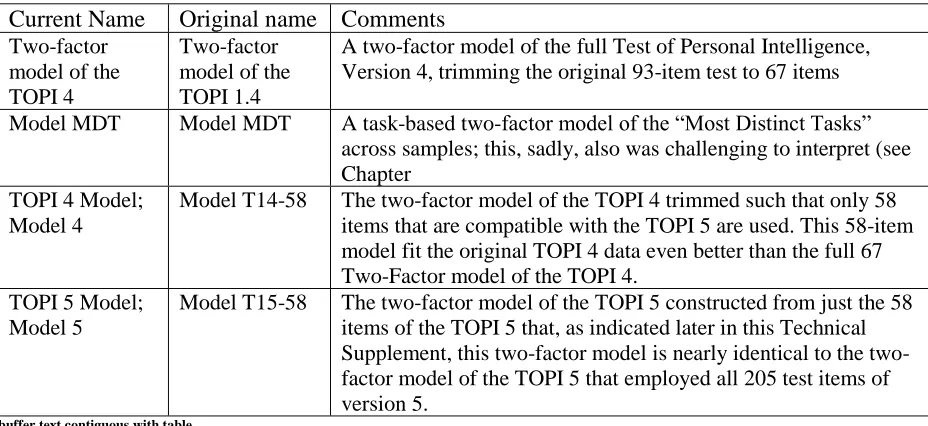
Versions of Two-Factor Models of the TOPI
buffer text contiguous with table Table 1.4
Version Control of the One- and Two-Factor Models of the Test of Personal Intelligence
Current Name Original name Comments Two-factor
model of the TOPI 4
Two-factor model of the TOPI 1.4
A two-factor model of the full Test of Personal Intelligence, Version 4, trimming the original 93-item test to 67 items
Model MDT Model MDT A task-based two-factor model of the “Most Distinct Tasks” across samples; this, sadly, also was challenging to interpret (see Chapter
TOPI 4 Model; Model 4
Model T14-58 The two-factor model of the TOPI 4 trimmed such that only 58 items that are compatible with the TOPI 5 are used. This 58-item model fit the original TOPI 4 data even better than the full 67 Two-Factor model of the TOPI 4.
TOPI 5 Model; Model 5
Model T15-58 The two-factor model of the TOPI 5 constructed from just the 58 items of the TOPI 5 that, as indicated later in this Technical Supplement, this factor model is nearly identical to the two-factor model of the TOPI 5 that employed all 205 test items of version 5.
buffer text contiguous with table
Overview of the Test Versions with Clusters and their Reliabilities
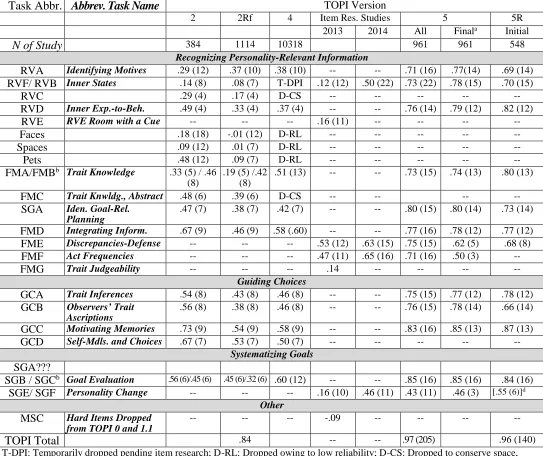
A summary of the forms, their clusters, and reliabilities can be seen in Table 1.5.
buffer text contiguous with table Table 1.5
Spreadsheet of Item Clusters Across Test Versions, with Alpha Reliabilities (and parenthetical no. of items)
Task Abbr. Abbrev. Task Name TOPI Version
2 2Rf 4 Item Res. Studies 5 5R
2013 2014 All Finala Initial
N of Study 384 1114 10318 961 961 548
Recognizing Personality-Relevant Information
RVA Identifying Motives .29 (12) .37 (10) .38 (10) -- -- .71 (16) .77(14) .69 (14)
RVF/ RVB Inner States .14 (8) .08 (7) T-DPI .12 (12) .50 (22) .73 (22) .78 (15) .70 (15)
RVC .29 (4) .17 (4) D-CS -- -- -- -- --
RVD Inner Exp.-to-Beh. .49 (4) .33 (4) .37 (4) -- -- .76 (14) .79 (12) .82 (12)
RVE RVE Room with a Cue -- -- -- .16 (11) -- -- -- --
Faces .18 (18) -.01 (12) D-RL -- -- -- -- --
Spaces .09 (12) .01 (7) D-RL -- -- -- -- --
Pets .48 (12) .09 (7) D-RL -- -- -- -- --
FMA/FMBb Trait Knowledge .33 (5) / .46 (8)
.19 (5) /.42 (8)
.51 (13) -- -- .73 (15) .74 (13) .80 (13)
FMC Trait Knwldg., Abstract .48 (6) .39 (6) D-CS -- -- -- --
SGA Iden. Goal-Rel. Planning
.47 (7) .38 (7) .42 (7) -- -- .80 (15) .80 (14) .73 (14)
FMD Integrating Inform. .67 (9) .46 (9) .58 (.60) -- -- .77 (16) .78 (12) .77 (12)
FME Discrepancies-Defense -- -- -- .53 (12) .63 (15) .75 (15) .62 (5) .68 (8)
FMF Act Frequencies -- -- -- .47 (11) .65 (16) .71 (16) .50 (3) --
FMG Trait Judgeability -- -- -- .14 -- -- -- --
Guiding Choices
GCA Trait Inferences .54 (8) .43 (8) .46 (8) -- -- .75 (15) .77 (12) .78 (12)
GCB Observers’ Trait Ascriptions
.56 (8) .38 (8) .46 (8) -- -- .76 (15) .78 (14) .66 (14)
GCC Motivating Memories .73 (9) .54 (9) .58 (9) -- -- .83 (16) .85 (13) .87 (13)
GCD Self-Mdls. and Choices .67 (7) .53 (7) .50 (7) -- -- -- -- --
Systematizing Goals SGA???
SGB / SGCb Goal Evaluation .56 (6)/.45 (6) .45 (6)/.32 (6) .60 (12) -- -- .85 (16) .85 (16) .84 (16) SGE/ SGF Personality Change -- -- -- .16 (10) .46 (11) .43 (11) .46 (3) [.55 (6)]d
Other
MSC Hard Items Dropped
from TOPI 0 and 1.1
-- -- -- -.09 -- -- -- --
TOPI Total .84 -- -- .97 (205) .96 (140)
T-DPI: Temporarily dropped pending item research; D-RL: Dropped owing to low reliability; D-CS: Dropped to conserve space, usually because area was oversampled.
athe TOPI final 1.5 are for the tasks after they were screened such that only “functional” items remained, i.e., > .35 loadings on their
chief factor; < .25 on any secondary.
bThe tasks were merged between the TOPI 2Rf and 1.4 owing to their reasonable similarity and similar behavior in early factor
analyses
cA version of the of the FME task that included several borderline items was re-introduced to augment the task’s reliability. dThe SGE alpha and items are indicated in brackets because they were not counted as items in the TOPI 5R proper but instead
included as an experimental task-in-development.
Chapter 2. Development and Construction of the TOPI 5
First Step: Modifications of the TOPI 4
The TOPI 4 was composed of 11 clusters and 93 items, but in the course of moving forward to the TOPI 5, we revised the 1.4, combining two pairs of clusters that appeared closely related to one another to form a 9 cluster test with little loss of breadth of content. : the first pair consisted of clusters that asked about which personality traits typically go together (FMA and FMB, merged into FMA), the second pair both asked test-takers to evaluate whether personal goals were potentially problematic (SGB and SGC, merged into SGB). That dropped the scale to 9 clusters.
Second Step: Composition of New Tasks and Their Study in Two Pilot Studies
Concurrently over the years 2013 and 2014, we conducted two studies (Ns = 446 and 381) to trial seven new item clusters as possible candidates for a revised TOPI, and to revive an earlier cluster we had discarded owing to an insufficient number of items remaining.
Overview of the Pilot Studies
Beginning in the summer of 2013, we developed a series of additional problem-solving tasks beyond those found in the TOPI 2 and the TOPI 4R (a subset of the TOPI 2 with more functional items).
TOPI Item Research 2013 (Pilot Study 1
)
The seven tasks upon which we began work included two tasks that “looked back” to TOPI versions 0 through 2: (a) The RVF “Inner States” task expanded on a promising TOPI 2 task that had been dropped en route to the 4 because it had lacked a sufficient number of well-performing items. (b) The second MSC “Miscellaneous Hard Questions” included items on early versions of the TOPI (versions 0 and 1) that fewer than 10%-15% of our participants could answer correctly and had therefore been dropped on the original scale, and that we now hoped to take a further look at.
The five new tasks included, (c) RVE “Room with a cue”, (d) FME “Discrepancies-defense mechanisms, (e) FMF “Act frequencies”, (f) FMG “Trait judgeability”, and (g) SGE “Personality change”. These seven tasks were piloted in a study called “TOPI Item Research-2013.” The earlier table, Table 1.5 (in the last chapter), provides an overview of the personal intelligence tasks that we had been working with up to that time, including the additional problem-solving tasks we tested in the pilot studies.
Participants. Five-hundred seventy-eight individuals logged into our survey; we
screened out 132 who had substantially incomplete data or completed the survey overly quickly, leaving 446 respondents. Based on these participants, we calculated the scale reliabilities as indicated in the middle columns of Table 1.5.
Results. Three of the six tasks were problematic: Although correct answers for each were keyed to published research (e.g., Gosling, Ko, Mannarelli, & Morris, 2002). FMG (Trait
reliability of α = .14; RVE contained just 3 items correlated with the overall TOPI above r > .10, and overall exhibited a reliability of α = .16. MSC, the miscellaneous hard items reinstated from the TOPI 0 through 2 had just three items that performed well, and we regarded those as not worth saving on their own.
The remaining four tasks, RVF, FME, FMF, and SGE, did show promise. Although Inner States (RVF) and Change (SGE) both had equally low reliabilities as the discarded scales, Inner States had except inner states had 5 of 12 items loading above r = .10 on the overall test—some substantially so, and SGE similarly had 5 of 10 meeting criteria. These four were carried forward to TOPI Item research 2014.
TOPI Item Research 2014 (Pilot Study 2)
Participants. Four-hundred and seventy-two people logged onto the survey, of whom 381 met criteria of (a) taking longer than 20 minutes for the items and (b) having fewer than 3 missing values. We reworked each of the four promising tasks based on the item information from the first pilot, increasing the length of each task by from 1 item (for SGE) to 10 (for FMF; see Table 1.5). Of the four tasks carried forward, RVF, FME, FMF, and SGE, RVF, FME, and FMF improved in reliability. SGE (personality change) dropped somewhat. Nonetheless, we decided to carry forward all four tasks RVF/RVB, FME, FMF and SGE to the new TOPI 5 without further changes to them. Specific cluster reliabilities were indicated in Chapter 1, Table 1.5.
Third Step: Addition of New Tasks
From the pilot studies, four trial clusters seemed most promising and were prepared for the TOPI 5: These new tasks concerned people’s problem-solving in areas of (a) evaluating inner states (RVF), personality change (SGE), identifying discrepancies in behavior, i.e., defense
Chapter 3: The TOPI 5 in Study 1
Sample
Initial logins to the study. Participants were tested under three conditions, spread over three academic years from 2014-2015 to 2016-2017. The first sample took the test in its original order online at a time and place of their choosing (N= 739 logins); the second sample (N=31) took the same test online while being proctored in a classroom. The third sample (N=540) took the test online, unproctored, in a “second-half-first” form, for which the first and second halves of the test were switched but otherwise the same. These samples were combined into an overall initial file with N = 1310 logins, which, after screening for reasonable levels of completion rates and of attention, resulted in a combined sample of N = 961 participants.
Screening in greater detail. Screening for completeness of data and for attention. Of the 1310 who had logged onto the survey, 69 were non-respondents (completing just a few items) and 94 were partial respondents (completing less than 50% of the TOPI survey), and these were removed, leaving 1147 in the remaining sample.
An additional series of screens flagged participants for signs of extreme inattention: We flagged 11 participants who completed the survey in less than 2 sec per item, 182 who failed more than 50% of the attention items (a surprisingly high number of participants), 4 participants who exhibited longstring responding over more than 10% of the test (i.e., endorsed the same alternative more than 21 times in succession), and 21 who responded with a single answer invariantly more than 2/3rds of the time across the test. In all, we flagged 183 participants: 153 respondents were flagged once, 13 twice, and 20 thrice: In our final screening step, all those flagged were removed, yielding a final sample of N = 961, upon which all further analyses were conducted.
Procedure
Participants were recruited via SONA software for an online study in which they would “complete items related to personal intelligence.” Further information provided defined what personal intelligence is, explained that the researchers were trying to evaluate test items related to the concept. We explained in advance that the survey would take between 1 to 2 hours, and encouraged participants to take a short break during filling it out. Participants received 2 hours of experimental credit toward their course requirement for completing the scale. If they signed up, they were then sent to a Qualtrics survey that provided the consent form, followed by the survey materials.
Additional Details Regarding Selected Factor Analyses and Results
Item retention in the factor model process
with high secondary loadings in the exploratory analyses on the TOPI 4/4R often violated the assumptions of the models we subsequently attempted to fit. (The second criterion was unchanged from our earlier development of the TOPI 4/1.4R).
Exploratory Factor Analysis
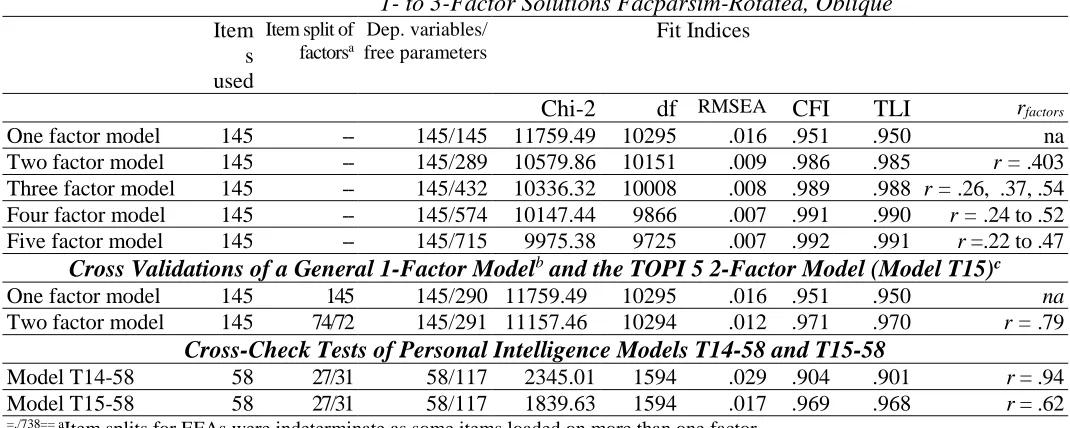
We began with Exploratory Factor analyses of the 205-item version in Mplus. We treated the data as categorical, and employed a Weighted Least Squares, Mean and Variance Adjusted (WLSMV) extraction, with a facparsim rotation—the latter member of the Crawford-Ferguson family of rotations particularly appropriate to large numbers of items (Finch, 2011; Sass & Schmitt, 2010). Table 3.1 lists the first five factor solutions and their fits. The 1-, 2-, 3-, and 5-factor solutions converged to criteria but the 4-5-factor solution did not, despite our allowing Mplus to employ up to 1.5 million iterations for each factor solution. (Our moderately fast laboratory laptop took 10 days, 16 hours and 17 minutes to complete the analyses for the 1 through the 5 factor solutions).
Given our criteria, all the tested models from the 1- to 5-factor model fit well, as can be seen from the fit statistics in Table 3.1. The 1-factor model led off with CFI and TLI both equal to .94, and an RMSEA of .015, with marked improvement for the 2-factor model (CFI, TLI = .984; RMSEA = .008), and continued but more gradual improvement through 5-factors (at which point we stopped our analysis).
A Further Evaluation of the Models in Terms of Item-Indicators
Aside from test structure, the factors also can be evaluated by how many items loaded on each factor—and according to whether certain tasks purely represented one factor or another. We examined these characteristics for the 1, 2, and 3 factor solutions. The 2-factor solution
represented most of the items well, and, in that solution, items within tasks all loaded on either factor 1 or factor 2 but not on both. By comparison, the 3-factor solution’s third factor was mostly defined by the FME task (coping and defense), and by 15 further items that arose across the remaining tasks; these additional items were difficult to interpret. Because items on the 5-factor solution exhibited mostly low loadings, that solution appears unlikely to support five reliable factor-based scales.
Expanded Version of Exploratory Factor Analysis Table in the article
Table 3.1 presents a version of Study 1 portion of Table 3 (Exploratory Factor Analyses at the Item level for Studies 1 and 2) that appeared in the paper with additional detail that we did not have room to fully discuss. These additional details include confirmatory factor analyses for 1-, 2-, and 3-factor models, including a variation in which several tasks were removed.
buffer text contiguous with table Table 3.1
Factor Models of the TOPI 5 (N = 961) at the Item Level
Item-Level Exploratory Factor Analyses 1- to 3-Factor Solutions Facparsim-Rotated, Oblique Items
useda
Item split of factorsb
Dep. variables/ free parameters
Fit Indices
Chi-2 df RMSEA CFI TLI rfactors
One factor model 0 -- 205/205 25135.28 20705 .015 .940 .940 na
Two factor model 0 -- 205/409 21673.45 20501 .008 .984 .984 r = .40
Three factor model 0 -- 205/612 21143.92 20298 .007 .989 .988 r = .23 to .47
Four factor model 0 -- NA NA NA NA NA NA NA
Five factor model 0 -- 205/1015 20477.52 19895 .006 .992 .992 r = .15 to .51
Initial Item-Level Confirmatory One-, Two-, and Three-Factor Models
Items loading < .35 on their primary factor and/or > .25 on any other factor removed.
One factor model 162 162 162/324 17556.09 12879 .019 .938 .937 na
Two factor model 146 74/72 146/293 11520.11 10438 .010 .983 .982 r = .688
Three factor model 90 33/31/26 90/183 4607.46 3912 .014 .977 .977 rs = .60, .73, .74 Item-Level Confirmatory for Two-Factor Model with (Three) Stub Tasksc Removed
Two factor model 135 69/66 135/271 9894.20 8909 .011 .983 .982 r = .672
Confirmatory Models for the Two-Factor Model with FME plus its Augmented Items and Stub Tasksc
Removed
Two factor model 145 69/66 145/291 11615.62 10294 .010 .979 .979 r = .698
aOut of an original total of 205 items to start
bItem splits for EFAs were indeterminate as some items loaded on more than one factor. cWe defined stub tasks as those with 5 or fewer remaining items
buffer text contiguous with table
Further Exploring the 2 Factors of the TOPI 5
Do the Factors Yield Reliable Scales?
We had hypothesized further that we could construct factor-based scales of the TOPI 5 that would exhibit good reliability. The reliability for the overall test was α = .97, and that for the two factor-based subscales was α = .94 for Factor 1 and α = .95 for Factor 2. Moreover, most of the individual tasks formed reliable composites as well, indicating the possibility of creating content-based scales. For the five tasks on each factor with more than 5 items, the reliabilities fell in the range of α = .74 to .85. For the remaining three tasks: FME, SGE and FMF, the reliabilities were lower.
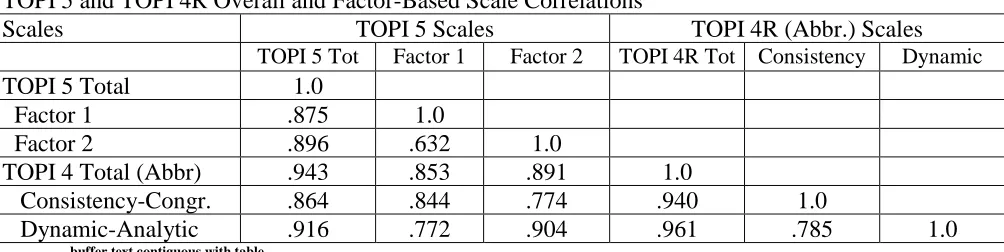
Correlation between the 2 Factors of the TOPI 4 and TOPI 5
initial scales of the TOPI 5 and the final scales of the TOPI 4R. These correlations are based on 62 items (this was before we had eliminated three items for non-functionality, and discovered another item had been a “stowaway” that shouldn’t have been carried forward…leading to the final 58) from the TOPI 5 that were carried over from the complete set of 67 TOPI 4R items, representing 92.5% of the earlier tests’ items.
Importantly, the TOPI 5 overall correlated r = .943 with the TOPI 4R. Also, the first factors of the two instruments and the second factors of the two instruments appeared to correlate somewhat more highly with one another, at r = .84 and .90 than they did across factors, at r = .77 and .77. that were included in the TOPI 5. Factors 1 and 2 of the earlier TOPI 4R had been labeled “Consistency-Congruency” and “Analytic-Dynamic” factors respectively.
buffer text contiguous with table Table 3.2
TOPI 5 and TOPI 4R Overall and Factor-Based Scale Correlations
Scales TOPI 5 Scales TOPI 4R (Abbr.) Scales
TOPI 5 Tot Factor 1 Factor 2 TOPI 4R Tot Consistency Dynamic
TOPI 5 Total 1.0
Factor 1 .875 1.0
Factor 2 .896 .632 1.0
TOPI 4 Total (Abbr) .943 .853 .891 1.0
Consistency-Congr. .864 .844 .774 .940 1.0
Dynamic-Analytic .916 .772 .904 .961 .785 1.0
buffer text contiguous with table
Devel
oping a two-factor TOPI 5 modelWorking from the two-factor exploratory factor analysis for the TOPI 5, we re-divided the 58 items depending upon whether their highest loading was on Factor 1 or 2 in the present sample. The placements were relatively straightforward because 51 of the 58 items possessed loadings > .20 higher on one factor than the other. By coincidence, the TOPI 5 model had 27 items on Factor 1 and 31 on Factor 2, the same numerical split as the TOPI 4 model, but with some items changing factors.
Testing the model on the present data
As can be seen in Table 3 (TOPI 5 Model, bottom right), the TOPI 5 model fit the TOPI 5 sample quite well with an RMSEA of .016 and CFI and TLIs of .977 and .976, respectively. The correlation between the two factors dropped to r = .61, indicating their greater independence than before. This was a viable overall fit for a two-factor model of mental ability in the area.
A fly in the ointment
two factors here, however, seemed to defy description, despite our collective experience at interpreting factors (see the Technical Supplement, Chapters 3 and 5).
Issues of Factor Interpretability
We found the factors nearly impossible to interpret. We note retrospectively that the two-factor model of the TOPI 4 also had been challenging to interpret, but that we had gone forward and characterized the two factors in a way that appeared satisfactory at the time. The two factors here, however, seemed to defy description, despite our collective experience at interpreting factors. Although Factor 1 at first appeared to concern the understanding of goal states (a group of high-loading items came from the Goal-Related Actions and Identifying Motives tasks), other high-loading items concerned drawing conclusions about a person from diverse information (from the Integrating Information task). Collectively, we thought, this might bear some resemblance to our earlier, Dynamic-Analytic factor. The interpretation of Factor 2 was
complicated by the issue that, similar to Factor 1, it also led off with goal-related questions from the Goal Evaluation task, and then continued with diverse questions about inner states, labeling traits, and recalling motivating memories from Inner-Experience-to-Behavior, Trait Knowledge, and Motivating Memories tasks—a diversity of content that, to us, defied characterization beyond concerning personal intelligence in general.
Post-Hoc Search for Artifactual Causes due to Test Form Qualities in
(Slightly) Greater Detail.
Given the difficulty we found earlier in interpreting the two-factor solution in the TOPI 5 factors, we next turned to the question of whether the two-factor solution could be due to some method artifact. To do so, we selected the top-10 items loading on factors 1 and 2, and compared them on a number of characteristics. These items were highly defining of their factors: Factor 1 items loaded on factors 1 and 2 rmean= .75 and .03, respectively; Factor 2 items reversed the pattern, rmean= .12 and .77. All our items were multiple choice, ruling out changes in the
response scales as a possible explanation here (cf., Legree et al., 2014), but we examined several other possible artifacts.
Item Difficulty
Readability
We entered the two sets of 10 items from the TOPI 5 into a readability calculator that scored the text simultaneously according to the Flesh-Kincaid Grade Level, Fog Scale measure, and four others (Scott, 2018). The average among six (default) estimates that provided grade level readability estimates was, for factor 1, 12.5, or midway through senior year high school, with a range of estimates from eighth grade to college graduate. The readability for the 10 items of Factor 2 was 11.2, or the beginning of junior year, with a range from the ninth grade to the end of 1st-year college. Given the wide variability and reasonable proximity of the mean
difficulty, these seemed unlikely to be the basis of the different factors.
Item Position
We also examined item position. Recall that the TOPI 5 administration order was counterbalanced according to the first and second halves of the test: The first half ran: RVA, FMD, GCB, SGA, RVB, and FME; the second half, GCA, SGB, RVD, FMA, GCC, SGE and FMF. We first observed that the top 10 items of Factor 1 all came from the first half of the test, whereas the top 10 Factor 2 items all came from the second half—a clear difference. Second, we assessed the distance of each item from the beginning of its test-half, in units of survey screens (each survey screen displayed about 3 items). The Factor 1 items all fell within a 29-screen span at the beginning of their half (Screens 3 through 32) of 53 screens; the Factor 2 items all came within a 23-screen span (Screens 12 through 35) of 57 screens, roughly toward the middle of their half.
Chapter 4. The TOPI 5R in Study 2
Participants and Screening
Participants were students taking psychology courses at the same large New England pubic university from which the participants for Study 1 were drawn. They were tested on-line during the fall, 2017 semester and screened using procedures identical to Study 1.
We used the same data screening process as in Study 1:There were N= 686 initial logins. We first removed 20 non-respondents and 20 non-respondents, leaving N = 633. Still using procedures of Study1, we three participants for undue speededness, three for longstring
responding on 10% or more of the test, and the remainder for failing to pass the attention-check items, yielding a final sample of N = 548, upon which all further analyses were conducted.
Measures
Demographic questions. Four demographic items asked about participants’ gender, age, educational level and ethnicity.
Developing the TOPI 5R from the TOPI 5
The Test of Personal Intelligence 5R (a.k.a., TOPI 1.7 or 7)
The TOPI 1.7 represents an abridged version of the TOPI 1.5, containing 145 items of the original 205-itemsTOPI 1.5. We abridged the test by (a) removing 55 items that failed to load > .35 on either factor of the 2-factor model or that correlated > .25 on its secondary factor--the same criteria we used earlier to construct the TOPI 1.4R (Mayer et al., 2017), and (b) removing SGE/SGF and FMF after the item-level screen left so few items on them that they lacked reliability.
Removing Tasks When Abridging the TOPI 5 to the TOPI 5R (a.k.a. TOPI 7)
To guide test development moving forward, we also further explored the three tasks that had five or fewer items remaining after our selection criteria: FME, FMF and SGE. FME, FMF and SGE had loaded 11, 11, and 4 items respectively above r = .35 on the 1-factor representation of personal intelligence—indicating the general level of the task’s functioning. The personality change task, SGE, was clearly unworkable as it stood. (We did, however, note that the three items that had worked in the 2-factor solution and potentially could be supplemented by rewrites of three “next-best” items that were similar in content and had exhibited some promise in their loadings (although failing to meet our criteria).
The FME and FMF tasks were, by comparison, sound measures of personal intelligence as indicated in the 1-factor solution. The issue with FMF was that most its items loaded on both factors of the 2-factor solution, and therefore failed to contribute to the scale’s measurement quality at the 2-factor level. (Specifically, 14 of FMF’s 16 items loaded higher on Factor 2 than Factor 1, but the items’ comparative loadings on both factors were within r = .15 of one another in half of those cases.
cut-off point of .25 on Factor 2 (3 items between r = .25 and .30; and 1 item r = .37 versus. r = .53 on Factor 1). Here, we elected to relax our initial screen to allow those four additional items in a revised model including that “augmented FME;” that revised model continued to fit the data well overall, as indicated in the bottom row of Table 1.5.
It was on that basis that we removed these tasks moving forward to the TOPI 5R.
Additional Measurement Scales
An additional four scales were used for various criterion tests. We judged, however, that establishing a robust and generalizable measure took priority over any further validation of our TOPI scales (which already had a good deal of evidence for their capacity to correlate and likely predict criteria). For that reason, we did not analyze these criterion scales in the present research, although we anticipate returning to the data at a later point in time in a subsequent article.
Self-Estimated Personal Intelligence—16-items (SEPI-16).
Participants completed the Self-Estimated Personal Intelligence-16 (SEPI-16, Mayer et al., 2017), a 16-item scale that includes statements such as, “I read people’s intentions well” and “I understand who I am” and answer indicating whether the item describes them on a 5-point response scale, from “1 strongly disagree” to “5 strongly agree”.
The Rosenberg Self-Esteem Scale (RSE). This 10-item scale includes questions such as
“On the whole, I am satisfied with myself” and “I feel I do not have much to be proud of.”
(Rosenberg, 1965). Participants answered on a 5-point scale from “1 strongly disagree” to 5 “strongly agree”. that departs from the original 4-point scale but is now the convention (e.g., Donnellan, Ackerman, & Brecheen, 2016).
WordsumPlus (WsP). This 14-item vocabulary test was refined using item response theory and serves as a proxy for more general intelligence (Cor, Haertel, Krosnick, & Malhotra, 2012).
HEXACO-60. This 60-item measure of the Big Six personality traits Honesty, Emotional Stability, Extraversion, Agreeableness, Consciousness and Openness; the scale contains items such as “I would be quite bored by a visit to an art gallery” (low Openness), which respondents answer on a 5-point scale from 1 “strongly disagree” to 5 “strongly agree” (Ashton & Lee, 2009).
Item-Level Exploratory Factor Analysis
buffer text contiguous with table Table 4.1
Exploratory and Confirmatory Factor Models of the TOPI 5R (N = 548) at the Item Level Item-Level Exploratory Factor Analyses 1- to 3-Factor Solutions Facparsim-Rotated, Oblique Item
s used
Item split of factorsa
Dep. variables/ free parameters
Fit Indices
Chi-2 df RMSEA CFI TLI rfactors
One factor model 145 -- 145/145 11759.49 10295 .016 .951 .950 na
Two factor model 145 -- 145/289 10579.86 10151 .009 .986 .985 r = .403
Three factor model 145 -- 145/432 10336.32 10008 .008 .989 .988 r = .26, .37, .54
Four factor model 145 -- 145/574 10147.44 9866 .007 .991 .990 r = .24 to .52
Five factor model 145 -- 145/715 9975.38 9725 .007 .992 .991 r =.22 to .47
Cross Validations of a General 1-Factor Modelb and the TOPI 5 2-Factor Model (Model T15)c
One factor model 145 145 145/290 11759.49 10295 .016 .951 .950 na
Two factor model 145 74/72 145/291 11157.46 10294 .012 .971 .970 r = .79
Cross-Check Tests of Personal Intelligence Models T14-58 and T15-58
Model T14-58 58 27/31 58/117 2345.01 1594 .029 .904 .901 r = .94
Model T15-58 58 27/31 58/117 1839.63 1594 .017 .969 .968 r = .62
=./738== aItem splits for EFAs were indeterminate as some items loaded on more than one factor. bThis model assigned all 145 items of the TOPI 5R to the same general factor.
cModel T15 employed the 2-factor Model T15 based on the earlier-conducted exploratory factor analysis of the TOPI 5. buffer text contiguous with table
Item-Level Confirmatory Factor Analysis
Chapter 5: Study 1 and 2 Analyses of the TOPI 5 and 5R at the
Task Level
Exploratory Factor Analyses of the Tasks Paralleled Those of the Items
We further wondered whether analyses of the TOPI 5 at the level of the 13 tasks would be consistent with analyses we had conducted of the 205 TOPI items. We regarded the 13 task scores as yielding continuous data and, of course, the 13 tasks were far fewer in number than the 205 items. For these reasons, we used the Mplus factor analysis defaults of continuous data, and Geomin rotation (this was different from our treatment of the test at the item level). Results from the fits of 1- through 5-factor fits in our exploratory analyses are indicated in the top rows of Table 5.1.
TOPI 5 Analyses at the Task Level
Dimensionality of the Individual Tasks of the TOPI 5
Before the TOPI 5, small sets of items were grouped in clusters; the clusters were brief and not expected to rise to acceptable levels of reliability as stand-alone indices. The TOPI 5 was constructed around tasks that were of sufficient length to attain levels of individual reliability.
The TOPI 5 was designed with the possibility in mind to be tractable for analysis at the level of its tasks—which we considered viable if the tasks individually reached levels of reliability around r = .70 or higher. We did accomplish this (see Table 1.5 in Chapter 1).
Exploratory Factor Analyses at the Individual Task Level
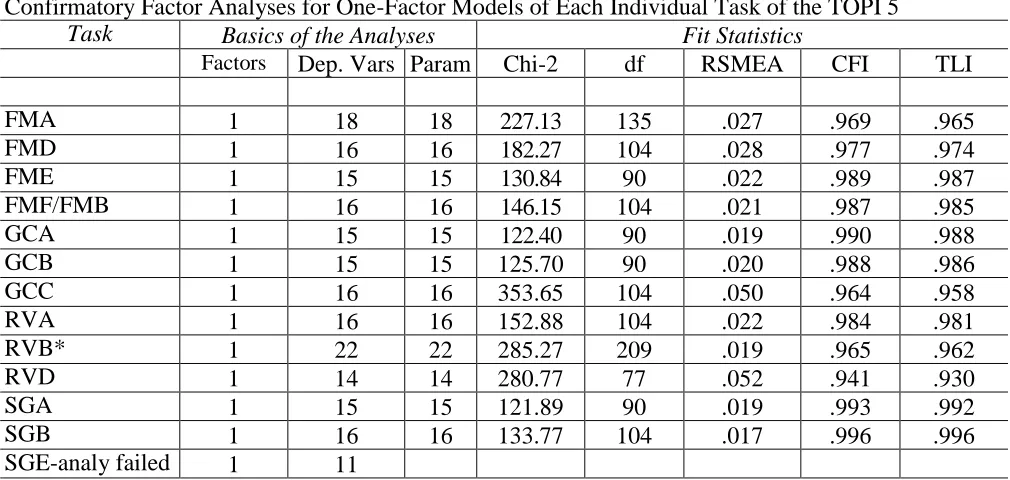
We carried out exploratory factor analyses for each of the 13 tasks. A one-factor EFA fit each of the tasks individually at our criterion fit levels, although several items within each task often failed to load on the single factor (see Table 5.1). This suggested minimally that that each task was a reasonably pure index of the factor it assessed, and perhaps, that the overall TOPI might be unifactorial. Supporting our hypothesis as to task reliability, thirteen of the fourteen tasks exhibited coefficient alphas between α = .71 to .85, with only SGE (personality change) below at α = .43 (see Table 1.5 in Chapter 1).
buffer text contiguous with table Table 5.1
Confirmatory Factor Analyses for One-Factor Models of Each Individual Task of the TOPI 5
Task Basics of the Analyses Fit Statistics
Factors Dep. Vars Param Chi-2 df RSMEA CFI TLI
FMA 1 18 18 227.13 135 .027 .969 .965
FMD 1 16 16 182.27 104 .028 .977 .974
FME 1 15 15 130.84 90 .022 .989 .987
FMF/FMB 1 16 16 146.15 104 .021 .987 .985
GCA 1 15 15 122.40 90 .019 .990 .988
GCB 1 15 15 125.70 90 .020 .988 .986
GCC 1 16 16 353.65 104 .050 .964 .958
RVA 1 16 16 152.88 104 .022 .984 .981
RVB* 1 22 22 285.27 209 .019 .965 .962
RVD 1 14 14 280.77 77 .052 .941 .930
SGA 1 15 15 121.89 90 .019 .993 .992
SGB 1 16 16 133.77 104 .017 .996 .996
SGE-analy failed 1 11
*Looks like an error on RVB with this run, from the data (one variable continuous, or variables not labeled as categorical
buffer text contiguous with table
Test of a One-Factor Model at the Level of the 13 Tasks
A 1-factor exploratory factor analysis at the level of the 13 tasks TOPI 5 tasks failed to fit the data well (Table 5.2); however, the 2-factor confirmatory factor analysis using the same 13 tasks, did fit, with an RMSEA = .049; TLI = .986; CFI = .979, and a r = .69 between Factor 1 and 2. The 3- and 4-factor solutions fit even better, but no task loaded above r > .35 on Factor 3 on either solution, or above r > .45 on Factor 4, so the latter two solutions were non-starters.
buffer text contiguous with table Table 5.2
Fit Levels of Factor Models of the TOPI 5 (N = 961) at the Task Level
Exploratory Factor Analyses of the TOPI 5 at the Task Level 1- to 3-Factor Solutions Facparsim-Rotated, Oblique Tasks
useda
Item split of factors
Dep. variables/ free parameters
Fit Indices
Exploratory Models for Unaltered Tasks (All Items)
Chi-2 df RMSEA CFI TLI rfactors
One factor model 13 13/39 1619.52 65 .158 .820 .784 --
Two factor model 13 13/51 173.81 53 .049 .986 .979 r = .690
Three factor model 13 13/62 86.63 42 .033 .995 .990 rs = .65, .43
Four factor model 13 13/72 48.85 32 .023 .998 .995 rs = .14 to .72
Confirmatory Models for Unaltered Tasks (All Items)
One factor model 13 13/39 1619.52 65 .158 .820 .784 --
Two factor model 13 13/39 2293.91 65 .189 .742 .690 r = -.97
Exploratory Models “Task-Level-Distilled” Tasksa, b, c Based on Task Factor Analyses
One factor model 14 14/42 1681.46 77 .147 .820 .787 --
Two factor model 14 14/55 230.14 64 .052 .981 .973 r = .659
Confirmatory Models “Task-Level-Distilled” Tasksa, b, c Based on Task Factor Analyses
One factor model 14 14/42 1681.46 77 .147 .820 .787 --
Two factor model 14 14/43 419.29 76 .069 .961 .954 r = .721
Confirmatory Models for “Item-Level-Distilled” Tasksd Based on the Original TOPI 5 Item Analyses
One factor model 12 12/36 1792.00 54 .18 .785 .738 --
Two factor model 12 12/37 259.83 53 .06 .974 .968 r = .68
aBased on the factor analyses of the original 13 tasks.
bBoth the 1- and 2-factor task-purified analyses raised warnings of non-definite positive first-order derivative product matrices, and
consequently, raised doubts as to the reliability of these fit statistics.
cBased on individual task analyses, removing items that loaded < |.35| on their primary factor and/or > |.25| on any other factor. dTask purification based on original item analyses, with items loading < .35 on their primary factor and/or > .25 on any other factor
removed.
buffer text contiguous with table
Confirmatory Factor Analysis at the Task Level
A 1-factor confirmatory factor analysis at the level of the 13 tasks TOPI 5 tasks failed to fit the data well; however, and—in distinction to the exploratory analysis—the 2-factor CFA also performed poorly (see Table 5.2, middle rows). confirmatory factor analysis using the same 13 tasks, failed to fit—with an RMSEA = .189; TLI = .742; CFI = .690. Imposing the additional constraints of simple structure (i.e., each task loading one factor) stretched the model too far (Factors 1 and 2, using all the items, correlated r = -.97 (details in Table 5.2)—as if they all measured the same general personal intelligence factor.
Results from the task-level analyses
Whereas the item-level analyses of the TOPI 5R were more-or-less as anticipated—with reservations as to the correlation between factors—the task-level 2-factor analysis was a bit more concerning. Replicating the 2-factor solution using the unaltered task assignments to factors as with the TOPI 5, the fit appeared to suffer a bit, with the
Exceptions to the rules
Examining the tasks item-by-item, the items on tasks RVA, SGA, GCB, FMD, and RVB loaded fairly exclusively on Factor 1 as before (with the exception of RVB’s last 3 items). Many of the tasks loading on Factor 2 again exhibited item-by-item loadings consistent with that: FMA, SGB (excluding the first 2 items), GCC, and RVD loaded fairly exclusively on Factor 2 as before. That said, the items from tasks GCA (of Factor 2) and FME (of Factor 1) were not so clear in the present data set: Although GCA loaded more on Factor 2 (as before), many of its items loaded near-equally on Factor 1, and the items of FME were so evenly split across the two factors that it was challenging to pick a predominant factor on which it loaded.
buffer text contiguous with table Table 5.3
Factor Models of the TOPI 5R (N = 548) at the Task Level
Cross-Check of the 2-Factor Confirmatory Model T15 at the Task Level for the TOPI 5R
Two factor, all tsks 11 6/5 11/34 278.23 43 .100 .939 .922 r = .79
Two factor, wo FME 10 5/5 10/31 117.02 34 .067 .976 .968 r = .74
aItem splits for EFAs were indeterminate as some items loaded on more than one factor. bThis model assigned all 145 items of the TOPI 5R to the same general factor.
cModel 5 employed the 2-factor Model 5 based on the earlier-conducted exploratory factor analysis of the TOPI 5. buffer text contiguous with table
Comparative Fit Levels for TOPI 5 and 5R Analyses
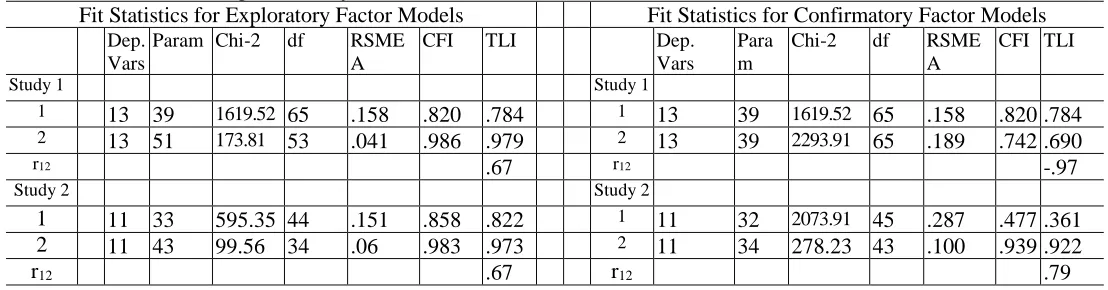
The comparative fit levels of the various solutions are shown in two different fashions (sequentially and side-by-side for comparative purposes) in Tables 5.4.
buffer text contiguous with table Table 5.4
Fit Levels of the Exploratory and Confirmatory Factor Models of the TOPI 5 (N = 961) and TOPI 5R (N = 548) at the Task Level Arranged Side-by-Side
Fit Statistics for Exploratory Factor Models Fit Statistics for Confirmatory Factor Models Dep.
Vars
Param Chi-2 df RSME
A
CFI TLI Dep.
Vars
Para m
Chi-2 df RSME
A
CFI TLI
Study 1 Study 1
1 13 39 1619.52 65 .158 .820 .784 1 13 39 1619.52 65 .158 .820 .784
2 13 51 173.81 53 .041 .986 .979 2 13 39 2293.91 65 .189 .742 .690
r12 .67 r12 -.97
Study 2 Study 2
1 11 33 595.35 44 .151 .858 .822 1 11 32 2073.91 45 .287 .477 .361
2 11 43 99.56 34 .06 .983 .973 2 11 34 278.23 43 .100 .939 .922
r12 .67 r12 .79
Tech note: Low fit for the TOPI 5-Abr 1-factor model in Study 2 is because RVA doesn’t fit the single factor well/mod
index of 260.83.
buffer text contiguous with table
(Non-) Interpretation of the Meaning of the Two Factors at the Task Level
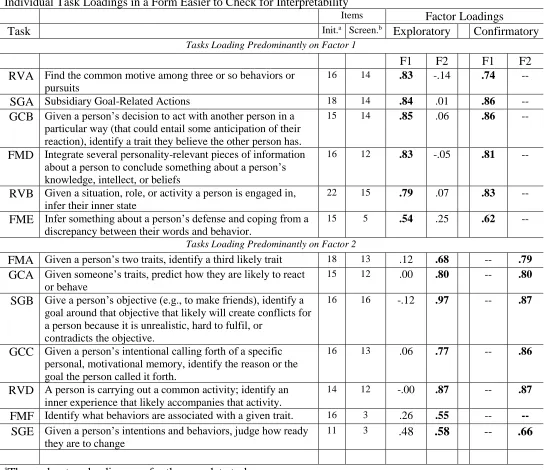
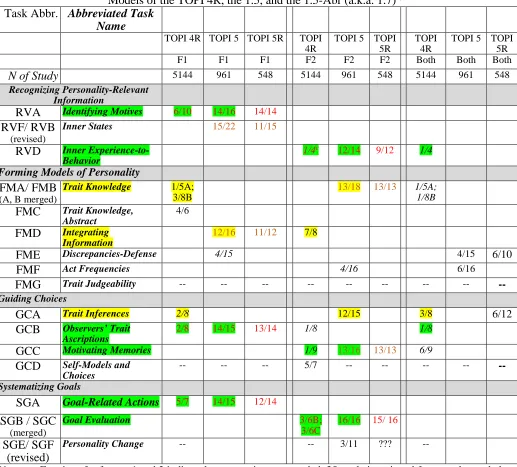
A general idea of what the two-factor model looks like at the task level can be gathered from Tables 5.5 and 5.6 which includes both the two-factor task loadings for the exploratory and confirmatory models. The “Exploratory Model” includes the complete, initial tasks. The
Confirmatory Model used the tasks from which the most function items had been retained, based on the item-level analyses.
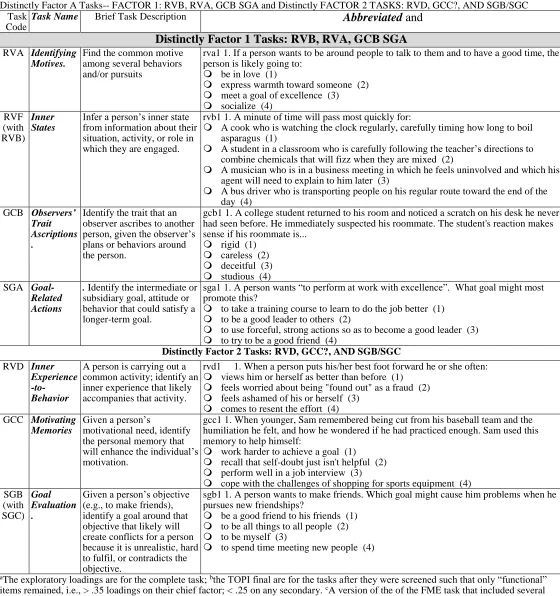
The two-factor structure was by-and-large resistant to interpretation: For example, as Tables 5.5 and 5.6 indicate, RVA and GCB loaded most highly on the first factor (rs = .84 and .81). Reference to Table 1 explains these tasks measure inferring a motive from a set of
behaviors and or pursuits (RVA) and identifying the traits that an observer ascribes to a target person, given how the observer behaves (GCB). By comparison, SGB and RVD loaded most highly on the second factor (rs = .96 and .89); consulting Table 1, these tasks measure the ability to identify a goal or goals that may conflict with a person’s aims (SGB), and to identify an inner experience that may accompany carrying out an activity. Examining further high-loading tasks failed to clarify the picture for us. Moreover, when subjected to the constraints of a simple structure confirmatory factor analysis, the two factors exhibited a correlation of r = -.97,
suggesting that there might be one factor to the TOPI despite the better 2-factor fits. (But please note that these analyses were on “untampered-with” tasks, i.e. no items deleted, no assumptions relaxed, etc.). We continued to track the task-level analyses in Study 2, but the results failed to become clearer, and because the task-level analyses have the drawback of being less comparable to the item-level analyses we have used in the past, we focus on the item level and do not further report the tasks here).