The University of San Francisco
USF Scholarship: a digital repository @ Gleeson Library |
Geschke Center
Master's Theses Theses, Dissertations, Capstones and Projects
Spring 5-20-2016
Savings Groups and Banks: Complements or
Substitutes? Financial Inclusion in Rural Tanzania
Shirleen Rubangura Teta
University of San Francisco, [email protected]
Follow this and additional works at:https://repository.usfca.edu/thes
Part of theBehavioral Economics Commons,Econometrics Commons, and theInternational Economics Commons
This Thesis is brought to you for free and open access by the Theses, Dissertations, Capstones and Projects at USF Scholarship: a digital repository @ Gleeson Library | Geschke Center. It has been accepted for inclusion in Master's Theses by an authorized administrator of USF Scholarship: a digital repository @ Gleeson Library | Geschke Center. For more information, please [email protected].
Recommended Citation
Rubangura Teta, Shirleen, "Savings Groups and Banks: Complements or Substitutes? Financial Inclusion in Rural Tanzania" (2016).
Master's Theses. 192.
Savings Groups and Banks: Complements or
Substitutes?
Financial Inclusion in Rural Tanzania
Shirleen Rubangura
M.S. Candidate International & Developmental Economics
University of San Francisco 2130 Fulton St. San Francisco, CA 94117
email:
[email protected]
May 2016
Abstract: The substantial increase in the number savings and credit groups as well as microfinance institutions over the past years suggests that individuals in the developing world have progressively become aware of the importance of access to financial services. This study adds to the existing literature on the function of savings and credit groups in places with lower use of formal financial services and inform us whether these groups are a possible substitute or complement for formal financial services (banks) within low-income communities. Based on household data collected in Tanzania in 2013, this paper attempts, using two different estimations, a Probit and then a 2SLS model, to evaluate the impact of participation in Savings and Credit Cooperatives (SACCO) on the probability of members joining formal financial institutions. Although results show no statistical significance in terms of a causal relationship, there remains a positively strong correlation between savings group participation and the probability of opening a formal savings account at a Bank.
I. Introduction
Financial illiteracy and information failures are major barriers to formal financial saving in low-income countries. In this paper, I attempt to evaluate the extent to which savings and credit cooperatives (SACCOs) in rural Tanzania play a role in increasing formal savings. Having access to formal financial services such as a savings account or a bank loan to manage ones’ finances and plan for the future plays a crucial role in households finance management. Access to financial services for households with limited income is an important factor in reducing inequality as well as growth opportunity for small businesses. (Karlan and Morduch 2010) Many studies have particularly shown the importance of microfinance as a great tool for poverty reduction in rural areas with high financial exclusion. Low-income households are indeed able to get small loans, access savings facilities, and develop financial literacy.
In this paper, I focus on Savings and Credit Cooperatives (SACCOs) in Tanzania; The International Cooperative alliance defines a cooperative as: “An autonomous association of persons united voluntarily to meet their common economic, social and cultural needs and aspirations through a jointly owned and democratically-controlled enterprise” (ICA, 1995) Thus, SACCOs are member based cooperatives that are owned and managed by members who live in the same community. SACCO members save their money together and offer loans to each other at a reasonable interest rate. In addition, SACCOs are prevalent in remote areas that may seem unattractive to other financial institutions such as Banks. SACOOs are prevalent in several Sub-Saharan countries such as Uganda, Kenya, Rwanda, Nigeria, Ethiopia, and many others. However, Tanzania is a particularly interesting country to study as it has one of the highest number of SACCOs and experienced an incredible increase of cooperatives over the past years: from 1700 SACCOs in 2005 to 4780 in 2008, meaning that the number almost tripled within a period of three years. Further, membership increased from 291,000 to 1,552,000 between 2006 and 2011. (Kaleshu, J., & Temu, S., 2012)
amongst members. Using household data collected in Tanzania in 2013, I investigate the impact of membership in a cooperative on the probability that a member opens a formal savings account at a bank, presuming that members gain a certain level of financial literacy by joining a savings and credit cooperative. Due to endogeneity concerns that often arise with observational data, I use an IV estimation to measure this impact, with proximity to a SACCO as a first choice instrument, and then afterwards, using a different instrument obtained by interacting two variables: the proximity variable and community involvement variable corresponding to whether the individual has a weak or strong sense of involvement in community groups, which has a strong correlation with SACCOs membership.
II. Background
Savings and Credit Cooperatives (SACCOs) originated in Germany with Herman schultze- Delitsche, who established a saving and credit cooperative for minor artisans and the urban middle classes over the course of the industrial revolution, and Freidrich Reifeisen, the founder of the rural saving and credit cooperatives. They subsequently spread all over Europe, Asia, and Latin America in the 20th century; but most recently, SACCOs have been
a successful tool for poverty alleviation in many developing countries, particularly Sub-Saharan Africa. Regardless of the country, all SACCOs function in a similar manner: The two fundamental function of a SACCO Society are financial intermediation and investment. The most basic function of SACCO Society is financial intermediation. That is bringing savers and borrowers together in a system that enables them to pool their money as savings and shares, and after capturing funds, transforming it into loans. (USAID, 2006)
The Rural Savings Promotion and Enhancement of Enterprise Development (SPEED), a USAID project, outlines the following SACCO principles that are the foundations of saving and credit cooperatives:
• Voluntary and open membership
Membership in a SACCO should be voluntary and open to all persons able to use their services and willing to accept the responsibilities of membership.
• Democratic Control, Administration and members’ leadership
SACCOs are democratic organizations controlled by their members, who actively participate in setting their policies and making decisions.
• Member Economic Participation
The SACCO Societies should serve their members to improve their livelihood by giving safe place to save, teaching people how to generate income, how they can develop thrift culture, wise use of resources.
• Continuous education, Training and Information to members
Education encourages member participation on their SACCO issues. This member’s participation is a key for the success to their SACCO development.
SACCO Societies are autonomous and self help financial organizations controlled and managed by members.
• Cooperation among SACCO Societies
SACCO Societies should cooperate among them selves in order to best serve the interests of their members and the community.
• Concern for the community
SACCO societies should work for the sustainable development of their communities through the policies approved by their members.
III. Literature review
Theoretical and empirical evidence show that people with access to financial services such as a savings account are more likely to increase consumption, productivity and income, and investment in preventive health. (Dupas and Robinson 2013) Yet, using survey data from interviews with more than 150,000 nationally representative and randomly selected adults from 148 countries, a recent study shows that only half of all adults report having an account at a formal financial institution. (Demirgüç-Kunt and Klapper, 2013). There are several reasons explaining the limited use of financial services in developing countries such as travel distance, illiteracy, or costs; however the high number of unbanked people in developing countries remains alarming, and designing policies that encourage financial inclusion has become a priority in the developing World.
to develop financial literacy, and progressively become self-reliant and contribute to the economy.
Microfinance institutions share similarities with SACCOs in terms of providing financial services to low-income households, yet the latter, as opposed to microfinance institutions, is member-based and funded by voluntary member deposits and households’ savings. In other words, loans provided by SACCOs are mostly from members’ savings, while microfinance institutions get external loans and grants from investors. In Tanzania, specifically, cooperative-based microfinance (SACCOs) gained popularity over the years as they played a crucial role in extending financial services to the majority of the population in rural regions. Indeed, SACCOs are not only prevalent in rural areas, but also, trust amongst members facilitates the functionality of these credit and savings groups. The Department of Cooperative Development reported that out of 5339 SACCOs in Tanzania in 2012, 3008 were in rural areas, managed by a board of voluntary directors; members are usually encouraged to participate in the decision making process in terms of capital formation and loans, as anticipated, the number of SACCOs keeps growing over time. (Kaleshu, J., & Temu, S., 2012).
In addition to income generating activities, many studies have showed that SACCOS led to an investment in human capital in various places. First of all, members, particularly women, tend to invest in their children’s education; in Kenya, a substantial number of loans taken were for paying school tuition (Evans, 2002). Further, as one expects, members not only gain financial literacy learning about the benefits of saving and investment as they join these SACCOS; but some cooperatives, such as the Menshat Kasseb cooperative in Egypt, also provide supplemental services, such as training female members and teaching them about the economics and management of their homes as well as health care. (Wanyama, F. O., Develtere, P., & Pollet, I., 2008)
In terms of empirical studies, Qin, X., Ndiege, B. O., & Pastory, D. (2013) also made supportive arguments as they found a positive and highly significant relationship of financial development through SACCOs on economic growth, using data that covers the period from 1990 to 2012 in Tanzania. The authors examine the relationship between financial development and economic growth using GDP as a proxy for economic growth and SACCOs as their case study. They find that an increase in cooperatives’ credits and savings leads to a significant growth in GDP. More specifically, they observe that savings foster economic development more than credits, and thus conclude that SACCOs are not only important for GDP growth, but also policy makers should emphasize more on promoting savings amongst SACCOs members.
acknowledge the fact that the study has major limitations, the main one being external validity, as results may be specific to cultural and economic conditions faced by the households considered in this study.
Savings and credit groups have also been successful amongst women in rural areas. For instance, Kedir and Ibrahim (2011), find that women in Ethiopia are more likely to participate in savings and credits groups due to their low confidence in the formal financial sector. In addition, there is less documentation required to join, and these groups give women a certain degree of financial independence as they choose how to manage their money whereas men usually control their finances. Furthermore, the authors report that the majority of members are illiterate; as one might anticipate, most members are either primary or secondary school graduates. This however supports the fact that savings and credit groups target a population that would otherwise be left out by financial institutions that are profit-driven, and brings optimism in terms of reaching the target of extending financial inclusion to those that are the most in need.
A study conducted in Kenya by Anderson, S. and Baland, J.-M. (2002) reached similar conclusions in terms of the observed high participation of women in savings and credit groups. The authors observed that the majority of female members are typically married and earn an independent income; they also suggest that participation is a strategy used by wives who earn an independent income to protect their savings against claims by their husbands for immediate consumption. Thus, based on different consumption choices between wives and husbands, women might prefer to save more as opposed to their husbands. As a result, women would often join savings groups to accumulate savings, which in turn enhances their welfare and increases their bargaining power as income grows.
no money and that is why I take a loan.” (Baland, J. M., Guirkinger, C., & Mali, C., 2007) In brief, due to the ease of obtaining credit with SACCOs, excess borrowing is a common problem, and since members use their savings to pay back the loans and interests, there is less and less money available in their savings account and a lower incentive to save. In this scenario, SACCOs members do not properly take advantage of the services that are offered to them, which prevents income growth.
Therefore, the ease of obtaining loans through SACCOs could lead to both a positive or negative outcome, as members could use loans to invest in profit generating activities, or unfortunately, use it in an unwise manner affecting their saving behavior and income. But it is no doubt that access to credit is important, and SACCOs are particularly successful in rural Tanzania because loans to members are usually extended, giving borrowers enough time to pay the loan back; for instance, due to predominant agricultural activities in rural areas, loans can be extended to a duration that ranges between 4 to 12 months. (Kaleshu, J., & Temu, S., 2012) In other words, SACCOs have a better knowledge of the local situation compared to Banks, and prioritize the members’ needs and concerns. On the other hand, Banks’ lending activities in Tanzania are sadly low, yet they have a higher capital and better management that can help prevent matters such as over borrowing and lack of repayment faced by many SACCOs.
The substantial increase in the number savings and credit groups as well as microfinance institutions over the past years suggests that individuals have progressively become aware of the importance of access to financial services. Even though some savings and credit groups may be dysfunctional due to the lack of proper management skills, this is a considerable step forward. Individuals are overall more aware of the use of savings, which potentially increases their trust in banks, as well as the probability of opening a formal savings account in the future. This study will add to the existing literature on the function of savings and credit groups in places with lower use of formal financial services and inform us whether these groups are a possible substitute or complement for formal financial services (Banks) within low-income communities.
Theoretical model
My study emphasizes on savings as it has been shown by many scholars to be welfare enhancing as well as a powerful tool for poverty reduction. The theoretical starting point for analyzing precautionary savings is Deaton’s model presented in Savings and Liquidity constraints (1991). Deaton states that in places without credit markets or limited credit facilities, money or assets are used to provide a buffer against the bad times that are likely to occur from time to time. In such situations, there are two kinds of individuals: on one hand, those who are patient and tend to postpone consumption, increasing assets over time, and who are unlikely to suffer when income shocks occur; on the other, individuals who are impatient or who are poor enough to feel that future consumption should not be valued over current consumption, and who will be more affected by income shocks. As one may suspect, a large number of low-income families fit in the second group, and this is a major concern because of the lack of borrowing facilities to facilitate consumption smoothing. Thus, poor households often hold liquid wealth (or precautionary savings) to act as a buffer in case of exogenous shocks to income. Deaton’s model describes the behavior of a risk averse household that accumulates precautionary savings or sells assets to act as a buffer against income shocks:
Vi(Xit,sit) = max Ui (Xit – Ait+1) + δ EVi (yi(sit+1) + (1+rit+1) Ait+1|sit+1
rate of time preference where we assume that δ>r, meaning that impatience outweighs the incentive to accumulate assets, as rit is the return on the household’s wealth at time t given by Ait. The model also assumes that households receive random income yi , which depends on
exogenous shocks (sit) in period t. Xit is the cash in hand of household i at time t. As
expected, households are assumed to be risk averse, so they have precautionary savings, but just enough to cope up with possible future income shocks.
However, households are often faced with life threatening situations, which cause them to liquidate their assets, making it hard to save and be able to finance a future investment. In the early 2000s, Banerjee and Duflo point out an additional important issue faced by households in rural areas, which is the obvious lack of financial institutions; and if there are no banks, saving at home can be difficult as the money can be stolen or taken by anyone, as well as the temptation of spending it immediately. Overall, many studies stressed the importance of financial inclusion and how it is welfare enhancing for poor households, yet the lack of access to financial services in most remote areas remained a problem. Rutherford (2000) described alternative strategies that were created to deal with this problem, such as savings and credit groups created and managed the groups’ own members, allowing community members to lend their savings to each other and participate in financial decision-making.
IV. Data
financial services and products, as informal savings and borrowing have been shown to be an important determinant of financial exclusion.
The first FinScope Tanzania survey was conducted in 2006, followed by a second one in 2009, and the most recent was conducted in 2013. For this study, I use the most recent survey conducted in 2013. The survey was conducted by 800 enumerators and the response rate was quite high (99.8%), 7987 individuals above 18 years old all over the country were interviewed (FinScope Tanzania, 2013). The 2013 report shows a significant increase in the number of people using non-bank financial services and products (ie: savings and credit groups, other MFIs, and mobile money) particularly in rural areas. Indeed, FinScope reported that the proportion of people using non-bank formal products in rural areas increased from 6.1% in 2009 to 38.7% in 2013. Also 70.4% of people reported saving at home in 2013 compared to 42.9% in 2009. Thus, even though the number of microfinance and savings/credit groups increased, a larger number of people reported keeping their savings at home.
Additional important variables are involvement in community groups as well as household characteristics such as age, education, assets, and income. The survey was conducted in the following rural regions located all over the country (figure 1), but primarily in the Northern and Eastern parts of Tanzania: Dodoma, Arusha, Kilimanjaro, Tanga, Morogoro, Pwani, Lindi, Mtwara, Ruvuma, Iringa, Mbeya, Singida, Tabora, Rukwa, Kigoma, Shyinyanga, Kagera, Mwanza, Mara, Manyara, Njobe, Katavi, Simiyu, and Geita. My initial sample consists of 4,473 adults residing in those regions.
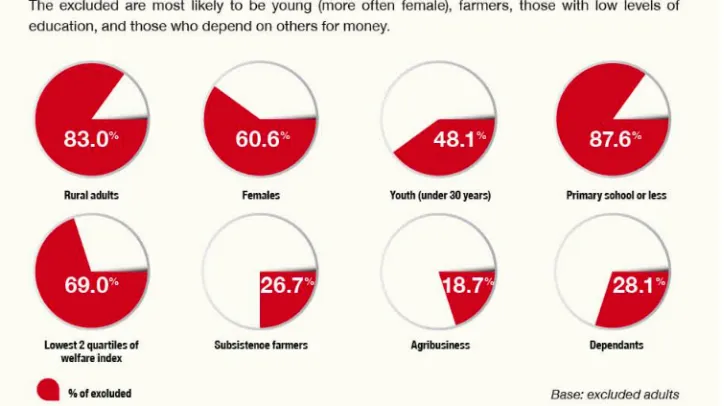
Figure 2 represents a descriptive graph of my sample in terms of the proportion of individuals that are financially included as opposed to those that are excluded. As presented in this figure, 34.1% of the population is financially excluded, meaning that they don’t have access to any sort of financial services, whether it is formal financial institutions or microfinance institutions. 38.5% reported using non-bank financial services, which include SACCOs and mobile money. Indeed, the use of mobile services has considerably expended over the years in several developing countries. Mobile money is used to send and receive money, but it can also be used to store/save money and pay bills. Alternatively, 20.5% of the sample claimed relying on friends and family for financial help, and only 6.7% reported using formal Bank services.
Econometric specification
As a starting point, one may wish to understand the relationship between group membership and individual saving behavior. Information sharing and behavioral imitation amongst group members have always been observed in societies. Manski (1995) suggested a few reasons explaining this behavioral imitation phenomenon. The first reason is correlated effects where individuals behave the same because they face similar environments. For instance, households may face common exogenous shocks such as natural disaster affecting all individuals’ finances. A second reason associated with behavioral imitation is contextual effects, where individuals have common characteristics, and thus behave similarly. Members who share characteristics such as education, level of income, or similar interests are more likely to join the same group and behave similarly. Finally, Manski also mentions endogenous effects as an explanation for herd behavior. This is a common situation where individual behavior varies with average behavior of group members. For example, Person A starts saving because Person B informs him of the benefits of having a savings account. Alternatively, if Person B doesn’t have a good experience with savings accounts, Person A will be less likely to open one as well.
variable, membership, that is now exogenous.
To probe the impact of membership in a group on financial behavior, I use proximity to a savings/credit cooperative as an instrument for SACCOs membership, since the later is an endogenous variable. Proximity to a SACCO is a variable corresponding to how far away the respondent is located from a cooperative depending on the traveling time reported. For instance, 1 corresponds to those who reported residing 30 minutes or less from a SACCO, 2 corresponds to 30 minutes to an hour, 3 corresponds to an hour or more, and so on. The IV model also addresses additional endogeneity issues that occur when regressing savings behavior on membership in a group such as reverse causality, as individuals savings behavior could be influenced by the group, alternatively, group behavior could influence the probability that one opens a formal savings account. The following model is estimated using a two-stage least squares (2SLS) estimator to explain the variation in savings behavior based on membership and a set of controls.
The first stage of the model consists of a regression of membership in a savings and credit cooperative (MB) on the instrument, which is proximity to a SACCO (L), and its covariates:
MBi,t = α + βLi,t+ γ Xi,t + εi
In the second stage, I include the predicted membership in the main regression, which yields:
Fi,t = α + βMB*i,t+ γ Xi,t + εi
Where Fi,t represents an outcome corresponding to the probability of opening a formal
savings account at a Bank; MBi,t is a variable indicating whether the individual is a part of a
savings/credit cooperative. Since information is transmitted through a network that is formed by participating in a savings/credit group, I hypothesize that members of a SACCO are more likely to open a formal savings account due to shared financial knowledge between cooperative members; in other words, I expect the coefficient of my main variable of interest MB to be positive. Further, Xi,t is a vector of household characteristics including household
accessibility and distance from the nearest Bank.
V. Results
Table 1 provides a description of summary statistics for the considered sample of 4473 individuals residing in rural Tanzania. Only adult individuals (>18 years old) were interviewed, and the average age is approximately 38 years old. The mean household size is five people per household; generally, larger families tend to save less as they have much more expenses. As expected, the average level of education of the head of household in rural areas is quite low, corresponding to level 3 or 4 of education, which is either some primary school or a primary school degree. Less than 50% of head of households own the house they live in, and about 12% report using mobile money, which is a successful phone-based microfinance service in several developing countries, allowing users to deposit money stored on their cell phones and to transfer money to other users. Owning a cellphone could imply that there’s a higher probability of using mobile money, and therefore save less with a bank. Alternatively, this could mean that cellphone owners have a higher income, and are more likely to open a savings account at a bank. 45% of the respondents reported using formal financial products, which include microfinance institutions and banks, and 43% report using informal mechanisms such as relying on friends and family for financial assistance. Of the respondents, 6% save at the Bank, 11% with a SACCO, 7% with a family member, and the majority, 75 %, save at home. Finally, the average income per month is 100,000 Tanzanian Shilling, which roughly corresponds to $50/month.
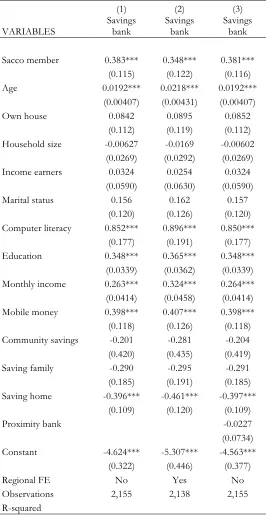
significant. Individuals who reported giving their money to a family member who can ‘keep it safe’, as well as those who save at home are less likely to join the bank, as expected. Education, age, income, and having a valid identification card are all significant determinants of formal savings. Finally, mobile money appears to be a positive significant determinant of formal savings. As I control for Regional fixed effects in column two of table 2, the coefficient slightly decreases, but remains significant. Similarly, controlling for bank proximity in the third column doesn’t seem to affect our coefficient of interest.
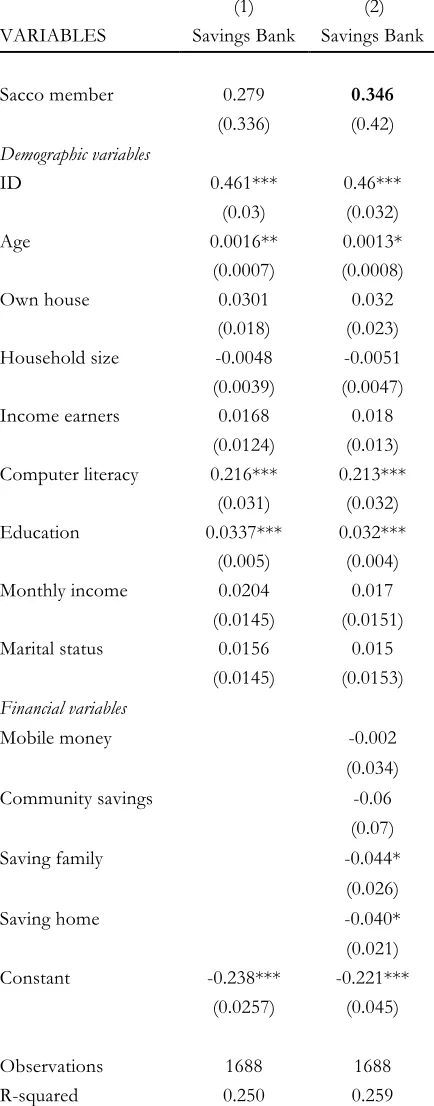
Moving on to table 3, I use a 2SLS model to estimate the impact of SACCO membership on formal savings due to endogeneity concerns. First and foremost, I run a Hausman test to test for endogeneity. I initially run an OLS regression of my dependent variable on the endogenous independent variable, and save the vectors of coefficients. Similarly, I run an IV regression and save the coefficients. A hausman test is then carried out to test the null hypothesis stating that OLS and IV coefficients are similar. Since Prob < 0.05, I reject the null hypothesis that the coefficients are the same, and conclude that the significant difference in the coefficients is due to bias in OLS caused by endogeneity.
I use proximity to a SACCO as an instrument for membership, this is a ranked categorical variable taking on values 1 through 4, 1 corresponding to being the closest to a SACCO, and 4 the furthest. As a rule of thumbs, to test the relevance of the instrument, the F-statistic in the first stage should be greater than 10. The F-statistic in my initial stage is 11.1, which indicates the reasonable strength of my instrument (F-stat >10) As shown in table 3, column 2, membership, controlling for regional fixed effects, has a positive but insignificant effect on formal savings when using the IV method. As expected, computer literacy, age, education, and having a valid identification card all have a positively significant impact on formal savings. As I add an additional set of controls in the second column, including financial variables such as whether the respondent uses mobile money, saves with community members, or saves at home, the membership coefficient increases, but remains insignificant.
SACCO loan and be able to increase their business capital. Secondly, they can choose to locate in such a region because it is highly populated, which means that there is a higher chance for their business to grow. In both cases, this can have an impact of the level of formal savings, and bias our results. Considering this possible source of bias, I choose to interact the following two variables: location and ranked importance of being part of a community group. I assume that individuals who believe being part of a community group is highly important and who are located close to a savings/credit group, will be more likely to join a SACCO, not because of the entrepreneurial attitude, but because they value group membership, and are more likely to refer to group members for financial decisions.
In Column two of table 3, I use an interactive instrument in order to see whether this can change the membership coefficient. Using a 2SLS model, I estimate the following model:
Stage 1:
MBi,t = α +δ proximity * involvement + ζ proximityi,t + η involvementi,t+ γ Xi,t + εi
Stage 2:
Fi,t = α + βMB*i,t+ γ Xi,t + εi
The instrument here is an interaction of the location and involvement variable corresponding to whether the individual has a weak or strong sense of involvement in community groups, which has a strong correlation with SACCO membership. I run a Hausman test for endogeneity to test whether IV is efficient compared to OLS. The significant p-value allows me to reject the null hypothesis that OLS is unbiased and efficient, which means that IV appropriate. The reported F-statistic in the first stage is 9.9; although not perfect, the F-stat is close to 10. These are my secondary results, and as they indicate in table 4 column 5, membership is positive and significant at the 10% level, thus individuals are more likely to join banks if they are SACCOs members; they are precisely 0.39 percentage points more likely to open a formal savings account. Age, education, computer literacy, identification card, and saving at home are still significant variables affecting formal savings.
by gender for SACCOs members. I find that there is no impact for male members, however, being a female member has a positive and significant impact on formal savings, and increases the probability of opening a savings account by 0.35 percentage points. This is in line with Kedir and Ibrahim (2011), who find that women are more likely to participate in a different form of savings and credit association knows as Rotating Savings and Credit Association (ROSCAS) in Ethiopia. Indeed women have a higher probability of joining savings/credit groups for the following reasons: there is less documentation required to join, these groups give women a certain degree of financial independence as they choose how to manage their money whereas men usually control their finances, and finally, as there is a higher level of interpersonal interactions amongst women in rural areas, and they are more likely to share information on savings groups, which influences financial behavior.
Women gain empowerment and some sort of financial independence that comes with non-bank financial products such as microfinance, savings groups, or mobile money. A woman who experiences some economic gain when using these products will be more open to the idea of formal savings. For instance, if the woman own a small business and gets a microfinance loan that allows her business to grow, she will progressively develop financial knowledge and literacy allowing her to choose banks over SACCOs, if she has had a negative experience with the later, which appears to be the case with most SACCOs members in rural Tanzania. Indeed, a study has shown that SACCOS in Tanzania have minimal contributions in promoting rural livelihoods, as 53.7 of the members reported that the decision to join a SACCO had no benefit, and did not make them better off. (Churk, 2015) An important reason identified as a problem related to savings and credits groups in Tanzania is the fact that there is a lack of good management skills, which should be a crucial component as villagers put their money and trust in savings/credit groups.
Discussion and conclusion
impact of SACCO membership on formal savings. My primary results show that participation in a savings and credit group in Rural Tanzania doesn’t have a significant effect on formal saving; however, further results indicate that individual degree of commitment to community groups plays an important role in determining financial behavior. Female SACCO members also appear to be significantly more likely to use formal bank services. Important policy implications following the results obtained so far are, first, the importance of making sure that SACCO truly promote economic interests of the members, as the majority of those residing in rural areas use non-bank products for financial services. Joining savings and credit groups appears to be more of a choice associated with trust, rather than an economic choice, thus policy makers need to ensure that these groups are well managed as they could substantially improve financial inclusion in rural areas. Secondly, I believe that targeting women is very important, as they often use savings to invest in the health and education of their children, which in turn has a positive impact on social welfare.
References
Anderson, S., & Baland, J. M. (2002). The economics of roscas and intrahousehold resource
allocation. Quarterly Journal of Economics, 963-995.
Anderson, S., Baland, J. M., & Moene, K. O. (2003). Enforcement and organizational design in
informal saving groups. Centre de recherche en économie du développement, Faculté
universitaires Notre-Dame de la Paix, Faculté des Sciences économiques et sociales.
Advani, A. (2014). Empirical methods for networks data: social effects, network formation and
measurement error. IFS Working Papers.
Baland, J. M., Guirkinger, C., & Mali, C. (2007). Pretending to be poor: borrowing to escape
forced solidarity in credit cooperatives in Cameroon.Economic Development and Cultural
Change.
Banerjee, A. V., & Dufflo, E. (2007). The economic lives of the poor. Journal of Economic
Perspectives.
Bwana, K. M., & Mwakujonga, J. (2013). Issues in SACCOS Development in Kenya and
Tanzania: The Historical and Development Perspectives.Developing Country
Studies, 3(5), 114-121.
Caudell, M., Rotolo, T., & Grima, M. (2015). Informal lending networks in rural Ethiopia.
Social Networks.
Chuang, Y., & Schechter, L. (2014). Social Networks in Developing Countries. Annual
Reviews.
Churk, Josephine. (2015) Contributions of Savings and Credit Cooperative Society on
Deaton, A. (1989). Saving and liquidity constraints (No. w3196). National Bureau of Economic
Research.
Demirgüç-Kunt, A., & Klapper, L. (2013). Measuring Financial Inclusion: Explaining
Variation in Use of Financial Services across and within Countries. Brookings Papers on
Economic Activity.
Dupas, P., & Robinson, J. (2013). Why Don’t the Poor Save More? Evidence from Health
Savings Experiments. American Economic Review, 103(4).
Evans A C (2002) The Unpaved Road Ahead: HIV/AIDS & Microfinance: An Exploration of
Kenya Credit Unions (SACCOs), Research Monograph Series No 21, World Council of
Credit Unions, Madison, Wisconsin.
Kaleshu, J., & Temu, S. (2012). Expansion of rural financial services through linkage banking
in Tanzania: Is joint action between savings and credit cooperative societies
(SACCOS) a promising approach?. Enterprise Development and Microfinance, 23(2),
146-160.
Karlan, D., & Morduch, J. (2009). Access to finance. Handbook of Development Economics, 5.
Kedir, A. M., & Ibrahim, G. (2011). ROSCAs in Urban Ethiopia: Are the Characteristics of
the Institutions More Important than those of Members?.Journal of Development
Studies, 47(7), 998-1016.
Ksoll, C., Lilleør, H. B., Lønborg, J. H., & Rasmussen, O. D. (2015). Impact of Village
Savings and Loans Associations: evidence from a cluster randomized trial. Journal of
Development Economics.
Lemma, T (2008) “Growth without Structures: The Cooperative Movement in Ethiopia”, in
Manski, C. F. (1993). Identification of endogenous social effects: The reflection
problem. The review of economic studies, 60(3), 531-542.
Mullainathan, S., & Shafir, E. (2009). Savings Policy and Decision-making in Low-Income
Households. Innovations for Poverty Action.
Newman, C., Tarp, F., & Van Den Broeck, K. (2014). Social Capital, Network Effects, and
Savings in Rural Vietnam. Review of Income and Wealth.
Prina, S. (2013). Banking of the poor via savings accounts: Evidence from a field experiment.
Qin, X., & Ndiege, B. O. (2013). Role of financial development in economic growth:
evidence from savings and credits cooperative societies in Tanzania.International
Journal of Financial Research, 4(2), 115.
Rutherford, S. (2000). Raising the curtain on the ‘microfinancial services era’.Small enterprise
development, 11(1), 13-25.
Smith, S & Ross, C (2006) How the SYNDICOOP Approach has Worked in East Africa, Geneva:
ILO, ICA and ICFTU.
Tache, G. M. (2006). Sustainable SACCO development. Chemonics International Inc.
Tache, G. M. (2007). Farmers empowering themselves–saving together. United States Agency
for International Development.
Figure 2: Included vs Excluded
Table1: Summary Statistics
1 2 3 4 5
VARIABLES N mean sd min max
Household size 4,473 5.06 2.59 1 15
Age 4,473 37.94 14.37 18 90
Marital status 4,473 0.72 0.44 0 1
Education 4,473 3.69 1.59 1 10
Computer literacy 4,473 0.026 0.16 0 1
Home owner 4,473 0.43 0.49 0 1
Monthly income (TZ Shillings) 4,473 100,000 1.04 50,000 2,000,000
Income earners 4,473 2 1.08 0 9
Mobile money 4,473 0.12 0.32 0 1
Savings Bank 4,473 0.06 0.23 0 1
Savings Sacco 4,473 0.11 0.31 0 1
SavingCommunity 4,473 0.01 0.12 0 1
Savings Family 4,473 0.07 0.26 0 1
Table 2
(1) (2) (3)
VARIABLES Savings bank Savings bank Savings bank
Sacco member 0.383*** 0.348*** 0.381***
(0.115) (0.122) (0.116)
Age 0.0192*** 0.0218*** 0.0192***
(0.00407) (0.00431) (0.00407)
Own house 0.0842 0.0895 0.0852
(0.112) (0.119) (0.112)
Household size -0.00627 -0.0169 -0.00602
(0.0269) (0.0292) (0.0269)
Income earners 0.0324 0.0254 0.0324
(0.0590) (0.0630) (0.0590)
Marital status 0.156 0.162 0.157
(0.120) (0.126) (0.120)
Computer literacy 0.852*** 0.896*** 0.850***
(0.177) (0.191) (0.177)
Education 0.348*** 0.365*** 0.348***
(0.0339) (0.0362) (0.0339)
Monthly income 0.263*** 0.324*** 0.264***
(0.0414) (0.0458) (0.0414)
Mobile money 0.398*** 0.407*** 0.398***
(0.118) (0.126) (0.118)
Community savings -0.201 -0.281 -0.204
(0.420) (0.435) (0.419)
Saving family -0.290 -0.295 -0.291
(0.185) (0.191) (0.185)
Saving home -0.396*** -0.461*** -0.397***
(0.109) (0.120) (0.109)
Proximity bank -0.0227
(0.0734)
Constant -4.624*** -5.307*** -4.563***
(0.322) (0.446) (0.377)
Regional FE No Yes No
Observations 2,155 2,138 2,155
R-squared
Table 3
(1) (2)
VARIABLES Savings Bank Savings Bank
Sacco member 0.279 0.346
(0.336) (0.42)
Demographic variables
ID 0.461*** 0.46***
(0.03) (0.032)
Age 0.0016** 0.0013*
(0.0007) (0.0008)
Own house 0.0301 0.032
(0.018) (0.023)
Household size -0.0048 -0.0051
(0.0039) (0.0047)
Income earners 0.0168 0.018
(0.0124) (0.013)
Computer literacy 0.216*** 0.213***
(0.031) (0.032)
Education 0.0337*** 0.032***
(0.005) (0.004)
Monthly income 0.0204 0.017
(0.0145) (0.0151)
Marital status 0.0156 0.015
(0.0145) (0.0153) Financial variables Mobile money -0.002 (0.034)
Community savings -0.06
(0.07) Saving family -0.044* (0.026) Saving home -0.040* (0.021)
Constant -0.238*** -0.221***
(0.0257) (0.045)
Observations 1688 1688
R-squared 0.250 0.259
Table 4
(1) (2) Female Male (3) (4)
VARIABLES Savings Bank Savings Bank Savings Bank Savings Bank Savings Bank Savings Bank
Sacco member 0.364* 0.413** 0.355* 0.373 0.39* 0.271
(0.202) (0.206) (0.216) (0.331) (0.221) (0.202)
Demographic variables
Age 0.0014** 0.0012** 0.0007 0.002** 0.001** 0.0012**
(0.0006) (0.0006) (0.0007) (0.0008) (0.0006) (0.0005)
ID 0.463*** 0.462*** 0.602*** 0.351*** 0.464*** 0.456***
(0.031) (0.032) (0.043) (0.0429) (0.031) (0.030)
Own house 0.033** 0.035** 0.0254 0.0199 0.352** 0.030*
(0.016) (0.017) (0.0233) (0.0288) (0.016) (0.015)
Household size -0.005 -0.005 -0.0013 -0.008 -0.055 -0.005
(0.0036) (0.003) (0.0051) (0.005) (0.0037) (0.0039)
Number income
earners 0.019** 0.0199** 0.0121 0.022* 0.0196** 0.0173
(0.009) (0.009) (0.011) (0.0125) (0.009) (0.009)
Computer literacy 0.215*** 0.214*** 0.198*** 0.263*** 0.212*** 0.206***
(0.032) (0.033) (0.037) (0.059) (0.033) (0.031)
Education 0.033*** 0.032*** 0.0204*** 0.043*** 0.032*** 0.032***
(0.004) (0.004) (0.006) (0.0082) (0.004) (0.004)
Monthly income 0.017* 0.015* 0.011 0.018 0.016* 0.023**
(0.009) (0.009) (0.014) (0.014) (0.009) (0.009)
Marital status 0.0144 0.015 0.013 0.032 0.015 0.014
(0.0114) (0.0119) (0.018) (0.0295) (0.0114) (0.014)
Financial variables
Mobile money -0.0079 -0.002 -0.001 -0.007 0.003
(0.0212) (0.0253) (0.0306) (0.0215) (0.017)
Community savings -0.067 -0.131 0.0402 -0.066 -0.0601
(0.064) (0.083) (0.068) (0.064) (0.059)
Saving family -0.046* -0.0611 -0.033 -0.045* -0.034
(0.0195) (0.0521) (0.045) (0.0195) (0.023)
Saving home -0.038** -0.0427** -0.0282 -0.039** -0.044**
(0.018) (0.0214) (0.035) (0.018) (0.018)
Proximity Bank -0.005 -0.0106*
(0.007) (0.006)
Constant -0.225*** -0.267*** -0.152** -0.27*** -0.206*** -0.162***
(0.0417) (0.034) (0.052) (0.0561) (0.05) (0.0403)
Regional FE No No No No No Yes