Maternal Smoking and Child Psychological Problems:
Disentangling Causal and Noncausal Effects
WHAT’S KNOWN ON THIS SUBJECT: Maternal prenatal smoking is strongly associated with various child psychological problems. It is not clear if this association reflects biological intrauterine effects of smoking or confounding by broader social,
environmental, and genetic factors.
WHAT THIS STUDY ADDS: Using multiple approaches for exploring causality we found evidence that whilst other psychological problems are unlikely to be causally related to maternal smoking, there is evidence that maternal smoking is causally related via intrauterine effects to child
conduct/externalizing problems.
abstract
+OBJECTIVE:To explore associations of maternal prenatal smoking and child psychological problems and determine the role of causal intrauterine mechanisms.
PATIENTS AND METHODS:Maternal smoking and child psychological problems were explored in 2 birth cohorts in Pelotas, Brazil (n⫽
509, random subsample), and the Avon Longitudinal Study of Par-ents and Children (ALSPAC) in Britain (n⫽6735). Four approaches for exploring causal mechanisms were applied: (1) cross-population comparisons between a high-income and a middle-income country; (2) multiple adjustment for socioeconomic and parental psychological factors; (3) maternal-paternal comparisons as a test of putative intrauterine effects; and (4) searching for specific effects on different behavioral subscales.
RESULTS:Socioeconomic patterning of maternal prenatal smoking was stronger in the ALSPAC compared with the Pelotas cohort. De-spite this difference in a key confounder, consistency in observed associations was found between these cohorts. In both cohorts, unadjusted maternal smoking was associated with greater off-spring hyperactivity, conduct/externalizing problems, and peer problems but not with emotional/internalizing problems. After ad-justing for confounders and paternal prenatal smoking, only the association with conduct/externalizing problems persisted in both cohorts (conduct problems in the ALSPAC cohort, odds ratio [OR]: 1.24 [95% confidence interval (CI): 1.07–1.46],P⫽.005; externaliz-ing problems in the Pelotas cohort, OR: 1.82 [95% CI: 1.19 –2.78],P⫽
.005; ORs reflect ordinal odds ratios of maternal smokers having offspring with higher scores). Maternal smoking associations were stronger than paternal smoking associations, although statistical evidence that these associations differed was weak in 1 cohort.
CONCLUSION:Evidence from 4 approaches suggests a possible intrauterine effect of maternal smoking on offspring conduct/ externalizing problems.Pediatrics2010;126:e57–e65
AUTHORS:Marie-Jo Brion, PhD,a,bCesar Victora, PhD,
MD,cAlicia Matijasevich, PhD, MD,cBernardo Horta, MD,c
Luciana Anselmi, PhD,cColin Steer, MSc,dAna Maria B.
Menezes, MD,cDebbie A. Lawlor, PhD, MB, ChB,a,band
George Davey Smith, MD, DSc, FMedScia,b
aMRC Centre for Causal Analyses in Translational Epidemiology, bDepartment of Social Medicine, anddCentre for Child and
Adolescent Health, University of Bristol, Bristol, United Kingdom; andcPostgraduate Programme in Epidemiology, Federal
University of Pelotas, Pelotas, Brazil
KEY WORDS
ALSPAC, Pelotas, prenatal smoking, child, behavioral problems, developmental origins
ABBREVIATIONS
ALSPAC—Avon Longitudinal Study of Parents and Children SDQ—Strengths and Difficulties Questionnaire
CBCL—Child Behavior Checklist OR— odds ratio
CI— confidence interval
Dr Brion conducted the analyses, wrote the first draft, and coordinated subsequent versions; Drs Victora, Horta, Matijasevich, Smith, and Lawlor provided guidance on the analyses; all the authors commented on the first and
subsequent drafts; Dr Anselmi is the psychologist for the Pelotas cohort and coordinated the collection of the psychological data; and Mr Steer conducted the statistical simulations for the nonpaternity sensitivity analyses.
www.pediatrics.org/cgi/doi/10.1542/peds.2009-2754
doi:10.1542/peds.2009-2754
Accepted for publication Apr 12, 2010
Address correspondence to Marie-Jo Brion, PhD, MRC Centre for Causal Analyses in Translational Epidemiology, University of Bristol, Oakfield House, Oakfield Grove, Bristol BS8 2BN, United Kingdom. E-mail: [email protected]
PEDIATRICS (ISSN Numbers: Print, 0031-4005; Online, 1098-4275).
Copyright © 2010 by the American Academy of Pediatrics
Associations between maternal smok-ing in pregnancy and increased psy-chological problems in offspring, in-cluding conduct disorders, antisocial behavior, attention-deficit/hyperactiv-ity disorder, and externalizing prob-lems, have been reported in many studies.1–6However, there is some
evi-dence that these associations may be completely confounded by social and familial factors that have not been pos-sible to fully take account of in studies to date.7–9Indeed, an inherent difficulty
in epidemiologic studies is the limited ability to control for all known con-founders.10 Thus, in order to obtain
reliable evidence of causal effects, it is important to use various different analytic approaches and alternative study designs.11
We aimed to explore the association of maternal smoking in pregnancy on off-spring psychological problems by us-ing 4 different approaches for explor-ing causality. First, we compared the consistency of associations between 2 birth cohorts, one from a high-income country (the Avon Longitudinal Study of Parents and Children [ALSPAC], in Britain) and the second from a middle-income country (the Pelotas 1993 co-hort, in Brazil), which would be likely to have different confounding structures for these associations. Such differ-ences have been found, for example, with respect to the confounding struc-ture of breastfeeding.12In high-income
countries, breastfeeding is strongly associated with more favorable socio-economic position, which is a known predictor of many beneficial health outcomes. This association between breastfeeding and favorable socioeco-nomic position results in a high prob-ability of observing relationships be-tween breastfeeding and improved health outcomes that are confounded by socioeconomic position (rather than reflecting causal effects of breastfeeding). However, because
breastfeeding does not tend to be related to socioeconomic factors in low- and middle-income countries, if associations largely reported in high-income countries were a result of residual confounding, we would antic-ipate that they would not be replicated in low- and middle-income countries. Conversely, causal relationships would be expected to be replicated in both the high- and low- or middle-income countries despite the differing socioeconomic patterning.
Second, we used extensive adjustment for multiple socioeconomic and paren-tal psychological factors. As stated above, the association between mater-nal smoking and offspring psychologi-cal problems may be completely con-founded by socioeconomic and psychological factors. Previous stud-ies have varied in the extent to which these factors have been adjusted for.
Third, we aimed to compare the associa-tions of maternal and paternal smoking during pregnancy with offspring out-comes as an approach for exploring in-trauterine effects on fetal develop-ment.13Briefly, this method was based
on the assumption that maternal expo-sures in pregnancy that directly affect fetal development will produce a much stronger association than paternal expo-sures at the same time, which would not generally be expected to affect fetal de-velopment or have minimal effects where secondhand smoke exposure is concerned. However, associations driven by shared familial, social, genetic, and environmental factors will be likely to produce similar maternal-paternal associations. This approach was vali-dated by markedly discordant associa-tions of maternal and paternal smoking in pregnancy with offspring birth weight, which is known to be directly affected by maternal smoking in pregnancy.13
The final approach was to search for specific effects of maternal smoking on different psychological outcomes,
because specificity of effects provides evidence that associations are caus-al.14If psychological problems involve
different biological pathways, a physi-ologic exposure would be expected to have specific effects on certain child psychological problems but not neces-sarily others.
METHODS
Participants
The ALSPAC Cohort
The ALSPAC cohort is a geographically based prospective cohort study that is investigating the health and develop-ment of children.15 Pregnant women
who resided in 3 health districts in the southwest of England with an expected date of delivery between April 1, 1991, and December 31, 1992, were eligible to enroll. In total, 14 541 pregnant women were recruited, 13 678 of whom delivered a live-born singleton child. For this study we excluded par-ents and children of multiple births. Data on both maternal and paternal smoking were available for 12 366 mother-partner pairs. Data on psycho-logical problems were available for 9314 children, and complete data on parental smoking were available for 8816 of these children. Analyses were conducted on 6735 children with complete data on socioeconomic confounders and mediators. Further analyses were also conducted on 4394 children with multiple mea-sures of parental psychopathology. Ethical approval for the study was obtained from the ALSPAC Law and Ethics Committee (IRB00003312) and 3 local research ethics committees.
The Pelotas Cohort
The 1993 Pelotas cohort consists of 5249 live-born newborns delivered in 1993 in Pelotas, Brazil. This cohort has been described in detail elsewhere.16
in the city. Pelotas is situated in the extreme south of Brazil near the Uru-guayan border and has a population of
⬃320 000 urban inhabitants. Four years after birth, a subsample that consisted of all low birth weight chil-dren plus a systematic sample of 20% of the remaining cohort were followed up. A random 50% subsample of the 1363 children located on that occasion were invited to take part in an assess-ment comprising detailed psychologi-cal measures.17Of these children (n⫽
634), our analysis was conducted on 509 singleton children with complete data on maternal smoking, paternal smoking, psychological problems, con-founders, and mediators.
Measures
Parental Smoking
For the ALSPAC cohort, data on mater-nal smoking in each trimester were available from questionnaires sent to mothers at 18 and 32 weeks’ gestation. Partner smoking during pregnancy was assessed from a questionnaire for partners given at 18 weeks’ gesta-tion. In Pelotas, information on mater-nal smoking in each trimester, as well as partner smoking, was collected at the perinatal visit.
Psychological Measures
For the ALSPAC cohort, child psycho-logical problems were assessed at 4 years by maternal report using the Strengths and Difficulties Question-naire (SDQ), a brief behavioral screen-ing questionnaire for children aged 4 to 16 years.18The SDQ comprises 25
questions that generate scores for inattention/hyperactivity, emotional symptoms (anxious and depressive symptoms), peer problems, and con-duct problems (aggressive and rule-breaking behavior). For the Pelotas co-hort, child psychological problems were assessed by using the Child Be-havior Checklist (CBCL)19administered
at the 4-year follow-up by a psycholo-gist.17The CBCL consists of 118 items
completed by parents and generates scores for scales on withdrawn, so-matic complaints, anxious/depressed, social problems, thought problems, at-tention problems, aggressive behav-ior, and rule-breaking behavior. Valid-ity of the CBCL has been demonstrated in a population of Brazilian children.20
Previous comparisons between the SDQ and CBCL have suggested equiva-lent validity between the instruments, with scores from the SDQ and CBCL be-ing both highly correlated and equally able to identify psychiatric cases.21
Furthermore, when judged against a semistructured interview, the SDQ was as good as the CBCL at detecting inat-tention and hyperactivity, internalizing problems, and externalizing problems. The psychological groups compared between the ALSPAC and Pelotas co-horts were based on those previously compared by Goodman and Scott21(ie,
SDQ scales of inattention/hyperactiv-ity, peer problems, emotional symp-toms, and conduct problems com-pared with the CBCL scales of attention problems, social problems, internaliz-ing [anxious/depressed, somatic complaints, thought problems] and ex-ternalizing [aggressive behavior, rule-breaking behavior], respectively).
Confounders and Mediators
Associations were adjusted for socio-economic position (maternal and pa-ternal education, social class, family income), parental psychopathology (ALSPAC cohort: maternal prenatal and postnatal depression, maternal prenatal anxiety, paternal prenatal and postnatal depression, paternal prenatal anxiety, maternal prenatal cohol intake, and paternal prenatal al-cohol intake; Pelotas cohort: maternal psychiatric problems; measures of pa-rental aggression/antisocial behavior were not available for either cohort),
and (in later models) for mediators (birth weight, gestational age, and breastfeeding). Detailed information on these measures is provided in the Supplemental Text.
Statistical Analysis
Socioeconomic patterning of mater-nal/paternal smoking was assessed by using quintiles/groups of family in-come and2tests for linear trend, and
cross-cohort differences were ex-plored by using indices of inequality22
pater-nal associations by using simulations (see Supplemental Text). All Pelotas-cohort analyses were weighted to cor-rect for the oversampling of low birth weight infants. Analyses were re-peated by using dichotomous out-comes for clinical psychological prob-lems. All analyses were performed by using Stata 10 (Stata Corp, College Sta-tion, TX).
RESULTS
The prevalence of any maternal smok-ing in pregnancy in the Pelotas sub-sample (similar to that of the whole cohort23) was almost twice as high as
that in the ALSPAC sample (29.4% vs 15.9%, respectively). In addition, the proportion of mothers who smoked at high doses (ⱖ20 cigarettes per day in the third trimester) was greater in the Pelotas cohort than in the ALSPAC co-hort (see Table 1).
Maternal and paternal smoking in pregnancy were both associated with
lower socioeconomic position in both the ALSPAC and Pelotas cohorts but the associations seemed steeper in the AL-SPAC cohort (Table 2). Indices of in-equality between the highest and low-est income levels with respect to maternal smoking were 3.7 times greater in the ALSPAC cohort (OR: 0.14 [95% confidence interval (CI): 0.11– 0.18]; P ⬍ .001, for maternal smoking in the highest compared with lowest level) than in the Pelotas cohort (OR: 0.52 [95% CI: 0.25–1.06];P⫽.07, for maternal smoking in the highest compared with lowest level). There was modest evidence of statistical het-erogeneity between the ALSPAC and Pelotas cohorts (P⫽ .07). Indices of inequality for paternal smoking were also greater in the ALSPAC cohort (OR: 0.19 [95% CI: 0.16 – 0.23]; P ⬍ .001) compared with those in the Pelotas co-hort (OR: 0.32 [95% CI: 0.17– 0.63];P⫽
.001), although there was weak evi-dence of ALSPAC-Pelotas heterogeneity (P⫽.3). Thus, although the statistical evidence for ALSPAC-Pelotas ences were modest to weak, differ-ences in point estimates suggest a stronger influence of socioeconomic position on parental smoking during pregnancy in the British cohort com-pared with that in the Brazilian cohort, which is further supported by the con-founder associations discussed below.
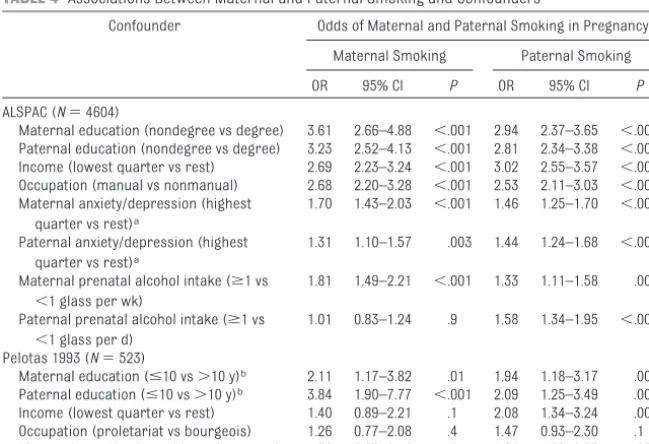
Associations with confounding factors are listed in Tables 3 and 4. In the AL-SPAC cohort, child psychological prob-lems were associated with lower
so-cioeconomic position and maternal and paternal anxiety/depression. In the Pelotas cohort, child psychological problems were unassociated with so-cioeconomic position but strongly as-sociated with maternal psychiatric problems. Maternal and paternal smoking were associated with socio-economic position and maternal pre-natal alcohol intake in the ALSPAC co-hort. In the Pelotas cohort, maternal smoking was associated with mater-nal and patermater-nal lower education but unassociated with other indicators of socioeconomic position and maternal psychiatric problems. Paternal smok-ing in the Pelotas cohort was associ-ated with all indicators of lower socio-economic position and maternal psychiatric problems.
In unadjusted models, maternal smok-ing in pregnancy was associated with inattention/hyperactivity, conduct/ex-ternalizing, and peer/social problems but not with emotional/internalizing problems (Table 5). In models for so-cioeconomic factors and maternal-paternal smoking that were mutually adjusted for one another, maternal smoking associations persisted for conduct/externalizing problems in both cohorts. Adjustment for potential mediators (birth weight, gestational age, breastfeeding duration) did not change the associations (data not shown). After mutually adjusting for parental psychopathology, socioeco-nomic factors, and maternal-paternal smoking (Table 6), the associations
TABLE 1 Maternal and Paternal Smoking in Pregnancy in the ALSPAC and Pelotas Cohorts
Parental Smoking in Pregnancy
ALSPAC, %
Pelotas, %a
Maternal smoking Any smoking in pregnancyb
15.9 29.4
First trimester Smoked in the first
trimesterb
18.3 27.3
Smokedⱖ20 cigarettes per dc
11.6 21.5
Second trimester Smoking in the second
trimesterb
14.1 27.1
Smokedⱖ20 cigarettes per dc
11.8 21.6
Third trimester Smoking in the third
trimesterb
15.4 26.0
Smokedⱖ20 cigarettes per dc
13.2 24.3
Paternal smoking Any smoking in pregnancyb
31.9 49.6
aThe Pelotas prevalence was weighted (because of the oversampling of low birth weight infants).
bProportion as a percentage of the whole sample. cProportion as a percentage of the smokers for that par-ticular trimester.
TABLE 2 Prevalence of Maternal and Paternal Smoking in Pregnancy According to Family Income
Cohort Prevalence of Parental Smoking in Pregnancy, % P, Trend Group 1 (Lowest
Income)
Group 2 Group 3 Group 4 Group 5 (Highest Income)
Maternal smoking
ALSPAC 45.5 31.6 20.2 15.1 11.1 ⬍.001
Pelotas 38.1 25.0 35.1 30.4 20.5 .05
Paternal smoking
ALSPAC 60.6 48.8 33.2 27.1 22.3 ⬍.001
Pelotas 69.0 42.2 54.2 57.5 31.4 ⬍.001
with conduct/externalizing problems persisted in both cohorts, and weaker or null associations were observed with hyperactivity, emotional/internal-izing, and peer/social problems.
Asso-ciations (fully adjusted, mutual model) did not differ systematically between the ALSPAC and Pelotas cohorts (P val-ues for heterogeneity: attention/hyper-activity, P⫽ .2;
emotional/internaliz-ing,P⫽.6; conduct/externalizing,P⫽
.1; peer/social,P⫽.5).
Statistical evidence for differences
be-tween the maternal and paternal smoking associations with child psy-chological problems were explored. In fully adjusted models there were
dif-ferences between point estimates of maternal and paternal smoking asso-ciations with child conduct/externaliz-ing problems, although with weak evi-dence of statistical difference in the
ALSPAC cohort (P[difference] ⫽ 0.3 and 0.03, ALSPAC and Pelotas, respec-tively). There was no strong evidence of maternal-paternal differences in as-sociations with the remaining types of
child psychological problems when fully adjusted (P[difference]⫽0.9 and 0.3 [attention problems], 0.9 and 0.3 [emotional/internalizing problems],
and 0.1 and 0.3 [peer problems], AL-SPAC and Pelotas, respectively).
Sensitivity analyses were explored by modeling effects of nonpaternity on the fully adjusted associations of
ma-TABLE 3 Associations of Child Psychological Problems With Confounders
Confounder Ordinal Odds for Higher Child Psychological Problem Score
Inattention/Hyperactivity (ALSPAC) or Attention
Problems (Pelotas)
Emotional (ALSPAC) or Internalizing (Pelotas)
Problems
Conduct (ALSPAC) or Externalizing (Pelotas)
Problems
Peer (ALSPAC) or Social (Pelotas) Problems
OR 95% CI P OR 95% CI P OR 95% CI P OR 95% CI P
ALSPAC (N⫽4394)
Maternal education (nondegree vs degree) 1.97 1.71–2.27 ⬍.001 0.86 0.75–1.00 .04 1.23 1.07–1.42 .003 1.50 1.30–1.73 ⬍.001 Paternal education (nondegree vs degree) 1.83 1.61–2.06 ⬍.001 0.95 0.84–1.08 .4 1.08 0.95–1.22 .2 1.35 1.19–1.53 ⬍.001 Income (lowest quarter vs rest) 1.61 1.40–1.87 ⬍.001 1.17 1.01–1.36 .03 1.55 1.34–1.80 ⬍.001 1.66 1.43–1.92 ⬍.001 Occupation (manual vs nonmanual) 1.51 1.29–1.77 ⬍.001 0.95 0.81–1.12 .6 1.40 1.19–1.64 ⬍.001 1.37 1.17–1.61 ⬍.001 Maternal anxiety/depression (highest
quarter vs rest)a
1.60 1.41–1.81 ⬍.001 1.73 1.52–1.97 ⬍.001 1.76 1.55–2.01 ⬍.001 1.75 1.54–2.00 ⬍.001
Paternal anxiety/depression (highest quarter vs rest)a
1.13 1.00–1.28 .05 o1.14 1.01–1.30 .04 1.32 1.17–1.50 ⬍.001 1.11 0.98–1.26 .1
Maternal prenatal alcohol intake (ⱖ1 vs
⬍1 glass per wk)
1.08 0.93–1.25 .3 0.99 0.85–1.15 .9 1.25 1.08–1.45 .003 1.23 1.06–1.42 .007
Paternal prenatal alcohol intake (ⱖ1 vs
⬍1 glass per d)
0.86 0.75–0.98 .03 0.99 0.86–1.14 .9 1.12 0.98–1.29 .1 0.92 0.80–1.06 .2
Pelotas 1993 (N⫽523)
Maternal education (ⱕ10 vs⬎10 y)b 1.06 0.70–1.61 .8 1.13 0.74–1.72 .6 0.80 0.55–1.17 .3 0.98 0.63–1.54 .9
Paternal education (ⱕ10 vs⬎10 y)b 1.97 1.22–3.17 .003 1.30 0.83–2.02 .3 1.05 0.67–1.65 .8 1.07 0.66–1.72 .8
Income (lowest quarter vs rest) 0.95 0.66–1.37 .8 1.36 0.93–1.99 .1 0.83 0.56–1.22 .3 1.03 0.68–1.58 .9 Occupation (proletariat vs bourgeois) 0.88 0.58–1.32 .5 1.05 0.69–1.58 .8 0.71 0.48–1.07 .1 1.00 0.67–1.48 .99 Maternal psychiatric problems (yes vs no) 3.31 2.21–4.95 ⬍.001 5.03 3.34–7.59 ⬍.001 3.06 2.07–4.50 ⬍.001 2.26 1.51–3.38 ⬍.001 aMaternal and paternal anxiety/depression scores represent combined scores on prenatal and postnatal depression and prenatal anxiety.
bTotal number of years of schooling.
TABLE 4 Associations Between Maternal and Paternal Smoking and Confounders
Confounder Odds of Maternal and Paternal Smoking in Pregnancy
Maternal Smoking Paternal Smoking
OR 95% CI P OR 95% CI P
ALSPAC (N⫽4604)
Maternal education (nondegree vs degree) 3.61 2.66–4.88 ⬍.001 2.94 2.37–3.65 ⬍.001 Paternal education (nondegree vs degree) 3.23 2.52–4.13 ⬍.001 2.81 2.34–3.38 ⬍.001 Income (lowest quarter vs rest) 2.69 2.23–3.24 ⬍.001 3.02 2.55–3.57 ⬍.001 Occupation (manual vs nonmanual) 2.68 2.20–3.28 ⬍.001 2.53 2.11–3.03 ⬍.001 Maternal anxiety/depression (highest
quarter vs rest)a
1.70 1.43–2.03 ⬍.001 1.46 1.25–1.70 ⬍.001
Paternal anxiety/depression (highest quarter vs rest)a
1.31 1.10–1.57 .003 1.44 1.24–1.68 ⬍.001
Maternal prenatal alcohol intake (ⱖ1 vs
⬍1 glass per wk)
1.81 1.49–2.21 ⬍.001 1.33 1.11–1.58 .002
Paternal prenatal alcohol intake (ⱖ1 vs
⬍1 glass per d)
1.01 0.83–1.24 .9 1.58 1.34–1.95 ⬍.001
Pelotas 1993 (N⫽523)
Maternal education (ⱕ10 vs⬎10 y)b 2.11 1.17–3.82 .01 1.94 1.18–3.17 .009
Paternal education (ⱕ10 vs⬎10 y)b 3.84 1.90–7.77 ⬍.001 2.09 1.25–3.49 .005
Income (lowest quarter vs rest) 1.40 0.89–2.21 .1 2.08 1.34–3.24 .001 Occupation (proletariat vs bourgeois) 1.26 0.77–2.08 .4 1.47 0.93–2.30 .1 Maternal psychiatric problems (yes vs no) 1.36 0.87–2.14 .2 1.64 1.06–2.53 .03
aMaternal and paternal anxiety/depression scores represent combined scores on prenatal and postnatal depression and prenatal anxiety.
ternal and paternal smoking on child conduct problems by using simulated data sets (seeSupplemental Table 7). The results of these simulations sug-gest that the ALSPAC data exhibited some sensitivity to nonpaternity, with the paternal smoking association in-creasing by 10% and maternal associ-ation decreasing by 2% for a 10% non-paternity rate. In contrast, the Pelotas data were relatively insensitive to non-paternity, which may reflect the small/ null paternal smoking effect on con-duct problems. These results indicate that any difference in parental effects in the ALSPAC study was weakened fur-ther; even without any nonpaternity there was little statistical evidence for differences in parental effects (P [dif-ference] ⫽ 0.3) despite
maternal-paternal point estimates being in the
ratio of 2:1. In contrast, for the Pelotas data, the greater maternal effect re-ported for the observed data is likely to be resilient to nonpaternity.
When psychological problems were analyzed as dichotomous outcomes for clinical psychological problems (in the ALSPAC cohort only; the Pelo-tas analyses were underpowered), results similar to those found when using ordered categories of psycho-logical problem scores were ob-served (seeSupplemental Table 8).
DISCUSSION
There was some evidence that mater-nal smoking in pregnancy is associ-ated with greater
conduct/externaliz-ing problems in offsprconduct/externaliz-ing at the age of 4 years via a causal intrauterine mech-anism. Consistent results were ob-served between the British and Brazil-ian cohorts despite different strengths in the confounding patterning of ma-ternal smoking according to socioeco-nomic position. In both cohorts associ-ations of maternal smoking in pregnancy persisted after adjustment for socioeconomic position, parental psychopathology, and paternal smok-ing, and there were consistent results for both cohorts regarding the speci-ficity of the maternal smoking associ-ation with conduct/externalizing prob-lems. Stronger maternal (versus paternal) smoking associations were observed in both cohorts (although not statistically different in the ALSPAC
TABLE 5 Associations of Maternal and Paternal Smoking in Pregnancy With Offspring Psychological Problems
Parental Smoke Offspring Psychological Problems, Score
Individual Maternal-Paternal Models Mutually Adjusted Maternal-Paternal Models
Model 1a Model 2b Model 1a Model 2b
OR 95% CI P OR 95% CI P OR 95% CI P OR 95% CI P
Hyperactivity/attention problems ALSPAC
Maternal smoking 1.46 1.31–1.62 ⬍.001 1.17 1.05–1.31 .004 1.37 1.22–1.53 ⬍.001 1.17 1.04–1.31 .009 Paternal smoking 1.28 1.17–1.40 ⬍.001 1.06 0.96–1.16 .3 1.17 1.07–1.29 .001 1.02 0.92–1.12 .7 Pelotas
Maternal smoking 1.56 1.08–2.25 .02 1.38 0.94–2.03 .1 1.48 0.99–2.19 .05 1.35 0.90–2.01 .1 Paternal smoking 1.31 0.94–1.82 .1 1.17 0.82–1.68 .4 1.18 0.82–1.69 .4 1.10 0.76–1.60 .6 Emotional/internalizing problems
ALSPAC
Maternal smoking 1.05 0.94–1.17 .4 1.00 0.89–1.12 .96 1.05 0.94–1.18 .4 1.01 0.90–1.14 .8 Paternal smoking 1.01 0.92–1.11 .8 0.97 0.88–1.07 .5 0.99 0.90–1.10 .9 0.97 0.87–1.07 .5 Pelotas
Maternal smoking 0.98 0.68–1.41 .9 0.95 0.65–1.39 .9 0.99 0.67–1.46 .9 0.97 0.65–1.45 .9 Paternal smoking 0.98 0.69–1.38 .9 0.92 0.65–1.32 .7 0.98 0.68–1.42 .9 0.93 0.64–1.36 .7 Conduct/externalizing problems
ALSPAC
Maternal smoking 1.65 1.48–1.84 ⬍.001 1.46 1.30–1.63 ⬍.001 1.52 1.36–1.71 ⬍.001 1.40 1.24–1.58 ⬍.001 Paternal smoking 1.36 1.24–1.49 ⬍.001 1.22 1.11–1.34 ⬍.001 1.20 1.09–1.33 ⬍.001 1.12 1.02–1.24 .02 Pelotas
Maternal smoking 1.67 1.17–2.39 .005 1.72 1.18–2.51 .005 1.68 1.13–2.50 .01 1.72 1.14–2.58 .009 Paternal smoking 1.15 0.82–1.60 .4 1.16 0.82–1.63 .4 0.98 0.68–1.42 .9 0.96 0.66–1.39 .8 Peer/social problems
ALSPAC
Maternal smoking 1.46 1.31–1.63 ⬍.001 1.23 1.09–1.37 ⬍.001 1.42 1.27–1.56 ⬍.001 1.24 1.10–1.40 ⬍.001 Paternal smoking 1.19 1.09–1.31 ⬍.001 1.02 0.92–1.12 .7 1.07 0.97–1.18 .2 0.96 0.92–1.03 .4 Pelotas
Maternal smoking 1.45 1.00–2.11 .05 1.45 0.98–2.14 .06 1.43 0.98–2.11 .09 1.44 0.97–2.15 .07 Paternal smoking 1.15 0.80–1.63 .5 1.10 0.76–1.60 .6 1.05 0.73–1.51 .7 1.02 0.70–1.50 .9
Ordinal logistic regression; ORs of having offspring in higher scores for psychological problems in maternal smokers versus non-smokers. ALSPAC:N⫽6735; Pelotas:N⫽509. aModel 1: unadjusted.
cohort), and paternal smoking was not strongly associated with offspring conduct/externalizing in either cohort.
Discordant maternal-paternal smok-ing associations suggest that mater-nal prenatal smoking may have specific intrauterine effects on com-ponents of offspring development. Any direct effects of maternal smoking in pregnancy on fetal development would
be expected to be substantially greater than effects of partners smoking dur-ing this period (includdur-ing the effects of exposures to secondhand smoke). However, maternal smoking may be more strongly associated with child problems than paternal smoking, me-diated by, for example, maternal psy-chological problems exerting a stron-ger influence on child behavior than paternal problems. Indeed, mothers who smoke during pregnancy have higher rates of interpersonal and be-havior problems and notably aggres-sive and antisocial behaviors.24
Al-though maternal antisocial behavior has been found to be an important component of the association between maternal smoking and child conduct problems,8it could not be explored in
our study because data on maternal aggressive or antisocial behavior were not available.
The potential role of genetic factors has been discussed previously.8,25–27
There is evidence from studies that used different study designs (such as studying children of twins,3discordant
siblings,28 and prenatal
cross-fostering9) that genetic factors may
play an important role in moderating the association between maternal pre-natal smoking and child behavioral problems. In addition, maternal smok-ing associations may also be partly confounded by genetic factors. Indeed, a recent twin study revealed that ge-netic effects may account for approxi-mately half of the observed associa-tion between maternal smoking and child conduct problems.8This could
oc-cur if, for example, mothers with be-havioral problems/antisocial behavior are more likely to smoke and, via ge-netic transmission, also have greater risk of having children with behavioral problems.3 One might anticipate that
such pathways would result in associ-ations of both mother’s and father’s smoking with offspring behaviors, as
genetic variants would be inherited from both parents. A stronger mater-nal association would be consistent with a parent-of-origin effect of inheri-tance, but to our knowledge such ef-fects have not been found or sug-gested for inheritance patterns of smoking behaviors. In our study there was no association between paternal smoking and offspring psychological problems, which would suggest that confounding by inheritance of ge-netic factors in this way may not be driving the associations observed here. Paternal associations may be diluted by nonpaternity; however, although the ALSPAC results were sensitive to increasing levels of non-paternity, such was not the case for the Pelotas associations.
The specificity of the maternal smok-ing association with child conduct/ex-ternalizing problems lends further support to the possibility that this as-sociation is mediated via adverse effects of intrauterine exposure to tobacco on neurodevelopmental path-ways. There is evidence to support a developmental neurobiological basis of antisocial and aggressive behavior and, in particular, in relation to fetal exposure to nicotine.29In animals, fetal
nicotine exposure results in altered physiology at neuronal sites that con-trol arousal and more excitable off-spring.30Nicotine-induced inhibition of
the monoamine oxidase system during fetal development has also been impli-cated in the relationship between ma-ternal smoking and offspring aggres-sion and conduct disorders.29
Although in the ALSPAC cohort mater-nal smoking was strongly associated with all indicators of socioeconomic position (a key confounder), in the Pe-lotas cohort maternal smoking was not consistently associated with these factors. Furthermore, indices of in-equality (based on income) for mater-nal smoking were⬃4 times lower in
TABLE 6 Associations of Maternal and Paternal Smoking in Pregnancy With Offspring Psychological Problems, Adjusted for Socioeconomic and Parental Psychopathology Factors
Parental Smoke Offspring Psychological Problems, Score
OR 95% CI P
Hyperactivity/attention problems ALSPAC
Maternal smoking 1.01 0.87–1.18 .9 Paternal smoking 1.03 0.91–1.17 .6 Pelotas
Maternal smoking 1.44 0.94–2.19 .09 Paternal smoking 1.04 0.71–1.50 .8 Emotional/internalizing
problems ALSPAC
Maternal smoking 0.95 0.81–1.11 .5 Paternal smoking 0.93 0.82–1.06 .3 Pelotas
Maternal smoking 0.99 0.66–1.50 .98 Paternal smoking 0.85 0.58–1.24 .4 Conduct/externalizing
ALSPAC
Maternal smoking 1.24 1.07–1.46 .005 Paternal smoking 1.11 0.98–1.26 .1 Pelotas
Maternal smoking 1.82 1.19–2.78 .005 Paternal smoking 0.96 0.66–1.41 .9 Peer/social
problems ALSPAC
Maternal smoking 1.20 1.03–1.40 .02 Paternal smoking 1.01 0.89–1.15 .9 Pelotas
Maternal smoking 1.46 0.97–2.19 .1 Paternal smoking 0.98 0.67–1.45 .99
the Pelotas than in the ALSPAC cohort. Thus, as a result of this weaker socio-economic patterning of maternal smoking observed in the Pelotas co-hort, if maternal smoking associations were driven by confounding by socio-economic position, one would expect smaller associations in the Pelotas hort compared with the ALSPAC co-hort. However, we observed consistent patterns of association in both co-horts, which suggests that residual confounding by socioeconomic factors is not likely to be completely driving the association of maternal smoking with offspring conduct/externalizing problems.
LIMITATIONS
Several potentially important con-founders were not available in this study, including maternal antisocial behavior and, in the Pelotas cohort, data on paternal psychological factors and maternal/paternal prenatal alco-hol intake. Second, although we aimed to compare the same psychological measures across cohorts, different in-struments were used to assess child behavior (SDQ versus CBCL). However, as discussed in “Methods,” these in-struments have been found to have equivalent validity and comparable subscales. Finally, assessment of pa-rental smoking in both cohorts was based on self-report. A meta-analysis of comparisons with biochemical mea-sures revealed self-reported smoking measures to be accurate.31However,
results of a recent retrospective
cross-sectional study suggest that there may be substantial underestima-tion of smoking behavior by women who are pregnant.32 If any such
mis-classification occurred in our cohorts and was nonsystematic with respect to our outcome measures (which is likely, because we obtained smoking data prospectively at the time of preg-nancy or birth, and mothers could not have known what their children’s be-havior would be like at that time), the statistical expectation would be that associations would be biased toward the null. Thus, the true association be-tween maternal smoking and child conduct/externalizing problems may be stronger.
CONCLUSIONS
On the basis of several different ap-proaches, we found some evidence of a causal relationship between maternal smoking and offspring conduct/exter-nalizing problems, but this association was not found for offspring attention-deficit/hyperactivity disorder or emo-tional/internalizing problems. If our findings are confirmed in future stud-ies, they imply that interventions to re-duce maternal smoking in pregnancy might have beneficial effects on future offspring conduct/externalizing prob-lems. By using multiple approaches (as we have done here) for assessing causality in observational studies, par-ticularly those that explore develop-mental origins of health and disease, etiologic epidemiology studies in gen-eral could be improved.
ACKNOWLEDGMENTS
The UK Medical Research Council (MRC), the Wellcome Trust, and the
University of Bristol provide core sup-port for the ALSPAC. The Pelotas 1993 cohort is currently funded by the Well-come Trust Major Awards for Latin
America on Health Consequences of Population Change. Dr Brion is funded by a Sir Henry Wellcome Postdoctoral Fellowship. Drs Lawlor and Smith work in an MRC center that receives
infra-structure support from UK Medical Re-search Council grant G0600705. Dr Lawlor’s contribution to this work is also supported by UK Economic and
So-cial Research Council grant RES-060-23-0011). Contents of this article repre-sent the views of the authors and not necessarily those of the funding
bod-ies. The funding bodies did not play a role in the design or conduct of this study; the collection, management, analysis, or interpretation of the data;
or the preparation, review, or approval of the manuscript. Drs Brion and Smith serve jointly as guarantors for the con-tents of this article.
We are extremely grateful to all the families that took part in both studies, the ALSPAC midwives for their help in
recruiting, and the ALSPAC and Pelotas teams, which include interviewers, computer and laboratory technicians, clerical workers, research scientists, volunteers, managers, receptionists,
and nurses. We thank Joe Murray for his comments on an earlier draft.
REFERENCES
1. Herrmann M, King K, Weitzman M. Prenatal tobacco smoke and postnatal secondhand smoke exposure and child neurodevelop-ment. Curr Opin Pediatr. 2008;20(2): 184 –190
2. Linnet KM, Dalsgaard S, Obel C, et al. Mater-nal lifestyle factors in pregnancy risk of at-tention deficit hyperactivity disorder and associated behaviors: review of the current evidence. Am J Psychiatry.2003;160(6): 1028 –1040
3. Knopik VS. Maternal smoking during preg-nancy and child outcomes: real or spurious effect?Dev Neuropsychol.2009;34(1):1–36
4. Huizink AC, Mulder EJ. Maternal smoking, drinking or cannabis use during pregnancy and neurobehavioral and cognitive func-tioning in human offspring.Neurosci Biobe-hav Rev.2006;30(1):24 – 41
5. Stene-Larsen K, Borge AI, Vollrath ME. Ma-ternal smoking in pregnancy and exMa-ternal-
external-izing behavior in 18-month-old children: re-sults from a population-based prospective study.J Am Acad Child Adolesc Psychiatry.
2009;48(3):283–289
6. Obel C, Linnet KM, Henriksen TB, et al. Smok-ing durSmok-ing pregnancy and hyperactivity-inattention in the offspring: comparing re-sults from three Nordic cohorts. Int J Epidemiol.2009;38(3):698 –705
Ma-ternal smoking during pregnancy and child behaviour problems: the Generation R Study.Int J Epidemiol.2009;38(3):680 – 689 8. Maughan B, Taylor A, Caspi A, Moffitt TE.
Pre-natal smoking and early childhood conduct problems: testing genetic and environmen-tal explanations of the association.Arch Gen Psychiatry.2004;61(8):836 – 843 9. Rice F, Harold GT, Boivin J, Hay DF, van den
Bree M, Thapar A. Disentangling prenatal and inherited influences in humans with an experimental design. Proc Natl Acad Sci U S A. 2009;106(7):2464 –2467
10. Lawlor DA, Davey Smith G, Kundu D, Bruck-dorfer KR, Ebrahim S. Those confounded vitamins: what can we learn from the differ-ences between observational versus ran-domised trial evidence? Lancet. 2004; 363(9422):1724 –1727
11. Thapar A, Rutter M. Do prenatal risk factors cause psychiatric disorder? Be wary of causal claims.Br J Psychiatry.2009;195(2): 100 –101
12. Batty GD, Victora C, Lawlor DA. Family based life course studies in low- and middle-income countries. In: Lawlor DA, Mishra G, eds. Family Matters: Using Family Based Studies to Determine the Mechanisms Un-derlying Early Life Determinants of Adult Chronic Diseases. Oxford, United Kingdom: Oxford University Press; 2009:129 –150
13. Davey Smith G. Assessing intrauterine influ-ences on offspring health outcomes: can epidemiological studies yield robust find-ings [published correction appears inBasic Clin Pharmacol Toxicol. 2008;102(5):489]?
Basic Clin Pharmacol Toxicol.2008;102(2): 245–256
14. Hill A. The environment and disease: associ-ation or causassoci-ation?Proc R Soc Med.1965; 58:295–300
15. Golding J, Pembrey M, Jones R. ALSPAC: the Avon Longitudinal Study of Parents and Chil-dren. I. Study methodology.Paediatr Peri-nat Epidemiol.2001;15(1):74 – 87
16. Victora CG, Hallal PC, Arau´jo CL, Menezes AM, Wells JC, Barros FC. Cohort profile: the 1993 Pelotas (Brazil) birth cohort study.Int J Epidemiol.2008;37(4):704 –709
17. Anselmi L, Piccinini CA, Barros FC, Lopes RS. Psychosocial determinants of behaviour problems in Brazilian preschool children.
J Child Psychol Psychiatry. 2004;45(4): 779 –788
18. Goodman R. The Strengths and Difficulties Questionnaire: a research note.J Child Psy-chol Psychiatry.1997;38(5):581–586 19. Achenbach TM.Manual for the Child
Be-haviour Checklist/4-18 and 1991 Profile. Burlington, VT: University of Vermont; 1991
20. Bordin I, Mari J, Caeiro M. Validation of the Brazilian version of the “Child Behavior Checklist” (CBCL): preliminary data [in Por-tuguese].Rev Bras Psiquiatr.1995;17(2): 55–56
21. Goodman R, Scott S. Comparing the Strengths and Difficulties Questionnaire and the Child Behavior Checklist: is small beautiful?J Ab-norm Child Psychol.1999;27(1):17–24 22. Mackenbach JP, Kunst AE. Measuring the
magnitude of socio-economic inequalities in health: an overview of available mea-sures illustrated with two examples from Europe. Soc Sci Med. 1997;44(6):757– 771
23. Horta BL, Victora CG, Barros FC, dos Santos I, Menezes AM. Tobacco smoking among pregnant women in an urban area in south-ern Brazil, 1982–93 [in Portuguese].Rev Saude Publica.1997;31(3):247–253 24. Wakschlag LS, Pickett KE, Middlecamp MK,
Walton LL, Tenzer P, Leventhal BL. Pregnant smokers who quit, pregnant smokers who don’t: does history of problem behavior make a difference? Soc Sci Med.2003; 56(12):2449 –2460
25. Fergusson DM. Prenatal smoking and anti-social behavior.Arch Gen Psychiatry.1999; 56(3):223–224
26. Maughan B. Unravelling prenatal influences: the case of smoking in pregnancy.Int J Epide-miol.2009;38(3):619 – 621
27. Davey Smith G. Intergenerational influences on health: how far back do we have to go?
Int J Epidemiol.2009;38(3):617– 618 28. D’Onofrio BM, Van Hulle CA, Waldman ID, et
al. Smoking during pregnancy and offspring externalizing problems: an exploration of genetic and environmental confounds.Dev Psychopathol.2008;20(1):139 –164 29. Baler RD, Volkow ND, Fowler JS, Benveniste
H. Is fetal brain monoamine oxidase inhibi-tion the missing link between maternal smoking and conduct disorders?J Psychia-try Neurosci.2008;33(3):187–195
30. Good CH, Bay KD, Buchanan RA, McKeon KA, Skinner RD, Garcia-Rill E. Prenatal exposure to cigarette smoke affects the physiology of pedunculopontine nucleus (PPN) neurons in development.Neurotoxicol Teratol.2006; 28(2):210 –219
31. Patrick DL, Cheadle A, Thompson DC, Diehr P, Koepsell T, Kinne S. The validity of self-reported smoking: a review and meta-analysis. Am J Public Health. 1994;84(7): 1086 –1093
DOI: 10.1542/peds.2009-2754 originally published online June 29, 2010;
2010;126;e57
Pediatrics
Smith
Anselmi, Colin Steer, Ana Maria B. Menezes, Debbie A. Lawlor and George Davey
Marie-Jo Brion, Cesar Victora, Alicia Matijasevich, Bernardo Horta, Luciana
Noncausal Effects
Maternal Smoking and Child Psychological Problems: Disentangling Causal and
Services
Updated Information &
http://pediatrics.aappublications.org/content/126/1/e57
including high resolution figures, can be found at:
References
http://pediatrics.aappublications.org/content/126/1/e57#BIBL
This article cites 30 articles, 3 of which you can access for free at:
Subspecialty Collections
http://www.aappublications.org/cgi/collection/smoking_sub Smoking
http://www.aappublications.org/cgi/collection/substance_abuse_sub Substance Use
following collection(s):
This article, along with others on similar topics, appears in the
Permissions & Licensing
http://www.aappublications.org/site/misc/Permissions.xhtml
in its entirety can be found online at:
Information about reproducing this article in parts (figures, tables) or
Reprints
http://www.aappublications.org/site/misc/reprints.xhtml
DOI: 10.1542/peds.2009-2754 originally published online June 29, 2010;
2010;126;e57
Pediatrics
Smith
Anselmi, Colin Steer, Ana Maria B. Menezes, Debbie A. Lawlor and George Davey
Marie-Jo Brion, Cesar Victora, Alicia Matijasevich, Bernardo Horta, Luciana
http://pediatrics.aappublications.org/content/126/1/e57
located on the World Wide Web at:
The online version of this article, along with updated information and services, is
http://pediatrics.aappublications.org/content/suppl/2010/06/24/peds.2009-2754.DC2 http://pediatrics.aappublications.org/content/suppl/2010/06/17/peds.2009-2754.DC1
http://pediatrics.aappublications.org/content/suppl/2010/06/24/126.1.e57.DC1
Data Supplement at:
by the American Academy of Pediatrics. All rights reserved. Print ISSN: 1073-0397.