University of Pennsylvania
ScholarlyCommons
Publicly Accessible Penn Dissertations
1-1-2016
Computational Methods for Analysis of Resting
State Functional Connectivity and Their
Application to Study of Aging
Harini Eavani
University of Pennsylvania, [email protected]
Follow this and additional works at:http://repository.upenn.edu/edissertations
Part of theBiomedical Commons,Computer Sciences Commons, and theStatistics and Probability Commons
This paper is posted at ScholarlyCommons.http://repository.upenn.edu/edissertations/1695
Recommended Citation
Eavani, Harini, "Computational Methods for Analysis of Resting State Functional Connectivity and Their Application to Study of Aging" (2016).Publicly Accessible Penn Dissertations. 1695.
Computational Methods for Analysis of Resting State Functional
Connectivity and Their Application to Study of Aging
Abstract
The functional organization of the brain and its variability over the life-span can be studied using resting state functional MRI (rsfMRI). It can be used to define a "macro-connectome' describing functional interactions in the brain at the scale of major brain regions, facilitating the description of large-scale functional systems and their change over the lifespan. The connectome typically consists of thousands of links between hundreds of brain regions, making subsequent level analyses difficult. Furthermore, existing methods for group-level analyses are not equipped to identify heterogeneity in patient or otherwise affected populations.
In this thesis, we incorporated recent advances in sparse representations for modeling spatial patterns of functional connectivity. We show that the resulting Sparse Connectivity Patterns (SCPs) are reproducible and capture major directions of variance in the data. Each SCP is associated with a scalar value that is proportional to the average connectivity within all the regions of that SCP. Thus, the SCP framework provides an
interpretable basis for subsequent group-level analyses.
Traditional univariate approaches are limited in their ability to detect heterogeneity in diseased/aging
populations in a two-group comparison framework. To address this issue, we developed a Mixture-Of-Experts (MOE) method that combines unsupervised modeling of mixtures of distributions with supervised learning of classifiers, allowing discovery of multiple disease/aging phenotypes and the affected individuals associated with each pattern.
We applied our methods to the Baltimore Longitudinal Study of Aging (BLSA), to find multiple advanced aging phenotypes. We built normative trajectories of functional and structural brain aging, which were used to identify individuals who seem resilient to aging, as well as individuals who show advanced signs of aging. Using MOE, we discovered five distinct patterns of advanced aging. Combined with neuro-cognitive data, we were able to further characterize one group as consisting of individuals with early-stage dementia. Another group had focal hippocampal atrophy, yet had higher levels of connectivity and somewhat higher cognitive performance, suggesting these individuals were recruiting their cognitive reserve to compensate for structural losses. These results demonstrate the utility of the developed methods, and pave the way for a broader understanding of the complexity of brain aging.
Degree Type
Dissertation
Degree Name
Doctor of Philosophy (PhD)
Graduate Group
Bioengineering
First Advisor
Keywords
Aging, Functional Connectivity, Functional MRI, Heterogeneity, Machine Learning, Pattern Recognition
Subject Categories
COMPUTATIONAL METHODS FOR ANALYSIS OF RESTING STATE FUNCTIONAL CONNECTIVITY AND THEIR APPLICATION TO STUDY OF AGING
Harini Eavani
A DISSERTATION
in
Bioengineering
Presented to the Faculties of the University of Pennsylvania in Partial
Fulfillment of the Requirements for the Degree of Doctor of Philosophy
2016
Supervisor of Dissertation
Christos Davatzikos,
Professor of Radiology,
University of Pennsylvania
Graduate Group Chair
Jason A. Burdick,
Professor of Bioengineering,
University of Pennsylvania
DISSERTATION COMMITTEE
Paul Yushkevich, Professor of Radiology, University of Pennsylvania
Danielle Bassett, Assistant Professor of Bioengineering, University of Pennsylvania
Ted Satterthwaite, Assistant Professor of Psychiatry, University of Pennsylvania
Bruce Fischl, Professor of Radiology, Harvard Medical School
Acknowledgements
I would like to thank my advisor, Christos, for his guidance and support during
my tenure as a graduate student. I appreciate his immense knowledge and insight
in a very broad range of topics, which are extremely valuable in the highly
inter-disciplinary field of computational neuroscience. He gave me considerable freedom
to think and work independently, which was crucial to the synthesis of novel ideas.
I have learned a great deal from his lucid writing style and presenting complex
research ideas to any audience. Most of all, he invests a lot of time and resources
in his prot´eg´es’ careers, and is genuinely interested in seeing them grow into good
scientists. This is a rare attribute that sets him apart from everyone else.
I would also like to offer my gratitude to my collaborators Ted Satterthwaite,
Lori Beason-Held and Susan Resnick whose help shaped large parts of this thesis.
My shared experiences with fellow graduate students Aoyan, Maria, Erdem and Ke
made my time in the lab memorable. I would also like to thank my colleagues
Nicolas, Aris, Spyros, Mohamed, Michael, Guray, Jimit and Mark who have helped
me with my research projects time and time again.
Above all, this thesis is a testament to the unwavering support of my family and
their ability to put my needs above all else. I hope I can return the favor, at least to
ABSTRACT
COMPUTATIONAL METHODS FOR ANALYSIS OF RESTING STATE FUNCTIONAL
CONNECTIVITY AND THEIR APPLICATION TO STUDY OF AGING
Harini Eavani
Christos Davatzikos
The functional organization of the brain and its variability over the life-span can
be studied using resting state functional MRI (rsfMRI). It can be used to define a
“macro-connectome” describing functional interactions in the brain at the scale of
major brain regions, facilitating the description of large-scale functional systems
and their change over the lifespan. The connectome typically consists of thousands
of links between hundreds of brain regions, making subsequent group-level analyses
difficult. Furthermore, existing methods for group-level analyses are not equipped
to identify heterogeneity in patient or otherwise affected populations.
In this thesis, we incorporated recent advances in sparse representations for
modeling spatial patterns of functional connectivity. We show that the resulting
Sparse Connectivity Patterns (SCPs) are reproducible and capture major directions
of variance in the data. Each SCP is associated with a scalar value that is
propor-tional to the average connectivity within all the regions of that SCP. Thus, the SCP
framework provides an interpretable basis for subsequent group-level analyses.
Traditional univariate approaches are limited in their ability to detect
hetero-geneity in diseased/aging populations in a two-group comparison framework. To
address this issue, we developed a Mixture-Of-Experts (MOE) method that
com-bines unsupervised modeling of mixtures of distributions with supervised learning
of classifiers, allowing discovery of multiple disease/aging phenotypes and the
We applied our methods to the Baltimore Longitudinal Study of Aging (BLSA),
to find multiple advanced aging phenotypes. We built normative trajectories of
functional and structural brain aging, which were used to identify individuals who
seem resilient to aging, as well as individuals who show advanced signs of aging.
Using MOE, we discovered five distinct patterns of advanced aging. Combined with
neuro-cognitive data, we were able to further characterize one group as consisting
of individuals with early-stage dementia. Another group had focal hippocampal
atrophy, yet had higher levels of connectivity and somewhat higher cognitive
per-formance, suggesting these individuals were recruiting their cognitive reserve to
compensate for structural losses. These results demonstrate the utility of the
devel-oped methods, and pave the way for a broader understanding of the complexity of
Contents
Acknowledgements iii
Abstract iv
Contents vi
List of Tables x
List of Figures xi
1 Introduction 1
1.1 Overview . . . 1
1.2 Aims of this thesis . . . 2
1.3 Significance . . . 5
1.4 Innovation . . . 7
1.5 rsfMRI data . . . 9
1.5.1 Datasets . . . 9
1.5.2 Node definition . . . 11
1.5.3 Computing the functional connectome . . . 13
2 Identifying Sparse Connectivity Patterns 14
2.1 Introduction . . . 14
2.2 Literature review . . . 15
2.3 The Sparse Learning approach . . . 18
2.3.1 Model formulation . . . 18
2.3.2 Optimization strategy . . . 21
2.3.3 Model selection . . . 21
2.3.4 SCP visualization . . . 22
2.4 Experiments on simulated data . . . 23
2.4.1 Generation of simulated data . . . 23
2.4.2 Performance on simulated data . . . 24
2.5 SCPs computed from rsfMRI data . . . 29
2.5.1 Areal graph nodes . . . 29
2.5.2 GraSP parcels . . . 37
2.6 Extensions . . . 38
2.6.1 Hierarchical Sparse Learning . . . 38
2.6.2 Discriminative Sparse Learning . . . 43
2.7 Discussion . . . 48
3 Capturing Heterogeneity using Mixture of Experts 52 3.1 Introduction . . . 52
3.2 Literature review . . . 54
3.3 Mixture-of-Experts: Formulation and optimization . . . 57
3.3.1 The expert model . . . 58
3.3.2 The mixture model . . . 59
3.3.4 Optimization strategy . . . 60
3.3.5 Prediction of test cases . . . 61
3.3.6 Model selection . . . 61
3.4 Experiments on simulated data . . . 63
3.4.1 Simulated data . . . 63
3.4.2 MOE choice of parameters and results . . . 65
3.5 Discussion . . . 68
4 Analyzing the effect of aging on functional connectivity 71 4.1 Introduction . . . 71
4.2 Literature review . . . 72
4.3 Effect of aging on functional connectivity . . . 74
4.4 Functional brain aging trajectory . . . 79
4.5 Resilient and advanced aging . . . 80
4.6 Discovering heterogeneity in advanced aging . . . 84
4.7 Discussion . . . 89
5 Final Remarks and Future Work 94 5.1 Future work . . . 95
5.2 Software . . . 98
Appendices 101 A rsfMRI data pre-processing 102 A.1 Time-series pre-processing . . . 102
A.2 Spatial Alignment . . . 103
A.3 Controlling for motion confound . . . 103
B BLSA: Cognitive Data 106
List of Tables
2.1 Accuracy and AUC values for disriminative Sparse Learning, and
other methods . . . 48
3.1 Table comparing ten-fold cross-validation accuracy for MOE method
List of Figures
1.1 Figure illustrating computation of the functional connectome . . . . 2
1.2 Visualization of the functional connectome as a correlation matrix
(left), an abstract graph representation (middle) and mapped to
cor-responding regions in the brain (right) . . . 3
1.3 Left: Areal Graph nodes, as defined in Power et al. (2011). Right:
Common group-parcellation of GM regions obtained by running GraSP
(Honnorat et al., 2015) on BLSA data . . . 12
2.1 Schematic 1 illustrating our method. Each subject specific correlation
matrixΣnis approximated by a non-negative sum of sparse rank one
matricesbkbTk, or Sparse Connectivity Patterns (SCPs). . . 19
2.2 Schematic 2 illustrating our method. Each subject specific correlation
matrixΣnis approximated by a product of three factors - the
group-common matrixB, subject specific matrixCnandBT. . . 20
2.3 Visualization of SCPs. Opposing colors reflect anti-correlation
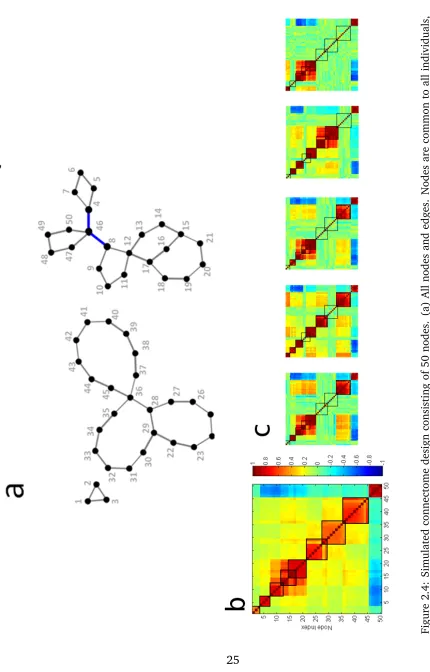
2.4 Simulated connectome design consisting of 50 nodes. (a) All nodes
and edges. Nodes are common to all individuals, different sets of
edges are inactive in different individuals. Edges in blue indicate
anti-correlation. (b) Average correlation matrix across all
individu-als. (c) Correlation matrices of five randomly chosen individuindividu-als. . . 25
2.5 Cross-validation results for simulated data: Plots of the mean square
error (Eqn. 2.3) vs. number of SCPs K (left), and sparsity level λ
(right). . . 26
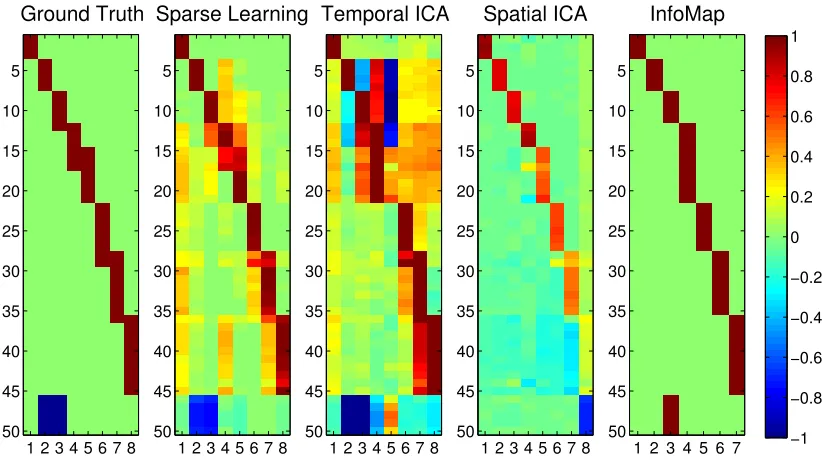
2.6 Performance on simulated data. The basis vectors identified by the
Sparse Learning approach, InfoMap, Spatial and Temporal ICA, shown
as node-weights (bk), compared against the ground-truth. . . 27
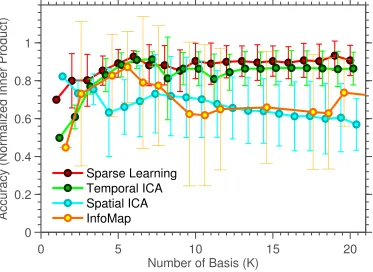
2.7 Performance on simulated data. Accuracy, measured using
normal-ized inner-product. . . 28
2.8 Individual-level coefficients estimated by Sparse Learning, projected
down to 2-D space, shown along with the ground truth. . . 29
2.9 Cross-validation results for PNC data: Plots of the mean square error
(Eqn. 2.3) vs. number of SCPs K (left), and sparsity levelλ (right). . 30
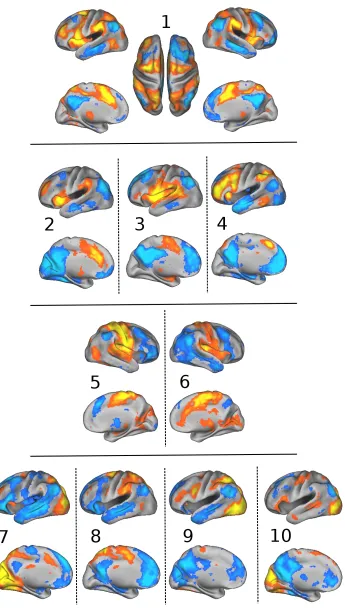
2.10 Ten SCPs computed in the Areal Graph node space. . . 31
2.11 Figure illustrating the heterogeneity of the data sample captured by
SCPs. The color indicates the extent to which each SCP is present in
a individual. . . 33
2.12 Reproducibility, data-fit, spatial overlap and temporal correlation
2.13 SCPs 1, 2, 5, and 9 computed from the PNC dataset(left), HCP+fBIRN
dataset (middle) and BLSA dataset (right) using Areal Graph nodes.
The inner product value (computed in the Areal Graph node space)
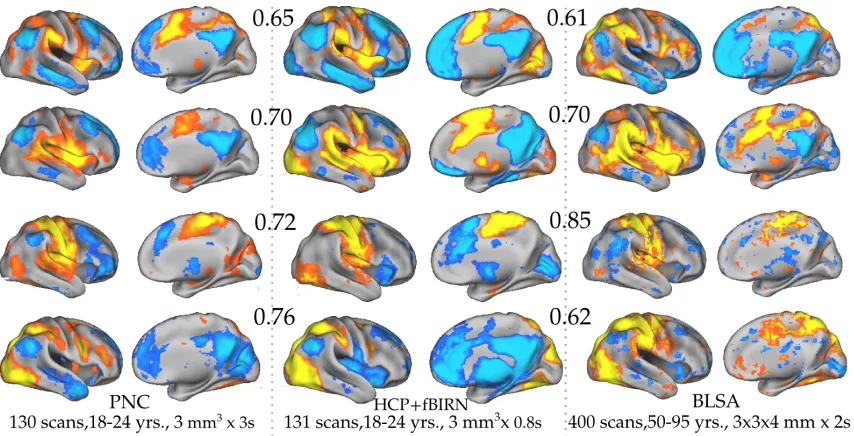
for each comparison is also shown. . . 38
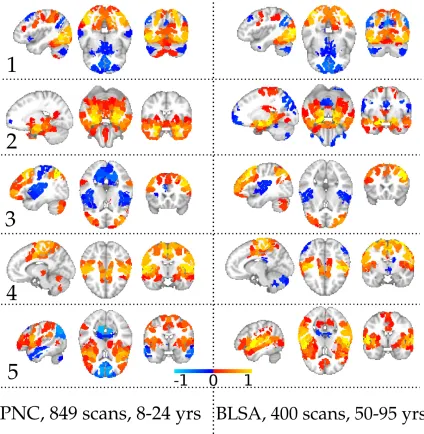
2.14 SCPs 1-5 generated from the PNC data (left) and BLSA data (right)
using GraSP parcels. . . 39
2.15 SCPs 6-10 generated from the PNC data (left) and BLSA data (right)
using GraSP parcels. Note that SCPs 9 and 10 do not match between
the two datasets. . . 40
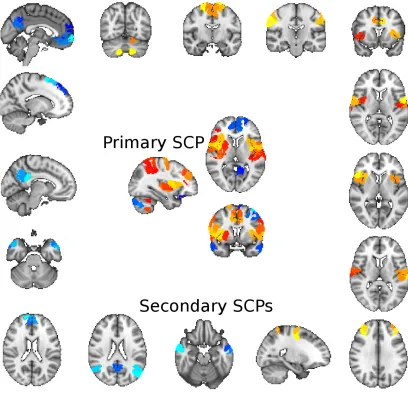
2.16 A primary SCP and some of its associated secondary SCPs computed
from the PNC dataset using GraSP parcels. . . 41
2.17 Split-sample error and reproducibility for secondary SCPs computed
from the PNC dataset. . . 42
2.18 SVM weight vector forl2-SVM (left) andl1-SVM (right) for
discrimi-nating children from young adults using the PNC dataset. . . 43
2.19 Schematic illustrating the discriminative Sparse Learning framework.
Panel to the left describes the SCP identification term, which
fac-torizes connectivity matrices Σn of each individual n into a set of
common SCPs B = [b1,b2, . . . ,bK] and its associated coefficients.
Panel to the right illustrates a linear SVM, which uses the total
ab-solute connectivity valuesdiag(BTΣ
nB)of all SCPs as input features
2.20 Top two SCPs that contribute to classification, based on their
hyper-plane weight. Corresponding graphs (bottom) plot total connectivity
within SCP for each individual vs. individual age. Uni-variate
p-value scores comparing total connectivity between two groups are
also shown. . . 47
3.1 An illustration that shows heterogeneity in the affected group,
rela-tive to a reference group. Non-linear classifiers can implicitly model
non-linearity but estimating the boundary (dashed lines) in high
di-mensional spaces is difficult. Mixture-of-Experts can approximate the
non-linear curve with a piece-wise linear boundary (red and green
lines) and find subgroups associated with each line (red and green
points). . . 55
3.2 Four 2-D simulated cases used to evaluate the performance of the
method. Hyper-planes and sub-groups obtained using MOE are also
shown using a different color for each hyper-plane and associated
subgroup. . . 64
3.3 Variation in four performance measures for K = {1,2, . . . ,5}, for each of the four simulated cases. From top-left, clockwise: Accuracy,
Maximum inner-product, cluster separation and cluster
reproducibil-ity. Results from each case is plotted in a different color. . . 66
3.4 Variation in four performance measures forK = 3,C, λ={2−3,2−2, . . . ,210},
for Case 3. From top-left, clockwise: Accuracy, Maximum
inner-product, cluster separation and cluster reproducibility. . . 67
4.1 Age distribution for the subjects used in this study. For each age bin,
4.2 Scatter plot showing the relationship between age and motion
(mea-sured using MRD), which is statistically insignificant. The color
indi-cates the number of time-points that were removed during the
scrub-bing procedure. . . 74
4.3 (Above) Connectivity within the DM vs. DA SCP is significantly
de-creased with age. (Below) Connectivity within the medial temporal
areas is significantly increased with age . . . 75
4.4 Connectivity within the visual vs. DM areas (above) and motor areas
(below) is significantly decreased with age. . . 76
4.5 Eight secondary SCPs of the motor SCP, correlation between
corre-sponding coefficients and age, and associated p-value. . . 78
4.6 Brain Age Index of each individual plotted against their age. The
Mean Absolute Error (MAE) of prediction, as well as the correlation
coefficient between the BAI and age is provided. . . 79
4.7 Primary and associated secondary SCPs that were found to be
signif-icant after permutation testing. Although not all primary SCPs are
significant (faded images are not), they are shown for reference. . . . 81
4.8 Functional and structural Brain Age Indices (BAIs) plotted against
each individual’s age. Functional BAI was computed from SCP
coef-ficients and local functional coherence measures; structural BAI was
computed from average GM density values. The aging trajectories
(solid lines) show the expected brain age. The BAI Residual for each
individual in each modality can be computed by subtracting their
4.9 The DM vs. DA SCP alone shows significantly decreased connectivity
in the advanced agers relative to the resilient agers after correcting
for age. . . 82
4.10 Univariate differences in local functional coherence and GM density
between resilient and advanced agers. . . 83
4.11 Summary of significant differences in GM density, functional
coher-ence and connectivity for all five groups of advanced agers relative
to resilient agers. As before, changes to GM density and coherence
at the level of ROIs are shown using p-value maps overlaid on a
tem-plate image (first two columns on right). SCPs whose coefficients
were significantly different between groups are shown in the last
col-umn. The color overlay for SCPs indicates patterns of correlated (or
anti-correlated) regions. . . 85
4.12 Functional and structural BAI Residual (= Expected Brain age - BAI)
plotted in a two-dimensional grid. The group membership of each
individual is reflected in the color, resilient agers are shown as white
points. . . 87
4.13 Differences in cognitive performance between advanced group 1 and
resilient agers, for eight cognitive domains. Mean and 95%
confi-dence intervals of the difference estimates are shown as errorbars.
CVLT: California Verbal Learning Task. BVRT: Benton Visual
Reten-tion Test. CRDROT: Card RotaReten-tion Test. FLULET: Letter Fluency.
FLUCAT: Category Fluency. TRATS: Trail Making Test Part A. TRBTS:
Trail Making Test Part B. DSST: Digit Symbol Test. . . 88
5.2 Command-line interface of MOE . . . 100
A.1 SCPs computed without global signal regression, from the PNC dataset,
using the Areal Graph nodes. Only SCP 1 has a significant area of
negative correlation - the Dorsal Attention vs. Default mode
anti-correlation pattern. The other nine SCPs showed only positive
corre-lation. Of these, the familiar patterns were the sensori-motor (8, 9
Chapter 1
Introduction
1.1
Overview
Magnetic Resonance Imaging (MRI) provides a non-invasive, in-vivo method of
studying the human brain. In the clinic, these three-dimensional images of the brain
are used to identify gross abnormalities visible to the naked eye (lesions, tumours,
abscesses). In research applications, MRI is acquired from many research
partici-pants, in order to understand the subtle effects of development, aging or illness on
brain function and structure which cannot be observed by visual inspection.
Resting state functional MRI (rsfMRI) (Biswal et al., 1995; Raichle et al., 2001)
is acquired when the individual is at rest inside the scanner. It measures the blood
oxygenation level in different regions of the brain. Higher oxygen levels imply
higher neural activity, therefore fMRI is assumed to be a surrogate measure of brain
function. Multiple 3-D images are acquired, typically once every couple of seconds.
In this manner, we can obtain a time-series of varying blood oxygenation level at
ev-ery location in the brain. This “spontaneous” brain activity can be used to measure
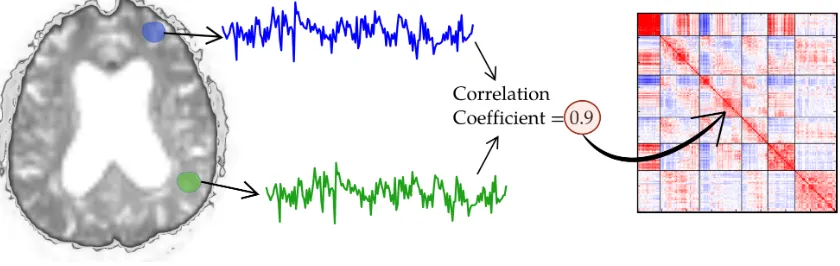
Figure 1.1: Figure illustrating computation of the functional connectome
in the brain by quantifying the amount of synchrony between corresponding
activ-ity. This synchrony is popularly quantified by computing the Pearson correlation
coefficient between the corresponding time-series, as illustrated in Figure 1.1. In
this manner, one can build build a whole-brainfunctional connectomethat captures
a time-averaged picture of the functional interactions between all brain regions.
Figure 1.2 shows the various ways in which the functional connectome is visually
represented.
A growing number of projects (Satterthwaite et al., 2014; Van Essen et al., 2012;
Shock et al., 1984) are acquiring rsfMRI data for a large number of individuals with
the aim of investigating normal inter-subject variability and variation over the
lifes-pan. To keep pace with the scale of such projects, there is an urgent need to develop
novel methodology that can capture complex, whole-brain normative patterns of
age-related changes in a data-driven manner, while ensuring interpretability.
1.2
Aims of this thesis
The functional connectome of each individual is very high dimensional, however,
di-Figure 1.2: Visualization of the functional connectome as a correlation matrix (left), an abstract graph representation (middle) and mapped to corresponding regions in the brain (right)
mensionality reduction method that is based on functional connectivity data.
Exist-ing approaches for dimensionality reduction divide the brain into spatially smaller
patterns, varyingly referred to as components, sub-graphs or sub-networks. Some
of these existing approaches use the rsfMRI time-series as input, which is not ideal
for connectome data. Others assume spatial or temporal separation of the patterns,
which is not suited to describe functional systems in the brain. As we describe in
the following chapter, we exploited recent advances in the mathematics of sparse
modeling to develop a methodological framework that decomposes the complex
functional connectome into parsimoniousSparse Connectivity Patterns (SCPs). The
description of ourSparse Learningmethod and resulting SCPs is provided in Chapter
2 of this thesis.
In rsfMRI studies, univariate statistical approaches or multi-variate classification
methods are often employed to identify connections that can predict diseased state
of an individual or are strongly correlated with age. Such linear models inherently
assume that there is a single pattern of change that linearly scales with disease
severity or age in all individuals. However many of the conditions under study
composed of a variety of external symptoms and cognitive changes. In Chapter 3
of this thesis, we present aMixture-Of-Experts(MOE) method that explicitly models
and captures heterogeneous patterns of change in the affected group relative to a
reference group of controls.
Increased life expectancy has resulted in a growing proportion of older people
across the globe. This has led to a greater prevalence of aging related mental
ill-nesses. In order to better understand functional disruptions of such disorders, it
is crucial to gain insight into how the functional organization in the brain changes
during the normal aging process. Although, on average, cognitive abilities decrease
with age, some individuals age well, while other decline faster. Some of these
in-dividuals could be at a greater risk for developing clinical pathology later in life.
Therefore, in addition to understanding the effect of aging on function, it is
im-portant to identify these high-risk individuals, as well as potentially heterogeneous
patterns of aging. Towards this goal, we applied the methodological approaches
developed and tested in chapters 2 and 3 to rsfMRI data acquired as a part of the
Baltimore Longitudinal Study of Aging (BLSA). Multiple patterns of aging related
changes in connectivity are reported and discussed in Chapter 4.
These aims are summarized below:
1. Develop and test a method based on sparse representations for the
identifica-tion of resting-state connectivity networks
2. Develop and test a mixture of experts method for identification of
heterogene-ity in affected populations
3. Apply the developed methods to the BLSA dataset (normal adults of age 50-96
1.3
Significance
In order to make rsfMRI applicable to large heterogeneous populations, we require
automated data-driven analysis approaches that can capture the complexity of
func-tional connectivity patterns within the data. We summarize the significance of our
work vis-a-vis existing methods below, and discuss them in greater detail in
individ-ual chapters.
In Aim one, we proposed a sparsity-based dimensionality reduction algorithm
that is complementary to existing graph-based or time-series based methods. The
significance of this aim is described below:
1. Seed-based correlation approaches require prior knowledge of a stable seed
location and do not directly quantify inter-subject variability.
2. Graph-based approaches (Power et al., 2011) that identify networks based on
correlation strengths limit their analysis to strong positive correlations based
on an ad-hoc thresholding operation, ignoring thepositive-semi-definite
prop-erty of the correlation matrix. Negative and weak edges correlations could
be informative, especially if considered collectively as part of a distributed
pattern.
3. Graph-based methods are limited to identifying patterns in a group-averaged
manner (Power et al., 2011), thereby losing valuable information about
inter-individual variability.
4. Time-series based approaches, such as spatial (Beckmann et al., 2005) and
temporal ICA (Smith et al., 2012) have been successful in producing stable
and reproducible spatial components (especially spatial ICA). However (1)
not directly encode inter-individual variability in connectivity. This entails
novel methods that can directly explain the variance in connectivity data.
Aim two proposed a mixture of experts framework to address the drawbacks
of linear and non-linear supervised learning approaches, which are enumerated
below:
4. Multi-variate classification methods are needed to find subtle, distributed
pat-terns of aging related changes in the connectome. However, linear methods
assume a single pattern of aging or disease-related change, which is
unrealis-tic.
5. While kernel based methods can be used to model non-linear effects, the
pat-tern of change itself is not explicitly computed; kernel approaches do not
provide any information about the features that contribute to classification.
This motivates the need for developing methods that model heterogeneity in
the data explicitly.
As a part of the third aim, we applied the methods developed in Aims 1 and
2 to understand the effects of aging on functional connectivity. Previous studies
that investigated aging effects used traditional analysis approaches, whose major
limitations are described below:
6. Past studies investigating the effects of aging used mass-univariate approaches
to identify functional connections that significantly correlated with age.
How-ever, traditional analysis approaches make it difficult to gauge the extent and
severity of aging for each individual.
7. In prior studies of aging, small sample sizes limited researchers to assume
Using mass-univariate methods, an overall decrease in functional connectivity,
especially in the default mode and motor regions, has been found consistently.
However, a single pattern of change does not explain the wide variation in
cognitive abilities seen among the elderly. These studies did not stratify older
populations in terms of their patterns of change in brain structure and
func-tion.
1.4
Innovation
The major contributions of this thesis are summarized as follows:
1. The developed Sparse Learning method for the analysis of correlation matrices
does not require the removal of weak and negative correlation values. This
model represents the data as a combination of Sparse Connectivity Patterns,
while retaining the positive semi-definite nature of correlation matrices in the
representation. The P.S.D assumption constrains the degrees of freedom in
the model resulting in more stable, reliable networks.
2. We incorporated inter-individual variability in the strength of SCPs in our
modeling strategy. Such a model allocates a scalar value per pattern in each
individual that reflects the average connectivity of all the regions within that
particular pattern. This is a clear advancement over seed-based correlation
approaches, which do not consider individual level variations.
3. Sparse decompositions are being greatly favored in the signal processing
com-munity, as evidence of parsimony in nature as well as in the functioning of the
brain is abundant. We used spatial sparsity as the driving assumption for the
in sparse representations of covariance matrices (Sivalingam et al., 2011; Sra
and Cherian, 2011; Soufiani and Airoldi, 2012) in our modeling strategy.
4. The MOE framework for identification of heterogeneous patterns of change
explicitly models two crucial pieces of information that we would like to
dis-cover in the data - (1) multiple patterns that differentiate two groups and (2)
sub-groups of individuals associated with each pattern of change. The MOE
method has a complexity level that is in-between that of linear and non-linear
methods. Thus, it can capture more information than a linear method, while
at the same time is not as complex as the kernel-based method, and by design,
has better interpretability.
5. With data from the BLSA study, we used multi-variate methods to pool
infor-mation across all connections to predict each individual’s age. Using
multi-variate techniques, we identified those connections that highly contribute to
the prediction, similar to uni-variate techniques. More importantly, we built
aging trajectories of functional connectivity, similar to growth charts that are
used for children at the pediatrician’s office. Each individual is assigned a
Brain Aging Index (BAI), that measures the functional age of that individual.
We then identified a subset of individuals whose BAI is higher than their
ex-pected BAI. Theseadvanced agerscould be at a higher risk for developing signs
of dementia as they grow older.
6. We applied the MOE method to the advanced aging individuals (withresilient
agers as a reference) and identified sub-groups of advanced agers with
het-erogeneous patterns of functional and structural change. To the best of our
knowledge, we are the first to identify advanced aging patterns and
perspective.
1.5
rsfMRI data
1.5.1
Datasets
MRI data used in this thesis was acquired as a part of two major studies. Details of
the study participants and MR acquisition parameters are described in the following
section. Appendix A details the pre-processing pipeline that was used to prepare
rsfMRI data prior to generation of functional connectivity matrices.
1.5.1.1 Baltimore Longitudinal Study of Aging (BLSA)
The Baltimore Longitudinal Study on Aging (BLSA) (Shock et al., 1984) is the
longest running study on aging at the National Institute on Aging (NIA). It is a
lon-gitudinal study that acquires comprehensive cognitive assessments and MR brain
imaging measurements (and many others for physical health), from research
vol-unteers.
A subset of the data from this study was used for methodology testing in Chapters
2 and 3. A more extensive analysis of this data is described in Chapter 4.
Participants
As of February 1, 2015, BLSA had acquired 780 rsfMRI scans from 567 participants.
For this thesis, we considered only baseline (first visit) scans of participants selected
based on the following criteria: (1) participant was older than 50 years at time of
scan (2) had low head motion during the acquisition, measured using Mean Relative
were “normal” at time of scan; i.e., did not meet criteria for onset of Mild Cognitive
Impairment or Alzheimer’s disease. This resulted in 400 subjects in the age range
50−96years (72.5±9.4years).
MRI Acquisition
Images were acquired at the NIA clinical research facility on a Philips Achieva 3T
MRI scanner, with an in plane resolution of 3 ×3mm, slice thickness of 4 mm, TR/TE=2000/30s and total scan duration of 6 minutes.
1.5.1.2 Philadelphia Neuro-developmental Cohort (PNC)
The Philadelphia Neuro-developmental Cohort (PNC) is a large scale study to
un-derstand the normal and abnormal developmental processes in the human brain.
In addition to neuroimaging, participants also received cognitive and psychiatric
assesments.
Subsets of this dataset were used for methodological testing in Chapter 2.
Participants
MRI data was acquired on 1445 participants as a part of this study. Of these, rsfMRI
was acquired on 1275 participants. We excluded 426 subjects based on bad data
quality or abnormal cognitive and/or psychiatric assessments, resulting in a final
tally of 849 rsfMRI scans.
MRI Acquisition
All data were acquired on the same scanner (Siemens Tim Trio 3 Tesla; 32
(BOLD) fMRI was acquired with the following parameters: 124 volumes, TR 3000
ms, TE 32 ms, flip angle 90◦, FOV 192x192 mm, matrix 64X64, slice thickness/gap 3mm/0mm, effective voxel resolution 3.0x3.0x3.0mm. During the resting-state
scan, a fixation cross was displayed as images were acquired. Subjects were
in-structed to stay awake, keep their eyes open, fixate on the displayed crosshair, and
remain still.
1.5.2
Node definition
A crucial aspect of SCP estimation is node definition. The high spatial
dimension-ality of fMRI data makes voxel-wise correlation matrices computationally infeasible
for many approaches, hence most studies resort to dimensionality reduction, often
through the use of apriori defined ROIs or through functional parcellation schemes.
In this thesis, we used two sets of node definitions; a set of ROIs defined from a
meta-analysis of fMRI studies (Power et al., 2011), and a data-driven rsfMRI
par-cellation defined by running the GraSP method (Honnorat et al., 2015) on each
dataset. Details are given below.
1.5.2.1 Spherical ROI Definition (Areal Graph)
We used 264 node locations defined in (Power et al., 2011) (“Areal Graph”) for some
of our methodology validation experiments in Chapter 2. These nodes were defined
exclusively based on fMRI. Of these nodes, 151 were non-overlapping 10mm
diam-eter spheres identified based on a meta-analysis of task-fMRI based studies
(Dosen-bach et al., 2006). The remaining 193 were cortical patches obtained by functional
connectivity mapping using resting state fMRI (Cohen et al., 2008). Figure 1.3 (left)
Figure 1.3: Left: Areal Graph nodes, as defined in Power et al. (2011). Right: Common group-parcellation of GM regions obtained by running GraSP (Honnorat et al., 2015) on BLSA data
1.5.2.2 Data-driven Parcellation (GraSP Parcels)
Using the Areal Graph described in the previous section limits the analysis to
well-established functional foci of activity. Alternately, one could use widely available
anatomical cortical atlases (Desikan et al., 2006; Van Essen, 2005) that delineate
region boundaries based on cortical macro-structure, i.e., sulci and gyri, and
av-erage data within anatomical regions. While this approach incorporates
informa-tion from all regions of the cortex, averaging observainforma-tions within these anatomical
boundaries might cause averaging across functional boundaries, which is not ideal.
It is therefore important that we define a parcellation based on the same rsfMRI
dataset that is being analyzed. Therefore, we used GRaSP (Honnorat et al., 2015),
which is a data-driven method used for parcellating the grey matter based on local
functional connectivity of the voxels. Run independently on the PNC and the BLSA
datasets, GraSP provided a study-based parcellation of 583 and 744 parcels
respec-tively. An example of the parcellation result on the BLSA data with 583 parcels can
1.5.3
Computing the functional connectome
After the nodes are defined in a common anatomical space, for each individual, the
average time-series xi within each node i is computed. In this thesis, we define
functional connectivityrij between any pair of nodes to be the Pearson’s correlation
coefficient between the corresponding time-series, as defined below:
rij =
(xi−x¯i)T(xj −x¯j) ||xi −x¯i||2||xj−x¯j||2
(1.1)
wherex¯denotes mean of the time-series.
The functional connectivity value rij lies between−1and 1. If two nodes have
a negative correlation value, they are said to be anti-correlated. The functional
connectivity between all pairs of nodes can be represented in a correlation matrix
Σi for each individuali. This matrix is symmetric andpositive-semi-definite.
1.6
Organization of this thesis
The two main methodological contributions of this thesis are described in chapters 2
and 3. Chapter 2 details the Sparse Learning method, its performance on simulated
data, and SCPs found using real data. In Chapter 3, we describe the MOE approach
and its performance using synthetic data. Chapter 4 describes the main application
of this thesis to aging, with detailed analysis of the BLSA dataset, including
identi-fication of heterogeneous sub-types of advanced aging. Chapter 5 summarizes all
Chapter 2
Identifying Sparse Connectivity
Patterns
2.1
Introduction
The functional connectome provides a rich source of information on the
tional organization of the human brain. It has also been demonstrated that
func-tional connectivity is altered in psychiatric and neurodegenerative illnesses such as
schizophrenia (Venkataraman et al., 2012) and Alzheimer’s (Greicius et al., 2004).
An accurate description of the brain’s functional connectome, and its variability
across individuals, is a critical prerequisite for understanding both normal brain
function and its aberrations in disease.
A multi-variate dimensionality reduction algorithm can be used to address both
issues - (a) it can provide a parsimonious representation of the functional
connec-tome in terms of a set of spatial patterns and (b) differential presence of these
patterns explains inter-subject variability, i.e., each individual’s connectome can be
We exploit recent advances in the mathematics of sparse modeling to develop a
methodological framework aiming to understand complex resting-state fMRI
con-nectivity data. By favoring patterns that explain the data via a relatively small
number of participating brain regions, we obtain a parsimonious representation of
brain function in terms of multiple “Sparse Connectivity Patterns” (SCPs), such that
differential presence of these SCPs explains inter-subject variability.
2.2
Literature review
rs-fMRI connectivity has been used to delineate major functional brain systems
(Biswal et al., 1995; Fox et al., 2006; Vincent et al., 2008), based on prior
knowl-edge of a “seed” region of interest. Given a seed region, the average time-series of
the seed is correlated with the time-series of every other voxel in the brain. The
re-sulting significant correlations form acorrelation mapwith respect to that seed. For
example, using the Posterior Cingulate Cortex (PCC) as the seed region results in
a correlation map which delineates regions belonging to the default mode, as well
as regions of the Dorsal Attention (DA) system that are known to be anti-correlated
with it. However, this method cannot be applied in a data-driven manner as it
requires prior knowledge of a stable seed location. It does not directly quantify
inter-subject variability.
Data-driven approaches have been developed to identify such functional
pat-terns. They can be divided into two major categories - (a) graph partitioning
proaches, which use correlation matrices as input, and (b) time-series based
proaches, which are applied directly to time-series data. Although time-series
ap-proaches do not directly describe connectome data, we describe them here, as prior
connectivity information.
Graph partitioning approaches, such as InfoMap (Rosvall and Bergstrom, 2008)
assume that any region of the brain can belong to only one brain network. This
approach was applied to rsfMRI in Power et al. (2011). Retaining only high positive
correlation values, the authors identified multiple spatially separated networks, or
“sub-graphs”, whose regions are strongly correlated, on average, across individuals.
However, InfoMap limits its analysis to strong positive correlations, while removing
negative and weak edges from the graph that could be informative (Fox et al.,
2005; Keller et al., 2013). In Yeo et al. (2011), a node’s functional connectivity to
all other nodes was used as input to a clustering algorithm. Similar to InfoMap, this
approach also provided spatially segregated networks.
Alternative approaches addressing some of these issues have been proposed in
other fields. The notion of “link communities” introduced in Ahn et al. (2010) is
elegantly able to handle overlaps by assigning unique membership to edges rather
than nodes, naturally resulting in multiple assignments per node. Approaches like
correlation clustering (Bansal et al., 2004) and the Potts model based approach
proposed in Traag and Bruggeman (2009) are partitioning approaches which allow
negative values. Since most of these methods are used to analyze social networks,
they interpret negative edge links as repulsion, and hence attempt to assign
nega-tively connected groups to different communities. While this may be appropriate
for social networks, in resting state fMRI, highly negative edges imply strong
anti-correlation - meaning that despite opposing phase information, these nodes express
the same information, since they are strongly statistically dependent. Allocating
anti-correlated regions to the same network can provide interesting new insights
into the functional organization of the brain.
Indepen-dent Component Analysis (ICA) are applied directly to the time-series to obtain a
set of basis, where each vector is a set of weights, one for each node. ICA
incor-porates higher-order moments to reveal patterns that are maximally independent.
However, time-series based approaches do not directly explain the variance in
con-nectome data. Spatial ICA is widely applied to rsfMRI data to obtain spatially
in-dependent components, commonly referred to as “Intrinsic Connectivity Networks
(ICNs)” (Calhoun et al., 2003). In practice, ICNs found using spatial ICA are
usu-ally non-overlapping. To address this issue of non-overlap, the study by Smith et al.
(2012) applied temporal ICA to rsfMRI data and found multiple functional brain
networks, or “Temporal Functional Modes (TFMs)”. Although this is a significant
advancement, these networks have been identified on the basis of independent
tem-poral behavior, i.e., lacking between-network interactions, which is contrary to the
notion that brain systems often act in concert during complex cognitive functioning.
A major disadvantage of connectivity based approaches is their inability to
di-rectly quantify inter-individual variability in functional connectivity, requiring
ad-ditional post-processing and analysis. An important source of variation across
indi-viduals is the average strength of patterns. This could possibly be due to the extent
to which (how much and for how long) that functional unit is recruited in each
individual, or as an indicator of life span changes or disease state. There are studies
that have found strong relationships between the clinical variable of interest and
the strength of such intrinsic rsfMRI networks (von dem Hagen et al., 2012; Mayer
et al., 2011; He et al., 2007a). It is important to build a model that can capture
2.3
The Sparse Learning approach
Motivated by models of neuronal activity (Vinje and Gallant, 2000), we propose
the use of spatial sparsity to drive identification of patterns of connectivity. In a
neuronal sparse coding system, information is encoded by a small number of
syn-chronous neurons that are selective to a particular property of the stimulus (e.g.
edges of a particular orientation within a visual stimulus). Multiple such spatial
patterns of neurons constitute a sparse neural basis which acts in concert in
re-sponse to the stimulus. A nearly infinite number of stimuli can be parsimoniously
encoded by varying the proportion in which these patterns are combined.
Extending this idea to rsfMRI, we assume that the observed spontaneous activity
arises from the concerted activity of multiple “Sparse Connectivity Patterns (SCPs)”
that encode system-level function, similar to sparse codes that are present at the
level of neurons. Each SCP consists of a small set of spatially distributed,
function-ally synchronous brain regions, forming a basic pattern of co-activation. These SCPs
capture the range of resting functional connectivity patterns in the brain, although
they do not necessarily need to be present in each individual or subsets of
indi-viduals. Using spatial sparsity as a constraint, we learn the identity of these SCPs
and the strength of their presence in each individual, revealing the variability in the
dataset.
2.3.1
Model formulation
The objective of our method is to find SCPs consisting of functionally synchronous
regions whose connectivity values co-vary across individuals, and are smaller than
the whole-brain connectome. The information content within any one of these SCPs
Figure 2.1: Schematic 1 illustrating our method. Each subject specific correlation matrix Σn is approximated by a non-negative sum of sparse rank one matrices bkbTk, or Sparse Connectivity Patterns (SCPs).
same information. Furthermore, we assume that if a set of ROIs belong to such a
pattern, then, in a set of normal subjects, inter subject variability is introduced by
the extent to which each system is recruited in a subject. Thus, nodes are assigned
to an SCP if the strength of the edges between them co-vary across subjects. To
sum-marize, SCPs would have the following properties - (1) large number of edges with
zero weights, or sparsity (2) low information content - or rank deficiency and (3)
an associated scalar SCPcoefficient, whose value is variable across individuals. Our
method takes as input correlation matrices and finds SCPs that satisfy all properties.
A schematic diagram illustrating our method is shown in Figure 2.1. The input
to our method is size P ×P correlation matrices Σn 0, one for each subject n,
n= 1,2, . . . , N. We would like to find smaller SCPs common to all the subjects, such
that a non-negative combination of these SCPs approximates the full-correlation
matrixΣn, for each subjectn. Each of theseK SCPs can be represented by a vector
of node-weights bk, where −1 bk 1, bk ∈ RP. Each vector bk reflects the
membership of the nodes to the sub-networkk. If|bk(i)|>0, nodeibelongs to the
sub-network k, and ifbk(i) = 0 it does not. If two nodes inbk have the same sign,
then they are positively correlated and opposing sign reflects anti-correlation. Thus,
Figure 2.2: Schematic 2 illustrating our method. Each subject specific correlation matrix
Σn is approximated by a product of three factors - the group-common matrix B, subject
specific matrixCnandBT.
constrain these SCPs to be much smaller than the whole-brain network by restricting
thel1-norm ofbk to not exceed a constant valueλ.
We would like to approximate each matrix {Σn} N
n=1 by a non-negative
combina-tion of SCPsB= [b1,b2, . . . ,bK], as shown in Figure 2.2. Thus, we want
Σn≈ K X
k=1
cn(k)bkbTk =B diag(cn)BT ,Σˆn
||bk||1 ≤λ, −1≤bk(i)≤1, cn≥0 (2.1)
where diag(cn)denotes a diagonal matrix with valuescn ∈RK+ along the diagonal.
Thus, each subject n is associated with a vector of K subject-specific measures cn
which are non-negative and reflect the relative contribution of each SCP to the
whole-brain functional network in then-th subject.
We quantify the approximation between Σn and Σˆn using the frobenius norm.
Note that there is an ambiguity in amplitude between the two factors - if bk and
this, we fix the maximum value in each SCP to unity; i.e.,maxi|bk(i)|= 1.
Bringing the objective and the constraints together, we have the following
opti-mization problem w.r.t the unknownsBandC= [c1,c2, . . . ,cn]:
minimize B,C
N X n=1
Σn−Bdiag(cn)BT 2 F subject to
||bk||1 ≤λ, k = 1, . . . , K,
−1≤bk(i)≤1, max
i |bk(i)|= 1, i= 1, . . . , P
cn ≥0, n= 1, . . . , N
(2.2)
2.3.2
Optimization strategy
The objective function in the proposed model is non-convex w.r.t both unknown
variables B and C. We use the method of alternating minimization to solve for
B and C. At each iteration a local minimum is obtained using projected
gradi-ent descgradi-ent (Batmanghelich et al., 2012). Such a procedure converges to a local
minimum.
2.3.3
Model selection
The free parameters of the model are the number of SCPsKand the sparsity level of
each SCPλ. As values ofKandλare increased, the approximation error is reduced;
however beyond a certain value of K it is likely that the model is over-fit to the
data; i.e., the SCPs computed by the algorithm are possibly used to explain noisy
(unwanted) variations in individual subjects. Hence we resort to cross-validation
in order to avoid over-fitting. Using a grid search, for each value of the parameters
(a) Node-based volumetric rendering ofbk. Overlay color
in-dicates the membership value of each region inbk. (b) Edge-based rendering ofbkbTk.
Size of nodes indicate value inbk.
Figure 2.3: Visualization of SCPs. Opposing colors reflect anti-correlation between regions.
there is no gain in generalizability (drop in error) is chosen to be the operating
point. This provides us with SCPs that might generalize better across data. The
cross-validation measure is the error computed on the test dataset relative to the
variance in the test data, defined as follows:
Test Error=
Ntest X n=1 Σ test
n −B
traindiag
(ctestn ) BtrainT
2 F Ntest X n=1
Σtestn −Σ¯test 2 F (2.3)
whereΣ¯test is the subject-averaged correlation matrix of the test dataset.
2.3.4
SCP visualization
Node-based visualization
Recall that each SCP bk is of size P, where P is the number of nodes, defined
either using the Areal Graph node definition or GraSP parcellation. For
visualiza-tion purposes, SCPs bk with large spatial extent are mapped to the voxels in the
dual-regression, similar to the procedure described in Smith et al. (2012) to map the
SCPs from nodes to voxels. For nodes defined using GraSP, the membership
val-ues of each parcel within an SCP is directly mapped to the spatial extent of that
parcel. These voxel-wise maps can be visualized using overlays in volumetric space
in FSLView(Jenkinson et al., 2012), as shown in Figure 2.3a or projected onto the
cortical surface usingCaret Visualization software (Van Essen et al., 2001).
Edge-based visualization
Smaller SCPs can be mapped to the brain using their edge-based representation
bkbTk, rendered usingBrainNet Viewer (Xia et al., 2013) as shown in Figure 2.3b.
2.4
Experiments on simulated data
2.4.1
Generation of simulated data
In order to illustrate the behaviour of our method, we generated a synthetic dataset
with forty instances (or individuals). Our connectome design is illustrated in Figure
2.4. Each subject is associated with a underlying connectome configuration
consist-ing of fifty nodes, as shown in Figure 2.4a. This connectome is designed in such
a way that it has eight SCPs, with SCP size varying between three and ten nodes.
Some of these SCPs are overlapping, with overlap size varying between one and
three nodes. The strength of each SCP varies across subjects in a binary fashion, i.e,
in each individual, SCPs are either “active/on” or “inactive/off”. In other words, an
SCP is inactive in a individual when all the edges/correlation strengths of that SCP
are close to zero for that particular individual. Furthermore, individuals are
inter-individual variability.
We input this connectome design into the simulation software NetSim (Smith
et al., 2011), which simulates BOLD time-series at each node. Each time-series has
120 time-points and a TR value of 3 seconds, making each dataset 6 minutes long,
similar to standard clinical rsfMRI acquisitions. In addition to inter-individual
vari-ability introduced by differential activation of SCPs we also include small random
perturbation of edge strength for all edges. Random external inputs are input to
some of the nodes. Thermal (white) noise is added to the output time-series at
each node.
Correlation matrices are computed from the simulated time-series for all forty
individuals, which form the input to our method. The average correlation matrix is
shown in Figure 2.4b. The matrices shown in Figure 2.4c correspond to the
corre-lation values computed from the time-series for five randomly chosen individuals.
The average correlation matrix, thresholded to obtain varying levels of edge density
was used as input to InfoMap. Absolute values of correlation were used as input to
InfoMap. The clustering assignments output by InfoMap are converted into a set of
binary basis vectors, one for each sub-graph. Concatenated time-series data were
used as input for Temporal ICA as well as Spatial ICA. In case of ICA,
dimensional-ity reduction was performed by running PCA first, as is routinely done in fMRI-ICA
literature (Smith et al., 2012).
2.4.2
Performance on simulated data
The output of the cross-validation experiments are shown in the plots in Figures
2.5, which shows the variation of the cross-validated mean square error as the free
1 2 3 4 5 6 7 8 9 10 11 12 13 14 15 0.2 0.4 0.6 0.8 1 1.2 1.4 1.6 1.8
Number of SCPs K
Cross−validation error
λ = 0.1 P
λ = 0.2 P ... λ = 1.0 P
(a) Variation with K
0.1 0.2 0.3 0.4 0.5 0.6 0.7 0.8 0.9 1.0 0.2 0.4 0.6 0.8 1 1.2 1.4 1.6 1.8
Sparsity Level λ / P
Cross−validation error
K = 1 K = 2 K = 3 ... K = 15
(b) Variation withλ
Figure 2.5: Cross-validation results for simulated data: Plots of the mean square error (Eqn. 2.3) vs. number of SCPsK(left), and sparsity levelλ(right).
computed the basis vectors for the simulated data using all four methods. (Note:
For the sampling of edge-densities used to compute results for InfoMap, we were
able to obtain K = 7 communities followed by K = 9. As K = 7 has greater accuracy, we display those results.)
The first image in Figure 2.6 shows the simulated ground-truth as a vector of
node-weights. The results from the four methods are shown next to the
ground-truth. Each column displays a basis vector bk. It is easy to see that SCPs computed
using Sparse Learning are closest to the ground-truth.
In order to quantify the performance of the algorithm on simulated data, we
compare the set of SCPs output by Sparse LearningB with the ground truthBtrue.
Before the comparison we first perform a one-to-one matching between the two sets
of vectors using the Hungarian Algorithm (Munkres, 1957). The sign of some of the
vectors inB is reversed, if necessary. We use the normalized inner product (cosine
of the angle between vectors) to compare these paired set of vectors.
vary-Ground Truth
1 2 3 4 5 6 7 8 5 10 15 20 25 30 35 40 45 50 Sparse Learning
1 2 3 4 5 6 7 8 5 10 15 20 25 30 35 40 45 50 Temporal ICA
1 2 3 4 5 6 7 8 5 10 15 20 25 30 35 40 45 50 Spatial ICA
1 2 3 4 5 6 7 8 5 10 15 20 25 30 35 40 45 50 InfoMap
1 2 3 4 5 6 7 5 10 15 20 25 30 35 40 45 50 −1 −0.8 −0.6 −0.4 −0.2 0 0.2 0.4 0.6 0.8 1
Figure 2.6: Performance on simulated data. The basis vectors identified by the Sparse
Learn-ing approach, InfoMap, Spatial and Temporal ICA, shown as node-weights (bk), compared
against the ground-truth.
ingK. When compared with the ground-truth, SCPs show slightly higher accuracy
than the three other methods, for all values of K (p< 0.05, compared at K=8, using a two-sided t-test for Sparse Learning vs. all other methods). Temporal
ICA comes a close second, as it is able to capture many of the positive/negative
correlations but results in a denser basis. Both Spatial ICA and InfoMap produce
non-overlapping ICNs/sub-graphs - and as the value ofK is increased, these
com-ponents get smaller/more fragmented, leading to a drop in accuracy, as seen in the
graph.
Finally, Figure 2.8 displays the individual level coefficients estimated by Sparse
Learning, along with the ground truth. This result shows that Sparse Learning is
able to capture the heterogeneity at the level of individuals, since the clustering of
0 5 10 15 20 0
0.2 0.4 0.6 0.8 1
Number of Basis (K)
Accuracy (Normalized Inner Product)
Sparse Learning Temporal ICA Spatial ICA InfoMap
−3 −2.5 −2 −1.5 −1 −0.5 0 0.5 1 1.5 −1.5
−1 −0.5 0 0.5 1 1.5
Ground Truth Group 1 Ground Truth Group 2 Ground Truth Group 3
Estimated Group 1 Estimated Group 2 Estimated Group 3
Figure 2.8: Individual-level coefficients estimated by Sparse Learning, projected down to 2-D space, shown along with the ground truth.
2.5
SCPs computed from rsfMRI data
2.5.1
Areal graph nodes
Having shown that Sparse Learning performs better on synthetic data that has
spa-tial and temporal overlaps, we next compared performance of the three methods
using resting state data from 130 healthy, young adults between the ages 19 to 22
years, acquired as a part of the Philadelphia Neuro-developmental Cohort (PNC)
(Satterthwaite et al., 2014). We used the Areal Graph nodes to define one
correla-tion matrix for each individual, as described in Chapter 1.
Figure 2.9 plots the variation of the cross-validated error as K and λ is varied.
From these figures, it is clear that the MSE saturates aroundλ = 0.3. However, the “knee” of the graph plotting variation withK is unclear.
2 4 6 8 10 12 14 16 18 20 22 24 26 28 30 0.19 0.2 0.21 0.22 0.23 0.24
Number of SCPs K
Cross−validation error
λ = 0.1 P
(a) Variation with K
0.1 0.2 0.3 0.4 0.5 0.6 0.7 0.8 0.9 1.0 0.19 0.195 0.2 0.205 0.21 0.215 0.22 0.225 0.23 0.235 0.24
Sparsity Level λ / P
Cross−validation error
K = 2
K = 4 K = 6 ...
K = 30
(b) Variation withλ
Figure 2.9: Cross-validation results for PNC data: Plots of the mean square error (Eqn. 2.3) vs. number of SCPsK(left), and sparsity levelλ(right).
K = 10, λ = 0.3. These ten SCPs are shown in Figure 2.10. We describe them in detail below, and compare to existing knowledge of the spatial extent and behavior
of known task-processing, attention and control systems.
Dorsal Attention SCP Figure 2.10 shows the first SCP defined by the anterior
mid-dle temporal area (aMT), superior parietal lobule (SPL), intra parietal sulcus (IPS)
and the frontal eye fields (FEF)(shown in red), which are known to be part of
the Dorsal Attention (DA) system (Corbetta and Shulman, 2002). These regions
are anti-correlated with the middle temporal gyrus (MTG), inferior parietal lobule
(IPL), medial pre-frontal cortex(mPFC), posterior cingulate cortex (PCC) and
ante-rior frontal operculum, which are part of the default-mode (DM) system (Raichle
et al., 2001)(shown in blue).
Executive Control SCPs SCPs 2, 3 and 4 predominantly show executive task-control
system (red) anti-correlated with different aspects of the DM system (blue). SCP 4
shows the Salience system (Seeley et al., 2007) consisting of dorsal anterior
The anti-correlated DM regions include the IPL, PCC and vmPFC. Regions from the
operculum, insula, temporal-parietal junction (TPJ), inferior frontal gyrus (IFG)
and the dACC dominate SCP 5, with anti-correlations to PCC and dmPFC. This SCP
consists of the Cingulo-Opercular (COP) system (Dosenbach et al., 2007) which is
known to de-activate the DM. SCP 6 consists of the aPFC, aI, IPL, and MT, which
form the Fronto Parietal task-control system, anti-correlating with the inferior MTG,
IPL, PCC, mPFC and PHC.
Motor SCPs SCPs 5 and 6 exhibit contributions from the sensori-motor, auditory
and visual areas. Both SCPs show the pre central (prCG) and post central gyrus
(poCG). In SCP 5 the motor areas positively correlate with the superior temporal
gyrus (STG) and posterior insula. The positive correlations in SCP 6 are more
ante-rior within the insula, and a large extent of the cingulum. Anti-correlated regions
include the FP system (aPFC, IPL, aI, ACC) in SCP 5 and aspects of the DM system
in SCP 6.
Visual SCPs SCPs 7, 8, 9 and 10 show four types of connectivity patterns involving
the visual areas. SCP 7 covers the entire visual system, including the medial visual,
lateral visual and higher visual (dorsal attention) areas. SCP 8 shows the higher
visual areas alone. The visual areas are anti-correlated with the DM system in both
the SCPs. SCPs 9 and 10 shows contributions from areas in the lower levels of the
visual hierarchy; the FEF and the prCS are less dominant, while including the lateral
visual areas, which are involved in higher level visual task-processing. Concomitant
with moving down along the hierarchy, we observe changes to the anti-correlated
regions - the involvement of the mPFC is greatly reduced, but the anti-correlation
the posterior cingulate is retained.
Overlap between SCPs The SCPs described above are clearly overlapping, mainly
Subject Index
SCP Index
20 40 60 80 100 120
2
4 6 8
10 0
0.2 0.4
Figure 2.11: Figure illustrating the heterogeneity of the data sample captured by SCPs. The color indicates the extent to which each SCP is present in a individual.
other systems. We note that the PCC and the IPL contribute to most of the SCPs,
which were identified by a prior study as one of the central hubs of connectivity in
the brain (Buckner et al., 2009).
Inter-individual variability Differential presence of the SCPs explains inter
individ-ual variability in functional connectivity. Figure 2.11 shows the strength of presence
of each SCP in every individual. The Sparse Learning approach exploits this
vari-ability; a heterogeneous distribution of the samples in this lower-dimensional space
allows robust identification of the SCPs.
Reproducibility
We evaluate the performance of our algorithm as well as Infomap and ICA based
on repeated split-sample reproducibility. Reproducibility was evaluated for K =
2,4, . . . ,30. In the case of InfoMap, the edge-density was varied between 2% and
40%. This provided sub-graphs varying in number from 4 upto 60, although not equally spaced. Similar to our earlier experiments involving simulated data, we
quantify the comparison between sub-samples using the normalized inner product,
averaged across basis vectors.
The reproducibility of the results is shown in Figure 2.12a, computed for values
2 4 6 8 10 12 14 16 18 20 22 24 26 28 30 0 0.2 0.4 0.6 0.8 1
Number of Basis (K)
Reproducibility (Normalized Inner Product)
Sparse Learning Temporal ICA Spatial ICA InfoMap
(a) Reproducibility
2 4 6 8 10 12 14 16 18 20 22 24 26 28 30 0
1 2 3 4 5 x 10
6
Number of Basis (K)
Correlation data fit (Error)
Sparse Learning Temporal ICA Spatial ICA InfoMap
(b) Correlation data-fit (Error)
2 4 6 8 10 12 14 16 18 20 22 24 26 28 30 3 4 5 6 7 8
9 x 10
8
Number of Basis (K)
Time−series data fit (Error)
Sparse Learning Temporal ICA Spatial ICA InfoMap
(c) Time-series data-fit (Error)
2 4 6 8 10 12 14 16 18 20 22 24 26 28 30 0 0.1 0.2 0.3 0.4 0.5 0.6
Number of Basis (K)
Spatial Overlap
Sparse Learning Temporal ICA Spatial ICA InfoMap
(d) Spatial Overlap
2 4 6 8 10 12 14 16 18 20 22 24 26 28 30 0 0.05 0.1 0.15 0.2 0.25 0.3 0.35 0.4
Number of Basis (K)
Temporal Correlation
Sparse Learning Temporal ICA Spatial ICA InfoMap
(e) Temporal Correlation
compared to0.86±0.15for InfoMap,0.79±0.07for Spatial ICA and0.60±0.12for Temporal ICA. InfoMap shows comparable reproducibility with sparse learning (p <
0.4, computed using two-group t-test). Spatial ICA components are as reproducible as Sparse Learning (p < 0.8), while Temporal ICA performs significantly worse
(p < 10−4) in terms of reproducibility.
Data fit
In addition to reproducibility, the data fit (approximation error) of all the methods
to the data was also compared. Given that Sparse Learning and InfoMap use
cor-relation values as input, and ICA methods use time-series as input, we evaluated
the approximation error for both types of input. Let B denote the set of basis
vec-tors output by any of the four methods. Let Yn ∈ RP×T and Xn ∈ RK×T be the
time-series of thenth individual and basis respectively. In the case of Sparse
Learn-ing and InfoMap, the basis-specific time-series Xn can be computed by regressing
the basis B against the individual-specific time-series Yn. Using these values, the
correlation data-fit measure is computed as follows:
Correlation data fit (Error)=
N X n=1
Σn−
ˆ Σn 2 F (2.4) where ˆ
Σn=Bdiag(cn)BT for Sparse Learning (2.5)