User experience and User performance
of feedback in a Pose Game.
Master Thesis by
Niek J.Hoeijmakers, MSc
Graduation Committee:
Dr. ir. Ronald Poppe
Dr. ir. Dennis Reidsma
Dr. Mannes Poel
Prof. dr. ir. Anton Nijholt
Human Media Interaction, Department of Electrical Engineering, Mathematics & Computer Science,
University of Twente
Summary
The goal of the research was to provide an enjoyable experience in posing. A pose game was developed that guided players to a desired pose. When the player reached the desired pose his image was placed in a fictional scene as a reward. The game provided feedback in the form of a hint towards the desired pose, an indication of the distance between the desired pose and the player’s current pose and, a mirror image of the player on screen. The input for the game was vision based. The Kinect provided the sensor data about the player’s pose to the pose game.
This thesis describes the study that aimed at evaluating the feedback of the pose game. Four feedback options were implemented in this study. With each option the hint towards the desired pose was varied. 1) The minimum feedback did not provide a hint. 2) The pose chain feedback showed in succession three silhouettes of poses describing the movement to the desired pose. 3) The inkspot transition had an undefined shape transforming into a silhouette as the player came closer to the pose. And 4) the focus image feedback showed an image of an object indicating the context and the focus of the pose.
The study questioned which of these options had the best user performance, based on the constructs effectiveness and efficiency, and which provided the best user experience, based on the constructs pleasure, engagement and satisfaction. The experiments were done in a laboratory setting and 28 participants, recruited from the University of Twente, provided their experiences with each of the four options through questionnaires and an interview. The order of the feedback was varied over four groups to balance the results. The results of the survey were analyzed using a repeated measures ANOVA. The feedback options, the participants and the respective measures were within subjects fac-tors and the group of feedback order was the between subjects factor. For the analyses where task completion was a constraint a one-way ANOVA was used with the feed-back options, the (un)completed tasks and the respective measure as the factors in the analyses.
Preface
First and foremost I dedicate this milestone to my father, Jan Hoeijmakers, who has been with me in spirit all these years.
This thesis marks the end of a long journey for me, as I look back on some fond years of my life. I close my chapter as being an undergraduate student, although I still have a lot more to learn and an interest in a few more courses. I am ready to take the next intersection on the road that is my life. Where this path shall lead me I do not know yet.
I have always had an interest in computer games and interactive entertainment in general. I had a lot of fun experimenting with new input devices in previous research courses. Thus when it came down to choosing the topic of my final project the choice was easy. After a discussion with some of my supervisors I ended up with the project presented in this thesis. Although it started out using a regular webcam at first. This was interesting, because it also presented me with the challenge of learning computer vision and image processing.
I would like to thank my mother, Trudy, and sister, Linda, for encouraging me and standing by me throughout my studies and its detours. I would also like to thank the rest of my family and friends who have given their moral support. All their support has made these years the best experience in my life.
I would like to thank my graduation committee, Ronald Poppe, Dennis Reidsma, Mannes Poel and Anton Nijholt for their guidance and support during all these months. Especially Ronald and Dennis for actively steering me when I was veering off course and slowing me down when I was going too fast through the steps. Also a big thanks to Betsy van Dijk for her advice and help with the statistical analyses. I could always come to you guys with any question I have had. I would also like to thank Lynn Packwood for grammar checking my thesis.
Finally I would like to thank all the volunteers who participated in the experiments of this study. Without them I would not have any data or results for this study.
Thank you all.
Contents
Summary i
Preface ii
Contents iii
List of Figures v
List of Tables vi
1 Introduction 1
1.1 The research . . . 1
1.2 The user study . . . 2
1.3 Overview of this report . . . 3
2 Related work 4 2.1 User performance . . . 4
2.2 User experience . . . 4
2.3 Exertion games . . . 7
3 The master’s thesis assignment 11 3.1 The project . . . 11
3.2 The feedback options in the study . . . 12
3.3 The evaluation in the study . . . 14
4 Methodology 15 4.1 Research questions . . . 15
4.2 Experiment design . . . 16
4.3 Experiment setup . . . 18
4.4 Experiment procedure . . . 19
4.5 The subjects . . . 20
4.6 The hypotheses . . . 21
5 Results 23 5.1 The participants . . . 23
5.2 Statistical analyses . . . 23
5.3 Poses . . . 24
CONTENTS
5.5 User experience . . . 28
5.6 Observations and comments . . . 33
6 Discussion 36 6.1 User performance . . . 36
6.2 User experience . . . 37
7 Conclusions 41 7.1 General results . . . 41
7.2 Acceptance of the hypotheses . . . 42
7.3 Answers to the research questions . . . 42
8 Recommendations for future work 45 8.1 Continuing the current work . . . 45
8.2 New opportunities . . . 46
A Survey 48 A.1 Before the experiment . . . 48
A.2 During the experiment . . . 48
A.3 After the experiment . . . 50
B Statistical results 51 B.1 User performance . . . 51
B.2 User experience . . . 54
C The pose game 60 C.1 Input devices . . . 61
C.2 Data preprocessing . . . 61
C.3 Data processing . . . 61
C.4 The pose knowledge base . . . 63
C.5 Reward image generation . . . 64
C.6 The game model & feedback . . . 65
List of Figures
1.1 Game show: “Hole in the Wall” . . . 2
2.1 Commercial exertion gaming . . . 7
3.1 Rewards of the pose game . . . 11
3.2 Visuals of the feedback options . . . 12
4.1 Poses used in the experiment . . . 16
4.2 Experiment setup layout . . . 19
4.3 The experimental procedure . . . 20
5.1 Results for the poses . . . 24
5.2 Effectiveness . . . 25
5.3 Efficiency . . . 27
5.4 Rankings of the feedback . . . 28
5.5 Means for the items on pleasure . . . 29
5.6 Means for the items on engagement . . . 30
5.7 Distortion of time . . . 31
5.8 Means for the items on satisfaction . . . 32
6.1 Perspective problem of the Kinect camera . . . 37
C.1 The pose game architecture . . . 60
List of Tables
5.1 Demographic data per group . . . 23
B.1 Estimated means and number of task completion . . . 51
B.2 Marginal mean differences on task completion . . . 51
B.3 The means for the distance accuracy . . . 52
B.4 Pairwise comparison of mean distance accuracy . . . 52
B.5 The means for the efficiency of completed tasks . . . 52
B.6 Pairwise comparison of mean efficiency of completed tasks . . . 52
B.7 The means for the efficiency of uncompleted tasks . . . 53
B.8 Pairwise comparison of mean efficiency of uncompleted tasks . . . 53
B.9 Estimated means and frequencies for Ranking . . . 54
B.10 Marginal mean differences for Ranking . . . 54
B.11 Estimated means on Pleasure . . . 54
B.12 Marginal mean differences on Pleasure . . . 55
B.13 Estimated means on immersion . . . 55
B.14 Marginal mean differences on immersion . . . 55
B.15 Estimated means on presence . . . 56
B.16 Marginal mean differences on presence . . . 56
B.17 Estimated means on flow . . . 56
B.18 Marginal mean differences on flow . . . 57
B.19 Estimated means on absorption . . . 57
B.20 Marginal mean differences on absorption . . . 57
B.21 Estimated means on playing time estimation . . . 58
B.22 Marginal mean differences on playing time estimation . . . 58
B.23 Estimated means on perceived playing time accuracy . . . 58
B.24 Marginal mean differences on perceived playing time accuracy . . . 59
B.25 Estimated means on satisfaction of the parts of the pose game . . . 59
Chapter
1
Introduction
Pose:
a way of standing or sitting, especially in order to be photographed, painted, or drawn.
Oxford Dictionaries
Everyone has had his or her picture taken at one time or another. Maybe for the family photo album; for the memories of a nice vacation; or for official documents, such as a passport. The photos for official documents often only contain the person’s head, but they still have some strict directives on how a person should pose. Specifications for measurements and facial expression should be adhered to when the picture is taken. Vacation photos on the other hand have absolutely no directives. The pictures can range from head shots to full body shots. A photo can contain only one person or a very large group. But every person in a picture is captured in a specific pose. These poses vary and can be funny, serious or action shots.
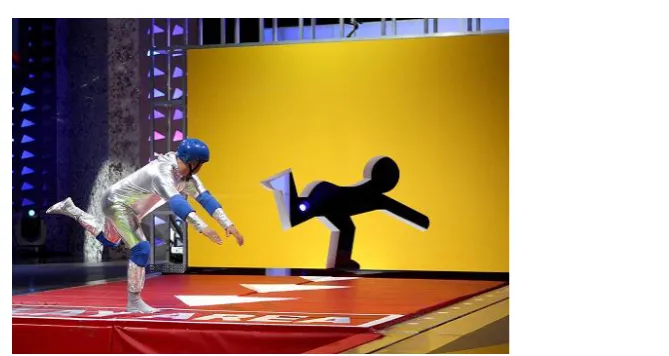
Posing in front of a camera can be fun and the resulting photos can tell a story. The activity of posing in itself can be entertaining, as the television game show “Hole in the Wall” has shown (see Figure 1.1). A game was developed for the research that let players experience the fun of posing.
1.1
The research
The goal of this research was to provide the player with an enjoyable experience in posing. A pose game was developed with the goal to motivate and persuade the player to assume various poses. The feedback of the game should draw the player’s attention and persuaded the player to keep on moving until the desired pose was reached. This desired pose was chosen by the game. The feedback provided by the game should steer the player towards the desired pose. Once the player was in the correct pose the game would take a picture and placed the player’s image in a fictional scene.
1. Introduction
Figure 1.1: The game show Hole in the Wall. The participants either suc-cessfully assumed the pose carved in the wall that was heading for them, scor-ing points for their team. Or they were pushed into the water. Source: http://www.realtvaddict.com/2009/10/21/tv-game-shows/
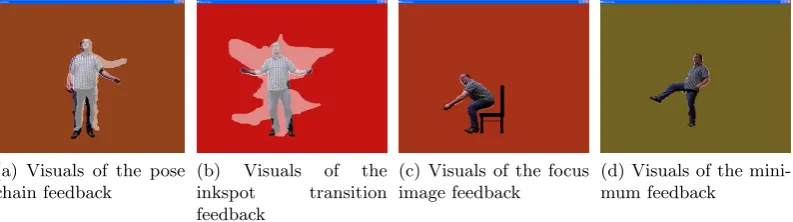
For the pose game that was developed for this study four different feedback methods were implemented. The feedback provided information about the pose that was desired by the game, and information on whether the player’s pose approached the desired pose. In all four feedback options there was a background that changed color from red to green when the player’s pose came close to the desired pose. In addition, all the feedback options displayed the player’s image like a reflection in a mirror. The difference between the feedback options was the hint they provided to the desired pose (see Chapter 3):
Minimum feedback provided no hint to the desired pose.
Pose chain feedback provided three silhouettes in succession leading to the desired pose.
Inkspot transition feedback provided an abstract shape that became more concrete and transitioned into the silhouette of the desired pose as the player approached it.
Focus image provided the image of an object whose context was an indication to the desired pose. Its position indicated the focus of the pose.
1.2
The user study
The focus of the user study was to evaluate how the four feedback feedback options that the pose game provided affected the user experience and the user performance. For the study two main research questions were formulated:
1. Which of the feedback options provides the best user experience? 2. Which of the feedback options has the best user performance?
User experience is still a very broad concept without a clear definition or decent measurement [Has05], unlike user performance which is well defined. In this study user experience was narrowed down to the constructspleasure,engagement andsatisfaction. User performance was measured by effectiveness and efficiency.
Overview of this report
participants and a large display for the output of the feedback. The measurements of the participant’s performance were logged by the game. The participants filled out a questionnaire after each task and participated in an interview at the end of the study.
1.3
Overview of this report
This report will further detail the research and the results. User performance, user experience and exertion games are central terms to this study. In chapter 2 these terms will be discussed in more detail.
The next two chapters will discuss the design and setup of the experiment. In chap-ter 3 a detailed explanation of the assignment will be provided. While in chapchap-ter 4 the methodology will be discussed, starting with the formulation of the research questions and subquestions. Next the experimental design, setup and procedure will be discussed. Followed by a description of the expected participants. Finally in this chapter the hy-potheses for the research will be discussed.
A demographic profile and the data gathered will be discussed and analyzed in chapter 5. Remarkable results will be highlighted and a general answer to the research questions will be provided based on the results. In chapter 6 we will take a critical view on the results.
Chapter
2
Related work
In this studyuser experienceanduser performance were two central subjects to be eval-uated with anexertion game. Where user performance is well defined, user experience is still lacking. This chapter will discuss user performance first, user experience second and finally what an exertion game is.
2.1
User performance
User performance is an objective term. Its measure is based on the two objective con-structs effectiveness and efficiency. User performance is well defined by the ‘Interna-tional Organization for Standards’ (ISO). They define user performance as the accuracy and completeness with which a user can achieve their goals using the system and the resources required to achieve the goals [ISO98].
To put it simply. User performance looks at whether the product does what its purpose is; how well the product does it; and how much it costs to complete its purpose. User performance can also be used to quantify and objectively compare several similar products, such as exertion interfaces [FHVN09].
Measuring user performance can been done relatively easily and objectively, consid-ering the definition [ISO98]. For example Manresa-Yee et al. were developing a vision based interface for disabled people. They assessed the performance of their product by having six subjects use their product in several sessions [MYPVP10]. The researchers noted whether the subjects were successful in their assigned task. How long the sub-jects needed to complete the tasks. And how fatigued they were after the task. The researchers compared the results with the performance of products that the subjects usually used.
Basically to measure performance is to measure how often someone fails or has success using the product. How close the user gets to success. The costs of a product can be several things such as time [FHVN09] or physical effort [MYPVP10]. The efficiency can be measured over a single task, over several tasks or the number of task that can be done within a set amount of resources.
2.2
User experience
User experience
understanding [Has05]. And Wright et al. state that “Experience is an elusive concept that resists specification and finalisation” [WMM05]. Yet, Manresa-Yee et al. argue that involving users and measuring user experience is essential in each stage of development [MYPVP10]. The questions remain ‘what is user experience?’ and ‘how can we measure user experience?’
2.2.1 Defining user experience
Some of the terms that immediately come to mind when looking at user experience are enjoyment [BFH05], pleasure [MR74], satisfaction [DTGP10] and being engaged [BFC+09]. However, none of these terms seem to fully cover user experience and are but a few of a wide range of constructs to measure. For most of these subjects there is no consensus on the definition either. And yet, user experience has become a catchphrase that everyone acknowledges.
ISO only considers satisfaction and provides a definition as “freedom from discom-fort, and positive attitudes towards the use of the product” [ISO98]. However other researchers have given other definitions of satisfaction in their works.
Deng et al. adopt the definition from Oliver: “Satisfaction is the consumer’s ful-fillment response. It is a judgment that a product or service provided a pleasurable level of consumption-related fulfillment, including levels of under- or over-fulfillment” [DTGP10]. In their view pleasure is a sub-construct of satisfaction. Their definition, however, contradicts the definition of Blythe and Hassenzahl. According to them sat-isfaction and pleasure are two equal constructs with an opposing aspect [BH05]. Satis-faction is the result coming from the confirmation of expectations, while pleasure is the result of a deviation from expectations.
Blythe and Hassenzahl also argue the difference between fun and pleasure. A fun experience is determined by its value as a distraction and being trivial, repetitive, a spectacle and a transgression. While pleasure is the opposite and determined by its value as an absorption, being relevant, progressive, aesthetic and being committed to the activity [BH05]. Fun is a short experience, while pleasure can take up a long time. To Blythe and Hassenzahl work can be pleasurable but not fun.
Sengers sees an experience of fun in a similar fashion, however does not make the explicit distinction between fun and pleasure [Sen05]. She argues that due to Taylorism our everyday lives and especially work have become a very bland and repetitive expe-rience. Thus for fun we spent our unplanned time doing activities, which maximize pleasure and minimize task achievement.
When discussing experience, flow is an often recurring term. The definition of flow that is most used in research was introduced by Csikszentmihalyi’s flow theory [MC96]. People experience flow when the activity they are involved in has a subtle balance between challenge and skill [BH05]. Brockmyer et al. consider flow to be a stage of ‘engagement’ along with immersion, presence and absorption [BFC+09]. Brockmyer et al. see the constructengagement as a generic indicator of game involvement.
2. Related work
definition of fun has changed through the course of history due to social and cultural changes [BH05].
Experience is the result of the situation and the apparent product character [Has05]. Fogg argues in [Fog03] that people often respond better to technology when there is a common element between the user and the product. He also argues that users experience the use of a product better when a positive psyche can be inferred from the product. The psyche and the product’s function need to be compatible with the user’s situation. Thus where user performance can be attributed to the product, user experience is attributed primarily to the user.
2.2.2 Measuring user experience
Measuring user experience is more difficult than measuring user performance, due to the vague definition and subjective nature of user experience [WMM05]. There is no method that can easily measure user experience entirely. Any measure created only covers a part. Thus for measuring it is better to focus on a construct or constructs that are the most meaningful to one’s own product/project. Various researchers have developed frameworks for measuring experience by focusing on a number of constructs [HDG10, WMM05, Shi09, DTGP10]. Some studies offer actual questionnaires that measure a certain construct of experience [BFC+09, PTF+95, BL94].
Moneta and Csikszentmihalyi mention that “the optimal approach to studying expe-rience is the collection of repeated measures” [MC96]. This means that users reported on their experience at different times and/or on different occasions. They used the Experience Sampling Method to measure the constructs concentration, the wish to do the activity, involvement and happiness. They attempted to find a correlation with the predictors perceived challenge and perceived skill.
Taylor and Agamanolis studied the satisfaction of a standard telecare product by asking users about their behavior in wearing the product [TA10]. While Manresa-Yee et al. asked their subjects about how satisfied they were [MYPVP10]. Deng et al. determined satisfaction based on cognitive absorption as a predictor in their model [DTGP10], which eventually determines the intention to continue to use the product.
Absorption was also measured in the work of Brockmyer et al. In their work they focussed on the potential for people to get engaged in video game-playing [BFC+09]. Their Game Engagement Questionnaire had 19 questions each measuring one of the four different stages of engagement they considered (immersion, presence, flow and absorp-tion).
Some measures of experience are based on emotions. Mehrabian and Russell devised a questionnaire to measurepleasure,arousal anddominance based on 18 opposing emo-tional adjectives, they called the Semantic Differential Scale [MR74]. Bradley and Lang later verified and simplified this scale into their Self-Assessment Manikin [BL94], with only three items represented with pictures. Hassenzahl et al. developed a framework where needs (competence, relatedness, popularity and more) and affects (from PANAS: afraid, scared, excited, inspired and more) are predictors for pragmatic and hedonic qualities of user experience [HDG10].
Exertion games
2.3
Exertion games
In the past decade there has been a rise in exertion gaming with the release of cheap commercially available motion sensing devices, such as the Sony Eye Toy1, Nintendo Wii2 and Microsoft Kinect3. One of the most successful games is Dance Dance Revolu-tion (DDR)4. It is one of the earliest commercial successes and has made its way into
a number of scientific works [And07, TP10]. Although attempts have been made since the 1980’s [NvDR08].
The idea behind an exertion game is that physical exertion is part of the gameplay experience and gameplay is part of the exertion experience [NvDR08]. Often the exertion is used as input, either through a motion sensing device or environment [NPvD+11]. But there are projects where exertion is the result of playing a game [SMM+11].
Scientific research in exertion games goes from developing and assessing new input devices [BTN04, FHVN09, LMW+11] to evaluating the effects of playing exertion games [MST+07, RN08, TP10]. With the latter it is mostly about evaluating physiological and psychological responses. The psychological effects can further be divided into emotional effects, such as mood, and behavioral effects, such as social interaction.
2.3.1 Effects of exertion games
When Nintendo first introduced the Wii console its arguments for motion control were that it makes gaming more enjoyable and gets gamers to be more active. With the introduction of the game Wii Fit Nintendo wanted to show the health benefits of gaming. The scientific community responded by evaluating such a claim and looking at how to
1http://blog.us.playstation.com/2010/11/03/eyetoy-innovation-and-beyond/, last viewed
14-09-2011.
2http://www.nintendo.com/wii, last viewed 14-09-2011. 3
www.xbox.com/kinect, last viewed 14-09-2011.
4
http://www.ddrfreak.com/, last viewed 14-09-2011.
(a) Sony Eye Toy (b) Nintendo Wii (c) Microsoft Kinect (d) Dance Dance Revolu-tion
Figure 2.1: Commercial successes in exertion gaming.
(a) A screen capture from the game Eye Toy Kinetic (source: http://www. dignews.com/platforms/ps2/ps2-reviews/eye-toy-kinetic-review/, last viewed 21-9-2011).
(b) Nintendo Wii promotional image of players holding a Wii remote (source: http: //damyn.wordpress.com/2010/03/16/concept-van-nu/, last viewed 21-9-2011). (d) Kinect promotional image of people playing a Kinect game (source: http://www. gamestar.hu/jatek/microsoft-kinect.html, last viewed 21-9-2011).
2. Related work
utilize it in medical contexts [HV09, TP10, GGLAC11].
Obesity and physical development in children and obesity in general has always been of great concern to parents and physicians [HHTR05]. Which is only made worse due to the sedentary lifestyles developed with the growing popularity of videogames [PB10, BDDM10]. In 2007 Mark Anders reported on a study done by the American Council on Exercise where the exertion video game DDR was evaluated as a viable alternative for physical exercise in schools [And07]. The results showed that the energy expenditure on the higher levels were sufficient for the recommended daily physical activity.
Thin and Poole performed a similar study, where they evaluated the health benefits of DDR and two Wii Fit games [TP10]. Their conclusion was that the specific games were not sufficient for the recommended daily physical activity. However they commented that this might be due to the subjects’ inexperience with the game. This suggestion had been corroborated by the study performed by Sell et al. Their results showed that the energy expenditure with experienced DDR players was higher than the inexperienced players [SLT08].
A number of studies focussed on the physiological benefits of exertion games, each with their own target demographic among the healthy population and using self-made or existing commercial games [PB10, BDDM10, WRK11]. Other studies focussed on helping disabled people exercise their muscles [SMM+11] or to even rehabilitate after being seriously injured [GGLAC11]. Manresa-Yee et al. developed a vision-based control interface for people with cerebral palsy. Originally this interface was meant to provide easier access to computers, however as a side effect it strengthened the subjects’ neck muscles and improved control over head movements [MYPVP10].
As the above mentioned studies focussed on the physiological effects, there were a few that actually looked at the psychological effects. Some of these studies looked at emotional effects such as mood changes [RN08], while others considered the behavioral effects, such as social interaction and bonding [MGVA08]. A reoccurring measure in almost every study, even with the former studies, was whether the subjects enjoyed the exertion game. And often the interactive videogame prevailed in enjoyment over the sedentary counterpart or a regular fitness exercise [PB10, SLT08, TP10, BDDM10]. However this might also be part of the novelty that the subjects were experiencing with exertion games [FHVN09].
Exertion games
family [KMC+07].
2.3.2 The technology behind exertion games
At the other end is the development of the technology, both as hardware and software. The technology can be simple or very complex. The main criteria is that it facilitates physical interaction between all the actors [NvDR08].
The Age Invaders project required a room with a tiled floor containing RFID sen-sors, RFID tagged slippers and a large display to show the virtual environment for the interaction between grandparents and grandchildren, while the parents could join over the internet via the computer [KMC+07]. The physical interaction took place over a larger area. The input was given to the computer with the RFID tags. The Breakout for Two project also used a large room as players need to shot a ball against the wall [MST+07]. However it was the impact of the ball against the wall that was the input to the virtual environment. For the social aspect a video conference image was projected on the wall.
Not all exertion games required a lot of space for people to move around in. Li et al. implemented awhack-a-mole game that players could control by swinging a brightly colored hammer around in front of a camera [LCW+08]. And Mueller and colleagues studied social interaction facilitated by playing on bongos in a game of Donkey Konga
[MBB10]. This type of interaction only relied on physical activity of the upper body, while the feet were stationary.
However limiting the space to move in does not limit the exertion to just the upper body. Even in a limited space the entire body can be used. For example by strapping the player in a harness [MST+07] or choosing an activity that does not require much space, such as rap dancing [RvWP+06] or a simple fitness exercise [RZvWR06]. In
FlyGuy Mueller and colleagues strapped the player in a harness. By twisting his body and using gravity the player could experience a virtual flight in a hang glider.
With the virtual rap dancer the player had to step on a DDR dance mat to start the interaction [RNRH05]. A camera then recorded and analyzed the player’s moves in order for the virtual rap dancer to dance along. This dancer provided feedback by either following the player or even leading the player by teaching new dance moves. The interaction only lasted as long as the player had one foot on the mat [FHVN09].
A great number of input devices have been developed. Some of the commercial devices were even considered for serious applications [dHGP08, Fik10]. The devices could be simple and developed for a single game. Or devices could be developed for a more general range of applications, such as the Wii Remote, Balance Board, Kinect or Joyfoot [FHVN09, Sol11, BTN04]. What they should do is provide the necessary information about the exertion to the virtual environment, such as the impact of a ball against a wall [MST+07].
The data from the devices needs to be interpreted by the game and converted into the right manipulation. The press of a button is often mapped to a single action, as with a dance mat and bongos [RNRH05, MBB10]. A device such as the Wii Remote uses accelerometers and a gyroscope [FHVN09]. Foot operated devices, such as the Joyfoot and Wii Balance Board, use pressure sensors to determine the player’s weight distribution [BTN04, dHGP08]. Cameras, such as the Kinect, are the least invasive devices but they give the most ambiguous of input. In a camera image the player first needs to be recognized [RSH+05, LMW+11] before the orientation and movement of the player can be determined [BD01].
2. Related work
Chapter
3
The master’s thesis assignment
This chapter will explain what the master’s thesis assignment was. The assignment was to create a posing game using a vision-based interface, the Microsoft Kinect sensor, that could provide a good experience in playing. The aim of the research was to develop an entertaining and enjoyable experience of posing in front of a camera for players. This study was to evaluate the user experience and user performance of the immediate feedback of the pose game during gameplay.
This chapter will deal with the research that this study was a part of and the study’s focus. The four feedback options that were implemented for this study will be presented. Finally the evaluation in this study will be discussed.
3.1
The project
The general project was to create a game that would engage players into assuming a specific pose in front of a camera in an enjoyable and entertaining manner. A player would step inside a booth, where he would see the game displayed on a large screen. Inside the booth the player would be motivated by the game to position himself in the pose. It was up to the player to find out what pose the game wanted. The game provided feedback to the desired pose and how far the player was still removed from the pose.
[image:19.595.118.518.650.724.2]The pose game continued as long as the player did not find all the poses. The player would lose the game when he would forfeit and walked away. When a pose was found the pose game took a picture of the player in the desired pose and put him in a different (fictional) scene. A new background, foreground and props would be added to place the player in a different setting and give a (new) meaning to the pose (see figure 3.1 for examples).
3. The master’s thesis assignment
The interaction of the game was considered in three stages. The first stage was attracting the player’s attention in that he was dealing with an interactive game and something could be won if he would complete all the tasks.
The second stage was engaging the player to continue playing. The game would provide immediate feedback based on the player’s actions. This feedback guided the player to the desired pose that the game selected. This stage was what this study focussed on and had several options implemented (see Section 3.2).
The last stage was rewarding the player for completing a single or all the tasks. This stage involved notifying the player of a task completion and the completion of the game. For completing the game the player was provided with the snapshots that the game took of the player in the desired poses.
3.2
The feedback options in the study
The focus was the immediate feedback that the player got when he was playing the game. The feedback showed the player’s progress towards the completion of a single task and a hint on which pose the game desired of the player. In addition, the feedback also needed to stimulate the player to continue playing until he completed one or more tasks in order to keep the game going. The focus of this study was to evaluate the user experience and user performance of each feedback.
Four different feedback options were designed and implemented. All options used only a visual modality for presenting the necessary feedback information to the player. This lowered the number of variables that could influence the results and kept the study to a manageable size. The aesthetics were kept simple. Fogg mentioned that the visual appeal had an effect on how people perceive technology. When the subject found the game appealing he would be more cooperative and more positive in his ratings and when it was not appealing the subject would be more negative. The appeal was however dependent on each person and their personality [Fog03].
The graphics would contain nothing more than was required to provide the necessary feedback. The feedback had three gameplay elements, of which two were consistent with all four feedback options. The first element gave information about the player himself. This was realized by displaying the image captured by the Kinect sensor on screen (see
(a) Visuals of the pose chain feedback
(b) Visuals of the inkspot transition feedback
(c) Visuals of the focus image feedback
[image:20.595.83.480.564.675.2](d) Visuals of the mini-mum feedback
The feedback options in the study
figure 3.2). The image of the player was mirrored.
The second element gave an indication on whether the player got closer to the desired pose or not. This element was realized by having the background color transition back and forth between two colors. The background became more red when the distance increased and more green when the distance decreased. The last element of the gameplay gave a hint on the desired pose. This hint was different for each feedback option.
3.2.1 Minimum feedback
The first feedback option did not give a hint to what pose was desired by the game. This option, shown in figure 3.2d, only included the first two gameplay elements common to all the feedback options. It excluded the third gameplay element.
With this feedback the player only had the background color that transitioned be-tween red and green to work with. Like a game of warm and cold the player had to search for the correct pose, only to get an idea of the desired pose when he reached it.
This feedback option also formed the basis of the other three options.
3.2.2 Pose chain feedback
This option was inspired by the’Hole in the Wall’ (see figure 1.1) concept and is shown in figure 3.2a. The hint was given by displaying the silhouette of a person performing the target pose. The player only needed to align himself with the silhouette and copy this pose.
When the player successfully copied the pose the game went to the next pose in the chain. The final pose in the chain was also the desired pose that would produce the reward. The complete sequence of poses (three in total) described the movement of the body from a base stance towards the desired pose.
3.2.3 Inkspot transition feedback
This option, shown in figure 3.2b, gave the hint on the pose in the form of an inkspot. The inkspot started out as a meaningless shape and would shrink towards a silhouette of a person performing the desired pose. The inkspot would only shrink when the player got closer to the pose he needed to assume. The inkspot would not increase in size when the distance increased again.
In this feedback the player needed to explore for a clue to the desired pose, rewarding the player with a smaller and more defined shape when he got closer to his goal. After the player came close enough the shape would be an example silhouette for the player to copy, like in the previous feedback but only the last pose in the chain.
3.2.4 Focus image feedback
3. The master’s thesis assignment
3.3
The evaluation in the study
In chapter 2 the terms user performance, user experience and exertion games were explored. These were most central to this study and influenced the experimental design in chapter 4. Posing is, by definition, standing or sitting and is not as physically active as dancing, walking or waving. Still in this game the player constantly needed to move his body or limbs to find the desired pose, which made the pose game an exertion game. Unlike many studies involving exertion games this study did not focus on the exer-tion part of the game and how the exerexer-tion was input in the game. The study evaluated user performance and user experience of the feedback in an exertion game. User perfor-mance is an objective concept that is well defined by the International Organization of Standards, as is discussed in section 2.1 [ISO98]. It was measured by how adequately the feedback of the pose game could fulfill its purpose, which was to guide the player to the correct pose that was desired by the game.
User experience on the other hand is a subjective concept, as is discussed in sec-tion 2.2. Even though many have an understanding of this concept its definisec-tion is still very broad, not coherent and rather elusive to finalize [Has05, WMM05]. Nor is there a measure that can adequately measure user experience in general. As concluded in section 2.2 it is better to select some sub-concepts fitting to the study. For an experi-ence the immediate feedback should have made playing pleasurable and have gotten the player engaged in posing. In addition the player should be satisfied with the feedback he got from the game.
Studies have indicated that exertion could have an influence on the mental state of a person, if the intensity was high enough. However it was not expected that the player would put in much exertion. Even though the full body was used in this game the player’s space to move was limited to the range of the Kinect sensor’s field of view, which was used as a noninvasive means of registering player input. The player did not need to attach visual markers nor hold the weight of a prop for visual recognition during gameplay. Studies also showed that the intensity of the exertion increased as the player was more familiar and skilled with the game. The participants in this study were not familiar with the game and its feedback, even though the activity of posing might be simple. There was no time limit or another constraint that forced the participant to hasten in finding the desired pose. The participants could play the game at their own leisure and stop when they chose to.
Chapter
4
Methodology
This study was a user evaluation in a laboratory setting with the goal of evaluating the user experience and user performance with the four feedback options of the pose game (see Chapter 3). The study measured the pleasure, engagement and satisfaction constructs for user experience and effectiveness and efficiency constructs for user per-formance. The survey consisted mostly of questions asked in a written questionnaire before and during the experiment and an oral interview after the experiment. These were aided by observations and computer logged data.
4.1
Research questions
By evaluatinguser experience the study questioned the participants about their experi-ence with each feedback option and distilled which option had the best user experiexperi-ence. The overall experience was assessed through several constructs as user experience is still a very broad term. These constructs were pleasure, engagement and satisfaction of the feedback elements (see Subsection 4.2.2).
In addition this study looked at the user performance of the feedback options. One feedback might move the participant to the desired pose more easier than others, while another would not get the participant to assume the pose at all. The user performance was measured by the constructs of effectiveness and efficiency (see Subsection 4.2.3).
For this study the following research questions and subquestions were formulated:
1. Which of the feedback options provides the best user experience?
(a) Which of the feedback options provides the most pleasure? (b) Which of the feedback options is the most engaging?
(c) With which of the feedback options are the participants most satisfied?
2. Which of the feedback options has the best user performance?
(a) Which feedback option is the most effective? (b) Which feedback option is the most efficient?
4. Methodology
[image:24.595.94.460.109.200.2](a) Umbrella (b) Weightlifting (c) Sit (d) Kick
Figure 4.1: These were the four poses used in the experiment that the participants had to assume.
4.2
Experiment design
This section will discuss the design of the experiment. It will discuss the independent variables, which were implemented in the pose game. And the dependent variables of user experience and user performance, that were measured using four techniques for data collection [DFAB03]. First a written questionnaire before and during the experiment, second an oral interview that was recorded on audio, third computer logging imple-mented in the pose game and notes taken by the experimenter was the final technique.
4.2.1 Independent variables
The independent variable that this study was interested in was the feedback. The study was set up as a within-subjects experiment that had each participant work with each of the feedback options. As the order in which the options were presented could have an influence on the results, the participants were divided into four groups. The order of the options was varied by applying a Latin’s square.
Group #1 Pose chain →Inkspot transition → Focus image→ Minimum. Group #2 Inkspot transition → Minimum→ Pose chain→ Focus image. Group #3 Focus image → Pose chain→ Minimum→ Inkspot transition. Group #4 Minimum → Focus image→ Inkspot transition→ Pose chain.
Another independent variable was the set of poses. Repeated execution of the same pose would influence the results due to a learning effect. Thus four different poses were selected to be executed by the participants. The differences between poses could have an effect on how the feedback would be perceived. A fixed order, as presented in figure 4.1, was used to make sure that the use of each pose was equally spread over the feedback options. The final independent variable was the participants, which will be discussed in Section 4.5.
4.2.2 Dependent variables of user experience
User experience was one of the two overall dependent variables. However it is still an ambiguous and very broad concept [Has05]. User experience was further specified into the dependent variables pleasure, engagement and satisfaction. These variables were measured with several items in a questionnaire and an interview (see Appendix A).
Pleasure
Experiment design
Russel [MR74] and later adapted by Bradley and Lang into the Self-Assessment Manikin [BL94]. Bradley and Lang verified that six of the 18 items represented the construct pleasure.
The Self-Assessment Manikin adapted the bipolar adjectives pairs into a single series of pictures. However some text was still needed to make sure everyone understood the context. Thus Mehrabian’s six bipolar adjective pairs for pleasure were used to measure pleasure in this study. The items were scored on a 9-point Likert scale.
Engagement
Brockmyer et al. devised, tested and verified a set of items to measure a persons po-tential to become engaged in video games, called the Game Engagement Questionnaire [BFC+09]. They also used it to measure how engaged subjects were after playing the videogame ‘S.T.A.L.K.E.R.’. An adapted version of Brockmyer et al. game engagement questionnaire was used to measure engagement in this study. Even though their ques-tionnaire was based on a sedentary game, it was not expected that the exertion in this study would be of the intensity that it would influence the results [DFAB03, NvDR08]. The items based on the Game Engagement Questionnaire were scored on a 5-point Likert scale with a range fromNo toMaybe toYes. Inspired by the work of Brockmyer et al. the participant’s perceived time spent playing were compared to the actual time spent playing. The greater the difference between the perceived time and the actual time playing the game (time accuracy) and the direction of the difference (time estimation) were an indication on how much the participant lost track of time and became engaged. Chaston and Kingstone mentioned that the more a person committed attention to a task the less attention was given to the passage of time from a person’s internal clock, which caused the difference between actual and perceived time [CK04].
Satisfaction
The next dependent variable was satisfaction. The items of this construct had been inspired by the work of Manresa-Yee et. al and the work of Taylor and Agamanolis. In [MYPVP10] Manresa-Yee et al. primarily looked for satisfaction at how useful their product was for their target demographic. Taylor and Agamanolis held a survey to measure the user experience for a telecare product in [TA10]. Although their focus was on the behavior and reasoning for wearing the product, they got a lot of feedback focussed on the satisfaction of specific aspects.
There were four aspects of the pose game noticeable through the feedback. The first three were the three elements of the feedback, the color changing background, the image of the player and the hint about the desired pose. The fourth aspect was how well the game accepts the player’s input pose as the desired pose, by being too lenient, correct or too strict. In addition, would the player expect to enjoy playing the game. Satisfaction was measured with these five items in a questionnaire that focussed on the contribution of each aspect of the feedback to the user experience [TA10]. These items were scored on a 5-point Likert scale with opposing adjectives.
User experience
4. Methodology
information they thought was lacking in the feedback. The specific questions of the questionnaire and the interview are provided in appendix A.
4.2.3 Dependent variables of user performance
Next to user experience, user performance was also a dependent variable in this study. However user performance is objective in nature and is measured through data logged by the computer. The ISO 9241 standard states that user performance is measured by effectiveness and efficiency [ISO98].
Effectiveness
According to the ISO 9241 definition: “Measures of effectiveness relate the goals or subgoals of the user to the accuracy and completeness with which these goals can be achieved” [ISO98]. For this study it meant that the completeness was determined by the number of participants that completed the tasks1 for each feedback. The pose game logged whether a participant completed a task with a feedback option.
The accuracy in this study was how close the distance between the participant’s pose and the desired pose became. To measure this the feedback data (see Appendix C) of each frame was recorded. The distance between poses in the feedback data was based on a weighted point-to-point distance between the joints of the captured skeleton and target skeleton. The primary joint in the pose had a weight of one (1.0,1.0), while irrelevant joints had a weight of zero (0.0,0.0). Tasks that were completed had a distance of zero, while uncompleted tasks had a distance larger than zero.
Efficiency
The ISO 9241 definition of efficiency is: “Measures of efficiency relate the level of ef-fectiveness achieved to the expenditure of resources.” [ISO98]. The physical effort was mostly dependent on the pose that was executed and not on the feedback option. Be-sides it was not expected that the participants had to put much physical effort in the posing. The only relevant resource in this study was time; the time to either complete or give up on a task.
The pose game recorded the time spent on each task in milliseconds for the most accuracy. The less time necessary to complete a task meant a more efficient feedback. The less time spent on an uncompleted task was also more efficient. As it did not spent time on a task that the participant considered he would never complete.
4.3
Experiment setup
The laboratory setup was simple and shown in figure 4.2. The graphics of the game were projected on a large display. Below this display the Kinect sensor stood elevated from the floor. The participant had enough space so the entire body was visible in the sensor. In addition, when the participant moved he did not bump into anything or anyone.
The experimenter sat at the side behind a desk and observed the participants. At the desk was also the computer that ran the pose game. The experimenter sat outside the view of Kinect sensor. He could control the flow of the experiment when required
1A single task meant that a participants assumed a single pose with one of the feedback options. In
Experiment procedure
Figure 4.2: This was the layout of the experiment. 1 was the space the participant had to pose in, which was determined by the sensor’s field of view. 2was the experimenter’s position. 3 was the large display that displayed the game. 4 was the Kinect sensor.
by using the keyboard. For example, when the participants gave up on completing the task.
4.3.1 The game setup
The poses of the participant needed to be recognized as input. This was done by means of computer vision using the Xbox360R KinectTM sensor from Microsoft and
the OpenNI framework2. The sensor, OpenNI framework and the game’s preprocessor and data processor (see Appendix C) captured and transformed the captured pose to feedback data that could be used by the game model.
Feedback data for the game model was created by comparing two pose descriptors (a previously recorded descriptor and the descriptor of the captured pose). The model adjusted its feedback settings and the feedback was provided to the participant. Then the game checked if a match was found. In case that a match was found a reward image was created with the participant in it and the next desired pose was selected. If there was no new desired pose to be selected the game was completed and the game continued to showing the reward images.
4.4
Experiment procedure
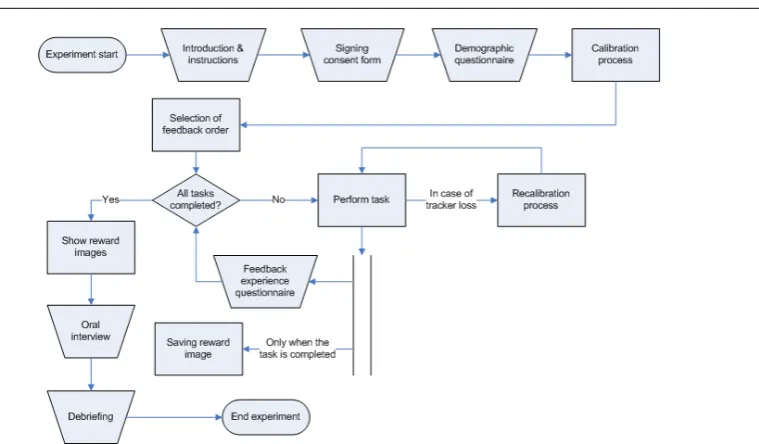
Before the experiment the participant was welcomed. The experimenter explained to him the purpose of the study and what data was going to be recorded. The experimenter told him about the general flow of the experiment and that the participant had to move to assume the correct pose desired by the game. The game would hint on the desired pose and how far the participant was from the desired pose through the feedback. The experimenter did not tell him what the exact feedback was in order to maintain a certain element of surprise, which could lead to pleasure [BH05].
The experimenter told the participant that he would have to complete four tasks with four different feedback options. Whenever the participant wished to give up on completing the task and continue to the next he needed to notify the experimenter. The
4. Methodology
Figure 4.3: This flowchart shows the flow of an experiment. This flowchart assumes that the participant continues playing until all the tasks are completed or given up. If the participant gives up on the experiment all his data is discarded and the experiment terminates immediately.
experimenter also told the participant that he could quit participating in the study at any time.
The participant signed a consent form that any data gathered during the experiment could be used for this study. The data would be reported on, but was completely anonymous and untraceable to the participant. Next the participant filled out a written demographic questionnaire and the experimenter assigned him to a group.
The experimenter started the experiment with the feedback order respective to the participant’s group. The participant tried to assume the correct pose based on the information provided by the feedback. Once he had completed or given up on the task he had to fill out a written questionnaire pertaining to the feedback option. The experimenter would tell the game to start the next task when the participant was ready to continue. This process was repeated three more times for each feedback option.
The participant could also choose to give up on completing the task. He then notified the experimenter, who asked him first if he was sure. When the participant was sure that he wanted to give up the experimenter told the game that the participant gave up. Just as completing a task the experimenter presented the participant with the questionnaire and told the game to continue to the next task, when the participant was ready.
When all the tasks were done and the respective questionnaires were filled out the participant might view his reward pictures. After this, the experimenter would take an oral interview asking the participant to compare and rank the various feedback options. Finally the experimenter debriefed the participant and thanked him for his partici-pation. The experimenter made a copy of the data files containing the logs of the pose game. The entire experiment would be about a half hour in length.
4.5
The subjects
The hypotheses
both females and males participating, although the number of males participating was expected to be larger than the number of females.
The subjects’ heights were ranging from 155 cm to 200 cm. Some of them had experience using the Microsoft Kinect sensor, while most would not have experience with it.
The participants were divided at random over the groups. They were told that they needed to move their limbs and torso; and that the position in the room mattered. The participants did not know what feedback to expect.
4.6
The hypotheses
Based on the research questions and the methodology to measure the constructs, these hypotheses were defined.
Hypothesis 1. The feedback options score differently on pleasure.
The first six items of the questionnaire provided the score on pleasure for the respec-tive feedback option. These items were based on the Semantic Differential Scale, which was a validated scale [BL94] and validated to measure the same.
The hypothesis could be accepted when a statistical analysis of pleasure showed a significant effect for feedback.
Hypothesis 2. The feedback options score differently on engagement.
Adapted questions from Brockmyer’s Game Engagement Questionnaire provided the score for engagement. The scale was validated and Brockmyer et al. stated that the scale measured four levels of engagement [BFC+09]. These were in order from low to high engagement: immersion, presence, flow and absorption. Immersion and presence were scored with one question each. Flow and absorption were scored by three questions for the respective category.
When there was a significant effect found for feedback with a statistical analysis of the score over all the items of engagement this hypothesis could be accepted.
Hypothesis 3. The feedback options score differently on satisfaction.
The final five items of the questionnaire measured the participant’s attitude towards (several aspects of) the pose game [ISO98]. Three items determined whether the partic-ipants were positive or negative towards their respective aspects of the feedback. One item determined if the participants considered the game too difficult or easy. And the last item determined whether the participants enjoyed the pose game.
The hypothesis could be accepted when the score for satisfaction provided by all the items showed a significant effect for feedback in a statistical analysis.
Hypothesis 4. The feedback options measure differently on effectiveness.
The purpose of the pose game was to get a participant to assume a pose. The effectiveness was thus how well the feedback option could fulfill the task; and how close the participant came when he failed [ISO98]. The task completion took all the cases into account, while the accuracy would only consider the cases for the feedback where the participant failed to complete the task.
4. Methodology
Hypothesis 5. The feedback options measure differently on efficiency.
The efficiency was determined by the means of the actual time played for all the tasks that were completed; and the means of the actual time played of all the tasks that had been given up for each feedback.
Chapter
5
Results
5.1
The participants
A total of 28 participants participated in this study. The participants were divided at random over the groups with 7 participants in each. All the participants were recruited from the University of Twente.
Five participants (18%) were female and 23 participants (82%) were male. Ten participants (36%, one female and nine male) had experience in using the Kinect prior to the experiment.
The average age was about 33 years old with a standard deviation of 10,059 years. The youngest participant was 24 years of age and the oldest was 59 years. The average height of the participants was about 181 centimeters with a range of 155 centimeters for the smallest participant and 198 centimeters for the tallest. Table 5.1 shows the demography for each group.
#Gender #Kinect used Age (in yrs) Height (in cm)
Female Male No Yes Mean Std.Dev. Mean Std.Dev.
Group 1 2 5 5 2 35,86 13,284 180,29 9,621
Group 2 0 7 4 3 30,71 8,015 186,14 7,777
Group 3 2 5 4 3 28,00 2,000 174,29 14,930
Group 4 1 6 5 2 37,14 13,692 184,29 8,261
Total 5 23 18 10 32,93 10,059 181,25 10,960
Table 5.1: The demographic values for each group.
5.2
Statistical analyses
The analyses focused on the differences in scores between the feedback options. The data had been analyzed by using a repeated measures ANOVA for within-subjects ex-periments. The combined statistical results can be found in Appendix B.
5. Results
72. Whenever Mauchly’s test of sphericity showed significant violation of sphericity, the degrees of freedom were corrected with a Huynh-Feldt correction.
However some variables, such as the efficiency with user performance, had an addi-tional constraint that the task needed to be completed or not. In these cases the sample sizes for each feedback option was not guaranteed to be equal (smallest being N = 2) over the feedback options. A one-way ANOVA was used to analyze these variables. The feedback options were in this case a between-subjects factor and the completed or uncompleted tasks were the within-subjects factor. A Levene’s statistic was used to determine the homogeneity of the variance.
In the both statistical methods the results were considered significant whenp <0.05 and marginally significant when p <0.1.
5.3
Poses
The poses were not considered a factor in the statistical analyses due to the fixed order in which they were presented to the participants. However this section will give a quick overview of cross reference analyses of the poses.
The results in figure 5.1b show that each pose was just as difficult as the others. There was not much difference in the number of completed and uncompleted tasks between the poses. This shows that none of the poses was easier or more difficult to do than another. In the actual playing time there was also not much difference between
(a) Rankings (b) Completion
[image:32.595.114.441.411.710.2](c) Playing time
User performance
the poses (see figure 5.1c). Participants seemed on average to take the longest time in completing the weightlifting pose, while this pose seemed to be the one that participants gave up fastest on. When participants were unsuccessful they tried the longest on the kick pose. However in all these cases there was a large variance to consider.
The more remarkable results can be found in figure 5.1a. It seems as if the umbrella pose was favored the least by the participants and the kick pose was favored the most. The sit pose gave an equal score over all the rankings. And the weightlifting pose seemed to receive the mostthird ranks. However it should be considered that the order of poses was never varied over the participants. For every participant, the umbrella pose was the first pose they needed to assume. The weightlifting and sit poses were respectively the second and third task to be performed. While the kick pose was always the last task. The rankings could also be the result of order in that the participants were becoming more familiar with the experiment. In addition the rankings were asked of the participants after the experiment and the last task was the freshest in their minds.
5.4
User performance
The second research question asked which of the four feedback options had the best user performance. The performance was determined by the effectiveness and efficiency. The effectiveness was determined by the number of tasks completed and how close the distance between the poses was with the uncompleted tasks. The efficiency was determined by the time the subjects used to complete or give up on the task [ISO98].
No pose was too difficult to perform with any of the feedback options. The results show that within each group there was at least one participant who completed all four of the tasks that the experiment presented them. Each participant completed at least one of the tasks.
5.4.1 Effectiveness
According to hypothesis 4 there were differences reported in the effectiveness of the feedback options. This hypotheses was tested with a repeated measures ANOVA (see Section 5.2) with thetask completion as the dependent variable. Task completion could
(a) Task completion (b) Pose Accuracy
5. Results
only have the valuescompleted and uncompleted. The analysis showed that the hypoth-esis was accepted due to significant within-subject effects between the feedback options on task completion (F(3.000,72.000) = 14.169,p <0.001 with a Huynh-Feldt correction (ε= 1.000)).
Both the pose chain and inkspot transition feedback had significantly more tasks completed than both the focus image and minimum feedback (see Figure 5.2a and Ta-ble B.2). The participants also commented that the pose chain feedback was the clearest to understand and the easiest to perform. The inkspot transition feedback option had an abstract shape that turned into a silhouette at its last stage. Once in the final stage the inkspot transition feedback was the same as the pose chain feedback, which explained the similarity in task completion.
Interestingly, was the minimum feedback option which was the only option with more uncompleted tasks (18) than completed (10) tasks. However it was also the only option that did not give a hint to the expected pose. The participants commented that this was frustrating. Only a few appreciated the difficult level of challenge.
The accuracy of nearing the pose1 was based upon those samples that had not completed the pose. Thus it had been analyzed using a one-way ANOVA with the real valued accuracy as the dependent variable. Levene’s statistic showed that equal variance could not be assumed (p <0.05) and the ANOVA test showed no significant differences in the mean between the feedback options (F(3,31) = 1.750, p = n.s.).
However the minimum feedback option was the least accurate in nearing the pose with the largest mean distance accuracy. Its standard deviation (σ = 0.30490) was also larger than the standard deviation of the other feedback options (see Table B.3). The experimenter observed that some participants were reasonably close to the desired pose, while others hardly got the background to change color.
The inkspot transition feedback had the smallest mean accuracy, but the difference with the pose chain and focus image feedback was very small. The final stage of the inkspot was the same as the pose chain feedback. However the experimenter observed with the pose chain feedback that participants were keeping the pose two dimensional for the arms. Posing two dimensionally meant that the participant moved the arms up and down to the side of the body instead of also forward and backward. The focus image feedback seemed to be the most consistent with the smallest standard deviation (σ = 0.04690, see Table B.3). However it should be noted that the pose chain and inkspot transition feedback had a small sample size of respectively N = 2 and N = 3 (see Table B.1).
5.4.2 Efficiency
To analyze the efficiency of the feedback options a one-way ANOVA (see Section 5.2) was used, because the differences between the feedback options in the time the participants played the game had to be separated in completed and uncompleted categories. The actual time played was used as the dependent variable for both categories. These results can be found in Tables B.5 and B.7 of Appendix B.
The participants commented that the pose chain feedback was the clearest and easi-est. This was reflected in the task completion and efficiency of this feedback. The mean time spent playing when a task was completed was the shortest for the pose chain feed-back (µ= 41.20,σ= 34.544). However hypothesis 5 states that differences between the
1
User performance
Figure 5.3: This chart shows the efficiency for each feedback option. The time it took for the participant to complete the task or give up.
feedback options were expected. Levene’s statistic showed no homogeneity in the vari-ance (p <0.05) and there was only a marginally significant difference reported between the feedback options for the actual playing time of completed tasks (F(3,73) = 2.525,
p <0.1). Thus hypothesis 5 cold not be accepted and was rejected.
The pose chain feedback required the participant to pose in three poses, but this had little influence on the completion time. The experimenter observed the participants spending most of the time finding the correct position for posing. Once this position was found the other poses in the chain were assumed relatively faster. For the inkspot transition feedback the challenge was ‘to find the correct direction’ to pose in, as the participants called it. And with the focus image the participants mentioned that it required some creative thinking, because the feedback presented you with an object. The participants did comment that they were confused at first. With the inkspot transition and focus image feedback options they first spent some time considering the hint that they were given. With the minimum feedback option the participants were confused as well, but most of them first waited to see if they would not get a hint after all.
The minimum feedback was the most inefficient option with µ = 92.94 and σ = 82.464. The participants commented that this feedback was too difficult and more or less they had an infinite possible directions to start posing in, without a hint on where to start. The feedback relied a lot on ’lucky shot’ tries to obtain the pose. This was somewhat confirmed by the fact that the fastest completion time on record for this feedback was about 10 seconds. The respective participant commented that he was surprised and had no idea what he had been doing to succeed.
For the uncompleted tasks it was the inkspot transition feedback that took the least amount of time (µ = 136.06 seconds). Thus the participants gave up the fastest with this option. With the pose chain (µ= 170.17 seconds) the participants tried on average more than 30 seconds longer than the inkspot transition feedback. However even with Levene’s statistic showing that equal variance could be assumed (p = n.s.), the one-way ANOVA results for the efficiency of uncompleted tasks showed no significant differences (F(3,31) = 1.331, p = n.s.).
5. Results
Research question 2 asked which feedback option had the best user performance (see Section 4.1). The answer to subquestion 2A, “which feedback is the most effective”, were the pose chain and inkspot transition feedback. In task completion the pose chain feedback option had one more completed task than the inkspot transition feedback, which was not a significant difference. Yet the accuracy of pose distance with the uncompleted tasks the inkspot transition feedback seemed to do better than the pose chain, even though the difference was not significant. However significant within-subjects effects were reported on task completion thus hypothesis 4 was accepted.
No significant differences had been reported for the efficiency of completing tasks, which meant that hypothesis 5 was rejected. Although the pose chain was the most efficient when it came to completing a task. And this answers research question 2B of which feedback option is the most efficient. Although the inkspot transition feedback seemed to take the least time when being unsuccessful.
The feedback option with the best user performance was the pose chain feedback. It had the better measured task completion and was measured to be the most efficient in completing the task. The accuracy of pose distance and the time spent with uncompleted tasks was based on too small a sample size for the pose chain and inkspot transition feedback to matter for performance. The minimum feedback was definitely the worst in user performance. It had a low task completion and had the worst pose accuracy. It also cost the most time no matter whether the task was completed or not.
5.5
User experience
“Which of the feedback options provides the best user experience” was asked by the first research question. Because user experience is too broad a concept to be measured [Has05], this study focused on the constructs pleasure [BL94], engagement [BFC+09], and satisfaction [MYPVP10, ISO98].
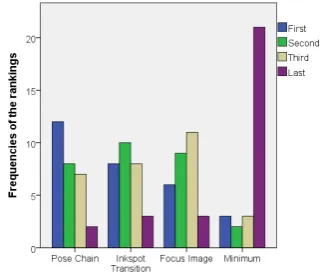
[image:36.595.197.358.567.706.2]In the interview the participants were asked to rank the feedback options according to their experience. The participants often commented that the minimum feedback was frustrating and way too difficult, which was clearly visible in the results. The minimum feedback was significantly ranked the worst feedback by 20 of the 28 participants (see Figure 5.4 and Table B.10 in Appendix B). The pose chain had the most votes ranking it as the favorite option. The reason the participants gave, is the pose chain being the
User experience
Figure 5.5: The estimated means for each item on pleasure with each feedback option.
most clear in what had to be done.
5.5.1 Pleasure
For each feedback option pleasure was scored by the first six items of the questionnaire. The range of score went from -4 for one end of the adjective pair to +4 for the other end, due to the adjectives being opposites from each other. In a repeated measures ANOVA (see Section 5.2) these six items provided the score on the dependent variable
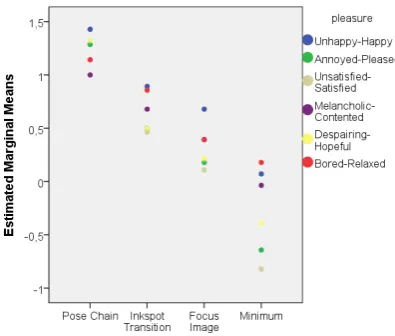
pleasure. According to hypothesis 1 the feedback options score differently on pleasure. This hypothesis was accepted as there were significant within-subjects effects reported between the feedback options on pleasure (F(3,72) = 8.912, p < 0.001). The pose chain feedback scored significantly higher than the three other options (see Table B.12 in Appendix B).
There was a definite order in scoring recognizable from figure 5.5, which provided an answer to research question 1A (see Section 4.1). The minimum feedback was the worst of them and even had a negative score of µ = −0.274. This feedback was thus on average associated with a negative emotional state. Which was expected considering the negative comments most of the participants made about this feedback.
The inkspot transition (µ=