PEDIATRICS Volume 139, number 6, June 2017:e20163673
Primum non nocere, Latin for “First do no harm, ” is a fundamental
bioethical principle indoctrinated into each of us at the commencement of our medical education and continuously reinforced during residency and fellowship training. Even though our training models have progressed from the cynical “see one, do one, teach one” to graduated autonomy, there remains significant room for improvement because inadequate resident supervision has been associated with patient harm and poor outcomes.1 In a national survey, Baldwin et al2 identified significant gaps
in resident supervision, and in a study of 240 closed malpractice cases involving trainees across all subspecialties, 58% involved lack of trainee competence or knowledge, with lack of supervision in 54% of cases versus only 7% in nontrainees.3 In a prospective study of supervised
endotracheal intubations, attending supervision was associated with a significant decrease in complications.4
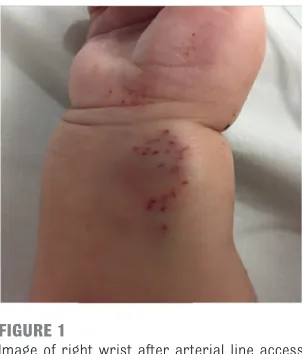
As part of a quality improvement program to investigate the causes of radial artery trauma to infants in our ICU, we realized that we had no policy that proactively defined the number of independent attempts at radial artery sampling by a physician trainee. The image is that of an infant’s wrist after 21 attempts (we counted the holes) at obtaining a radial artery sample by a trainee during fellowship (Fig 1). After the clinical team decided that an arterial sample was indicated in this infant, the fellow disappeared behind the patient’s privacy curtain and reappeared ∼45 minutes later, only to declare their lack of success. The image prompts us to reflect on how to improve graduate medical education and medical practice as a whole. Not only has the patient been failed, but the trainee has been failed as well. Aside from the lack of knowledge of infant arterial anatomy, as evidenced by the pattern of attempted needle insertions, perhaps the most important lesson from this image is, “When should trainees call for help?” Because the answer is not readily found in the literature on medical teaching, in this essay we propose an achievable 2-part paradigm consisting of deliberate practice and the incorporation of a predetermined stopping point that is discussed during performance of the preprocedural timeout.
In our specialty of anesthesiology, when invasive procedures such as central lines, arterial lines, and nerve blocks are performed by trainees,
When Should Trainees Call for Help
With Invasive Procedures?
Adam C. Adler, MD, MS, a, b Ronald S. Litman, DOc, d
PEDIATRICS PERSPECTIVES
aDivision of Pediatric Cardiovascular Anesthesiology, Department of Anesthesiology, Perioperative and Pain Medicine, Texas Children’s Hospital, Houston, Texas; bBaylor College of Medicine, Houston, Texas; cDepartment of Anesthesiology and Critical Care Medicine, The Children’s Hospital of Philadelphia, Philadelphia, Pennsylvania; and dPerelman School of Medicine at the University of Pennsylvania, Philadelphia, Pennsylvania
Dr Adler conceptualized the manuscript, drafted the initial manuscript, and reviewed and revised the manuscript; Dr Litman drafted the initial manuscript and reviewed and revised the manuscript; and both authors approved the final manuscript as submitted.
DOI: 10.1542/peds.2016-3673 Accepted for publication Feb 3, 2017
Address correspondence to Adam C. Adler, MD, MS, Department of Anesthesiology, Texas Children’s Hospital, 6621 Fannin St, Suite A3300, Houston, TX 77030. E-mail: axadler@ texaschildrens.org
PEDIATRICS (ISSN Numbers: Print, 0031-4005; Online, 1098-4275).
Copyright © 2017 by the American Academy of Pediatrics FINANCIAL DISCLOSURE: The authors have indicated they have no financial relationships relevant to this article to disclose.
FUNDING: No external funding.
POTENTIAL CONFLICT OF INTEREST: The authors have indicated they have no potential conflicts of interest to disclose.
To cite: Adler AC and Litman RS. When Should Trainees Call for Help With Invasive Procedures?. Pediatrics. 2017; 139(6):e20163673
at Viet Nam:AAP Sponsored on August 28, 2020
www.aappublications.org/news
ADLER and LITMAN especially in the early phases of
residency, they are usually done in the presence of a supervising attending physician who will provide continuous feedback during the procedure and, if necessary, intervene when procedural success has not been met after a deemed reasonable number of attempts. Although anesthesia practice has a trainee coverage model (mandated by the Centers for Medicare & Medicaid Services) of a maximum of 2 trainees per attending physician, this is not the case for all areas of medical training. For example, critical care sites rarely maintain this type of attending-to-trainee ratio even though these high-acuity units are associated with the frequent performance of high-risk and error-prone technical procedures.5
DELIbERATE PRACTICE
The perseveration injury seen in this infant probably resulted from the lack of deliberate practice, a consistent set of principles that uses supervised practice and continuous performance feedback to lead to excellence and expertise. Deliberate practice has most notably been applied in the areas of music and athletics, but it can be applied in almost any area, including medicine.6
Unlike music or athletics, however, excellence in medical practice is
difficult to measure, and the ability to practice on live patients is limited. After all, trainees cannot merely practice endlessly on their own, like violin students. But trainees can be taught and modeled by their mentors the principles of continuous self-inflection and self-evaluation. Like top-performing athletes and musicians, who maintain coaches throughout their professional careers for consistent performance feedback, physicians can do the same.7 In the example of performing
a difficult technical procedure, such as a radial arterial sample in an infant, deliberate practice would consist of intimate knowledge of the anatomy of the area (and its normal variants), familiarity and discussion of the proper equipment to be used to accomplish the procedure (eg, “Should I use an angiocatheter or a butterfly needle?” “Blind insertion attempts or ultrasound guidance?”), and direct supervision by a provider experienced in arterial line placement who can instruct on proper technique, give continuous ongoing feedback during the procedure, and instruct the trainee when it is appropriate to stop and ask for assistance after unsuccessful attempts. After making a predetermined number of unsuccessful attempts independently, a trainee should be taught the self-insight to summon a more experienced provider or perhaps just a fresh pair of hands.8
ThE STOPPING POINT DISCUSSION
The second part of our proposed paradigm is the incorporation of a stopping point discussion during the preprocedural timeout process. Invasive diagnostic or therapeutic procedures require a “timeout, ” performed by ≥2 care providers, to confirm patient identifiers (eg, correct patient and correct side) and key concerns (eg, expected blood loss, antibiotic administration).9
The inclusion of a stopping point discussion within the timeout ensures that all members of the team agree with the number of attempts, and in turn it takes the pressure off the trainee to accomplish the procedure successfully after unsuccessful attempts. This step is akin to a common situation in the operating room where an anesthesiologist, caring for an unstable patient, will ask the attending surgeon for a “short leash” on the surgical trainee before taking over the procedure to minimize patient morbidity.
We also recommend establishing a process to monitor and document unsuccessful procedural attempts by trainees. In a culture of safety, this type of transparency should be used as a means of examining practice patterns and identifying modifiable risks. Without such a process, the number of procedural attempts is likely to be underreported and underappreciated as a factor related to patient harm, and an attending physician will not be able to determine the level of technical competency of a particular trainee. As an example, it was not until the recent analysis of the multicenter Pediatric Difficult Intubation registry that the important relationship between number of intubation attempts and patient morbidity became fully apparent.10
Most studies that have attempted to determine causes of resident error have focused on the adverse effects of prolonged duty hours, but the idea of recognizing the need for assistance and maintaining situational awareness has not been adequately addressed.11 To be sure,
graduated autonomy is necessary for progression into independent practice but should be granted only when the supervising physician is confident that the trainee can realize limitations, report errors, and request assistance when appropriate. The Accreditation Council for
2 FIGURE 1
Image of right wrist after arterial line access attempts.
at Viet Nam:AAP Sponsored on August 28, 2020
www.aappublications.org/news
PEDIATRICS Volume 139, number 6, June 2017 Graduate Medical Education relies on individual residents to determine the limits of their scopes of practice and relies on individual programs to set guidelines for when residents are expected to communicate with attending physicians and call for assistance.12 With the use of
simulation training and incorporation of objective structured clinical examination formats throughout numerous medical specialties both in training and during board certification cycles, it would be beneficial to include scenarios testing a physician’s situational awareness of when to stop a procedure and ask for assistance.
CONCLUSIONS
Using a case example where an unsupervised trainee failed to ask for help with a technical procedure in a timely manner, we propose a 2-part paradigm shift that will improve patient safety and improve trainee learning, with advancement to independent practice. Our culture of learning must shift from a state where asking for help is synonymous with weakness to a state where all trainees, as well as other health care
providers, know when it is in their patients’ best interest to ask for help.
REFERENCES
1. Ulmer C, Wolman DM, Johns MME.
Resident Duty Hours: Enhancing Sleep, Supervision, and Safety. Washington, DC: The National Academies Press; 2009
2. Baldwin DC Jr, Daugherty SR, Ryan PM. How residents view their clinical supervision: a reanalysis of classic national survey data. J Grad Med Educ. 2010;2(1):37–45
3. Singh H, Thomas EJ, Petersen LA, Studdert DM. Medical errors involving trainees: a study of closed malpractice claims from 5 insurers. Arch Intern Med. 2007;167(19):2030–2036 4. Schmidt UH, Kumwilaisak K, Bittner E,
George E, Hess D. Effects of supervision by attending anesthesiologists on complications of emergency tracheal intubation. Anesthesiology. 2008;109(6):973–977
5. Pronovost PJ, Angus DC, Dorman T, Robinson KA, Dremsizov TT, Young TL. Physician staffing patterns and clinical outcomes in critically ill patients: a systematic review. JAMA. 2002;288(17):2151–2162
6. Ericsson KA. Deliberate practice and the acquisition and maintenance
of expert performance in medicine and related domains. Acad Med. 2004;79(suppl 10):S70–S81
7. Gawande A. Personal best. Top athletes and singers have coaches. Should you?The New Yorker. October 3, 2011 8. Reisman A. A piece of my mind.
How many have you done? JAMA. 2016;316(5):491
9. Berlinger N, Dietz E. Time-out: the professional and organizational ethics of speaking up in the OR. AMA J Ethics. 2016;18(9):925–932
10. Fiadjoe JE, Nishisaki A, Jagannathan N, et al. Airway management
complications in children with difficult tracheal intubation from the Pediatric Difficult Intubation (PeDI) registry: a prospective cohort analysis. Lancet Respir Med. 2016;4(1):37–48 11. Landrigan CP, Rothschild JM, Cronin
JW, et al. Effect of reducing interns’ work hours on serious medical errors in intensive care units. N Engl J Med. 2004;351(18):1838–1848
12. The Members of the ACGME Task Force on Quality Care and Professionalism. The ACGME 2011 duty hour
standards: enhancing quality of care, supervision, and resident professional development, 2011. Available at: https:// www. acgme. org/ Portals/ 0/ PDFs/ jgme- monograph[1]. pdf. Accessed January 15, 2017
3 at Viet Nam:AAP Sponsored on August 28, 2020
www.aappublications.org/news
DOI: 10.1542/peds.2016-3673 originally published online May 9, 2017;
2017;139;
Pediatrics
Adam C. Adler and Ronald S. Litman
When Should Trainees Call for Help With Invasive Procedures?
Services
Updated Information &
http://pediatrics.aappublications.org/content/139/6/e20163673 including high resolution figures, can be found at:
References
http://pediatrics.aappublications.org/content/139/6/e20163673#BIBL This article cites 9 articles, 0 of which you can access for free at:
Subspecialty Collections
http://www.aappublications.org/cgi/collection/safety_sub
Safety
g_-_development_sub
http://www.aappublications.org/cgi/collection/practice-based_learnin
Practice-Based Learning & Development
_management_sub
http://www.aappublications.org/cgi/collection/administration:practice
Administration/Practice Management
following collection(s):
This article, along with others on similar topics, appears in the
Permissions & Licensing
http://www.aappublications.org/site/misc/Permissions.xhtml in its entirety can be found online at:
Information about reproducing this article in parts (figures, tables) or
Reprints
http://www.aappublications.org/site/misc/reprints.xhtml Information about ordering reprints can be found online:
at Viet Nam:AAP Sponsored on August 28, 2020
www.aappublications.org/news
DOI: 10.1542/peds.2016-3673 originally published online May 9, 2017;
2017;139;
Pediatrics
Adam C. Adler and Ronald S. Litman
When Should Trainees Call for Help With Invasive Procedures?
http://pediatrics.aappublications.org/content/139/6/e20163673
located on the World Wide Web at:
The online version of this article, along with updated information and services, is
by the American Academy of Pediatrics. All rights reserved. Print ISSN: 1073-0397.
the American Academy of Pediatrics, 345 Park Avenue, Itasca, Illinois, 60143. Copyright © 2017 has been published continuously since 1948. Pediatrics is owned, published, and trademarked by Pediatrics is the official journal of the American Academy of Pediatrics. A monthly publication, it
at Viet Nam:AAP Sponsored on August 28, 2020
www.aappublications.org/news