http://sajlis.journals.ac.za doi: 10.7553/79-1-112 22
“Information needs changing over time”: a critical
discussion
Theo JD Bothma
1and Henning Bergenholtz
2[email protected]; [email protected]
Received: 27 March 2013 Accepted: 15 June 2013
For the past twenty years phrases such as “stable information needs”, “unstable information needs” or “information needs changing over time” are found in many contributions to information science. At first view these concepts seem to be easy and clearly understandable. However, after some considerations different questions arise: For which types of information need do we see that these needs are changing over time – for all types, or only for certain types? How do information needs relate to changes in the world, or to changes in the human understanding of the world? We will show that “information need changing over time” is a very complex concept and only understandable if we distinguish between changes in the world, situation/context, user, types of information need and interpretation of data. Clarity of writing is essential in scientific writing and authors using the concept “information needs changing over time” or similar phrases should clearly define what they mean by the phrases to ensure that no ambiguity exists when readers interpret their writings.
Keywords: Information needs, change over time, function theory
1 Stable or unstable information needs
The statement that information needs change over time occurs quite frequently in information science literature. Neither “change” nor “over time” is, however, clearly defined and from the context of the use of the phrase it is clear that different authors interpret both concepts differently. Most of the articles are purely descriptive and don‟t try to offer a theoretical discussion. In this paper we give an overview of examples as they occur in recent publications and discuss all variables that impact on the interpretation of these terms.
The often-cited article by Belkin and Croft (1992) deals primarily with the relation between information filtering and information retrieval. They conclude that “information retrieval and information filtering are indeed two sides of the same coin. They work together to help people get the information needed to perform their tasks” (Belkin and Croft 1992: 37). One of the characteristics of information filtering, according to them, is that
[i]nformation filtering is concerned with much larger data sets, and, generally, with information needs which are relatively stable over relatively long periods of time (Belkin and Croft 1992: 37).
For this discussion the second part of this quotation is of primary importance: if there are information needs that are relatively stable over relatively long periods of time, the logical deduction is that there are also information needs that are relatively unstable over long or short periods of time. Instability implies change, i.e. it is safe to deduce that their description implies that information needs may change over time (regardless of the length of the time period). This is to a certain extent substantiated by the following quotation from Belkin and Croft (1992):
relatively stable, long-term, or periodic goals or desires (e.g., accomplishing a work task, or being entertained) [...] then lead to regular information interests (e.g., keeping up-to-date on a topic) that may change slowly over time as conditions, goals, and knowledge change (Belkin and Croft 1992: 31).
Even though they here refer to interests and not needs, the statement still supports the preceding deduction, as information interests imply or lead to information needs. They also imply that the changing information needs could be triggered by conditions external or internal to the user of the information: conditions can refer to the context or situation of the information need; goals are internal in the user of the information and knowledge could be either the knowledge of the user or refer to the “state of knowledge” (e.g. changes in factual knowledge as the world changes). Belkin and Croft (1992), however, do not discuss the issue of changing information needs any further. As this issue is not the focus of their article, they do not discuss either the nature of such changes in information needs or the concept “over time” in any detail. Does change, for example, refer to a gradual change in an existing information need, or does change imply a new information need? As indicated above, “over time” in their discussion could also refer to a short period of time; could this then be interpreted as the time of a search session or the completion of a work task, or even a much longer period? Therefore, does change in a single search session refer to a gradual change in a single information need, or a multiple of
1. Theo JD Bothma is a Professor in the Department of Information Science, University of Pretoria, South Africa.
new needs, or both? The same applies to change over a long period of time. Furthermore, are there any additional variables that may play a role, may change or trigger change in information needs over time?
2 Examples from the literature
Many authors since Belkin and Croft (1992) have addressed the issue of changing information needs over time. Some examples are discussed briefly. From these examples it is evident that there is no single meaning ascribed to either “change” or “over time” and that different authors use these terms differently. The examples are all from recent literature and are therefore selective; we try to show the range of meanings currently ascribed to the terms.
The focus of the paper of Adams and Blandford (2005) “is on the way that users‟ information requirements change over time” (Adams and Blandford 2005: 160). They identify “users‟ changing information needs over time via an „information journey‟ that involves the use of both online and offline resources” and state that
digital libraries have further to go in supporting users‟ changing needs for all types of information (both theoretical and practical) according to varying contextual requirements (Adams and Blandford 2005: 168).
It seems as if “over time” here refers to a fairly long period of time as implied by the “information journey”, but it is unclear whether the changing information need refers to a gradually changing need or an abrupt one, or whether it could be both.
The article by Shen, Tan and Zhai (2005) deals with the effect user modelling and understanding the context of the user can have on retrieval precision. Shen, Tan and Zhai (2005: 824) also state that
[a] user‟s information needs may change over time. The same user may use “Java” sometimes to mean the Java island in Indonesia and some other times to mean the programming language. Without recognizing the search context, it would be again impossible to recognize the correct sense.
In this case it is evident that they refer to a totally new information need, unrelated to the previous need the user had. The length of the time dimension is here unimportant – the user could experience the new information need directly after the existing information need, or at an indefinite period later. However, in the former case context is not necessarily a disambiguating factor: the person could be programming in Java for which he may need more information, be tired and distracted and think a holiday in Java is what s/he needs.
The idea of information needs changing over time also occurs in a variety of different contexts or situations, such as descriptions of students‟ information seeking behaviour, commercial settings, travel environments, general commercial settings and health information seeking behaviour. The following examples come from these environments.
An article by Grant, Clarke and Kyriazis (2011) refers to information needs of consumers, and Aspray‟s article of 2011 discusses changing information needs over the years when buying cars:
“The consumer‟s information needs are likely to change as product knowledge and search skills grow over the time of their search, so such changes require real-time assessment”. “Linguistic and semantic analysis of an individual‟s entries in an online forum or in text queries may therefore offer clues to changes in need reflecting real-time reactions to information on the website or drawn from elsewhere” (Grant, Clarke and Kyriazis 2011: 9 and 17).
“The act of buying a car is an excellent case for understanding how information needs in American life have changed over time” (Aspray 2011: 10).
In these two cases it is evident that “over time” has totally different connotations, referring either to a single search session, or to a very long period: Grant, Clarke and Kyriazis (2011) explicitly refer to the “time of their search”, typically therefore a single session in a contained time period, while Aspray (2011) refers to the changing needs over the approximately century that cars have been sold and bought. In the one case the changes in information needs are brought about by increased knowledge on the part of the users, in the other the development of new cars and the availability of new models precipitate the need for more updated information.
Increased knowledge on the part of the user seems to change users‟ information needs, as is evident from the following two quotations. Both examples clearly imply that new information needs develop based on increased knowledge:
“As they advance in their programs, their information needs change and begin to mirror the characteristics of faculty” (Mateson 2011: 47).
http://sajlis.journals.ac.za doi: 10.7553/79-1-112 24
The study by Chu and Law (2007) identifies three stages of students‟ information needs: general, specific and the most current. These various stages of information needs are closely linked to the students‟ research progress:
“Students‟ information needs change from general to specific” [...] Students‟ information needs change from specific to the most current” (Chu and Law 2007: 38).
In the following examples from planning travels it is evident that the changes in information needs occur over the full period of planning the journey and during the journey itself:
“This implies that decisions made at earlier stages influence decisions made at later stages, and thereby different functional information needs are triggered as the travel decision process evolves” (Choi et al. 2012: 38).
“That is, information needs appeared to decrease after purchasing the travel, but to increase again when novel or unexpected situations (e.g., to make international calls, to find a place for taking a rest, or to be lost at a certain sightseeing place at the travel destination) were encountered, or at the time decisions had to be made during trips” (Choi et al. 2012: 33).
The authors describe changes that are triggered by decisions based on information obtained. These changes can evidently be fairly small changes, but could be totally new information needs – typically information needs that may have been latent during the planning process, but may only be acted upon when the actual situation arises during the journey.
Wu, Liu and Chang (2009) stress the changing information needs of workers during task execution. The duration of the task is not discussed, but the time period is clearly delineated: from the beginning to the end of the task:
“[...] they cannot identify and track a worker‟s dynamic information needs (task needs) over time precisely. This is a critical issue because a worker‟s task-needs can emerge and change in different time frames during a task‟s execution” (Wu, Liu & Chang 2009: 2431).
“Thus, the proposed method is more effective for workers whose information needs change a great deal during a task‟s execution” (Wu, Liu & Chang 2009: 2447).
In addition, information needs may vary or change depending on the stage of a worker‟s progress in task execution combined with state of his/her knowledge:
“Reference service has been one of the focal points of IFSI Library‟s Outreach Program and needs constant adjustment according to changes in users‟ information needs and behaviour” (Ruan & Sung 2003: 72).
“Overall, a high degree of reliance on outreach service is necessary to enable firefighters to meet their changing information needs” (Ruan & Sung 2003: 75).
In articles dealing with the provision of information in healthcare environments, changing information needs are mentioned quite regularly. The following quotations from a number of selected recent publications illustrate this:
“The long-term nature of most of the conditions discussed meant that several patients talked about information needs changing over time. [...] Information needs also change and fluctuate over time. [...] It also became apparent that the needs changed over time as the patient moved through the treatment process to rehabilitation and self-care. [...] Attitudes towards information can also change over time as patients recover and become less willing to simply accept what they are told by their doctors. [...] The information needs of the patients interviewed changed over time, but did not necessarily diminish. Individuals talked about the importance of „being in the loop‟ so that they were kept up to date with any new research or developments that might improve their quality of life. [...] On the other hand, the flexibility the internet offers, allowing patients to choose the timing and extent of their information searches, makes it ideal for patients whose information needs may change daily and over time” (Cartwright & Magee 2006: 4, 8, 14, 60, 66, 68).
“Information needs change over time; clinical situations as well as individual and family attitudes evolve and adjust. [...] Patients who were initially averse to learn prognostic information and elected to hear only what was required to provide consent to treatment may later spontaneously ask about their condition and prognosis. Conversely, patients who are quite near the end of life may be less inclined to seek discussion of a specific survival time” (Schapira & Steensma 2012).
“This study demonstrates that patients‟ information needs change over time which is consistent with previous studies” (Halkett et al. 2012: 402).
“Studies addressing changes in information needs over time showed that information needs generally remain high as patients move through different treatment stages” (Douma et al. 2011).
and carers become disconnected from the hospital service, their preferences for receiving this information also change” (Eames et al. 2011: e19, e22).
“The category pertaining to timing of information provision is best understood through consideration of two subcategories: changes in information needs over time and caregivers‟ need for proactive information provision. [...] [C]aregivers of stroke survivors stressed the significant changes in their information needs over time. [...] Studies of non-stroke caregivers also identified ways in which caregiver information needs varied over time” (Washington et al. 2011: 40-42, with many references to earlier studies).
“We hypothesize that, over the course of the cancer continuum, information needs of patients, caregivers, family, and friends will change over time as they go through treatment, complete treatment, and move towards maintenance phases, long-term survivorship, or relapse” and they then come to the conclusion that “the sample size is sufficient to clearly demonstrate changes in [information] needs over time, which is the main objective of the study” (Gansler et al. 2010: 302, 310).
“Patients‟ and families‟ information needs and preferences also change during the course of the illness, under the positive influence of a secure relationship with their oncologists” (Kagawa-Singer et al. 2010: 19).
“Health professionals also need to be aware that the information needs of clients with stroke and their carers will change over time, and with improvement or deterioration in their condition. [...] This should include detection of how information needs may change over time and recognise the need for information to be reinforced after discharge from rehabilitation” (Gustafsson et al. 2010: 191, 195).
“Furthermore, patients‟ needs and quest for information will continue and change over time in response to their personal experiences with the medication. [...] Therefore it is possible that the needs of new medication users differ from those of chronic users, i.e. patients who have been taking this medication for a period of time. [...] A qualitative study in patients who had recently experienced a myocardial infarction showed that patients‟ information needs change during their recovery process and thus require periodic assessment and education updates” (van Geffen et al. 2011: 303, 308).
“The findings of the present study highlight the changing pattern of patients‟ preferences and information needs during the evolving clinical situation; therefore, clinicians should be sensitive to such changes” (Decker et al. 2007: 464).
“Placing information on the website will enable people with stroke and their families to access information about particular topics as their needs change over time and at a time, place, and pace to suit them” (Kerr, Hilari & Litosseliti 2010: 1185).
“In response to changing situations, events and experiences information needs and preferences for information inevitably change. [...] Information needs are temporal changing over time along the disease continuum related to a series of challenges, critical and/or social events” (Ormandy 2011: 98).
“The information needs of patients with cancer differ among patients, change over time, relate to the type and stage of the disease, and persist through the cancer care trajectory” (Frenkel, Ben-Arye & Cohen 2010: 181).
From the preceding quotations it is clear that, in healthcare literature, changing information needs are accepted as a given. According to the literature, these changes occur within patients, their families and their caregivers. The information needs depend on the stage and prognosis of the illness, as well as changing situations, events and experiences and change in information needs are triggered throughout the continuum of the illness by these factors. Changes can imply a need for more detailed information, or less detailed information. Most of these studies include empirical research, even listing the different information priorities at different stages of an illness, e.g.
Changes in information priorities over the cancer continuum [...] confirm initial hypotheses based on the authors' experience in clinical practice and patient education. For example, all groups expressed greatest interest in information concerning coping with side effects while the patient was undergoing treatment and, presumably, experiencing one or more side effects. Likewise, all groups were interested in learning about treatment options before and during treatment and at the time of relapse or during remission or maintenance therapy when they are at risk for relapsing, but had little interest in this topic after completion of initial treatment (Gansler et al. 2010: 308).
Many of the above contributions in the healthcare environment focus on the fact that, as the health condition of a patient changes, this change gives rise to a change in the information needs. Another kind of change could be the relationship between doctors and patients. For example, if a patient does not trust the doctors any more, s/he will have more information needs than before. This too is called "change". There are in other words at least two kinds of changes: (a) in the world, (b) in the user needs.
http://sajlis.journals.ac.za doi: 10.7553/79-1-112 26
a new need, which traditionally is called a changed need. Or it can be the need to get an answer of the same question again, but this time not an answer with a short, easy understandable text, but the wish to get a text with longer and more detailed data, even if such a text is not written for a layman, but for an expert or an semi-expert.
In one case (by Washington et al. 2011: 40-42) not only the pure information is mentioned, but also what they call a “need for proactive information provision”, that is, not only a need to get information, but to get help to act in the right way (which is called an operational need). In another paper a so-called secondary information need is mentioned, that means that the medium (the web) and the use of this medium are mentioned to help with obtaining access to the needed information (Kerr, Hilari & Litosseliti 2010: 1185).
We see that the plural and singular of need, respectively needs and need, are used almost as synonyms. In fact a single user can have any number of information needs, but if there is more than one s/he will have to make separate searches for each need. We will come back to that question, which sometimes is called a differentiation between well-defined and ill-well-defined information needs. This, again, perhaps is more a differentiation between the information need for a single topic or a complex topic.
However, none of the articles study the concepts of “change” and “over time” at a theoretical level, simply because it is not the focus of any of these research reports – all the articles are descriptive of specific situations or case studies in which the authors elaborate on their observations. A number of observations can, however, be made:
In most cases it is not clear to what extent these changes in information needs imply new information needs, a clearer specification of an earlier information need, or a modification of an earlier information need. In some case the changes arise because of knowledge or experience gained, for example in the case of students that need more specific or detailed information as they progress with their studies and research; this is clearly a more precise specification of the need. In the healthcare examples, the information needs of patients, care givers and others are modifications of existing needs based on the progression or remission of the illness. In the travel example, however, it is clear that new needs arise based on new circumstances: the user only needs to find out how to make an international call once s/he is in the specific situation. “Change” therefore has at least three dimensions: a requirement for more detailed information, a requirement for information based on a modified need and a requirement for information based on a new need.
Changes in information needs can be brought about because of a deeper understanding by the user of the issues involved (for example, in a research or study environment), by changes in the user‟s personal circumstances (for example, a change in the execution of a work task or changes in the health condition of the user) or changes in the world (for example, the development of new cars over a long period of time). Changed information needs can therefore be precipitated by changes in the knowledge of the user, the circumstances of the user or changes in the world at large.
From the quotations it is also clear that “over time” could imply either a quite short time (for example, the time spent on a search session or the duration of a work task) or a very long time (as is the case with car sales since the first cars became available to the present). In the healthcare examples, “over time” usually implies the duration of the illness, i.e. from the time the patient came into contact with the healthcare professionals up to the time the illness is resolved (either through the patient recovering or the patient‟s death). And in many cases, where patients need follow-up care, the need for information about the illness, treatment and post-illness phases may continue for many years, as, for example, in a patient who had a heart attack where s/he may need information about lifestyle changes after the initial recuperation. It is therefore clear that “over time” in healthcare does not refer to the duration of a simple search session or a work task.
3 The Ingwersen/Järvelin model
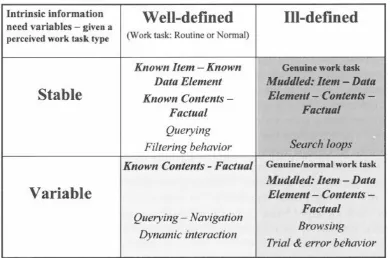
Figure 1 Matrix of four distinct cases of information requirements, taken from Ingwersen and Järvelin 2005: 298
Based on Ingwersen (1996) they state that a specific work task may represent a rather stable cognitive state during the information retrieval session, “but not in a longitudinal sense”, and continue:
The nature of the corresponding information need may indeed be expected to change even during session time, from a muddled to a more well-defined type, with input from clarifying information and via learning during search task activities. However, one may also experience that the information need does stay stable – at least for a while. […] The other dimension corresponds to the variability of the need over time, i.e. the actor‟s motivation and ability for change (Ingwersen & Järvelin 2005: 297).
Mainstream information retrieval research mainly concentrates on the well-defined, stable environment in which work tasks may be of a “routine or normal nature”, and searchers are capable to do query modification and provide relevance feedback. In the well-defined, variable environment, exploratory navigation is more common. Browsing is common in the ill-defined and variable environment. The ill-defined but stable environment “assumes high complexity and a genuine work task with properties and mode of solution that are only vaguely perceived by the actor” (Ingwersen & Järvelin 2005: 299). The detailed discussion by Ingwersen and Järvelin (2005) centres on information behaviour during searching and on different types of relevance judgements, but does not discuss in any detail the nature of the change in information needs, or the time dimension. It furthermore concentrates on a fairly short time, viz. a single search session, or possibly the time of the specific work task. Since it is evident from the examples that the time period in “change over time” is not defined (it could be short or long), the time factor is not addressed sufficiently in this model. A clearer definition is therefore needed for both these concepts, as well as an indication of what the interaction between all variables is.
4 The modern function theory
If we look at the many quotations in Section 2, it is evident that they have one and only one type of information need in common (with only a few exceptions): a need to get knowledge about something. This type of need is, however, only one of at least four different types of information need. In the so-called modern function theory (Bergenholtz & Tarp 2003; Tarp 2008) four types are distinguished. The authors of those papers have very often focused on the use of dictionaries, but the theory is a general theory for all kinds of information need. There can be many reasons for the origin of an information need which can lead to the usage situation of an information source. This source can be an information tool, a certain text about the topic, asking an expert or anyone knowing an answer etc. The usage situations are divided into:
http://sajlis.journals.ac.za doi: 10.7553/79-1-112 28
The information need of these kinds is called primary needs, i.e., a need for the information itself. In the function theory, secondary information needs are also identified, namely the need to have access to the required information tools or sources and the need for information on how to use these tools or sources.
The function in focus in most contributions in information science is the cognitive function. It is defined as related to the need by a potential user to provide
specific information about a certain topic, concept or word
general comprehensive or encyclopaedic information (Tarp 2008).
The communicative functions are specially well described in the function theory because the authors are lexicographers and many dictionaries give such information. A communicative situation exists when the potential user needs help to solve a problem with a text. There are various communicative situations, of which the most important are:
need for information to solve problems related to text reception in the native language need for information to solve problems related to production of texts in the native language need for information to solve problems related to text reception in a foreign language need for information to solve problems related to production of texts in a foreign language
need for information to solve problems related to translation of texts from the native language into a foreign language
need for information to solve problems related to translation of texts from a foreign language into the native language
In a communicative situation one has a problem with a text. When this problem is solved one can go on with the text: reading, writing or translating. Referring to a well-known book by Austin (1975), one does things with words.
In this respect, the operative situations are different. The potential user has a need for help to act, s/he needs instructions how to fulfil a physical act. It can be how to install a new television or how to find a certain place in a town, and many other practical acts (in the preceding examples, typically in work task execution and health care situations). This information need can be solved by a text, but the goal is not the text itself, but to act in the physical world.
An interpretative situation is one where the potential user does not understand a non-linguistic sign, e.g. a traffic sign or the meaning of the red blinking lamp in a car.
This kind of typology does not mean that in real situations there is only one type of need – they can be mixed. For example, if one wants to install a television and some of the terms that are used in the user guide are unknown, one has a new information need, viz. a text reception need in a communicative situation. Bergenholtz and Bothma (2011: 59) use the term “sub-task” to indicate the process of the fulfilment of the information need. This therefore implies that the work task which may have one primary information need, viz. “get more knowledge about a specific topic”, may be interrupted by a number of additional information needs at the level of text reception, viz. to understand the meaning of unknown words.
In information science, one traditionally only deals with cognitive needs; in lexicography, one normally deals with both communicative and cognitive needs, quite seldom with operative and interpretative needs. The three last types are in the sense of the topic equal – over time we have the different kinds of changes as discussed. However, for communicative needs, the needs are usually well-defined and stable because we here deal with text reception, text production or translation problems in a specific text at a specific time.
5 Implications for a typology of "information needs changing over time"
From the preceding it is clear that there are a number of variables that influence the understanding of the phrase “information needs changing over time”. At least the following variables can be distinguished:
Information needs Changes in the world
The context or situation in which the information need occurs The user
Changes in the data set Changes in the interpretation
Each of these variables can remain stable, or can change to a greater or lesser extent.
5.1 Information needs
understand a text, no change in information need occurs – the meaning itself is sufficient to solve the information need and no changes will occur.
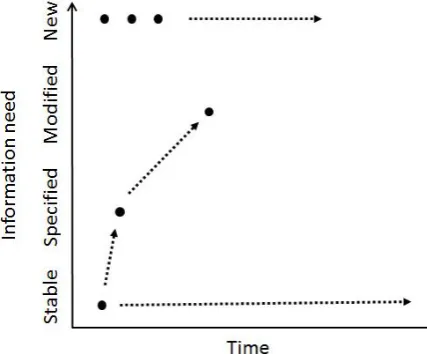
In the other three quadrants of the Ingwersen and Järvelin model (2005), changes do occur. Change could imply a clearer specification of the information need, i.e. zooming in on specific detail (from the broader to the narrower), or modifying the need in which the focus is changed. It could also imply a totally new information need that may be only tangentially related to the preceding information needs. This can be represented diagrammatically as in Figure 2.
Figure 2 Changes information needs
Any such changes obviously occur over time, but the time period is not defined as such – it could be anywhere on the continuum of a very short period (for example a single search session) to a very long period (stretching over many years).
5.2 Changes in the world
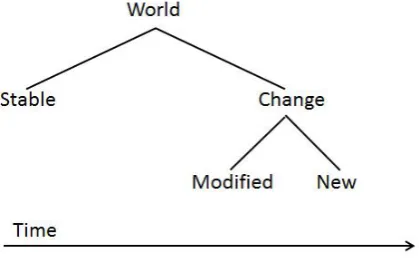
The world – the broad context in which an information need occurs – can be fairly stable or can change very quickly and dramatically, as is evidenced in geological time and in history. Changes could be “natural” or could be the result of human intervention. A severe earthquake could have a very dramatic influence on the world and could lead to great changes and totally new situations; many natural phenomena may, however, lead to only very small changes and modifications. Human intervention could also lead to greater or smaller changes – many inventions have led to huge changes in the world, while others may have only a minor impact. This is reflected in Figure 3.
Figure 3 Changes in the world over time
If there are changes in the world, this can trigger change in the information needs. Change in the world is (as is the case in "change in information needs over time") a very broad expression going from gradual changes to abrupt changes, new inventions or something suddenly happening. There are a number of such examples in the quotations in Section 2. Depending on the kind of change, the information need can be a new or modified need. It will usually be a cognitive need, but can indeed be one of the three other main types of needs as well.
5.3 Context / Situation of information needs
http://sajlis.journals.ac.za doi: 10.7553/79-1-112 30
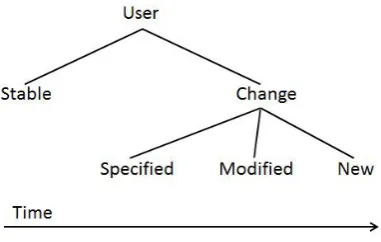
Figure 4 Changes in the situation or context over time
Situation or context implies, in addition, that the user needs to decide on and find the specific information tool, as well as to find out how the information tool is to be used. The secondary information need is an operational need to enable the user to fulfil the need in a communicative, cognitive, operational or interpretative situation.
5.4 The user
From the famous example used by the Greek philosopher Heraclites we have learned that “everything flows”: one cannot step into the same river twice, as it is not the same water in the river as few seconds earlier. But also the person looking at the water is not the same. S/He may have obtained new knowledge or new interests. But also a single person is, in the sense of having information needs, not one user (or the same user) but several different users according to the person‟s different knowledge and ability in different situations.
Figure 5 Changes in the user over time
A person A with the knowledge and ability Z can some time later have the same information need because s/he has forgotten the information s/he obtained some time ago. S/He could have a modified information need if, with the same problem, s/he wants to have more detailed data: it would then be a person A1 with the knowledge and ability Z1. It could also be the case that the user A sees that the first question was very broad and that he or she therefore wants to specify his/her question being user A2 with the knowledge Z2. Or we can still have the user A, but with quite another and a new information need, not related to an earlier information need. Many of the cases Section 2 are within the same situation type, e.g. within the healthcare environment. However, in the case of another disease or in another subject field our user is not user A, but user B, because s/he has different knowledge and abilities in that field.
5.5 Data set
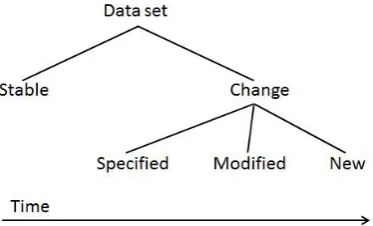
A data set is a human artefact. It therefore contains what the creators have put in the data set. A very small or very large collection of data (or even the whole World Wide Web) can be seen as a data set and obviously any variation in-between. A data set can consist of many smaller data sets, e.g. a database of articles could consist of a number of different sub-databases with articles of different kinds or from different publishers. It is the same with dictionaries. One dictionary can contain two dictionaries, e.g. an English-German and a German-English part which could each have been published as separate dictionaries. A further example is the typical Japanese "electronic dictionary", which is a small handheld computer with sometimes even hundreds of different electronic dictionaries.
Figure 6 Changes in the data set over time
In some cases knowledge increases exponentially, e.g. in molecular biology, knowledge has doubled every 18 month since 1990. In such cases the data set of articles needs to be updated much more frequently, even in real time to keep the data set relevant for users. It is well known that exchange rates and weather forecasts are updated at least every day, and in the case of share prices, updating databases occurs in real time, as long as the share markets are open.
5.6 Interpretation of data
Data may be interpreted differently over a period of time based on new insights and better understanding of the issues at hand (Figure 7).
Figure 7 Changes in the interpretation over time
The discussion by Heraclites whether the river is the same today as yesterday and tomorrow can be used on the interpretation of data as well. But in this case there are different aspects. It could be the case that the data are formulated in a way which makes different interpretations possible. It could also be the case that one user of data in an information tool makes a wrong interpretation, e.g. because this user misunderstood a part of the data. But even if a user of an information tool understands the data correctly it does not mean that two different users arrive at exactly the same interpretation. And in the case of the interpretation of the same data at a specific time and again some years later, there will in many cases be different interpretations. It differs from field to field and from one subject to another. A very clear example is that of the interpretation of a novel where one could have different interpretations over time. A further example is the interpretation of the Bible over time and within different religious traditions. To formulate this differently: data and information are not the same. Users make interpretations of data, and this interpretation is the information the user gets.
6 The relationship between information needs, change and time
In the previous section we have seen that at least the following single aspects play a role for the use and understanding of the expression “information needs changing over time”: the world, the situation or context, the time duration, users and user needs, and the interpretation of data. In this concluding section we will focus on the relationship between information needs, change and time.
In the literature one can find different contexts with "over time":
search session work task
a specific period, e.g. the time being ill a whole life
http://sajlis.journals.ac.za doi: 10.7553/79-1-112 32
But "over time" cannot only be a longer or even much longer period, it can also be shorter periods, subdividing a given time period. Any subdivision could be divided into even smaller parts. When discussing information needs, a period of time could be anything from the shortest time that a human can perceive up to the longest possible time. "Over time" is therefore a broad term, the precise meaning of which must be deduced from the context or situation.
In Figure 8 this time aspect is only indicated. We see here that information needs can be stable, the same over time, but that within a short or longer time they can change slightly because the user needs some more details (because of changes in the world, his/her interests etc.). Or s/he could have a need of information about further aspects – what we call a “modified need”. Those three possibilities are quite different from a “new information need”, which can occur again and again over time. But as soon as this new need is there it will find its place at the bottom of this figure, being stable at the first moment but over time it may perhaps require specification or modification.
Figure 8 Changing information needs over time
From the quotations in Section 2 it is evident that change has different characteristics in different articles. In some cases it is evident that change in information need simply implies a whole new set of information needs, e.g. in a travel situation the information needs in the planning phase are different from the information needs during the holiday. In the planning phase some information needs about how to get to the destination as such and which attractions to visit may be important; after arriving at the destination, how to find the different places of interest, what the opening times of these places are etc. will be more important. Those information needs are definitely related to the initial information needs but the individual needs are, as is clear from the specific example, evidently different. It is not a further specification of the original need. Change in these examples implies new information needs.
After having received certain information as the answer to a question, a person can have the wish to acquire further knowledge. This person has arrived at new insights but with the implication that the existing information need is not necessarily valid any more, and should be modified and adapted due to the additional knowledge which was acquired in the first place. The health care situation is a good example of such modifications. There can be slight changes in a person‟s search parameters during the development of his/her disease. S/He could want to know more precisely what is happening in a certain phase of the disease. Change in these examples implies a modification of the information needs.
In the example of the travel-related information needs before and during the holiday referred to previously, the information needs may not necessarily be well defined in the user‟s mind. S/He could find out that s/he needs to search more exactly by specifying his/her information need, e.g. that it should be the opening time in August and on a Friday. A further example: someone wants to write an essay about the influence of the Napoleonic wars on European countries in the first part of the 19th century. Such an information need is too complex for a simple interaction with the information tool. It can be necessary to break it down into its constituent parts, such as the direct influences in Germany directly after the wars, the influence in the time 1825-1840 etc. Change in this example means a division of a complex information need into a number of smaller information needs which are a specification of the complex need.
7 Conclusion
References
Adams, A. & Blandford, A. 2005. Digital libraries‟ support for the user‟s „information journey‟. Proceedings of the 5th ACM/IEEE-CS joint conference on digital libraries. 7-11 June 2005. Denver, Colorado: ACM. 160-169.
Aspray, W. 2011. One hundred years of car buying. In everyday information: the evolution of information seeking in America. W. Aspray & B.M. Hayes, Eds. Cambridge, MA: MIT Press. 9-70.
Austin, J.A. 1975.How to do things with words: the William James lectures delivered at Harvard University in 1955. 2nd edition. Oxford: Clarendon.
Belkin, N.J. & Croft, W.B. 1992. Information filtering and information retrieval: two sides of the same coin?
Communications of the ACM, 35(12): 29-38.
Bergenholtz, H. & Bothma, T.J.D. 2011. Needs adapted data presentation in e-information tools. Lexikos, 21: 53-77. Bergenholtz, H. & Tarp, S. 2003. Two opposing theories: on H.E. Wiegand‟s recent discovery of lexicographic functions.
Hermes,31: 171-196.
Cartwright, J. & Magee, H. 2006. Information for people living with conditions that affect their appearance – report I: the views and experiences of patients and the health professionals involved in their care: a qualitative study. Oxford: Picker Institute Europe.
Choi, S., Lehto, X.Y., Morrison, A.M. & Jang, S. 2012. Structure of travel planning processes and information use patterns. Journal of travel research, 51(1): 26-40.
Chu, S.K. & Law, N. 2007. Development of information search expertise: research students' knowledge of source types.
Journal of librarianship and information science, 39(1): 27-40.
Decker, C., Garavalia, L., Chen, C., Buchanan, D., Nugent, K., Shipman, A. & Spertus, J. 2007. Acute myocardial infarction patients' information needs over the course of treatment and recovery. Journal of cardiovascular nursing, 22(6): 459-465.
Douma, K.F.L., Koning, C.C.E., Zandbelt, L.C., de Haes, H.C.J.M., Ellen M.A. & Smets, E.M.A. 2011. Do patients‟ information needs decrease over the course of radiotherapy? Supportive care in cancer. [Online]. DOI 10.1007/s00520-011-1328-0. (Accessed 8 June 2012).
Eames, S., Hoffmann, T., Worrall, L. & Read, S. 2011. Delivery styles and formats for different stroke information topics: patient and carer preferences. Patient education and counselling, 84(2): e18-e23.
Frenkel, M, Ben-Arye, E & Cohen, L. 2010. Communication in Cancer Care: Discussing Complementary and Alternative Medicine. Integrative Cancer Therapies, 9(2): 177-185.
Gansler, T., Kepner, J., Willacy, E., Soloe, C., Rupert, D., Jarblum, M., Driscoll, D., Orr, A., et al. 2010. Evolving information priorities of hematologic cancer survivors, caregivers, and other relatives. Journal of cancer education, 25(3): 302-311.
Grant, R., Clarke, R.J. & Kyriazis, E. 2011. Modelling real-time online information needs: a new research approach for complex consumer behaviour. Journal of marketing management, iFirst: 1–23. [Online]. DOI: 10.1080/0267257X.2011.621440. (Accessed 12 June 2012).
Gustafsson, L., Hodge, A., Robinson, M., McKenna, K. & Bower, K. 2010. Information provision to clients with stroke and their carers: self-reported practices of occupational therapists. Australian occupational therapy journal, 57(3): 190-196. [Online]. DOI: 10.1111/j.1440-1630.2008.00765.x. (Accessed 5 June 2012).
Halkett, G.K.B, Kristjanson, L.J., Lobb, E., Little, J., Shaw, T., Taylor, M. & Spry, N. 2012 Information needs and preferences of women as they proceed through radiotherapy for breast cancer. Patient education and counselling, 86(3): 396-404.
Ingwersen, P. & Järvelin, K. 2005.The turn: integration of information seeking and retrieval in context. Dordrecht: Springer.
Ingwersen, P. 1996. Cognitive perspectives of information retrieval interaction: Elements of a cognitive IR theory. Journal of Documentation, 52(1): 3-50.
Kagawa-Singer, M., Dadia, A.V., Yu, M.C. & Surbone, A. 2010. Cancer, culture, and health disparities: time to chart a new course? CA: a cancer journal for clinicians, 60(1): 12-39.
Kerr, J., Hilari, K. & Litosseliti, L. 2010 Information needs after stroke – what to include and how to structure it on a website: a qualitative study using focus groups and card sorting. Aphasiology, 24(10): 1170-1196.
Mateson, M. 2011. The research habits of graduate students and faculty: is there a need for reference sources? In E -reference context and discoverability in libraries: issues and concepts. S. Polanka, Ed. Hershey: IGI Global: 46-60.
Ormandy, P. 2011. Defining information need in health-assimilating complex theories derived from information science.
Health expectations, 14(1): 92-104.
Ruan, L. & Sung, J.S. 2003. Meeting changing information needs of Illinois firefighters. The reference librarian, 39(82): 69-105.
Schapira, L. & Steensma, D.P. 2012. Truth telling and palliative care. In Handbook of pain and palliative care: biobehavioral approaches for the life course. R.J. Moore, Ed. Dordrecht: Springer. 35-42.
Shen, X., Tan, B. & Zhai, C. 2005. Implicit user modeling for personalized search. Proceedings of the 14th ACM international conference on Information and knowledge management. New York: ACM. 824-831.
http://sajlis.journals.ac.za doi: 10.7553/79-1-112 34
van Geffen, E.C.G, Philbert, D., van Boheemen, C., van Dijk, L., Bos, B.B. & Bouvy, M.L. 2011. Patients‟ satisfaction with information and experiences with counseling on cardiovascular medication received at the pharmacy. Patient education and counselling, 83(3): 303-309.
Washington, K.T., Meadows, S.E., Elliott, S.G. & Koopman, R.J. 2011. Information needs of informal caregivers of older adults with chronic health conditions. Patient education and counselling, 83(1): 37-44.
Wu, I., Liu, D. & Chang, P. 2009. Learning dynamic information needs: a collaborative topic variation inspection approach. Journal of the American Society for Information Science and Technology,60(12): 2430-2451.