Original Research Article
Effect of treatment on the quality of life of cervical cancer patients:
a prospective study from a tertiary care centre of West Bengal
Manisha Sarkar*
INTRODUCTION
Cancer is regarded as a curse to the patient and their family members. Cervical cancer is one of many such cancers. Being the third most common cancer among women in India, as well as an important cause of death due to cancer, it is an important health problem in our country.1 Quality of life (QoL) is a subjective and multidimensional concept that includes physical, emotional, functional and social components that focuses on the impact of disease and its treatment on the well-being of an individual.
With the advancement in different treatment modalities of cervical cancer, an increasing number of patients now seek treatment for better survivability. Better survival rates further demand for better QoL. The currently available treatment modalities of cancer put huge financial burden to patient and their family. Even after complete treatment the mortality risk still remains. So, the question is that whether it is worth putting the patients to the mortality and morbidity risks due to complications of radiotherapy or chemoradiation at the cost of their QoL including financial crisis? Knowledge about QoL issues is also crucial to constitute follow-up care programs. There are many studies on QoL of cervical cancer patients
ABSTRACT
Background: Cervical cancer is one of many health care ironies. Better survival rates demand better quality of life (QoL). The aim of present study was to determine the change in QoL of cervical cancer patients due to treatment. Methods: An observational prospective study was conducted from July 2017 to June 2018 among 80 new cervical cancer patients without any prior history of treatment for cervical cancer, attending radiotherapy department of a tertiary care centre of West Bengal using a semi-structured schedule and European Organization for Research and Treatment of Cancer (EORTC) quality of life questionnaire (QLQ). Information was collected on socio-demographic and clinical aspects and QoL domains. Those with history of surgery for cervical cancer, advanced stage of disease were excluded. EORTC QLQ was administered at baseline and one month after completion of treatment. Data was analysed by percentage, means±standard deviation, range and Wilcoxon signed rank test etc. using SPSS-16.
Results: Only 60 patients could be analysed as 10 patients died and 10 lost to follow-up. After treatment there was a significant improvement in global health, physical, emotional and cognitive functioning as well as decrease in symptoms like fatigue, pain, insomnia, appetite loss and constipation along with worsening of financial difficulties. There was significant improvement in body image, decrease in problems of symptom experience, peripheral neuropathy and menopausal symptoms after treatment.
Conclusions: The cervical cancer patients show an overall improvement in their QoL in most of the domains after one month of treatment except worsening of financial difficulties.
Keywords: Cervical cancer, Quality of life, EORTC QLQ C-30, EORTC QLQ CX-24, EORTC Department of Community Medicine, Bankura Sammilani Medical College, Bankura, India
Received: 15 November 2019 Accepted: 12 December 2019
*Correspondence: Dr. Manisha Sarkar,
E-mail: [email protected]
Copyright: © the author(s), publisher and licensee Medip Academy. This is an open-access article distributed under the terms of the Creative Commons Attribution Non-Commercial License, which permits unrestricted non-commercial use, distribution, and reproduction in any medium, provided the original work is properly cited.
worldwide but, only a few studies in our country have addressed the impact of treatment on quality of life of cervical cancer patients and particularly the sexual quality of life. More so, a prospective assessment of QoL in cervical cancer patients is further underreported in West Bengal. With this background the present study was conducted with an aim to find out the socio-demographic factors and selected clinical aspects of cervical cancer patients and to determine the change in QoL of cervical cancer patients after treatment in comparison to their QoL before treatment.
METHODS
An institution based observational prospective study was conducted among cervical cancer patients attending radiotherapy department of a tertiary care centre in West Bengal from July 2017 to June 2018. In a study, standard deviation for physical functioning scale post treatment was found to be 27.06.2 In order to detect 10-point difference i.e., clinically relevant difference between pre-treatment and post pre-treatment, the chosen test was paired t- test with α set to 1%.3 The needed number of patients was
calculated by the formula: [(Zα)2 (SD)2] / d2 where Zα is
the Z value for α error, SD is standard deviation and d represents the mean difference to be detected. Sample size thus came to be 48.74, rounding to 49. Considering attrition and missing data rate of 20% each, the required number of patients was 76.56. Finally, 80 new cervical cancer patients were enrolled. Inclusion criteria were histologically proven cases; new cases i.e., not received any radiotherapy or chemoradiation from anywhere and those who gave consent for initiation of treatment. Those who had undergone surgery for cervical cancer, who didn’t complete the treatment course, who were in advanced stage (IVA/ IVB) and those with co-existing malignancies or complications were excluded. QoL data were collected at baseline and after one month of completion of treatment. Full treatment usually required 2-3 months. All the cervical cancer patients (census method) fulfilling the eligibility criteria during first eight months of study period (2 days of data collection per week) were enrolled, till the desired number was achieved. Finally, 10 patients died within study period after completing treatment and 10 were lost to follow up despite every attempt to minimize attrition. Thus 60 patients who completed treatment and follow up after one month of treatment were ultimately considered for analysis.
Study variables included socio-demographic and clinical profile, QoL domains like global QoL, physical, role, emotional, cognitive and social functioning etc. and cervical cancer specific quality of life domain like symptom experience, sexual functioning, lymphoedema, peripheral neuropathy etc. were considered. Study tools were predesigned pretested semi-structured schedule, validated European Organization for Research and Treatment of Cancer (EORTC) quality of life questionnaire (QLQ) core 30 items (EORTC QLQ-C30,
version 3) and the cervical cancer module 24 items (EORTC QLQ-CX 24). Final validation of the tools was done by experts of the department of community medicine of the institute. Study techniques included interview, record analysis, self-administration of EORTC QLQ and tracking of patients via phone. When self-administration was not possible due to some reasons (e.g. forgotten spectacles, illiterate), then proxy respondents (care givers) / hospital staff member were considered who read the questions to them and marked the patient’s response on their behalf (as per the EORTC guidelines).
4-6 The same person was ensured for the post treatment
QLQ administration via phone contact. In case of missing data, patients were addressed specifically about the particular problem in a comprehensible way. In this way missing data was reduced to zero.
Data were analysed using MS excel and SPSS-16. The results were recorded as frequencies, percentages, means±SD and range, wherever applicable. QoL scores were obtained based on the EORTC scoring guidelines as depicted below and tested for normality. As none of the scores followed normal distribution therefore Wilcoxon Signed ranks test was done to compare the scores of the cervical cancer patients before and after treatment. A p-value of less than 0.05 was considered significant.
Study was conducted after obtaining Institutional ethical clearance, permission from EORTC QoL groups via mail and informed consent from patients. Anonymity and confidentiality of patients was maintained.
Scoring
EORTC QLQ-C30
The QLQ-C30 is composed of both multi-item scales and single-item measures. These include five functional scales, three symptom scales, a global health status/ QoL scale, and six single items. Each of the multi-item scales includes a different set of items i.e. no item occurs in more than one scale. All of the scales and single-item measures range in score from 0 to 100. The principle for scoring these scales is the same in all cases. The average of the items that contribute to the scale is estimated; this is the raw score. Linear transformation is done to standardise the raw score, so that scores range from 0 to 100; a higher score represents a higher ("better") level of functioning, or a higher ("worse") level of symptoms.
EORTC QLQ-CX24
RESULTS
In the present study it was found that the mean (SD) age of cervical cancer patient was 51±11.18 years with a range from 26 to 83 years. 63.4% of the study population belonged to the age group 40-59 years. Majority (88.3%) of the study population was Hindu while remaining were Muslims. About 60% of the study population was literate. Majority (85%) of the study populations were homemakers while the remaining were house maid, private tutor, shopkeeper, agricultural worker etc. Nearly two third (66.7%) of the study population lived in rural area. Most (86.6%) of the study population belonged to SES class IV and V according to Modified BG Prasad scale, May 2018. 61.6% of the study populations were currently married, 36.7% were widowed while 1.7% were never married. Mean age (SD) at marriage was 15.6±2.14
years with a range from 11 years to 22 years. Mean (SD) age at menarche was 13.7±1.41 years. 93.2 % of the ever-married respondents were multiparous rest being primiparous. Among these multiparas, 32.7% were grand multiparous. Mean (SD) age at menopause was 44.1±5.8 years ranging from 35-60 years. Cervical cancer patients in general had more than one chief complaint. Nearly 85% of cases complained of bleeding per vagina, 28.3% had vaginal discharge, 21.7% had pain abdomen while rest had other symptoms (10%) like diarrhoea, constipation, nausea, vomiting, low back pain etc. 20% of the study population belonged to stage IA and IB, 45% stage IIA and IIB and 35% belonged to stage IIIA and IIIB. Majority (98.3%) of the patients took approximately 2-3 months to complete the entire treatment (57-91days) except one who took 4 months.
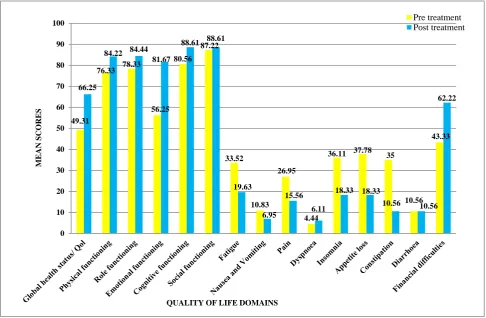
Figure 1: Multiple bar chart showing comparison of general cancer QoL scores (EORTC QLQ C-30) before and after treatment (n=60).
Note: A higher score using EORTC QLQ C-30 represents a higher ("better") level of functioning, or a higher ("worse") level of symptoms.
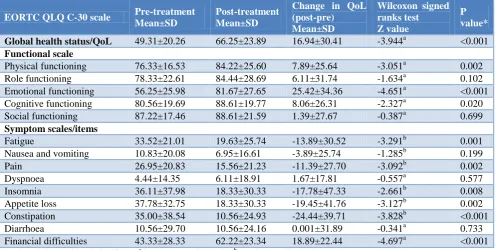
Figure 1 and 2 shows the comparison of general and cervical cancer specific QoL of cervical cancer patients respectively before and after treatment. After treatment, there was an improvement in global health, physical, emotional and cognitive functioning as well as decrease in symptoms like fatigue, pain, insomnia, appetite loss and constipation. However, there was worsening of financial difficulties after treatment and all of these were statistically significant (Table 1). There was an improvement in role and social functioning, decrease in
problems of nausea and vomiting, almost no change in the problem of diarrhoea along with worsening of dyspnoea but these changes were not statistically significant (Table 1). Table 2 shows that after treatment there was significant improvement in body image, decrease in problems of symptom experience, peripheral neuropathy and menopausal symptoms. However, there was decrease in problem of sexual worry after treatment as well as increase in lymphoedema and sexual inactivity, but these were not statistically significant (Table 2). 49.31
76.33 78.33
56.25 80.56
87.22
33.52
10.83 26.95
4.44
36.11 37.78 35
10.56 43.33 66.25
84.22 84.44
81.67
88.61 88.61
19.63
6.95 15.56
6.11
18.33 18.33
10.56 10.56
62.22
0 10 20 30 40 50 60 70 80 90 100
M
E
A
N
S
C
OR
E
S
QUALITY OF LIFE DOMAINS
Figure 2: Multiple bar chart showing comparison of cervical cancer specific QoL scores (EORTC QLQ CX-24) before and after treatment (n=60).
Note: The higher the scores (obtained by using EORTC QLQ CX-24) the worse is the problem (except sexual activity and sexual enjoyment). In case of scores of sexual activity and sexual enjoyment, the higher the score, fewer are the problems.
Table 1: Comparison of pre- and post-treatment general cancer (EORTC QLQ C-30) quality of life scores in cervical cancer patients (n=60).
EORTC QLQ C-30 scale Pre-treatment
Mean±SD
Post-treatment Mean±SD
Change in QoL (post-pre) Mean±SD
Wilcoxon signed ranks test Z value
P value*
Global health status/QoL 49.31±20.26 66.25±23.89 16.94±30.41 -3.944a <0.001 Functional scale
Physical functioning 76.33±16.53 84.22±25.60 7.89±25.64 -3.051a 0.002 Role functioning 78.33±22.61 84.44±28.69 6.11±31.74 -1.634a 0.102 Emotional functioning 56.25±25.98 81.67±27.65 25.42±34.36 -4.651a <0.001 Cognitive functioning 80.56±19.69 88.61±19.77 8.06±26.31 -2.327a 0.020 Social functioning 87.22±17.46 88.61±21.59 1.39±27.67 -0.387a 0.699 Symptom scales/items
Fatigue 33.52±21.01 19.63±25.74 -13.89±30.52 -3.291b 0.001
Nausea and vomiting 10.83±20.08 6.95±16.61 -3.89±25.74 -1.285b 0.199
Pain 26.95±20.83 15.56±21.23 -11.39±27.70 -3.092b 0.002
Dyspnoea 4.44±14.35 6.11±18.91 1.67±17.81 -0.557a 0.577
Insomnia 36.11±37.98 18.33±30.33 -17.78±47.33 -2.661b 0.008
Appetite loss 37.78±32.75 18.33±30.33 -19.45±41.76 -3.127b 0.002 Constipation 35.00±38.54 10.56±24.93 -24.44±39.71 -3.828b <0.001
Diarrhoea 10.56±29.70 10.56±24.16 0.001±31.89 -0.341a 0.733
Financial difficulties 43.33±28.33 62.22±23.34 18.89±22.44 -4.697a <0.001 *p value <0.05 considered significant; a based on negative ranks; bbased on positive ranks.
0 5 10 15 20 25 30 35 40
Body image Symptom
experience
Lymphoedema Peripheral
Neuropathy
Menopausal symptoms
Sexual worry 28.89
21.31
3.33
26.67
36.67
11.11 13.33
9.39
8.89
12.22 13.33
7.22
M
EAN
S
CO
RES
Cervical cancer specific quality of life domains
Table 2: Comparison of pre and post treatment cervical cancer specific (EORTC QLQ CX-24) quality of life scores in study population (n=60)
EORTC QLQ CX-24 Scale
Pre treatment Mean±SD
Post treatment Mean±SD
Difference/change in QoL (post-pre) Mean±SD
Wilcoxon signed ranks test Z value
p value*
Functional scales
Body image 71.11±19.75 86.67±22.76 15.56±29.45 -3.618b <0.001
Sexual activity 98.89±6.03 - - - -
Sexual enjoyment 83.34±23.57 - - - -
Sexual/vaginal functioning 87.50±5.90 - - - -
Symptom scales
Symptom experience 21.31±14.69 9.39±12.46 -11.92±15.04 -5.169b <0.001
Lymphoedema 3.33±13.31 8.89±23.66 5.56±23.90 -1.731a 0.083
Peripheral neuropathy 26.67±26.61 12.22±21.23 -14.44±25.58 -3.732b <0.001 Menopausal symptoms 36.67±31.11 13.33±23.13 -23.33±32.65 -4.299b <0.001
Sexual worry 11.11±23.50 7.22±21.34 -3.89±30.12 -1.033b 0.302
*p value <0.05 considered significant; a based on negative ranks; b based on positive ranks.
DISCUSSION
An observational, longitudinal study was conducted among cervical cancer patients attending radiotherapy department with the main objective of determination of socio-demographic and clinical profile of cervical cancer patients and the comparison of their QoL before and after treatment. QoL data was collected at baseline and one month after the completion of treatment.
In the present study the mean (SD) age of the study population was 51±11.18 years. This was consistent with the study done by Kumar et al and Shambhavi Singh.2,8 Majority (85%) of the study populations in the present study were homemakers, while rest (15%) were home maid, shopkeeper, private tutor, agricultural labourer etc. This was consistent with Pradhan et al, where majority (74.2%) of the study population were housewives.9 In this study it was found that 93.2% of the ever-married respondents were multiparous, among these multiparas, 32.7% were grand multiparous. Similarly, Satwe et al found in their study that 80% of the study population had parity ranging from one to four and 20% were grand multiparous.10
In the present study it was found that after treatment, there was an improvement in global health, physical, emotional and cognitive functioning as well as decrease in symptoms like fatigue, pain, insomnia, appetite loss and constipation. On the other hand, there was worsening of financial difficulties after treatment and all of these were statistically significant. Similar results were obtained by Lachi et al and Ljuca et al.11,12 The study of Fang et al concluded that patient-reported health related QoL significantly worsened during radiotherapy treatment with subsequent improvement, affirming transiency of treatment-induced toxicities.13
In the present study it was found that during follow up, none were sexually active after treatment. The overall
cervical cancer specific problems were less after treatment except sexual activity, these findings were consistent with Kumar et al with minor variations. The differences in the sexual activity in the above studies could be attributed to the differences in the time of follow-up after treatment i.e., one and six months respectively. Immediately after treatment sexual intercourse is generally not encouraged till the complete healing of the lesion.2 However, Satwe et al found that after radiation therapy 77.14% women had shown decline from good to average level in global health status scale.10 11.29% of women had increase in cervical cancer specific problems too. These differences could be possibly due to the differences in inclusion criteria. Satwe et al did the study on gynaecological cancer i.e. endometrium, cervix, vulva, vagina, fallopian tubes in contrast to the present study done only on cervical cancer patients.10
Though the study limitations were recall bias, attrition bias, heterogeneity in respondents yet it generates important findings related to QoL of cervical cancer patients after treatment.
CONCLUSION
and thus, that may help in construction of follow-up care programs. Ultimately, the overall improvement in QoL of patients suffering from cervical cancer should be focused and not mere the survivability.
ACKNOWLEDGEMENTS
The author acknowledges the guides and mentors Prof. Dr. Malay Mundle, Prof. Dr. Shyamal Kumar Sarkar, Dr. Nirmalya Manna, Dr. Amitabha Manna, the faculties of Medical College, Kolkata for providing their valuable support, and guidance. The author also acknowledges the patients for their cooperation during the study and EORTC QOL groups for giving the permission to use their tool.
Funding: No funding sources Conflict of interest: None declared
Ethical approval: The study was approved by the Institutional Ethics Committee
REFERENCES
1. IARC. Lyon: GLOBOCAN 2018. Population fact sheets; 2018. Available from: http://gco.iarc.fr/ today/data/factsheets/populations/356-india-fact-sheets.pdf. Accessed on 02 November 2019. 2. Kumar S, Rana ML, Verma K, Singh N, Sharma
AK, Maria AK, et al. PrediQt-Cx: Post treatment health related quality of life prediction model for cervical cancer patients. PLoS One. 2014;9(2):e89851.
3. Osoba D, Rodrigues G, Myles J, Zee B, Pater J. Interpreting the significance of changes in health-related quality of life scores. J Clin Oncol. 1998;16(1):139-44.
4. EORTC QLQ-C30. EORTC - the EORTC Groups Websites. Available from: http://groups.eortc.be/qol/ eortc-qlq-c30. Accessed on 02 November 2019. 5. EORTC. Why do we need modules? EORTC - the
EORTC Groups Websites. Available from: http://groups.eortc.be/qol/eortc-modules. Accessed on 02 November 2019.
6. EORTC. Quality of life FAQ. Available from: http://groups.eortc.be/qol/faq?page=4. Accessed on 02 November 2019.
7. Greimel ER, Kuljanic Vlasic K, Waldenstrom A-C, Duric VM, Jensen PT, Singer S, et al. The European Organization for Research and Treatment of Cancer (EORTC) Quality-of-Life questionnaire cervical cancer module. Cancer. 2006;107(8):1812–22. Available from: http://doi.wiley.com/10.1002/ cncr.22217. Accessed on 02 November 2019. 8. Singh S. Causes for Miserable Quality Of Life of
Northern Indian Female Cervical Cancer Patient Population. World J Pharmacy Pharm Sci. 2014;3(8):568–80.
9. Pradhan S, Sarkar S, Lakshminarayanan S. Quality of Life in Cervical Cancer Patients on Follow-Up Care in a Regional Cancer Centre in South India. 2015;4(1):139–50.
10. Satwe S, Salunkhe J, Satave V. Quality of Life (QOL) of Women with Radiation Therapy. IjsrNet. 2014;3(3):14–8. Available from: http://www.ijsr.net/ archive/v3i3/MDIwMTM5NjY=.pdf. Accessed on 02 November 2019.
11. Lachi PK, Malik M, Adavikolanu KR, Syedakram Kothwal S, Deepajoseph M, Syed FA, et al. Quality of life in patients of carcinoma cervix treated with chemoradiotherapy: A prospective study. 2013 ASCO Annual Meeting; J Clin Oncol. 2013;suppl:abstr-e16545. Available from: http:// meetinglibrary.asco.org/content/117100-132. Accessed on 02 November 2019.
12. Ljuca D, Marosevic G. Quality of life in patients with cervical cancer FIGO IIb stage after concomitant chemoradiotherapy. Radiol Oncol. 2009;43(4):293–8.
13. Fang P, Tan KS, Grover S, McFadien MK, Troxel AB, Lin L. Psychosocial encounters correlates with higher patient-reported functional quality of life in gynecological cancer patients receiving radio-therapy. Radiat Oncol. 2015;10(1):1–8.