Review Article
Regularity, treatment adherence and outcome among diabetic
patients in primary care: an overview
Sridhar D., Narayan K. A.*
INTRODUCTION
Non Communicable Diseases contributes to 43% of worlds overall disease burden and are expected is expected to raise 60% and will be responsible for 73% of all deaths by 2020.1 Diabetes along with hypertension can lead to life-threatening complications like cardiovascular diseases and stroke.2 Globe has about 392 million people suffering from diabetes.3 This number is anticipated to rise to 592 million by the year 2035.3 About four-fifths live in Low and Middle Income Countries (LMIC). India is home for nearly 69.9 million people with diabetes mellitus, only next to China.3 International Diabetes Federation (IDF) estimates that diabetes accounts for 14.5% of all-cause mortality among people aged between 20 and 79 years.3 There is high healthcare spending to
treat diabetes and prevent its complications; estimated to be 673 billion USD and projected to increase by 20% in
2040.4 Global Burden of Diseases (GBD) rated
hypertension which is a common co morbid condition with diabetes as the second important cause of mortality placed only next to under-five malnutrition in South Asia.6
India is facing the twofold burden of disease with soaring burden of communicable and non-communicable diseases.7 The load of diabetes has increased considerably over the last few decades.8 With increasing burden of the diseases and premature mortality associated with non-communicable disease like diabetes, National Program for Prevention and Control of Cancer, Diabetes, Cardiovascular Diseases and Stroke (NPCDCS) was
ABSTRACT
Early detection and compliance to prescribed treatment is the cornerstone to avert life threatening complications among those with non-communicable diseases (NCD). Assessing regularity of visits, adherence to medication and its correlates can help in devising effective strategies to improve medication adherence. The objective of the study was to review about regularity, treatment adherence and outcome among diabetic patients in primary care. In this literature review, electronic data sources viz. Pub Med, Proquest, Google Scholar, Research gate with the use of the keywords or Mesh words like “Diabetes,” “Primary Health care” “Treatment adherence” “Regularity of treatment” “process of care indicators” and “outcome indicators” were searched. The searches were limited to studies reported in English and were available as free full text from January 2009 to June 2018. Related articles including descriptive cross-sectional, cohort, randomized controlled trials, qualitative studies and systematic reviews were also extracted and refined further. From our review it’s clearly evident that the level of Diabetic care in terms of regularity and follow-up is suboptimal compared to standards established in developed nations. There is a wide scope for improvement in diabetic care as demonstrated successfully in many nations using regular clinical audit, which needs future introspection.
Keywords: Diabetes, Primary health care, Treatment adherence, Non communicable diseases
Department ofCommunity Medicine, Mahatma Gandhi Medical College and Research Institute, Puducherry, India
Received: 22 March 2019
Accepted: 08 May 2019
*Correspondence:
Dr. Narayan K. A.,
E-mail: [email protected]
Copyright: © the author(s), publisher and licensee Medip Academy. This is an open-access article distributed under the terms of the Creative Commons Attribution Non-Commercial License, which permits unrestricted non-commercial use, distribution, and reproduction in any medium, provided the original work is properly cited.
launched.9 The program advocates delivery of care to the patients with NCD at the Primary Health Centres (PHCs), with timely referral to secondary and tertiary hospitals. Despite regular availability of drugs and laboratory investigations free of cost, the lack of adherence & irregularity in visits prevails among NCD patients. However, NPCDCS has not devised and implemented any standard operating procedures for assessing adherence or regularity to medication among NCD patients.
Irregularity in treatment and lack of adherence results into all-cause of hospitalization, mortality. The out of
pocket expenditure among patients with non
communicable diseases especially diabetes increases too.10
But, it is important to assess the reasons for irregularity and lack of adherence in the primary care as those patients are prone to develop complications. Identifying the patients and factors associated with irregularity and lack of adherence will help in developing targeted interventions in future among these patients to improve their regularity and limit the complications that may arise due to irregularity.
In this context, the present literature review is done to provide a description about regularity, treatment
adherence and outcome about diabetic patient
management in Primary health care.
METHODS
In this Literature review, electronic data sources viz. Pub Med and Google Scholar, were searched with use of the keywords “Diabetes,” “Primary Health care,” “Treatment adherence” “Regularity of treatment “Structural indicators” “process of care indicators” and “outcome indicators”. The searches were limited to studies reported in English from January 2009 to May 2018 as the
comprehensive care programme for NCD was
implemented in India only in 2011. Articles available as free full text were selected for review. Approximately 100 related articles including descriptive cross-sectional, cohort, randomized controlled trials, qualitative studies and systematic reviews in varying numbers were extracted. Since only limited studies are available in India and for comparison with global standards International studies with similar objectives, methodology, study designs and other common grounds of comparability were taken into consideration and the limited number of articles was consolidated.
RESULTS
We are trying to explore the reasons under following headings
Regularity of visits and adherence to medication among diabetes patients
Blood sugar control among diabetes patients
Noncommunicable disease- diabetic care
NCD care process can be defined as what the health care provider did for the patient to improve his or her health status. Process involved in control of the NCD disease burden by identifying complications in early stage and how efficiently it was done. Care process is a series of inter-related activities undertaken to achieve objectives of treating a NCD patient. Process indicators are the measure of activities and tasks during patients’ health care visits
In addition to regularity of seeking treatment and adherence to treatment, performance of Blood sugar test, renal function test, lipid profile, ECG, Fundoscopy, foot examination and specialist consultation are the common process of care that can be assessed in a programme for diabetes patients
In this review, however, we are focusing on two main aspects of diabetic care process, that is, regularity of visits and adherence to treatment.
Regularity of visits and adherence to medication in diabetic care
The definition of the term “adherence” is “the extent to which a person’s behavior such as taking medication, following a diet and/or executing lifestyle changes corresponds with the agreed recommendations from a health care provider”.11
Regularity of visits is based on the operational definitions adopted by various studies based on standard guidelines in their Health care system. In brief, it means that “how frequently they visit the Health center for their NCD care as per the recommended standard Guidelines”
Based on our observation, in India studies assessing adherence to medication among diabetes patients are mostly limited to patients attending tertiary care facilities.12-14 Though its appreciable it will be more ideal if done on primary care level.
As a co morbid condition when observed for level of Hypertension follow up the propotion of adherence were similar. The study from rural Tamil Nadu showed 75.9% of the hypertensive patients to be less adherent to medication yet another facility based cross-sectional study conducted in a public primary care clinic in China showed 32.6% of the hypertensive patients to have low adherence to medication.16,17 Strictly emphasizing the fact that comprehensive NCD care must be provided instead of just treating the current illness.
Two clinical audits conducted Puducherry and Vellore by Pruthu et al and Rahman et al showed Blood sugar monitoring was 44.9%and 97% respectively.18,19 As both were intervention based studies with proper training to health care providers on adherence to guidelines they showed Proportionately better results compared to other studies conducted in India. And also the above two studies were done on a smaller population when compared to other study population.
Similar study done by us involving secondary data conducted by us showed due to higher case load could also have resulted in incomplete documentation reflecting low proportion of regularity and adherence than actually what is being provided. This requires further introspection. It is a matter of concern that even those who were regular in attending the Health centers did not have their blood glucose monitored as per norms. Few reasons that could be attributed in health care provider’s perspective are more case load, inadequate manpower, resources and training. From the patients perspective it may be due to their geographical location, accessibility – Modes of transport ,level of dependence i.e. the dependency ratio all these factors play a vital role especially in developing countries like India. An inventory analysis of the consumables and drugs and a study on the process of procurement would be valuable in identifying the reasons for the gaps in service.
Studies done in other nations show higher propotion of regularity and treatment adherence compared to Indian studies as shown in Table 1.
Table 1: Proportion of regularity and treatment adherence compared to Indian studies.
S.No Study Study group Biochemical test Frequency of testing %
1 Mathias Ph Toh et al-2013 Singapore20 575 case records HbA1c Once in 6 months 83.0
2 Al-Khaldi et al -2014 Saudi Arabia21 637 case records Blood glucose Not specified 82
Studies conducted in other nations, especially developed nations show relatively high level of regularity and adherence to the treatment due to various factors like health seeking behavior, awareness, health infrastructure etc. But one more striking feature from our observation was that there were regular clinical audits or interim assessment of the level of function in terms of manpower, process of care and treatment outcome as seen in above mentioned studies. Thereby if any gaps or lacunae are found in the treatment provided to the patients are rectified there by halting as reversing the progress of non communicable diseases which is in accordance Global Action Plan for the prevention and control of NCDs
2013-2020 announced by WHO in UN summit.22
Blood sugar control among diabetes patients
Outcomes are status of health or events that follow care provided from the health facilities like Ideal control of
diabetes. Outcomes help to measure the efficiency of a health care process. An ideal outcome indicator is specific, measurable and would capture the effect of care processes on the health and well being of the patients.
Important outcome indicators assessed for diabetes patients are ideal fasting blood sugar, random blood sugar, BP control, HbA1c, cholesterol control and normal
renal parameters. Diabetic patients with
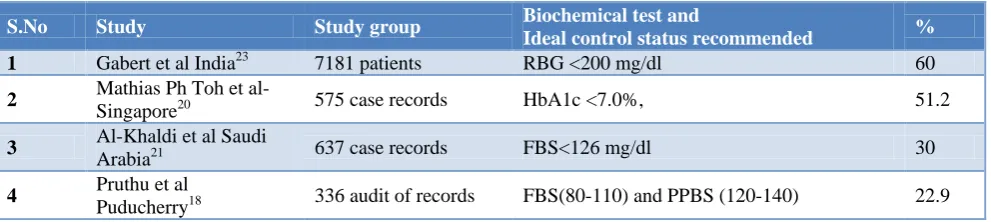
controlled/satisfactory blood sugar status must have blood sugar levels within the optimal range of FBS ≤ 126 mg/dl and/or PPBS/ RBS ≤ 200 mg/dl as recommended by NPCDCS guidelines.
Studies done in other nations show better propotion of treatment outcome compared to Indian studies as shown in Table 2.
Table 2: Proportion of diabetic treatment outcomes compared to Indian studies.
S.No Study Study group Biochemical test and
Ideal control status recommended %
1 Gabert et al India23 7181 patients RBG <200 mg/dl 60
2 Mathias Ph Toh et al-
Singapore20 575 case records HbA1c <7.0%, 51.2
3 Al-Khaldi et al Saudi
Arabia21 637 case records FBS<126 mg/dl 30
4 Pruthu et al
Different parameters were used to ascertain the ideal outcome status of diabetic individuals based on their own nation’s standards like RBS, HbA1c etc. However, Studies conducted in other nations, especially developed nations show relatively high level of ideal treatment outcomes similar to regularity due to various factors as mentioned.
DISCUSSION
Currently India is spending about 2.3% of its GDP in Health care which in comparison to other Developed Nation is suboptimal, which needs to be improved in accordance the global disease burden and transition.
“Build capacity at various levels of health care for prevention, diagnosis and treatment of common Non communicable diseases (NCD)” have been achieved tremendously after the implementation of NPCDCS programme, however the lacunae’s exists in the Process of care eventually leading to suboptimal treatment outcome.
The regularity of patient visits, periodic monitoring for life threatening complications and control of blood sugar are sub-optimal among the NCD patients treated in Health facilities which need to be addressed. Proper training to health care providers on adherence to guidelines they showed proportionately better Treatment outcome.
Regular adequate training needs to be provided to all level of health care providers more frequently as diabetes management change more frequently unless prompt updates are made the treatment outcome won’t be fruitful
Cumbersome way of documentation must be rectified, the method of online registry which captures the patient details and information during each follow-up of patient visit can be implemented and this will led to improvement of documentation and shift the focus to on other NCD activities thereby achieving good quality of care in the management of NCD patients.
Clear lack of job responsibility especially decision
making in changeling treatment regimen, lab
investigations and their documentation exists among the health care providers which needs to be rectified.
Local health system planners and managers need to prioritise the care for diabetes, hypertension and other non communicable diseases in a similar level provided to that of antenatal care and immunization as there is an impending global transition and the burden of Non communicable disease is expected to rise even more as stated by WHO. The Epidemiological transition ratio in India since 1990 is less than one is various states clearly showing the picture that the disease burden due to Non communicable disease is clearly out running the burden
contributed by Maternal and child care illness, hence shift in the priority is the Need of the Hour.
CONCLUSION
Though as per constitution health is responsibility of the state there must be uniformity in treatment protocol as implemented in the form of NPCDCS. From our review it’s clearly evident that the level of Diabetic care in terms of regularity and follow-up is suboptimal compared to standards established in developed nations. There are wide scopes of improvement successfully demonstrated in many nations in the form regular clinical audit which needs future introspection.
ACKNOWLEDGEMENTS
Authors would like to acknowledge the help received from the scholars whose articles are being cited and included in references of this manuscript. The authors are also grateful to authors /editors / publishers of all those articles, books and journals from where the literature for this article has been reviewed and discussed.
Funding: No funding sources Conflict of interest: None declared Ethical approval: Not required
REFERENCES
1. World Health Organization. 2008-2013 Action plan
for the global strategy for the prevention and control of noncommunicable diseases: prevent and control cardiovascular diseases, cancers, chronic respiratory diseases and diabetes. Geneva: WHO; 2009.
2. Cade WT. Diabetes-related microvascular and
macrovascular diseases in the physical therapy setting. Phys Ther. 2008;88:1322–35.
3. IDF IDF Diabetes Atlas, Eight 8th Edn Brussels: International Diabetes Federation; 2017.
4. Ogurtsova K, da Rocha Fernandes JD, Huang Y, Linnenkamp U, Guariguata L, Cho NH, et al. IDF Diabetes Atlas: global estimates for the prevalence of diabetes for 2015 and 2040. Diabetes Res Clin Pract. 2017;128:40–50.
5. Lim SS, Vos T, Flaxman AD, Danaei G, Shibuya K,
Adair-Rohani H, et al. A comparative risk assessment of burden of disease and injury attributable to 67 risk factors and risk factor clusters in 21 regions, 1990–2010: a systematic analysis for the Global Burden of Disease Study 2010. Lancet. 2012;380:2224–60.
6. Lopez AD, Mathers CD, Ezzati M, Jamison DT,
Murray CJ. Global and regional burden of disease and risk factors, 2001: systematic analysis of
population health data. The Lancet.
2006;367(9524):1747–57.
8. Anchala R, Kannuri NK., Pant H. Hypertension in India: a systematic review and meta-analysis of prevalence, awareness, and control of hypertension. J Hypertension. 2014;32(6):1170–7.
9. National Centre for Disease Control, Directorate General of Health Services, Ministry of Health & Family welfare, Government Of India. National Program for Prevention and Control of Cancer, Diabetes, Cardio Vascular Diseases and Stroke (NPCDCS): Operational Guidelines (Revised: 2013-17). New Delhi: National Centre for Disease Control; 2013 :22.
10. Ho PM, Rumsfeld JS, Masoudi FA, McClure DL, Plomondon ME, Steiner JF, et al. Effect of medication nonadherence on hospitalization and mortality among patients with diabetes mellitus. Arch Intern Med. 2006;166(17):1836–41.
11. World Health Organization. Adherence to long term
therapies: Evidence for action. Geneva, Switzerland: WHO; 2003: 135-145.
12. Arulmozhi S, Mahalakshmy T. Self care and
medication adherence among type 2 diabetics in Puducherry, Southern India: A hospital based study. J Clin Diagn Res. 2014;8:UC01–3.
13. Kumar N, Unnikrishnan B, Thapar R, Mithra P, Kulkarni V, Holla R, et al. Factors associated with adherence to antihypertensive treatment among patients attending a tertiary care hospital in Mangalore, South India. Int J Cur Res Rev. 2014;6(10):77-85.
14. Hema K, Padmalatha P. Adherence to medication among hypertensive patients attending a tertiary care hospital in Guntur, Andhra Pradesh. Indian J Basic Applied Med Res. 2014;4(1):451-6.
15. Sankar UV, Lipska K, Mini GK, Sarma PS,
Thankappan KR. The adherence to medications in diabetic patients in rural Kerala, India. Asia Pac J Public Health. 2015;27:NP513-23.
16. Venkatachalam J, Abrahm S, Singh Z, Stalin P, Sathya GR. Determinants of patient’s adherence to
hypertension medications in a rural population of Kancheepuram District in Tamil Nadu, South India. Indian J Community Med. 2015;40(1):33-7.
17. Lee GKY, Wang HHX, Liu KQL, Cheung Y,
Morisky DE, Wong MCS. Determinants of
medication adherence to antihypertensive
medications among a Chinese Population Using Morisky Medication Adherence Scale. PLoS ONE. 2013;8(4):e62775.
18. Pruthu TK, Majella MG, Nair D. Does audit
improve diabetes care in a primary care setting? A management tool to address health system gaps. J Nat Sci Biol Med. 2015;6(Suppl 1):S58-62.
19. Rahman SM, David KV, Priscilla RA, Cynthia S. Audit on diabetes care in a secondary hospital in
South India. Indian J Endocrinol Metab.
2013;17:1130–2.
20. Toh MP, Heng BH, Sum CF, Jong M, Chionh SB, Cheah JT. Measuring the quality of care of diabetic patients at the specialist outpatient clinics in public hospitals in Singapore. Ann Acad Med Singapore. 2007;36:980-6.
21. Al-Khaldi YM. Quality of diabetic care in family practice Centre, Aseer Region, Saudi Arabia. J Health Spec 2014;2:109-13.
22. World Health Organization. Global Action Plan for
the prevention and control of NCDs 2013-2020. Geneva: World Health Organization; 2013.
23. Gabert R, Ng M, Sogarwal R, Bryant M, Deepu RV,
McNellan CR, et al. Identifying gaps in the continuum of care for hypertension and diabetes in two Indian communities. BMC Health Serv Res. 2017;17(1):846.