Journal of Chemical and Pharmaceutical Research, 2015, 7(1):527-534
Research Article
CODEN(USA) : JCPRC5
ISSN : 0975-7384
Development and validation of HPLC-procedures of doxylamine
determination in blood in the variant of the method of standard
Klimenko L. Yu., Trut S. M., Moroz V. P. and Erlish O. O.
Analytical Chemistry Department, National University of Pharmacy, 53, Pushkinska str., Kharkiv, Ukraine __________________________________________________________________________________________
ABSTRACT
The set of procedures of doxylamine quantitative determination in blood by the method of high-performance liquid chromatography using amphiphylic solvents (isopropanol, acetonitrile, methanol) under the conditions of aqueous phase saturation by ammonium sulphate has been developed; acetonitrile application in the weak-acid medium (рН = 5) is optimal. Validation of the developed procedures has been carried out in the variant of the method of standard and the possibility of application of the method of standard for determination has been shown with the purpose of ration-alization of quantitative determinations carrying out in forensic toxicology.
Keywords: validation, bioanalytical methods, high-performance liquid chromatography, doxylamine, method of standard
__________________________________________________________________________________________
INTRODUCTION
Development of strong medicines determination procedures in human biological fluids for application in forensic and clinical toxicology is one of the actual problems of pharmaceutical science, but validation of such analytical procedures becomes much more vital and widely discussed problem of analytical toxicology in the past decade [1 – 7].
The available international guidance’s on carrying out validation of bioanalytical methods [6, 7] are reckoned on the experiment performance in the variant of the method of calibration curve that implies carrying out a lot of routine analyses in practical work. In forensic toxicology we often meet with single examinations, and various biological fluids, organs and tissues are sent for the examinations, i.e. it is necessary to determine analyte quantitatively in some various biological objects, and the necessity of carrying out such determination can arise rarely enough. In such situation plotting the calibration curve for each matrix demands quite nonrational investment of time, and to the moment of obtaining the results of analysis they can become irrelevant.
Taking into account the experience of standardized validation procedures development in Ukraine [8], we offered the approaches to determination and estimation of such main validation parameters as specificity, recovery, linearity, precision and accuracy for procedures of analyte quantitative determination in biological fluids applied in forensic toxicology in the variant of the method of standard [9 – 11].
The developed approaches were successfully applied to procedures using optical methods of analysis [11], and it is interesting to approve these validation procedures on chromatographic methods of analysis.
method uncertainty, and also estimating the possibility of the method of standard application for doxylamine HPLC-determination in blood.
EXPERIMENTAL SECTION
Doxylamine of pharmacopoeial purity was used in the experiment. The procedure of preparation of standard, pro-cess and model solutions, and also model samples is presented on Scheme 1.
mcg/ml 10 20; 30; 40; 50; 60; 65;
=
calibrator i C
mcg/ml 32
=
model reference
C Cimodel=52;48;40;32;24;16;8mcg/ml
Scheme 1. The order of solutions and samples preparationfor validation of doxylamine determination procedures in blood by the meth-od of HPLC
The design of experiment on development of procedures of doxylamine determination in blood by the method of HPLC is presented on Scheme 2.
The model (see Scheme 1) and also blank-samples and blank-solutions were analysed for each developed procedure; the blank-samples were prepared in the following way: 5 samples (20.00 ml) of the blood obtained from the differ-ent sources, 1.00 ml of distilled water were added into them.
Each solution to be analysed was chromatographed 3 times or, as required, more following the our offered require-ments to repeatability of peaks areas Sfor replicateinjections – the relative standard deviation of the mean RSDnom
calculated towards the nominal value of peak area Snomshould not exceed:
,
=
6
52
2
5
22
2
4
88
1
3
47
1
)
1
%,
95
(
max
0.1
100
25
min %
nom
As
nom nom
S
S
S
;
n
%;
.
n
%;
.
n
%;
.
n
%;
.
n
t
n
%
S
s
RSD
=
=
=
=
=
=
−
⋅
∆
⋅
≤
⋅
=
where max∆As – is the extreme relative uncertainty of the procedure of analysis, max∆As = 20% [6];
S
25% – theScheme 2. The main stages of the procedures of doxylamine determination in blood by the method of HPLC
RESULTS AND DISCUSSION
The HPLC-method for doxylamine determination using the system of HPLC-analyzer«МилихромА-02» was devel-oped by authors before [12]; the retention time for doxylamine was 11.85 min. This method was applied for estima-tion of efficiency of doxylamine isolaestima-tion from blood by maceraestima-tion with 10% trichloroacetic acid soluestima-tion and sub-sequent extraction with chloroform in the alkaline medium (рН = 11) – the recovery was equal to ~75% [13].
In this paper it has been suggested to carry out doxylamine isolation from using amphiphylic solvents with subse-quent separation of organic layer under the conditions of aqueous phase saturation by electrolyte; this approach en-joys wide popularity in modern forensic and toxicological analysis [5, 14]. Such amphiphylic solvents as isopropa-nol, acetonitrile and methanol have been used in the experiment; ammonium sulphate has been applied as electrolyte for saturation of aqueous phase.
Thus, the development of the set of HPLC-methods of doxylamine determination in blood has become the result of this stage of investigations; the methods differ by the procedures of sample preparation (see Scheme 2).
For choosing the optimal method of doxylamine determination in blood we have carried out validation of all devel-oped procedures by such parameters as specificity, recovery, linearity, accuracy, repeatability and intermediate pre-cision according to the approaches offered by us in the variant of the method of standard [9 – 11].
The validation procedure foresees application of the normalized coordinates. For normalization of the obtained ex-perimental data the reference solution with the concentration of analyte corresponded to its concentration in the end solution to be analysed under the condition of zero losses for the point of 100% in the normalized coordinates is used. The peak area for reference solution is corrected taking into account the value of recovery R, which signifi-cance and value has been showed at the preliminary stage of validation, and is used for normalization of peak areas for the model samples.
The range of the methods application is D = 25 – 175%; the number of concentration levels is g = 7 in constant in-crements of 25%; as 100% the mean toxic doxylamine concentration in blood [5] is accepted.
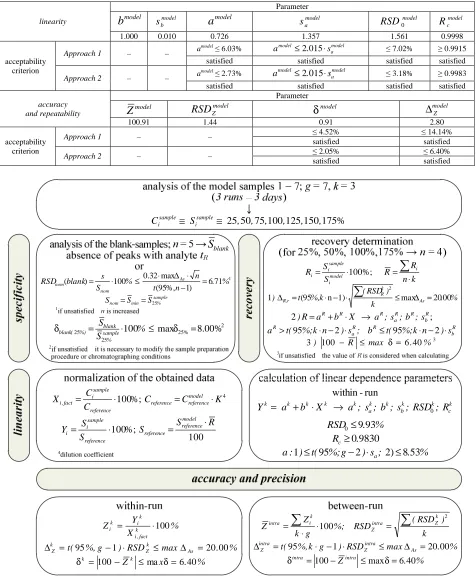
The methods validation has been carried out at the first stage using model solutions (Scheme 3) and proceeding from two approaches [9]:
Approach 1:the uncertainty of sample preparation procedure is equal to the uncertainty of analyte quantitative
de-termination in model solutions
∆
modelAs .Approach 2:the uncertainty of analyte quantitative determination in model solutions
∆
modelAs is insignificant againstthe total uncertainty of analysis results∆As.
00% 1 75% 1 50 1 25 1 0 0 1 5 7 50 25 ≅ ≅ ≅ ≅ model reference model reference model i model i S C , , , , , , S C
%
100
%;
100
=
⋅
⋅
=
model reference model i model i model reference model i model fact , iS
S
Y
C
C
X
model c model model b model model a model model modelR
;
RSD
;
s
;
b
;
s
;
a
X
b
a
Y
=
+
⋅
→
0%
.
;
s
)
g
%;
(
t
)
:
a
.
R
%;
.
RSD
model a model model c model03
6
2)
2
95
1
9915
0
02
7
0≤
⋅
−
≤
≥
≤
%
.
;
s
)
g
%;
(
t
)
:
a
.
R
%;
.
RSD
model a model model c model73
2
2)
2
95
1
9983
0
18
3
0≤
⋅
−
≤
≥
≤
model model model Z model Z model fact , i model i modeli
%;
t
(
%,
g
)
RSD
;
Z
X
Y
Z
=
⋅
100
∆
=
95
−
1
⋅
δ
=
100
−
%
.
%
.
model model model As model Z05
2
max
40
6
max
=
δ
≤
δ
=
∆
≤
∆
%
.
%
.
model model model As model Z52
4
max
14
14
max
=
δ
≤
δ
=
∆
≤
∆
The total results of validation are presented in Table 1 and allow to point to the conclusion about acceptable lineari-ty, accuracy and repeatability of the HPLC-procedure of doxylaminequantitative determination in the variant of the method of standard both for Approach 1 and Approach 2 that gives the possibility to recommend it to further appli-cation in forensic toxicology with the purpose of development of the methods of biological objects analysis for dox-ylaminequantification.
Table 1 The total results of validation of doxylamine determination procedure by the method of HPLC, which were obtained using model
solutions linearity Parameter model
b
model bs
a
model modela
s model
RSD0 model c R
1.000 0.010 0.726 1.357 1.561 0.9998
acceptability criterion
Approach 1 – – a
model≤ 6.03% 2015 model a model
s .
a ≤ ⋅ ≤ 7.02% ≥ 0.9915
satisfied satisfied satisfied satisfied
Approach 2 – – a
model≤ 2.73% 2015 model a model
s .
a ≤ ⋅ ≤ 3.18% ≥ 0.9983
satisfied satisfied satisfied satisfied
accuracy and repeatability
Parameter
model
Z
RSD
Zmodelmodel
δ
modelZ
∆
100.91 1.44 0.91 2.80
acceptability criterion
Approach 1 – – ≤ 4.52% ≤ 14.14%
satisfied satisfied
Approach 2 – – ≤ 2.05% ≤ 6.40%
satisfied satisfied
75% 1 50 1 25 1 0 0 1 5 7 50 25
S , , , , , ,
C isample sample
i ≅ ≅
100 %; 100 %; 100 4 R S S S S Y K C C C C X model reference reference reference sample i i model reference reference reference sample i fact , i ⋅ = ⋅ = ⋅ = ⋅ = k c k k b k k a k k k k k R ; RSD ; s ; b ; s ; a X b a Y 0 run -within → ⋅ + = % . ; s ) g %; ( t ) : a . R % . RSD a c 53 8 2) 2 95 1 9830 0 93 9 0 ≤ ⋅ − ≤ ≥≤ % . x Z % . max RSD ) g %, ( t % X Y Z k k As k Z k Z k fact , i k i k i 40 6 ma 100 00 20 1 95 100 = δ ≤ − = δ = ∆ ≤ ⋅ − = ∆ ⋅ = % . Z % . max RSD ) g k %, ( t k ) RSD ( RSD %; g k Z Z intra intra As intra Z intra Z k Z intra Z k i intra 40 6 max 100 00 20 1 95 100 2 = δ ≤ − = δ = ∆ ≤ ⋅ − ⋅ = ∆ = ⋅ ⋅ =
∑
∑
blankS
3 40 6 1003) −R ≤ max δ = . %
% . k ) RSD ( k %, t ) As k R r ,
R (95 n 1) max 2000
1 2 = ∆ ≤ ⋅ − ⋅ = ∆
∑
k n R R S SR model i
i sample i i ⋅ = ⋅
= 100%;
∑
2 25%
25
25 = ⋅100 ≤ maxδ =8.00%
At the second stage the methods validation has been carried out using model samples – the determination procedure and acceptability criteria are presented at Scheme 4.
For specificity investigation for the developed procedures as for the components of biological matrix we have
de-termined the sum of peaks areas on the chromatograms of blank-samples within 11thand 12th minutes –
S
blank.The maximum peak area for doxylamineis observed in the case of detection at the wavelength of 210 nm, but at the same wavelength the sum of peaks areas is maximum on the chromatograms of blank-samples. At the same time the less intensive doxylamine peak at λ = 260 nm (this wavelength is the nearest to characteristic doxylamine in UV-range of spectrum) is accompanied by the absence of peaks with the retention time, which is coincident with (or near to) the doxylamine retention time, on the chromatograms of blank-samples for all variants of procedures of analyte isolation from blood that points to the conclusion about acceptable specificity of the developed methods as for the components of biological matrix when using 260 nm as a working wavelength.
The absence of peaks with the retention time, which is coincident with (or near to) the doxylamine retention time, on the chromatograms of blank-solutions for all wave lengths used for detection in the described HPLC-system is the evidence of the correct choice of sample preparation procedure for all considered cases, i. e. the sample preparation procedure does not influence on the results of analysis.
It is necessary to note that in all cases carrying out doxylamine isolation from blood at рН = 5 provides lower sum of peaks areas on the chromatograms of blank-samples than in the case of alkaline рН using; at the same time by the results of recovery study small decreasing of doxylamine isolation efficiency from blood – within 3 – 5% – is noted under these conditions. The methods with acetonitrile application are characterized by the best extraction efficiency.
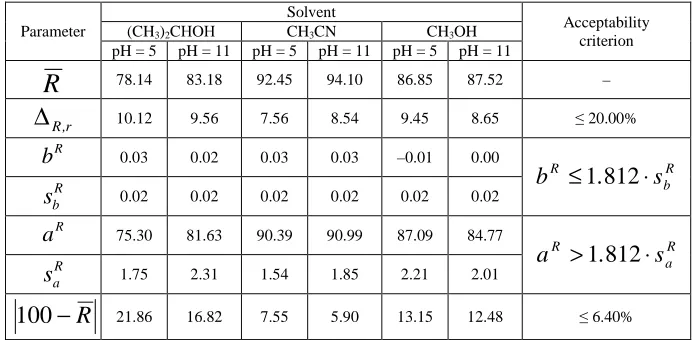
[image:6.595.132.480.396.566.2]The reproducibility of recovery values (Table 2) satisfies the acceptability criteria for all variants of methods.
Table 2 The results of recovery determination for HPLC-methods of doxylamine quantification in blood
Parameter
Solvent
Acceptability criterion
(CH3)2CНOН CH3CN CH3OH
pH = 5 pH = 11 pH = 5 pH = 11 pH = 5 pH = 11
R
78.14 83.18 92.45 94.10 86.85 87.52 –r , R
∆
10.12 9.56 7.56 8.54 9.45 8.65 ≤ 20.00%R
b
0.03 0.02 0.03 0.03 –0.01 0.00R b R
s
.
b
≤
1
812
⋅
R b
s
0.02 0.02 0.02 0.02 0.02 0.02R
a
75.30 81.63 90.39 90.99 87.09 84.77R a R
s
.
a
>
1
812
⋅
R a
s
1.75 2.31 1.54 1.85 2.21 2.01R
−
100
21.86 16.82 7.55 5.90 13.15 12.48 ≤ 6.40%Taking into account the data about specificity of the developed procedures the investigations of linearity, accuracy and precision have been carried out only for the set of procedures with application of the weak-acid medium for doxylamine isolation from blood – the total results are presented in Table 3.
For the method with acetonitrile application at рН = 5 calculation of linearity, accuracy and precision parameters has been carried out both with correction by the R value and without it – absence of such correction does not lead to signif-icant worsening of the method validation parameters.
Table3 The results of linearity, accuracy and precision determination for HPLC-methods of doxylamine quantification in blood (pH = 5)
Parameter (CH3)2CНOН CH3CN CH3OH Acceptability
criterion linearity
k
a
–3.739 –2.422 –2.507 –2.639 –0.810 –1.497 –2.131 –1.502 0.457a
s
.
a
≤
2
015
⋅
a≤ 8.53%
k a
s
1.388 2.039 2.720 3.049 3.029 2.696 2.795 4.129 2.840k
b
1.067 1.049 1.047 1.036 1.023 1.023 1.007 0.997 0.988k b
s
0.013 0.019 0.025 0.028 0.028 0.025 0.026 0.038 0.026 –k
RSD
0 1.598 2.346 3.130 3.509 3.486 3.103 3.216 4.752 3.269 ≤ 9.93%k c
R
0.9996 0.9992 0.9986 0.9982 0.9982 0.9985 0.9984 0.9964 0.9983 ≥ 0.9830 accuracyk
Z
101.38 101.58 99.98 99.93 101.33 101.05 96.82 97.26 99.11 –k
δ
1.38 1.58 0.02 0.07 1.33 1.05 3.18 2.74 0.89 ≤ 6.40%intra
Z
100.98 100.77 97.73 –intra
δ
0.98 0.77 2.27 ≤ 6.40%precision
k Z
RSD
4.07 4.12 7.36 3.73 3.32 5.97 6.45 4.61 3.03 –k Z
∆
7.91 8.01 14.30 7.25 6.45 11.60 12.53 8.96 5.89 ≤ 20.00%intra Z
RSD
5.41 4.50 4.90 –intra Z
∆
9.33 7.76 8.45 ≤ 20.00%CONCLUSION
1.The set of HPLC-procedures of doxylamine quantitative determination in blood using amphiphylic solvents (isopro-panol, acetonitrile, methanol) for analyte isolation from matrix in the weak-acid and alkaline medium with further sepa-ration of organic layer under the conditions of aqueous phase satusepa-ration by ammonium sulphate has been developed. 2.Validation of the developed procedures has been carried out and it has been set that acetonitrile application in the weak-acid medium (рН = 5) is optimal for doxylamine determination in blood – the extraction efficiency is maximal and equal to ∼97%, and parameters of linearity, accuracy and precision are optimal.
3.The possibility of application of the offered approaches to validation of quantitative determination procedures for forensic and toxicological analysis in the variant of the method of standard has been shown for validation of procedures using the method of high-performance liquid chromatography.
REFERENCES
[1] G Tiwari. Pharm. Methods, 2010, 1(1), 25–38.
[2] P Wal; B Kumar; ABhandari; AK Rai; A Wal. Journal of Pharmaceutical Science and Technology, 2010, 2(10), 333–347.
[3] G Smith. Bioanalysis, 2010, 2(5), 929–935. [4] E Theodorsson. Bioanalysis, 2012, 4(3), 305–320.
[5] AC Moffat; MD Osselton; B Widdop. Clarke’s analysis of drugs and poisons in pharmaceuticals, body fluids and postmortem material, 4th Edition, Pharmaceutical Press, London, 2011, 2609.
[6] Guidance for the Validation of Analytical Methodology and Calibration of Equipment used for Testing of Illicit Drugs in Seized Materials and Biological Specimens, United Nations, New York, 2009, 70.
[7] Standard Practices for Method Validation in Forensic Toxicology, Scientific Working Group for Forensic Toxi-cology, 2013, 52.
[8] OIGryzodub. Standardized validation procedures for methods of medicines quality control.Analytical Chemistry in Development, Standardization and Quality Control of Medicines, НТМТ, Kharkiv, 2011, 3, 520.
[12] VVBolotov; ІМIvanchuk.Visnykfarmatsiyi, 2005, 4(44), 16–19.
[13] VVBolotov; ІМIvanchuk; LYuKlimenko.Visnykfarmatsiyi, 2008, 3(55), 20–22.
[14] S Mitra. Sample Preparation Techniques in Analytical Chemistry, John Wiley & Sons, 2003, 472.