Original Research Article
Assessment of occupational exposure to sharp injuries among health
care workers in King Abdulaziz University Hospital
Samia S. Abdulmageed
1*, Fatmah Alabbassi
2, Mai Alradi
2,
Nebras Alghanaim
2, Sundos Banjar
2, Malak Alnakhli
2INTRODUCTION
Sharp injuries are any wound resulted from a sharp object such as scalpel, needle which result in mixture of blood with other body fluid. They are a result of a dangerous equipment being used in a stressful setting.1
Many diseases are transmitted via blood borne contact, such as HIV, hepatitis B and hepatitis C. The first HIV needle stick transmitted case played an important role to
increase awareness and concerns about the health care worker (HCW) handling of their environment.2–4
Exposure prevention network (EPINet) reported that sharp injuries occurred in almost half the time of usage, while the majority happened before using the safety device and rules, where 40% of those injuries were a safety designed tool. However, the report shows that the vast majority of injuries occurred in surgical team members and nurses.5
ABSTRACT
Background: Sharps injuries are accidental infiltrating wounds that are typically the consequences of utilizing hazardous equipment in the usual fast-paced, and stressful health care setting. As a result, exposure to blood-borne pathogens from sharps injury poses a significant risk to health care workers. These injuries predispose the staff to dangerous infections such as hepatitis B, C and HIV. The aim of the study was to assess the occupational exposure to sharps injuries among health care workers in King Abdulaziz University Hospital in Jeddah.
Methods: A cross-sectional descriptive study was conducted. Nurses, residents, dentists, and housekeepers working in the surgical ward, obstetrics and gynaecology ward, emergency department, operation room, labor and delivery room, and dental clinics at King Abdulaziz University Hospital were included. A random sample of 161 subjects was recruited in this study using a self-administered structured questionnaire.
Results: Of 161 participants, 53 (32.90%) had a history of sharps injury. Among them 25 (47.16%) were nurses, both surgical and gynaecological residents had the same result of 11 (20.76%), and 6 (11.32%) of them were dentists. Most of the injuries had occurred during the use of the suture needle; 24 (45.28%) suggested that work overload was the main reason for sharps injury occurrence.
Conclusions: Among health care workers, nurses were especially at risk of exposure to sharps injury. The most important risk factors for injury occurrence include long working hours, continuous rotating shifts, and work overload. Also, not all of the health care workers knew about the hospital’s reporting system.
Keywords: Sharp injuries, Healthcare workers, Occupational exposure
1
Faculty of Nursing, Public Health Department, 2College of Nursing, King Abdulaziz University, Jeddah, Saudi Arabia
Received: 08 March 2018
Revised: 27 March 2018
Accepted: 29 March 2018
*Correspondence:
Dr. Samia S. Abdulmageed,
E-mail: [email protected]
Copyright: © the author(s), publisher and licensee Medip Academy. This is an open-access article distributed under the terms of the Creative Commons Attribution Non-Commercial License, which permits unrestricted non-commercial use, distribution, and reproduction in any medium, provided the original work is properly cited.
Memish study report of infection control in Saudi Arabia showed that the infection control policies were born from the preventive medicine concern of Hajj pilgrim’s to Mecca, which is unrelated to hospital policies of international safety standards. Multiple usage of shaving blades has been reported as a source of blood borne infection among the hajj population, which led to the fast growing awareness program of infection control.6
In Saudi Arabia, infection control is a new field that is constantly and rapidly growing. Blood-borne pathogens from sharp injuries continues to pose a significant risk to health care workers. These injuries predispose the staff to dangerous infections such as hepatitis B, C and HIV. Our aim for this study is to further assess the occupational exposure of these injuries in the university’s teaching hospital.
Rationale of the study
In this research, it is hypothesized that there is a high incidence of sharp injuries occurs among nurses, increased working hours contributes to sharps injury incidence, and low working experience leads to higher exposure to sharp injuries. Therefore, the main objective of this research was to assess the occupational exposure to sharp injuries among health care workers in KAUH. More specifically, the study aimed at determining the incidence of sharp injuries due to occupational exposure among health care workers in KAUH, determining factors associated with the incidence of sharp injuries in KAUH, and identifying policies and strategies available for blood-borne infections associated with sharp injuries.
METHODS
This study was a descriptive cross-sectional study that was conducted in over four-month duration from February to May 2015. The study took place in King Abdulaziz University Hospital which is a part of the KAU Medical City, alongside the faculty of nursing, faculty of medicine, faculty of pharmacy, faculty of applied medical sciences, faculty of dentistry and King Fahd Medical Research Center. The surgical ward, obstetrics and gynecology ward, emergency department, operation room, labor and delivery room, and dental clinics at King Abdulaziz University Hospital were included. Subjects recruited for the research included nurses, residents, dentists, and housekeepers in the areas aforementioned at KAUH (Male and Female, Saudi and non-Saudi) that are at risk for exposure to sharps injuries were included in this study.
Sampling
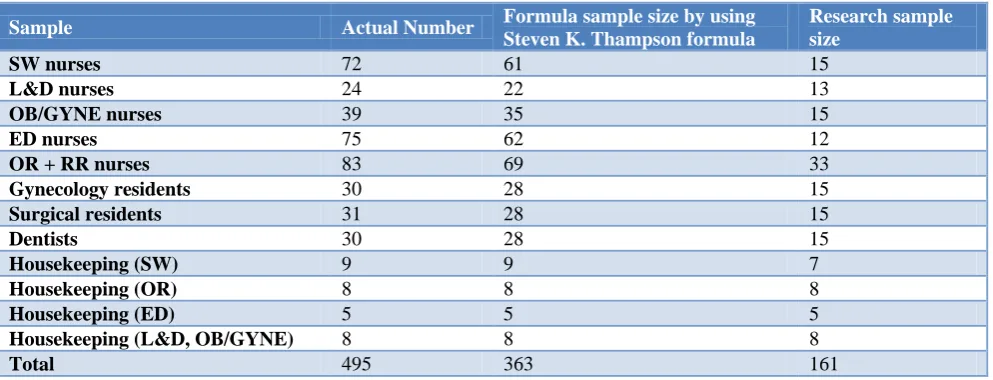
A stratified simple random sample was used. By using Steven K. Thompson formula for deciding the sample required for the research to represent 495 participants, the sample is of 363 participants (61 SW nurses, 22 L&D nurses, 35 OB/GYNE nurse, 62 ED nurses, 69 OR + RR nurses, 28 gynaecology residents, 28 surgical residents, 28 dentists, 9 housekeepers in SW, 8 housekeepers in OR, 5 housekeepers in ED, and 8 housekeepers in L&D and OB/GYNE ward).
Data collection was conducted using a self-administered structured questionnaire was previously constructed and pre-tested.
Table 1: Research sample size.
Sample Actual Number Formula sample size by using
Steven K. Thampson formula
Research sample size
SW nurses 72 61 15
L&D nurses 24 22 13
OB/GYNE nurses 39 35 15
ED nurses 75 62 12
OR + RR nurses 83 69 33
Gynecology residents 30 28 15
Surgical residents 31 28 15
Dentists 30 28 15
Housekeeping (SW) 9 9 7
Housekeeping (OR) 8 8 8
Housekeeping (ED) 5 5 5
Housekeeping (L&D, OB/GYNE) 8 8 8
Total 495 363 161
Data was analyzed using Statistical Package for Social Science (SPSS) software version 22 at (p=0.05). Written consent was taken from all participants. The Ethical Research Committee at the Faculty of Nursing & KAU approved the proposal of the study and a written consent from the administration of KAUH was obtained.
RESULTS
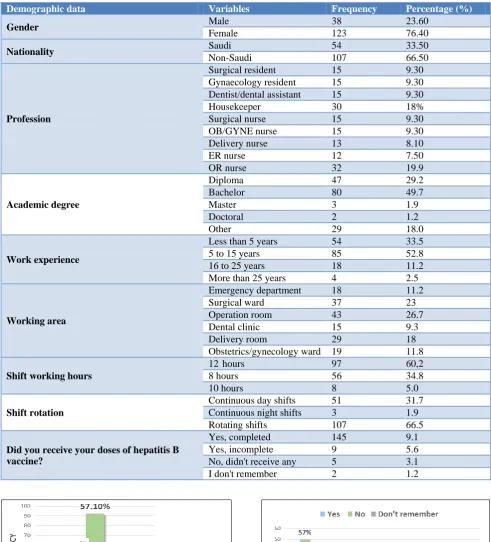
The vast majority of participants were females (76.0%). Two-thirds were of non-Saudi nationalities. The details of demographic data are depicted in Table 2.
Table 2: Demographic data of the recruited sample.
Demographic data Variables Frequency Percentage (%)
Gender Male 38 23.60
Female 123 76.40
Nationality Saudi 54 33.50
Non-Saudi 107 66.50
Profession
Surgical resident 15 9.30 Gynaecology resident 15 9.30 Dentist/dental assistant 15 9.30
Housekeeper 30 18%
Surgical nurse 15 9.30 OB/GYNE nurse 15 9.30 Delivery nurse 13 8.10
ER nurse 12 7.50
OR nurse 32 19.9
Academic degree
Diploma 47 29.2
Bachelor 80 49.7
Master 3 1.9
Doctoral 2 1.2
Other 29 18.0
Work experience
Less than 5 years 54 33.5 5 to 15 years 85 52.8 16 to 25 years 18 11.2 More than 25 years 4 2.5
Working area
Emergency department 18 11.2
Surgical ward 37 23
Operation room 43 26.7 Dental clinic 15 9.3
Delivery room 29 18
Obstetrics/gynecology ward 19 11.8
Shift working hours
12 hours 97 60,2
8 hours 56 34.8
10 hours 8 5.0
Shift rotation
Continuous day shifts 51 31.7 Continuous night shifts 3 1.9 Rotating shifts 107 66.5
Did you receive your doses of hepatitis B vaccine?
Yes, completed 145 9.1 Yes, incomplete 9 5.6 No, didn't receive any 5 3.1 I don't remember 2 1.2
Figure 1: Number of participants who have experienced a sharps injury (n=161).
Figure 2: Number of participants who have experienced a sharps injury according to their
As regards exposure to sharp injuries, only one third of the participants could recall that they had been exposed to sharp injuries (Figure 1). In relation to the occupation, surgical residents and residents of obstetrics and gynecology were the highest group to report exposure to sharp injuries (73%). Dentists and nurses came next with 40 and 29% reporting exposure to injury, respectively (Figure 2).
Figure 3: Number of nurses who have experienced a sharps injury according to their specialty (n=87).
Figure 4: Incidence occurrence time (n=53).
When nurses were analyzed more specifically, it was found that OR nurses had the highest exposure to sharp injuries followed by nurses working in surgical, obstetrics, and gynecology departments (Figure 3). Over one half of those nurses reported that the injury occurred more than one year before the time of the study, whilst only 16% could recall that they experienced a sharp injury during the past 6 months (Figure 4).
Figure 5: Type of activity that was associated with the injury (n=53).
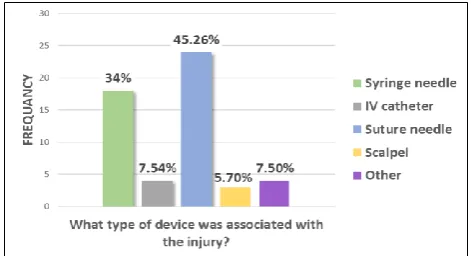
Figure 6: Type of device associated with the injury (n=53).
The type of activity during which the injury occurred was also assessed (Figure 5). Most participants experienced the injury during performing a procedure using the sharp item (30.2%). Suture needles were the most common type causing sharp injuries (45%) followed by syringe needles (34%). IV catheters, scalpels, and other devices constituted lower percentages (Figure 6).
Figure 7: Participants first action after the injury (n=53).
Figure 8: Number of participants who have received training on sharps/waste disposal technique (n=145).
whether they have received any prior training about dealing with sharp injuries, and more than 85% denied any (Figure 8). Most of the participants thought that work overload was the most common factor responsible for sharp injuries. Putting used needles in waste particles were thought by about one fifth of participants to be a risk factor, and low experience came next (Figure 9). Over 85% of participants did not have a reporting system for needle stick injury (Figure 10).
Figure 9: Opinions of participants on the factors that may lead to a sharps injury (n=145).
Figure 10: Awareness of participants about reporting system for needle stick injury (n=145).
The relationship between exposure to sharp injuries and many factors were studied in this research, namely the profession, the work experience, and shift working hours. Only profession had a significant correlation with the incidence of sharp injury exposure with a p<0.0001 (Table 3). While no significance was found between injury and work experience nor working hours.
Table 3: The relationship between sharps injuries and profession.
Profession
Total
Nurse Surgical
resident
Gynaecology resident
Dentist/dental
assistant Housekeeper
Yes 25 11 11 6 0 53
No 50 3 4 6 29 92
Don’t remember 12 1 0 3 0 16
Total 87 15 15 15 29 161
Chi-Square, (P value=0.000).
DISCUSSION
In this research, females constituted a higher percentage of participants in comparison to males, with nationalities of Non-Saudi over Saudis. As nursing students, nurses were our concern. Therefore, most of the samples were nurses as it showed in the findings. Work experience of 5 1o 15 years had the highest result, and it showed that there is no correlation between work experience and the occurrence of sharps injury, which disagree with the result of Mohammed in Iran. Of note, OR nurses represented the highest percentage of HCWs being injured, and this also matches Mohammed's study, which says that sharp injuries occur mostly among nurses in the OR. Regarding to shift working hours and shift rotation 12 hours and rotating shift were more frequent ones. The vast majority of the participants have received and completed their hepatitis B vaccine doses, as a protective strategy provided by the hospital for their HCWs.
Factors associated with sharp injuries
According to the results, most of the participants who answered "yes" to the question "have you ever
experienced a sharp injury?" were nurses, followed by surgical residents and gynecologists evenly with the
The first action after being injured was washing the area with soap being the most frequent one, squeezing the injury, disinfection with alcohol, no action, while sending a blood sample from the patient and reporting the injury had even occurred as the least common. Work overload was the most common factor leading to sharp injuries as shown in the results followed by putting used needles in waste basket, with while training/teaching others being the least common, a study by Choa shows that poor working conditions such as stress, staff shortage and exhaustion is one of the factors that increase the incidence of sharp injuries and another study by Shriyan showed that most of the injuries occurred in nurses in relation to the number of cases admitted per day which correlates with the finding of our study.1 According to the findings very high percentage of the participants received training programs about sharps disposal and know about the reporting system in the hospital, on the contrary Memish mentioned in a study that KSA's hospitals had a low level of education about sharps injury incidence report, and they should increase the awareness of their HCWs towards sharp injuries incidence.
To test the hypothesis of the study, there was a significant relationship between the nursing profession and sharps injury events with (p=0.000), while there were no statistical significant between sharps injury events and working experiences (p=0.241) or shift working hours (p=0.690).
Strengths
The sample included different groups of participants from different professions, academic degrees, nationalities, genders, ages, and cultures. This is the first study for sharps injury exposure assessment to be done among dental personnel in dental clinics.
Limitations
This study was conducted only in KAUH and the dental clinics, so we might not be able to generalize the results. KAUH is an educational hospital; which is why the working conditions might differ from those in MOH hospitals.
CONCLUSION
This study was conducted at King Abdul-Aziz University Teaching Hospital in Jeddah. The main findings of the study were that 33% of participants were injured during their work and the most common type of activity was during the use of an item, with suture needle being the most common type of device associated with the injury followed by the and syringe needle. There was highly significant relationship between occupation and sharp injuries events, while there were no statistical significant
between sharp injuries events and working experiences or shift working hours. Also, the study showed that there were enough training programs for staff regarding to hazards associated with sharp injuries, and most of the staff were aware of the reporting system in the hospital. At last, further studies are needed before generalizing these study findings.
Funding: No funding sources Conflict of interest: None declared
Ethical approval: The study was approved by the Institutional Ethics Committee
REFERENCES
1. Cho E, Lee H, Choi M, Park SH, Yoo IY, Aiken LH. Factors associated with needlestick and sharp injuries among hospital nurses: A cross-sectional questionnaire survey. Int J Nurs Stud. 2013;50(8):1025-32.
2. Article O. Needle stick injuries: nurses at risk. Mich Nurse. 2000;73(3):8-9.
3. Wodak A, Cooney A. Do Needle Syringe Programs Reduce HIV Infection Among Injecting Drug Users: A Comprehensive Review of the International Evidence. Subst Use Misuse. 2006;41(6-7):777-813. 4. Jacob A, Newson-Smith M, Murphy E, Steiner M,
Dick F. Sharps injuries among health care workers in the United Arab Emirates. Occup Med (Chic Ill). 2010;60(5):395-7.
5. White F. National Institute for Occupational Safety and Health (NIOSH) Prevention through Design (PtD) Workshop Closing Remarks. J Safety Res. 2008;39(2):203-4.
6. Memish ZA. Infection control in Saudi Arabia: Meeting the challenge. Am J Infect Control. 2002;30(1):57-65.
7. Memish ZA, Assiri AM, Eldalatony MM, Hathout HM. Benchmarking of percutaneous injuries at the ministry of health hospitals of Saudi Arabia in comparison with the United States hospitals participating in exposure prevention information network (epinetTM). Int J Occup Environ Med. 2015;6(1):26-33.
8. Memish ZA, Assiri AM, Eldalatony MM, Hathout HM, Alzoman H, Undaya M. Risk analysis of needle stick and sharp object injuries among health care workers in a tertiary care hospital (Saudi Arabia). J Epidemiol Glob Health. 2013;3(3):123-9.