RVC OPEN ACCESS REPOSITORY – COPYRIGHT NOTICE
This is the peer reviewed, manuscript version of the following article:
Kinnison, T., S. A. May and D. Guile (2015). " Errors in veterinary practice: preliminary lessons for building better veterinary teams." Veterinary Record.
Which has been published in final form at http://dx.doi.org/10.1136/vr.103327. The final article is © 2015, BMJ Publishing Group.
The full details of the published version of the article are as follows:
TITLE: Errors in veterinary practice: preliminary lessons for building better veterinary teams
AUTHORS: T. Kinnison, S. A. May, D. Guile
JOURNAL TITLE: Veterinary Record
VOLUME/EDITION:
PUBLISHER: BMJ Publishing Group
PUBLICATION DATE: 22 October 2015 (online)
Errors in Veterinary Practice: Preliminary Lessons for Building Better Veterinary Teams Tierney Kinnison1, David Guile2 and Stephen May3
Abstract
Case studies in two typical UK veterinary practices were undertaken to explore teamwork, including interprofessional working. Each study involved one week of whole team observation based on practice locations (reception, operating theatre), one week of shadowing six focus individuals (veterinary surgeons, veterinary nurses and administrators) and a final week consisting of semi-structured interviews regarding teamwork. Errors emerged as a finding of the study. The definition of errors was inclusive, pertaining to inputs or omitted actions with potential adverse outcomes for patients, clients or the practice. The 40 identified instances could be grouped into clinical errors (dosing/drugs, surgical preparation, lack of follow up), lost item errors, and most frequently, communication errors (records, procedures, missing face-to-face communication, mistakes within face-to-face communication). The qualitative nature of the study allowed the underlying cause of the errors to be explored. In addition to some individual mistakes, system faults were identified as a major cause of errors. Observed examples and interviews demonstrated several challenges to interprofessional team working which may cause errors, including: lack of time, part time staff leading to frequent hand overs, branch differences and individual veterinary surgeon work
preferences. Lessons are drawn for building better veterinary teams and implications for Disciplinary Proceedings considered.
Introduction
Medical error, or adverse events, is understandably a high profile topic. In the US it has been estimated that between 44,000 and 98,000 people die in hospital each year as a result of
preventable errors (Institute of Medicine 2000). Occasionally an individual repeatedly does or does not do something, despite evidence and education on the appropriate course to take, and should therefore face repercussions, as per a ‘just culture’ (Wachter and Pronovost 2009). This emphasis on an individual’s mistake has persisted in various professions and societies, and it is a considerable
1The LIVE Centre, Royal Veterinary College, Hawkshead Lane, North Mymms, Hatfield AL9 7TA, UK
2Lifelong and Comparative Education, Institute of Education, UCL, London, UK
3Department of Veterinary Clinical Sciences, Royal Veterinary College, Hawkshead Lane, North Mymms,
source of anxiety for veterinary students (Tomlin and others 2010). However, studies have suggested that medical errors arise not only through individual acts of negligence or incompetence by
practitioners but also as a result of system complexities (Kalra 2004). Potentially inherent to
organisational systems are latent errors associated with features such as their hierarchical structure and the workload they embrace (Kalra 2004). Such latent conditions when added to an active failure (direct contact with a patient) and a local trigger (e.g. time pressure) lead to an accident opportunity (Reason 2000).
Increasingly, therefore, it is seen as more beneficial to take a systems approach (Gawande 2007) and consider the culture and history of a practice and its team with regard to an error, rather than focus on the one person at the end of the line. It is unlikely that it will ever be possible to completely eradicate errors, due to human frailties and an ever changing context for healthcare delivery. However, whether they are no fault, systems or cognitive errors (Graber and others 2002), they may be reduced, if they are first recognised. . Where a culture of blaming a single individual persists, who is then at risk of punishment and malpractice claims, it is perhaps unsurprising that some errors fail to be reported. However, this is to the detriment of the ability of the profession to learn from its mistakes (Paterick and others 2009). Societal attitudes and the law, therefore, may work against the disclosure of errors, and the process of dealing fairly with affected patients/clients and improving practice (Liang 2002).
Communication between professions is an area highlighted as a cause for errors. There are several notorious examples of latent errors within the UK’s recent history where communication between professions was highlighted as an area of concern. Two such are the case of Baby P and the Bristol heart scandal. In both cases, interprofessional communication was identified as requiring
Similarly, although there are reports of the prevalence of clinical errors in veterinary practice, these have focused on individual performance in areas such as veterinary anaesthesia and surgery rather than errors at the level of the team, although authors have highlighted the merits of a systems focus in eliminating errors (Mellanby and Herrtage 2004), which could utilise checklists (Mcmillan 2014), successfully used in medical practice (Gawande 2007).
In health care, the outcomes of interprofessional communication errors within operating rooms have been shown to include procedural error, inefficiency, tension, and inconvenience to patients (Lingard and others 2004). Within the veterinary field the focus has been on patient health
outcomes within similar situations, an understandable aim. It is, however, one that detracts from the notion that errors may occur outside of surgery, even when a patient/client is not present, and may subsequently have a multitude of potential outcomes, detrimental to the practice and the team, as well as the client and patient.
This paper is based on embedded case studies of two contrasting veterinary practices in England that were a part of a larger scale case study of veterinary teamwork. Errors emerged as a finding during the observations. The report documents from a neutral stand point the range of errors observed as they occurred in a practice context in the field. The mistakes are not confined to any particular area of practice or outcome and cover a range of activities undertaken by the whole team. The rich data provided by the qualitative methods that were used also allowed consideration of the causes and the way in which those involved responded to the recognition of errors.
Method
The methodological design was the same for both practices. During the first week, general
observations were conducted based on different locations (reception, operating theatre, prep room) within each branch. Observations included all members of the team who were visible in that location throughout the observation period. In total, 37 individuals were observed to a greater or lesser extent during the case study in the first practice (97.4%) and 58 individuals at the second practice (82.9%). Field notes regarding the whole team’s behaviours and interactions were recorded. The second week entailed shadowing six focus individuals for one day each. This included continuously following the individual from room to room within the branch and occasionally a move to other branches. In each case, the six individuals were two veterinary surgeons, two veterinary nurses, one administrator and one receptionist. They were chosen based on their perceived level of integration within the team’s work and their availability. During the shadowing week, attention was directed towards actions and interactions of the focus individual. The third week involved semi-structured interviews regarding teamwork with all focus individuals. Interviews were recorded and transcribed. Final general observations were also conducted to fill identified gaps, such as out-of-hours work. During the observations, notes were taken continuously on a tablet computer. The notes included descriptions of the scene and activities, verbatim prose, summarised prose and initial
interpretations. In total, 105 hours of observations were conducted at the first practice and 115 hours at the second. Interviews with the focus individuals totalled 3.4 hours at the first practice and 5.1 hours at the second.
After the case studies were conducted the field notes and interview transcripts were reviewed for themes through content analysis using an inductive stance. In identifying various behaviours, a group crystallised into the broader category of errors. Mellanby and Herrtage (2004) utilised a definition of errors within veterinary practices as “an erroneous act or omission resulting in a less then optimal or potentially adverse outcome for a patient”. This study aimed to be inclusive and also included an act or omission with potential adverse outcomes for clients or the practice, with all severity of errors included. The field notes were then revisited to identify all instances of error, and these were divided into subgroups based on their type. This further analysis in addition to producing a comprehensive description of the errors encountered also revealed the suspected causes of error and potential solutions which were identified during the case studies.
Practices and participants have been anonymised. The error examples include veterinary surgeons coded VS, veterinary nurses coded VN (student veterinary nurses, SVN), receptionists coded R, administrators coded A and ‘others’ coded O. The numbers after the profession are to clarify different individuals within an example and do not correspond between examples.
The project received ethics approval from the Royal Veterinary College’s Ethics and Welfare Committee, Ref: URN 2013 0086H.
Results
Within the six weeks of observations in these two cases, forty instances were categorised as errors. These observable errors were divided into three types: clinical errors, team communication errors and a small group of lost item errors. Clinical errors could be sub-divided into Dosing/Drugs, Surgical Preparation and Lack of Follow-Up. Communication errors could be sub-divided into Records,
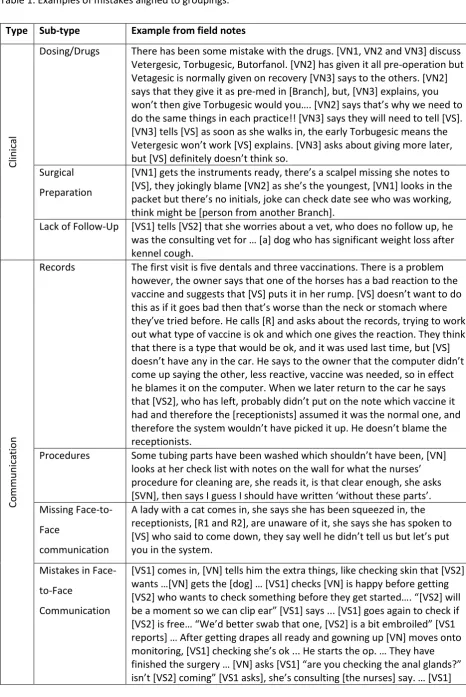
Procedures, Missing Face-to-Face Communication and Mistakes within Face-to-Face Communication. Examples of each type and sub-type are shown in Table 1.
Causes of error
In addition to identifying errors the data collected allowed exploration of underlying causes. The clinical errors rest with veterinary surgeons and veterinary nurses. In the majority of cases veterinary nurses were the propagators of the error; however as in the example given for dosing/drugs errors, errors can be attributed to the system (branch differences) as well as cognitive mistakes. In the surgical preparation example the team jokingly blame a veterinary nurse who is absent. The lack of follow-up example signifies a more serious claim of culpability; however at the time this was not reported back to the veterinary surgeon in question. Other latent systems errors in terms of workload (lack of time and requirement for more staff) were identified, as the lost item example demonstrates.
It’s just things like booking appointments at really ridiculous times when [the nurses] are manic and [the receptionists will] book like a puppy consult that takes half an hour, we don’t have half an hour… it’s mostly the receptionists booking things in or booking things in at the wrong time for stiches out… I don’t know if it’s because umm if it’s communication as such, but they don’t have the knowledge that we do… I think communication between those guys [receptionists] because like once we [the nurses] have gone at 4pm and you tell them to pass the message on, but you know that doesn’t always happen (VN).
I think the front of house staff, the reception staff and this is a generalisation because it doesn’t apply to all of them, want, quite often want a standard process that they know that they can fall back on and they can rely under every single scenario, that would make life easy and simple for them and I think they struggle with, struggle with one vet liking to do
something one way and then another vet coming in and going well I don’t do it that way (VS).
Discussions between veterinary surgeons and veterinary nurses regarding receptionists were also observed during the case studies. For example within one day, the following was included in the field notes:
[R1] leaves [the room] and [VS] and [VN1] talk about receptionists not being able to think outside the box and have to go through tick list of things… [VS] and [VN1] talk about asking for things to get done but they are not done, by the receptionists… A known client calls asking for [VN2], [R2] comes in to tell [VN2], prefixing it with “I know you’re very busy”, [VN2] is cross because there is no reason this client should have been sent specifically to her (Field notes).
Occasionally it was noted how difficult it can be for a receptionist working in a busy clinical practice. One nurse acknowledged the difficulties presented by differences between branches:
it is difficult for them [receptionists], because a lot of them work part time, a lot of them work at other surgeries as well, and it is different in each surgery they work at, so when they come here and sometimes maybe at one of the other surgeries they are not allowed to do that, but we expect them to do that here (VN).
During the case studies, suggestions for improvements to interprofessional working were made. For example, when a veterinary nurse addressed the Practice Manager regarding a letter which had gone missing, due, she suggested, to the receptionists, the Practice Manager gave the following advice:
best thing to do is to email one or two people so they take responsibility, not the whole branch as then it’s just a case of ‘oh yeah delete’ (Field notes).
In the interview with the veterinary nurse who complained about receptionists making bookings inappropriately, she was asked how the level of knowledge of receptionists could be improved so that they no longer made these errors. The veterinary nurse changed her mind from this being a purely knowledge issue to also being an issue of not reading notes, therefore communication.
Umm we do have kind of protocols where it’s all the same so cat spays come back in 10 days, bitch spays or dog castrates 3 or 10 but if it’s something weird like an eye … or a cruciate or something like that, umm because I think if they don’t check the notes, I think because there’s such a high number of receptionists, they are all part time and so you know they change over all the time so you know you tell one person and it’s a bit like Chinese Whispers... Or they forget to tell the new person (VN).
A new development at one of the practices is proposed for receptionists in the Farm Animal
department to address their lack of understanding of clinical procedures. An administrator explained the theory in her interview:
One thing that was picked up recently from a meeting was perhaps whether some of the receptionists go out on a farm visit… So they see the basics of what is done and how long things take… Because again really, they’ve got no concept as to how long things will take if they don’t know the process (Administrator).
Discussion
(2007) has pointed out, most errors like those described here are procedural and relate to failure to communicate and apply the best practice that is already known.
Within 220 hours of observations in two typical veterinary practices in the UK, 40 instances
identified as errors were noted. Except for the example regarding lack of follow up care, where the dog experienced significant weight loss, but was then treated appropriately, none of the errors had a significantly detrimental effect on a patient’s health. This was mainly due to the timely admission of the error by the perpetrator(s) to the team and the subsequent quick resort to corrective action. Thus, openness is vital. It has been demonstrated that highly reliable teams can adapt from a normal hierarchical structure (as is seen in veterinary practices) to a structure where those with the greatest experience take control in emergency situations (Reason 2000). Therefore, while it may be a
veterinary nurse identifying an error to a veterinary surgeon who then takes control, it may also be vice versa if the experience of the nurse dictates that this should be the case. In the majority of cases the negative outcome of the error was inconvenience to the client (and hence cost to the practice): for instance, a client having to arrange another visit with the veterinary surgeon and a client having to wait for test results due to a missing sample. Once identified, errors can be addressed, through apologies and compensation, and ideally changing the system to avoid recurrence, for the benefit of the patients, clients, practice and clinicians (Liang 2002).
Receptionists are central to communications with clients and other practice staff, and therefore it is perhaps not surprising that most communication errors involved reception staff. Other members of the practice team suggested that the part time nature of the receptionist’s work and the subsequent fluid receptionist team made this an area prone to errors. This would appear to be an ideal focus for a targeted systems approach to improvement. A systematic way to transfer existing notes to the next receptionist could help eliminate the “Chinese Whispers” effect that occurs at every shift change. A better induction to the practice, even for experienced receptionists, would also help emphasise management expectations of staff including appropriate booking of appointments and follow-through with clients. Clinical staff cannot expect a receptionist to have knowledge of all topics to which they are privy. As the least trained occupation, it is potentially unjust that they are blamed for some mistakes. Receptionists did undergo some training at both practices, “on the job”; however certain aspects which they were expected to know were not covered by introductory protocols. Improving the introductory training and continued development of receptionists, for example, as suggested, taking them out on farm visits, will improve their knowledge. For those interested, there is substantial literature on quality management in healthcare which could be adapted to the
A further and significant challenge for receptionists and veterinary nurses is dealing with multiple veterinary surgeons that each have their own ways of working. One veterinary surgeon complained that the receptionists could not think outside of the box and wanted them to adapt to each
individual’s preferences. This difference in cultures between clinicians and nurses has also been recognised in medicine, and is suggested as the reason why naïve application of lay views on
teamworking is unlikely to effect changes in hospital practices. Doctors value autonomy, and expect to be able to practice in their own way, whereas nursing is seen by both doctors and nurses as “collectivist and structured” around nursing protocols (Barrow and others 2015). This individualistic approach of veterinary surgeons to the variety they see in their work, in contrast to other
professional groups, has been seen as a strength (Proctor and others 2011), and is important where a unique situation requires a unique solution. However, where individualism is not beneficial to patients and may undermine the performance of the whole veterinary team it is not appropriate. In medicine, the clinician culture of autonomy has led to some resistance to checklists and standard procedures. However, in the wide range of situations in which these have been used, there have been massive benefits to patients, that in many cases have surprised those involved (Gawande 2007). The right balance needs to be achieved between individualism and conformity to protocols. The adoption of common systems by all veterinary surgeons within a practice would make a
receptionist’s life easier and is likely to reduce errors. Although, part of being a professional is having the esoteric knowledge that allows authority and autonomy in decision making (Evetts 2003), and protocols can be seen to restrict this autonomy, it is important that the effectiveness of protocols is appreciated alongside the excellence of the profession’s knowledge, skills and abilities in order to achieve ‘efficacy’ in service delivery (Sellman 2011).
A limitation of the current study is that it may have under-reported individual clinical error. By definition, this work has exposed errors that were observed within certain cases and a set time frame, and, in so doing, once more demonstrated the value of teamwork: “nobody’s perfect - but a team can be” (Jay 1980). However, unrecognised individual error either remains undetected (or is detected by chance) if it has no adverse consequences, or is detected, often by others, when adverse consequences show. Many reports in medicine and other areas take an outcomes approach, and focus on errors that have resulted in adverse consequences and claims for damages, meaning that the true incidence of error in medicine is under-reported (Graber 2013). It is now recognised that most errors with consequences are not associated with single events. They have their root in multiple factors, and each in isolation may be of little concern. Collectively, they remain an unrealised “accident opportunity” (Reason 2000). This study through observation and interviews has taken an inputs approach. It addresses the constant emergence of potential accident
opportunities and advocates their attention and reduction. It is also highlights the importance of managers and regulators recognising these as the context for “errors with consequences” when dealing with the apparent paradox that “it is often the best people who make the worst mistakes” (Reason 2000).
Error will remain a part of human activity, at all levels and in all contexts. This is the first qualitative investigation of errors in veterinary practices and as such further work is required to elaborate on its findings. In the veterinary context, animal welfare should be the primary remit. It is likely that in the modern world the number of complaints and subsequent investigations regarding patient outcomes will increase, so for good professional reasons and to avoid negative consequences, attention needs to focus on better interprofessional interactions such as communication. This has implications for both professional skills education in veterinary surgeon and veterinary nursing curricula (Kinnison and others 2011), as well as staff development in veterinary practices. The presence of error needs to be accepted within a no-blame (or ‘just’) culture which allows errors to be reported and dealt with effectively. It is hoped that this paper will promote this culture of recognition of errors and systems improvement to avoid perpetuation of poor veterinary team processes, in the interests of animals, the public and the professional service.
Acknowledgement
answering follow-up questions to aid understanding. If this work encourages better approaches to system improvements, and more research involving interprofessionalism as it affects the veterinary team, their contributions must be recognised as seminal to that.
References
BARROW, M., MCKIMM, J., GASQUOINE, S. and ROWE, D. (2015) Collaborating in healthcare delivery: exploring conceptual differences at the “bedside.” Journal of Interprofessional Care
29, 119–124.
BECK, M. and MELO, S. (2014) Quality Management and Managerialism in Healthcare: A Critical Historical Survey. Palgrave Macmillan.
BRISTOL ROYAL INFIRMARY INQUIRY (2001) BRI Inquiry Final Report Section Two Recommendations. CARE QUALITY COMMISSION (2009) Review of the involvement and action taken by health bodies in
relation to the case of Baby P.
EVETTS, J. (2003) The Sociological Analysis of Professionalism: Occupational Change in the Modern World. International Sociology 18, 395–415.
GAWANDE, A. (2007) Better. Profile Books Ltd.
GRABER, M., GORDON, R. and FRANKLIN, N. (2002) Reducing diagnostic errors in medicine: what’s the goal? Academic medicine : journal of the Association of American Medical Colleges 77, 981– 992.
GRABER, M.L. (2013) The incidence of diagnostic error in medicine. BMJ quality & safety 22 Suppl 2, ii21–ii27.
JAY, P. (1980) Nobody’s perfect – but a team can be. Observer Magazine, 26–33.
KALRA, J. (2004) Medical errors: an introduction to concepts. Clinical biochemistry 37, 1043–51. KINNISON, T., LUMBIS, R., ORPET, H., WELSH, P., GREGORY, S. and BAILLIE, S. (2011) Piloting
interprofessional education interventions with veterinary and veterinary nursing students.
Journal of veterinary medical education 38, 311–8.
KINNISON, T., MAY, S.A. and GUILE, D. (2014) Inter-professional practice: from veterinarian to the veterinary team. Journal of veterinary medical education 41, 172–8.
LIANG, B. a (2002) A system of medical error disclosure. Quality & safety in health care 11, 64–68. LINGARD, L., ESPIN, S., WHYTE, S, REGEHR, G., BAKER, G., REZNICK, R., BOHNEN, J., ORSER, B.,
observational classification of recurrent types and effects. Quality and Safety in Health Care 13, 330–334.
MCMILLAN, M. (2014) Checklists in veterinary anaesthesia : why bother ? MEDICINE, I. of (2000) To err is human: building a safer health system.
MELLANBY, R.J. and HERRTAGE, M.E. (2004) Survey of mistakes made by recent veterinary graduates. The Veterinary record 155, 761–765.
PATERICK, Z.R., PATERICK, B.B., WATERHOUSE, B.E. and PATERICK, T.E. (2009) The challenges to transparency in reporting medical errors. Journal of Patient Safety 5, 205–209.
PROCTOR, A., LOWE, P., PHILLIPSON, J. and DONALDSON, A. (2011) Veterinary field expertise: using knowledge gained on the job. Veterinary Record 169, 408–410.
RADFORD, A.., STOCKLEY, P., TAYLOR, I.., TURNER, R., GASKELL, C.., KANEY, S., HUMPHRIES, G. and MAGRATH, C. (2003) Use of simulated clients in training veterinary undergraduates in communication skills. The Veterinary Record 152, 422–427.
RCVS (2015) Disciplinary Committee hearings. http://www.rcvs.org.uk/concerns/disciplinary-hearings/. Accessed April 2, 2015.
REASON, J. (2000) Human error: models and management. BMJ (Clinical research ed.) 320, 768–770. ROSS, T.K. (2014) Health Care Quality Management: Tools and Applications. John Wiley & Sons. RUSSELL, R.L. (1994) Preparing Veterinary Students with the Interactive Skills to Effectively Work
with Clients and Staff. Journal of veterinary medical education 21, 40–43.
SELLMAN, D. (2011) Professional values and nursing. Medicine, Health Care and Philosophy 14, 203– 208.
TOMLIN, J.L., BRODBELT, D.C. and MAY, S. a (2010) Veterinary students’ understanding of a career in practice. The Veterinary record 166, 781–786.
Table 1. Examples of mistakes aligned to groupings.
Type Sub-type Example from field notes
Cli
n
ical
Dosing/Drugs There has been some mistake with the drugs. [VN1, VN2 and VN3] discuss Vetergesic, Torbugesic, Butorfanol. [VN2] has given it all pre-operation but Vetagesic is normally given on recovery [VN3] says to the others. [VN2] says that they give it as pre-med in [Branch], but, [VN3] explains, you won’t then give Torbugesic would you…. [VN2] says that’s why we need to do the same things in each practice!! [VN3] says they will need to tell [VS]. [VN3] tells [VS] as soon as she walks in, the early Torbugesic means the Vetergesic won’t work [VS] explains. [VN3] asks about giving more later, but [VS] definitely doesn’t think so.
Surgical Preparation
[VN1] gets the instruments ready, there’s a scalpel missing she notes to [VS], they jokingly blame [VN2] as she’s the youngest, [VN1] looks in the packet but there’s no initials, joke can check date see who was working, think might be [person from another Branch].
Lack of Follow-Up [VS1] tells [VS2] that she worries about a vet, who does no follow up, he was the consulting vet for … [a] dog who has significant weight loss after kennel cough. Co m m u n ica tio n
Records The first visit is five dentals and three vaccinations. There is a problem however, the owner says that one of the horses has a bad reaction to the vaccine and suggests that [VS] puts it in her rump. [VS] doesn’t want to do this as if it goes bad then that’s worse than the neck or stomach where they’ve tried before. He calls [R] and asks about the records, trying to work out what type of vaccine is ok and which one gives the reaction. They think that there is a type that would be ok, and it was used last time, but [VS] doesn’t have any in the car. He says to the owner that the computer didn’t come up saying the other, less reactive, vaccine was needed, so in effect he blames it on the computer. When we later return to the car he says that [VS2], who has left, probably didn’t put on the note which vaccine it had and therefore the [receptionists] assumed it was the normal one, and therefore the system wouldn’t have picked it up. He doesn’t blame the receptionists.
Procedures Some tubing parts have been washed which shouldn’t have been, [VN] looks at her check list with notes on the wall for what the nurses’ procedure for cleaning are, she reads it, is that clear enough, she asks [SVN], then says I guess I should have written ‘without these parts’. Missing
Face-to-Face
communication
A lady with a cat comes in, she says she has been squeezed in, the receptionists, [R1 and R2], are unaware of it, she says she has spoken to [VS] who said to come down, they say well he didn’t tell us but let’s put you in the system.
Mistakes in Face-to-Face
Communication
gets gloved up to check glands. Checks the board. He notes they do want swab from both ears, I’ve just cleaned it [VN] says, “numpty” he calls her, we had this conversation before we knocked him out! He asks what’s she’s used and will swab anyway… [VS2] comes in, she seems to think they would have waited for her, but [VS1] had said they were starting. She wanted the ear thing on slides not swabs in tubes, says she thought she had written that on the paper, never mind she says and goes to take a look at the dog…. [VS1] calls [VS2] back, says it’s a shame about the ear swab dog, [VS2] says it’s ok.
Lo
st
ite
m