Volume-7 Issue-2
International Journal of Intellectual Advancements
and Research in Engineering Computations
Experimental study on paver block using alternative Cementitious
material
R. Pradheepa
1, M.Nanthini
2, P.Thilip kumar
2, S.Vidya Bharathi
2, T.P.Vigneshwaran
21
Assistant Professor, Department of Civil Engineering, Nandha Engineering College, Tamilnadu,
India.
2
BE -Final Year, Department of Civil Engineering, Nandha Engineering College, Tamilnadu,
India
ABSTRACT
The aim of the project is to replace cement with lime sludge and rice husk ash in paver block and to reduce the cost of paver block when compared to concrete. At present 122 million tons of paddy are produced annually by India, about 20% to 22% of rice husk ash are produced. Hence the project is helpful in reducing Industrial and agricultural waste in useful way. In this project we have used lime slud ge and rice husk ash in different proportions with fine and coarse aggregates. The paver blocks were prepared and tested and the results were discussed.
Keywords:
Lime sludge, Rice husk ash, Compressive strength test, Flexural strength test, Water absorption test.INTRODUCTION
Paver block paving is versatile, aesthetically attractive, functional, and cost effective and requires little or no maintenance if correctly manufactured and used. Most concrete block paving constructed in India also has performed satisfactorily but two main areas of concern are occasional failure due to excessive surface wear, and variability in the strength of block. Natural resources are depleting worldwide at the same time the generated wastes from the industry and residential area are increasing substantially. The sustainable development for construction involves the use of Non conventional and innovative materials, and recycling of waste materials in order to compensate the lack of natural resources and to find alternative ways conserving the environment.
Lime sludge and rice husk ash used in this work was brought from Industries and agricultural areas. Currently, 2500 million tons per year, industrial and agricultural wastes are dumped.
These wastes pollutes the surrounding environment.
The replacement of lime sludge and rice husk ash for cement provides potential environment as well as economic benefits.
LITERATURE REVIEW
1. J. Jegan, B. Sriram (2018) This experimental study investigates the strength performance of paver block using granite powder by replacing cement. At 25%, 50% and 75% replacement where investigated using paver blocks. By casting zigzag paver of size 250 x 123 x 80mm with M40 grade of concrete mix where used. The following tests are conducted such as compression strength test, flexural strength test and water absorption test.
2. Swami Nathen. A. N, Robert Ravi. S (2017) Explained Indian Rice husk ash which improving the mechanical properties of concrete. Rice husk is generated from paddy. It is used as cement replacement material. Replacement of cement by RHA has become a common recommendation almost in all the international building codes. RHA is one of the Agro waste materials.
3. G. Navya, J.Venkateshwara Rao (2014) Explained the experimental investigation on properties concrete paver block with the inclusion of Natural fibers. In this experimental investigation the compressive strength, water absorption and flexural strength of paver block are determined by adding fiber at the proportion of 0.1%, 0.2%, 3%, 0.4% and 0.5% in the volume of concrete the tests are
4. Samadhan Pawar, Sackin sangde, A kshay shinde, Shreyash patil, Abhi patil, Shubhan Arthmwar (2018) Explained about the use of rubber waste and recycled paver block material in production of concrete paver block. This study investigation was to analyze the compressive strength of paver block with various wastages to the conventional concrete paver block.
5. B. Shanmugavali, K. Gowtham, P. Jeba Nalwin, B. Eswara Moorthy (2017) Explained about replace cement with plastic
waste in paver block and to reduce the cost of paver block compared to convention concrete paver blocks. The following tests are done, compressive strength and oven test.
6. Vijay pal, Er. R. P. mahal (2016) Explained the study of effect of lime sludge and Silica fume on strength of concrete where at the ratio of lime sludge is about 5%, 10%, 15% which is attained acceptable strength within 7 and 28days.
OBJECTIVES OF STUDY
To identify various industrial waste suitable for utilization in cement replacement.
To assess the compatibility of industrial solid waste as raw material/blending material/admixture.
To determine the compressive strength, flexural strength, and water absorption of paver block after 7 and 28days.
MATERIAL PROPERTIES
Properties of Lime Sludge
Lime sludge is generated from paper, acetylene, sugar, fertilizer, sodium chromate and soda ash industries. Approximately 4.5 million tons of sludge in total are generated annually from these industries.
Fig.No.4.1 Lime Sludge
All the lime sludge other than carbide sludge contains lime as calcium carbonate. The carbide sludge from acetylene industry mainly contains lime as calcium hydroxide. These sludge essentially contain lime as major constituent,
considerably depending upon the composition of limestone used in the parent process.
percent SO
3, upto 1.5 percent P2O5 and upto 2 percent fluoride as major contaminants. Similarly paper, sugar and chromium sludge contain free alkalies upto 2 percent. The chromium sludge and carbide sludge in addition also contain chromium upto 10 percent and chloride upto 2 percent respectively. The presence of these deleterious constituents/contaminants restricts their bulk utilization in making cement and related building materials.
Detailed investigations were carried out on the utilization of lime sludge from various industries. The study has revealed that sludge from paper industry can be utilized upto 74 percent (dry basis) as a component of raw mix for the manufacture of cement clinker. In addition to it around 30 percent (dry basis) lime sludge can also be utilized for the manufacture of masonry cement. Due to the presence of deleterious constituents in higher
quantities carbide sludge can be used only upto 30 percent whereas level of utilization for other sludge could reach to only 10 percent in the manufacture of cement clinker.
PROPERTIES OF INDIAN RICE
HUSK ASH
RHA is a very fine material. The average particle size of RHA ranges from 5 to 25μm. RHA is a very rich in silica content. Silica content in RHA is generally more than 80-85%. RHA to be used as pozzalona in cement concrete, it satisfies requirements for chemical composition of pozzolonas as per ASTM C618. The combined proportion of silicon dioxide, aluminium oxide and iron oxide in the ash should not be less than 70% and LOI should not exceed 12% as stipulated ASTM requirements.
Fig.No.4.2 Rice Husk Ash
PHYSICAL PROPERTIES OF INDIAN
RHA
Mean particle size - 63.8μm Specific gravity 2.06 Fineness passing 45μm
COMPONENTS OF
PROPORTIONING
Grade of concrete: M20
Type of cement: OPC 53 grade
Maximum water cement ratio: 0.6 % - IS 456-2000.
Type of aggregate: 8 to 12mm aggregate.
EXPERIMENTAL METHODOLOGY
Table.1. Mix proportion
S.No Mix Cement (%) Sludge (%) Ash (%)
1. CS 100% 0 0
2. A1 90% 3% 7%
3. A2 85% 5% 10%
4. A3 80% 10% 10%
Test Specimen and testing procedures
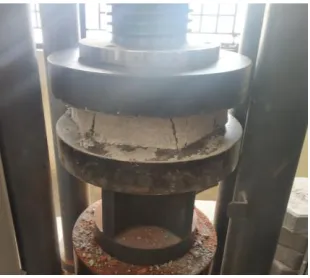
For compressive strength test, water absorption and flexural strength test paver block of dimensions 120x120x60 mm were casted. The samples were cured in water at 7 and 28 days. For determining the compressive strength samples
were tested in compressive testing machine and flexural strength test was conducted using universal testing machine. The compressive, flexural and water absorption tests are conducted as per IS: 15658:2006.
Fig. No.5.1 Compressive strength test
EXPERIMENTAL RESULT
Compressive strength
The compressive strength values of the standard concrete paver block & paver block with admixtures values are shown in table.2.
Table.No.2 Compressive strength at 7 and 28 days for Paver blocks without and with admixtures S.NO Mix 7Days strength (N/mm2) 28Days strength (N/mm2)
1. CS 12.53 25.46
2. A1 23.07 27.6
3. A2 18.69 27.07
4. A3 18.07 23.0
Fig.No.6.1.1 Compressive Strength Graphical Representation
From fig.3.it is observed that the compressive strength of concrete paver block is increasing with the increase in admixture content compared to standard concrete paver block at 7and 28 days. It is observed that at mix A1, 3% of sludge and 7% of rice husk ash attain maximum strength.
Water absorption
The water absorption values of the concrete paver blocks at the age of 7 and 28days are determined and the results were presented in table.3.
Table.No.3. Water absorption at 7and 28 days for Paver blocks without and with Admixtures
S.No Mix 7days Strength (%) 28days Strength (%)
1. CS 4.02 3.83
2. A1 3.55 2.04
3. A2 3.98 2.19
4. A3 3.73 2.98
0 10 20 30
cs A1 A2 A3
COM
PRE
SS
IVE
STRE
N
GTH
(N
/m
m
2)
MIX PROPORTION
7 DAYS
Fig.No.6.2.1Water absorption Graphical Representation
From fig.4 it is observed that the admixture is increased in the mix of A2, 5% of ric10 husk ash and 5% of lime sludge. Compared to the standard paver block at the age of 7and 28 days respectively.
Flexural strength
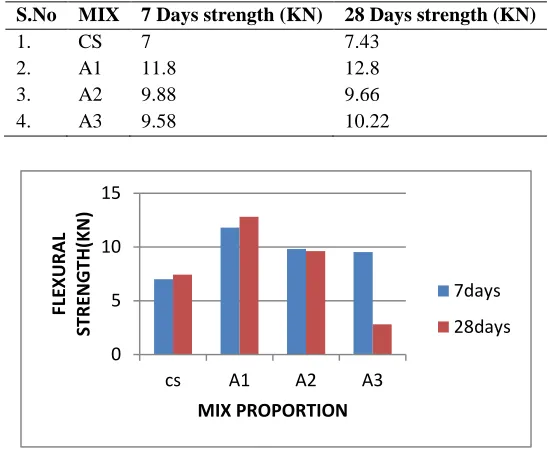
The flexural strength values of the standard concrete paver block & paver block with admixture values are shown in table.4.
Table .No.4 Flexural strength at 7 and 28 days for Paver blocks without and with admixtures
S.No MIX 7 Days strength (KN) 28 Days strength (KN)
1. CS 7 7.43
2. A1 11.8 12.8
3. A2 9.88 9.66
4. A3 9.58 10.22
Fig.No.6.3.1 Flexural Strength Graphical Representation
From fig.5 it is observed that the flexural strength of concrete paver block is increasing with the increase in admixture content compared to standard concrete paver block at 7and 28days. It is observed that increasing strength at mix of A1
CONCLUSION
In this project, concrete mix containing lime sludge and rice husk ash as partial replacement of cement was prepared and
0 1 2 3 4 5
CS A1 A2 A3
WA
TE
R
A
B
SORPTIO
N
(%
)
MIX PROPORTION
7DAYS
28DAYS
0 5 10 15
cs A1 A2 A3
FLE
X
URAL
STRE
N
GTH
(K
N
)
MIX PROPORTION
7days
strength, flexural strength and water absorption test.
Compressive strength of the paver block increased by adding rice husk ash and lime sludge in optimum content.
The inclusion of the admixtures are lime sludge 10%, 15% and 20% where as rice husk ash are 20%, 15% and 10%.
These blocks will permit the rain water into the ground.
The reuse of lime sludge and rice husk ash reduces the disposal of industrial and agriculture waste.
REFERENCE
[1]. Vishal Kumar “utilization of waste material in concrete paver block” International Journa l for Research in Applied Science & Engineering, 4, 2016, 3.98 ISSN: 2321-9653
[2]. Poonam Sharma. Ramesh kumar Batra. Cement Concrete Paver Blocks for Rural Roads. International Journal of Current Engineering and Scientific Research, 3(1), 2016, 114-121.
[3]. Cement and Concrete Institute, the Manufacture of Concrete Paving Blocks, Midrand, South Africa, 2001.
[4]. “The Use of Fly Ash and Lime Sludge as Partial Replacement of Cement in Mortar” VaishaliSahu*, V.Gayathri, International Journal of Engineering and Technology Innovation, 4(1), 2014, 30-37.
[5]. “Study of Concrete Involving Use of Waste Paper Sludge Ash as Partial Replacement of Cement” Sajad Ahmad, M.Iqbal Malik, Muzaffar Bashir Wani, Rafiq Ahmad IOSR Journal of Engineering (IOSRJEN) e-ISSN:2250-3021, p-ISSN: 2278-8719 3(1), 2013, 06-15.
[6]. Ganesan, K., K.Rajagopal, 2008, Rice Husk Ash Blended Cement: Assessment of Optimum level of replacement for Strength and Permeability properties of concrete. Construction and Building materials, 22(8), 2008, 1675-1683.
[7]. Malhotra, V.M, Fly ash, slag, Silica fume, and Rice Hush Ash in concrete: A review, concrete international. 15(4), 1993, 2-28.