Volume-7 Issue-1
International Journal of Intellectual Advancements
and Research in Engineering Computations
A study on identifying problems faced by the respondents in adulteration
of foods with reference to Erode
N.Bharanitharan, R.Gobalakrishnan
1
ndMBA Nandha Engineering College
ABSTRACT
Adulteration in food has been a concern since the beginning of civilization, as it not only decreases the quality of food products but also results in a number of ill effects on health. Authentic testing of food and adulterant detection of various food products is required for value assessment and to assure consumer protection against fraudulent activities. Through this review we intend to compile different types of adulterations made in different food items, the health risks imposed by these adulterants and detection methods available for them
INTRODUCTION
Food is the basic necessity of life. One works hard and earns to satisfy our hunger and relax (enjoy) later. But at the end of the day, many of us are not sure of what we eat. Often, we invite diseases rather than good health .Food adulteration is an act of intentionally debasing the quality of food offered for sale either by the admixture or substitution of inferior substances or by the removal of some valuable ingredient. Food adulteration takes into account not only the intentional addition or substitution or abstraction of substances which adversely affect nature, substances and quality of foods, but also their incidental contamination during the period of growth, harvesting, storage, processing, transport and distribution.
Adulterant means any material which is or could be employed for making the food unsafe or sub-standard or mis-branded or containing extraneous matter; Food is adulterated if its quality is lowered or affected by the addition of substances which are injurious to health or by the removal of substances which are nutritious.
STATEMENT OF THE PROBLEM
Many products used in everyday cooking, such as cottage cheese and clarified butter, are adulterated. Colouring agents in spices are also posing problems. The use of carbide to make fruit ripen faster has created a number of health hazards. The youth who enjoy the street food are mostly at risk .Young and old are the most affected .Children and elderly people are the most vulnerable to these toxins in food. Although some people say that in a country where 40 percent of the population lives below the poverty line, there should be less stress on adulterated food and more on the fact that people should have enough food to eat [1].
OBJECTIVES OF THE STUDY
To identify the Demographic Profile of Respondents.
To rank the Problems faced by the Respondents due to food adulteration.
SCOPE OF THE STUDY
To study some of the common food adulterant’s in food stuff’s
Adulteration of various substances in food
LIMITATIONS OF THE STUDY
Many Respondents neglected to respond to the Survey in their Busy Schedule.
Many Respondents found it difficult to Rank the Problems faced by them, as they are equally facing all the problems.
As the Questionnaire is based on food adulteration the respondents not ready to share some secrets
LITERATURE REVIEW
1. Sharifa Nasreen ., Tahmeed Ahmed the
extent of food adulteration was high enough to warrant further action to control the situation. Collection procedure of food samples has the potential for based estimation and therefore, undermines the validity of the extent .a systematic procedure of random food sample collection incorporated in surveillance for food adulteration could give an accurate picture of situation.
2. Dr.Sitaram, the survey about the identifying
common food adulterants . food adulteration is growing menace that unscrupulous traders and manufacture all over the world indulge in to exploit gullible consumers to make quick and easy money.
3. Ameeta Sharma, Neha, Batra, Anjali Grag
, AnkitaSaxena -Food Adulteration from the review and discussion the food items can the affect on health without our knowledge. Adulteration can be prevented by few altering steps in our society. While purchasing food items we have to check whether it is toxic. Non adulterated food is necessary to make sure that such food do not cause and health problem.
RESEARCH METHODOLOGY
Research Design
A Master plan that specifies the method and procedures for collecting and analysing needed information.
Sample Design
Sampling is the process of selecting a sufficient number of elements from the population. A Sample Design is a definite plan for obtaining a sample from the sampling frame. It refers to the technique or the procedure the researcher would adopt in selecting some sampling units from which inferences about the population is drawn [2].
Non-Probability Sampling
Non-Probability sampling is a sampling technique where the samples are gathered in a process that does not give all the individuals in the population equal chances of being selected.
Convenience Sampling
Convenience sampling (also known as Availability Sampling) is a specific type of non-probability sampling method that relies on data collection from population members who are conveniently available to participate in study [3].
Size of the Sample
The Sample size is 50. (Employee - 14, business- 18, others- 18)
DATA COLLECTION METHOD
Primary Data
These are data which are collected for the first time directly by the Researcher for the Specific study undertaken by him. In this research primary data are collected directly from the Respondent by using Questionnaire cum Enumeration Method.
Secondary Data
STATISTICAL TOOLS USED
To analyse and interpret collected data the following simple percentage and ranking were used.
Simple Percentage Analysis
To analyse and interpret collected data the following simple percentage and ranking were used.
FORMULA
Number of respondents
Percentage = ---X 100
Total number of respondents
Henry Garrett Ranking
Garrett’s ranking technique to find out the most significant factor which influences the respondents; Garrett’s ranking technique was used. As per this method, respondents have been asked
to assign the rank for all factors and the outcomes of such ranking have been converted into score value with the help of the following formula: Percent Position = 100 (Rij – 0.5) Nj Where Rij = Rank given for the ith variable by jth respondents Nj= Number of variable ranked by jth respondents.
DATA ANALYSIS
The Respondents participated in the research are from diversified background with age group, gender and occupation.
Table No 1: Demographic Profile of the Respondents|
Details of the Respondents No. of. Respondents Percentage
Age 18-25 Years 9 18
25-35 Years 22 44
35- 45 Years 15 30
Above 45 Years 4 8
Total 50 100
Gender Male 47 94
Female 3 6
Total 50 100
Occupation Employee 14 28
Business 18 36
Others 18 36
Total 50 100
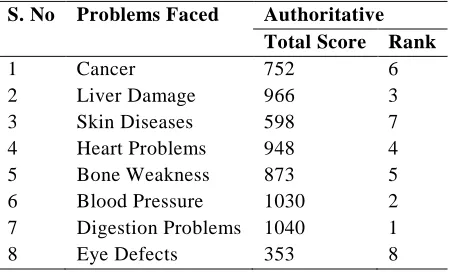
Table No 3: Problems faced by the respondents in food adulteration revealed through Henry Garett
Ranking Technique
S. No Problems Faced Authoritative
Total Score Rank
1 Cancer 752 6
2 Liver Damage 966 3
3 Skin Diseases 598 7
4 Heart Problems 948 4
5 Bone Weakness 873 5
6 Blood Pressure 1030 2
7 Digestion Problems 1040 1
8 Eye Defects 353 8
INTERPRETATION
From this study, it is found that from the table it is evident that, Digestion Problem is ranked as no.1 with the total score of 1040, Blood Pressure is ranked as no.2 with a total score of 1030, liver Damage is ranked as no.3 with the total score of 966.
FINDINGS
1. Digestion Problem is ranked as no.1 with the total score of 1040,
2. Age Group of the 44% of the respondents fall under the category of 25 – 35 years,
3. 36% of respondents fall under the category of Business and another 36% of respondents fall under the category.
4. 94% of the respondents fall under the gender group of Male.
5. From this content “Digestion Problem’’ is ranked as no .1 with the total score of 1040. 6. Blood pressure is ranked as no. 2 with the total
score of 1030.
7. Liver Damage is ranked as no. 3 with the total score of 966.
SUGGESTIONS
a. Food Adulteration may be avoided to have a healthy environment
b. Organic food items can be used to protect the future generation.
c. The farmers can cultivate natural items, so that they can set a role model for others.
CONCLUSION
The present study reveals that some amount of adulterant was found in the samples of coriander powder, chilli powder and salt. We can summarize that the adulteration which is been added in the food items can cause tremendous affect on health without our knowledge. Adulteration can be prevented by few altering steps of our society. While purchasing food items, selection of wholesome and non-adulterated food is necessary to make sure that food do not cause and health problems. The consumer should avoid buying food places which do not maintain proper hygiene conditions. Both local and branded food stores should be inspected by government bodies. The above general consciousness is simple and easy to initiate for our healthy life. If we tend to actively participate in these changes than we can bring about a healthy and non venturous future for the upcoming generations.
REFERENCES
[1]. Ameeta Sharma, Neha,Batra, Anjali Grag , AnkitaSaxena – Department of Biotechnology, The IIS University, Jaipur, Rajasthan, India, International Journal for Research in Applied Science and engineering Technology ( IJRASET) 2017.