in University Learning Environments
Asma Md Ali
(
Doctor of Philosophy
)
2013
University Learning Environments
A thesis submitted in fulfilment of the requirements for the degree of
Doctor of Philosophy
Asma Md Ali
B.IT. (Multimedia Systems) (Hons),
M.IT. (E-Business)
School of Business Information Technology and Logistics
RMIT University
Melbourne, Victoria, Australia
ii
I certify that except where due acknowledgement have been made, the work is that of the author; the work has not been submitted previously, in whole or in part, to qualify for any other academic award; the content of the thesis is the result of work which has been carried out since the official commencement date of the approved research program; and any editorial work carried out by a third party is acknowledge.
Signed :
Name : Asma Md Ali
iii
Studying a PhD is definitely a complex process. Initially the concept of research does not seem so very difficult but to get a PhD is not easy. Although a PhD journey seems solitary, it is a team project with many hands and souls along the way. I would like to express my sincere gratitude to the team.
I am grateful to Associate Professor Dr Joan Richardson, my primary supervisor, for being available to review my work, for helping me to restructure my thoughts, for providing keen insights which have enhanced my understanding of research, and for support throughout the academic journey. I also thank Associate Professor Dr Peter Macauley, my second supervisor, for advice on career and life, and for the review of my thesis submissions.
Thank you to the Ministry of Higher Education, Malaysia, and the International Islamic University Malaysia, for the financial scholarship. I also thank my colleagues at KICT and the officers at MSD; and the research office staff at RMIT SBITL, SGR, SBGR and the libraries. I appreciate the people who gave their time to participate in the interviews. I also gratefully acknowledge friends and mentors in SBITL who have shared much of my journey with me. I would also like to thank the editors and the paper reviewers.
My heartfelt thanks to my dearest husband and my children. I thank my husband, Fakhrullah, for his faith and forgiveness, for attending to the baby, the kids and things, and for being a good motivator. I thank my children, Noor Ain, Omar Muaz and baby Ilham Hafiz, who were understanding when Ummi was too busy. Thank you for welcoming me when I get home. Thank you for cheering me up. Thank you to my dearest mama, Masniyati Salikin, and papa, Md Ali Othman. Thank you for the love, sacrifices and prayers. Thanks to family, relatives and friends for support, well wishes and inspiration during these years.
It has been a real pleasure to work collaboratively with a great team. I thank you all for the encouragement and support in helping me to complete this thesis. Although a great deal of assistance has been received from many people, I must claim responsibility for any and all mistakes and shortcomings in this thesis.
iv
The following papers were written as part of this research:
Asma Md Ali, Joan Richardson. Web Interactive Multimedia Technology: State of the Art in Jasni Mohamad Zain, Wan Maseri Binti Wan Mohd, Eyas El-Qawasmeh (Eds.), Part III Communications in Computer and Information Science 181 Springer 2011, ISBN 978364 22220 23, p.41-53.
Asma Md Ali, Joan Richardson. Web Interactive Multimedia Technology Evolution in Jianhong Zhou(Ed.), ASME Press 2011, ISBN 9780791859735.
Asma Md Ali, Joan Richardson “Using Web Interactive Multimedia Technology: Several Approaches” paper submitted for the International Journal of Learning on April 2012.
Asma Md Ali, Joan Richardson, “Web Interactive Multimedia Technology: Implementation from Two Perspectives”, International Journal on New Computer Architectures and Their Applications (IJNCAA) 2(1): 154-166, The Society of Digital Information and Wireless Communications (ISSN: 2220-9085)2012.
Asma Md Ali, Joan Richardson, “Web Interactive Multimedia Technology: State of the Art" International Conference on Software Engineering and Computer Science (ICSECS) 2011, Kuantan, Malaysia,Proceedings,Paper 342.
Asma Md Ali, Joan Richardson, “Web Interactive Multimedia Technology Evolution” International Conference on Computer Engineering and Technology (ICCET) 2011, Kuala Lumpur, Malaysia.Proceedings.Paper T10049.
Asma Md Ali, Joan Richardson, “Web Interactive Multimedia Technology Implementation: A University Context” UK Academy for Information Systems (UKAIS) International Conference 2012,Proceedings,Paper 37.
Asma Md Ali, Joan Richardson, Peter Macauley, Evaluation on Web Interactive Multimedia Technology, Poster - Presented at RMIT Business Research Week 2011, RMIT University, Melbourne, Australia.
Asma Md Ali, A Study on Web Interactive Multimedia Technology – Presented at ACIS 2009 Doctoral consortium, Monash University, Melbourne, Australia.
v
LIST OF FIGURES VIII
LIST OFTABLES IX
GLOSSARY OF TERMS,ACRONYMS AND ABBREVIATIONS X
ABSTRACT 1
1 INTRODUCTION 2
1.1 Background and Context 6
1.2 Aim and Significance 13
1.3 Structure of the Thesis 16
2 LITERATURE REVIEW 18
2.1 Web Interactive Multimedia Technology Affordances 20
2.1.1 The History of Affordance Capability 22
2.1.2 Emerging Technologies Use in Higher Education 23 2.1.3 Web Interactive Multimedia to Improve Lectures 26 2.1.4 Organisational and Academic Implementation of Web 2.0 Technology 30
2.2 Technology Adoption Issues in Higher Education 32
2.2.1 Reliability of the Technology 34
2.2.2 Change to Suit New Generation of Students 34
2.2.3 Direction (Guide) for Implementation 36
2.2.4 Time for Learning to Use Emerging Technology 37
2.2.5 Incentive (Organisational Support) 37
2.2.6 Attitude towards Emerging Technology 38
2.2.7 Information Technology Skills or Proficiency 39
2.3 Web Interactive Multimedia Technology Adoption in Learning 39
2.3.1 Theory of Reasoned Action (TRA) - Fishbein and Ajzen (1981) 43 2.3.2 Theory of Planned Behaviour (TPB) - (Ajzen, 1985) 44
vi
2.3.6 Web 2.0 Augments Delivery of Well Designed Curricula 49
2.4 Design Science Research in Information Systems 53
2.4.1 Guidelines for the Use of a Design Science Research Approach 58 2.4.2 A Paucity of Design Science Research Applications 62
2.5 Design Science Research Framework 64
2.5.1 Design Science Research Model Components 65
2.5.2 Solution Technology Invention 67
2.5.3 Elluminate – Web Interactive Multimedia Technology Affordances 69
2.5.4 Naturalistic Evaluation 70
2.5.5 Theory Building 71
2.5.6 Web Interactive Multimedia Technology In Learning 72 2.5.7 Development of the Research Conceptual Framework 75
2.6 Summary 76
3 METHODOLOGY 78
3.1 Design Science Research Approach 79
3.1.1 Elluminate Affordances Use from an Information Systems Perspective 80 3.1.2 Design Science Research Model – Solution Technology Invention, Theory Building and Naturalistic
Evaluation 82
3.1.3 The Research Process 83
3.2 Case study 86 3.3 Interpretive Research 87 3.4 Qualitative Research 88 3.5 Research Design 90 3.5.1 Participants 91 3.5.2 Interviews 92 3.5.3 Observation 95 3.5.4 Document Analysis 95 3.5.5 Thematic Analysis 96
vii
3.7 Ethical Considerations 103
3.8 Summary 104
4 DATA AND ANALYSIS 105
4.1 Overview 105
4.1.1 Solution Technology Invention – Delivery Strategies and Constraints 105 4.1.2 Naturalistic Evaluation – Stakeholders’ Evaluation 106 4.1.3 Theory Building – Learning Constructive Alignment 106 4.1.4 Elluminate as an Exemplar of Web Interactive Multimedia Technology 107
4.2 Web Interactive Multimedia Technology in Subjects Case Studies 107
4.3 A Neuroscience Postgraduate Subject (Case 1) 110
4.3.1 Case 1 Neuroscience – Learning Environment 110 4.3.2 Case 1 Neuroscience – Student Class Size 111
4.3.3 Case 1 Neuroscience – Why Elluminate? 111
4.3.4 Case 1 Neuroscience – Solution Technology Invention: Delivery Strategies and Constraints 112 4.3.5 Case 1 Neuroscience – Elluminate Affordances 114 4.3.6 Case 1 Neuroscience – Naturalistic Evaluation: Stakeholders’ Evaluation 117 4.3.7 Case 1 Neuroscience – Theory Building: Learning Constructive Alignment 118 4.3.8 Case 1 Neuroscience – Web Interactive Multimedia Technology in Learning 120
4.3.9 Case 1 Neuroscience– Conceptual Model 123
4.4 A Postgraduate Business Subject (Case 2) 126
4.4.1 Case 2 Business – Learning Environment 127
4.4.2 Case 2 Business – Student Class Size 127
4.4.3 Case 2 Business - Why Elluminate? 128
4.4.4 Case 2 Business – Solution Technology Invention: Delivery Strategies and Constraints 128 4.4.5 Case 2 Business – Naturalistic Evaluation:- Stakeholders Valuation 131 4.4.6 Case 2 Business – Theory Building: Learning Constructive Alignment 132 4.4.7 Case 2 Business – Web Interactive Multimedia Technology in Learning 133
4.4.8 Case 2 Business – Conceptual Model 136
viii
4.5.3 Case 3 Computing - Why Elluminate? 139
4.5.4 Case 3 Computing - Solution Technology Invention: Delivery Strategies and Constraints 140 4.5.5 Case 3 Computing - Naturalistic Evaluation: Stakeholders Evaluation 144 4.5.6 Case 3 Computing - Theory Building: Learning Constructive Alignment 144 4.5.7 Case 3 Computing - Web Interactive Multimedia Technology in learning 145
4.5.8 Case 3 Computing – Conceptual Model 146
4.6 A Postgraduate Consultancy Subject (Case 4) 148
4.6.1 Case 4 Lactation Consultancy - Learning Environment 148 4.6.2 Case 4 Lactation Consultancy - Student Class Size 149 4.6.3 Case 4 Lactation Consultancy - Why Elluminate? 149 4.6.4 Case 4 Lactation Consultancy - Solution Technology Invention: Delivery Strategies and Constraints
149
4.6.5 Case 4 Lactation Consultancy - Naturalistic Evaluation - Stakeholders Evaluation 152 4.6.6 Case 4 Lactation Consultancy - Theory Building: Learning Constructive Alignment 153 4.6.7 Case 4 Lactation Consultancy - Web Interactive Multimedia Technology in Learning 154 4.6.8 Case 4 Lactation Consultancy – Conceptual Model 156
4.7 Web Interactive Multimedia Technology in Subjects Stakeholders’ Analysis 157
4.7.1 Solution Technology Invention – Delivery Strategies and Constraints 158 4.7.2 Naturalistic Evaluation – Stakeholders’ Evaluation 162 4.7.3 Theory Building – Learning Constructive Alignment 162
4.8 Summary 163
5 DISCUSSION 165
5.1 Solution Technology Invention – Delivery Strategies and Constraints 166
5.1.1 Affordance Use and Class Management 171
5.1.2 Affordance Related Communication Constraints 175
5.1.3 Technical Infrastructure 177
5.1.4 People Initiative 179
5.2 Naturalistic Evaluation – Stakeholders’ Evaluation 181
5.2.1 Useful for Learning 182
5.2.2 Easy-to-use 185
ix
5.3 Theory Building – Learning Constructive Alignment 194
5.3.1 Design and Planning to Meet Intended Learning Objectives 194
5.3.2 Affordance Use Summary 198
5.4 Guidelines for Implementing Technology Affordances in Learning Activities 201
5.5 Lessons Learnt From This Study 205
5.5.1 Design Science Research Reflection 205
5.6 Summary 207
6 CONCLUSION 208
6.1 Web Interactive Multimedia Technology in University Learning Environments0 208
6.2 The Guidelines to Subject Design 213
6.3 Contributions of the Study 214
6.4 Suggestions for Future Study 217
REFERENCES 219
APPENDIXI: Ethics Approval 236
APPENDIXII: Sample of Invitation to Participate 237 APPENDIXIII: Sample of Participant Consent Form 239
x
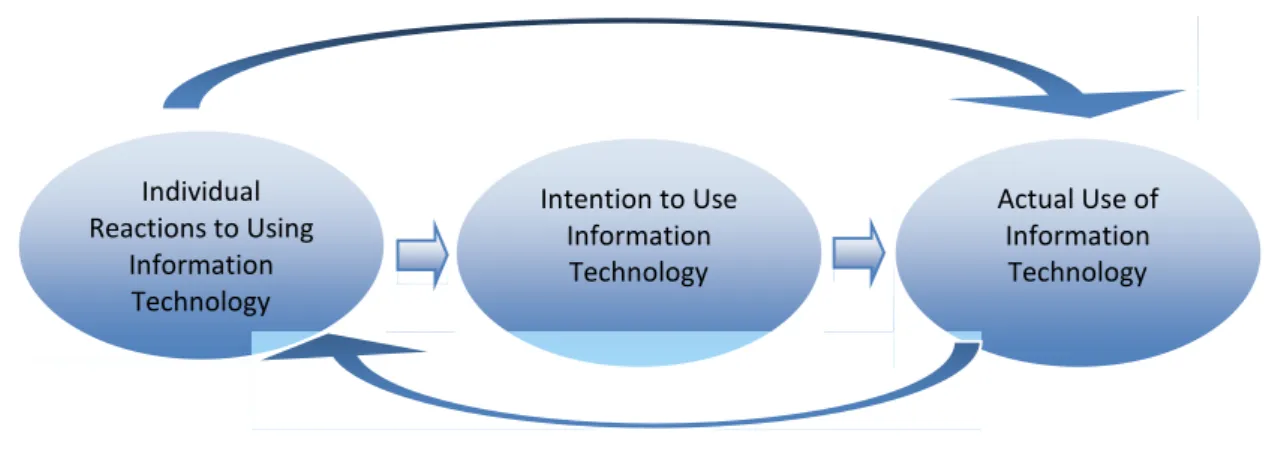
Figure 2.1: Basic concepts underlying stakeholder acceptance model (adopted from Masrom & Hussein 2008) 43
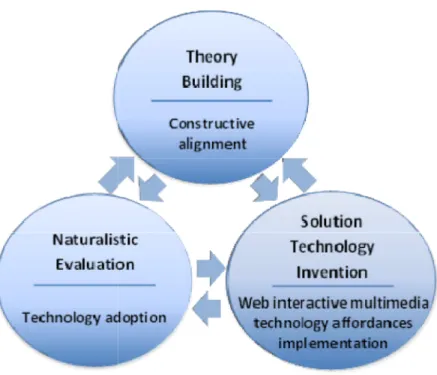
Figure 2.2: Research conceptual model (adapted from Venable 2006a) ...76
Figure 3.1: Research design (adapted from Creswell 2009; IIvari & Venable 2009; Myers 2009; Venable 2006a; Yin 2009)...91
Figure 3.2: Interview broad topic areas based on the research conceptual model ...93
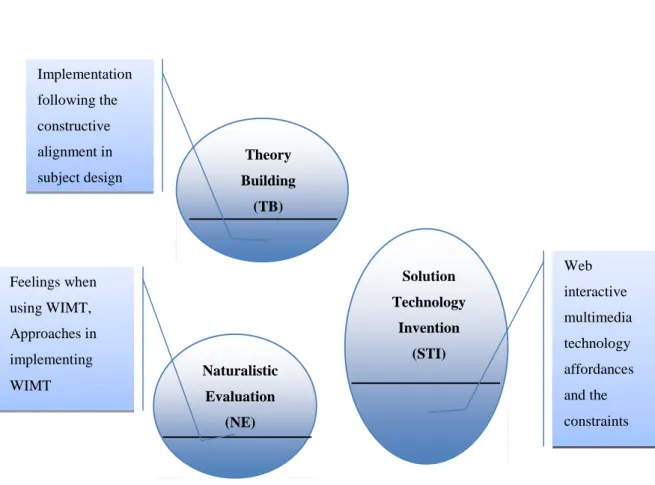
Figure 3.3: Themes constructed from the interview data based on the research conceptual model...97
Figure 3.4: Development of a theme in Solution Technology Invention ...99
Figure 4.1: Case 1 Neuroscience – A sample of constructional alignment...118
Figure 4.2: Case 1 model ...125
Figure 4.3: Case 2 Business - The design of the learning activities and assessment alignment ...132
Figure 4.4: Case 3 Computing - Aligning learning activities and assessment to intended learning outcome...145
Figure 4.5: Case 4 Consultancy - Aligning learning activities and assessment to intended learning outcomes or objectives ...154
Figure 4.6: Stakeholders’ relationships...158
xi
Table 2.1: Summary of five technology theories in the study of technology adoption ... 49
Table 2.2 : Summary of the learning theories (adapted from Ally 2008; Ertmer & Newby 1993) ... 51
Table 2.3: The five types of theory in Information Systems (IS) (adapted from Gregor 2006) ... 55
Table 2.4: The artefact and output in Design Science Research (adapted from Hevner et al. 2004; March & Storey 2008; Vaishnavi & Kuechler 2008) ... 57
Table 3.1: A concise conceptual model ... 83
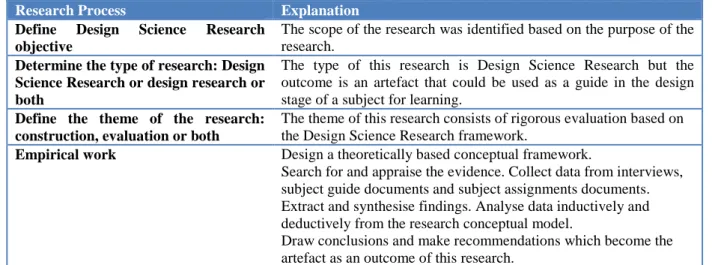
Table 3.2: The summary of this research process (adapted from Alturki, Gable, & Bandara 2011a) ... 85
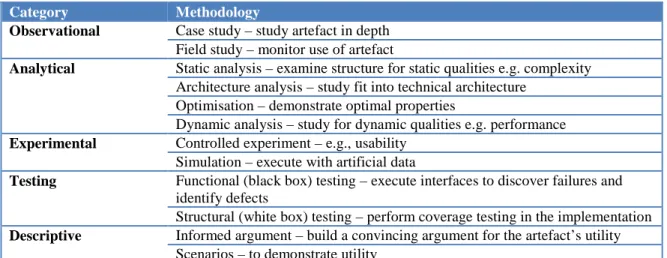
Table 3.3: Design evaluation methods (Hevner et al. 2004)... 86
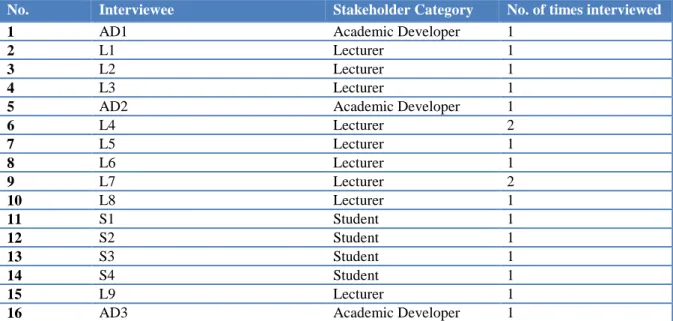
Table 3.4: The stakeholders’ categorisation and reference... 92
Table 3.5: The aim in each domain of the research conceptual model for categories development... 98
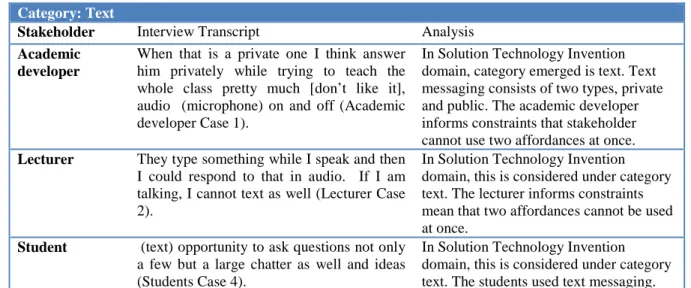
Table 3.6: Applying the text component to all three stakeholders ... 100
Table 4.1: Summary of Elluminate affordances used in learning and teaching activities in Case 1 ... 116
Table 4.2: Summary of web interactive multimedia technology affordances for learning in Case 1 ... 126
Table 4.3: Summary of Elluminate affordances used in learning and teaching activities in Case 2 ... 130
Table 4.4: Summary of web interactive multimedia technology affordances for learning in Case 2 ... 137
Table 4.5: Summary of Elluminate affordances used in learning and teaching activities in Case 3 ... 143
Table 4.6: Summary of web interactive multimedia technology affordances for learning in Case 3 ... 147
Table 4.7: Summary of Elluminate affordances used in learning and teaching activities in Case 4 ... 151
Table 4.8: Summary of web interactive multimedia technology affordances for learning in Case 4 ... 157
Table 4.9: Identified themes from interviews... 159
Table 5.1: Web interactive multimedia technology affordances guidelines ... 203
xii
Term Definition
Academic Developer
The university staff member who supports lecturers’ use of Elluminate for learning and teaching activities. An academic developer’s role is described as “to enhance your teaching with practical tips and assistance from colleagues working within the different schools on a range of topic…provides a range of support services to Schools, leads the continuous improvement in the design and delivery of programs and courses, and manages a range of strategic projects aimed at researching, contextualising and evaluating learning and teaching initiatives and activities” (RMIT University 2013a).
Affordances An affordance is the discovery of possible actions in an interface. It refers to the qualities of an object or environment which allow an individual to perform an action. In this thesis, affordances refer to the features of Elluminate or other web interactive multimedia technology which are used by stakeholders to carry out tasks in learning activities. The term affordance has several meanings in the literature and there is no agreed understanding (Brown 2004). The word affordance was first used by J J Gibson, a perceptual psychologist, in 1966. The author later claimed: “The verb to afford is found in the dictionary, but the noun affordance is not. I have made it up. I mean by it something that refers to both the environment and the animal in a way that no existing term does” (Gibson 1979, p. 127).
Artefact A construct, model, method or instantiation that could contribute to research knowledge (Hevner et al. 2004; March & Storey 2008). An artefact is the outcome of research in Design Science Research in Information Systems.
Blended learning environment/ blended learning
Mixed web and face-to-face interaction in a traditional classroom environment. “Blended environment” in this study refers to the combination of virtual and physical spaces for learning which is different than traditional classroom where the students and lecturer existed physically in the same room, the use of web technology in the classroom.
Elluminate An exemplar of a web interactive multimedia technology. Elluminate (also referred to as e-Live or Elive) is web conferencing software which can be used in real-time for collaborative activities. Elluminate enables lecturers and students to have real-time discussions while viewing MS PowerPoint slides or websites.
Framework “A structure made of parts joined to form a frame; esp. one designed to enclose or support; a frame or skeleton… In extended use: an essential or underlying structure; a provisional design, an outline; a conceptual scheme or system...an essential or underlying structure; a provisional design, an outline; a conceptual scheme or system” (Oxford English Dictionary).Frameworks can be represented in table format. Frameworks are also portrayed in diagrammatic form and are often referred to as models (Dix 2007).
Information Systems
A field of study that incorporate technology, societies and organisations (Oinas-Kukkonen 2010). Information Systems promotes multidisciplinary research as it involves the human and technical domains within one context.
Interactive Web technology that is non-static, dynamic and responsive to user input. For example, technology that enables audio for a user to be able to talk to another user on the web allows interaction between the users.
Learning Activities
The activities which are stated in a subject guide prepared before a course starts to provide the scope of the subject for lecturers to design subject delivery and to guide the students, who are expected to do more self-directed learning in higher education institutions than in schools.
xiii
research and publish in relevant academic forums, while engaging in collaborative research projects with other members of the school” (RMIT University 2013b).
Model “A representation of structure, and related senses…A summary, epitome, abstract; the argument of a literary work….A simplified or idealised description or conception of a particular system, situation, or process, often in mathematical terms, that is put forward as a basis for theoretical or empirical understanding, or for calculations, predictions, etc; a conceptual or mental representation of something…Mathematical model n. a description or representation of something conceived or presented in mathematical terms…a summary, epitome, abstract; the argument of a literary work…a simplified or idealised description or conception of a particular system, situation, or process, often in mathematical terms, that is put forward as a basis for theoretical or empirical understanding, or for calculations, predictions, etc; a conceptual or mental representation of something” (Oxford Dictionaries).
Multimedia The combination of two or more media – audio, text, image, animation and video – provided within a single platform.
Student “A person who is studying esp. at a place of education or training” (Longman Dictionary of Contemporary English 1987). A person who is enrolled in a subject at a higher education institution. Students can be enrolled to study at different levels (certificate, diploma and different levels of degrees) (RMIT University 2013c).
Usefulness Usefulness is used to illustrate the practicality of the technology affordance to achieve the intended learning objective from the stakeholder’s perspective.
Web 1.0 Traditional HTML web pages that are static (Linaje, Preciado & Sanchez-Figueroa 2007). The user just read the information displayed on the web pages and it is largely text. Users were passive consumers of content (Usluel & Mazman 2009).
Web 2.0 The web sites are dynamic where the information is created by the user to be shared on the Web which enable collaboration and self-publishing (Kennedy, Chang, Churchward, Gray, Judd, Waycott, Dalgarno, Bennett, Maton, Krause & Bishop 2007; Usluel & Mazman 2009).
Web Interactive Multimedia Technology
Systems that combine more than two media, responding to users’ input and delivered/accessed through the internet. In this thesis, web interactive multimedia technology refers to technology such as Elluminate which is used on the web to conduct almost real-time sessions and for communication between lecturers and students to support students’ learning.
This research studies the implementation of Elluminate, a web interactive multimedia technology used for teaching in universities. Four higher education level subjects were used as case studies to gather qualitative data from a range of stakeholders. A Design Science Research in Information Systems approach underpinned the research model used to drive data collection. This approach ensures that a utility artefact is generated by the research. In this research, guidelines were derived to assist lecturers and academic developers to choose appropriate technology affordances during subject design. Assistance during the subject design phase when lecturers and academic developers are faced with emerging technologies, such as, Elluminate, new learning spaces and a range of group sizes is critical to delivery of successful learning activities.
The importance of Web 2.0 technologies to higher education institutions is undisputed. Trends towards blended classrooms, globalisation and students separated by geographical distance have influenced universities’ decisions to adopt technologies that enable ready access to information, real-time interactivity and collaboration, in order to facilitate students’ learning. The challenges for universities are to provide a continuous upgrade of information technology infrastructure and to enable fast adoption and implementation in the classroom. At times the rate of technology advancement and institutional adoption outstrips staff capacity to implement the technology affordances effectively in the learning and teaching environment. Hence, studying the use of Elluminate, technology affordances in learning activities in higher education, which is the central focus of this research, is a key to successful learning and teaching in universities.
This research provides a contribution to support decision making in subject design in the form of guidelines. The guidelines as an outcome of this research were built from the data analysis based on the Design Science Research framework (Venable 2006a). A Design Science approach required a theoretical underpinning to the research model that included the use of technology adoption theories and constructive alignment learning theory (Davis 1989; Rogers 2003; Biggs 1996). Stakeholders’ opinions were considered to provide a holistic view of Elluminate implementation in universities.
1 Introduction
Information and communications technologies provide a promising approach to create a blended classroom for university learning environments (Virkus 2008). The marketplace for education has expanded geographically, physically and socially with the emergence of the web and social networking capacity, especially among the Y generation (Enonbun 2010). Technologies, such as instant messaging, blogs, wikis, learning management systems, Google Apps, iTunes and video, provide opportunities for improvement in learning outcomes through innovative delivery methods. Traditional lectures were presented in real-time on the web. As technologies became available lectures were recorded and applications such as MS PowerPoint made text and images available to support the transfer of information from the lecturer to the students.
The use of Web 2.0 technology offers many opportunities to create activities for students that enable information sharing and collaboration (Ajjan & Hartshorne 2008). The main aim of the use of technologies in higher education institutions is to facilitate learning. Although many experts tout the potential of web technologies or Web 2.0 to facilitate learning, formal evaluation and other evidence regarding successful or effective implementation are generally lacking (Ajjan & Hartshorne 2008). Technology also changes end-users’ perspective of the world, as they follow market surges without considering the need to fit the technology to the required purpose (Postman 1992, 2004).
Implementation in an organisation is considered successful when most of the people adopt the technology change (Williams, Dwivedi, Lal & Schwarz 2009). The Information
Systems lifecycle comprised of five stages: planning, design, development, implementation and maintenance. This research is in the implementation stage. Technology adoption issues are important during each stage of the development cycle. Adoption is an important domain in understanding how to use Web 2.0 technologies to facilitate learning in higher education institutions (Irani, Themistocleous & Love 2003). During the design of curriculum and delivery modes, stakeholders’ perspectives of the impact of emerging technology on their ability to operate within the Information System are taken into account. Organisational constraints to technology implementation and stakeholder opinions must both be taken into account to produce change in the work place that will be adopted (Waring 2001).
Web interactive multimedia technology is a group of Web 2.0 technologies that support real-time collaboration, co-authoring and open access to information on the web. Elluminate is an exemplar of a web technology that enables real-time collaboration with more than just a text-based facility. Elluminate is a web interactive multimedia application that is currently available free of charge to all Victorian educational institutions including kindergartens, primary schools, secondary schools, TAFE institutions and universities. State, independent and Catholic schools are included through the Knowledge Bank of the Department of Education and Early Childhood Development.
This thesis studies the uses of Elluminateaffordances in university subjects that facilitate learning. A number of emerging technologies adopted in universities contain a diverse range of technology features, such as, audio, text, video, instant messaging, wikis and blogs. Elluminate offer audio, text, video and instant messaging for real-time collaboration. In this thesis, the term ‘affordance’ is used to refer to the web technology
features and associated interactions actually used in learning environments. Elluminate affordances need to be studied in order to ascertain best-practice in higher education learning for particular learning activities. Identification of useful affordances prior to planning a class provides an opportunity to ensure an appropriate suite of resources for university learning activities is chosen. A number of devices support the use of web technologies that include computers, smart phones and tablets (John & Jenkins 2011). A number of technologies offer similar affordances that enable the end-user to collaborate using open-source information. Elluminate is a central server application that enables lecturers to communicate with other lecturers and students in almost real time. Learning activities can be conducted online and students can receive immediate feedback.
This thesis explores the technology adoption issues that many higher education institutions face during the implementation of Elluminate. Investigation of Elluminate implementation at the institutional level by all stakeholders provides possibilities to minimise organisational cost by minimising replication of effort by various interested parties (Parfenovics & Fletcher 2004). Investigation of the educational resource delivery method is also important when evaluating the use of web technology in higher education, in order to optimise the quality of the learning environment (Elgort 2005). The following chapters describe technology adoption and implementation by presenting the findings of an investigation of Elluminate use to deliver subjects on the web. Case studies explore technology adoption issues encountered in many higher education subjects when implementing Elluminate for learning.
The design of the case study evaluations conducted was based on a Design Science Research framework in Information Systems (Venable 2006a). Design Science Research
in Information Systems underpinned this research in order to create a useful artefact capable of fast-tracking adoption of the emerging technology affordances (Hevner, March, Jinsoo & Ram 2004; Kuechler & Vaishnavi 2008; Peffers, Tuunanen, Rothenberger & Chatterjee 2007; Venable 2010). The lens used to look at the affordances used in the web classroom sessions was based on a Design Science Research framework. Stakeholders were asked how useful affordances were to learning, as well as asked about the constraints. The subjects chosen as case studies were first examined to ensure their subjects were well designed according to Biggs’s constructive alignment principles (Biggs 1996; Biggs & Tang 2007). The focus of this study was on the alignment of affordances used in learning activities, learning objectives and assessment, to identify delivery modes using Elluminate affordances that augmented traditional practice. Teaching schedules for all the subjects used as case studies were evaluated to check for evidence of constructional alignment (Biggs 1996; Biggs & Tang 2007). This study generated an artefact to guide lecturers and educational developers to choose technology affordances to augment the learning activities planned for delivery.
This qualitative research project incorporated an initial assessment of each case study to ensure quality in terms of the design of subject delivering on the potential to deliver specified learning outcomes. Stakeholders’ opinion was collected in relation to the learning and teaching effectiveness of each affordance and the technological constraints to create an artefact (guidelines) that would improve implementation by supporting lecturers to embed technology use at the learning activity design stage. Through the use of a focused theory on constructive alignment (Biggs 1996; Biggs & Tang 2007), the technology acceptance model (Davis 1989; Venkatesh, Morris, Davis & Davis 2003), the diffusion of innovation theory (Rogers 2003), systems thinking (Waring 2001) and a
Design Science framework (Venable 2006a), a research model was constructed. The purpose of the artefact or guidelines to support decision making in subject or curriculum design when the learning environment includes Elluminate implementation was to improve current practice (Venable 2006a).
To understand the purpose, aim and significance of this research further, this chapter is organised into three sections. Section 1.1 describes the background and context of this research, the objectives and significance of this research are in Section 1.2 and finally the outline of this thesis is in Section 1.3.
1.1 Background and Context
Information and communications technology has continued to shape public and professional interactions with the emergence of the web technology where data is easily accessible (Ion & Vespan 2011). The challenge for lecturers is to change the curriculum resources, subject delivery and subject design to make best use of the technology. Web 2.0 has had an enormous impact on web applications and society due to features that provide a means for collaborative learning, open access to information and social networking (Kim 2011). For example, lecturers in higher education no longer provide hand-written notes for students attending traditional lectures, and even the use of MS PowerPoint slides is becoming less standard.
The ‘roll-out’ of emerging technologies remains costly and is often difficult to implement because of poor business requirements and Information Systems alignment at the
operational level (Althonayan & Papazafeiropoulou 2011). As systems start to be deployed, many organisations begin to realise that the systems fall short of their initial expectations (Wafa & Belkhamza 2012). The lack of alignment of technology and operational functionality during the design and implementation phases of the adoption of an emerging technology such as Elluminate acts as a constraint to successful practice change. However, the adoption and diffusion of emerging technologies are an imperative for organisations because of rapid change in stakeholder expectations. Lecturers and students expect to communicate at anytime and anyplace in real time (Andrews, Smyth, Tynan, Vale & Caladine 2008; Armstrong & Franklin 2008; Virkus 2008).
Higher education institutions need to meet stakeholders’ expectations and challenges whilst implementing emerging technologies (Althonayan & Papazafeiropoulou 2011). The use of technology is an inevitable transition in higher education due to the growing student demand for flexible delivery of subject resources and interaction between lecturers and students outside traditional classrooms (Raj 2011). However, the adoption of technologies does not always result in successful implementation nor does it mean that the quality of education improves. Stakeholder knowledge of the technology and how to effectively use it in a learning and teaching environment and organisational constraints hinder successful implementation (Eom 2011). To address these issues, many universities encourage the use of Web 2.0 technologies (Dupin-Bryant 2012). The challenge is the focus of universities must change from asking whether or not technology should be used, to how to successfully adopt and diffuse technology to improve the quality of the learning environment.
Web 2.0 technologies such as iTunes, Flickr, YouTube and blogs look promising, for improving access to information and learning activities in higher education (Brown 2008; Hossain & Aydin 2011). There are studies on the impact of Web 2.0 on student learning and how to provide web interactive technologies that improve learning environments and are easily adopted by stakeholders (Yu, Yuen & Park 2012). There is a distinct lack of studies that evaluate emerging technologies in terms of lecturer assistance or specific technology features that improve learning (Lê& Le 2012). Elluminate in this study is an exemplar of an emerging web interactive multimedia technology developed for use in learning environments. When this study started, Elluminate was an independent licensed software application that operated using a centralised server. Elluminate was designed for use by education institutions and business organisations needing to deliver classes online and to collaborate in real-time. The software application operates on a Java platform that is a plug-in to browsers or Learning Management Systems. Elluminate is now part of the Blackboard Learning Management System often used in higher education institutions (ITS 2012).
Web technologies such as e-mail, subject websites and newsgroups have added value to traditional classroom knowledge delivery through the potential to add quality by increasing opportunities for interaction. Successful implementations of the technologies have impacted on subject delivery and design in many colleges and universities (Ajjan & Hartshorne 2008).Web 2.0 technologies, have emerged with the potential to further enhance higher education learning environments due to their capacity to support co-authoring, collaboration and open access. With the use of Web 2.0, students no longer access the web only for dissemination of subject resources; instead they access it to create
collective knowledge through social interactions (Waycott, Thompson &Richardson 2010). Currently, the use of Web 2.0 enables students to connect different pieces of information and create new information that can be shared with others (Richardson, Hamilton, Gray, Waycott & Thompson 2012).
Universities have begun to adopt technologies that support blended learning environments, which are defined as traditional classrooms in which web technologies are used. Web 2.0 technologies have the capacity to enrich the learning experience for young and old and to nurture life-long learning (Carchiolo, Longheu & Malgeri 2010). The group of Web 2.0 technologies such as Elluminate facilitate real-time collaboration and interactive information sharing using multimedia. Web interactive multimedia technology can enable large numbers of people to interact, collaborate and share content during an agreed period of time. Examples include Elluminate and Wimba. Web 2.0 technologies provide students with the option of completing a learning activity without physically attending a classroom at the university campus or attending a class and surfing the web to expand upon knowledge provided. Learning can be undertaken inside or outside the traditional classroom. Blended learning enables students’ interaction with lecturers using Web 2.0 technology and self-study.
Lecturers as Stakeholders Adopting Emerging Technologies
Lecturers are an important group of stakeholders in a university in their role as practitioners who implement technology for effective learning (Elgort 2005). It is important for lecturers who would like to use technology in their classroom to understand how and when to use technology. For example, during a lecture in a web session using
Elluminate, the lecturer could use MS PowerPoint or a blank screen, audio or text, emoticons or polling. Students, another important group of stakeholders in a university, can be viewed as the customers who need to learn the subjects offered by the university.
Students’ Capacity to Learn in Blended Environments
Today’s students are described as digital natives who have functioned in a digital environment for most of their lives; as a result, technologies that faculty and staff typically see as revolutionary can be routine for students (Abrahams 2010; Hillier & Vogel 2003; John & Jenkins 2011). This cohort of students are also described as ‘net generation’, students who arrive at the university accustomed to using text messaging, telephones, e-mail, searching the internet and watching television or YouTube (Ebner, Lienhardt, Rohs, Meyer & Dafoulas 2010). The students can access information using multiple devices. They can also collaborate with their peers through Facebook and validate their learning online through assessment activities. They are ready for web learning to be delivered in flexible modes and for schedules which are not tied to set times and places. Current students have readily embraced emerging technologies for learning (Rosen & Nelson 2008). As the new generation uses Web 2.0 technologies such as web-cam for video conferencing and Facebook for social networking systems in their daily life they expect Learning Management Systems, such as, BlackBoard to support instant messaging and multimedia (Huang & Nakazawa 2010). Long-held learning beliefs and established educational methods should be reshaped in order to incorporate the benefits of Web 2.0, which has the potential to change the model for higher education from the traditional classroom framework to a web technology mode (Dupin-Bryant 2012; Waks 2007). The change is not an abrupt change for students as it does not require
them to learn how to use emerging Web 2.0 technologies. Students need to apply knowledge of how to use technology gained in their social life to Web 2.0 technologies implemented in blended learning environments. This represents a need to learn new uses of familiar technologies.
This research looked at the implementation stage in the Information Systems lifecycle (Waring 2001; Laudon & Laudon 1998). In the implementation stage, Elluminate was deployed in higher education institutions. In the case studies chosen for this research, the lecturers were early adopters of Elluminate and implemented the technology in the subjects they delivered. Students were required to learn the subject material within a limited time frame. Academic developers, lecturers and students were interviewed about their experiences of using Elluminate for lectures and tutorials. In order for the implementation to become a success, the lecturers and academic developers needed to adopt the system and implement it in their learning and teaching activities. The adoption and use of technology is a central theme of Information Systems research (Hevner et al. 2004). Web 2.0interactive multimedia technologies include information and communication technologies such as devices and systems that are perceived by stakeholders to be emerging technologies (Rogers 2003). This study focused on stakeholders’ perspectives of the effective use of Elluminate affordances in learning and teaching environments.
As universities move ahead with emerging technologies, a guide for lecturers that helps them to design technology-supported delivery will help higher education institutions to avoid disruptive and costly problems as numerous lecturers use trial and error as an approach to discover the best uses of emerging technologies (Dykman & Davis 2008).
This research investigates the use of a web interactive multimedia technology to complete learning activities, at the level of affordances.
Information Systems evaluation is a challenging task. Lack of user support and involvement are among the key reasons for Information Systems project failure (Raza & Standing 2012). Established technology-based Information Systems adoption models such as the Technology Adoption Model (TAM) only consider technology adoption from an individual user’s viewpoint (Davis 1989). TAM does not provide a mechanism to deal with multiple stakeholders’ perspectives and their roles in a holistic framework in learning in higher education. TAM is technology focused and does not consider context. Stakeholder opinion is taken into consideration by TAM to determine the ease-of-use of a technology. Ease-of–use may be impacted on by the organisational infrastructure but this is considered as a fault of the technology, in terms of potential for adoption. The Design Science Research model uses stakeholders’ perspectives in the same way as TAM but also includes consideration of the effective design of the subject and technology constraints (Davis 1989; Venable 2006a). There is also potential to inform students’ expectations for technology use for learning (Morgan 2012). The outcome of this research is an artefact to guide lecturers’ decision making of which web interactive multimedia technology affordances are useful for particular learning activities at the subject design stage.
1.2 Aim and Significance
The aim of this research is to add to knowledge in the adoption of Information Systems field, by using Design Science Research to look at the implementation of Elluminate in university learning environments. The broad aim of this research is to better understand the implementation of web technologies affordances in higher education from stakeholders’ perspectives. This thesis investigates case studies on Elluminate implementation in subjects to develop guidelines for implementing technology affordances in learning activities. The guidelines developed will enhance the subject design phase and will be scaleable across subjects and Web 2.0 technologies.
By undertaking this research using case studies, the use of Elluminate affordances were identified. Lessons can be learnt from each particular early adoption of Elluminate aimed at augmenting the teaching of undergraduate and postgraduate subjects across a range of disciplines. The findings of the research provide opportunities to disseminate best practice and to ease adoption for lecturers through the implementation guidelines developed. The guidelines are like a recipe where lecturers can improvise to suit their subject’s delivery choices. The Design Science Research model used to design data collection ensures that the guidelines are theoretically underpinned. Constructive alignment is used to validate the alignment of learning outcomes, activities and assessments in the case study subjects (Biggs 1996). The Technology Adoption Model is used to establish ease-of-use and usefulness of Elluminate in blended learning environments (Davis 1989). Evaluations of stakeholders’ perspectives of the impact of the use of Elluminate affordances on the effectiveness of learning and teaching informed the guidelines for adoption developed by the research. The approach takes into consideration stakeholders’ experiences whilst
evaluating Elluminate use holistically by including technology, organisation and people constraints in the analysis.
Design Science Research demands that research produces an artefact or utility theory that improves the current situation (Venable 2006b). A description of a current situation is not a sufficient outcome (Iivari & Venable 2009). This research studied the affordances used by lecturers and academic developers implementing software applications that enable web interactive multimedia, to support delivery of learning activities in university learning environments. This thesis used a case study methodology through the Design Science Research approach in Information Systems framework to analyse the use of Elluminate in subjects. The four subjects chosen for the research case studies were drawn from a range of disciplines. The common denominator and main driver for the case study choice was the use of Elluminate for learning activities.
The evaluation of the subject design against Biggs’ (1996) constructivist alignment theory was conducted to ensure that the case studies chosen for investigation were good examples of pedagogically sound curriculum resources and delivery plans without considering the use of technology. The popularity of Massive Open Online Courses (MOOC) is based on a connectivist philosophy that supports each person learning different things through machines that are not necessarily tied to the expected learning outcomes. An example of a MOOC is Stanford University’s ‘Writing in the Sciences’ subject at https://www.subjectra.org/subject/sciwrite. In an online subject such as this, students can register freely and then follow the materials given weekly by the lecturers in one semester. Students can also ask questions about the assignments. At the end of the subject, the materials are available online and there are no marks or acknowledgement
given to the students officially by the university. Emerging technologies support life-long learning and nurture a knowledge-based society (Butcher 2011; Redecker, Ala-Mutka, Bacigalupo, Ferrari & Punie 2009). However, this research focused on the constructivist philosophy that the learning outcome is important to direct the learning.
It is important to underscore the importance and significance of this research in the light of exponentially increasing costs globally and the growing trends of universities to implement web technology as a solution to stem such cost increases with debate on technology-driven pedagogy (Gosper, Malfroy, McKenzie & Rankine 2011). There are changes in the market place where students value the use of web technology in learning and demand videocast, electronic collaboration and access to a range of information and communication technology facilities (Porter 2010). This research serves to facilitate better and more effective uses of Web 2.0 technologies and thereby supports value-driven learning delivery. ‘Web interactive multimedia technology’ is a term used, in this thesis, to describe the set of Elluminate affordances investigated. The group of Elluminate affordances under investigation are also available in a myriad of combinations in other software applications. The actual Elluminate affordances investigated are:
text that allows interactive chat or instant messaging in a public or private manner
audio that enables audio conferencing with microphone and speaker control
participants’ profiles that enable the lecturer to enable or disable some affordances to the students
video that enables video conferencing
hand raise that enables students to raise their hands with an ascending number allocated to each student in the order of raising hands
recording that enables the web session to be recorded and displayed later
editing tools such as writing, deleting and pointing tools
a whiteboard that enables the end user to write on it or to display MS PowerPoint slides
1.3 Structure of the Thesis
The thesis is structured in six chapters. This chapter, Chapter 1, has provided an overview of the study and presented the research objective that guides this research, the research approach for achieving the goals shall be achieved and how the thesis contributes to research.
Chapter 2 presents a review of the literature on Information Systems adoption. The evolution of web interactive multimedia applications and associated affordance capability as representative of emerging technologies used in higher education is identified from the literature that could improve lectures for learning. It further explores the research theories. An overview of technology adoption issues in higher education is discussed. The common terms used in the analysis, including Web 2.0, web interactive multimedia technology, and affordances are defined. The Design Science Research framework developed to underpin the research model used in this thesis is derived from the Design Science Research in Information Systems. The model domains, which are Solution Technology Invention, Naturalistic Evaluation and Theory Building are explained.
Chapter 3 discusses in greater detail the approach taken in this research. It presents the chosen research approach and methods. The chosen interpretivist view and the qualitative method are justified in this chapter. Research design with data collection and data analysis is explained. Limitations of the research are also presented. This chapter also details the ethics considerations required for data collection purposes.
Chapter 4 presents the analysis and findings from the interview and document analysis highlighting themes within each domain. It includes within-case analysis and a cross-case analysis of four subjects which are neuroscience, business, foundation computing and consultancy. Each case comprises a review of the respective subject’s background, from the perspectives of the Solution Technology Invention, Naturalistic Evaluation and Theory Building domains. The stakeholders involved in the data collection and analysis comprised academic developers, lecturers and students.
Chapter 5 covers the findings of the case-based analysis. It includes discussion describing how the findings support the research conceptual framework that comprises the three domains of Solution Technology Invention, Naturalistic Evaluation and Theory Building. The lessons learnt are presented, including a reflection on the use of Design Science as an approach that demands an artefact as an outcome.
Finally, Chapter 6 provides the conclusion and highlights the guidelines as the outcome of this research, other contributions of the study and suggestions for future research that arise from the study.
2 Literature Review
This chapter explores existing research and theory to provide an interpretative lens to explore the use of applications that enable the use of web interactive multimedia affordances in higher education. Implementation issues in higher education are investigated. A conceptual model underpinned by Design Science Research in Information Systems is developed based on the literature to guide the evaluation of the use of Elluminate affordances in learning activities. The following literature review serves to highlight the current gap in understanding the ways of using web technology affordances in higher education learning and teaching that illustrate the lack of guidance provided to lecturers and academic developers to support curriculum design during subject planning. For example, when a lecturer designs a subject, the lecturer may consider the technology in the subject design stage or during implementation. Currently, it is posited that decisions relating to the best use of the technology often occur during subject delivery, which creates a trial-and-error experience for early adopters.
Whilst individuals choose to adopt appropriate technologies for particular learning and teaching activities there is rarely a guide for matching chosen learning activities, delivery modes and technology affordances. A model or a guide that academic developers and lecturers could use to assist in requisite decision-making, irrespective of the technology tool or discipline would improve the rate of adoption. At the time of initial adoption, academic developers and lecturers often experience a lack of time and expertise, and fail to leverage the full potential of the emerging technology, which results in a misalignment in learning. Due to the complexities of this issue the literature is presented as follows:
The web interactive multimedia technology affordances are described in Section 2.1, followed by
o The history of affordance capability (Section 2.1.1)
o The use of web technology applications in higher education (Section 2.1.2) o Web interactive multimedia technology potential to improve lectures (Section
2.1.3)
o Organisational and academic implementation of Web 2.0 technology (Section 2.1.4)
Technology adoption issues in higher education are explained in Section 2.2. this section include these issues:
o Reliability of the technology (Section 2.2.1)
o Change to suit new generation of students (Section 2.2.2) o Direction (guide) for implementation (Section 2.2.3)
o Time for learning to use emerging technology (Section 2.2.4) o Incentive (lack of organisational support) (Section 2.2.5) o Attitude towards emerging technology (Section 2.2.6) and o Information technology skills or proficiency (Section 2.2.7)
The adoption theories and how they relate to this study are described in Section 2.3. This section includes a description of the following theories :
o Reasoned Action (Section 2.3.1), o Planned Behaviour (Section 2.3.2),
o Technology Acceptance Model (Section 2.3.3),
o Unified Theory of Acceptance and Use of Technology (Section 2.3.4) and o Diffusion of Innovation Theory (Section 2.3.5).
Biggs’s (1996) theory of constructional alignment is used to check the alignment of the intended learning objectives, the resources needed to deliver learning activities and assessment tasks that evidence the learning achieved. Section 2.3.6 describes this
theory and how it is used to assess potential subjects for the case studies in this research.
Design Science Research in Information Systems is introduced in Section 2.4.
The Design Science Research framework described in Section 2.5 is used as a guide to evaluate web interactive multimedia technology affordances in higher education learning. This framework underpins the research conceptual model developed for this study.
The summary and the significance of this study based on the literature are presented in Section 2.6.
2.1 Web Interactive Multimedia Technology Affordances
Affordances in this research refer to the features used by the lecturers and students completing learning activities in university blended learning and teaching environments. In this research Elluminate affordances are used on the web to communicate in real-time sessions. The term affordance has a variety of meanings in the literature; there is little agreement with respect to the understanding of the use of the term but it is generally refers to the action that a technology allows or disallow (Brown, Stillman & Herbert 2004; Ignatiadis & Nandhakumar 2009). Zahidi, Mat Sin and Jamal (2011) refer to learning affordances to refer to the features provided in Facebook that could contribute to students’ motivation to participate in the Facebook for learning. Ajjan and Hartshorne (2008) describe pedagogical affordances by referring to social bookmarking sites that enable collaboration between students that enabling storing and sharing of web addresses with others. Wettasinghe, Majal and Hasan (2009) use affordances to refer to online chat messages ability to provide real-time interaction, immediacy, motivation, and collaborative learning that were categorised into course content,
consensus-seeking, socialising, providing support and navigating the live classroom. In a study of the literature conducted by McLoughlin and Lee (2007), MySpace, Facebook and Friendster were examples of software applications that contained affordances that facilitated connectivity and social interaction, websites such as Del.icio.us, Furl and Digg contain affordances that enable collaborative information discovery and sharing, Really Simple Syndication (RSS) supports knowledge and information aggregation and content modification, and includes technologies that enable podcasting and vodcasting where audio and video content is aggregated. O’Riordan, Feller and Nagle (2012) categorised social affordances into social connectivity and social interactivity. Social connectivity refers to an individual’s list of connections and profile page; social interactivity using comments, posts, e-mail, instant messaging and rating; and profile management to manage photos and image identity. Content affordances is categorised by O’Riordan, Feller and Nagle (2012) into content discovery using links, content sharing using word-of-mouth and content aggregation using media such as audio and visual.
The word affordance was used by a perceptual psychologist, J. J. Gibson who claimed that “the verb to afford is found in the dictionary, but the noun affordance is not. I have made it up...”, to refer to actionable properties between the world and an actor (Gibson 1979, p. 127).
O’Riordan, Feller & Nagle (2012) proposed the use of the affordance concept to measure the potential use of web technologies because both the features and associated human behaviour in a particular context were taken into account. This type of investigation was an improvement on counting the number of times a feature was used or describing the use of a feature in a single context. Technology affordances can share similar capabilities in different contexts (O'Riordan, Feller & Nagle 2012). For example, the text affordance can be used as a
chat medium between students or as a means to ask the lecturer questions or for the provision of assessment feedback.
A panel of experts at the European Conference on Information Systems 2012 (http://ecis2012files.esade.edu/) discussed the development of a theory of technology affordances for virtual collaboration (Malhotra & Majchrzak 2012). The use of web interactive multimedia technologies was considered a virtual collaboration affordance as they provide opportunities to communicate via the World Wide Web, rather than face-to-face. This thesis contributes to the current discussion of affordance use to remove geographical boundaries in the higher education learning and teaching context. Web interactive multimedia affordances used to conduct learning and teaching interactions in real-time, whilst removing traditional classroom boundaries, are evaluated in this thesis.
2.1.1 The History of Affordance Capability
Web technology based on a distributed hypertext system that allows for the dissemination of information across broad geographical boundaries, commenced years ago, subsequent to the development of early hypertext systems and the internet (Berners-Lee 1989). Today the World Wide Web hosts distributed servers providing concurrent access to stakeholders all around the world. Browsers are the platform for the applications’ graphical user interfaces. HyperText Transfer Protocol (HTTP) provides a simple and effective communication layer and a standard for web browsers and servers to communicate.
The early web browser implemented a simple hypertext layer that enabled web pages to own links. The simple approach to hypertext depended on a stateless protocol of HTTP and
Hypertext Markup Language (HTML) (Gogulakrishnan, Thirumalaivasan, Nithiya 2013). The early web just allowed users to access text and images within documents. The early web performed as a closed hypertext system due to its restricted linking functionality. After 1990, the World Wide Web experienced a rapid growth with the development of web architecture and browsers. However, without interactive multimedia support, most web learning systems still use static HTML pages. The inclusion of a lecture in a HTML page only allows the information to be treated as text. Students learning in this environment are limited to reading the text. From 2004, the appearance of Web 2.0 allowed collaboration and interaction for multiple users in real time. Web 2.0 provides a platform for lecturers and students to explore interactive affordances that support learning and teaching activities (Gooding 2008).
In a Web 1.0 environment a hyperlink can be provided to a MS PowerPoint presentation that allows note taking and commentary, audio and video. Web 2.0 provides enhancements to the traditional online non-interactive learning and teaching environment (Ajjan & Hartshorne 2008). The main advantages of using web interactive multimedia technology for learning are to convey information quickly and effectively to all students and to allow for the interaction that has the potential to improve student engagement. Elluminate, the application investigated in this study, allows a lecture to be delivered as text or a using MS PowerPoint presentation and audio.The lecturer can also provide audio and a screen-board to facilitate students asking questions in writing or orally, in real-time.
2.1.2 Emerging Technologies Use in Higher Education
Web 1.0 refers to an online environment that includes one-way video-conferencing, e-mail, and discussion forums that provide the capacity for communication between stakeholders but
lacked the technological capabilities required to support interaction and collaboration. ‘Web 2.0’ is a term introduced to make a distinction from what then became labelled ‘Web 1.0’, and refers to dynamic websites that enable almost real-time interaction and collaboration between active stakeholders (Mazman & Usluel 2010). In a report by the Department of Education and Early Childhood Development Victoria (2010), Web 2.0 was defined as a range of technologies that allow stakeholders to access and contribute to websites and web-enabled events. Web 2.0 technologies enable active participation and collaboration, attributes which distinguish the technologies from earlier web functionality, which was largely read-only. The most common activities in Web 2.0 are blogging, wiki writing, social networking, audio or video podcasting, virtual world activities and social bookmarking (Gray, Waycott, Thompson, Clerehan, Sheard, Humilton & Richardson 2011; Usluel & Mazman 2009). Web 2.0 enables synchronous tools such as chat that provide real-time communication and collaboration in a same time, different place mode. The affordances allow people to communicate at a single point in time and at the same time. Open access and collaboration are thus enabled via Web 2.0.
If effectively implemented, Web 2.0 offers ways to enhance students’ learning experiences and deepen students’ engagement and collaboration (Gray et al. 2011). Lecturers and students can create shared narratives or resources that incorporate multimedia as well as digitised text (Richardson et al. 2012). Web 2.0 connects lecturers and students in distributed physical spaces and enables activities that support collaborative learning (Milne 2009). Learning activities enable students to construct knowledge that may not come from the lecturer’s direct instruction (Richardson, Raider, Henschke & Jackling 2009).
This student-centred learning approach develops students as collaborators in the learning process. The immediate access that Web 2.0 provides to an increasing amount of knowledge, in both the disciplinary and future professional areas of students’ supports opportunities for authentic and problem-orientated learning (Ginns & Ellis 2007). A study by López-Pérez, Pérez-López & Rodríguez-Ariza (2011) on Web 2.0 used learning outcomes and the students’ perceptions regarding the blended learning activities performed in a general accounting subject in a higher education institution. The study involved a total of 17 groups, with 1431 students registered for the 2009–2010 academic year and found that it resulted in a reduction in student dropout rates. This implies that blended learning motivates students to continue learning. A second positive impact was a general improvement in performance evidenced by better exam marks for the cohort using Web 2.0 technologies (López-Pérez, Pérez-López & Rodríguez-Ariza 2011). Further research is needed in investigating how technologies could be better used to assist or encourage interactions between students and lecturers in university settings (Goodwin, Kennedy & Vetere 2010).
There is a need to continuously evaluate technology affordances and update operational guidelines to direct use (Attwell 2007). If particular affordances are accepted as important to the facilitation of web learning activities, there is a need to identify what makes some systems effective while others fail (Mendenhall & Johnson 2010). Williams and Chinn’s (2009) study found that Web 2.0 usage was a fulfilling experience for both lecturers and students. In that study a Web 2.0 based experiential learning assignment was designed and implemented as a required component in an introductory sport management subject. Approximately 105 students in three subject areas participated in the study, by completing an assignment, in self-selected teams of five people. The interdisciplinary component was developed in partnership with the Management Information Systems faculty and with input from business partners who
were seeking to increase their own information technology literacy. The details of the assignment, some examples of student work and a description of how the project was evaluated both in terms of grading criteria and student assessment were shared. Multi-disciplinary teams using Web 2.0 affordances to complete assessment was found to improve student engagement as noted in both lecturers’ and students’ evaluations of the assignment (Williams & Chinn 2009).
Web interactive multimedia technology affordances must be intentionally incorporated in learning activities, as it does not just happen (Attwell 2007). A potential area for research is the association between stakeholders’ perspectives of affordance usefulness for purpose and the actual use of the many affordances (Chou 2003; Davis 1989). This research aims to fill this gap by examining the use of technology affordances in Elluminate, stakeholders’ perspectives of the usefulness of the technology and the technological constraints of the affordances used in learning and teaching in higher education.
2.1.3 Web Interactive Multimedia to Improve Lectures
Web 2.0 has also been found to be useful in improving lectures. Küfi and Özgür’s (2009) study found that Web 2.0 affordances enabled collaborative learning and co-authoring of documents. They study teams of students that shared their learning experiences and discussed topics with each other in a professionally facilitated environment. Relationships built through conversations assisted learners to develop patterns of behaviour that supported lifelong learning (Küfi & Özgür 2009; Wang 2009).
In Gosper, Green, McNeil, Philips, Preston & Woo’s (2008) study, there was also evidence that Lectopia, a web lecture technology, was used by students as a study tool to complement face-to-face lectures. Lectopia, is a technology that records and publishes lectures on the web, for students’ future use (Gosper et al. 2008). Students reported using Lectopia to support their learning, as after class they could revise or check the notes they had taken during the class. Lectopia was used by students to check notes, review difficult concepts, prepare for exams and listen to missed lectures. Still to be answered, as mentioned by Gosper et al. (2008) are questions on how web technologies can be integrated into the delivery of a unit of study by adjusting the lecturing style and how a course can be delivered to make the most effective use of web-based lectures.
Gosper et al. (2008) studied Lectopia which had been used by four universities in Australia namely Macquarie University, Murdoch University, Flinders University and the University of Newcastle. Gosper et al.’s (2008) research investigated the use of audio recording technology and linear video technology of live lecture within Learning Management Systems (Blackboard and WebCT). Research was conducted using a case study approach involving a survey with the lecturers and students and interviews with volunteered students. Gosper et al.’s (2008) study looked at linear or recorded audio and video technology rather than a web interactive multimedia technology that provide immediate feedback.
Feedback received from staff and students who had used Lectopia raised questions relating to changes in teaching style and good teaching practice. The experiences of staff and students in the use of web technology indicated that the best way to support learning is the provision of opportunities for feedback and interaction rather than focussing purely on the dissemination of information to a large group. Activities were designed to support learning (rather than
delivery through interaction and feedback). Gosper et al.’s (2008) paper reported on studies confirming students’ appreciation of the convenience and flexibility offered by the provision of online lectures in terms of time and remote access to lectures.
The exploration of the impact of Lectopia on learning and teaching is of interest to the higher education sector because of the increasing demand from students for flexible access to educational opportunities. Substantial financial investments have been made by institutions to support Lectopia adoption and implementation as it has the potential to substantially improve teaching practice and students’ learning experiences. In the report by Gosper et al. (2008), Lectopia was used by the students and staff, with 76% students and 54% staff having generally positive experiences. However, there was a mis-match between the perceptions of Lectopia reported by students and staff in relation to the benefits for learning. Eighty percent of students agreed that Lectopia benefited their learning whilst 49% of staff reported perceived benefits to learning.
With increased demands posed by work and family commitments, one way to address students need for flexibility is to provide easy access to lecture recordings. In addition to the benefit of flexibility, the impact of these technologies is generally positive on students’ learning (Williams &Fardon 2007). In McElroy and Blount’s (2006) survey of 411 students on their usage of Lectopia, more than 75% of students agreed that iLecture enhanced the subject when compared to other subjects that did not use the technology. Soong, Chan, Cheers and Hu (2006) reported on a similar study conducted in Singapore, but with video-recorded lectures. In a survey of 1160 students, they found that 94.9% agreed that the video-recorded lectures were useful in relation to their studies. The most popular reasons for using video-recorded lectures were for viewing difficult parts of the lectures and for exam preparation.