Performance Analysis of On-Demand Routing Protocols in Wireless Mesh
Networks
Arafatur RAHMAN, Saiful AZAD, Farhat ANWAR
Faculty of Engineering, Department of ECE, International Islamic University Malaysia (IIUM)
Gombak, Malaysia
[email protected], [email protected], [email protected]
Wireless Mesh Networks (WMNs) have recently gained a lot of popularity due to their rapid
dep-loyment and instant communication capabilities. WMNs are dynamically organizing,
self-configuring and self-healing with the nodes in the network automatically establishing an adiej
hoc network and preserving the mesh connectivity. Designing a routing protocol for WMNs
re-quires several aspects to consider, such as wireless networks, fixed applications, mobile
applica-tions, scalability, better performance metrics, efficient routing within infrastructure, load
ba-lancing, throughput enhancement, interference, robustness etc. To support communication,
vari-ous routing protocols are designed for varivari-ous networks (e.g. ad hoc, sensor, wired etc.).
How-ever, all these protocols are not suitable for WMNs, because of the architectural differences
among the networks. In this paper, a detailed simulation based performance study and analysis
is performed on the reactive routing protocols to verify the suitability of these protocols over
such kind of networks. Ad Hoc On-Demand Distance Vector (AODV), Dynamic Source Routing
(DSR) and Dynamic MANET On-demand (DYMO) routing protocol are considered as the
repre-sentative of reactive routing protocols. The performance differentials are investigated using
va-rying traffic load and number of source. Based on the simulation results, how the performance of
each protocol can be improved is also recommended.
Keywords: Wireless Mesh Networks (WMNs), IEEE 802.11s, AODV, DSR, DYMO.
IntroductionNow-a-days Internet connections are limited for wire line infrastructure deploying a DSL, T1 or ca-ble-modem based connection. Nevertheless, wire line infrastructures are more expensive and time-consuming to set up than a wireless one. Besides, the providers of the developing countries are not willing to install the necessary equipment such as optical fiber, copper-wire and other infrastructures for broadband services with little profit at the rural areas. Therefore, Wireless Networks have emerged as a promising solution to overcome this crisis. It provides high data rate over wide areas for a large number of users, and better services rather than wired network. Moreover, it provides several facili-ties which include low cost equipment, ensure inte-roperability, and reduce investment risk for opera-tors.
The Wireless mesh networks (WMNs) are dynami-cally organization, configured and self-healing, with the nodes in the network automatical-ly setting up an ad hoc network and preserving the mesh connectivity [1]. Wireless mesh is functional-ly similar to the standard IEEE 802.11 infrastruc-ture network with respect to its Basic Service Set (BSS) and Extended Service Set (ESS). The
novel-ty is that, if the source and the destination station are not in the same BSS domain, the source Access Points (AP) does not forward the packet to all the APs in the ESS but the packet is sent along an APs or station path to reach the destination station. The stations are relay competence and the mesh APs are called Mesh Points (MPs). The Wireless Distribu-tion System (WDS) uses an extension of the IEEE 802.11 MAC/PHY to provide a protocol for auto configuring paths between MPs in a multi-hop to-pology, supporting broadcast, multicast and unicast traffic.
WMNs currently use three categories of protocols such as Proactive, Reactive and hybrid. Proactive routing protocols maintain routes to all destinations, regardless of whether these routes are needed or not. To preserve correct route information, a node must periodically send control messages. There-fore, proactive routing protocols may waste band-width since control messages are sent out unneces-sarily when there is no data traffic. Reactive routing protocols only set up a route between a source and its destination when required. Hybrid routing pro-tocols combine both reactive and proactive routing to increase the overall scalability in the networks. In this paper we only focused on reactive routing
1
protocols due to its advantages compare to others. The rest of the paper is organized as follows. Re-lated works are discussed in section 2. Descriptions of reactive routing protocols are given in Section 3. Section 4 describes simulation environment. Re-sults are discussed and analyzed in section 5. Final-ly, conclusion is drawn in section 6.
2 Related Works
In recent years, several wireless routing protocols are designed to provide communication in wireless environment, such as AODV, OLSR, DSDV, ZRP, LAR, LANMAR, STAR, DYMO etc. Performance comparison among some set of routing protocols are already performed by the researchers such as among PAODV, AODV, CBRP, DSR, and DSDV [2], among DSDV, DSR, AODV, and TORA [3], among SPF, EXBF, DSDV, TORA, DSR, and AODV [4], among DSR and AODV [5], among STAR, AODV and DSR [6], among AMRoute, ODMRP, AMRIS and CAMP [7], among DSR, CBT and AODV [8], among DSDV, OLSR and AODV [9] and many more. These performance comparisons are carried out on ad hoc networks. No comparison is performed on reactive protocols over wireless mesh network. Therefore, evaluating the performance of reactive routing protocols in wireless mesh network environment is still an ac-tive research area and in this paper we study and compare the performance of AODV, DSR, and DYMO routing protocols.
3 Reactive Routing Protocols
A. Ad hoc On-demand Distance Vector (AODV)
Ad hoc On-demand distance vector (AODV) [10] is another variant of classic distance vector routing algorithm, based on DSDV [11] and DSR [12]. It shares DSR’s on-demand characteristics, discovers routes on an as needed basis via a similar route dis-covery process. However, AODV adopts traditional routing tables; one entry per destination which is in contrast to DSR that preserves multiple route cache entries for each destination. The early design of AODV is undertaken after the experience with DSDV routing algorithm. Like DSDV, AODV pro-vides loop free routes in case of link breakage but unlike DSDV, it doesn’t need global periodic routing advertisement. AODV uses a broadcast route discovery algorithm and then the unicast route reply massage. The following sections ex-plain these mechanisms in more details.
1) Route Discovery:
When a node wants to send a packet to some desti-nation and does not have a valid route in its routing table for that destination, initiates a route discovery.
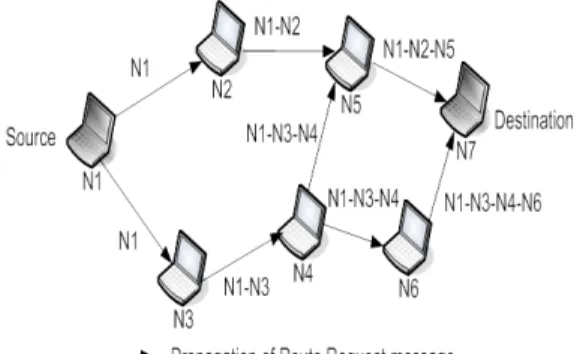
Source node broadcasts a route request (RREQ) packet to its neighbors, which then forwards the re-quest to their neighbors and so on. Fig. 1 indicates the broadcast of RREQ across the network. To con-trol network-wide broadcasts of RREQ packets, the source node use an expanding ring search tech-nique. In this technique, source node starts search-ing the destination ussearch-ing some initial time to live (TTL) value. If no reply is received within the dis-covery period, TTL value incremented by an in-crement value. This process will continue until the threshold value is reached.
Fig. 1. Propagation of RREQ throughout the net-work
When an intermediate node forwards the RREQ, it records the address of the neighbor from which first packet of the broadcast is received, thereby estab-lishing a reverse path. When the RREQ reaches a node that is either the destination node or an inter-mediate node with a fresh enough route to the des-tination, replies by unicasting the route reply (RREP) towards the source node. As the RREP is routed back along the reverse path, intermediate nodes along this path set up forward path entries to the destination in its route table and when the RREP reaches the source node, a route from source to the destination establish.
Fig. 2. Reply of RREP towards the network Figure 2 indicates the path of the RREP from the destination node to the source node.
2) Route Maintenance:
A route established between source and destination pair is maintained as long as needed by the source.
If the source node moves during an active session, it can reinitiate route discovery to find out a new route to destination. However, if the destination or some intermediate node moves, the node upstream of the break remove the routing entry and send route error (RERR) message to the affected active upstream neighbors. These nodes in turn propagate the RERR to their precursor nodes, and so on until the source node is reached. The affected source node may then choose to either stop sending data or reinitiate route discovery for that destination by sending out a new RREQ message.
B. Dynamic Source Routing (DSR)
The Dynamic Source Routing (DSR) [12] is one of the purest examples of an on-demand routing pro-tocol that is based on the idea of source routing. It is designed especially for use in multihop ad hoc networks for mobile nodes. It allows the network to be completely self-organizing and self-configuring and does not need any existing network infrastruc-ture or administration. DSR uses no periodic routing messages like AODV, thereby reduces net-work bandwidth overhead, conserves battery power and avoids large routing updates. Instead DSR needs support from the MAC layer to identify link failure. DSR is composed of the two mechanisms of Route Discovery and Route Maintenance, which work together to allow nodes to discover and main-tain source routes to arbitrary destinations in the network. The following sections explain these me-chanisms in more details.
1) Route Discovery:
When a mobile node has a packet to send to some destination, it first checks its route cache to deter-mine whether it already has a route to the destina-tion. If it has an unexpired route, it will use this route to send the packet to the destination. On the other hand, if the cache does not have such a route, it initiates route discovery by broadcasting a route request packet.
Fig. 3. Propagation of route request message across the network
Each node receiving the route request packet searches throughout its route cache for a route to the intended destination. If no route is found in the cache, it adds its own address to the route record of the packet and then forwards the packet to its neighbors. This request propagates through the network until either the destination or an interme-diate node with a route to destination is reached. Figure 3 demonstrates the formation of the route record as the route request propagates through the network.
Whenever route request reaches either to the desti-nation itself or to an intermediate node which has a route to the destination, a route reply is unicasted back to its originator. Fig. 4 illustrates the path of the RREP from the destination node to the source node
Whenever route request reaches either to the desti-nation itself or to an intermediate node which has a route to the destination, a route reply is unicasted back to its originator.
2) Route Maintenance:
In DSR, route is maintained by using route error packets and acknowledgments. When a packet with source route is originated or forwarded, each node sending the packet is responsible for confirming that the packet has been received by the next hop. The packet is retransmitted until the conformation of receipt is received. If the packet is transmitted by a node the maximum number of times and yet no receipt information is received, this node returns a route error message to the source of the packet. When this route error packet is received, the hop in error is removed from the host’s route cache and all routes containing the hop are truncated at that point.
Fig. 4. Propagation of route reply message towards the source
C. The Dynamic MANET On-demand (DYMO):
The Dynamic MANET On-demand (DYMO) [13] routing protocol is a simple and fast routing proto-col for multihop networks. It determines unicast routes among DYMO routers within the network in an on-demand fashion, offering improved conver-gence in dynamic topologies. To ensure the
cor-rectness of this protocol, Digital signatures and hash chains are used [14]. The basic operations of the DYMO protocol are route discovery and route management. The following sections explain these mechanisms in more details.
1) Route Discovery:
Route discovery is the process of creating a route to a destination when a node needs a route to it. When a source node wishes to communicate with a desti-nation node, it initiates a Route Request (RREQ) message. The route discovery process is illustrated in Fig. 5.
Fig. 5. The DYMO route discovery process In the figure, source node wants to communicate with destination node. In the RREQ message, the source node includes its own address and its se-quence number, which is incremented before it is added to the RREQ. It can also include prefix value and gateway information if the node is an Internet gateway capable of forwarding packets to and from the Internet. Finally, a hop count for the originator is added with the value 1. Then information about the destination node is added. The most important part is the address of the destination node. If the originating node knows a sequence number and hop count for the target, these values are also included. Upon sending the RREQ, the originating node will await the reception of an RREP message from the target. If no RREP is received within RREQ wait-ing time the node may again try to discover a route by issuing another RREQ. When the RREQ reaches the destination node, an RREP message is then created as a response to the RREQ, containing in-formation about destination node, i.e., address, se-quence number, prefix, and gateway information, and the RREP message is sent back along the re-verse path using unicast. Similar to the RREQ dis-semination, every node forwarding the RREP adds its own address to the RREP and installs routes to destination node.
2) Route Maintenance:
Route maintenance is the process of responding to changes in topology that happens after a route has initially been created. To maintain paths, nodes continuously monitor the active links and update the Valid Timeout field of entries in its routing ta-ble when receiving and sending data packets. If a node receives a data packet for a destination it does not have a valid route for, it must respond with a Route Error (RERR) message. When creating the RERR message, the node makes a list containing the address and sequence number of the unreacha-ble node. In addition, the node adds all entries in the routing table that is dependent on the unreacha-ble destination as next hop entry. The purpose is to notify about additional routes that are no longer available. The node sends the list in the RERR packet. The RERR message is broadcasted. The dissemination process is illustrated in Fig. 6. A link breakage node (LBN) receives a data packet for destination node. When it finds a link is broken, it will wait up to node timed out period after that the entry has become invalid. LBN generates an RERR message, which is propagated backwards towards source node.
Fig. 6. Generation and dissemination of RERR messages
4 Simulation Environment
The overall goal of this simulation study is to ana-lyze the performance of different existing wireless routing protocols in WMNs environment. The si-mulations have been performed using QualNet ver-sion 4.5 [15], a software that provides scalable si-mulations of Wireless Networks and a commercial version of GloMoSim [16]. In our simulation, we consider a network of 100 nodes (one source and one destination) that are placed randomly within a 1000m X 1000m area and operating over 500 seconds. Multiple runs with different seed numbers are conducted for each scenario and collected data is averaged over those runs.
(a)
(b)
(c)
(a)
(b)
(c)
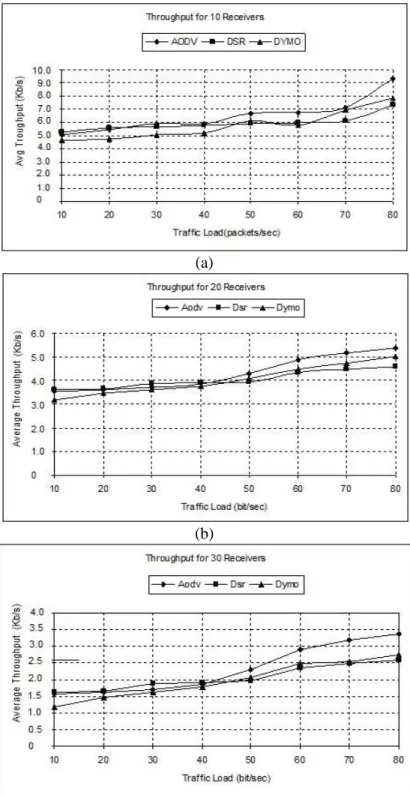
Fig. 8. Throughput, (a) for 10 receivers, (b) for 20 receivers, (c) for 30 receivers. A two-ray propagation path loss model is used in
our experiments with lognormal shadowing model. The transmission power of the routers is set con-stant at 20 dBm and the transmission range of the routers is 250 meters. The data transmission rate is 2Mbits/s. At the physical layer 802.11b and at MAC layer MAC 802.11 is used. The traffic source is implemented using Constant Bit Rate (CBR), sending at a rate of 1 packets/s. The packet size without header is 512 bytes. The length of the
queue at every node is 50 Kbytes where all the packets are scheduled on a first-in-first-out (FIFO) basis.
To evaluate the performance of routing protocols, both qualitative and quantitative metrics are needed. Most of the routing protocols ensure the qualitative metrics. Therefore, we use four different quantitative metrics to compare the performance. They are
sent by the application that are received by the re-ceivers [18].
• Jitter: Jitter is the variation in the time between packets arriving, caused by network congestion, timing drift, or route changes.
• Average End-to-end delay: End-to-end delay in-dicates how long it took for a packet to travel from the source to the application layer of the destina-tion. [19].
• Throughput: The throughput is defined as the to-tal amount of data a receiver R receives from the sender divided by the times it takes for R to get the last packet [20].
5 Result and Discussion
The performance differentials in this simulation are investigated using varying traffic load and number of sources. Traffic load is varied from 10 pack-ets/sec to 80 packpack-ets/sec where it is increased by 10 packets/sec. On the other hand, number of sources is increased from 10 sources to 30 sources. The results gained from simulations are illustrated in Fig 7 to 10.
In Fig 7(a), 7(b) and 7(c), packet delivery ratio ob-tained for AODV, DSR and DYMO for various sources, 10, 20 and 30 are shown respectively. At the beginning when traffic load was 10 packets/sec, all three protocols display high packet delivery ra-tio. However, packet delivery ratio decline with in-creasing traffic load. It can easily be observed that AODV and DYMO perform much better than DSR. DSR does not have a mechanism to expire stale routes in the cache, or to prefer “fresher” routes when face with multiple routes [5]. Consequently, if stale routes are used, it causes two problems, such as, 1) consumption of extra network band-width interface queue slots even though the packet is finally dropped or delayed and 2) possible pollu-tion of caches in other nodes. On the other hand, AODV and DYMO have better approach than DSR. They choose fresher route if they have mul-tiple routes. Therefore, DSR performs worse than AODV and DYMO.
Fig 8(a), 8(b) and 8(c) show the throughput com-parison of AODV, DSR, and DYMO at various numbers of sources. The general observation from the simulation is that for application- oriented me-tric throughput, DSR outperforms AODV in less “stressful” situations (lower traffic load). AODV, however, outperforms DSR in more stressful situa-tion. The poor throughput performance of DSR is caused by its aggressive use of caching and stale route problem.
DYMO is predominantly a successor of AODV. Therefore, the architecture is similar like AODV.
DYMO is made for MANET, however, we do our simulation for WMNs. In the overall simulation, we have got that AODV outperform than DYMO
Conclusions
A simulation based performance comparison of three different reactive protocols (AODV, DSR, and DYMO) is described in this paper. Simulation has been conducted over wireless mesh environ-ment. From the result of our studies and analysis, it can be concluded that, on an average AODV per-form better than DYMO and DSR. However, the overall performance of the three protocols in WMNs is not quite good. The major reason behind the performance degradation is because all these protocols are designed mainly for ad-hoc network. Though some features of ad hoc networks are simi-lar to WMNs, they have lots of features those are different from each other. For instance, to develop an ad-hoc routing protocol, features need to be considered are mobility, limited power consump-tion, adaptability, flexibility, security, scalability etc.
On the other hand, to design routing protocol for wireless mesh network, requires to consider fixed application, mobile application, scalability, better performance metrics, efficient routing within in-frastructure, robustness etc. Existing ad-hoc routing protocols have already considered some of the features of WMNs but not all the features, due to their different architecture. To improve these protocols performance, multiple matrices, multi radio, multi path, cross-layer technique etc can be considered. Consequently, existing protocols need to be enhanced or re-invented for WMNs.
References
[1] Akyildiz and X. Wang, “A Survey on Wireless Mesh Networks”, IEEE Communication Magazine, vol. 43, no. 9, pp. S23–S30, September 2005.
[2] A. Boukerche, “Performance Evaluation of Routing Protocols for AdHoc Ad hocNetworks”, Mobile Net-works and Applications, vol. 9, Kluwer Academic Pub-lishers, 2004, pp. 333-342.
[3] J. Broch, D. A. Maltz, D. B. Johnson, Y-C Hu and J. Jetcheva, “A Performance Comparison of Multihop Ad hocAd Hoc Network Routing Protocols”, In Pro-ceedings Of MOBICOMM, October 1998.
[4] S. R. Das, R. Castaneda and J. Yan, “Simulation Based Performance Evaluation of Mobile Ad Hoc Net-work Routing Protocols”, In Proceedings of Seventh In-ternational Conference on Computer Communications and Networks, 1998.
[5] S. R. Das, C. E. Perkins and E. M. Royer, “Perfor-mance Comparison of Two On-Demand Routing Pro-tocols for Ad Hoc Networks”, In Proceedings Of IN-FOCOM 2000, Tel-Aviv, Israel, March 2000.
[6] H. Jiang, “Performance Comparison of Three Routing Protocols for Ad Hoc Networks”, Communica-tions of the ACM, vol. 37, August 1994.
[7] J. Broch, D. A. Maltz, D. B. Johnson, Y. Hu and J. Jetcheva, “A Performance Comparison of Multi-Hop Ad hocAd Hoc Network Routing Protocols”, Proceed-ings of the Fourth Annual ACM/IEEEInternational Con-ference on Mobile Computing and Networking, Mobi-Com’98, October 1998, pp. 25-30.
[8] A. Boukerche, “Performance Comparison and Analysis of Ad Hoc Routing Algorithms”, In Proceed-ings of IPCCC 2001, USA, April 2001, pp. 171-178. [9] S. Azad, A. Rahman and F. Anwar, “A Perfor-mance Comparison of Proactive and Reactive Routing Protocols of Mobile Ad-hoc NETwork (MANET)”, Journal of Engineering and Applied Sciences, vol. 2, no. 5, 2007, pp 891-896.
[10]C. E. Perkins and E. M. Royer, “Ad Hoc On-demand Distance Vector Routing”, In Proceedings of the 2nd IEEE Workshop on Mobile Computing Systems and Applications, New Orleans, LA, February1999, pp. 90-100.
[11]C. E. Perkins and P. Bhagwat, “Highly Dynamic Destination-Sequenced Distance-Vector Routing (DSDV) for Mobile Computers”, SIGCOMM, London, UK, pp. 234-244, August 1994.
[12]D. B. Johnson and D. A. Maltz, “Dynamic Source Routing in Ad-Hoc Ad hocNetworks”, Mobile Compu-ting, ed. T. Imielinski and H. Korth, Kluwer Academic Publishers, pp. 153-181, 1996.
[13]Chakeres and C. Perkins. “Dynamic MANET On-demand (DYMO) Routing Protocol”, IETF Internet Draft, v.06, October 2006.
[14]M. Guerrero, “Securing ad hoc routing protocols”, IETF In-ternet Draft, v.06, september 2006.
[15]QualNet Network Simulator; Available: http://www.scalable-networks.com.
[16]GloMoSim Simulator;Available: ttp://pcl.cs.ucla.edu/projects/glomosim.
[17]QualNet documentation, “QualNet 4.5 Model Li-brary: Advanced Wireless”. Available: http://www.scalable-networks.com/products/ qual-net/download.php#docs
[18] J. G. Jetcheva and D. B. Johson, “A Performance Comparison of On-Demand Multicast Routing Proto-cols for Ad Hoc Networks,” school of computer science, computer science department, Pittsburgh, December 15, 2004.
[19]D. O. Jorg, “Performance Comparison of MANET Routing Protocols In Different Network Sizes”, Com-puter Science Project, Institute of ComCom-puter Science and Applied Mathematics, Computer Networks and Dis-tributed Systems (RVS), University of Berne, Switzer-land, 2003.
[20]U. T. Nguyen and X. Xiong, “Rate-adaptive Multicast in Mobile Ad-hoc Networks,” IEEE International Conference on Ad hocand Mobile Computing, Networking and Communications 2005 (WiMob 2005), Monreal, Canada, August 2005.
Md. Arafatur RAHMAN has graduated in Computer Science and Engineering from International Islamic University Chittagong, Bangladesh. He is currently conducting his master’s in Computer and Information Engineering from International Islamic Univer-sity Malaysia (IIUM), Malaysia. His research interests are Wireless Communication, Mobile IPv6, Image Processing, Neural Network and Programming.
Md. Saiful AZAD has graduated in Computer Science and Information Technology from Islamic University of Technology (IUT), Dhaka, Bangladesh. He is currently con-ducting his master’s in Computer and Information Engineering from International Is-lamic University Malaysia (IIUM), Malaysia. His research interests are Routing Proto-cols for Ad Hoc Networks, Routing in Wireless Mesh Networks (WMNs), QoS issues in IP Networks, Network Security.
Dr. Farhat ANWAR received a Ph.D degree in Electronic and Electrical Engineering from the University of Strathclyde UK in 1996. His research interest includes QoS in IP networks, routing in Ah-hoc and sensor networks, computer simulation and perfor-mance analysis, and biometrics. He has published extensively in international journals and conferences. He has been with IIUM since 1999 and currently working as an Assoc. Professor in the department of Electrical and Computer Engineering.