tions have developed rich and var-ied forms of both formal and informal social interaction in the modern workplace (for example, hallway exchanges and water-cooler conversations, meetings and conferences, brown bag lunches, newsletters, and telecon-ferences).
Increasingly, however, these communities are moving beyond
UNDERSTANDING
THE
BENEFIT
AND
COSTS
OF
COMMUNITIES
OF
PRACTICE
David R. Millen, Michael A. Fontaine, and Michael J. Muller
Promoting healthy
collaboration in
communities of
practice takes
management support
at all levels. And
management, of
course, wants
and needs to
comprehend what
the firm gets for
that investment.
T
here has been increasing interest within large organizations in the
development and support of communities to promote collaboration,
improve social interaction, increase productivity, and to improve
orga-nizational performance
[
3, 8
]
. These worker
groups, often called “communities of
practice,” are defined by a common
disciplinary background,
simi-lar work activities and tools,
and shared stories,
con-texts, and values. Dating
back to the trade guilds
of the Middle Ages,
these longstanding
vol-untary worker
face-to-face exchanges, to interact in online environ-ments, shared Web spaces, email lists, discussion forums, and synchronous chats. Not surprisingly, the support of these environments demands both finan-cial and technological resources. These demands force organizations to invest with caution while trying to capture the value that communities ultimately deliver to their financial balance sheets. As with any other significant investment in IT and human capital, man-agers are naturally interested in understanding the impact these communities have on individual perfor-mance, team effectiveness, and overall productivity.
To address the challenge of how organizations can begin to analyze these financial tradeoffs, we explore the benefits and costs of communities of practice within large, geographically dispersed organizations and discuss the challenges inherent in justifying the corporate investment in such communities. To better understand the benefits and costs of communities of practice, researchers from the IBM Institute of Knowledge-based Organizations (formerly the Insti-tute for Knowledge Management) and IBM Research
conducted a study of nine com-munities in seven firms sampled from a broad range of industry sec-tors—finance, manufacturing, pharmaceutical, software, chemi-cal, and telecom (see the table). In total, we conducted semi-struc-tured interviews with more than 60 community members, leaders, and knowledge management per-sonnel. The sample communities were both local and global in scope, and ranged in practice from programming, to biochemical research, to land and real estate development in poverty-plagued nations. After analyzing the inter-view data, we developed a mind map, [2] a nonlinear graphical rep-resentation of the factors and rela-tionships in our findings. This map uncovered the following five major community themes, the final two of which serve as the basis for this article:
•Development path:How did the community form and evolve? What was its catalyst? •Membership:How and why did members join,
leave, or give of their time and energy?
•Activities:What did members do in the commu-nity? How did they interact?
•Organizational support: How was the community supported by the organization?
•Value:What value did members receive? How did the organization benefit from the community?
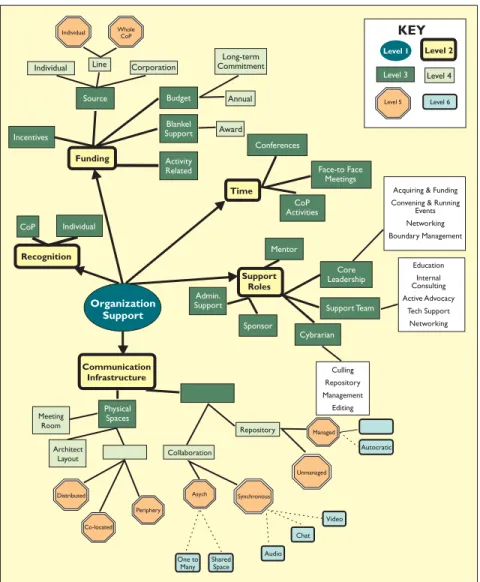
Two themes, organization support and value, pro-vided the lens and categorization scheme we used to extract the benefits and costs discussed here (Figures 1 and 2).
Recognizing Community Benefits
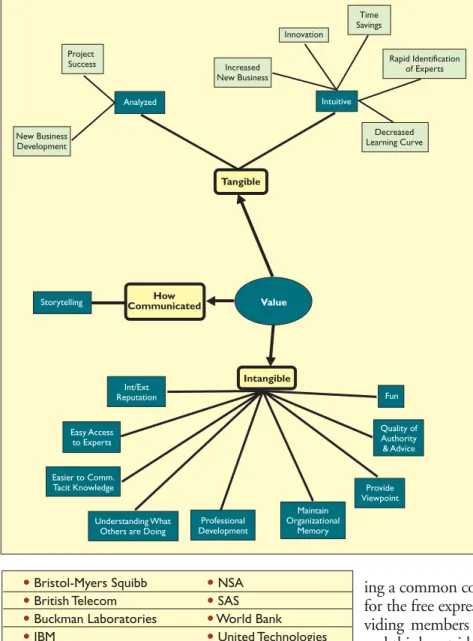
Our analysis of member interviews originally depicted in the value section of the mind map revealed three distinct categories of community ben-efits: individual, community, and organizational.
Individual benefits spanned many topic areas including improved reputation, a better understand-ing of what others were dounderstand-ing in the organization Annual Level 4 Corporation Line Individual Award Level 3 Long-term Commitment Core Leadership Support Team Repository Culling Repository Management Editing
Acquiring & Funding Convening & Running
Events Networking Boundary Management Collaboration Face-to Face Meetings Budget Mentor Sponsor Cybrarian Conferences Source Incentives Blankel Support Activity Related CoP Activities Admin. Support Physical Spaces Meeting Room Communication Infrastructure Recognition Funding Time Level 2 Support Roles Education Internal Consulting Active Advocacy Tech Support Networking Autocratic Level 6 Video Chat Audio Shared Space One to Many Synchronous Asych Periphery Co-located Distributed
Individual WholeCoP
Level 5 Managed Unmanaged Organization Support KEY Level 1 CoP Individual Architect Layout
Figure 1. Community of practice mind map, organization support theme.
and increased levels of trust. The familiar and supportive environment found in many communities of practice
encourages member interaction and ongoing profes-sional development and learning about new tools, methods and procedures. Study participants expressed the importance of the benefits of increased access to subject-matter experts and valuable infor-mation resources. Together these benefits allowed members to develop professionally, remain at the forefront of their discipline, and gain confidence in their own expertise. Some of the sentiments echoed in the collective comments were:
“If you’ve done good work on a project, package it up, put it into the tool [community knowledge-shar-ing database] and it’s well-perceived by other develop-ers around the world, it’s a good way of getting your
name known and raising your pro-file in the organization.” (SAS)
“If I have a question about an offering, for instance ... to find the right person to answer the ques-tion might take several phone calls. This way, I can go out here [online community portal] and I will not only find the answer to my ques-tions, but I will also find docu-mentation and information that goes well beyond what I was think-ing of in the first place, and it will expand my knowledge. I think that is not only helpful profession-ally, but personally in that it expands my knowledge about the offerings, who the contacts are, and who I can contact for more information.” (IBM)
Community benefits consist of those benefits that accrue to the community. These benefits included increased idea creation, increased quality of knowledge and advice, problem solving, and creat-ing a common context. Communities provide a forum for the free expression of creativity and new ideas, pro-viding members with the opportunity to share ideas and think outside of the box:
“Members might be in a project where they need advice, or they need guidance on how to do some-thing. That’s when they really feel good about the fact that they can go somewhere [community portal] and find out where things are, or they can ask on the list server and get some good advice. They get profes-sional, high knowledge advice.” (SAS)
“Well, I think because there is a sense of commu-nity, shared values, and shared goals; you can talk to people about similar issues that they will have had before. Everybody is quite open and they will give you lots of help.” (British Telecom)
Organizational benefits involve the most tangible types of value expressed in communities—business outcomes. Study participants indicated that the improved communication among community
mem-Project Success New Business Development Increased New Business Innovation Time Savings Rapid Identification of Experts Decreased Learning Curve Intuitive Analyzed Storytelling Int/Ext Reputation Fun Quality of Authority & Advice Provide Viewpoint Maintain Organizational Memory Understanding What
Others are Doing Easy Access to Experts Easier to Comm. Tacit Knowledge Value Intangible How Communicated Professional Development Tangible
Figure 2. Community of practice mind map, value theme.
•
Bristol-Myers Squibb•
British Telecom•
Buckman Laboratories•
IBM•
NSA•
SAS•
World Bank•
United Technologies Organizations that participated in the research.bers contributed to successfully executed projects, increased new business, and product innovation. The more compelling evidence of community benefits for the firm was in the area of time savings. These com-ments highlight the reduced time to perform a variety of information-seeking and -sharing tasks that con-tributed to improved operational efficiency:
“It’s the fact that we don’t have to reinvent the wheel all the time. If we’re sharing our information, then I can use what somebody else has learned and work on it somewhere else, instead of spending 80 hours doing it myself. It not only saves time, it also has improved the effectiveness of people’s delivery material.” (United Technologies)
“It’s probably 50% of the time that you will find someone else who has had the problem and who has solved it. Basically, that can save a lot of work.” (SAS) “We are gaining information that enables us to make value decisions quickly. It benefits the business and it benefits customers. I’ve got a good example. One of my project managers came to me and needed a project implementation for a big proposal going out the next day, and we hadn’t yet done a similar project, [so we] requested a PM [online] discussion. He came back within five to ten minutes. The project imple-mentation part was done in a completely different sector and we were able to quickly doctor it into our customer’s proposal. If we had had to do it internally, it would have taken us three or four days. It would have taken somebody the afternoon just to collect the information, put it in, and go.” (British Telecom)
In summary, study participants described a rich qualitative set of individual, community, and organi-zational benefits provided by their respective commu-nity of practice, some of which can be quantified through traditional time, financial, and transaction cost analysis.
Exploring Community Costs
For a complete understanding of the contributions of a community of practice, we must also consider the costs of supporting a community. All too often the cost estimates for communities are based on the technology investments, which significantly underestimates the total cost of ownership (TCO) for a community. In studying organization sup-port, we found four major categories of TCO cost drivers. These include the costs of the participa-tion time for community members, meeting and conference expenses, technology, content
publish-ing, and promotional expenses.
Specifically, the costs of participation included the salaries for members who were identified as support-ing the community through 11 identifiable roles (for example, community member, leader, core team, sub-ject matter expert, sponsor, mentor, facilitator, con-tent coordinator/cybrarian, admin/events coordinator, technologist, and journalist) [6]. Technology costs included the costs of synchronous and asynchronous group messaging applications and community Web sites. Meeting costs included the expenses associated with face-to-face meetings, including travel expenses, as well as the costs associated with electronic meetings (for example, teleconferencing). And finally, the cost of publishing content included the cost of online con-tent development and production costs for commu-nity newsletters and promotional materials.
To assess whether the cost categories were reason-able and complete, 36 knowledge management pro-fessionals divided into teams of six were asked to consider the TCO framework in a budget allocation exercise. In this exercise, a case study of a developing community of practice was presented and the teams decided how to allocate financial resources across each of the cost areas. There was remarkable consistency among the responses from the six groups. On average, the groups allocated 52% of the community budget to pay for salaries (and incentives) for community workers. On average, 32% was used to pay for meet-ing expenses, 10% for technology, and 6% for pub-lishing and promotion expenses. The relatively low investment in technology was a bit of a surprise, but may be reasonable given that the exercise assumed that general corporate communication infrastructure (for example, telephone and email) was available to the community at no additional expense.
Developing a Business Case
for Community Investment and ROI
The results of our multicompany research offers qualitative evidence for several kinds of benefits from communities of practice, and a reasonable framework to consider the costs to support such communities. There is increasing pressure, however, to augment the qualitative results with more formal measurement of the financial benefits and costs of the communities. Measures of value are instrumen-tal for communities to gain visibility and influence as well as to educate and guide their own develop-ment [11]. This emphasis on financial measuredevelop-ment is similar, in most respects, to the formal cost/bene-fits analysis for investments in information systems [10], electronic performance support systems [5], human factors [9], and usability [1].
No doubt, precise financial measurement of the costs and benefits of a community of practice is a sig-nificant challenge. To measure the financial benefits, we have considered two approaches. The first is based on measurements of the cost savings due to specific community activities. An example would be the time saved preparing a customer proposal by using a tem-plate found on a community portal (as reported by interviewees). Measurements of these kinds of cost savings could be gathered through a variety of means, including self-report surveys and through well-designed activity logs within the community software environments. This approach is promising, as there were several participants in our study who described costs savings due to community knowledge-sharing activities.
A second approach to estimating the financial ben-efits of a community of practices is by using a special form of storytelling referred to as a “serious anecdote” [4]. A serious anecdote is a story with an easily quan-tifiable punchline. An example can be seen in the ear-lier quotation where an employee utilized his community relationship and community portal to find a specific person and template to achieve a cus-tomer-facing business objective in three to four days less than expected. The benefits associated with decreased preparation time can be easily calculated.
In contrast to measuring the benefits of a commu-nity, the measurement of the cost to support a com-munity is more straightforward. Based on the TCO workshop results, we believe that reasonable estimates of the costs associated with communities are readily available to community leaders.
Once reasonable estimates of the costs and finan-cial benefits of a community are in hand, there are several traditional ways to evaluate community invest-ment decisions. One method frequently used in capi-tal budgeting exercises is to look at the discounted costs (cash outflows) and returns (cash inflows) over a multiyear horizon, and compare the resulting Net Pre-sent Value (NPV) of several investment alternatives [3]. A good illustration of the use of NPV and related financial measures (for example, Return on Invest-ment, or ROI) can be found in a discussion of the cost justification of usability [7].
The financial evaluation of a community is useful for at least two reasons. First, community builders and managers need to be aware of the path to value for their communities and some cost justification is required for many corporate environments. Second, financial measurement allows community managers to compare different communities and focus attention on community activities that work and those that need to be changed.
Measuring and demonstrating the value of com-munities of practice is as difficult, in its way, as is the measurement and demonstration of the value of user-centered design or usability work (for example, [7]). It should be noted that while we have described various approaches to measuring the costs, benefits and returns for a community of practice, we feel there is much work to be done in this area. Financial surements of community are often based on soft mea-sures or estimates of costs and benefits of questionable reliability and validity. Many economics and finance researchers are looking into radically different approaches to measuring the value of communities by looking at the assets that a community creates. The valuation of these intangible assets may be a promising approach to evaluating community contributions.
References
1. Bias, R.G., and Mayhew, D.J., Eds. Cost Justifying Usability.Academic Press, New York, 1994.
2. Buzan, T. The MindMap Book: How To Use Radiant Thinking to Max-imize Your Brain’s Untapped Potential.Dutton, New York, 1994. 3. Clare, M. and Detore, A.W. Knowledge Assets: A Professionals Guide to
Valuation and Financial Management. Harcourt, New York, 2000. 4. Davenport, T.H. and Prusak, L.Working Knowledge.Harvard Business
School Press, Boston, MA, 1998.
5. Desmarais, M.C., Leclair, R., Fiset, J., and Talbi, H. Cost justifying electronic performance support systems. Commun. ACM 40, 7 (July 1997), 39–48.
6. Fontaine, M.A. Keeping communities of practice afloat: Understanding and fostering roles in communities. Knowledge Manage. Rev. 4, 4 (Sept./Oct. 2001), 16–21.
7. Karat, C-M. A business case approach to usability cost justification.
Cost Justifying Usability.R.G. Bias and D.J. Mayhew, Eds. Academic Press, New York, 1994.
8. Lesser, E. and Storck, J. Communities of practice and organizational performance.IBM Systems J. 40, 4 (2001).
9. Mantei, M.M., and Teorey, T.J. Cost/benefit analysis for incorporating human factors in the software lifecycle. Commun. ACM 31, 4 (Apr. 1988), 428–439.
10. Sassone, P.G. Cost benefit analysis of information systems: A survey of methodologies. In Proceedings of the ACM Conference on Supporting Group Work. (Palo Alto, CA). ACM Press, New York, 126–133. 11. Wenger, E., McDermott R.M., and Snyder, W.M. Cultivating
Com-munities of Practice. Harvard Business School, Boston, MA. 2002.
David R. Millen ([email protected]) is a research scientist at IBM Collaborative User Experience Research Group in Cambridge, MA.
Michael A. Fontaine ([email protected]) is a
knowledge management research consultant at the IBM Institute for Knowledge-based Organizations (IKO) in Cambridge, MA.
Michael J. Muller ([email protected]) works as a research scien-tist at IBM Collaborative User Experience Research Group in Cam-bridge, MA.
Permission to make digital or hard copies of all or part of this work for personal or classroom use is granted without fee provided that copies are not made or distributed for profit or commercial advantage and that copies bear this notice and the full citation on the first page. To copy otherwise, to republish, to post on servers or to redistribute to lists, requires prior specific permission and/or a fee.
© 2002 ACM 0002-0782/02/0400 $5.00