i
EFFICIENT SIMULTANEOUS ENCRYPTION AND
COMPRESSION OF DIGITAL VIDEOS IN
COMPUTATIONALLY CONSTRAINED APPLICATIONS
By
Nazar Al-hayani
Applied Computing Department, the University of Buckingham United Kingdom
ATHESIS
Submitted for the degree of Doctor of Philosophy in Secure
Video Transmission To the school of Science and Medicine
In the University of Buckingham
ii
ABSTRACT
This thesis is concerned with the secure video transmission over open and wireless network channels. This would facilitate adequate interaction in computationally constrained applications among trusted entities such as in disaster/conflict zones, secure airborne transmission of videos for intelligence/security or surveillance purposes, and secure video communication for law enforcing agencies in crime fighting or in proactive forensics. Video content is generally too large and vulnerable to eavesdropping when transmitted over open network channels so that compression and encryption become very essential for storage and/or transmission. In terms of security, wireless channels, are more vulnerable than other kinds of mediums to a variety of attacks and eavesdropping. Since wireless communication is the main mode in the above applications, protecting video transmissions from unauthorized access through such network channels is a must. The main and multi-faceted challenges that one faces in implementing such a task are related to competing, and to some extent conflicting, requirements of a number of standard control factors relating to the constrained bandwidth, reasonably high image quality at the receiving end, the execution time, and robustness against security attacks. Applying both compression and encryption techniques simultaneously is a very tough challenge due to the fact that we need to optimize the compression ratio, time complexity, security and the quality simultaneously.
There are different available image/video compression schemes that provide reasonable compression while attempting to maintain image quality, such as JPEG, MPEG and JPEG2000. The main approach to video compression is based on detecting and removing spatial correlation within the video frames as well as temporal correlations across the video frames. Temporal correlations are expected to be more evident across sequences of frames captured within a short period of time (often a fraction of a second). Correlation can be measured in terms of similarity between blocks of pixels. Frequency domain transforms such as the Discrete Cosine Transform (DCT) and the Discrete Wavelet Transform (DWT) have both been used restructure the frequency content (coefficients) to become amenable for efficient detection. JPEG and MPEG use DCT while JPEG2000 uses DWT. Removing spatial/temporal correlation encodes only one block from each class of equivalent (i.e. similar) blocks and remembering the position of all other block within the equivalence class. JPEG2000 compressed images
iii
achieve higher image quality than JPEG for the same compression ratios, while DCT based coding suffer from noticeable distortion at high compression ratio but when applied to any block it is easy to isolate the significant coefficients from the non-significant ones.
Efficient video encryption in computationally constrained applications is another challenge on its own. It has long been recognised that selective encryption is the only viable approach to deal with the overwhelming file size. Selection can be made in the spatial or frequency domain. Efficiency of simultaneous compression and encryption is a good reason for us to apply selective encryption in the frequency domain.
In this thesis we develop a hybrid of DWT and DCT for improved image/video compression in terms of image quality, compression ratio, bandwidth, and efficiency. We shall also investigate other techniques that have similar properties to the DCT in terms of representation of significant wavelet coefficients. The statistical properties of wavelet transform high frequency sub-bands provide one such approach, and we also propose phase sensing as another alternative but very efficient scheme.
Simultaneous compression and encryption, in our investigations, were aimed at finding the best way of applying these two tasks in parallel by selecting some wavelet sub-bands for encryptions and applying compression on the other sub-sub-bands. Since most spatial/temporal correlation appear in the high frequency wavelet sub-bands and the LL sub-bands of wavelet transformed images approximate the original images then we select the LL-sub-band data for encryption and the non-LL high frequency sub-band coefficients for compression. We also follow the common practice of using stream ciphers to meet efficiency requirements of real-time transmission. For key stream generation we investigated a number of schemes and the ultimate choice will depend on robustness to attacks.
The still image (i.e. RF’s) are compressed with a modified EZW wavelet scheme by applying the DCT on the blocks of the wavelet sub-bands, selecting appropriate thresholds for determining significance of coefficients, and encrypting the EZW thresholds only with a simple 10-bit LFSR cipher This scheme is reasonably efficient in terms of processing time, compression ratio, image quality, as well was security robustness against statistical and frequency attack. However, many areas for improvements were identified as necessary to achieve the objectives of the thesis.
iv
Through a process of refinement we developed and tested 3 different secure efficient video compression schemes, whereby at each step we improve the performance of the scheme in the previous step. Extensive experiments are conducted to test performance of the new scheme, at each refined stage, in terms of efficiency, compression ratio, image quality, and security robustness.
Depending on the aspects of compression that needs improvement at each refinement step, we replaced the previous block coding scheme with a more appropriate one from among the 3 above mentioned schemes (i.e. DCT, Edge sensing and phase sensing) for the reference frames or the non-reference ones. In subsequent refinement steps we apply encryption to a slightly expanded LL-sub-band using successively more secure stream ciphers, but with different approaches to key stream generation. In the first refinement step, encryption utilized two LFSRs seeded with three secret keys to scramble the significant wavelet LL-coefficients multiple times. In the second approach, the encryption algorithm utilises LFSR to scramble the wavelet coefficients of the edges extracted from the low frequency sub-band. These edges are mapped from the high frequency sub-bands using different threshold. Finally, use a version of the A5 cipher combined with chaotic logistic map to encrypt the significant parameters of the LL sub-band.
Our empirical results show that the refinement process achieves the ultimate objectives of the thesis, i.e. efficient secure video compression scheme that is scalable in terms of the frame size at about 100 fps and satisfying the following features; high compression, reasonable quality, and resistance to the statistical, frequency and the brute force attack with low computational processing. Although image quality fluctuates depending on video complexity, in the conclusion we recommend an adaptive implementation of our scheme.
Although this thesis does not deal with transmission tasks but the efficiency achieved in terms of video encryption and compression time as well as in compression ratios will be sufficient for real-time secure transmission of video using commercially available mobile computing devices.
v
Dedicated to
vi
A
CKNOWLEDGMENTS
First and foremost, all thanks to Allah the Almighty for blessing me with the strength to achieve this goal.
I would like to thank my wife for her patience and endless love. Together we have been sharing each and every detail in the life. Her support and encouragement was in the end what made this thesis possible and for her I dedicate this work. Thank you my wife for colouring my life with great memories, and for being my second half, my soul mate, and my best friend.
I would like to dedicate this thesis and all the good things in my life to my sons, Mustafa, Yasser and Weasaam, who have been my continuous source of hope and determination to go on despite the difficult times I have been away from them. Their patience has often pushed me to put in my best efforts to be a better person. Also, many thank go to the rest of my family, brothers and sisters for their support, encouragement and praying during my study.
I cannot find words to express my sincere gratitude to my first supervisor Prof. Sabah Jassim for his guidance, understanding, patience, and editorial advice was essential to the completion of this thesis and has taught me innumerable lessons and insights on the workings of academic research in general, and most importantly, his friendship during these years.
I also gratefully acknowledge my second supervisor Dr. Naseer.Al-Jawad. Without his encouragement and patience I would not have been writing this thesis. His mentorship was essential in providing a well-rounded experience, excellent guidance, caring, patience, and providing me with an excellent atmosphere for doing research.
I would also like to thank my personal tutor (Dr. Harin Sellahewa) for being a very good listener and for his continuous support and encouragement. I highly thank Mr. Ali Albu-Raghaif, Mahar Al-Aboodi and Suleyman Al-Showarah for unique insights. And also extend my thanks to Dr.Abdul Hassan N AL-dijalie of encouragement and predicative get to complete my studies.
vii
I would like to express my thanks to the Ministry of Higher Education and Scientific Research (MHESR) in Iraq for sponsoring my PhD program of study.
Last but not least, many thanks are due to all my friends, fellow students, and all members of staff at the applied computing department, University of Buckingham for the fruitful collaboration work and for all their support and important discussions.
viii
A
BBREVIATIONS
A5 Stream cipher
AES Advanced Encryption Standard ASC Average Speed Computer B-Frame Bidirectional frames bior2.2 BiorSplines2.2 bpp Bit per pixel
CABAC Context Adaptive Binary Arithmetic Coding CAC Chaotic Arithmetic Coding
CAVLC Context Adaptive Variable Length Coding CC Correlation Coefficients
CF Current Frame CH 5M Method of Chapter 5 CH 6M Method of Chapter 6 CLM Chaotic Logistic Map CLT Central Limit Theorem coif2 Coiflets2
CR Compression Ratio CS Compressed sensing
CVES Chaotic Video Encryption Scheme CVQ Compressive Vector quantization db1 Daubechies1
db4 Daubechies4 db9 Daubechies9
DCT Discrete cosine Transform DCTM Transform matrix of DCT DES Data Encryption Standard
𝐷𝑖𝑠𝑡 Distance
DWT Discrete wavelet transform EZW Embedded Zero trees of Wavelet FLV Flash player
ix
GSM Global System for Mobile communications H3 High frequency sub-band of level 3 HDTV High-Definition Television
HE Homomorphic Encryption HEVC High Efficiency Video Coding HH High-high frequency sub-band HI Histogram Intersection
HL High -low frequency sub-band HME Hierarchical Motion Estimation I-Frame Intra-frame
ISO/IEC International Standardization Organization/ International Electro-technical Commission
ITU-T International Telecommunications Union JDWCT-CVQ Joint DWT, DCT and CVQ
JDWCT-CVQ-Edge Joint DWT, DCT , CVQ and edge sensing JDWCT-CVQ-Edges-phase
sensing
Joint DWT, DCT, CVQ, Edges and phase sensing
JnCE Joint Compression and Encryption JPEG Joint Picture Expert Group
JPSEC Security for JPEG-2000
L1 Level 1
L2 Level 2
L3 Level 3
LFSR Linear Feedback Shift Register LH low - High frequency sub-band LL low frequency sub-band
LL3 Low frequency sub-band of level 3
LM Logistic Map
MDMF Maximum Deviation Measuring Factor MPEG Motion Picture Expert Group
MEZW Modified EZW MEZWE MEZW Encryption MJ2 Motion JPEG2000
x
MQ-coder binary arithmetic coder MSE Mean Square Error n-RF non-Reference Frame P-Frame Predictive frames
PMMLG Modulo Multiplicative Linear Congruence Generators PSNR Peak Signal to Noise Ratio
PWLCM Piece-Wise Linear Chaotic Maps QMS Quadrant Monotonic Search
RAS Ronald Rivest, Adi Shamir and Leonard Adleman rbio2.2 ReverseBior2.2
RD Rate Distortion RF Reference Frame RLE Run-Length Encoding
RHSC Relatively High Speed Computer SC Significance Coefficients
SC-LL3 Significance Coefficients of low frequency sub-band of level 3 SM Sensing Matrix
SMa Sine Map
SOC Start of code-stream
SPIHT Set Partitioning in Hierarchical Trees SQ Scalar Quantization
SqCE Sequential Compression and Encryption STD Standard Deviation
sym2 Symlets2
THR Threshold
VQ Vector Quantization
WDR Wavelet Difference Reduction WT Wavelet Transform
xi
T
ABLE OF
C
ONTENTS
ABSTRACT ... ii ACKNOWLEDGMENTS ... vi ABBREVIATIONS ... viii TABLE OF CONTENTS ... xiList of Figures ... xiv
List of Tables ... xvii
Declaration ... xviii
Chapter 1Introduction ... 1
1.1 Introduction to Image and Video Compression ... 2
Still image compression techniques and tools ... 3
1.1.1 Video compression tools and standards ... 10
1.1.2 1.2 Image and Video Encryption ... 13
1.3 Thesis Objectives, Main Approaches, and Contributions ... 15
1.4 Thesis organisation ... 18
1.5 List of Publications ... 19
Chapter 2Literature Review ... 20
2.1 Image and video compression techniques ... 20
Image compression ... 20
2.1.1 Video compression ... 27
2.1.2 2.2 Image and Video Encryption ... 34
Stream ciphers ... 35
2.2.1 Sequential Compression and Encryption (SqCE) ... 39
2.2.2 Joint Compression and Encryption (JnCE) ... 39
2.2.3 Homomorphic Encryption ... 43
2.2.4 Security for JPEG-2000 (JPSEC) ... 43
2.2.5 2.3 An over view of thesis investigations and approach. ... 46
Chapter 3Analysis of Still image Compression and Encryption ... 47
3.1 Image compression using wavelet transform ... 47
3.2 Image compression using DCT coding ... 53
The encoding process ... 53 3.2.1
xii
DCT transform ... 53
3.2.2 Quantization ... 56
3.2.3 3.3 Optimized EZW technique for image compression and encryption ... 58
A Combined DCT and EZW image compression scheme ... 58
3.3.1 The Encryption Component of the MEZW ... 64
3.3.2 Conclusion ... 69
3.3.3 Chapter 4Optimizing still Image compression & Encryption ... 70
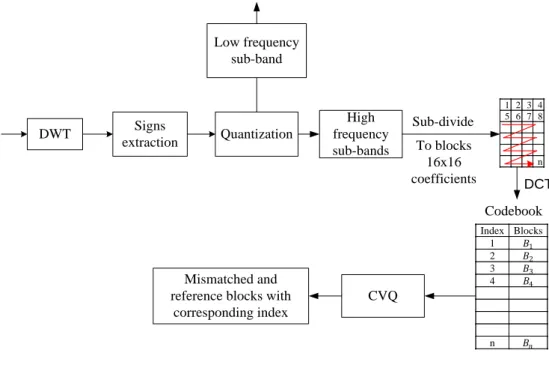
4.1 The JDWCT-CVQ simultaneous compression and Encryption ... 70
Compressive Vector quantization (CVQ) ... 71
4.1.1 The proposed JDWCT-CVQ scheme ... 73
4.1.2 Experimental and analysis results ... 76
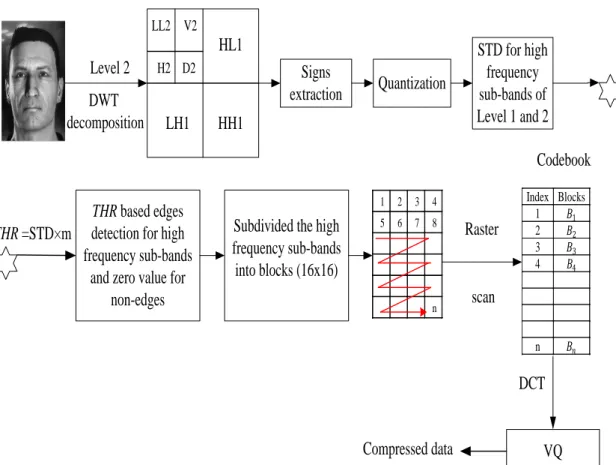
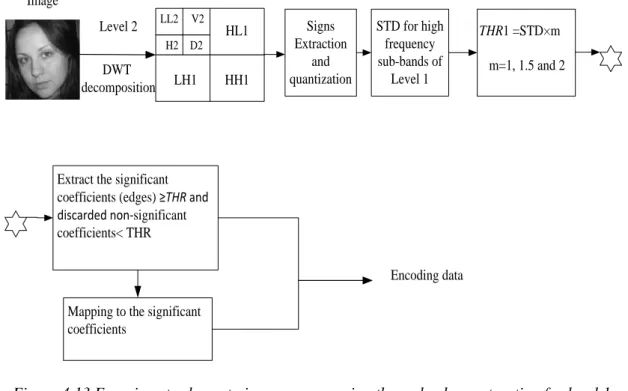
4.1.3 4.2 JDWCT-CVQ-Edge compression ... 85
JDWCT-CVQ-Edge scheme ... 85
4.2.1 Experimental work and analysis of results ... 86
4.2.2 4.3 Conclusion ... 93
Chapter 5CVQ for Secured Video compression ... 95
5.1 Existing Video coding techniques ... 95
5.2 JDWCT- CVQ scheme for video compression and encryption ... 98
The compression algorithm ... 99
5.2.1 The encryption algorithm ... 101
5.2.2 5.3 Experimental work and analysis ... 103
The periodicity of reference frames ... 104
5.3.1 Compression analysis ... 107 5.3.2 Encryption analysis ... 111 5.3.3 5.4 Conclusion ... 116
Chapter 6Edges Sensing for Simultaneous Video Compression and Encryption ... 117
6.1 Chaotic logistic map for pseudo-random number generation ... 118
6.2 Combined sine map and chaotic logistic map ... 121
6.3 The JDWCT-CVQ-Edge secure for video compression scheme ... 123
A revised Video Compression scheme ... 123
6.3.1 The Encryption scheme ... 125
6.3.2 6.4 Experimental work and results ... 127
Compression analysis ... 127
6.4.1 Testing the effect of using wavelet different filters ... 130
6.4.2 Encryption analysis ... 131
6.4.3 6.5 Conclusion ... 136
xiii
7.1 Phase Sensing ... 138
7.2 The A5 cipher description ... 143
7.3 JDWCT-CVQ-Edges-phase sensing scheme ... 145
The video compression scheme ... 146
7.3.1 The encryption proposed scheme ... 147
7.3.2 7.4 Experimental results ... 150
Analysis of compression result ... 151
7.4.1 Security analysis ... 164
7.4.2 7.5 Selective encryption based on AES ... 169
7.6 Conclusion ... 170
Chapter 8Conclusion and Future work ... 172
xiv
List of Figures
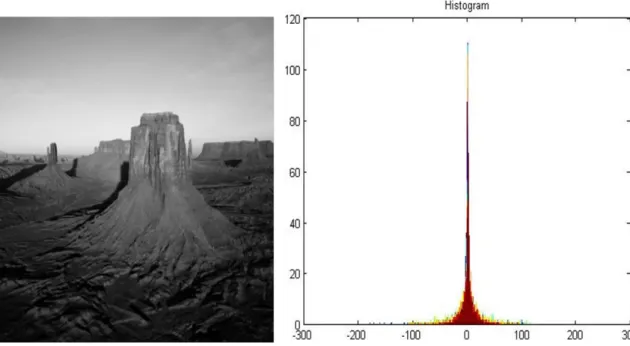
Figure 1.1 Desert image and its histogram of differences between neighbouring pixels ... 5
Figure 1.2 DCT encoding to Lena eye ... 7
Figure 1.3 Image (Lena) decomposition by DWT, (A) the first level decomposition and (B) second level decomposition ... 8
Figure 1.4 Histogram for original image (Lena) and for image after decomposed by DWT ... 9
Figure 1.5 Block diagram of image compression and decompression ... 10
Figure 1.6 coding order in MPEG ... 12
Figure 1.7 PB and D frame prediction ... 13
Figure 1.8 simultaneous video compression and encryption Approach... 15
Figure 2. 1The block diagram of transform image coding 21 Figure 2.2 PB Mode 29 Figure 2.3 JPEG 2000 fundamental building blocks 30 Figure 2.4 the search area 32 Figure 2.5 The JPSEC creator and consumer 44 Figure 2.6 The structure of JPSEC stream 45 Figure 3. 2 (a) the sub-bands of WT i for 8x8image (b) the quad-tree for each coefficient HL3 and X2/HL2 sub-bands………. ……… … .49
Figure 3.3 Morton scan ... 49
Figure 3.4 Quantization transforms ... 51
Figure 3.5 (a) a block 8x8 pixels from Lena image that is DWT (b) Three-level scan order ... 51
Figure 3.6 (a) Iteration 1, threshold = 1024. (b) Iteration 6 threshold = 64 ... 52
Figure 3.7 Block diagram of image encoding based DCT coding ... 53
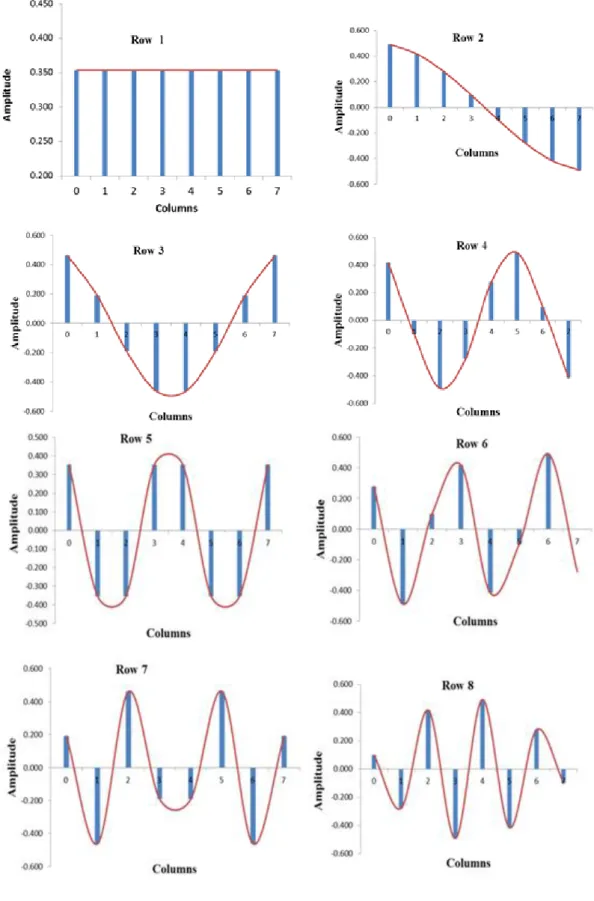
Figure 3.8 the DCT basis function of 8x8 arrays ... 55
Figure 3.9 Quantization tables (A) Low compression high quality (B) high compression Low quality ... 57
Figure 3.10 Zigzag scanning order of quantized DCT coefficients sequence ... 58
Figure 3.11 The Block diagram of proposal compression system ... 60
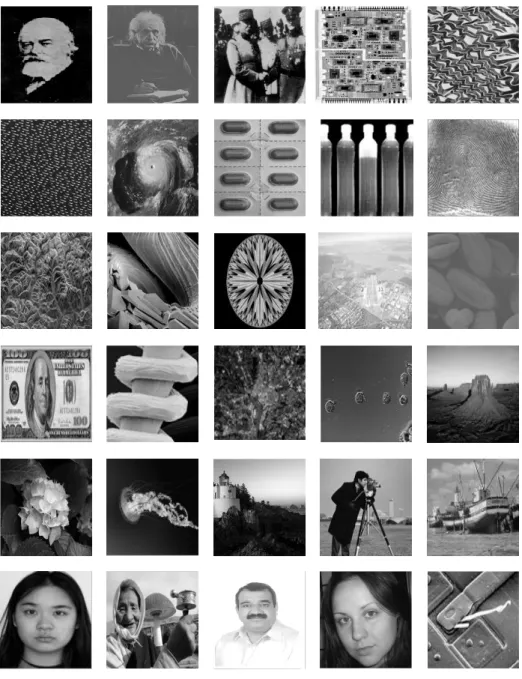
Figure 3.12 shows images test ... 62
Figure 3.13 the comparison results between MEZW and EZW ... 64
Figure 3.14 The scheme diagram of MEZWE system ... 65
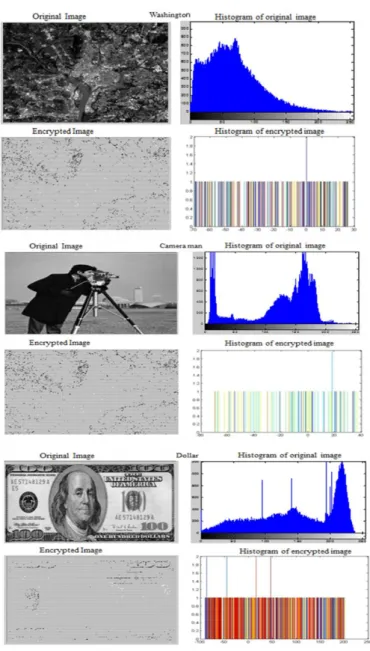
Figure 3.15 Histogram of original and encrypted image ... 66 Figure 4.1 Parallel Image compression and encryption 71 Figure 4.2 Vector quantization coding and decoding 72 Figure 4.3 example of CVQ encoding 73 Figure 4.4 Block diagram of image compression based on hybrid DWT, DCT and CVQ. 75 Figure 4.5 Block diagram of the proposed encryption 76 Figure 4.6 Compression results after WT to level 2 77 Figure 4.7 The mean and STD of Compression results after WT to level-3 and level-2 78
Figure 4.8 Encrypted Images 81
Figure 4.9 Histogram of original and encrypted image 83 Figure 4.10 PSNR of encrypted images 85 Figure 4.11 Illustrated steps for image compression scheme 86 Figure 4.12 Illustration of the Empirical Rule 87 Figure 4.13 Experiment scheme to image compression through edges extraction for level 1
wavelet decomposition 88
xv
Figure 4.15 Number of significant coefficients of the sub-bands (V1, H1 D1) for THR=1, 1.5, 2. 90 Figure 4.16 CR and PSNR of JDWCT-CVQ-Edge encoded images for different thresholds. 91 Figure 4.17 represent the comparison results between compression based on hybrid method and
edges extraction 92
Figure 5.1 example of video frames encoding (A) display order (B) encoding order ... 97
Figure 5.2 displays corresponding blocks from an inter- frame and RF frame and the search area in the RF frame. ... 98
Figure 5.3 parallel video compression and encryption ... 99
Figure 5. 4 Block diagram of the video compression ... 101
Figure 5.5 Illustrates the Encryption scheme ... 102
Figure 5.6 shows sample frames of videos test ... 104
Figure 5.7 shows a periodic Reference Frame (RF) in video compression proposed scheme .. 105
Figure 5.8 the effect of period RF on CR ... 106
Figure 5.9 the mean and STD of PSNR of tested videos at different RF period ... 107
Figure 5.10displays CR for tested video ... 108
Figure 5.11 illustrates the execution time for video compression-encryption and decompression-decryption ... 109
Figure 5.12 (A1, C1) represents encrypted frame, (B1, D1) represents histogram of encrypted frame, (A2, C2) represents decrypted frame, (B2, D2) represents histogram of decrypted frame ... 112
Figure 5.13 (A) represents encrypted frame, (B) represents decrypted frame (C) represents histogram of encrypted frame, (D) represents histogram of decrypted frame ... 113
Figure 5.14 illustrates the correlation of two adjacent pixels in the encrypted and decrypted frames, (A1, C1, E1) represent the correlation test in horizontal direction of the encrypted frame in video 1,3 and 6 respectively, (A2, C2, E2)represents correlation test of encrypted frame in vertical direction,(B1, D1, F1) and (B2,D2, F2) represents the correlation test for decrypted frame in the horizontal and vertical direction respectively. ... 114
Figure 6.1 represents the curve of the orbit map ... 119
Figure 6.2 A cobweb diagram of the logistic map, showing chaotic behaviour for various values of initial condition (𝒙𝟎 ) and control parameters ( 𝒓 ), 𝒏 is the number of iterations. ... 120
Figure 6.3 bifurcation diagram (A) for logistic map, (B) for sin map (C) for combine logistic and sin map ... 122
Figure 6.4 The simultaneous compression and encryption scheme ... 123
Figure 6.5 diagram illustrates the video compression scheme ... 125
Figure 6.6 represent Encryption scheme ... 127
Figure 6.7 CR for tested video ... 128
Figure 6.8 The execution time ... 129
Figure 6.9 illustrates PSNR of video frames at constant CR of 97%... 129
Figure 6.10 CR, execution time and PSNR for different wavelet filters ... 131
Figure 6.11 shows the encrypted and decrypted frames of tested videos (A) encrypted-decompressed frame (B) decrypted-encrypted-decompressed frame ... 133
Figure 6.12 Histogram of encrypted and decrypted frame selected from tested video (A) encrypted frame (B) decrypted frame ... 135
Figure 7. 1 The sinusoidal signal ... 138
Figure 7. 2 illustrates the mismatched block compression based on phase sensing ... 140
Figure 7.3 simultaneous video compression and encryption ... 143
Figure 7.4 illustrates the A5 structure ... 144
xvi
Figure 7.6 shows the encryption scheme ... 149
Figure 7.7 represent sample frames from test videos ... 151
Figure 7. 8 shows the achieved CR for tested video ... 152
Figure 7. 9 the mean and STD of PSNR for decompression and decryption videos ... 152
Figure 7.10 shows the bit rate comparison ... 153
Figure 7.11 CR comparison ... 154
Figure 7.12 shows execution time ... 154
Figure 7.13 PSNR for different video frames at constant CR of 97% ... 155
Figure 7.14 sample of recovered frame by three different methods (A) JDWCT-CVQ-Edges-phase sensing (B) DCT based(C) SPIHT ... 156
Figure 7.15 Comparison between phase sensing and RLE followed by Huffman encoding .... 157
Figure 7.16 represents sample frames size 512x512 pixels from test videos ... 157
Figure 7.17 illustrates the results of test videos with frame size 512x512 pixels ... 159
Figure7. 18 represents sample frames size 512x512x3 pixels from test videos ... 160
Figure7.19 illustrates the results of test videos with frame size 512x512x3 pixels ... 160
Figure 7. 20 represents sample frames size 240x320x3 pixels from test videos ... 161
Figure 7. 21 illustrates the results of test videos with frame size 240x320x3 pixels ... 161
Figure 7.22 the histogram of encrypted and decrypted frame (A) encrypted frame (B) decrypted frame(C) the histogram of encrypted frame (D) the histogram of decrypted frame ... 166
Figure 7.23 the correlation coefficient of adjacent pixels in encrypted and original frames .... 168
Figure 7.24 the mean and STD of PSNR for encrypted and decrypted videos ... 168
xvii
List of Tables
Table2.1 video coding standard ... 28
Table 3.1 results of EZW and proposal encoder 60 Table 3.2 Compression results after encoded by EZW and EZW combined with DCT 63 Table3.3 The correlation coefficient between two adjacent pixels in original and encrypted image. 68 Table 4.1: Number of blocks post compression, at decomposition level 1, 2 and 3. 79 Table 4.2 the comparison results between MEZW and JDWCT-CVQ 80 Table 4.3 Correlation coefficients analysis 84 Table 4. 4 the comparison results between MEZW, JDWCT-CVQ and JDWCT-CVQ-Edge 92 Table 5.1 The Mean and STD of PSNR for decompression video at different period RF ... 106
Table 5.2 the Mean and Standard Deviation (STD) of PSNR for decompression and decryption video ... 108
Table 5. 3PSNR of reconstructed frame of endoscopic video ... 110
Table 5.4 the mean and STD of PSNR of tested video at constant CR = 97%. ... 110
Table 5.5 the Correlation coefficient of adjacent pixels ... 113
Table 5. 6 the Mean and Standard Deviation (STD) of PSNR for encrypted video ... 115
Table6. 1 The Mean and Standard Deviation (STD) of PSNR for decompression and decryption video 128 Table 6.2 The Mean and Standard Deviation (STD) of PSNR for CH6M and CH5M method 130 Table 6.3 the Mean and Standard Deviation (STD) of PSNR for encrypted video 132 Table7. 1 the edges and mapping them in a zeroes matrix ... 142
Table7. 2 the clocking rule of A5 ... 145
Table7. 3 shows the mean and STD of PSNR and CR ... 155
Table7.4 the comparison results between coding frame size 512x512 and 256x320 pixels ... 158
Table 7. 5 shows the execution time by two different computers for coding 100 frames from 30 different videos with size (256x320) pixels in grayscale ... 163
Table 7. 6 shows the execution time by two different computers for coding 100 frames of 10 different coloured videos ... 164
xviii
Declaration
I hereby declare that all the work in my thesis entitled “Efficient Simultaneous Encryption and Compression of Digital Videos in Computationally Constrained Applications” is my own work except where due reference is made within the text of the thesis.
I also declare that, this thesis is not submitted for any degree at the University of Buckingham or any other university.
1
Chapter 1
Introduction
In recent years multimedia transmission through wireless channels has grown fast as a result of advances in wireless technology and availability of sensors and devices with increasing capacity for high resolution imaging. This has contributed to exponential increase in bandwidth and storage requirements far beyond the capabilities of existing open network channels and storage device. Therefore, data compression becomes essential for reducing the resulting heavy and ever increasing burden these requirements place on storage or transmission. The choice of the appropriate compression technique depends on the domain of application requirements in terms of competing factors such as image/video quality, bandwidth availability and efficiency. Moreover, many applications such as military images, video conferences, video telephony, digital TV and Internet streaming are transmitted through “unsecured” network channels such as the Internet. In such scenarios, video content is vulnerable to access or interception by unauthorized parties. Therefore, beside compression there is a need to deploy some security mechanism to protect the image/video content during transmission or in storage.
This thesis is concerned with efficient secure video transmission over open networks. The amount of uncompressed video data is too large for limited transmission channel. Therefore, video compression is an essential to achieve faster communication as possible through a limited bit-rate transmission channel. Over the last few decades, various methods and techniques for data and image compression have been developed. In general data compression algorithms can be categorized in two groups: lossy and lossless data compressions.
The general approach adopted in image./videos compression consist of 3 main steps: applying a frequency domain transform; a quantisation scheme which is meant to produce a sparse representation of the frequency data; and a coding scheme to map the output symbols onto a compact table of digital code words representing the compressed image/video. In this thesis we investigate and develop a video compression technique that is based on combining two main transforms, DWT and DCT, followed by Vector quantization and edge-phase sensing.
2
There are many well established cipher systems that have been developed over the years, Moreover; selective encryption technique is also performed to provide security when compressing data during transmission or storage. This technique will be shown to be fast enough to meet an efficient video streaming in constrained computational power. In the first section of this chapter we shall describe general approaches to image and video compression. Section 1.2 describes available video and image encryption. Section 1.3 presents thesis objectives, main approaches, and contributions. Section 1.4 gives thesis organisation. Finally, list of publication is presented in section 1.5.
1.1
Introduction to Image and Video Compression
Multimedia technologies have been advanced in recent years. Many applications such as military images, video conferences, video telephony, digital TV and internet streaming are transmitted through network channels. A digital image is composed of a finite number of elements known as pixels. In grey scale image, pixels are represented by unsigned 8-bits and having values ranging from 0 to 255. Pixels in colour images are represented by three colour channels; in Red, Green and Blue (RGB) colour space. Each component of RGB required 8-bits in binary representation and thus 24-bits per pixel. And there are other colour spaces such as Y CB CR . The Y component is luminance and
CB CR represents chrominance components which define the actual colour.
Generally, the content of Multimedia objects (e.g. image/video) is too large in size with high bit rates when produced from uncompressed digital video streams. Accordingly, such objects require large storage space, and their transmission over network channels requires very high bandwidth. When the data rate is generated by video streams become greater than the available network bandwidth, the data transmission process will suffer from long delays and possible failure.
For example, if a digital monochrome video of spatial resolution of 320×240 pixels is to be displayed at the standard rate of 25 frames per second (fps), then the corresponding bit rate is 320×240 ×25 ×8= 15360000 bits per second (bps). Now assuming the availability of a 56000 bps telephone network link , then we need to compress the video data by at least 275 times in order to accomplish the data transmission in real-time. Real-time is meant that the algorithm will run the video at the rate of the source supplying video. It is definitely impossible to transmit such a large volume of data (uncompressed video) over bandwidth limited networks used in low constraint devices.
3
The case of coloured images/videos is 3 times more demanding in terms of storage and bandwidth.
Therefore, data compression becomes essential before any video storage or transmission because it produces a low bit rates and reduces the time required for sequence video frames to be sent over different network channels (Shi and Sun 2008) (Annadurai 2007) (David, Motta and Bryant 2007).
Generally, the range frequencies required to transmit the audio are far narrower than that required for image/video transmission. Therefore, the audio also can be compressed at high quality using relatively low bit rate (high compression ratio).
Still image compression techniques and tools
1.1.1
Generally, compression of digital image/signals aims to faithfully represent digital data with fewer bits than necessary without degrading the amount of information conveyed by the data. This is possible because data and pixel values in images are not randomly dispersed within their spatial domain and include many redundancies. Compression is closely dependent on the amount of data redundancy in the generated image/video data. The amount of redundancy in an image has a measurable impact on the amount of information the image is conveying. Data compression techniques work by removing redundancies as much as possible and producing a compact representation of the data with little or no effect on the amount of information conveyed by the data. According to the theory of information, the amount of information a data/signal conveys is determined by the measure of Entropy which is computed in terms of the probability distribution of the symbols occurring in the data. According to the Information Theory, any symbol “S” in a signal/data holds an amount of Information (measured in bits) that reflects the frequency of its presence within the signal/data. The more a symbol “S” occurs in a signal the less its presence adds to the amount of information conveyed by the data. Shannon Theory of information models the amount of information a symbol “S” holds within a signal by the formula:
𝐼(𝑆) = log2(1𝑝) = − log2𝑝 𝑏𝑖𝑡 1. 1
Where ‘p’ is occurrence probability of “S” in the signal.
From the above equation 1.1, one can infer that a small value of ‘p’, shows that more information the symbol holds and vice-versa.
4
The amount of information for symbol 𝑆𝑖 (𝑖 = 1,2, … 𝑛) is called the Entropy (E), where
E can be described as below:
𝐸 = − ∑ 𝑝𝑖log2𝑝𝑖 𝑛
𝑖=1
𝑏𝑖𝑡 1. 2
Shannon declares that a massage of ‘n’symbols can be coded to n*E bit. A fixed length bit code representation for all symbols is not a realistic approach, but an optimal solution means that a minimum bit rate will be required for coding the more frequently occurring symbols while larger bit rate can be afforded for low occurring symbols. This approach is referred to in the literature as entropy coding. The fundamental concept in entropy coding is to assign the shortest code words to the symbols that occur more frequently, and the longest code words to those that appear infrequently. Accordingly, knowledge of the probability distribution of image spatial domain pixels (or the frequency coefficients), is essential for optimal compression. However, achieving optimality in this respect may have adverse effect on efficiency, and in many applications some loss of information may become necessary.
The main challenges to compression are the efficiency of detecting and locating the secinifacant data, and coding the data in a compact manner that remain within the actual constraints of data storage and/or communication bandwidth. In digital images, data redundancy may exist in the form of correlation between neighbouring pixels. In fact, pixel values are very similar and high correlation in the non-edge smooth regions, where differences between neighbouring pixels are generally very small or zero. For example, Figure 1.1 shows a histogram of differences in grey value between each pixel and its adjacent pixel in the 320x320 Desert image. It can be seen from Figure 1.1 that the differences clustered around zero i.e. there is high correlation between adjacent pixels in raw image. But neighbouring pixels around significant features differ significantly in their values. Hence, image compression could benefit from knowledge/detection of the smooth regions as well as the significant regions so that it can remove the redundancies in the first while retaining as much information as possible in the latter.
5
Figure 1.1 Desert image and its histogram of differences between neighbouring pixels Compression algorithms generally exploit statistical information about the frequency distribution of symbols/characters of the input data in order to reduce redundancies and to create new coding map of the data. Knowledge of the frequency distribution of symbols in the original data can be used to represent symbols with variable length bit strings and reduced redundancies. For example, in Figure 1.1, one can afford using long code words for symbols further away from the 0. There are various coding schemes that have been used in compression such as Huffman coding (Yang and Bourbakis 2005), Run Length Coding (RLE), Arithmetic coding LZW and etc. For more details see (Carreto-Castro, et al. 1993), (Pandur and Thiruvallur 2009) (David, Motta and Bryant 2007).
Image/video compression systems usually consist of three main steps: (1) de-correlation step which aims to reduce the amount of data redundancy; (2) a quantisation step; and (3) entropy encoding step. The de-correlation step is achieved by transformation of the uncompressed data from the spatial domain to the frequency domain where redundancies can be easily detected and removed. Often this step results in increased memory requirements because the output image data are real numbers rather than fixed length integer. However, the output data consist of large amount of small values (near 0) that are redundant. The second quantisation step, results in a small number of symbols that approximating the real-number data obtained in step 1. The entropy coding results in a coding table, to represent the quantised symbols in code words (bit strings) of variable length. The second step (quantisation) may result in loss of information. In
6
many applications certain level of such loss may be tolerated but has an effect on compression ratio and image quality. Accordingly, compression can be classified into two classes: lossless and lossy.
Generally compression exploits the statistical information in the image and is a reversible process by the decompression procedure. In the lossless case the re-construction is perfect, and the image quality is preserved. However, lossless compression can only achieve low compression ratios. A very simple example of lossless compression skips the first two steps and use RLE, commonly used for any type of data, and basically replaces any run (sequence of adjacent) pixels of the same grey value by giving the pixel value followed by the length of the run. For our purposes we shall focus more on Lossy compression but we aim to minimize the amount of loss, and achieve acceptable processing time as well as image quality.
Lossy compression is irreversible, because some information contained in the original data will be lost primarily during the quantisation step and the original data cannot be recovered exactly. It is typically used for images and sound compression where a little bit of loss in resolution is frequently undetectable. Therefore, the decompressed image contains degradations relative to the original image. Generally, more compression can be achieved at the expense of more distortion. However, there is always a trade-off between compression ratio, retrieve data in computational time and quality. The higher compression ratio is, the smaller the compressed data size is and the lower the bandwidth requirement is but the output will suffer from lower quality.
There are a variety of transforms that can be used for the de-correlation step, which normally project the image spatial domain (considered as a vector in a high-dimensional vector space) into another domain where the most significant image features can be approximated by a vector in a smaller dimensional subspace. The frequency domain transforms of Discrete Cosine Transforms (DCT) and the Discrete Wavelet transforms (DWT) are widely accepted for their capacity to re-organise input data in such a way that redundant transformed data can be detected easily. The existing image and video compressions tools of JPEG and MPEG are based on DCT while JPEG2000 is based on DWT. The DCT transforms the original data from spatial domain to frequency domain, while the DWT decompose the original data into different frequency sub-bands (low frequency sub-band and high frequency sub-bands). On their own, these transformations do not realize any compression, but they de-correlate the original data and compact the
7
significant information in certain frequency coefficients that form a relatively small set compared other frequency coefficients.
For efficiency purposes, the original uncompressed image may be first divided into smaller non-overlapping blocks and the transform is applied on each block separately. In the case of the DCT, the blocks are usually of size 8x8, but unfortunately this may result in blocky effects depending on the compression ratio.
For an 8x8 image block B = (bIJ) the DCT transform outputs an 8x8 frequency coefficient matrix T(B) so that for each i=1..8 and j=1..8.
𝑇(𝐵) = { √1 𝑛𝑐𝑜𝑠 (2𝑗 + 1)𝑖𝜋 2𝑛 , 𝑖 = 0; 𝑗 = 0,1, … . , 𝑛 − 1 √2 𝑛𝑐𝑜𝑠 (2𝑗 + 1)𝑖𝜋 2𝑛 , 𝑖 = 1; 𝑗 = 0,1, … . , 𝑛 − 1
All the coefficients of T(B) appear in ascending order of frequency magnitude in zigzag manner starting from the top left corner (see chapter 3 for description of DCT based image coding). Usually, the lower order coefficients contain significant information about a particular block and this information are more important in human perception. Therefore, in this thesis we shall be calculating DCT for only the top left triangle part of the T(B) block where the energy is locate. This method will reduce the computational time of DCT to the half and become more suitable to low constraint applications, see Figure 1.2. Blockwise DCT transform Partitioned to 8x8 blocks
The top left triangle part
Lena image eye
T(B)
8
JPEG2000 is DWT based coding method and produces higher quality compressed images compared to the earlier JPEG tool. On the other hand, JPEG2000 is still not so popular and the commercial options for JPEG2000 are not that great (Acharya and Tsai 2005) (Vetrivel, Suba and Athisha 2010) (David, Motta and Bryant 2007). The DWT decomposes an input image into four sub-bands labelled as LL1, HL1 (V1), LH1 (H1) and HH1 (D1) as shown in Figure 1.3 A. Subsequent decompositions are possible in many different ways. In the pyramid decomposition scheme, the LL1 (low frequency sub-band) is further decomposed into the next level of four sub-bands as shown in Figure 1.3 B. The low frequency sub-band (LL) represents an approximation of the original image. Therefore, the histogram distributions of LL sub-band is identical to the histogram of original image. The non-LL sub-bands (high frequency sub-bands) contains image features such as edges and corners. The non-LL sub-bands have Laplacian distribution and the significant coefficients (image features) are furthest away from the mean of each high frequency sub-band, this property remains valid at all level of decomposition as shown in Figure 1.4 (Al-Jawad, Ehlers and Jassim 2006). JPEG2000 and many recent compression schemes exploit these properties to gain knowledge about the non-smooth regions and increase compression ratio over JPEG (Ma 2002) (Ehlers 2008).
Figure 1.3 Image (Lena) decomposition by DWT, (A) the first level decomposition and (B) second level decomposition
9
Figure 1.4 Histogram for original image (Lena) and for image after decomposed by DWT The Standard Deviation (STD) of the non-LL sub-bands can be used to reveal these significant coefficients which correspond to edges and corners.
Having transformed the input image, the second reduction in entropy step of compression in each DCT block (or DWT sub-band) is achieved by removing the non-significant information which is traditionally done by applying a scalar quantization of the transformed coefficients. The quantization is based on the human visual system which is more perceptive to low frequency information than high frequencies. The simplest quantization can be done by dividing the block contents by a quantization factor, chosen in terms of the desired compression ratio, and rounding frequency coefficients to the nearest integer value. This is an irreversible process because cannot recover the lost information by inverse process. In the final step, the quantized coefficients are losslessly encoded using entropy encoding such as Run-Length Encoding(RLE), Huffman coding and arithmetic coding. Consequently, the entropy of quantized data can be represented by a variable bit rate compared with raw image pixel values that have fixed size bit representation. The basic idea in entropy coding is to assign the shortest bit-string code (known as word) to the symbols that occur more frequently, and the longest code words to those that appear infrequently.
A more advanced quantization technique for image compression is called Vector Quantization (VQ). In VQ the image is subdivided into non-overlapping blocks, each block is considering a vector called a code vector. The encoder will construct a list consisting of all code vectors is called a codebook. Then for each code vector, the closet
10
matched vector is determined and its index in codebook is encoded and transmitted to the decoder. At the decoder, the index is decoded and replaces it with the associated code vector with the same codebook as at the encoder. This technique will be demonstrated in more detail in chapter 4.
The image decompression procedure is just an inverse of compression process which starts by using the code book to recover the quantized values and finally applying the inverse of the DCT/DWT frequency transform. The following is a block diagram that covers both compression and de-compression.
Original Image Reconstructed Image Compressed data Entropy Encoder
Inverse Transform Entropy Decoder Compression Decompression Quantization and rounding Image block De-quantization and rounding Transform
Figure 1.5 Block diagram of image compression and decompression
When compressing RGB colour images, they are first converted to the Y CB CR . The human visual system is more sensitive to the Y component than other two components. So that, the Y component can be encoded at low compression ratio and the
CB CR components may be encoded at high compression ratio.
In this thesis we focused our investigations primarily on monochrome grey scale images/videos. However, we shall test the performance of a multi-channel version of our final monochrome coding scheme on colour videos to demonstrate the viability and suitability of our proposed scheme for efficient secure coding of colour videos (see chapter 7). (Shi and Sun 2008) (Blelloch 2001) (Sayood 2012)
Video compression tools and standards
1.1.2
Digital video is a sequence of images, each called a frame. In video sequences there are two types of redundancies that could be noticed. The first type is the spatial redundancy
11
(also called the intra-frame redundancy) that exists in each frame i.e. correlation between pixels within each frame. The second type is the temporal redundancy which is concerned with correlation between successive frames of video that are usually very similar. Video compression techniques are therefore based on reducing redundancies in both spatial and temporal directions. A common technique for video compression starts by encoding the first frame (Intra-frame) using a still image compression procedure. Then encoding each successive frame (Inter-frame) by determining the differences between the Intra and inter frame and encoding these differences and transmitting the differences (motion vector data) rather the whole frame over again. However, this approach results in accumulating errors and hence requires frequent corrections.
There are several methods to determine the motion vector; one such method is block based motion compensation which starts by sub-dividing the current frame into uniform non overlapping blocks. Then each block is compared with a set of candidate blocks in the preceding frame to select the one that best match the current block. However, motion estimation is time consuming in video compression process. Several standards like MPEG-x, H.26x, (x=1, 2, 3, 4) have been developed over the years and are commonly used for video compression. MPEG-x has been designed for storage (DVD) and TV broadcast, while H.261, 263 and H.264 are usually optimized for real-time video communication. Both standards are motion compensation based in Intra-frame coding.
To expedite motion vector prediction, MPEG separates the video into three types of frame: intra-frame (I), Predictive frames (P) and Bidirectional frames (B). The P frames are predicted directly from previous I frame. B frames are predicted from both previous (I or P) and next frame (I or P) as shown in Figure 1.6.
12
Video
frames
Encoder
Figure 1.6 coding order in MPEG
The H.263 video compression tool use frame mode for temporal encoding. PB-mode consists of two frames: P frame predicted from the latest decode frame and B frame predicted from both last frame (P or I valid) and the next frame P. The flash video codec (flash player) replaces the B frames with D frames. D frames only use the past P or I frame for motion vector prediction. The codec D frames achieve less compression ratio compared with H.263 but it improves the real-time processing, see Figure 1.7. We will describe this topic in more detail in chapter 2.
JPEG, MPEG-x and H.26x are DCT based image/video coding. However, the image based DCT coding suffers from noticeable distortion at high compression ratio (low bit rate). In this thesis we shall investigate the use of a hybrid of DWT and DCT for video compression to achieve a better performance than DCT based coding in term of quality.
13
Figure 1.7 PB and D frame prediction
Motion JPEG2000, also known as MJ2, employs only intra-frame. MJ2 compresses each frame individually by using JPEG2000 algorithms for still image compression.
1.2
Image and Video Encryption
For many organisations that rely in their work on the transmission of digital media objects over open network channels, protecting their contents from hackers and eavesdroppers has become an essential step in protecting their knowledge asset. Being the main and most commonly used security mechanism, encryption techniques are the natural scheme to be used to protect video data against security violations in storage and in transit. Encryption has been used for centuries for the protection of secrets and a wealth of ciphers have been developed within the wider area of information theory. Suitability of image/video encryption algorithms is dependent on various factors such as security level, computational time and their impact on compression efficiency. Modern data encryption ciphers such as AES, DES, and RSA generally work well on data stream input such as audio, video and text. Most of these ciphers work by acting on blocks of certain sizes. When dealing with offline secure video streaming, the above encryption algorithms can provide strong security, but are not fast enough for video streaming due the large size of the data input unless considerable amount of computational power are deployed. Stream ciphers are the alternative type of ciphers
14
that may be provide more efficiency, because they work on small size units of data. Examples of such ciphers include the Linear Feedback Shift Register (LFSR). In recent years, chaotic maps have been used to create stronger stream ciphers.
When dealing with both tasks of compression and encryption, the choice of a specific cipher is not the only influencing factor. Much consideration has been given to whether security necessitates the encryption of the entire compressed data, and whether these tasks can be implemented in parallel. Such decisions also have an influence on the choice of the appropriate cipher. Note that distorting an image in a way that renders recognition of the regions/objects of interest very difficult is akin to securing the image content. This idea have led to the concept of selective encryption which works by encrypting a small amount of the image data with a difficult to break cipher while using simple shuffling, if necessary, on the remainder. For example, encrypting certain wavelet sub-band(s) such as the LL-sub-band with a strong cipher may be sufficient to secure the image content. Selective encryption is useful for efficiency and will be investigated in this thesis. Moreover, the fact that image/video data have certain spatial redundancies that have been exploited for compression presents a choice between two approaches: Sequentially Compress and Encrypt (SqCE) or Joint Compression and Encryption (JnCE) by interleaving the encryption task with the steps of compression (i.e. the de-correlation step, quantisation, and entropy coding). In SqCE compression and encryption are done independently, inefficient and in the case of videos it complicates the effort of exploiting temporal redundancies across adjacent frames. For the JnCE approach, the encryption algorithm can implicitly have access to data at various compression processing steps, which is known SqCE compared with the JnCE; therefore the JnCE is better than SqCE in low constrained applications.
In this thesis, we incorporate selective encryption into the JnCE framework and refer to this modified approach as Simultaneous Compression and Encryption (SCE) which allows the data to be securely exchanged. Figure 1.8 depicts our SCE framework, taking into account our use of wavelet transforms as the de-correlation tool.
15
Figure 1.8 simultaneous video compression and encryption Approach
1.3
Thesis Objectives, Main Approaches, and Contributions
This project is aimed at meeting a growing demand for secure video transmission as a mean of gathering timely reliable awareness of events from unconventional locations while availability and affordability of sophisticated computing and communication facilities and infrastructure are restricted to the very basic. This is a typical scenario in many third world countries and in particular countries that are facing widespread international terrorism, organised crime, and internal civil conflicts while their law enforcing agencies and armed forces are deprived of material and skilled human resources. My research project is meant to utilise commercially available and affordable mobile devices that could be incorporated and integrated into its modest computing and communication infrastructure, this to facilitate remote intelligence gathering from around the country through secure communications with their personal who may be equipped with modest handheld devices that are endowed with reasonable cameras. The computing power requirements is estimated to be equivalent to speed computer equipped with Intel (R) i5 processer 2.3 GHz and RAM 4 GB.
In this project the concept of JnCE scheme can be based on the ability to process colour videos at a minimum rate of 30 frames per second. The standard frame size on the mobile devices we envisage in this thesis is 256x320 pixels. We will consider larger size standard definition video frames in this thesis of 512x512 pixels. Moreover, to
16
further reflect the limited computing and storage capabilities of some participant, we shall assume that the handheld devices do not save of videos for offline transmission. The developed scheme described in chapter 7 can be used by legitimate armed forces of under-developed nations by providing very low cost maintenance of secure communication as a cheap alternative of using costly systems such as satellite communications and/or early warning aircrafts. In these scenarios there are no fundamental reasons why the gathered intelligence videos should be of High Definition (HD), but due to our assumption on the constrained devices capabilities we will not experiment with HD videos. By no mean this is a shortcoming of the developed algorithms but rather a reflection of scares and constrained computational power affordable in the above circumstances. Moreover, we plan to widen the scope of our research in the future to include such investigations.
For my sponsor, this project fits into their effort to build capacity in developing advanced and secure digital technology solutions to fit their needs in a volatile region. The implementation of a secure video transmission system that can be used with high mobility low-cost constrained devices is only one step in their aim, this for achieving self-reliance in the development of cost effective enabling digital technology systems to maintain and adaptable for use in different applications including civil applications. Below is a list of use scenarios that the intended system can be utilised with basic modifications if necessary:
1. In dangerous zones of conflict, the intended system should work inside and on the periphery of the theatre of operations for the secure timely online relay of video content without saving for later use. However, the encrypted and compressed videos would be available for storage at the Command, Control, Computers, Communication and Intelligence (4CI) units.
2. The implementation of the same technology on unmanned aerial vehicle systems or fixed CCTVs as a general surveillance activity for information/intelligence gathering on possible terrorist and criminal. Such activities provide vital information for 4CI units in preparation of necessary tactical plans, or to protect vital infrastructure and industrial installations.
3. The use of the developed solution is by no mean limited to military and security purposes. In fact it can provide vital enabling information for civil applications,
17
such as the monitoring of critical instillations like oil pipes, borders, green fields for agriculture and environmental purposes, etc.
Our main approach is based on the SCE version of JnCE framework to achieve computational efficiency. It will benefit from the wealth of knowledge achieved over the years in existing work on video encryption and compression techniques developed according to existing standards including MPEG-x and H.26x. Compression will be based on a hybrid of: DWT, DCT, VQ, wavelet based edge detection and phase sensing. We aim to achieve lossy compression on the high frequency sub-bands and simultaneously applying selective encryption to the low frequency sub-band. We shall investigate various ways of dealing with Intra-frame Reference Frame (RF) and the Inter- frame as non- Reference Frame (n-RF) to reduce temporal redundancies and we shall determine the most suitable RF updating policy to maintain efficiency, high quality and to reduce processing time.We shall also benefit from existing knowledge in the fields of digital signal processing and data transmission over wireless communication system. In particular we shall study efficient ways of mapping the sparse blocks output from the various de-correlation procedures.
For security objectives, we adopt the selective encryption approach due to its suitability for constrained application. Three selective encryption algorithms will be investigated in chapter 5, 6 and 7 respectively and applied to different components of wavelet coefficients independently of the compression procedures. We develop and test the performance of different stream ciphers, whereby the key stream is generated in different ways but analogous to the A5 stream cipher and clocked by chaotic logistic map.
The experimental results show that the proposed algorithms for video compression and encryption are having the following features: high compression ratio, acceptable quality, resistance to the brute force and statistical attack and low computational processing to meet our constrained requirements.
18
1.4
Thesis organisation
This thesis is organised as follows;
Chapter 2 gives a literature review of different kinds of image/video compression and encryption and recent work on sequential and joint compression - encryption techniques for image/video data.
Chapter 3 describes the analysis of still image compression and encryption based on combining DWT and DCT to improve the compression efficiency of EZW. We demonstrate that the DCT reduces the loops scan of EZW encoding. On other hand, the computational time of this combined scheme is relatively high and has relatively slow processing time.
Chapter 4 proposes two approaches to optimize the image compression and encryption. The first approach is based on Joint DWT, DCT and Compressive Vector quantization (JDWCT-CVQ). The second approach (CVQ-Edge) uses the edges detection combined with the JDWCT-CVQ to improve the image compression-encryption.
Chapter 5 discusses the approach of using JDWCT-CVQ for secure video compresion.
Chapter 6 propose edge sensing to improve the security of the video encryption and to optimize the computational performance for video compression and encryption that were used in chapter 5.
Chapter 7 proposes phase sensing to optimize the video compression efficiency of the approach in the previous chapter. Moreover, the chapter proposes combined chaotic logistic map with A5 cipher to real-time secure video transmission.
19
1.5
List of Publications
Al-Hayani, Nazar, Naseer Al-Jawad, and Sabah Jassim. "Simultaneous video compression and encryption for real-time secure transmission." In Image and Signal Processing and Analysis (ISPA), 2013 8th International Symposium on, pp. 240-245. IEEE, 2013.
N. Al-Hayani, N. Al-Jawad and S. A. Jassim, “Simultaneous compression and encryption for secure real-time secure transmission of sensitive video transmission,” in International Society for Optics and Photonics, 2014. N. Al-Hayani, N. Al-Jawad and S. Jassim, “Simultaneous edge sensing
compression and encryption for real-time video transmission,” in International Society for Optics and Photonics, 2014.
20
Chapter 2
Literature Review
Over the years, variety image/video compression techniques have been developed to meet a number of conditions on compression ratio, image/frame quality and bandwidth. Data Encryption, on the other hand, has a long history but video encryptions is more recent and require special considerations due to the large size of image/video data and the presence of spatial as well as temporal redundancies. In this chapter we review the literature on existing image/video compression and image/video encryption. Section 2.1 will be devoted for compression, while section 2.2 covers the literature on the combined online compression and encryption for image/video. We shall end the chapter by describing the various refinement steps we adopted in our investigations that culminated in final proposed secure compression of video (SCE) scheme.
2.1
Image and video compression techniques
In this section a critical review of existing compression techniques will be conducted highlighting the advantages and shortcomings in relation to suitability for these thesis objectives. Although this thesis is concerned with secure videos under constrained conditions, but the starting point is on image compression techniques which we review in section 2.1.1. In section 2.1.2 the video compression standards, JPE2000 and Inter-frame compression techniques are presented.
Image compression
2.1.1
Transform image coding has developed at the early stages as the main theoretical framework of image compression and refers to encoding the spatial image pixels into compact data representation. It is appropriately used in coding prediction error in motion compensated predictive coding of sequence of video frames.
Usually, the transform image coding works in three steps as shown in Figure 2.1. Firstly, the raw image is divided into blocks size 8x8 or 16x16 pixels. Then, each block is linearly transformed by orthogonal transformation (orthogonal i.e. the dot product of the row with itself is one and with different rows is zero and the same think for columns. The inverse of orthogonal is its transpose; the product of the data transformed
21
with the inverse of orthogonal transform reconstructs the original data). The orthogonal transform retain the energy in the original image data and faithfully represents the significant image information in terms of a basis of few elements of transformed vectors, also called atoms, which can be used to recover the significant data of original image. The few transformed elements are less correlated compared with raw pixels. Subsequently, quantisation converts the non-significant information (high frequency confidents) to zero. The quantisation processing is related with image quality consideration, if high quality required the quantisation step will be small and vice versa(the quantisation will be explain in more detail in chapter 3) . The three functions quantisation, truncation and entropy encoding are called bit allocation as shown in Figure 2.1The quantized coefficients(after truncation) are collected by zigzag scan. This produces a string (one dimension) of coefficients that starts with non-zero coefficients (low frequency coefficients) and ends with many coefficients being zero. A code known Run Length Encoding (RLE) is very effective to encoding these scanned coefficients. The RLE works by reducing the size of repeating strings, called run, is typically encoding into two bytes. The first represents the number of coefficients in the run and the second byte is the coefficient value in the run. For instance, a run of 8 zeros coefficients will be encoded with two byte (8 and zero) rather than encoding each zero separately. Finally, the entropy encoding will be assigned short bit code word to coefficients that occur more frequently and longer bit code word to coefficient that occur less often. (Rao and Yip 2010) (Shi and Sun 2008).
Raw image Block division Linear transform Bit allocation (quantisation, entropy encoding) Figure 2. 1The block diagram of transform image coding
The role of the linear coding transform, both in lossless and lossy compression, is to de-correlate spatial domain of the image. A variety of such transforms are available for this task, which project the high-dimensional image spatial domain into another vector subspace generated by a small number of base vectors, called atoms, sufficient for approximating the most significant image features. Transforms like Singular Value Decompositions (SVD) and Principle Component Analysis (PCA) are applicable but not practical. The SVD is not efficient because it relies on solving an eigenvalue problem obtained from the image itself, while the PCA require solving the eigenvalue problem of the covariance matrix of a large training set of images of the same type of content,