Procedia Computer Science 89 ( 2016 ) 187 – 192
1877-0509 © 2016 The Authors. Published by Elsevier B.V. This is an open access article under the CC BY-NC-ND license (http://creativecommons.org/licenses/by-nc-nd/4.0/).
Peer-review under responsibility of organizing committee of the Organizing Committee of IMCIP-2016 doi: 10.1016/j.procs.2016.06.038
ScienceDirect
Twelfth International Multi-Conference on Information Processing-2016 (IMCIP-2016)
Mutual Entity Authentication Protocol Based on ECDSA for WSN
Ayaz Hassan Moon
a,∗, Ummer Iqbal
aand G. Mohiuddin Bhat
baNational Institute of Electronics and Information Technology, J & K bUniversity of Kashmir J & K
Abstract
Digital Signatures are primarily employed to achieve data integrity, data origin authentication and non-repudiation. In comparison to RSA-based digital signatures, the ECC (Elliptical Curve Cryptography) based Signature schemes like ECDSA (Elliptical Curve Digital Signature Algorithm) are more efficient and suited for a resource-constrained network like WSN. In a WSN, proper entity authentication is to be achieved before the sensor data is exchanged. The use of ECDSA is not suitable for achieving mutual authentication between the entities like the base station, cluster heads and nodes. Based on the study of ECDSA, the paper designs a mutual authentication protocol with the help of a computationally low signature scheme. To the best of our knowledge, this is the first digital signature based scheme which achieves mutual entity authentication. The paper also brings out performance parameters of the developed protocol.
© 2016 The Authors. Published by Elsevier B.V.
Peer-review under responsibility of organizing committee of the Twelfth International Multi-Conference on Information Processing-2016 (IMCIP-2016).
Keywords: Authentication; Mutual Entity Authentication; Wireless Sensors Network; ECDSA; TinyOS.
1. Introduction
Authentication is an assurance about the identities of communicating nodes or principals in any network. It involves a process to ascertain that the data has come from the alleged source and has not been modified en route. An adversary may spoof the source address and then inject malicious packets into the network so as to camouflage its originality1. As WSN primarily involve sensor data, based on which certain alarms and actuators are activated, authentication becomes imperative. Mutual entity authentication plays an important role in securing WSN against many types of attacks like impersonation, falsification of data, replay attacks etc. leading to DoS. Not many computationally efficient schemes have been developed to achieve this security primitive suitable for WSN.
DSA is a widely acknowledged mechanism for accomplishing authentication. It was initially proposed by the National Institute of Standards and Technology (NIST) in August 1991 and was notified in Federal Information Processing Standard of U.S Government called the Digital Signature Standard (DSS). Elliptic Curve Digital Signature Algorithm (ECDSA) which is based on DSA, provides a proficient message authentication scheme for WSN2. In this
paper based on the study and research of the ECDSA, a mutual authentication scheme comprising of 4 phases has been proposed.
∗Corresponding author. Tel.: 0194-2300502; Fax: 0194-2300949. E-mail address:[email protected]
© 2016 The Authors. Published by Elsevier B.V. This is an open access article under the CC BY-NC-ND license (http://creativecommons.org/licenses/by-nc-nd/4.0/).
Table 1. Signature Generation.
Input: parameter groupD=(q,F R,S,a,b,P,n,h), private keyd, messagem. Step Operation
1 Selectingk
2 Calculation: Calculatek P=(x1,y1)
3 Calculation: Calculater= ¯x1modn. Ifr=0, then to 1). 4 Calculation: Calculatee=H(m).
5 Calculation: Calculates=k−1(e+dr)modn. Ifs=0, then to 1). 6 Return: Return(r,s).
Output: signature(r,s).
Table 2. Signature Verification.
Input: parameter groupD=(q,F R,S,a,b,P,n,h), private keyQ, messagem, signature(r,s). Step Operation
1 Check out weatherrandsare between 1 andn−1. If anyone is not, the verify result is false. 2 Calculatee=H(m).
3 Calculatew=s−1modn
4 Calculateu1=ewmodn 5 CalculateX=u1p+u2Q
6 IfX= ∞, then refuse this signature else Take the x-axis coordinatesx1ofXto integerX1, calculatev=x1modn
Output: Return: Ifv=r, return acceptance of this signature, else return not accept
1.1 Elliptical Curve Discrete Log Problem
ECC based cryptosystem was proposed by Miller3and Koblitz4. An elliptic curve comprises of a set of numbers (x,y), regarded as points on that curve. The curve has to satisfy the following equation:
y2=x3+ax+b (1)
Elliptic curve cryptography offers a higher level of security in comparison to more traditional public crypto scheme like RSA. The hardness of the curve is assumed because of its elliptic curve discrete logarithmic problem ECDLP5
nature, for which the best known algorithm is exponential6. This enables ECC to work with smaller key size to achieve the same level of security as RSA does with comparatively larger key size. It has been reported than 160 Bit ECC can provide comparable security to 1024 Bit RSA7. Use of smaller key size results in achieving faster computation efficiency, saving of bandwidth, memory and energy. These features in ECC make it a front-end choice for WSN security.
1.2 Elliptical curve digital signature algorithm
The elliptic curve digital signature algorithm is the elliptic curve analogue of DSA and serves the same purposes of key generation, signature generation, and signature verification5, 6. As given in Wang8, ECDSA comprises of 2 parts
• Signature Generation
• Signature Verification
The Elliptic Curve parameters can be described as:T =(F R,E,P,n,h), whereF Ris the field representation,Eis an elliptic curve,Pis the generator point,nis the order ofPa large prime number andhis cofactor. The system uses a hash functionH. The user chooses a private keyd, and calculates its corresponding public key asPd = P∗d. The signature generation and verification is shown in Table 1 and Table 2.
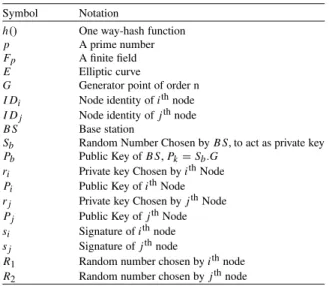
Table 3. Notations used. Symbol Notation
h() One way-hash function
p A prime number
Fp A finite field
E Elliptic curve
G Generator point of order n
I Di Node identity ofithnode
I Dj Node identity ofjthnode
B S Base station
Sb Random Number Chosen byB S, to act as private key
Pb Public Key ofB S,Pk=Sb.G
ri Private key Chosen byithNode
Pi Public Key ofithNode rj Private key Chosen byjthNode
Pj Public Key ofjthNode
si Signature ofithnode
sj Signature ofjthnode
R1 Random number chosen byithnode R2 Random number chosen byjthnode
2. Proposed Node Authentication Protocol
The protocol design comprises of following phases: Initialization phase, Signature generation phase, Signature verification phase, Mutual authentication phase. The notations used in this paper are given in Table 3.
2.1 Initialization phase
Base station functions like a key generation and distribution center and sets up the system parameters as following: The parameter group of system isD=(Fp,E,G,n,h,H,Sb,Ps).
2.2 Signature generation phase
It is a pre-deployment phase in which base Station selects a random numbersb between 1 ton−1 as its private key and computes its public keyPb =G.sb. For each nodei, the base station generates a random numberrsuch that 1 < r < n−1. It computes public key for each nodePi = G.ri. Base station computes a signature for each node using signature functionsi(ri,I d,sb).
Signature of each node
si=ri−1[ri.h(I d)+sb] (2) Each node is preloaded with its specific signaturesi., public certificate of base stationsband public certificate of each nodePiis made public to the network.
2.3 Signature verification phase
This is a selfcheck by the node to ensure that the signaturesi pertains to it and has been correctly generated and thereafter loaded into it. The node uses its node identification, public certificate, and the public certificate of the base
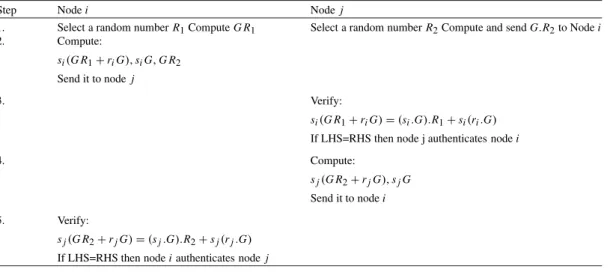
Table 4. Mutual authentication phase.
Step Nodei Nodej
1. Select a random numberR1ComputeG R1 Select a random numberR2Compute and sendG.R2to Nodei 2. Compute:
si(G R1+riG),siG,G R2
Send it to nodej
3. Verify:
si(G R1+riG)=(si.G).R1+si(ri.G) If LHS=RHS then node j authenticates nodei
4. Compute:
sj(G R2+rjG),sjG Send it to nodei
5. Verify:
sj(G R2+rjG)=(sj.G).R2+sj(rj.G) If LHS=RHS then nodeiauthenticates nodej
station to verify the authenticity of its signature.
si =ri−1[ri.h(I d)+sb] (3)
ri =si−1[ri.h(I d)+sb] : Multiplying each side byG
G.ri=G.si−1[ri.h(I d)+sb]=si−1.Gri.h(I d)+si−1.G.sb (4) G.ri=si−1.h(I d).public certificate of nodei+si−1.public certificate of base station
Nodeiverifies its signature valuesias given at (1) by computing the RHS value of equation (2) and comparing it with LHS. If the equation (2) is satisfied then the signaturesi of nodei is verified. Signature verification is undertaken by the other nodes in a similar manner.
2.4 Mutual authentication
Let nodei and node jhave to authenticate each other. Their mutual authentication can be achieved by using their respective signatures, their public certificates and the public certificate of the base station. Let their signatures be Si andSj as following:
si=ri−1[rih(I d)+sb] (5) sj =r−j1[rjh(I d)+sb] (6) The mutual authentication process flow between Nodeiand Nodejare shown in Table 4.
3. Time and Energy Analysis
Initialization and signature generation phases are done at pre-deployment, thus, their contribution to energy consumption at post-deployment is not considered. For capturing computational time of different key operations like Point Addition, Scalar Multiplication, Inverse a fundamental setup was created using MicaZ9mote and a MIB5209 Gateway. A nesC program has been written on TinyOS10, 11platform to compute on the time of various operation on
MicaZ mote.The program has been enabled with TinyECC12library. The computational time recorded for different operations is shown in Table 5. Computational time has been recorded over 3 standard SECG curves: Secp 192r1, Secp 160r1, Secp 128r1 to analyze the effect of key size on energy consumption.
Table 5. Computational Time Recorded.
Time Taken (Seconds)
Operation Secp192r1 Secp160r1 Secp128r1 Scalar Multiplication 6.07 3.90 2.23 Point Addition 0.21 0.14 0.098 Inverse Operation 0.16 0.12 0.069
Table 6. Critical Operation in 4 phases of Mutual Entity Authentication Protocol.
Inverse S. No. Phase Scalar Multiplication Point Addition Multiplication
1 Initialization – – –
2 Signature Generation – – –
3 Signature Verification 2 1 1
4 Mutual Authentication 4 2 –
Table 7. Energy and Time Analysis of Mutual Entity Authentication Protocol.
Secp192r1 Secp160r1 Secp128r1 Time Energy Time Energy Time Energy S. No. Phase Taken (Secs) Consumed (mJ) Taken (Secs) Consumed (mJ) Taken (Secs) Consumed (mJ)
1 Initialization – – – – – –
2 Signature Generation – – – – – –
3 Signature Verification 12.51 739.34 8.06 476.34 4.62 273.04 4 Mutual Authentication 24.78 1464.49 15.88 938.50 10.88 643.00
Total 37.29 2203.83 23.94 1414.84 15.5 916.04
The number of critical operations in various phases of the authentication framework is tabulated in Table 6. Energy is calculated by usingE=V∗I∗T(joules) is used, whereVandIstand for voltage and current drawn respectively and T is the execution time for each operation. The calculations have been done targeting MicaZ node powered by 02 AA batteries with 3 Volts and 19.7 mA load current. The energy and time calculations are shown in Table 7.
4. Conclusions
Based on the concept of ECC and ECDSA, a mutual authentication protocol comprising of 3 phases has been designed and proposed. An experimental setup was created to compute the time taken by various significant operations. Time and energy analysis of the proposed protocol was carried on Micaz motes. As key Size plays an important role in the level of security, time and energy analysis was carried out on 192, 160 and 128-bit curves. The protocol finds its feasibility in smart city applications where low power sensor nodes are used.
References
[1] A. H. Moon, N. A. Shah, Iqbal Ummer and Ayub Adil, Simulating and Analyzing Security Attacks in WSN Using Qualnet,IEEE Conference on ICMIRA, pp. 68–76, (2013).
[2] A. Khalique, K. Singh and S. Sood, Implementation of Elliptic Curve Digital Signature Algorithm,Int. J. Comput. Appl., vol. 2, no. 2, pp. 21–27, (2010).
[3] V. S. Miller, Use of Elliptic Curves in Cryptography,Advances in Cryptology CRYPTO85 Proceedings, Springer, pp. 417–426, (1986). [4] N. Koblitz, Elliptic Curve Cryptosystems,Mathematics of Computation, vol. 48, no. 177, pp. 203–209, (1987).
[5] B. Menzes, Network Security and Cryptography, Cengage Learning. [6] D. Hankerson, Guide to Elliptic Curve Cryptography, Springer.
[7] A. H. Moon and Khan Ummer, Authentication Protocols for WSN using ECC and Hidden Generator,International Journal of Computer Applications, (0975–8887), vol. 133, no. 13, (2016).
[8] W. H. Wang, Y. L. Cui and T. M. Chen, Design and Implementation of an ECDSA-Based Identity Authentication Protocol on WSN,
3rd IEEE International Symposium on Microwave, Antenna, Propagation and EMC Technologies for Wireless Communications, (2009). [9] Mote Works, Getting Started Guide, March (2013). PN: 7430-0102-02.
[10] TinyOS. http://www.tinyos.net.
[11] P. Levis and D. Gay, TinyOS Programming, Cambridge University Press (2009).