Informatics - Telecommunication - Electronics
Website Jurnal : http://ejournal.st3telkom.ac.id/index.php/infotelISSN : 2085-3688; e-ISSN : 2460-0997
Risk Factor Assessment of Software Usability Using
Fuzzy-Analytic Hierarchy Process Method
Afriyanti Dwi Kartika1*, Sofia Umaroh2
1,2 Institut Teknologi Nasional (ITENAS), Bandung 1,2Jl. PKH. Mustopha No.23, Bandung, West Java 40124, Indonesia
*Corresponding email: [email protected]
Received 04 July 2018, Revised 13 July 2018, Accepted 19 July 2018
Abstract — Software adds significant value to a wide range of products and services. Thus, in the process of software development, maintaining the quality of the software is an important aspect that the developer must do. In several software quality models, usability is stated as one of significant factor that gives impact to software performance. The existence of problems in usability lead to less useful of the software. This research was conducted to assess software usability risk factors which derived from the attributes and sub-attributes of usability, that affecting the quality of the software negatively. The importance of risk factors assessed by using fuzzy-Analytic Hierarchy Process. This risk assessment on software usability made it possible to process the evaluation of the respondents defined by linguistic format, in which information can be processed from insufficient data, subjective, inaccurate or vague. As result, this assessment showed dominant factors which were considered as the source of the usability software risk.
Keywords – usability software, risk assessment, fuzzy AHP, risk factor
All rights reserved.
I. INTRODUCTION
Today, businesses in companies and organizations essentially require the use of software. In today's modern information-based world, the world relies heavily on software systems that control facilities in areas such as energy, communications, finance, aviation, government and other areas.
In several software quality model, usability is stated as one of significant factor that gives impact to software performance [1][2]. Usability is defined as a significant factor in increasing acceptance and reliability of the product, improve user satisfaction and financially gives benefits to the enterprise [3].
Problems in usability can cause problems in software quality [3]. Usability problems can be occurred in interface design, operation process, or product structure that causing low effectiveness, efficiency and difficulty in use by users.
Problems on the usability can be regarded as a risk factor [2]. In the terminology in usability, risk is defined as "users cannot use product" [4]. Usability risk is an action or specific activities that are potentially cause harm or unexpected results which
give impact on the usability of software [2]. Usability risk is also an important factor that lead to the failure of software because it does not associated with quality products technically, but it is a problem that occurs during the using of software that resulting in a negative user experience [5]. Thus, usability risks should be managed both to reduce product failures and to produce software that is usable.
At this time, the research on software usability risk is still in small number. There are not many approaches taken to identify potential usability risks that occur in software [2]. If this continues to happen, then the possibilities in producing software that is not usable will be increased [2]. Thus, the development of risk assessment models in software usability is important [3].
Research [3][6][7][8] have discussed about software usability risks, the importance of software usability assessment and a model of software usability risk assessment which carried out by calculating the likelihood and impact of the risks (Risk Exposure (RE)). However, likelihood and impact of the risk are subjective, that leads difficulties in calculation. Furthermore, to get the comparison and the priority of
the risk, then the qualitative assessment is required, where the use of language terminology is needed. However, the assessment using RE does not allow it to do so.
Moreover, other research stated that there are various factors that influence the amount of risk [9]. These factors should be integrated in the risk assessment process to obtain reliable results [9].
Therefore, we proposed a model to assess factors of risk of software usability by using Fuzzy-AHP methodology referring to the research [9] and [10]. This model allowed an assessment by using language terminology and more flexible in dealing with the variation of judgment on decision making. Also, this model can be used to overcome uncertain information.
II. RESEARCH METHOD
A. Usability Software
Software adds significant value to a wide range of products and services and allow for competitive differentiation on the market. Software enables productivity and faster growth in all industries [11][12].
Maintaining the quality of software in its development process is an important aspect. The quality of software depends on the processes that take place during development process [13] and various improvements to software that is performed after the development process is done will take a high cost [14]. Usability has been recognized as an important quality factor in the software and has been there ever since the model of quality software was first discovered, known as FCM (Factor Criteria Metrics) introduced by McCall in 1997 [4].
Usability is defined by ISO as "the extent to which a product can be used by specified users to achieve specified objectives effectively, efficiently and meet the satisfaction of the specific context of use". Then IEEE Std. 610. 12 defines usability as "the ease with which users can learn to operate, prepare input, and interpret the output of a system or component" [15].
Various definitions of usability provide attributes of usability that can be applied to a wide range of products [5].
B. Usability Risk Factors
Various definitions of risk on software provides almost the same definition but provide different aspects and effects of different risks (negative and positive effects). This study only analyzed the risk of a negative consequence rather than as an opportunity.
The existence of problems in usability will lead to a lack of quality software that causes less useful of the software and also led to failure in meeting the expectations of users [16].
Usability issues can be considered as a significant risk factor for producing software that is usable [16], so there is a need to understand the risks in software usability. If the risk of software usability is properly
managed, overall change in reducing the risk of failure and to produce usable software will be increased [16].
Reducing the risk of potential usability in software development phase can improve the quality and also the usability of software that meets user expectations. It also helps developers in increasing sensitivity to risk usability that should be reduced or eliminated during the software development phase.
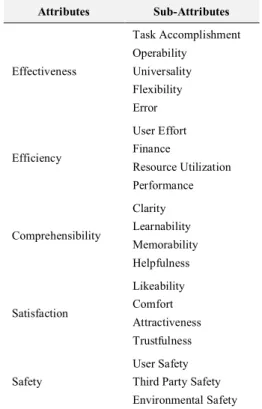
Potential usability risks in the software development process were identified [16]. Identification of software usability risks were conducted by using the attributes of usability [17]. Risk factors of usability software derived from the attributes and sub-attributes of usability, that is expressed in Table 1.
Table 1. Usability Software Attributes and Sub-attributes
Attributes Sub-Attributes Effectiveness Task Accomplishment Operability Universality Flexibility Error Efficiency User Effort Finance Resource Utilization Performance Comprehensibility Clarity Learnability Memorability Helpfulness Satisfaction Likeability Comfort Attractiveness Trustfulness Safety User Safety Third Party Safety Environmental Safety
This is in line with the logic that the factors affecting the quality of the software can be identified from the attributes defined in the model of software quality [7]. Thus, attributes and sub-attributes of usability software can be used as a risk factor of usability software.
C. Fuzzy - Analytic Hierarchy Process (FAHP)
Decision-making is used to select the criteria and alternatives that have different preferences and interests, therefore, it takes a measurement [18]. AHP is a measurement theory through pair-wise comparisons that relies on rating to obtain the priority scale. Implementation of AHP is conducted by constructing a hierarchy and make an assessment on a pair of each elements on the criteria for obtaining a scale of preferences, which then were synthesized
through the structure to select the desired alternative [19].
One area in which AHP is implemented is the risk assessment phase. In this phase, AHP is used to structure and prioritize the different risk factors, including the assessment of experts.
Decision making in complex and uncertain environments, will generally be related to the issue in which the description of the environment and elements of the decision to be very subjective, vague, and / or not right. Especially the use of qualitative evaluation criteria, particularly in the case of expert decision making, which can lead decision makers interpret the same information into different ways [10]. Therefore, it would be unrealistic and not appropriate to get a decision. The literature in the field of decision making in the past 15 years suggests to use fuzzy theory approach to overcome the uncertainty [10][20].
Decision makers are usually easier to express the assessment by using the interval value rather than by a fixed value [21]. In this case, the fuzzy theory can cope with uncertain information and more flexible in dealing with variations in assessment of decision makers [15]. As fuzzy logic has been demonstrated as an effective tool to accommodate human expertise and communication through linguistic variables [19].
III. RESULT
A. Determining Fuzzy Membership Function (MF)
Fuzzy Membership Function (MF) is a curve showing the membership function mapping input data in the interval 0-1. MF is usually derived from experimental data, the perception of terminology, linguistics and simulation of reality, which characterized by linguistic variables that are defined and accommodated to the environment under consideration [9]. If the variable takes words in natural language as a value, it is known as linguistic variables, in which the words are characterized by fuzzy sets [9].
There are several functions that can be used through the approach function to get the value of membership, such as Triangular, Trapezoidal, Gaussian, and Generalized Bell. For the present study, the MF used were Triangular and Trapezoidal.
B. Background Analysis of Respondents and Allocation of Contribution Factor (CF)
The risk analysis was carried out by the respondents (experts) who have a wide range of expertise in the field of software. Each respondent had different effect on the outcome, so the amount will be determined for each respondent. To define the skill of the respondents, moderator gave a number between [0-100] for each expert, and the amount of each experts was calculated by (1) [17], as follows:
= ∑
Where:
- ei = __th expert - P = Points for experts
C. Determining Risk Factors
The risk factor is uncertain conditions and have an influence on the cost, duration and quality of the project negatively, and if it is ignored or not mitigated, it will cause a serious threat to the project.
Software usability risk factor is derived from the attributes and sub-attributes of usability [7]. This is in line with the logic that the factors affecting the quality of the software can be identified from the attributes defined in the model of software quality [15]. Thus, attributes and sub-attributes of usability software can be used as a risk factor of usability software, showed at Table 1.
D. Comparing the Risk Factors in Pair-wise
Each factor was evaluated using AHP to analyze the multi-criteria decision making that consists of criteria hierarchy. The results of the comparison matrix will be calculated using the geometric mean.
Assessment was made for each factor based on the knowledge of the respondents using AHP. The respondent may make an assessment using exact numbers, ranges, or linguistic terminology or fuzzy numbers. In some situations, if the required information is available, the respondents tend to give exact numbers or numbers with certain ranges. However, respondents sometimes have difficulty in determining the assessment in the form of a number, so the terminology of linguistic or fuzzy numbers can be used [22].
The risk factors were assessed using a number of crisp or fuzzy, with the scale of the numbers 1-9 [18]. Example:
- Using linguistic terms: such as, "about 8". - Using a range, such as “(5,7)”, the scale is
approximately between 5 and 7.
- Using fuzzy numbers, such as “(3, 5, 7)”, the scale is between 3 and 7, tends to 5.
E. Converting Assessment Result to STFN (Standardized Trapezoidal Fuzzy Number)
Due to the risk factor values given by the respondent may be the value of a number, a range of numbers, terms of language or fuzzy numbers, then STFN was used to convert expert assessment into a universal number for the composition of the group assessment [9].
If U is the set of rules, U = [0,u], then STFN can be defined as A* = (al, am, an, au), where 0 al am an au, shown by (2) [9], as follows: ∗ ( ) = ⎩ ⎨ ⎧( − )/( − ) ≤ ≤ 1 ≤ ≤ ( − )/( − ) ≤ ≤ 0 ℎ
The value of a number, number range and triangular fuzzy number can be converted to STFN in a simple way [9], ie:
a) If al = am = an = au, then STFN is a single
number.
b) If al = am and an = au, then STFN is the range
number.
c) If am = an, then STFN is triangular fuzzy
number.
d) If the expert cannot provide his judgment on a particular comparison, then the value 0 can be used for STFN, that is (0,0,0,0)
F. Aggregating Individuals Assessment into One Group Assessment
The purpose of this step was to build an adequate operator to aggregate the value of individual assessment into a single value. Aggregation of individual values was conducted by using the operator trapezoidal fuzzy weighted averaging, which was defined as (3) [9], as follows:
∗= ∗ ⊗ + ∗ ⊗ + ⋯ + ∗ ⊗
Where:
- S*i = Fuzzy aggregation value of risk
factors
- Si1*, Si2*, ...Sim*= STFN of the risk factors
assessed by m number of experts
- C1, C2, C3, ..., Cm= Value of CF
(Contribution Factor) of each expert, where: C1 + C2 + C3 + ...+ Cm = 1.
STFN scale aggregation is defined as (4), as follows:
∗ = ∗ ⊗ ⊕ ∗ ⊗ ⊕ … ⊕ ∗ ⊗
Where:
- a*ij = Fuzzy scale of Fi compared to Fj
- i,j = 1,2,..., n
- a*ij1, a*ij2, ..., a*ij3 = STFN scale of Fi
compared with Fl measured by experts E1, E2, ..., Em.
G. Defuzzification of STFN
To convert STFN scale aggregation into a number that present group preferences, it takes a defuzzification [22].
If there was a value of STFN a*ij = (alij, amij, anij, au
ij), then the value of aij was obtained (5) [9], as
follows:
=
Where:
- aii=1, aji=1/aij
All fuzzy aggregation scale a*ij (i, j= 1,2, ..., n)
was transferred into scale of one number in range [0..9].
H. Calculating the Amount of Priority of Risk Factors
If F1, F2, F3, ..., Fn were risk factors in one session,
while aij was a scale representing defuzzification of Fi
assessment results compared with Fj, then pair-wise
comparisons between Fi and Fj, in a session in a
matrix of n x n, as follows: = = 11 … 1 1 … 1 … … 1 … … … … … … … … 1 , = 1,2, … Where: - aii=1, aji = 1/aij.
The amount of priority of risk factors in the matrix A can be calculated using the arithmetic average [4] as (7), as follows:
= ∑ ∑ , , = 1,2,3, … ,
Where:
- wi = Amount of Fi
Assume that Fi has top sessions (upper section) in
different levels of hierarchy FI, and w section is the amount of sessions on all i. The ultimate size of w1i of Fi can be calculated by (8), as follows [9]:
= × ∏ ( )
IV. DISCUSSION
Assessment of risk factors of usability software using fuzzy methodology was intended to be used on variety of software. To test the assessment, then a testing was conducted on a software which recorded the annual work program of an organizational unit and the actual hours worked daily activities that were assigned to each employee
A. Determining Fuzzy Membership Function (MF)
MF approach used was Triangular, where Very Poor (VP), Poor (P), Fair (F), Good (G), and Very Good (VG) are used to describe the impact of factor risk to software as shown in Fig.1.
Fig. 1. Membership Function (MF) for Risk Factors B. Background Analysis of Respondents and
Contribution Factor (CF)
Each respondent provided an assessment based on their knowledge and expertise on each factor in the hierarchy. Each expert had different perspectives so as to produce different decisions in judging. For that, the moderator performed a contribution factor (CF) assessment of each respondent by assigning a number between [0-100].
Assessment was conducted by some respondents, which in this study was conducted by 5 experts in the field of software with different backgrounds, which then be calculated using (1), as showed in Table 2.
Table 2. Contribution Factor (CF) for Every Experts
Expert Pei Cei E1 80 0,21 E2 75 0,20 E3 70 0,19 E4 80 0,21 E5 70 0,19 Where C1 + C2 + C3 + C4 + C5= 1.
C. Determining Risk Factors
Usability software factors were derived from the attributes and sub-attributes of usability [7], showed in Table 1.
D. Comparing Risk Factors in Pair-wise
Risk factors that affect the occurrence of usability risk are presented in Table 1 in hierarchy. The assessment was based on the knowledge of the respondents for each factor using fuzzy – AHP. The assessment used linguistic scale as follows at Table 3:
Table 3. Linguistic Scale of Factor Risk
Value Definition
Very Poor
(VP)
Factors have high impact on the usability of software
Poor (P) Factors have specific impact on the usability of software
Fair (F) Factors not have a major impact on the usability of software
Good (G) Factors not have critical impact on the
Value Definition
usability of software
Very Good(VG)
Factors have not affect the usability of software
E. Converting Preference into STFN
The above comparison results were then converted to STFN to convert expert judgments into a universal number format for group appraisal compositions.
F. Aggregating Individual Assessment One Group Assessment
The results of these STFN, then aggregated into a single value. Aggregation of individual values was performed using trapezoidal operator, which is defined in (3).
Here's an example of calculating the aggregation value in the sub-attribute Task Accomplishment:
= (5.0,7.5,7.5,10.0)⨂0.21⨁(2.5, 5.0,5.0,7.5)⨂0.20 ⊕ (7.0,10.0,10.0,10.0)⨂0.19⨁(5.0,7.5,7.5,10.0)⨂0.21⨁ (0.0,0.0,0.0,2.5)⨂0.19
= (4.042,6.075,6.075,8.075)
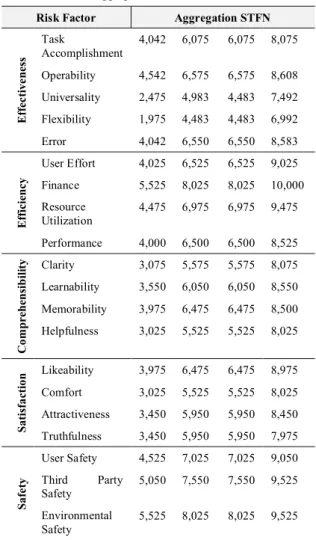
After all sub-attributes are calculated, then obtained the following results at Table 4.
Table 4. Aggregation Value of Factor Risk
Risk Factor Aggregation STFN
Effec tive ness Task Accomplishment 4,042 6,075 6,075 8,075 Operability 4,542 6,575 6,575 8,608 Universality 2,475 4,983 4,483 7,492 Flexibility 1,975 4,483 4,483 6,992 Error 4,042 6,550 6,550 8,583 Efficiency User Effort 4,025 6,525 6,525 9,025 Finance 5,525 8,025 8,025 10,000 Resource Utilization 4,475 6,975 6,975 9,475 Performance 4,000 6,500 6,500 8,525 Co m prehensib ili ty Clarity 3,075 5,575 5,575 8,075 Learnability 3,550 6,050 6,050 8,550 Memorability 3,975 6,475 6,475 8,500 Helpfulness 3,025 5,525 5,525 8,025 Satisfa ctio n Likeability 3,975 6,475 6,475 8,975 Comfort 3,025 5,525 5,525 8,025 Attractiveness 3,450 5,950 5,950 8,450 Truthfulness 3,450 5,950 5,950 7,975 Safe ty User Safety 4,525 7,025 7,025 9,050 Third Party Safety 5,050 7,550 7,550 9,525 Environmental Safety 5,525 8,025 8,025 9,525
G. Defuzzification of STFN
First assessment of IF section was by pair-wise comparison of the five risk factors usability attributes, namely Effectiveness, Efficiency, Comprehensibility, Satisfaction and Safety. The comparisons result then was aggregated using (8) to get the value of W, as shown by Table 5.
Table 5. Result of IF Comparison
Effec tive ness Efficiency Co m prehensib ili ty Satisfa ctio n Safe ty W 1,000 1,380 2,580 3,360 2,960 0,346 1 / 1,380 1,000 2,580 3,340 3,340 0,310 1 / 2,580 1 / 2,580 1,000 1,760 2,160 0,153 1 / 3,360 1 / 3,340 1 / 1,760 1,000 1,780 0,107 1 / 2,960 1 / 3,340 1 / 2,160 1 / 1,780 1,000 0,084
The next step was to pair-wise comparison of the sub-attributes of the risk factors of usability.
Pair-wise comparisons on Effectiveness factors, where aji = 1 / aij. For each aij (1, 2, 3, ... n), calculated
using (4).
= (3,3,3,3) ⊗ 0,21 ⊕ (5,5,5,5) ⊗ 0,20 ⊕ (3,3,3,3) ⊗ 0,19 ⊕ (5,5,5,5) ⊗ 0,19 = (4.200, 4.2000, 4.200, 4.200)
After the result of aij obtained, it was then carried defuzzification of STFN scale by using (5).
=4,200 + 2(4,200 + 4,200) + 4,200
6 = 4,200
If all of the aij (1, 2... n) is obtained, the results are as follows: = ⎩ ⎪ ⎨ ⎪ ⎧ 1 1/4,200 1/4,200 1/4,360 1/4,980 2,600 1 1/5,020 1/4,980 1/4,600 4,200 5,020 1 1/3,020 1/3820 4,360 4,980 3,020 1 1/4,490 4,980 4,600 3,820 4,490 1 ⎭⎪ ⎬ ⎪ ⎫
Thus, scale aggregation obtained from the FI part Effectiveness are:
= {0.363, 0.2521, 0.096, 0.053, 0.038} H. Calculating the Amount of Priority of Risk
Factors
By using the same formulation, all factors on a hierarchy of risk factors are calculated. The end result of these quantities is then calculated by using (8).
ℎ
′ = ×
ℎ = 0.036 × 0.0346 = 0.126
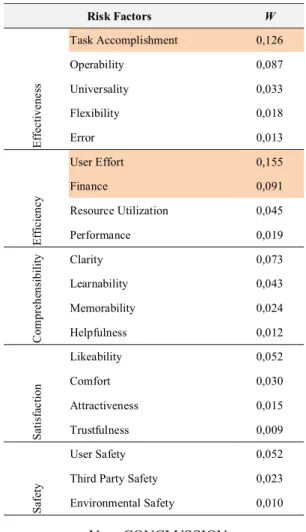
From the results of these calculations, we know which risk factors that had the greatest importance
value, which was defined as the largest software usability factor in the software. The factor that had the greatest value was the factor User Effort (W = 0.155), Task accomplishment (W = 0.126) and Finance (W = 0091) shown by the Table 6, as follows.
Table 6. The Importance Value of Risk Factors
Risk Factors W Effec tive ne ss Task Accomplishment 0,126 Operability 0,087 Universality 0,033 Flexibility 0,018 Error 0,013 Efficien cy User Effort 0,155 Finance 0,091 Resource Utilization 0,045 Performance 0,019 Com p reh en sibility Clarity 0,073 Learnability 0,043 Memorability 0,024 Helpfulness 0,012 Satisfac tion Likeability 0,052 Comfort 0,030 Attractiveness 0,015 Trustfulness 0,009 Safety User Safety 0,052
Third Party Safety 0,023
Environmental Safety 0,010
V. CONCLUSSION
The risk assessment on software usability with fuzzy methodology made it possible to process the evaluation of the respondents defined by linguistic format, in which information can be processed from the data were insufficient. This fuzzy methodology allowed to process the data that were subjective, inaccurate or vague. Assessment of risk factors was conducted by using AHP that can be used to identify the dominant factors that become a source of risk..
ACKNOWLEDGMENT
This work was supported by the Institut Teknologi Nasional (Itenas), Bandung, Indonesia.
REFERENCES
[1] A. Dromey and R. Geoff Dromey, “A Model for
Software Product Quality,” IEEE Trans. Softw. Eng., vol. 21, no. 2, 1995.
[2] J. T. Sambantha Moorthy, S. bin Ibrahim, M. Naz,
and ri Mahrin, “Identifying Potential Usability Risk During Software Development Process.”
[3] J. Moorthy, S. Ibrahim, and M. Mahrin, “The Need For Usability Risk Assessment Model,” Second Int. Conf. Informatics Eng. Inf. Sci. (ICIEIS2013). Soc. Digit. Inf. Wirel. Commun., pp. 215–220, 2013.
[4] T. Altom, “Usability as risk management,”
interactions, vol. 14, no. 2, p. 16, Mar. 2007.
[5] M. Uzzafer, “A risk classification scheme for
software projects,” Int. J. Softw. Eng. its Appl., vol. 7, no. 1, pp. 57–68, 2013.
[6] J. T. S. Moorthy, S. Bin Ibrahim, and M. N. R.
Mahrin, “Formulation of usability risk assessment model,” 2013 IEEE Conf. Open Syst. ICOS 2013, pp. 168–173, 2013.
[7] J. Sambantha Moorthy, S. Bin Ibrahim, and M. N. R.
Mahrin, “Identifying usability risk: A survey study,” 2014 8th Malaysian Softw. Eng. Conf. MySEC 2014, pp. 148–153, 2014.
[8] J. T. S. Moorthy, S. Ibrahim, and M. Naz,
“Developing Usable Software Product Using
Usability Risk Assessment Model,” Int. J. Digit. Inf. Wirel. Commun., vol. 4, no. 1, pp. 95–102, 2014.
[9] J. Zeng, M. An, and N. J. Smith, “Application of a
fuzzy based decision making methodology to construction project risk assessment.”
[10] G. Yucel, S. Cebi, B. Hoege, and A. F. Ozok, “A fuzzy risk assessment model for hospital information system implementation,” Expert Syst. Appl., vol. 39, no. 1, pp. 1211–1218, 2012.
[11] B. W. Boehm, “Software Risk Management: Principles and Practices,” IEEE Softw., 1991.
[12] H.-M. Lee and L. Lin, “FUZZY RISK
PRESUMPTIVE EVALUATION IN SOFTWARE
DEVELOPMENT,” Int. J. Innov. Comput., vol. 7, no. 7, pp. 3881–3889, 2011.
[13] J. Munch, O. Armbrust, M. Kowalczyk, and M. Soto, Software Process Definition and Management. 2013. [14] J. Li, M. Li, D. Wu, and H. Song, “An integrated risk
measurement and optimization model for trustworthy software process management,” Inf. Sci. (Ny)., vol. 191, no. May 2012, pp. 47–60, 2012.
[15] A. K. Sharma, A. Kalia, and H. Singh, “An Analysis of Optimum Software Quality Factors,” IOSR J. Eng., vol. 2, no. 4, pp. 663–669, 2012.
[16] by A. Steven Wake Sallie M Henry, “Predicting Maintainability with Software Quality Metrics.” [17] S. Cebi and C. Kahraman, “Developing a group
decision support system based on fuzzy information axiom,” 2009.
[18] T. L. Saaty and L. G. Vargas, Decision making with the analytic network process. 2013.
[19] A. F. Shapiro, “Risk Assessment Applications of Fuzzy Logic CAS annual meeting.”
[20] W. Gunawan and A. Zainal Arifin, “Lokal Fuzzy
Thresholding Berdasarkan Pengukuran Fuzzy
Similarity Pada Interaktif Segmentasi Citra,” Infotel, vol. 9, no. 1, pp. 40–47, 2017.
[21] C. E. Bozdag, C. Kahraman, and D. Ruan, “Fuzzy group decision making for selection among computer integrated manufacturing systems,” Comput. Ind., vol. 51, no. 1, pp. 13–29, 2003.
[22] T. L. Saaty and M. Hall, “FUNDAMENTALS OF THE ANALYTIC NETWORK PROCESS,” ISAHP, 1999.