Modeling language learning using specialized Elo ratings
†Jue Hou,†Maximilian W. Koppatz,†Jos´e Mar´ıa Hoya Quecedo, ?Nataliya Stoyanova,‡Mikhail Kopotev and †Roman Yangarber †University of Helsinki, Department of Computer Science, Finland ‡University of Helsinki, Department of Modern Languages, Finland
?University of Milan, Department of Foreign Languages and Literatures, Italy [email protected]
Abstract
Automatic assessment of the proficiency lev-els of the learner is a critical part of Intelligent Tutoring Systems. We present methods for assessment in the context of language learn-ing. We use a specialized Elo formula used in conjunction with educational data mining. We simultaneously obtain ratings for the pro-ficiency of the learners and for the difficulty of the linguistic concepts that the learners are trying to master. From the same data we also learn a graph structure representing a domain model capturing the relations among the con-cepts. This application of Elo provides ratings for learners and concepts which correlate well with subjective proficiency levels of the learn-ers and difficulty levels of the concepts.
1 Introduction
A key goal of Intelligent Tutoring Systems (ITS) is to provide students with individualized learning, and thus support their learning process. Several systems for various subjects have proven to be ef-fective, (Ritter et al., 2007; Arroyo et al., 2014; Klinkenberg et al., 2011). Our work is part of an international collaborative effort to developing large-scale Intelligent Computer-Aided Language Learning (ICALL) systems for use in real-world environments. Our system, Revita (Katinskaia et al., 2018), is in use in official university-level curricula at several major universities, to enhance language learning and teaching.1
To develop automated methods for personalized tutoring, robust models for assessing the current proficiency of learners are required. Such models enable quantitative evaluation and comparison of teaching methods with respect to the rate of devel-opment of the learners, which enables us to evalu-ate the performance of the ICALL system.
1https://revita.cs.helsinki.fi/
Several approaches for modeling knowledge have been proposed, such as Bayesian Knowledge Tracing (Corbett and Anderson, 1994), Learn-ing Factor Analysis (Cen et al., 2006), and its more advanced variant—Performance Factor Analysis, (Pavlik Jr et al.,2009). These models, however, are complex and time-consuming to im-plement for ITS, and require large amounts of data for each learner, (Pel´anek,2016).
In this work, we present a simple and effective method for assessing the proficiency of language learners, as well as the difficulty of linguistic con-cepts, by utilizing the Elo formula, (Elo,1978)— in an unsupervised fashion. The result is a set of rated concepts and a method for assessing the cur-rent and historical proficiency of each learner. We also present a concept graph—learned from the educational data—representing the dependencies between concepts.
We use educational data, collected from real language learners, in two assessment contexts. One context is where learners take language profi-ciency tests. During the test the system samples questions from a database, each question linked to a specific linguistic concept. Examples of con-cepts are collocations, certain type of verb inflec-tion, certain word-order rules, etc. In the second context, learners do exercises based on “authentic” texts—chosen based on the learners’ interests— that have a difficulty estimate, assigned by a sta-tistical model. In each context, the result is a nu-meric Elo-based rating describing learners’ profi-ciency in the target language.
The paper is organized as follows. Section 2 outlines out data generation process. In Section3, we describe the Elo rating system, and discuss our modifications to the formulas in the two assess-ment contexts. In Section 4, we discuss our ap-proach for building a domain model, represented by a concept graph. Section 5 describes
simula-tions and experiments on obtaining Elo ratings for concepts and for assessing learner competency. In Section6, we discuss preliminary results on corre-lation between Elo ratings in different assessment contexts, and the correlation between the Elo rat-ings and the performance levels assigned by teach-ers. We also demonstrate a graph of concepts, each with Elo difficulty estimates. In Section7, we dis-cuss current problems. Section 8concludes with current directions of research.
2 Data
This work builds on educational data we have col-lected through a collaborative effort with language teachers at several universities. In this paper, we focus on students learning Russian as a second language (L2) at different levels on the CEFR scale, ranging from A1 to C2, (Little,2007). The students yield data in two assessment contexts: Language tests: In the testing context, the stu-dents take online language tests on a platform pro-vided by the system. Each test is time-limited, and comprised of approximately 300 test items, sampled from a database of 3390 multiple-choice questions. The questions were prepared by lan-guage teachers and linguistic experts over a period of 20 years, (Kopotev,2012,2010). Each question is linked to one of 140 linguistic “concepts,” also predefined by the experts. At the time of this writ-ing, the response data consists of 600 000 test an-swers, by approximately 1000 learners. For each answer we record to which concept the question belongs, whether the answer was correct, as well as timestamps.
Language practice: In the practice context, stu-dents practice the language by doing exercises based on a text. The response data consists of student answers to the exercises: one set of ex-ercises is associated with a snippet of text (e.g, one paragraph). The system offers various types of exercises, including multiple-choice questions, “cloze” quizzes (fill-in-the-blank), and listening comprehension, which are generated automati-cally based on the text chosen by the learner. Each text has been assigned a difficulty rating by a lin-ear model, described in3.4. Currently, we do not use information about to which linguistic concepts each exercise belong. For each attempted set of exercises, we use the percentage of correct an-swers, text difficulty, and the timestamp.
3 Rating methods
This section describes how we calculate and up-date ratings of users and linguistic concepts. We cover the two assessment contexts in which the data were generated: first, the testing context, and second, the practice context. The estimator of text difficulty is described at the end of this section. 3.1 Elo ratings
The Elo rating, introduced by Arpad Elo, (Elo, 1978), was originally used for rating the skills of chess players, and evolved versions of it are now widely used in a variety of domains, ranging from video-games to Tinder.
The Elo formula defines the expectedresult of actorAin a match against actorBaccording to:
EA=
1 1 + 10RB−σRA
(1)
EAis a value between 0 and 1, indicating the ex-pectation (probability) of success/win. RX refers to the current rating of actorX, andσ is a scale variable. The scale is traditionally set to 400 (in chess). This controls the spread of the resulting ratings. In the present work, we usedσ= 600.2
The rating of actorAaftera match with another actor is completed is updated according to:
R0A=RA+K(SA−EA) (2)
The factorKcontrols the maximum rating adjust-ment that is possible at one time. We use a static
K value of 32. SA denotes the outcome, or the score of a match for actorA: loss, draw and win forAis denoted as 0, 0.5 and 1, respectively.
The Elo rating method has three important prop-erties. First, the formulas are symmetric:AandB
switch places when calculating with respect toB. This leads to the zero-sum property of the Elo rat-ing distribution, whenK is static—the amount of Elo lost by the losing actor is transferred to the winning one. As a result, the mean of the ratings of all actors will be whatever the initial rating is set to. We initially set the rating of all players (con-cepts and learners) to 1500.
Second, the magnitude of the rating update de-pends on the difference between the outcomeSA
2
The reason for this is largely aesthetic; the number of users is currently small (about 1000), which results in a some-what narrow spread of the rating distribution. A larger spread is more comparable to actual chess ratings, which is more familiar and easier to conceptualize.
and the expected score EA. This means that a highly rated actor failing against a significantly lower rated one will have a severe loss in Elo, ap-proaching the value ofK. Conversely, the success of a higher rated actor is expected, thus it yields a small update in the rating. If the actors are evenly matched the update is between the two extremes.
Finally, the final, or “current,” distribution of Elo ratings in a system depends on the order of the matches. This implies that the Elo rating is a representation of an actor’scurrentproficiency. Consider an actor who fails in the first half of 100 matches, and succeeds in the second half, and compare the result to the reverse order. Because the rating updates decrease toward the expected extremes, and are exaggerated at the unexpected extremes, the resulting rating of the actor will be high when his successes are in the second half of the matches and low in the reverse case—even though the two sequences are events are the same, and differ only in their ordering.
3.2 Language test ratings
In (Klinkenberg et al.,2011;Pel´anek,2016), it was shown that Elo ratings can be adapted for use in educational systems, to model the proficiency of students and the difficulty of questions. In our sys-tem, in the testing context, the analogue of an out-come of a “game” is a student attempting an exer-cise; the two rated “actors” are the student and the exercise. SArepresents whether a student has an-swered the question correctly. The ratingRQof a questionQcaptures the difficulty of the question. An adjustment is made for multiple-choice problems to account for the fact that students have some chance of guessing correctly, even if they do not know the correct answer. For this, we adopt an approach recommended byPel´anek(2016), penal-izing the expected value by the probability that a random guess is correct. A similar expectation for-mula is proposed in Item Response Theory (Em-bretson and Reise,2013).
In (Klinkenberg et al.,2011;Pel´anek,2016), the focus was assessing the difficulty of each particu-lar question. In our system, we model the con-cept category to which the questions belong; ev-ery question from a concept is a representative for the concept in the calculations. In our data, each question is linked to one linguistic concept. The formula for the expectation of student S having a correct response on a question from ConceptC
adjusted for guessing is:
EA= 1 k ·1 + (1− 1 k)· 1 1 + 10RC −RS σ , (3) wherekis the number of choices in the multiple-choice question. We expect the Elo ratings for concepts to approach their true value after a large number of data points (“games” or ex-ercise attempts) have been sampled. To ob-tain concept ratings of better quality, they are learned by re-adjusting all ratings by re-playing all games/attempts in chronological order over sev-eral epochs. We call this the Elo “burn-in” period, and describe it in Section5.1. This is used to ob-tain “stable” concept ratings.
3.3 Language practice ratings
In the practice context, the exercises are different from the test context. Our method therefore dif-fers in the two contexts in several ways. Here, the exercises sets that the learners have answered are composed of a variety of exercises, some of which may not be linked to a specific linguistic concept (recall, each test item is linked to a con-cept). This means we cannot share the ratings di-rectly between the two learning contexts.
To address this problem, we make the simplify-ing assumption thaton averagethe exercises in a given text correspond to thedifficultyrating of the text. The method for estimating the difficulty of a text is described in the following subsection.3
Concretely, we define SA as the percentage of correct responses in a given set of exercises. EA for a set of exercises is set to the Elo rating of the entire textfrom which the exercises are drawn.
We update the learner’s Elo aftereachset of ex-ercises, but update the text’s Elo only after an en-tire iteration through the text. Crucially, the sys-tem updates the Elo for the text only with respect to the specific user who practiced it. This mod-els the notion that as I practice with the same text over and over, the text becomes “easier” for me— but not for other players.
3.4 Estimator of text difficulty
Modeling and characterizing the readability of texts is a well-studied problem with a long his-tory, (Dubay,2009). Experiments with lexical and
3This means that A. our difficulty model should return an
accurate estimate of the complexity of the text, and B. that these difficulty estimates should be properly calibrated to the desired rating scale.
grammatical features have been conducted, (Chen and Meurers,2016;Heilman et al.,2008).
We use a simple linear model for estimating the difficulty of a given text. The output of this model is scaled onto the Elo rating scale. This enables us to calculate the expected result of any rated learner solving exercises from any rated text.
Lexical frequency is known to be a powerful predictor of text readability, (Chen and Meurers, 2016). We use the normalized mean of the lexical frequencies of the tokens in a text as a feature. Ad-ditionally, we usemean token lengthandmean sentence length, as they are also used in classic readability measurements, (Kincaid et al., 1975; Flesch,1979). These three features are scaled for a simple 3-variable regression model.
Currently, data for training this model are parti-tioned into two types: texts from sources with sim-plified language vs. texts from difficult sources. We label simple texts with a value of 0.2 and dif-ficult texts with 0.8.4 We aim for a model that produces a correct ordering of texts with respect to their difficulty. We do not need an exact es-timate. If the learner Elo ratings based on these estimates correlate well with the ratings from the testing context, we consider this estimator accu-rate enough. In Section5we show that so far, this indeed seems to be the case.
The model outputs typically range between 0 and 1. We scale these values to Elo ratings ac-cording to formula4. This transformation is based on the Elo rating distribution acquired in the test-ing context. The bounds are clamped at(0,1), as some texts may get a high difficulty value (some-times even>2, in extreme cases).
f(x) = 600, ifx <−0.4 1000x+ 1000, if −0.4≤x≤1.4 2400, ifx >1.4 (4) 4 Concept graph
We are interested in finding a model for the “nat-ural” order in which learners acquire linguistic concepts—directly from learner data. Learners will find some orders more natural than others—
4
This is a simplification, which does not reflect reality ac-curately, as not all texts from a given source are of equal dif-ficulty. However, simply fitting a low dimensional, high-bias estimator such as this yields a reasonable baseline model that generalizes well enough to other texts. We will explore more sophisticated models in the future.
e.g., when some concept is a requirement for other. The fact that one concept “precedes” an-other is called thesurmiserelation in Knowledge Space Theory (Doignon and Falmagne,1999).
Often the domain model in ITS is built by elic-iting domain knowledge from experts. We devised a baseline model to infer such relations from user data, without supervision. As we mentioned, each test question is mapped to a certain linguistic con-cept, and we store all test results from all students. Based on these results, we know to what extent which users have mastered which concepts; from this, we can try to tell apart the more basic con-cepts from the more advanced ones.
The aim is to build a partial order over the set of all conceptsC, which specifices which concepts are related—i.e., we writec2 → c1 to mean
con-ceptc2 presupposes(or implies) conceptc1.5 Given a set of users U, we build a matrix of “mastery” scoresM, of dimension|U| × |C|. Ev-ery element Mij is the proportion of correct an-swers that userui has given for conceptcj. In the current implementation, we consider each “user” to be a single test session. If the same person completes the test at different times, they will be treated as different users for the purpose of com-puting consistency. This is done to take into ac-count the fact that a user’s level of proficiency changes over time.
For every pair c1, c2 ∈ C, we check whether
c2 → c1, c1 → c2 orc1 ⊥ c2 . We compare all
columns ofM pairwise. Let cj denote column j ofMandckcolumnk. To check whetherck→cj is true, we define a logical functionCONuwhich checks that useruis consistent with this relation:
Muk Muj CONu(ck→cj)
0 0 1
1 0 0
0 1 1
1 1 1
Again, here ck is the “harder” concept than cj. Thus, if Muk = 0 (useru knows nothing about concept ck), that is consistent with ck → cj re-gardless of the value ofcj. Conversely ifMuj = 1 (userumastered conceptckperfectly), that is con-sistent withck→cj regardless of the value ofck.
In practice, the values in M are fractions be-tween 0 and 1. Therefore we introduce two
thresh-5We would like to say thatc
1is aprerequisiteforc2, but
that may be too strong a claim. However wemaybe able to learn from the data thattypicallyc1is mastered beforec2.
old parameters to map Mij to zeroes and ones: we believe that a useru really does not know the (harder) conceptck ifMuk 6θguess: the “guess-ing” upper bound, below which we believe that the user does not know the concept, while sometimes only guessing the correct answer. Analogously, we say that a user u has mastered quite well the (easier) concept cj ifMuj > θmaster: the “mas-tery” lower bound, above which we believe that the user knows the concept, while sometimes mak-ing a few mistakes.
To check whetherck→cj, we compute the pro-portionσof all users who are consistent with this relationck→cj, as follows: σ(ck→cj) = 1 n X u∈U CONu(Muk, Muj) where: CONu(Muk, Muj) = 1 ifMuk6θguess 1 ifMuj >θmaster 0 otherwise
nis the total number of users. θguess andθmaster refer to the thresholds of guessing and master-ing respectively. That is, we ignore all users where the level of proficiency inc1andc2suggests
that user only partially understands both concepts, since they do not support to the consistency from
ck→cj.
We then apply a consistency threshold θ such that, ifσ(c2 →c1)> θ, we add the relationc2 →
c1to our partial order.
Finally, we represent the partial order as a di-rected acyclic graph (DAG), where each path in the graph represents a possible prerequisite route toward learning a concept. For example, if we wish to obtain a complete syllabus for a language course, then we can find a total order compatible with our partial order (i.e., a linear extension) by topologically sorting the nodes in the graph.
We tested this approach with a set of over 620K answers gathered from 700 users, and manually evaluated the results, settingθ=.7.
Our domain experts confirm that the resulting graph provides a plausible model for the relations between the concepts in the language.
5 Experiments 5.1 Elo burn-in
In conventional Elo rating systems, the ratings of both actors are updated after each match. Our goal
Figure 1: Learning concept Elo ratings with burn-in
is to learn a stable rating for each language con-cept, which we can keep unchanged as learners take further tests and improve. The rationale be-hind this is that the concepts don’t become less difficult for everyone if a learner masters it.
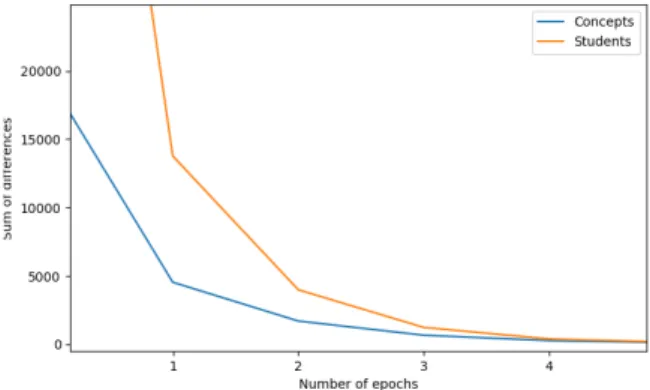
To achieve this, we perform a burn-in simu-lation based on the user data we have collected. Specifically, we take the entire collection of data and calculate the Elo updates for each data point— user U doing exercise E—in chronological order. We do this for repeated epochs until the sum of differences between epochs nears zero. This is il-lustrated in Figure1.
Once convergence is achieved, we reset the stu-dent ratings, and recalculate them from scratch with thefixedconcept ratings. This yields a system where the learners’ ratings are comparable and in-dependent for any learner, including future ones. 5.2 Test and exercise simulation
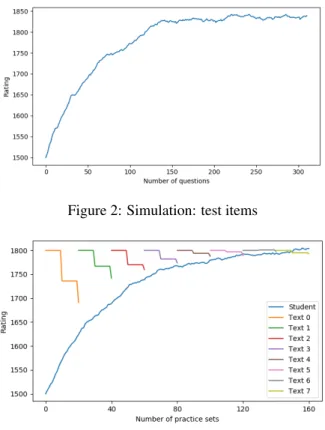
To verify that one test (of 300 items) is sufficient for a learner to reach her current “true” rating, we performed simulation experiments. Concretely, we measured how many test items a new learner (e.g., with a rating of 1800 Elo) must answer in order to settle on her rating.
In this simulation, each student is initially rated as 1500, and complete some test items. We use the Elo expectation formula to get the response accuracy for the simulated actors. We perform randomized simulations of actors performing one 300-item test with this average response accu-racy and observe the results, shown in Figure 2. The actors’ responses—correct or false—are sam-pled randomly according to her supposed correct rate. We also add a small amount of normally dis-tributed random noise. As Figure2shows, in this case, one 300-item test is enough to reach one’s “true” rating.
Figure 2: Simulation: test items
Figure 3: Simulation: exercises based on texts
In contrast to the test item context, in the con-text of con-text-based exercises, the Elo ratings will be updated over time both for for learners and prac-tice texts. We conducted a simulation to visualize the rating trends.
In the exercise simulation, the simulated actor has the same starting point as in the simulation for tests—1500. We fix her rate of correct responses, e.g., as 50%, and the actor is practicing only sim-ulated texts rated at 1800. This means that the the-oretical upper bound of the actors’ rating is, by definition, under 1800.6 The same normally dis-tributed noise is introduced in this simulation as above. The data in our system shows that texts typ-ically contain 10 snippets (exercise sets) or fewer. After a full pass through a text, namely, 10 prob-lem sets, the ratings for the text are updated with respect to this particular actor. In this simula-tion each text is to be practiced twice. Figure 3 shows the result of this simulation. We stopped the simulation after 8 texts (each practiced twice) because the rating of the actor had converged to 1800. Since the student begins far below 1800, the first several problem sets will have a substan-tial drop in their rating, due to the large inisubstan-tial
dif-650% success rate in a competition setting means the
play-ers are perfectly matched; since the text is rated 1800, the learner’s Elo rating should also reach 1800 and remain there.
Figure 4: Expert annotated CEFR groups vs. mean Elo rating for each CEFR level
ference between student’s rating and text’s diffi-culty estimate. This initial burn-in process soon ends, after the student practice several snippets. As we can observe in Figure 3, the initial burn-in process ends after 3 texts—10 snippets/practice sets per text, each text practiced twice, yielding 60 snippets—the subsequent ones showing only a slight change. The simulation is based on the assumption that the student will go though every problem set in strict order. In reality, this is not very likely. We can therefore infer that this student can reach a rating around 1800 rating after practic-ing with less than 140 snippets/problem sets. 6 Results
The result of primary interest is how well the Elo ratings given by our system correspond to CEFR levels assigned to the learners by the expert teach-ers, who estimate the learners’ proficiency based on a wide range of assessment criteria, including written essays and oral exams. The relationship between Elo and CEFR is illustrated in Figure4.
The figure shows the means and 95% confi-dence intervals of the Elo ratings for the CEFR levels of students, assigned subjectively by the teachers. The numbers of students at each CEFR level in our experiments are given in Table1. The data in Figure 4comes from 142students whose CEFR levels were established independently of these tests by the teachers. Although language competency encompasses several skills—reading, writing, aural comprehension, speaking—and the learner may be at different levels in different skills, we normally expect that the competencies across different sills are fairly well correlated. The cor-relation om Figure4is0.90. Thus, the data in the figure indicate good correlation between our rating method and actual proficiency.
CEFR Students A1 48 A2 31 B1 18 B2 6 C1 17 C2 22 Total 142
Table 1: Number of CEFR rated students in Figure4
Figure 5: A representative student test Elo progress
of learners is largely in the realm of future work, we have interesting preliminary data of learners’ improvement. Figure 5shows an example of the progress of a typical actual learner taking tests. The learner takes (randomized) tests over a period of time, with the rating improving consistently. In this example, we see an increase of almost 300 in average Elo during the periods. The improvement is attributed to the fact that the learner has covered new material during the period, mastered more of the concepts in the test, and consequently scoring better on those questions.
Another crucial question is how well our Elo estimates from the exercise context correlate with Elo ratings from the testing context. For this we also have initial results, shown in Figure 6. We have so far collected only a modest amount of learner data, and therefore the conclusions drawn from the data are preliminary. Investigating this correlation requires substantial data from learners who have worked in both contexts: practicing with exercises based on texts, and completing tests. The figure shows results for the top 17 students, who have completed at least 1000 exercise sets (text snippets, in orange) and at least 300 test items (in blue)—sorted according to their testrating. The figure shows good correlation between the two
rat-Figure 6: Correlation between test and text-based exer-cise ratings (ρ= 0.79)
ings for the students. At present, the correlation between test and practice Elo score is0.79.
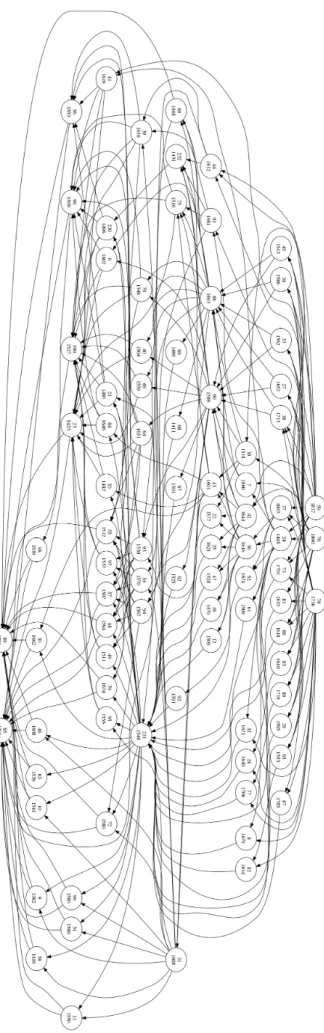
The last goal in our work is to investigate the re-lationship between the concept graph and the Elo ratings. Figure7 shows a small sub-graph of the concept graph. The complete concept graph8can found in the Appendix. From Figures7and8, we can see that typically (though not always), if con-cept A surmises concon-cept B, A will have a higher Elo rating than B. This makes sense, as more dif-ficult concepts should surmise easier ones. The Elo ratings and the graph structure do not corre-spond perfectly. Expecting that real-valued linear ratings can accurately describe the natural order of concepts is unreasonable. Since the graph and the Elo ratings describe different processes, it is not surprising to find inversions in the graph, such as between concepts 98 and 93, in Figure7. The structure of the graph, its relation to the difficulty of concepts, and the natural learning order of con-cepts is an key future research topic.
Figure 7: Sub-graph of the complete concept graph (see Supplementary Materials). Arrows denote implication. Top number: ID of the concept (appendixA); bottom number: Elo score of the concept (appendixB).
7 Current problems
We are in the process of collecting user data and evaluating the methods of assessment presented in this paper. Subjective CEFR ratings are being col-lected from the teachers for some of the students. While the number of hand-labeled CEFR ratings is modest at the time of writing, it is sufficient to indicate that using Elo-based ratings for measur-ing language proficiency shows promise. Buildmeasur-ing domain models based on the concept precedence graph is another direction of research.
Comparing our ratings and expert-annotated proficiency levels in larger quantities will raise the confidence of our method. We must note that a sin-gle value cannot be expected to describe the lan-guage proficiency of a learner completely, as there are several aspects of the language to master.
We plan to compare other Elo-based mod-els, such as Glicko (Glickman, 1999), and TrueSkill (Herbrich et al.,2007), with our Elo rat-ing formula. Robust methods for obtainrat-ing nu-merical estimates of skills enables us to develop ICALL systems, by facilitating the quantitative evaluation of skills, and the resulting improvement of the learners.
8 Conclusions
The main contributions of this paper are:
• We adapt and evaluate Elo-based rating for-mulas for modeling language learners’ profi-ciency, as well as the difficulty of texts and linguistic concepts, not only the difficulty of questions/test items.
• We obtain static difficulty ratings for the linguistic concepts by performing an ini-tial burn-in for the Elo ratings based on a large amount of learner data, and then as-sess students’ proficiency using the learned Elo ratings. Feedback from language teach-ers/experts indicates that the ratings correlate with their estimates of learner competency. • We use a linear-regression model of text
dif-ficulty as an estimator, to obtain Elo ratings for the texts. This enables us to rate the per-formance of learners, who practice with ex-ercises generated from the texts. Preliminary results indicate that there is a positive corre-lation between ratings in the exercise and the test contexts.
• We build a partial order over all concepts found in the domain, and visualize the par-tial order as a DAG over concepts. The con-cept graph is not linear as the Elo ratings. The structure of the concept graph and the Elo ratings of the concepts generally agree in that the graph displays a strong tendency of decreasing rating from the more complex concepts to the more fundamental concepts, as indicated by the actual data collected from the learning process.
In sum, the proposed methods enable us to rate the proficiency of the current and future language learners, which is a fundamental goal in ITS and ICALL.
Acknowledgements
This work was supported in part by the Academy of Finland, Project FinUgRevita, Grant No. 267097.
References
Ivon Arroyo, Beverly Park Woolf, Winslow Burelson, Kasia Muldner, Dovan Rai, and Minghui Tai. 2014.
A multimedia adaptive tutoring system for mathe-matics that addresses cognition, metacognition and affect. International Journal of Artificial Intelli-gence in Education, 24(4):387–426.
Hao Cen, Kenneth Koedinger, and Brian Junker. 2006. Learning factors analysis – a general method for cognitive model evaluation and improvement. In In-telligent Tutoring Systems, pages 164–175, Berlin, Heidelberg. Springer Berlin Heidelberg.
Xiaobin Chen and Detmar Meurers. 2016. Character-izing text difficulty with word frequencies. In Pro-ceedings of the 11th Workshop on Innovative Use of NLP for Building Educational Applications, pages 84–94.
Albert T Corbett and John R Anderson. 1994. Knowl-edge tracing: Modeling the acquisition of procedural knowledge. User modeling and user-adapted inter-action, 4(4):253–278.
Jean-Paul Doignon and Jean-Claude Falmagne. 1999.
Knowledge Spaces.
William Dubay. 2009. Unlocking language: The
clas-sic readability studies. Professional
Communica-tion, IEEE Transactions on, 51:416 – 417.
Arpad E. Elo. 1978. The rating of chessplayers, past and present. Arco Pub., New York.
Susan E Embretson and Steven P Reise. 2013. Item response theory. Psychology Press.
Rudolf Flesch. 1979. How to write plain English: Let’s start with the formula. University of Canterbury. Mark E Glickman. 1999. Parameter estimation in large
dynamic paired comparison experiments. Journal of the Royal Statistical Society: Series C (Applied Statistics), 48(3):377–394.
Michael Heilman, Kevyn Collins-Thompson, and Maxine Eskenazi. 2008. An analysis of statistical models and features for reading difficulty predic-tion. InProceedings of the third workshop on inno-vative use of NLP for building educational applica-tions, pages 71–79. Association for Computational Linguistics.
Ralf Herbrich, Tom Minka, and Thore Graepel. 2007.
TrueskillTM: A Bayesian skill rating system. In
B. Sch¨olkopf, J. C. Platt, and T. Hoffman, editors,
Advances in Neural Information Processing Systems 19, pages 569–576. MIT Press.
Anisia Katinskaia, Javad Nouri, and Roman Yangarber. 2018. Revita: a language-learning platform at the intersection of ITS and CALL. In Proceedings of LREC: 11th International Conference on Language Resources and Evaluation, Miyazaki, Japan. J Peter Kincaid, Robert P Fishburne Jr, Richard L
Rogers, and Brad S Chissom. 1975. Derivation of new readability formulas (automated readability in-dex, fog count and Flesch reading ease formula) for Navy enlisted personnel.
Sharon Klinkenberg, Marthe Straatemeier, and Han LJ van der Maas. 2011. Computer adaptive practice of maths ability using a new item response model for on-the-fly ability and difficulty estimation. Comput-ers & Education, 57(2):1813–1824.
Mikhail Kopotev. 2010. Система прогрессивного тестирования Karttu (описание и первые результаты). Русский язык за рубежом, (3):23–29.
Mikhail Kopotev. 2012. Karttu: результаты языкового тестирования в школе и вузе. Формирование и оценка коммуникативной компетенции билингвов в процессе двуязычного образования: Сб. ст./Под ред. ЕЕ Юркова и др. СПб.: МИРС, pages 312–339.
David Little. 2007. The common European framework of reference for languages: Perspectives on the mak-ing of supranational language education policy. The Modern Language Journal, 91(4):645–655. Philip I Pavlik Jr, Hao Cen, and Kenneth R Koedinger.
2009. Performance factors analysis–a new alterna-tive to knowledge tracing. Online Submission. Radek Pel´anek. 2016. Applications of the Elo rating
system in adaptive educational systems. Computers & Education, 98:169–179.
Steven Ritter, John R. Anderson, Kenneth R. Koedinger, and Albert Corbett. 2007. Cognitive
tutor: Applied research in mathematics education.
A List of concepts
ID Rating Name of concept
6 1602 Lexicology. Lexical semantics 7 1860 Collocations
8 1679 Lexicology. Coordination of words 9 1382 Verb. Case government
10 1541 Verb. Prepositional government 11 1550 Adjectives
12 1509 Nouns
19 1471 Impersonal verbs (except verba meteorologica) and their government 20 1482 Predicative adverbs and their government. Existence, state, time
21 1480 Predicative adverbs and their government. Necessity, possibility, impossibility 22 1577 Negative constructions with predicative ‘be’ (and synonyms), genitive of negation 23 1423 Sentences with dative subject:‘Кате 25 лет’
24 1445 Expressions of time, place and manner. Preposition-free expressions 25 1621 Constructions with cardinal numerals
26 1470 Constructions with collective numerals 27 1652 Genitive plural of Pluralia tantum words
28 1630 I declension. Type‘музей-музеи, воробей-воробьи’
29 1595 I declension. Type‘санаторий’
30 1662 I declension. Fleeting vowels and alternationsя, е, ё / й(‘заяц-зайца, заём-займа’) 31 1608 I declension. Type‘карандаш’ 32 1671 I declension. Type‘адрес-адреса’ 33 1562 I declension. Type‘солдат-много солдат, сапог-пара сапог’ 34 1586 I declension. Type‘-анин/-янин, -ин’ 35 1518 I declension. Type‘дерево-деревья’ 36 1616 II declension. Type‘армия’ 37 1603 II declension. Typeна -ня 38 1713 II declension. Type‘статья’
39 1616 Fleeting vowel in genitive plural
40 1504 Nouns with prepositionsв/наending in-у/-юin prepositional singular 41 1619 Nouns ending in-у/-юin prepositional singular and-аin nominative plural 42 1644 Possessive adjectives. Type‘лисий’
43 1601 Ordinal numbers. Type‘третий’
44 1612 Possessive adjectives. Type‘мамин’
45 1543 Cardinal numbers.‘Сто’vs.‘пятьсот, шестьсот, семьсот, девятьсот’
46 1608 Quantifiers. Collective quantifiers in oblique cases 47 1528 Quantifiers. Collective quantifiers‘оба, обе’
48 1594 I conjugation. Type‘плакать’
49 1511 I conjugation. Type‘рисовать’
51 1560 II conjugation. Type‘молчать’
52 1674 Preterite. Type‘исчезнуть’
54 1570 Regular verbs with vowel alternation 55 1512 Resultative
56 1553 Iterative / potential iterative / qualities 57 1507 Expression of duration -‘за какое время’
58 1416 Factual meaning of verbs
59 1817 Aspect, expression of action completed in the past
60 1648 Aspect, expression of capability/incapability. (‘Тебе этого не понимать/понять!’) 61 1509 Inception of action 62 1525 ‘Забыть, успеть, удаться’+ infinitive 63 1539 ‘Уметь, нравиться, любить’etc. + infinitive 64 1651 ‘Пора, скорее’+ infinitive 65 1553 ‘Нельзя, невозможно, не могу’+ infinitive 66 1499 ‘Не’+ infinitive 67 1501 Negative sentences 68 1411 Imperative 69 1559 Proximal future
70 1674 Impersonal sentences. Infinitival sentences. Subordinate sentences (‘если / прежде чем’+ infinitive) 71 946 Impersonal sentences. Infinitival sentences. Modal expressions
72 1580 Impersonal sentences. Infinitival sentences. Sentences, with negative pronouns and adverbs 73 1701 Generis-personal sentences
75 1516 Passive and its relation to indefinite-personal sentences (equivalent of Finnish impersonal passive) 76 1800 Stress: forms of verbal preterite
77 1706 Stress: short adjectives 78 1736 Stress: participles
79 1548 Nouns. Type A: stress on the stem
81 1633 Nouns. Type C, C1: stress on the stem in singular, on the ending in plural 82 1614 Nouns. Type D, D1: stress on the ending in singular, on the stem in plural 83 1610 Nouns. Type‘нож-ножом, сторож-сторожем’
84 1646 Declension of adjectives. Type‘хорошего’
85 1295 Place of adverbs of time, place and manner 86 1693 Place of negation in the sentence
87 1785 Place of participles in the sentence 88 1618 Place of gerunds in the sentence 89 1296 Place of pronouns in a phrase
90 1589 Word order in sentences introducing direct quotations 91 1681 Second person singular imperative in conditionals (‘если’) 92 1591 Usage of‘сам’ and ’один’
93 1530 Sentences of type‘Знаю его как врача.’
94 1567 Sentences of type‘Быть грозе’
95 1556 Sentences of type‘Лодку унесло ветром’
96 1509 Genitive plural
97 1537 Frequent prefixed verbs of motion + prepositional constructions 98 1539 Animate noun object
99 1580 Unprefixed verbs of motion
100 1121 Unstressed fleeting vowels in roots and suffixes of nouns and adjectives 101 1391 Unstressed vowels in verbal forms
102 907 Unstressed vowels in roots 103 1452 Unstressed vowels in case endings 104 1179 Unstressed vowels in prefixes 105 370 Unstressed vowels in suffixes 106 1557 Unstressed vowels linking compounds 107 1224 Unstressed particlesнеandни
108 357 Letterгin ending-ого(-его) 109 1443 Letterй
110 1241 Letterчandшbeforeнandт
111 1427 Lettersъandь: 112 1500 Vowels in verbal endings
113 1451 Vowels in the infinitive (indefinite form) before-ть
114 1365 Vowels not after sibilants andц
115 1231 Vowels after sibilants andц
116 1091 Voiceless and voiced consonants
117 1378 Consonant clusters at the juncture of morphemes 118 1654 Double and single-н-in suffixes of adjectives and nouns
119 2025 Double and single-н-in suffixes of full and short forms of adjectives
120 1706 Double and single-н-in suffixes of past passive participles and corresponding adjectives 121 1414 Double and single-н-in words derived from adjectives and participles
122 1341 Double consonants in borrowed roots and suffixes 123 1529 Double consonants in native roots
124 1131 Double consonants at morpheme juncture 125 997 Silent consonants
126 1050 Peculiarities of spelling of certain roots 127 1273 Peculiarities of spelling of certain suffixes
128 1868 Joint vs. separate spelling of negation‘не’: verb (+participles) 129 1320 Joint vs. separate spelling of negation‘не’: pronoun
130 1296 Joint vs. separate spelling of negation‘не’: adverb (+‘несколько’) 131 1475 Joint vs. separate spelling of negation‘не’: adjectives (+full-short) 132 1490 Joint vs. separate spelling of negation‘не’: noun
133 1563 Joint vs. hyphenated spelling: adjectives 134 1590 Joint vs. hyphenated spelling: numerals 135 1059 Joint vs. hyphenated spelling: pronouns 136 1312 Joint vs. hyphenated spelling: adverbs 137 1555 Joint vs. hyphenated spelling: common nouns 138 1484 Joint vs. hyphenated spelling: function words 139 1836 Joint vs. hyphenated spelling: proper names
140 1555 Capitalized vs. lowercase: astronomical/geographical names 141 1664 Capitalized vs. lowercase: posts, titles, awards
142 1738 Capitalized vs. lowercase: names of official organizations
143 1898 Capitalized vs. lowercase: names linked to religion, historical epochs and events 144 1718 Capitalized vs. lowercase: names of trademarks, documents, works of art 145 1309 Capitalized vs. lowercase: proper names of persons, animals
190 1527 Accusative/ergative subject + Impersonal verb:‘Васю тошнит’
191 1467 Prep+genitive subject + Impersonal verb:‘У меня болит голова/шумит в голове’
230 1496 Dative subject + adverb:‘мне (стало) плохо/нужно/скучно’
231 1548 Dative subject + impersonal verb:‘мне идет/надоело/везет/хватит’