Teaching young musicians expressive
performance: A mixed methods study
Henrique Meissner
A thesis submitted for the degree of PhD
The University of Sheffield Faculty of Arts and Humanities
Department of Music August 2018
Supervisors and Examiners
First supervisor: Dr Renee Timmers
Second supervisor: Professor Stephanie E. Pitts Internal examiner: Professor Nicola Dibben External examiner: Professor Graham F. Welch
Abstract
This doctoral project aimed to develop and test methods for facilitating young musicians’ learning of performance expression. The project consisted of three studies. In the first study 29 pupils (aged 8-15) took part in an improvisation test and an experimental vs. control group session. The aim of the improvisation test was to explore whether participants had knowledge about the use of expressive cues for conveying basic emotions. Assessments indicated that most participants could convey happiness, sadness and anger effectively in improvisations. The experimental study investigated whether discussion of musical character is more effective for improving pupils’ expressiveness than instruction focusing on accuracy and technique. Video -recordings of participants’ performances of two extracts portraying contrasting emotions (happiness and sadness) pre- and post-teaching were assessed by four adjudicators. Results indicated that the experimental teaching had been significantly more effective for improving emotional expression and overall expressiveness scores in the ‘sad’ extract than control teaching, and there was a tendency for control teaching to be more effective for improving technical fluency and accuracy scores in the ‘happy’ piece. The second study took place in conjunction with the first and explored participants’ views on methods used during the experimental study: practice of difficult sections; scales practice; improvisation; questions and dialogue. Participants filled in questionnaires and 16 pupils took part in video-stimulated recall interviews. Most participants found these methods useful and experimental group participants reported that questions regarding musical character had been helpful for understanding the ‘musicality’ of pieces. In the third study five tutors investigated teaching and learning expressiveness in a participatory action research project. Tutors observed that various methods and learning aims are interconnected. Findings from this doctoral project demonstrate that a dialogic teaching approach supported by modelling can facilitate pupils’ learning of expressiveness. Implications for teaching young musicians performance expression will be discussed.
Acknowledgements of Previous Publications
I declare that this thesis is my own work and does not contain any material previously published or written by another person, except where explicitly acknowledged. This thesis contains material from previously published articles and conference presentations that report on the research conducted for this doctoral project:
Articles
• Study 1 was published in Meissner, H., & Timmers, R. (2018). Teaching young musicians expressive performance: An experimental study. Music Education Research. DOI: 10.1080/14613808.2018.1465031. The Version of Record of this manuscript has been published with Gold Open Access under Creative Commons Attribution Licence, under which the authors retain full copyright. The article is freely available in Music Education Research, 02 May 2018, https://www.tandfonline.com/doi/full/10.1080/14613808.2018.1465031
• Study 2 will be published in Meissner, H., Timmers, R., & Pitts, S. E. (in preparation). ‘Just notes’: Young musicians’ views on learning expressive performance.
• Findings from my Master’s study were reported in Meissner, H. (2017). Instrumental teachers’ instructional strategies for facilitating children’s learning of expressive music performance: An exploratory study. International Journal of Music Education, 35(1), 118–135.
Conference presentations
• Meissner, H., & Timmers, R. (2017). Young musicians’ views on their learning of expressive performance within an action research project. Poster presentation at the International Conference of the European Society for the Cognitive Sciences of Music (ESCOM), Ghent, Belgium.
• Meissner, H., & Timmers, R. (2017). Facilitating young musicians’ learning of expressiveness in music performance. Global Arts and Psychology Seminar (GAPS), Sheffield, UK.
• Meissner, H., & Timmers, R. (2017). Teaching children expressive music
performance: An action research study. International Conference for Research in Music Education (RIME), Bath, UK.
• Meissner, H. (2016). Stimulating thinking, enhancing expressiveness. Conference of the International Society for Music Education (ISME), Glasgow, Scotland.
• Meissner, H. (2016). Stimulating thinking, enhancing expressiveness. International Conference of the Performance Studies Network (PSN), Bath, UK.
• Meissner, H. (2015).Stimulating students’ thinking, enhancing expressiveness, Conference of the European Recorder Teachers Association UK, London, UK. • Meissner, H. (2015).Stimulating students' thinking, enhancing expressiveness,
Teachers’ Forum,Open Recorder Days Amsterdam, Amsterdam, The Netherlands. • Meissner, H. (2015). Teaching and learning expressive performance. International
Conference for Research in Music Education (RIME), Exeter, UK.
• Meissner, H. (2014). Teaching and learning expressive music performance. Musicians in Community Conference, London, UK.
• Meissner, H. (2013). Can teaching about music and emotion improve children’s expressive performance? Poster presentation at the International Conference for Research in Music Education (RIME), Exeter, UK.
• Meissner, H. (2013). Teaching and learning expressive performance. Poster presentation at the Doctoral Student Forum, during the International European Association for Music in Schools conference. Leuven, Belgium.
Acknowledgements of Funding
This doctoral project was supported by a scholarship from the Arts and Humanities Research Council, RCUK [grant number AH/K503289/1] with an additional stipend awarded by The University of Sheffield.
The action research project (Study 3) was supported by funding from the Arnold Bentley New Initiatives Fund, SEMPRE (Society for Education, Music and Psychology Research) complemented by sponsoring from the Department of Music of The University of Sheffield.
I am very grateful to these organisations for supporting my studies. Without this scholarship, stipend and funding this research would not have been possible.
Acknowledgements
Many people have contributed to this doctoral project in various ways, by participating, giving feedback, asking questions, listening or exchanging ideas. I am especially grateful to all the pupils, tutors and adjudicators who participated in these studies; thank you so much for your time, ideas and feedback. This work would not have been possible without your help. Additionally, I want to thank all the pupils I taught over the years; you have helped me to reflect on my teaching and have inspired me with your questions, responses and progress. It has been a great joy working with all of you.
I feel very fortunate that I had the privilege to work with two excellent supervisors, both experts in their field. Dr Renee Timmers, thank you for being such an open-minded supervisor. You have supported and encouraged my work throughout this long project, asked questions, given valuable feedback and provided me with opportunities to explore my ideas. Likewise, I am very grateful to Professor Stephanie Pitts for stimulating conversations and feedback on the analysis of the qualitative data and ideas for the organisation of the action research study. I thank Dr Stephanie Bramley for invaluable help with NVIVO. Additionally, I want to thank everyone in the department of music at The University of Sheffield for the friendly and stimulating atmosphere and feedback on study days and conferences. I also thank the examiners, Professor Graham Welch and Professor Nicola Dibben, for their suggestions.
Supported by funding from the Department of Music of The University of Sheffield I attended several international conferences, which provided valuable feedback from many scholars that have informed my work. Special thanks go to Mary Broughton for suggestions on training adjudicators. I am grateful to Dr Mary Stakelum, Professor Tade Buchborn and all participants of the Doctoral Student Forum of the EAS conference 2013 for stimulating conversations and feedback at the start of my doctoral studies.
friendship. It was great to spend time with you during my trips to Sheffield. I thank Chris Akhurst for proofreading sections of this work and for very helpful advice on English language and grammar. I am also grateful to Caroline Petryszak for being always happy to answer my questions on English idiom and grammar. Hetty Keegstra, thank you for your help with graphic design of conference posters and theoretic models. Furthermore, I am indebted to Dr Adrienne Dengerink Chaplin for explaining some of Susanne Langer’s work and ideas. I am grateful to all my colleagues and friends for many inspiring conversations about teaching music.
I am very grateful to my parents for giving me opportunities for instrumental music learning and musical participation. I thank my father for encouraging critical thinking. I thank my sons for their interest in and contributions to my studies: Niels for sending stimulating podcasts, Sebastiaan for explaining philosophical ideas and Matt for asking critical questions and giving helpful suggestions about statistics. I am grateful to Lieke for helping out with word and power point editing problems.
Hans, I’m very grateful for your enduring support and down-to-earth approach to investigations and results during this long journey.
Above all, I thank God for giving life, music and opportunities to explore, ‘for “in Him we live and move and have our being”’1.
Table of Contents
Abstract 4
Acknowledgements of Previous Publications 5
Acknowledgements of Funding 7 Acknowledgements 8 Table of Contents 10 List of Tables 13 List of Figures 14 1. Introduction 17 2. Literature Review 22
2.1. Definitions and Scope 22
2.2. The guided construction of knowledge 22
2.3. Expressive music performance 27
2.4. The foundation for young musicians’ learning of expressive performance 41
2.5. Teaching and learning expressive performance 45
2.6. Summary and conclusion literature review 53
3. Aims and Research Questions 55
3.1. Background for studies 1 and 2 56
3.2. Aim, hypothesis and research questions study 1 57
3.3. Aim and research questions study 2 58
3.4. Aim and research questions study 3 59
4. Method 61
4.1. Methodology of study 1: Experimental study 62
4.2. Methodology of study 2: Qualitative study 66
4.3. Methodology of study 3: Participatory action research study 70
4.4. Assessments 79
4.5. Analysis 81
5. Findings Study 1: Experimental vs. control group teaching session 84
5.1. Findings improvisation session 84
5.2. Findings experimental vs. control group teaching session 88
5.3. Reflection on experimental research design in music education research 101
5.4. Discussion 102
6. Findings Study 2: Young musicians’ views on their learning of expressive performance
107
6.1. Participants’ evaluation of their learning in the research sessions 107
6.2. Focus in practice: Technicality vs. musicality 115
6.3. Perceived challenges and rewards of instrumental music learning 122
6.4. Reflection on video-stimulated recall interviews 123
6.5. Discussion 124
6.6. Conclusion studies 1 and 2 128
7. Findings Study 3: Teaching and learning expressive performance in an action research project
129
7.1. Vignettes of participating teachers and their pupils 129
7.2. Tutors’ decisions, strategies and actions 133
7.3. Tutors’ views on strategies for teaching expressive performance 138
7.4. Pupils’ views on their learning and progress during the project 154
7.5. Issues that can hinder learning of expressiveness 163
7.6. Assessments of pupils’ performances 170
7.7. Reflection on action research methodology 171
7.8. Discussion 174
7.9. Conclusion 180
8. General Discussion and Implications for Teaching 182
8.1. Participants’ use of expressive cues prior to experimental teaching 182
8.2. Dialogic teaching stimulates thinking, enhances expressiveness 185
8.3. The implementation of dialogic teaching 190
8.4. Sense of achievement, self-efficacy and musical agency 193
8.5. Development of a theoretical framework for teaching and learning expressive music performance
195
8.6. Implications and suggestions for educational practice and policy 202
8.8. Limitations of the studies 209
8.9. Suggestions for future research 209
8.10. Summary and conclusion 210
References 213
Appendices 233
Appendix 1 Material study 1 235
Appendix 2 Questionnaire study 2 237
Appendix 3 Questions for the semi-structured video-stimulated recall interviews study 2
242
Appendix 4 Questionnaire for pupils at the start of the action research project 243 Appendix 5 Questionnaire for pupils at the end action research project 249 Appendix 6 Questionnaire for teachers at the start of the action research project 254 Appendix 7 Questionnaire for teachers at the end of the action research project 257 Appendix 8 Sample page from pupils’ music diary in the action research project 262 Appendix 9 Sample page from teachers’ logbook in the action research project 263 Appendix 10 Questions for the semi-structured video-stimulated recall interviews in
action research project
264
Appendix 11 Description rating scale improvisation test 266 Appendix 12 Description rating scale experimental-control group teaching test 267 Appendix 13 Sample questions for dialogic teaching in the music studio 268
List of Tables
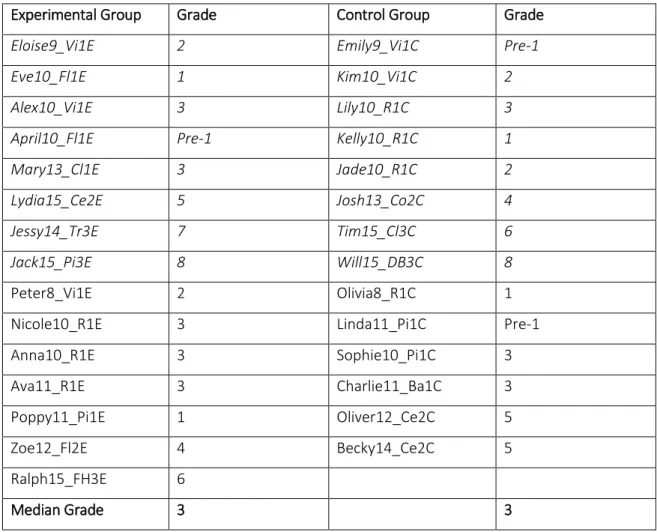
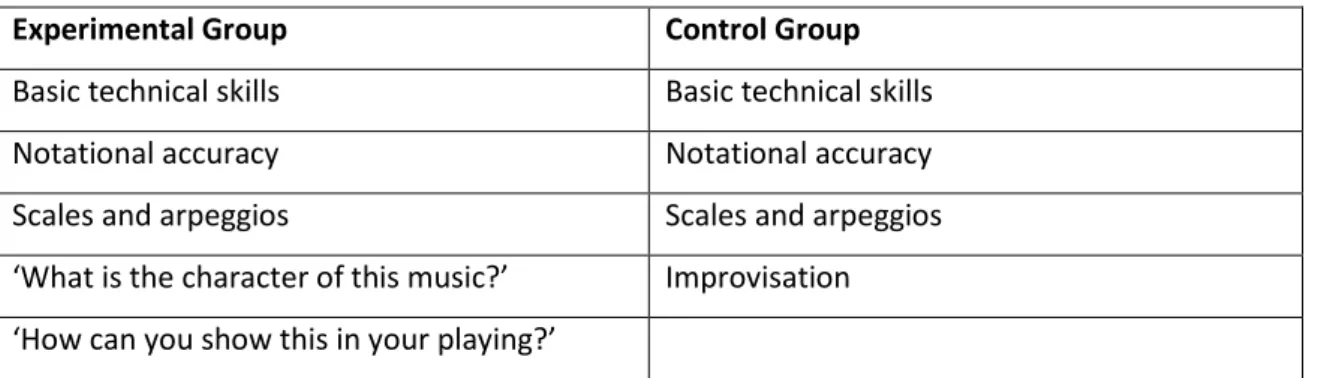
Table 4.1 Participants study 1 and 2, allocation to experimental/control groups,
and level of playing. Names of VSRI participants in italic. 64 Table 4.2 Teaching content of experimental and control group lessons. 67 Table 4.3 Codes and pseudonyms of participants in the action research study.
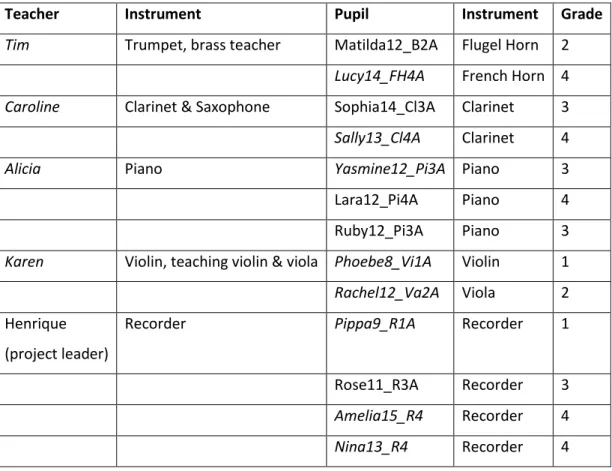
VSR-Interviewees in italic. 72
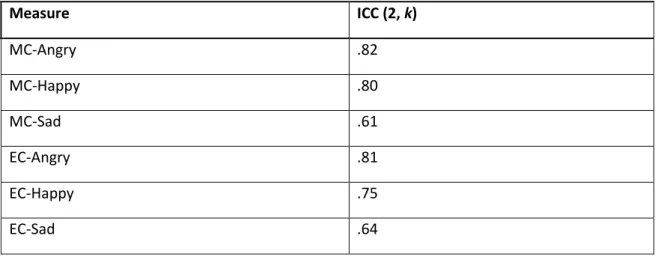
Table 5.1 Two-Way Random Consistency ICC (2, k), average measures, for
assessments by four adjudicators. 85
Table 5.2 Mean and median scores for MC and EC per emotion, N = 29. Scores
averaged across adjudicators. 86
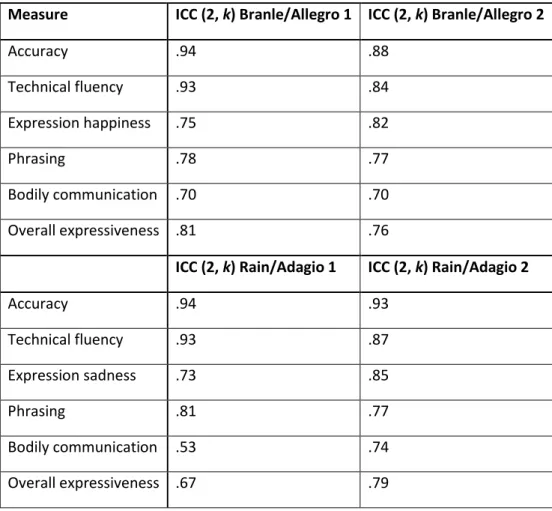
Table 5.3 Two-Way Random Consistency ICC Intraclass correlation coefficient,
average measures for 4 adjudicators. 89
Table 5.4 Results Wilcoxon Signed-Rank Test, pre- and posttest median scores, Z, p-values and effect size r per assessment and group condition
(Statistically significant increases in bold).
N (Experimental) = 15, N (Control) = 14. 91
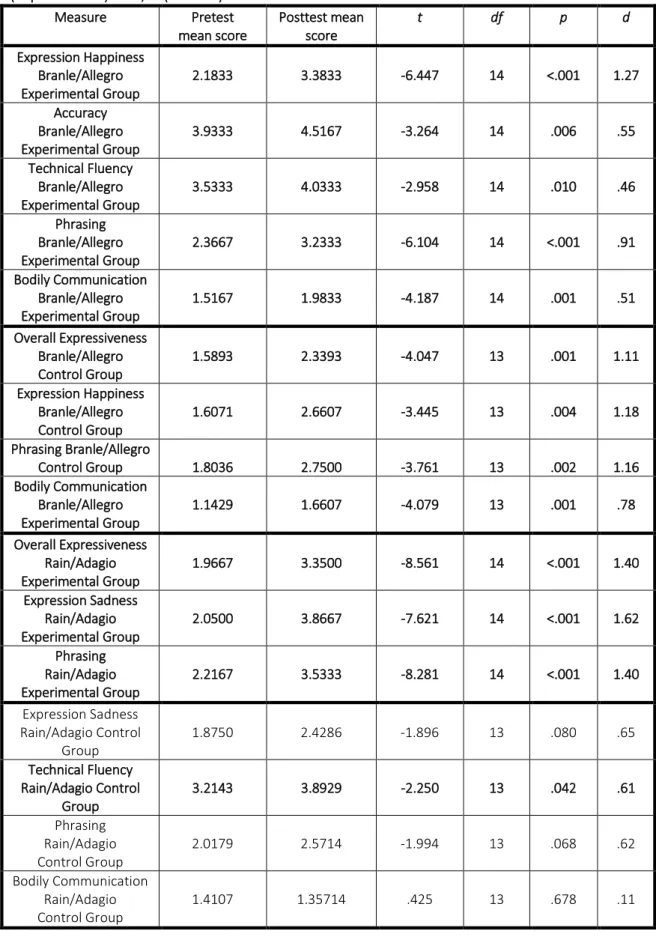
Table 5.5 Results Paired Samples T-test, pre- and posttest mean scores, p-values, Z and Cohen’s d per assessment and group condition (Statistically
significant increases in bold). N (Experimental) = 15, N (Control) = 14. 92 Table 5.6 Spearman’s ρ correlations between overall expressiveness and other
performance assessment scores at the end of the sessions. 99 Table 6.1 Overview of pupils’ answers regarding practice habits. 120 Table 7.1 Overview of methods used by tutors in the action research project. 135 Table 7.2 Overview of methods used by teachers prior and during the action.
research project, and methods described as effective afterwards. 140 Table 7.3 Median assessment scores for pupils’ performances in sessions 1, 2, 3
List of Figures
Figure 3.1 Overview of thedoctoral project. 55
Figure 3.2 Theoretic model for teaching and learning expressive music performance. 57 Figure 3.3 Theoretic model for teaching and learning expressive music performance,
incorporating supplemental strategies that could be employed to
illustrate the dialogic teaching of expressiveness. 58
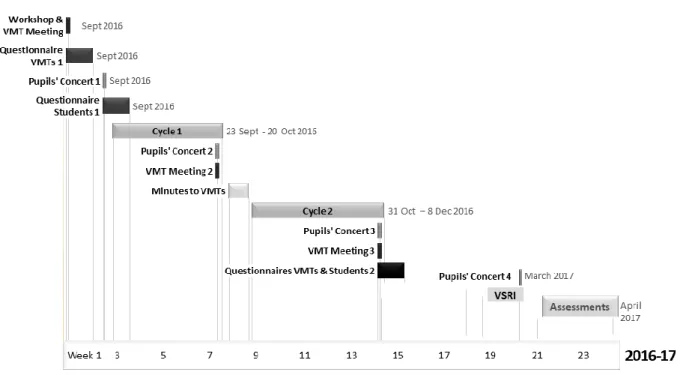
Figure 4.1 Timeline of Study 1 and 2. 64
Figure 4.2 Timeline of the action research project 72 Figure 5.1 Difference scores (Post – Pretest scores) overall expressiveness
Branle/Allegro (BA) and Rain/Adagio (RAd) for experimental and control
group, error bars 95% CI. 94
Figure 5.2 Difference scores (Post – Pretest scores) emotional expression
Branle/Allegro (BA) and Rain/Adagio (RAd) for experimental and control
group, error bars 95% CI. 95
Figure 5.3 Difference scores (Post – Pretest scores) technical fluency Branle/Allegro (BA) and Rain/Adagio (RAd) for experimental and control group, error
bars 95% CI. 95
Figure 5.4 Difference scores (Post – Pretest scores) accuracy Branle/Allegro (BA) and Rain/Adagio (RAd) for experimental and control group, error bars 95% CI. 97 Figure 5.5 Difference scores (Post – Pretest scores) phrasing Branle/Allegro (BA) and
Rain/Adagio (RAd) for experimental and control group, error bars 95% CI. 97 Figure 5.6 Difference scores (Post – Pretest scores) bodily communication
Branle/Allegro (BA) and Rain/Adagio (RAd) for experimental and control
group, error bars 95% CI. 98
Figure 6.1 Proportions of experimental group participants’ questionnaire answers
describing what they had learnt especially in the research sessions. 111 Figure 6.2 Proportions of control group participants’ questionnaire answers
describing what they had learnt especially in the research sessions. 111 Figure 6.3 Overview of the themes and ideas in study 2. 124 Figure 7.1 Depiction of ARP-Tutors’ views on teaching and learning expressive music
performance using a dialogic teaching approach. 138 Figure 7.2 Potential effects of a dialogic teaching approach on various aspects of the
teaching-and-learning process. 175
Figure 8.1 Illustrative figure depicting reasons why certain instructional strategies
may be effective in a dialogic teaching approach. 196 Figure 8.2 The challenges of instrumental music learning may cause limited
expressiveness. 197
Figure 8.3 Open questions and dialogue can raise pupils’ awareness of the musical character thus improving their expressiveness. 197 Figure 8.4 Theoretic model, at the start of Study 3, for teaching and learning
expressive music performance incorporating supplemental strategies that could be employed to support the dialogic teaching of expressiveness. 199
Figure 8.5
Figure 8.6 Figure 8.7
Figure 8.8
ARP-Tutors’ views on teaching and learning expressive music performance within a dialogic teaching approach.
Toolkit of strategies forteaching expressive music performance.
Open questions and dialogue about the musical character supported by modelling may affect various aspects of the teaching-and-learning process.
Everything is intertwined in a dialogic approach for teaching and learning of expressive music performance.
199 200
201
‘I never thought it was telling a story with what you’re playing, because it’s just notes…’
Jessy (15) ‘I'd just sort of played it (…) thinking of that character (…) you put yourself in their
shoes and you're just able to do it better’
1.
Introduction
Some years ago, I auditioned for a place at the Utrecht Conservatoire to study music. When I returned to the audition room to hear the result, the director of early music told me that I would be offered a place, because he could see that I had the potential to become an expressive musician. I studied recorder with this tutor, Leo Meilink, and in the following years we worked extensively on expressive performance. Looking back, I am very grateful that I was given the opportunity to study music and to improve my expressiveness. My own teaching is greatly influenced by the instruction I received and is based on the notion that most young musicians can learn to improve their expressive performance. Over the years I have seen many pupils improve their expressiveness; some who initially were quite ‘wooden’ players, even acquired music scholarships in their teenage years. This process influenced their confidence and identity as musicians enormously. Because of my experiences as student and teacher, I am intrigued by the process of teaching and learning expressive music performance and consider this a central aspect of instrumental tuition. However, there does not seem to be a systematic pedagogy of teaching children and teenagers performance expression, nor is there to date any methodical research on children’s learning of expressiveness (Lisboa, 2008; McPhee, 2011). According to Hallam (2010) research is needed to investigate how tutors ‘can promote emotional communication in learners as they are composing, improvising, and performing’ (Hallam, 2010, p. 809). It is important to develop a systematic pedagogy for facilitating pupils’ learning of expressivity (Laukka, 2004; Williamon, 2014; Woody, 2000) and this doctoral project was designed to contribute towards this goal.
From conversations with colleagues about teaching expressivity I found that the opinions of instrumental tutors on this subject varied widely. Several colleagues did not endeavour to teach communication in performance, whilst others had their preferred, often idiosyncratic methods for teaching expressiveness. Some mainly spoke about phrasing and dynamics while others thought that movements and
gestures facilitated pupils’ learning of expressivity (Den Otter Meissner, 2011). It seems that there is still a strong ‘folk belief’ that high achievement in music performance is an innate ability (Sloboda, Davidson, & Howe, 1994); often parents and teachers assume that a child either has a gift for expert music performance or not. Consequently, tutors might not aim to teach communication in performance as they might consciously or unconsciously expect a young musician to flourish and play expressively if they have this innate musical ability. After a longitudinal study that investigated the development of 157 young musicians from their seventh to their twenty-second birthday, McPherson, Davidson, and Faulkner (2012) reported that they did not find evidence of teaching aimed at musical communication or expression:
It is difficult to find any data in our study that suggest that the students were explicitly learning about the communicative and expressive potential of playing those notes during the early years of learning. (McPherson et al., 2012, p. 219)
Musical participation for most students in their sample focused on the technical side of playing, which, according to the researchers, was unconstructive for their musical development. Furthermore, some studies suggest that instrumental lessons tend to focus on reading and technical skills (Karlsson & Juslin, 2008; West & Rostvall, 2003; see also Hallam, 2010), while several studies have shown that pupils are inclined to concentrate on note reading and technique during practice (Hallam et al., 2012; Lisboa, 2008; McPherson & Renwick, 2001; Pike, 2017; Pitts & Davidson, 2000; Pitts, Davidson, & McPherson, 2000). If expression and musical communication are not taught clearly in the early stages of learning, children might not consider issues of interpretation and expressiveness, and it seems likely that they perceive playing from notation as a reading and/or technical exercise, something they have to decode and play using technical tools (Meissner, 2017). As there is no systematic pedagogy of teaching expressive music performance, and pupils might see playing repertoire as a reading or technical exercise (Meissner, 2017) it is important to investigate this fascinating aspect of music education: How do pupils learn to play expressively, and which instructional strategies are effective for facilitating and developing their expressive performance? For this doctoral project and thesis an expressive music performance is defined as one
in which the musician conveys their interpretation of the compositional structure and
musical character convincingly to a listener (see section 2.3. for a discussion of expressive music performance).
Facilitating pupils’ expressive music performance was the subject of my Master’s project, which consisted of an action research (AR) project and a Small Exploratory Study (SES). The aim of the AR project was to explore methods for improving pupils’ performance expression. Nine instrumental tutors, including the author, and 14 pupils (aged 9-15) participated in this project which consisted of ten weeks teaching on expressive music performance. At the beginning and end of this period, pupils’ concerts were held, and performances were audio-recorded. Participating tutors used a wide variety of strategies to develop pupils’ expressiveness:
Enquiry, discussion, explanation of expressive devices, gestures and movements,
singing, imagery, modelling, ‘projected performance’ and listening to own recordings.
According to the teachers these strategies had been useful in lessons. However, analysis of performance assessments did not show a significant improvement in students’ expressivity. Interestingly, four out of five pupils who did improve their expressiveness had been taught by tutors who used enquiry and discussionofmusical character and instruction about modifying expressive devices. The AR project influenced the practice of most participating tutors, as they focused more on teaching expressive performance (Meissner, 2017).
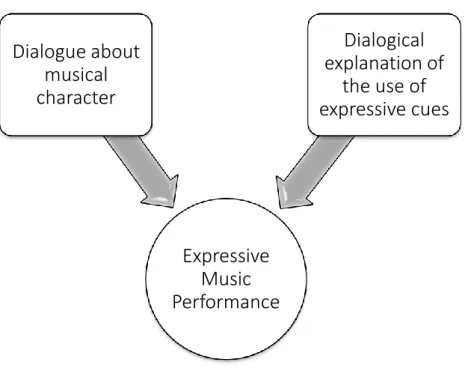
In the SES project, pupils’ progress in expressivity after a 30 minutes lesson was investigated. Eight pupils (aged 6-13) were given two pieces portraying contrasting emotions and received a lesson in which they were asked about the character of the extract and how this could be communicated in their playing. Their performances at the beginning and end of the lessons were audio-recorded. In most (87.5%) performances expressiveness had improved. Enquiry and discussion of musical character, instruction about modifying expressive devices and modelling were used to improve pupils’ performance expression (Den Otter Meissner, 2011). Results from these studies suggest that enquiry and discussion of musical character combined with an explanation of the use of expressive devices are helpful for raising children’s awareness of the musical character and their use of expressive cues,
thus improving their expressivity. Therefore, the hypothesis of the first study in this doctoral project is that open questions and dialogue can develop pupils’ awareness of the musical character and their understanding of the use of expressive tools, such as tempo, articulation, dynamics and tone colour, to convey the musical meaning, thus improving their expressiveness (see Figure 3.2., section 3.2.). As the previous project consisted of preliminary studies with limited numbers of participants, the following principal research questions remain: (1) Can discussion of the musical character combined with dialogue about modifying expressive devicesbe effective for improving pupils’ expressive music performance? (2) Is this approach more effective for developing expressiveness than teaching that concentrates on technique and notational accuracy? (3) How can we implement such dialogic teaching of expressive performance in weekly instrumental music tuition? (4) Would this dialogic teaching approach be sufficient, or do learners need other instructional modes supporting this instruction? Additionally, I had the following sub questions: (1) How do the pupils in this study evaluate their learning in the control or experimental instrumental music lessons? (2) What is their assessment of the instructional methods used? (3) What do these pupils generally focus on in their instrumental practice? (4) What do these pupils find hard in their instrumental music learning, and what do they find enjoyable?
This doctoral project on teaching young musicians expressive performance aims to answer these questions, and consists of three studies. The first study is an experimental vs. control group teaching test, the second explores qualitative data related to the first study, while the third study consists of an action research project. The first study was instigated to investigate whether questions about and discussion of musical character combined with instruction about modifying expressive devices is more effective than teaching about technique and notational accuracy for improving pupils’ (aged 8-15) expressive music performance. Information about pupils’ views on their learning of expressiveness, and the instructional strategies used, was gathered in the second study via a questionnaire and video-stimulated recall interviews. The third study consisted of an action research project with five instrumental music tutors, including the author, and 11 pupils (aged 8-15) during one school term. This was a participatory action research study in which tutors worked alongside the researcher
exploring how dialogic teaching of expressiveness can be implemented in instrumental music tuition. Additionally, I investigated whether this approach is sufficient, or whether learners would benefit from supplementary instructional modes (e.g. aural modelling, gestures, visual imagery or projected performance) supporting this instruction. Questionnaires and video-stimulated recall interviews were used to gather information about tutors’ and pupils’ views and experiences. Findings from these three studies will expand our knowledge of teaching and learning expressive music performance. The implications of these studies for performance pedagogy and suggestions for teachers will be discussed.
2.
Literature Review
2.1. Definitions and scope
It would be useful to first define teaching and learning. Ambrose, Bridges, DiPietro, Lovett, and Norman (2010) define learningas ‘a process that leads to change, which occurs as a result of experience and increases the potential for improved performance and future learning’ (Ambrose et al, 2010, p. 3). Their definition of learning contains three important elements: Firstly, learning is a process that takes place in the mind. Tutors can only infer from students’ work or performances that it has happened. Secondly, ‘learning involves change in knowledge, beliefs, behaviours, or attitudes. This change unfolds over time; it is not fleeting but rather has a lasting impact on how students think and act’ (Ambrose, et al., 2010, p. 3). Thirdly, learning is something students do. It is the result of how they ‘interpret and respond to their experiences’ (Ambrose, et al., 2010, p. 3). Teaching can be defined as guiding and facilitating the learning process. This guiding and facilitating includes transfer of knowledge. Teaching methods or strategies can be described as actions used by tutors to facilitate student learning.
In this thesis, ‘emotion’is usedin a generic sense, including affect, feeling and mood. ‘Instrumental tutors’, ‘visiting music teachers’ (VMTs) and ‘music teachers’ will be used interchangeably. ‘Pupils’ will be used to refer to young musicians or students aged 8-18 years old. The aim of this doctoral project is to explore how instrumental music tutors can guide and facilitate young musicians’ learning of expressive performance. Particularly, young musicians aged 8-15 years, who receive weekly instrumental music tuition but are not studying at a specialist music school or junior academy.
2.2. The guided construction of knowledge
Traditionally, instrumental music tuition is based on the master-apprentice model and seen as transmission of knowledge; the master-teacher instructs the student about note reading, technique, interpretation and performance (e.g. Harnoncourt, 1988):
Der Meister lehrt den Lehrling also seine Kunst, und zwar alle Aspekte seiner Kunst. Er lehrt ihn nicht nur, ein Instrument zu spielen oder zu singen, sondern auch, die Musik darzustellen. (Harnoncourt, 1982, p. 26)2
Research findings suggest that instrumental tuition tends to be teacher directed; the teacher selects the repertoire and decides how the music is to be played, musically and technically (Hallam, 2006 referring to Hepler, 1987). Often tutors expect their students to be compliant, allowing them little space for developing their own ideas and interpretations (Persson, 1994; Persson, 1996). Alongside the master-apprentice model, Lehmann, Sloboda, and Woody (2007) distinguish the mentor-friend model, which provides more opportunity for exchange between teacher and student. Hallam proposed that instrumental teaching should not be teacher directed but student based; teachers should be facilitators of learning (Hallam, 1998, 2006), giving their students space to develop their musical ideas and experiences. Recently, Creech and Gaunt (2018) suggested that individual instrumental tuition should ‘focus on student reflection, autonomy, and motivated, self-directed learning’ (Creech & Gaunt, 2018, p. 155); teachers and students should be equipped to collaborate and problem-solve together.
In educational psychology literature a similar discourse can be found. Behaviourists emphasize the importance of external events on learning and view the teacher as controller of stimuli and shaper of behaviour (see Kauchak & Eggen, 2012), and thus as transmitter of knowledge. Contrastingly, in the constructivist theory, the teacher is seen as a facilitator of learning; teachers design learning activities in which learners can construct their own understanding (ibid.). However, according to Kleine Staarman and Mercer (2010) there should not be a dichotomy between the roles of the teacher being either ‘transmitter of knowledge’ or ‘facilitator of learning’, as teachers have a variety of roles depending on the situation. In some settings teachers need to explain new concepts, while in other situations they facilitate their students’ learning process by using questions and dialogue. Kleine Staarman & Mercer suggested
2‘The master must teach the apprentice his art in all its aspects. He taught not merely how to play an
that teaching and learning should be seen as an interactive process, in which teachers and learners develop a shared understanding, by using a special type of communication, which they call the ‘guided construction of knowledge’ (Mercer, 1995). The guided construction of knowledge describes the ‘communication process that lies at the heart of education: that in which an expert helps a novice to develop their understanding and knowledge’ (Kleine Staarman & Mercer, 2010, p. 75). Through spoken language teachers and learners expand their knowledge and develop their ideas. Language is an important ‘meaning-making’ tool for learners and an essential pedagogic tool for teachers (ibid.). Mercer’s notion of the guided construction of knowledge is based on the work of Vygotsky (1978; 1986) and incorporates the ideas of scaffolding (Wood, Bruner, & Ross, 1976) and dialogic teaching (e.g. Alexander, 2008).
Vygotsky suggested that language is crucial for the development of thought: ‘Thought is not merely expressed in words; it comes into existence through them’ (Vygotsky, 1986, p. 218). Vygotsky proposed that language is both a cultural and a psychological tool; understanding is constructed through people’s spoken language and involvement in social events. Vygotsky was especially interested in the development of children’s cognitive processes, thinking, reasoning and understanding, which he labelled ‘higher mental functions’. According to Vygotsky, social interactions and the cultural environment are both essential for children’s development of ‘higher mental functions’.
Every function in the child’s cultural development appears twice: first on the social
level and later, on the individual level; first, between people (interpsychological), and then inside the child (intrapsychological). (...) All the higher functions originate as actual relations between human individuals. (Vygotsky, 1978, p. 57)
Therefore, teaching and learning should be seen as an interactive process of ‘teaching -and-learning’; tutor and student are both active in this process:
Under the protective apprenticeship of, often, more capable and advanced members of the community, children are able to gradually internalize the cultural tools so that they become part of the child’s own mental repertoire. (Kleine Staarman & Mercer,
2010, p. 77)
Theorising about the relationship between children’s learning and development, Vygotsky (1978) proposed the idea of the Zone of Proximal Development (ZPD) which he defined as ‘the distance between the actual developmental level as determined by independent problem solving and the level of potential development as determined through problem solving under adult guidance or in collaboration with more capable peers’ (ibid., p. 86). According to Kleine Staarman & Mercer (2010) Vygotsky’s ZPD could be seen as a static concept, emphasising a learner’s developmental level at a certain point in time. Conversely, they believe that this should be seen as a dynamic process, a ‘joint effort by learner and teacher to create and maintain a shared communicative space in which the teacher enables the learner to work beyond his current capabilities’ (ibid., p. 80). Therefore, they proposed the notion of an
Intermental Development Zone (IDZ) ‘a shared communicative space between a teacher and learner, which has to be maintained constantly through dialogue.’ (ibid., p. 80) To create an IDZ teacher and learner ‘have to be mutually attuned to one another, to create intersubjectivity through which a learner is able to learn. Intersubjectivity is the process through which participants in joint activity establish and maintain mutual understanding of the situation’ (Kleine Staarman & Mercer, 2010, p. 81). The notions of ZPD and IDZ are closely related to the idea of scaffolding.
Scaffolding describes the interactive process of tutoring. ‘This scaffolding consists essentially of the adult “controlling” those elements of the task that are initially beyond the learner’s capacity, thus permitting him to concentrate upon and complete only those elements that are within his range of competence’ (Wood, Bruner & Ross, 1976, p. 90). For effective scaffolding it is crucial that the tutor has a thorough understanding of the problem or task and how this can be completed. Additionally, the tutor should have a ‘theory of the performance characteristics of his tutee’. Without a thorough knowledge and understanding of both the task and the student, the tutor can neither provide feedback nor adjust the lesson situation so that his feedback will be ‘more appropriate for this tutee in this task at this point in task mastery’ (ibid., p. 97). Furthermore, in effective scaffolding the tutor maintains direction in the problem solving, limits frustration and models solutions when the learner can recognise them
(ibid., p. 99).
Some critics have argued that the theory of scaffolding is based on the narrow foundation of one study with young children limited to a single isolated task (Wood & Wood, 2013). Although the scaffolding theory was developed on observations related to one problem solving task, it seems likely that the idea of scaffolding applies to a wide range of tutoring situations, and this is supported by Rogoff’s (1990) findings. Rogoff, building on various publications, proposed the notion of guided participation:
Guided participation involves collaboration and shared understanding in routine problem-solving activities. Interaction with other people assists children in their development by guiding their participation in relevant activities, helping them adapt their understanding to new situations, structuring their problem-solving attempts, and assisting them in assuming responsibility for managing problem solving. This guidance of development includes tacit and intuitive forms of communication.... (Rogoff, 1990, p. 191)
Rogoff’s guided participation differs to scaffolding in that it refers to children’s cognitive and cultural development in a social context throughout childhood, while the
scaffolding metaphor refers to the role of tutoring in a specific task.
Also incorporated in the guided construction of knowledge, are the concepts of
dialogic pedagogy (Skidmore & Murakami, 2016) and dialogic teaching (Alexander, 2008). Dialogic pedagogy is a philosophy of education which places great emphasis on the importance of ‘socio-verbal interaction’, contrasting to ‘monologic’ or lecturing -style teaching. Dialogic pedagogy employs enquiry and problem-posing, inviting ‘students to participate actively in reshaping their own understanding of reality’ (Skidmore & Murakami, 2016, p.13 referring to Freire, 1993). Teachers employing dialogic pedagogy acknowledge their students as ‘capable of consciousness and intentionality, and treats them as co-investigators into the nature of reality’ (Skidmore & Murakami, 2016, p. 12 referring to Freire, 1993). According to Alexander (2010)
dialogic teaching ‘harnesses the power of talk to stimulate and extend pupils’ thinking and advance their learning and understanding. It helps the teacher more precisely diagnose pupils’ needs, frame their learning tasks and assess their progress’ (ibid., p. 1). For effective dialogic teaching it is important that teachers ask ‘authentic’ and open
questions, which do not have just one correct answer. If teachers expect one specific answer, this will not help their students to develop their own thinking. Instead, questions and answers should form the building blocks of the conversation, developing the understanding of students and teachers (Alexander, 2010). For an effective dialogic discussion both teachers and students need enough ‘thinking time’ (Alexander, 2008). As there is evidence for the effectiveness of dialogic style teaching in general education (Alexander, 2008; Nystrand, 1997; Skidmore, 2016) and for stimulating children’s ‘higher-order’ thinking in composing tasks (Major & Cottle, 2010), it seems likely that dialogic teaching would be effective in instrumental music tuition too. One could object that the theory of dialogic teaching was developed for, and tested in, classroom teaching. However, a central requirement for effective scaffolding and
dialogic teaching is that the tutor knows their pupil well, so that the tutor can pitch questions to individual students appropriately. In large classes or in schools where teachers see hundreds of students every week, it might be very difficult to implement dialogic teaching effectively. Conversely, in individual or small group instrumental music lessons this would be perfectly possible, as tutors can discover and understand their pupils’ skills, difficulties and potential when they see them every week in studio music lessons (cf. Creech & Gaunt, 2018). Therefore, it seems likely that dialogic teaching can be employed for tutoring expressive music performance.
2.3. Expressive music performance
Reflecting on teaching performance expression, it becomes apparent that all aspects of expression in music performance are difficult to define (e.g. Doğantan-Dack, 2014; Epperson, 2016). We could simply define music as‘the temporal organization of tones generated by vibrations of air’ (Stone-Davis, 2011, p. xi), or aim to include more detail, describing how music can be significant to us. Epperson writes that music is
Art concerned with combining vocal or instrumental sounds for beauty of form or emotional expression, usually according to cultural standards of rhythm, melody, and, in most Western music, harmony. Both the simple folk song and the complex electronic composition belong to the same activity, music. (Epperson, 2016, para. 2)
Kania (2013) observed that most philosophers who have written about music seem to have assumed that all music is artistic or have not discussed ‘non-artistic’ music. Kania defines music as ‘any event intentionally produced or organised to be heard, and either to have some basic musical feature, such as pitch or rhythm, or to be listened to for such features’ (Kania, 2013, p. 640, referring to Kania, 2011). This definition comprises artistic as well as ‘non-artistic’ music, thus including lullabies, children’s vocalizations and folk music. Tagg (2012) defines music as ‘that form of interhuman communication in which humanly organised non-verbal sound can, following culturally specific conventions, carry meaning relating to emotional, gestural, tactile, kinetic, spatial and prosodic patterns of cognition’(Tagg, 2012, p. 44). These four descriptions complement each other and demonstrate the complexity of defining music comprehensibly.
Furthermore, for performing and teaching purposes it is important to consider how we define expressive music performance as our views on the meaning of music, its expressiveness and how this can be conveyed will, consciously or unconsciously, influence our performance and teaching practice (Bonastre, Muñoz, & Timmers, 2017; Doğantan-Dack, 2014). In this overview we will first look briefly at expressive music performance from a philosophical viewpoint; whether music can be expressive, and if so, what it is expressive of. Secondly, we will look at the question of expressive performance from a music psychological viewpoint: How can the musical meaning be conveyed in performance? Finally, we will define a perspective on expressive music performance that can be useful for a pedagogy of teaching young musicians expressive playing.
2.3.1. Perspectives on expressiveness of music from analytical philosophy
Among music philosophers there has been a long debate on musical meaning; ‘That musicmeans is beyond dispute. How it does so is not’(Stone-Davis, 2011, p. xi). In his overview DeBellis (2005) describes three main conceptions of musical meaning: Firstly, in the expressionist theory the arousal of emotion is seen as the main purpose and nature of music (e.g. Meyer, 1957); thus music listening and understanding demands affective involvement. Likewise, several Baroque musicians thought that a performer should aim to move their listeners:
Musical execution3 may be compared with the delivery of an orator. The orator and
the musician have, at bottom, the same aim in regard to both the preparation and the final execution of their productions, namely to make themselves masters of the hearts of their listeners, to arouse or still their passions4, and to transport them now to this
sentiment, now to that (Quantz, 1752, p. 119).
Both Quantz and Carl Philip Emanuel Bach (1753/1762) thought that a musician should experience the affects expressed in the composition in order to communicate these to their listeners in performance.
Secondly, there is the iconic or referentialist conception which views music as an imitation or representation of some aspect of the extra-musical, ‘“human” world of emotions, characters, and ideas’ (DeBellis, 2005, p. 531). Various philosophies can be categorized under an iconic view of musical meaning. For example, Langer (1957) suggested that music is symbolic of developing and fluctuating human feelings (see 2.3.1.1.). Kivy proposed that music’s expressiveness is related to its resemblance to human speech and bodily movements, and therefore listeners can recognize expressive character in music. According to Kivy music resembles human expressions of emotions but music is not about emotions and therefore does not refer to emotions. Kivy views such understanding of musical character as a cognitive rather than an affective response (DeBellis, 2005, referring to Kivy, 1989). Conversely Goodman proposed that expressive character in music is a ‘metaphorical exemplification’ of emotions or characters (DeBellis, 2005, referring to Goodman 1976).
Thirdly, the formalist theory of music focuses ‘on the cognitive grasp of musical properties and relationships’; the meaning of music is thus in its structure. According to this view music cannot be expressive of any extra-musical concepts (e.g. Small, 1999; Stravinsky, 1935) but should be enjoyed for its intrinsic value. Although Stravinsky argued that music is ‘essentially powerless to express anything at all, whether a feeling, an attitude of mind, a psychological mood, a phenomenon of nature’ (Stravinsky, 1935, p. 53), his compositions often refer to extra-musical associations (Epperson, 2016). DeBellis points out that the referentialist and formalist theories of
3German: ‘Vortrag’ 4German: ‘Affect’
musical meaning are not mutually exclusive; one can have a formalist view of music while arguing that understanding musical properties leads to affective responses. It seems that these three theories, expressionist, representational and formalist, complement each other and describe aspects of what music can express (DeBellis, 2005). A detailed introduction to expressive character and musical meaning from the perspective of analytic philosophy can be found in DeBellis (2005).
2.3.1.1. Susanne Langer on significance in music
A notable philosophy within the referentialist theory of musical meaning, is the theory of Susanne Langer (1957). She proposed that the significance of music is that it is a
symbolization5 of emotion:
If music has any significance, it is semantic, not symptomatic. Its “meaning” is
evidently not that of a stimulus to evoke emotions, nor that of a signal to announce
them; if it has an emotional content, it “has” it in the same sense that language “has”
its conceptual content – symbolically. It is not usually derived from affects nor intended for them; but we may say, with certain reservations, that it is about them. Music is not the cause or the cure of feelings, but their logical expression; though even in this capacity it has its special ways of functioning, that make it incommensurable with language, and even with presentational symbols like images, and rites. (Langer, 1957, p. 218)
According to Langer, the strength of musical expressiveness is that music can symbolize and articulate feeling better than language. ‘Because the forms of human feeling are much more congruent with musical forms than with the forms of language, music can reveal the nature of feelings with a detail and truth that language cannot approach’ (ibid., p. 235). Music can be a constantly changing ‘kaleidoscopic play’ of feelings and meanings (ibid., p. 238) and therefore she proposed that verbal descriptions of musical feeling would ‘limit musical imagination’ (ibid., p. 244). However, Langer acknowledged that it can be useful to think in pictures, words or associations for learners to understand music. Langer compares verbal labelling and visual imagination to the use of a crutch:
5 Langer makes a distinction between signs, which work as signals, and symbols, that work as vehicles for conception (Dengerink Chaplin, in press).
…nothing can prevent our falling back on mental pictures, fantasies, memories, or having a Sphärenerlebnis of some sort, when we cannot directly make subjective sense out of music in playing or hearing it. A program is simply a crutch. (…)
Where such interpretation is spontaneous, it is perfectly legitimate practice, common among musically limited persons, and helpful. (Langer, 1957, p. 242-243)
Consequently, Langer views music as expressive of constantly changing feelings and subtle moods; the dynamic process of a particular feeling in its various layers and stages of development, sometimes even overlapping (Dengerink Chaplin, in press). According to Langer this can be described with words, pictures or ideas during the learning process, provided tutors and pupils realize that true musical meaning is more varied and complex than verbalized concepts. This view of music as symbolic of ever changing affects and feelings that cannot be verbalized adequately but may be described with metaphors as heuristics (see Leech-Wilkinson & Prior, 2014) during the learning process may be useful for a performance pedagogy of teaching expressiveness.
2.3.2. Perspectives on performance expression from music psychology
There seems to be an essential difference between philosophical and music psychological conceptions of expressive music performance. Philosophers discuss theoretic aspects of music; how music as art form might be expressive, and if so, what it might symbolize, resemble, or express. Conversely, music psychologists seem to have more pragmatic aims as they tend to investigate questions such as: Which elements of a composition can convey emotion; how do listeners perceive, recognize or even experience emotions in music? How do musicians play expressively? What do they do? Yet there is some overlap between some philosophers’ ideas and the theories in music psychology. Generally, three main conceptions of performance expression can be found in the music psychology literature: Firstly, some scholars emphasize the importance of conveying musical structure convincingly in performance expression (e.g. Clarke, 1988; Friberg, Anders & Battel, 2002; Juslin, 2003; Palmer, 1997; Seashore, 1923). This view is related to a formalist theory of musical meaning; if the structure of a musical work is the most important feature for understanding music, then this should be communicated clearly. Musicians can manipulate various performance features, e.g. articulation, dynamics, tempo and ‘ensemble timing’ (Friberg & Battel,
2002) to communicate phrases and harmonic structures (e.g. Palmer, 1996; Repp, 1992, 1998; Todd, 1985).
Secondly, many music psychologists subscribe to a referentialist conception of musical meaning, perceiving music as resembling or expressing extra-musical features, such as affects (Cespedes-Guevara & Eerola, 2018), emotions, moods, feelings, motion, characters, or patterns of sound (Brendel, 2011; Gabrielsson, 1999; Gabrielsson & Juslin, 1996; Juslin, 2003; Juslin & Laukka, 2000; Juslin & Persson, 2002). Research has shown that especially characteristics such as dynamics, mode, harmony, pitch, tempo and rhythm can shape the perception of emotion in music (Gabrielsson & Lindström, 2010), while melodic contour and pitch can contribute to this too (Coutinho & Dibben, 2013; Schellenberg, Krysciak, & Campbell, 2000). Additionally, there is evidence that emotional communication in speech and music share the same acoustic cues (e.g. Juslin & Laukka, 2003; Coutinho & Dibben, 2013). Conversely, Cespedes-Guevara & Eerola (2018) proposed that music communicates core dimensions of affects (arousal and valence) rather than basic emotions. They argue that ‘the phenomenon of perception of emotions in music arises from the interaction of music’s ability to express core affects and the influence of top-down and contextual information in the listener’s mind’ (Cespedes-Guevara & Eerola, 2018, p. 1). Although Cespedes-Guevara & Eerola’s hypothesis sounds plausible, this theory is not practical for a pedagogy of teaching and learning expressiveness, as it seems likely that tutors and pupils need metaphors referring to emotions, moods or character for developing their understanding and interpretation of the works they study. An overview of music and emotion research can be found in Timmers (2018).
Shaffer (1992) suggested that, for understanding performance expression and developing an interpretation, it might be helpful to think of music as conveying an ‘abstract narrative’ containing a protagonist with a ‘musical character’. Performers need to invent a musical character in response to moods and structures perceived in the music to ‘solve a series of expressive problems’ and create an expressive performance (Shaffer, 1995, p. 31). Likewise, Watt & Ash (1998) proposed that music might be perceived as if it were a virtual person making a disclosure. In order to convey the musical character, performers may modulate various expressive devices,
such as articulation, dynamics, tempo, timing, timbre, attack, decay (Juslin, 2003; Juslin & Persson, 2002; Juslin & Timmers, 2010), intonation (Johnson, 2004), vibrato (Juslin, Friberg, Schoonderwaldt & Karlsson, 2004; Timmers & Desain, 2000), ornamentation (Timmers & Ashley, 2007; Windsor, Aarts, Desain, Heijink, & Timmers, 2000) and ancillary gestures (Davidson, 1993, 2005; Davidson & Correia, 2002; Dahl & Friberg, 2007; Wanderley & Vines, 2006).
Thirdly, Nusseck & Wanderley (2009) proposed that performance expression is characterized by expressive intensity and musical tension. Their expressive intensity is related to the degree of expressiveness of the performance (Fabian, Timmers, & Schubert, 2014; Timmers, Marolt, Camurri, & Volpe, 2006) and is similar to Schubert and Fabian’s (2014) expressiveness amount and Davidson’s (1993) performance manner. Davidson distinguishes three different expressive manners, namely deadpan, projected (as in a normal recital) and exaggerated performance manner. Additionally, Nusseck & Wanderley distinguish musical tension as a characteristic of expressive performance; they describe high musical tension as a ‘feeling of excitement and involvement, whereas low tension refers to uncertainty and unsteadiness’ (ibid.: 338). Another aspect of expressiveness that is strongly related to musical tension, but often neglected in the literature, is forward movement or forward energy (cf. Broomhead, 2006). Musicians can experience a sense of forward movement whilst playing; the music has direction and ‘flows’ towards the end of a phrase, cadence or a ‘tipping point’6 (Chew, 2013). Contrastingly, when a performance is not going well, players have the impression that the music is static; the performance feels heavy and performers and listeners might lose focus (Den Otter Meissner, 2011). It is common knowledge among music teachers and musicians that compositions requiring a slow tempo (e.g. an adagio) are harder to perform expressively than fast and virtuosic works, because they demand more musical tension and more focus on forward movement to be perceived as expressive. It seems likely that musical tension and forward movement
contribute to the perceived expressive intensity of a performance and are important
6The ‘tipping point’ moment in music creates tension as it generates expectancy and is an aspect of expressiveness. The composer and performer together create the expectation in the listener (Chew, 2013).
for learning and teaching expressiveness.
Music psychologists appear to agree that performance expression is conveyed through the variation of expressive gestures (e.g. Fabian et al., 2014; Juslin & Persson, 2002; Juslin, 2003) such as articulation, dynamics, tempo, timing, timbre, attack, decay, intonation, vibrato, ornamentation and ancillary gestures.
2.3.2.1. Juslin’s GERMS model
Juslin developed the so-called GERMS model of performance expression to provide ‘a solid foundation for the teaching of expressive skills in music education’ (Juslin, 2003, p. 273). This GERMS model consisted of five components that describe aspects of expressive music performance: Generative rules; Emotional expression; Random fluctuations; Motion principles; and Stylistic unexpectedness. Generative rules refer to the communication of the structure of a work. The musician’s interpretation of the musical structure generates expressive variations that communicate the phrases and sections of a composition (e.g. Clarke, 1988; Palmer, 1996). This is in line with the formalist theory of musical meaning and the first music psychologists’ approach as described above. Emotional expression refers to the communication of emotion in music performance. In order to convey emotions, musicians modify various expressive cues as mentioned above. According to Juslin emotional expression has a strong effect on listeners’ evaluation of expressiveness and is an important aspect of performance expression (Juslin, 2003; Juslin, Friberg, Schoonderwaldt & Karlsson, 2004; Lindström, Juslin, Bresin, & Williamon, 2003). The use of expressive cues varies among performers, and depends on instruments and musical styles (Juslin, 2000; Juslin & Timmers, 2010).
To describe the process of emotional communication in music performance Juslin proposed a modified Brunswick lens model (Juslin, 2000, 2003 Timmers & Juslin, 2010, referring to Juslin 1995). This model shows how the musician conveys emotions by modifying various uncertain and partly redundant expressive cues such as tempo, loudness, timbre and articulation, which can be recognized and decoded by the listener. According to Juslin, individual expressive cues are neither necessary nor sufficient but the more expressive tools are used, the more reliable the communication (Juslin, 2000; Timmers & Juslin, 2010).
Motion principles refer to tempo changes that reflect naturally occurring movements from animate or inanimate origin (Lehmann et al., 2007). For example final ritardandi in music performances tend to follow a similar pattern to runners’ decelerations (Friberg & Sundberg, 1999). Although music can express emotion or motion, a composition could also be expressive of other ideas or imagery as mentioned above. One could perceive motion and emotion as aspects of a work’s expressive character.
Random fluctuations are a result of the limitations in motor precision and contribute to the ‘living’ character of the music (Juslin, 2003), while stylistic unexpectedness comprises ‘local deviations from performance conventions’ (Juslin, 2003, p. 273); Musicians often diverge from stylistic conventions to create a unique and idiosyncratic performance (Lehmann et al., 2007). Juslin acknowledged that musicians generally aim to limit random fluctuations, while many seek to increase the originality of their interpretation and performance (Juslin, 2003, p. 287).
In summary, according to the GERMS model music can be expressive of structure, emotions or motion, whilst stylistic unexpectedness and random fluctuations also shape the expressivity of a performance. Juslin’s modified Brunswick lens model is a theoretical representation of the emotional communication in expressive music performance.
Juslin’s GERMS model can be a helpful tool for thinking about teaching and learning performance expression, as it explains how this phenomenon consists of various components that can be taught and practised. However, a limitation of this model is that it does not account for the effects of expressive intensity, musical tension or stylishness. Not all forms and degrees of stylistic unexpectedness are valued as contributing positively to the overall expressiveness of a performance (Schubert & Fabian, 2014). It depends on the enculturation, personality, and preference of the performer, teacher or listener to what extent such stylistic unexpectedness is acceptable (Fabian, 2014; Juslin, 2003; Meissner, 2017; Schubert & Fabian, 2014). Therefore, Schubert and Fabian (2014) recently developed a taxonomy of performance expression.
2.3.2.2. Schubert and Fabian’s taxonomy of performance expression
Stylishness and expressive intensity are accounted for in Schubert and Fabian’s (2014) taxonomy of performance expression. This theoretical model aims to bring together some of the elements of musical meaning discussed earlier. If we make a distinction between the expressiveness of a musical work and the expressiveness of the musician’s performance, then it seems logical to distinguish between compositional and performance aspects in performance expression. Therefore, Schubert and Fabian (2014) proposed a taxonomy of performance expression consisting of a compositional
and a performance layer, both comprising of musical and emotional expression content. The compositional layeris based on the ‘structural elements of music that are determined by a musical score/composer’ (ibid., p. 286) whilst the performance layer
relates to the manipulation of expressive devices such as articulation, tempo and dynamics by the musician. Thus, the compositional layer consists of musical content, the ‘objective expressiveness’ (Schubert & Fabian, 2014, referring to Gilman, 1892) of the composition, and emotional content which is related to ‘emotional correlates of compositional features’ (Schubert & Fabian, 2014, referring to Gabrielsson & Lindström, 2010) which may include other forms of expressive content, like imagery or motion. In this model the performance layer comprises two salient dimensions of musical expression content, namely stylishness and expressiveness amount.Stylishness
refers to expressiveness appropriate to performance conventions (Schubert & Fabian, 2014, referring to Fabian & Schubert, 2009 and Kendall & Carterette, 1990), for example Baroque music played with historically informed ornamentation, articulation and expressiveness. Expressiveness amount refers to the expressive intensity of the performance. Thus, in this taxonomy the performer’s manipulation of expressive devices to convey emotion refers to the emotional expressiveness content of the performance layer.
Although at first sight Schubert and Fabian’s (2014) taxonomy seems a logical theoretic classification of performance expression, it raises several questions. While a distinction between a composition and performance layer seems plausible, I wonder whether it is possible for listeners to distinguish between the composition’s and the performer’s expressiveness. Quantz’s comment is interesting in this respect, as he